After leaving Rainbow as their lead singer, Graham Bonnet and others formed the group Alcatrazz. While I didn’t know who he was until I sat down to write this, young Swedish guitarist Yngwie Malmsteen appears to have benefited the most from the group–as opposed to Graham Bonnet. He was only 20 when the album that had Hiroshima Mon Amour on it was released.
The following is from an interview Bonnet gave with Songfacts:
Songfacts: And then what are some memories of writing the song “Hiroshima Mon Amour”?
Graham: I saw a movie when I was in school called Hiroshima Mon Amour [a 1959 French film]. We played in Japan a lot, and I thought this would be a nice little tribute to what happened. I was always horrified by what happened. And Hiroshima, my love, it was like, goddamn, you know, I didn’t want that to happen again. So I read up a little bit about it, and that’s how that came about. It was something I thought should never have happened. It was just a horrible thing. I couldn’t believe that the Americans would do this, or anybody would do that to anybody. It was sort of a protest song in a way.
It’s been a little over a year since I watched Hiroshima Mon Amour, so I can’t speak to any potential similarities between this and the film.
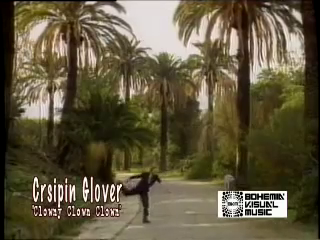
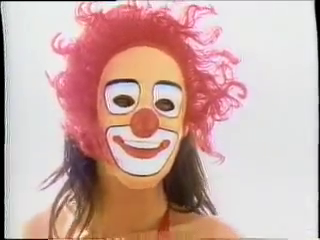
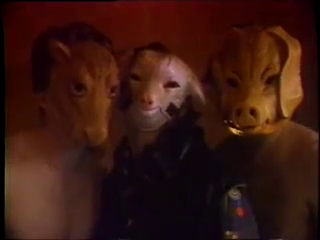
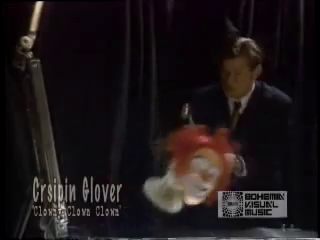
Move over, David Lynch. Decades before you and your Crazy Clown Time, George McFly did Clowny Clown Clown.
Glover brought us this glorious piece of songwriting and the corresponding music video to us earthlings in 1989. Well, at least that’s when his album, The Big Problem ≠ The Solution. The Solution = Let It Be, came out. I’m assuming the video came out at the same time.
I love the genre listed on Wikipedia: Outsider music. I had no idea that was a label given to some music.
That’s it! As much cult success as this video seems to have had over the years, much like David Hasselhoff’s cover of Hooked On A Feeling, I can’t find anything on this.
First things first, the title. The official posting of the video lists the title as Clear Nite, Moonlight. However, both the greatest hits album I have and mvdbase list the song as Clear Night, Moonlight. That’s why I included both in the title of this post.
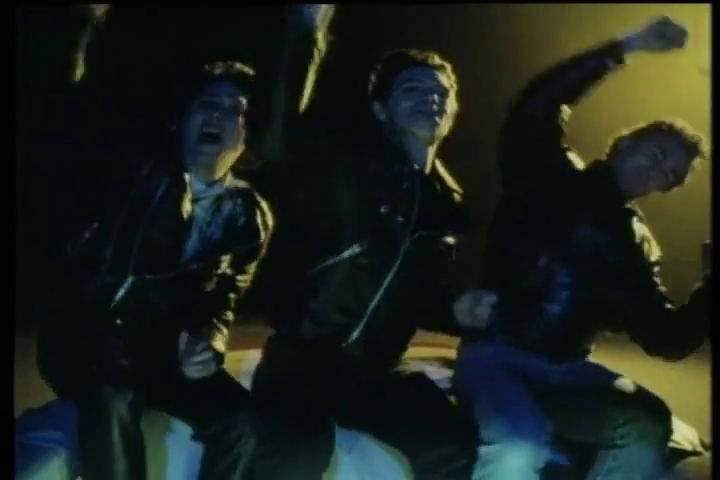
This song is from Golden Earring’s 1984 album N.E.W.S., that has what must not only be their most controversial song, but video–When The Lady Smiles.
I’m spotlighting this video for a few different reasons. The first is that I love the song, and wanted to share it. The second reason is that I like the darkness of the video–literally and figuratively–that is juxtaposed with an upbeat song that makes you want to sing along. The same is true with When The Lady Smiles, which probably explains how it got used in such a weird context, despite the lyrics. I’ll talk about that video another time.
The last is the ending.
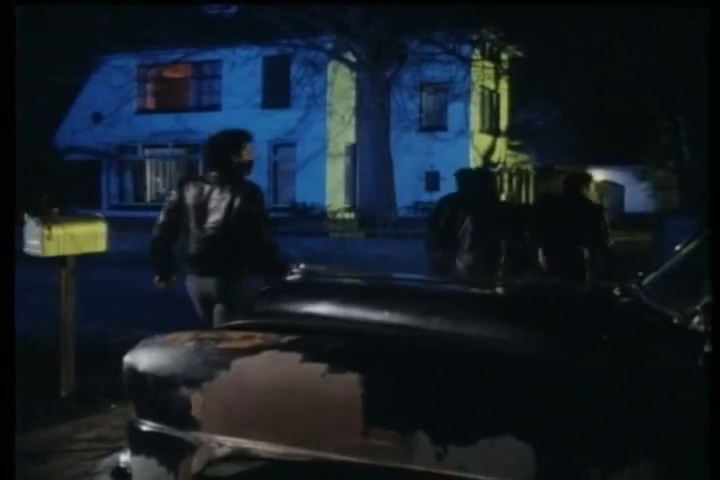
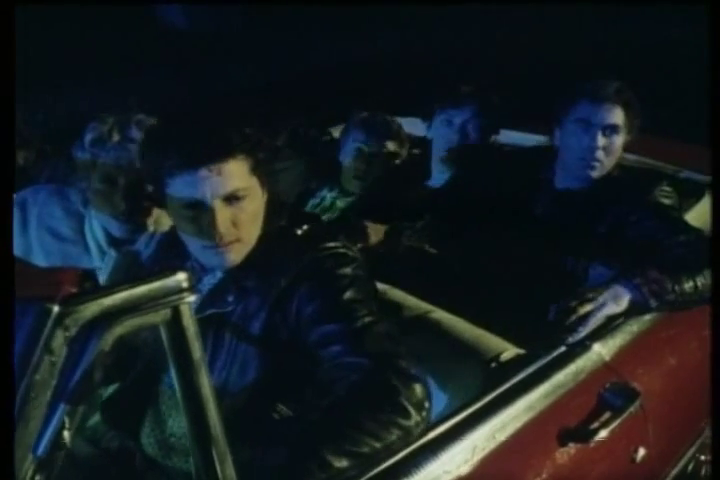
We see the band abandon their beat-up vehicle after pulling up to a house.
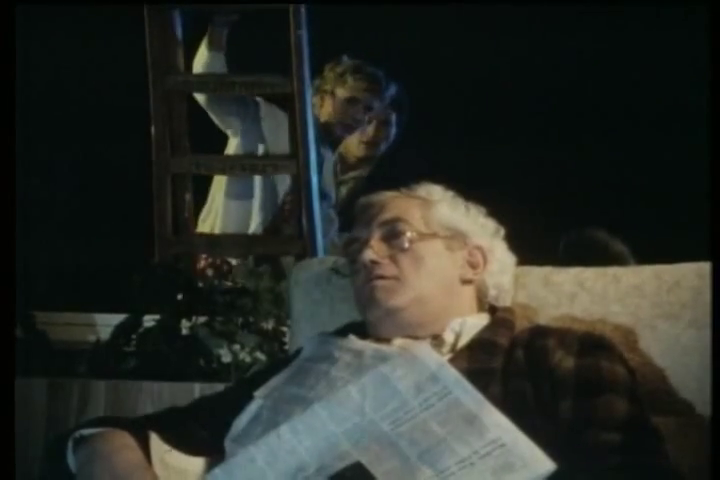
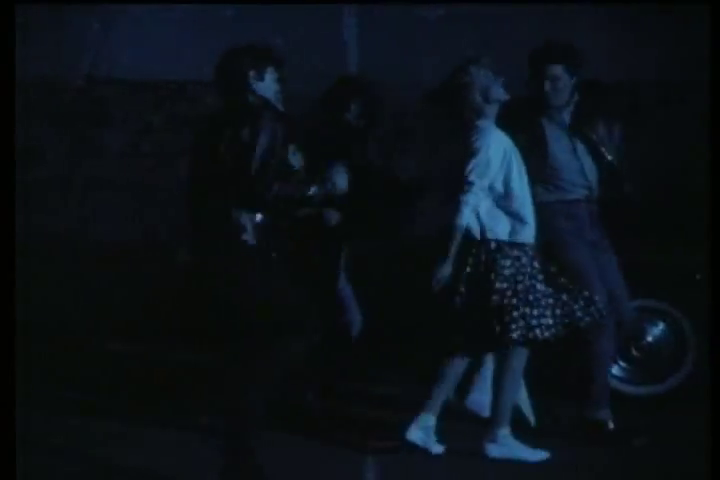
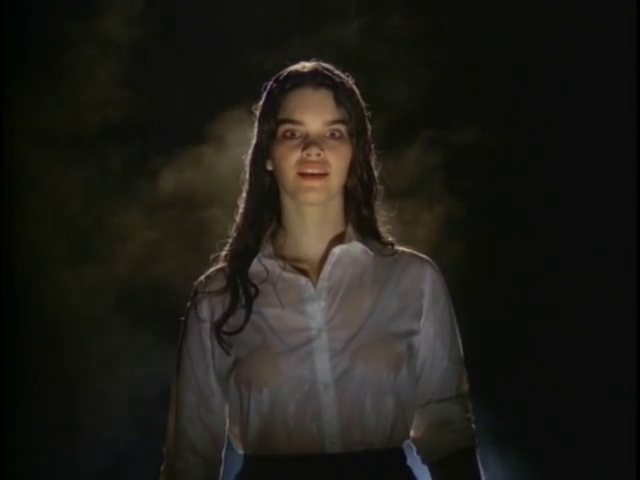
They help a woman down from her room past her sleeping father.
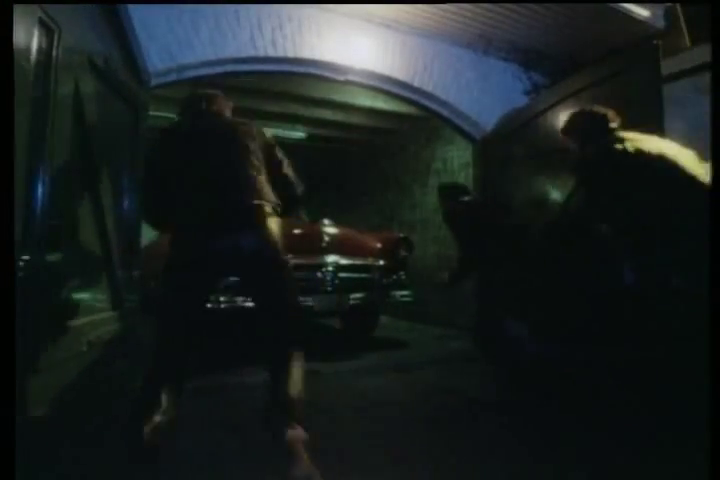
They steal her father’s car.
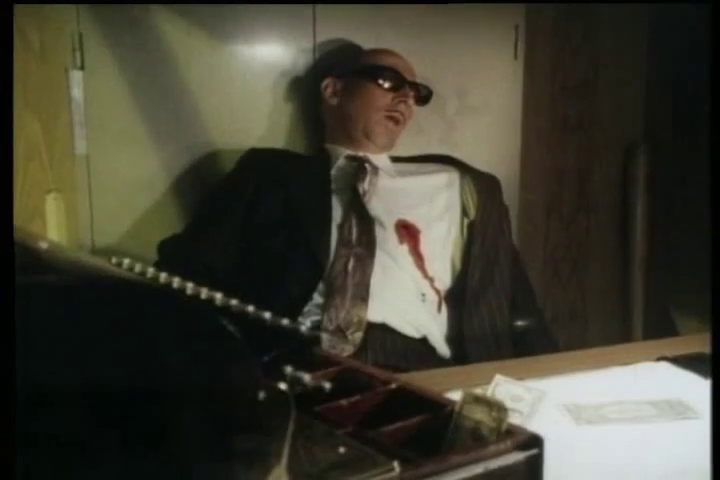
They rob a car dealer, and kill him in the process.
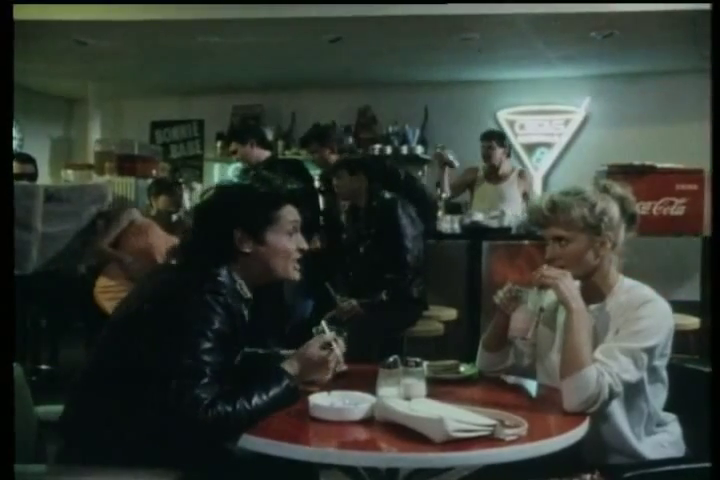
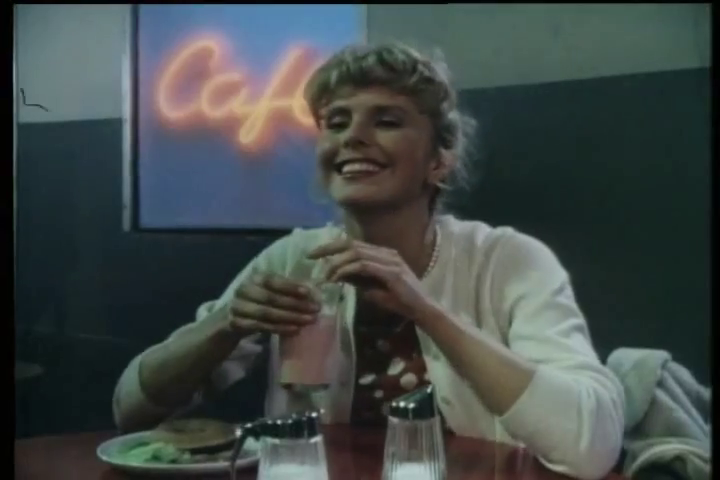
They go to a cafe.
We see she is having a good time despite the murder.
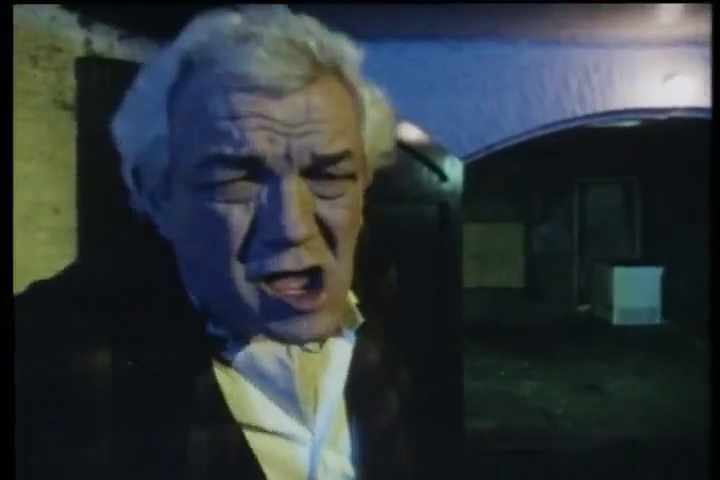
In fact, when her father says, “Bloody murder,” we cut to her smiling.
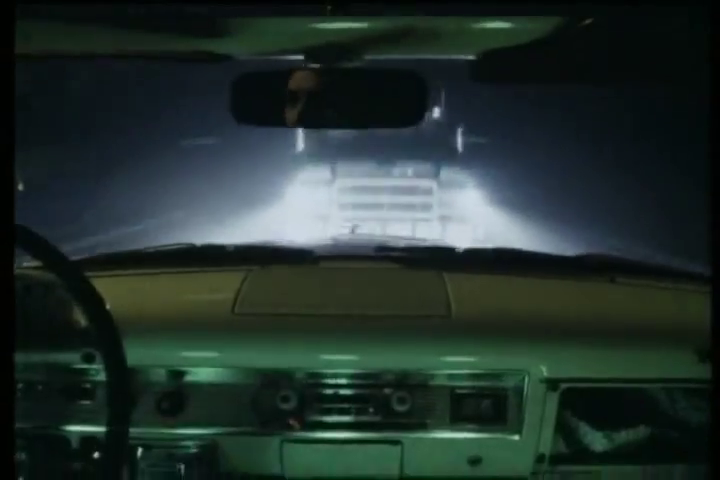
They nearly die by crashing head-on into a truck.
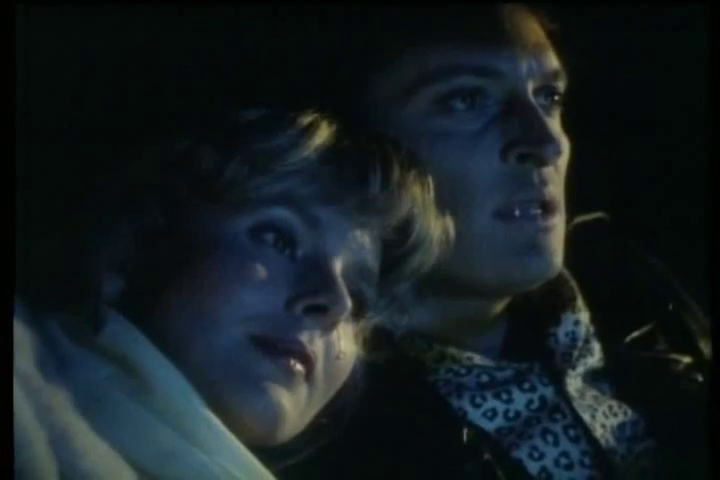
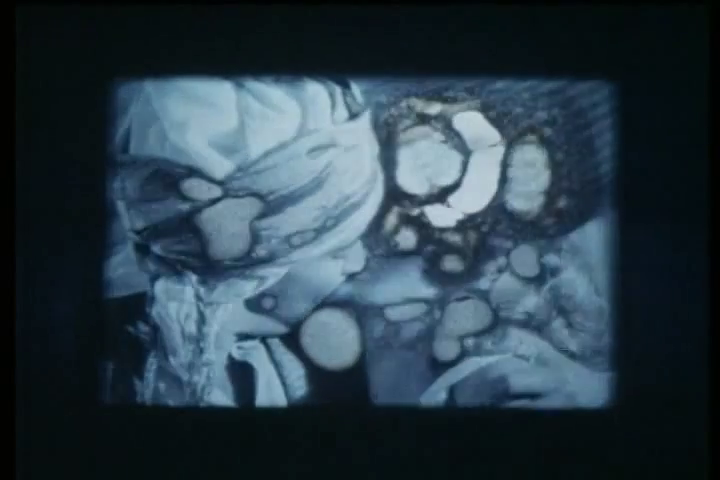
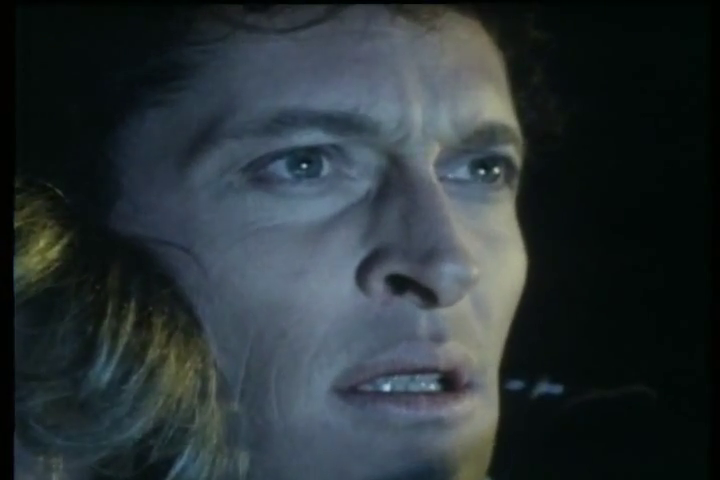
They go to a drive-in theater where we see her cry, and Hay look confused and sad when the film eats itself. I’m assuming it is a film with Rudolph Valentino in it.
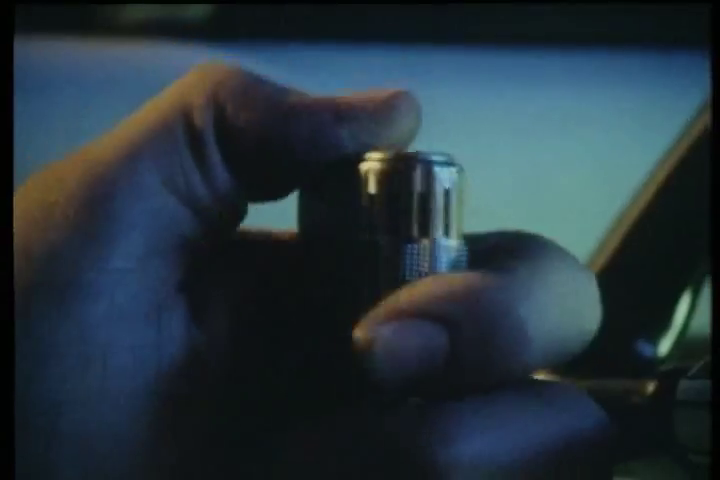
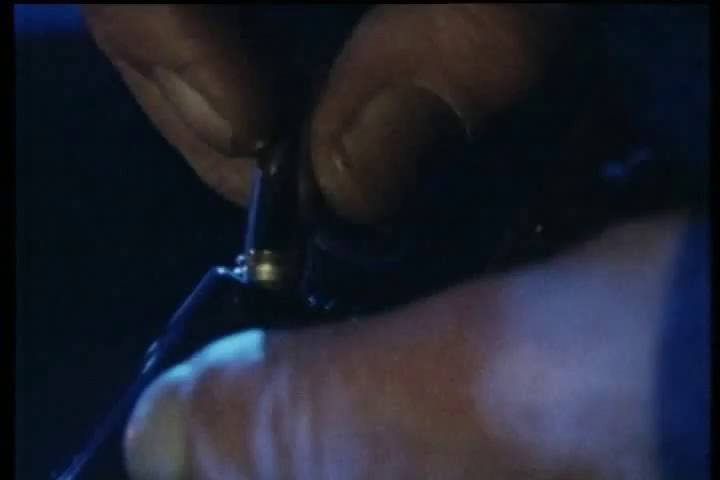
Then we some matching on action between Hay trying to start a lighter and people loading guns.
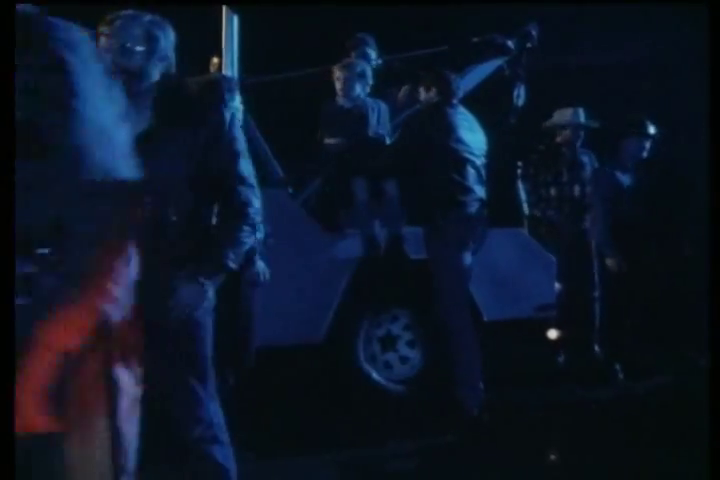
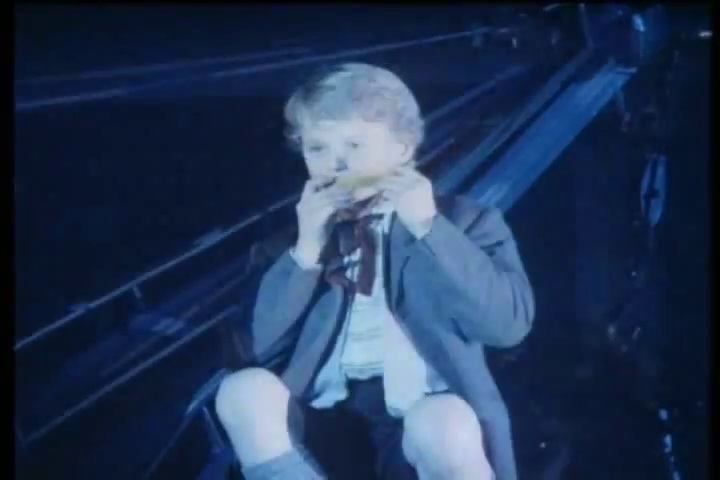
Then a kid is taken to sit on a tow truck.
The car stops.
We zoom in on the kid, and we can see and hear bullets filling the car, which presumedly kills everyone inside.
I have no idea why that last part happens. The kid doesn’t even look like he comes from the 1980s.
Edit: I messed up when originally posted this. I missed the “So Little Time” license plate at the start, which foreshadows this ending. It doesn’t come out of nowhere.
I also think that the video is meant to take place in the 1950s, and not just have a retro look to it. That might explain the appearance of the kid.
The whole video has this otherworldly feeling about it that seesaws between comfort and unease, happiness and death, and then screeches to a halt with the cops unloading on the five passengers with what sounds like every gun they have, all in front of kid watching as he eats.
Back to the book, I Want My MTV, again. One thing I’d like to make clear before I start is that if there is one group that dominates that book, then it’s Bon Jovi.
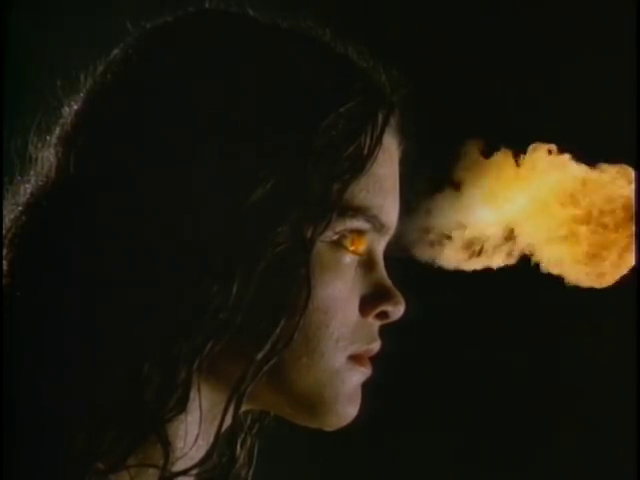
Doc McGhee [managed Bon Jovi, Mötley Crüe, Scorpions, and Skid Row at the height of each band’s career]: I’d just starting to manage Bon Jovi when we did the video for “Runaway.” There’s a chubby girl who’s a runaway, but she has laser eyes, and the band is playing in a warehouse that’s burning. In the ’80s, every video had to look like Escape from New York. Something had to be on fire, and you had to be in an alley that was wet, or else you couldn’t shoot a video.
Seen here! A chubby girl.
Also, lasers!
Okay, so McGhee’s memory might not be so good. I can give him a break on both counts. I have to imagine that in 1984, he was bombarded with so many models trying out for these parts that Jennifer Gatti actually does look chubby reaching back around 30 years in his mind.
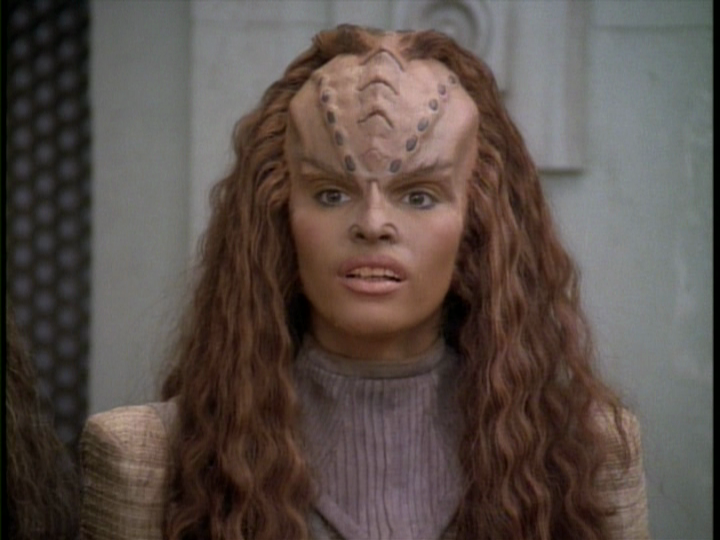
You might know Gatti from playing Ba’el on Star Trek: The Next Generation.
Star Trek: The Next Generation — Birthright, Part II (1993)
Cut to a few years later after the rocky start with Runaway:
Doc McGhee: I mean, MTV was playing so much Mötley and Bon Jovi, I’d have to tell them, “You’re overexposing my artists. If you don’t take them off the air, I’m not going to give you another video.” I was fighting to get less airplay, not more.
Len Epand [was a video production executive for PolyGram Records]: Once Bon Jovi established a winning style on “Bad Name” and “Livin’ on a Prayer,” we pulled their prior videos out of circulation. They were all deemed embarrassing, or at least not the right image. We notified all video outlets, including MTV, that they were no longer licensed for use. I doubt they ever appeared on broadcast again.
Luckily, the video is up officially on YouTube. While not being fond of the video, the band apparently still plays the song during concerts. It’s on the greatest hits album of there’s that I have. I can understand why they pulled this video back then. They had hit on a winning image with videos like Livin’ On A Prayer. They ran that formula into the ground, but still, it worked.
Len Epand: For “Runaway,” we used a commercial director named Michael Cuesta, who had no music-video experience.
I can’t only find one other credit for Cuesta–Crow Dog (1979). I’m not even sure that entry on IMDb is him because there is another Michael Cuesta who has been successful as a producer and director.
Bob Montgomery (Robert Mont) was the producer. I can only find a couple of music video credits for him.
If you’ve ever heard of Slade, then it’s likely because their songs Cum On Feel The Noize and Mama Weer All Crazee Now were covered by Quiet Riot and The Runaways. I’m not sure what led me to find them, but I’ve enjoyed their music ever since. I had no idea they made it out of the 1970s in order to have music videos like this one out there.
The reason we have it is that Quiet Riot’s cover re-popularized Cum On Feel The Noize. This created attention in America for their music. Thus, we got Run Runaway, among other songs, which did well in the States. And we got this video to go with it.
If the Wikipedia article on the band is to be believed, then they are cited as an influence on just about everyone from the late-70s onward. I can understand that. For me, they fall into the same category as Sweet–ahead of their time, underrated, and influential.
A music video was filmed to promote the single, which was directed by Tim Pope for GLO Productions and cost £16,000 to make. It was shot at Eastnor Castle in Ledbury, Herefordshire. In keeping with the song’s celtic/jig sound, the video featured the band performing the song in front of an audience dressed in tartan. Other sequences showed a marching bagpipe band and a kilted Scot grappling with a caber.
The video was a big success in America, where it reached the top of the playlist charts. Its constant showing on MTV helped “Run Runaway” become Slade’s biggest American hit. Despite its success, the band were disappointed that the video did not feature any direct shots of Powell. In a 1986 interview, Lea said that the band’s only requirement in their music videos is that each band member is featured, however in the “Run Runaway” video, Powell is only seen in the background. In a 1986 fan club opinion poll, fans voted the video was the band’s best music video.
In 2011, the coat guitarist Dave Hill wore in the video sold on eBay for £295. The seller had bought the coat many years ago from the Slade Fan Club where Hill auctioned off a few items to raise money to build a home recording studio.
The only thing I would add is that I like that it captures the goofiness of the band. I especially love the part near the end when the camera is looking up at them. You keep thinking it’s going to cut away from them, but it doesn’t. They just keep going.
I didn’t think there’d be much to say about this video other than that Mudhoney–much like Meat Puppets–are one of those groups that get brought up if you want to go further than just Nirvana and the other members of the Big Four. In fact, they go back to another group that is part of those bands that are important, but aren’t household names–Green River.
The only other thing I noticed was Krist Novoselic in the video.
I wasn’t even sure when this video was done.
Then I came across an article over on the A.V. Club’s website. I can’t say I’m a fan of that particular article even if Sean O’Neal did seem to be writing in a style to mirror the video and career of the band–which I do appreciate. It did provide me with some useful information though. Most notably that this video wasn’t done in 1998 as the video would suggest, not only by it claiming to be celebrating 10 years of grunge, but by also looking like a video I would expect from that era by a band such as Mudhoney.
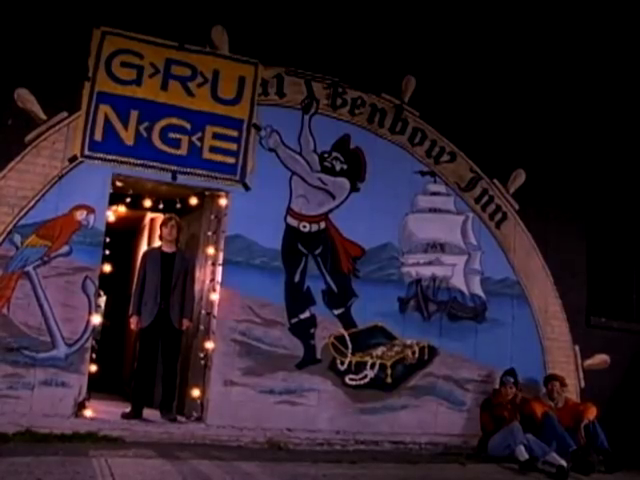
This was apparently done in 1992. It’s a joke. You’ve got the band playing at the Admiral Benbow Inn in Seattle. It has the commemorative posters, and the viewer can enjoy both the song and energy of the performance. But it’s sad. That shot of Novoselic above gets that across quite nicely.
I didn’t grow up on this particular song. But there is a song I did grow up on that sums up what I read in the aforementioned article concerning the band and this video–We Are Not Going To Make It by The Presidents Of The United States Of America.
Peterson–like many music-video directors–is a photographer. His work has shown up in films such as 2015’s Cobain: Montage of Heck. Unfortunately, I can’t find any listings of music videos he’s done. He’s also written some books about the grunge scene. You can see some of his photographs on his website.
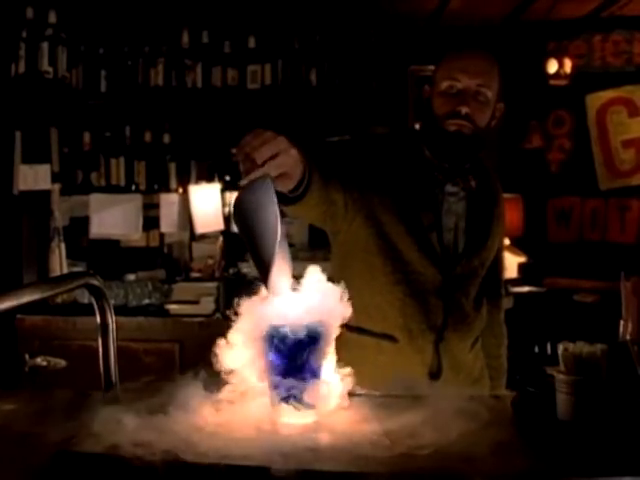
There’s one last thing I’d like to mention. Despite seeing the Sub Pop label all the time as a kid, I wouldn’t have recognized the founders of the label. Courtesy of the A.V. Club article, Bruce Pavitt is the one tending bar, and Jonathan Poneman is the one manning the door.
If you’re like me, then you learned about the Meat Puppets thanks to Nirvana’s cover versions of Plateau; Oh, Me; and Lake Of Fire from the album, MTV Unplugged in New York. Cobain even said their name during the concert. Also, the Kirkwood brothers were guest musicians during that performance.
Like numerous videos, I am guessing about the release date based on the release date of the album it was on–Forbidden Places. The band dates back to the early-80s, and saw a resurgence of popularity thanks to Nirvana. The songs Nirvana performed are from 1984’s Meat Puppets II. They are one of those bands that are brought up whenever you hear discussions about the groups that led to Nirvana, Soundgarden, and other bands of that sort.
Despite that this is the only video on the Meat Puppets Vevo channel, I can’t find any info on it.
It’s not a complex video. The only thing noteworthy is the editing that matches the machine-gun fired lyrics. I always like editing that matches the pace of the song. It draws you in without having to tell a story, but doesn’t simply point a camera at some people standing on a stage. Otherwise, it’s just them playing a catchy song inside of a building, and outside of it.
I decided to spotlight it because it has been my queue for a while, and I love the quick delivery.
However, I can’t find anything specific to this video. I’m guessing that it came out in 1980 because that’s when the single was released. I think the director might be Chuck Statler since he worked with Iris on several other videos, but I can’t find anything to make me feel comfortable enough to include his name in the title.
There’s the usual nonsense in the YouTube comment section. I only look on a video like this because once in a blue moon there’s something useful about the video. There wasn’t anything this time. The closest I came across was speculation about the identity of the woman in the video.
Michael Stipe: Robert Longo was one of the premier painters coming out of New York. We wanted to upset the visual language of videos, and that’s what we got with “The One I Love.” He was referencing Renaissance paintings, rather than Madonna. I saw the video he did for New Order’s “Bizarre Love Triangle”–he interrupts it about two-thirds of the way through with a scene out of a movie, where a woman stands up at a table and says, “I refuse to believe in reincarnation, because I will not come back as a bug or an insect,” a guy goes, “Well you’re a real up person,” and then it slam-cuts back into the song. I don’t think anyone had ever interrupted a song, cut to something, and then cut back to the song.
That’s quite the memory Stipe has. He still misquoted the video, but he was really close. That part actually goes like this:
“I don’t believe in reincarnation because I refuse to come back as a bug or as a rabbit.”
“You know, you’re a real ‘up’ person.”
I can’t find out who the third person in the room is, but the other two are well-known.
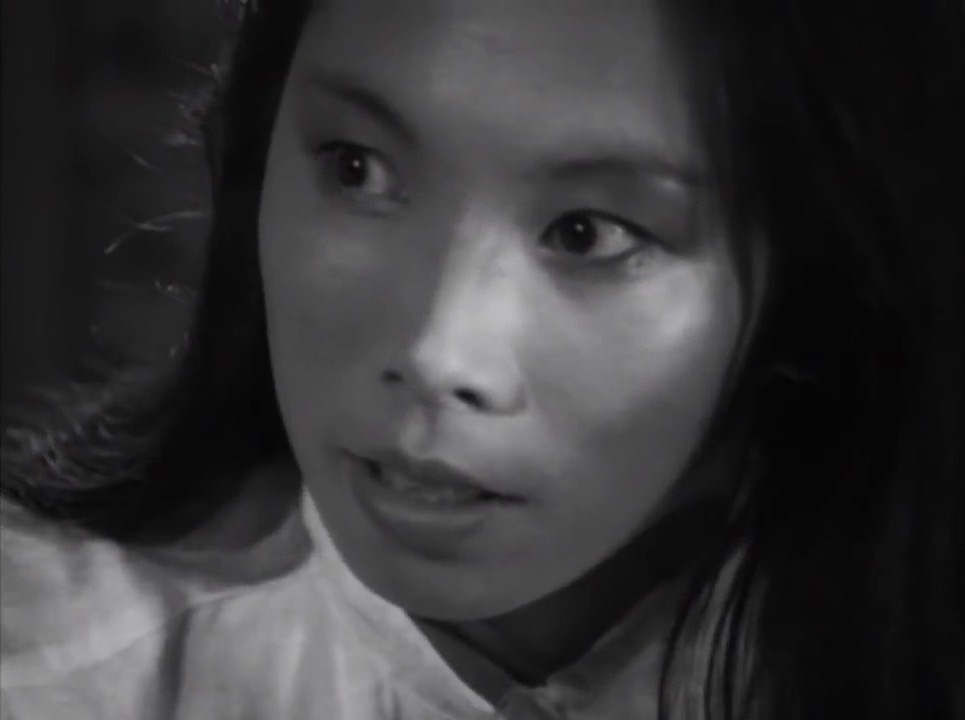
The first is Jodi Long. She’s been in a bunch stuff, and is still acting today. She was in Paul Schrader’s Patty Hearst (1988), which Lisa reviewed yesterday. I didn’t pick out this video to go with that review. I didn’t know till I went to write this that there was even a record of who these two people are.
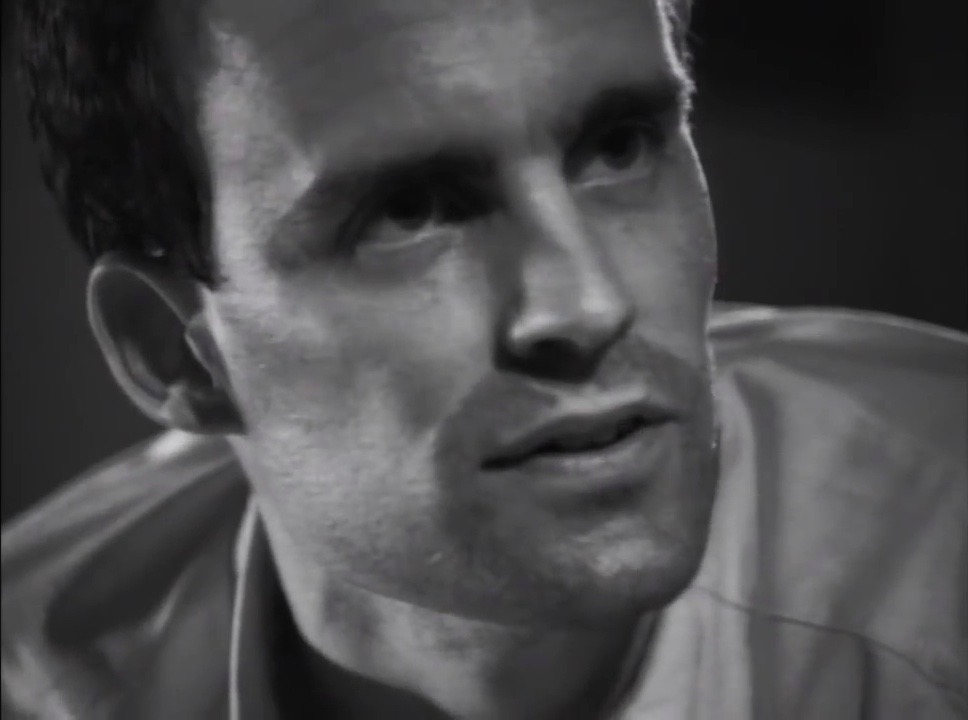
The second is E. Max Frye. He has done numerous things over the years. You probably know him best as co-writing the screenplay for Foxcatcher (2014), which earned him an Oscar nomination.
Stipe says that this part is from a movie. From what I’ve read in other articles, that part was shot for this video. If this was a film, it is still undocumented on IMDb. The only time I can find on IMDb where Long and Frye worked together was on the film, Amos & Andrew (1993). That film was written and directed by Frye.
For the video for “Bizarre Love Triangle,” released in November of 1986, New Order turned to New York-based director and visual artist Robert Longo, who claimed that the music of Joy Division and New Order were very influential on his work.
Longo would end up giving New Order a very experimental film as a promotional video, with fragmented vertiginous fast cuts, infused with color, which were then merged together visually competing ideas.
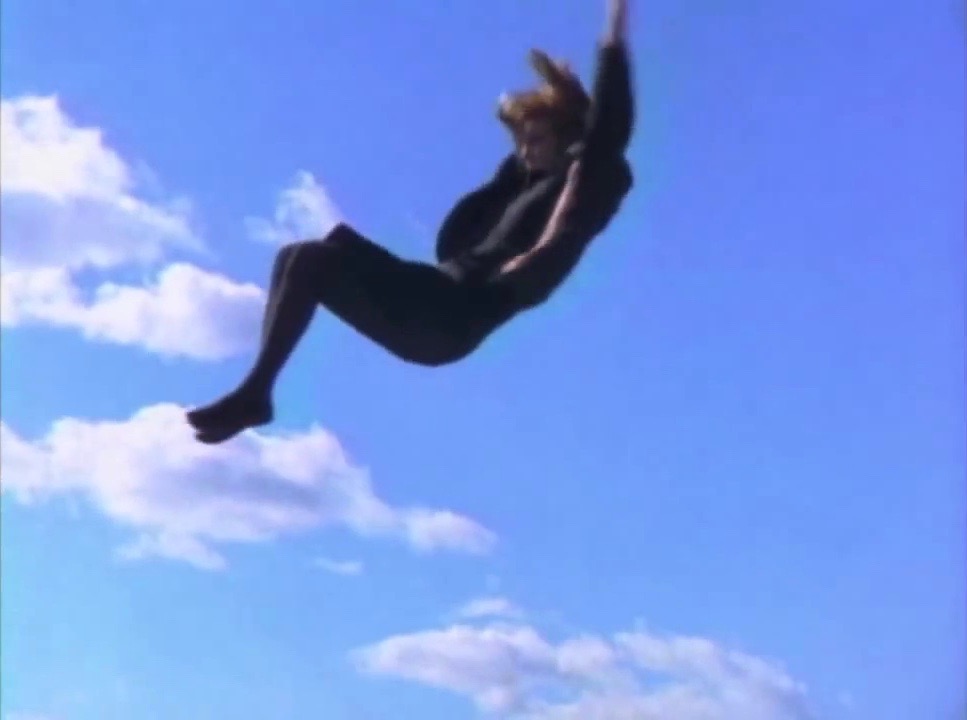
One of those ideas included men and women in business suits are seen falling through the air, something he’d based on his own set of lithographs called “Men in the Cities.”
Another of the other ideas Longo pursued was the use of visually appealing panels of Longo’s own art, which are then interrupted by a “bizarre love triangle,” a black and white melodrama scene with Asian actress Jodi Long and Oregon-based screenwriter and filmmaker E. Max Frye arguing emphatically about reincarnation.
They also go on to say that the shots of the band were filmed when they performed live “in the hills of Italy.”
Director Robert Longo appears to have made only one feature film. He directed Johnny Mnemonic (1995).
The video was produced by Michael Shamburg. Shamburg produced quite a few videos for New Order. He’s also has producer credits for a lot of well-known movies such as The Big Chill (1983), Reality Bites (1994), Gattaca (1997), Garden State (2004), and Django Unchained (2012).
According to Peter Hook of New Order in the book I Want My MTV:
We met Michael Shamburg when he filmed us playing in New York, and we gave him more or less complete artistic freedom to do our videos. Michael’s a big producer now–he did Pulp Fiction and Garden State–and he introduced us to interesting directors: Robert Longo, Kathryn Bigelow, Philippe Decouflé, Robert Frank, William Wegman, and Jonathan Demme.
We’re going back to New Zealand. This time it’s for a hit song by Sharon O’Neill called Maxine.
The video is about a prostitute named Maxine who is followed by a case worker played by O’Neill who is unable to help her. Maxine gets kidnapped and killed. O’Neill is there when they wheel her into the hospital dead. In the end, we see O’Neill lay a flower at what is supposed to be her grave before they crane the camera upward to reveal how large the graveyard is. Just like her case is #1352, her death is #???, and is lost in the crowd.
O’Neill said the following about the inspiration for the song in an interview with the NZ Herald in response to a question about why she moved to Australia:
The record company, CBS, wanted to see if they could break me in Australia so they sent me over with my Kiwi band which had Dave Dobbyn in it – he’ll josh me for saying that. We worked the pub scene five nights a week and really schlepped it.
I was living in a hotel in Kings Cross when I got the inspiration to write Maxine. She was always out there working at 3am when we’d get home bleary-eyed from a gig in Newcastle.
In that same interview, she added some info about the video in response to another question:
[Q] What do you think about the way women are portrayed in the music industry now?
[A] I find some of the videos really explicit. It’s got to the point where young girls think that’s the way it’s got to be. Back in the 1980s they wouldn’t screen the Maxine video till after 8pm because she goes into the toilets with a razor blade. You’ve got people gyrating like they’re having sex but you can’t show that because it’s drugs. I mean she’s a junkie, she dies. It’s a terribly sad story.
She’s right about the drugs part. I believe I mentioned back when I featured Twilight Zone by Golden Earring that it wasn’t just censored for the topless spy scene, but also for the couple of seconds where we see lead-singer Barry Hay injected by one of the dancers. The scene exists as a way of sending him back to the stage-dimension that may or may not be only in his mind. I wonder how they covered that up seeing as it is a key-scene. It’s not like When The Lady Smiles where they could just play some footage from earlier in the video over the parts that are still censored on YouTube today.
I’d say, enjoy, but this isn’t that kind of video.

 Through the Shattered Lens