Not all good Halloween scenes have to come from a movie. Sometimes, they can come from a video game!
One of my favorite missions in PS4’s Spider-Man is Back To School. That’s where you, as Spider-Man, have to search the Empire State University Halloween Party for an Oscorp scientist named Dr. Delaney and rescue him from Mister Negative and the Demons. Because it’s a Halloween party, you should be able to search for Delaney without anyone realizing that you’re the Spider-Man. The bad news is that, again because it’s a Halloween party, almost every party goer is dressed up like one of your enemies. And when Mister Negative does attack, it turns out that a drunk college student dressed up like the Rhino can be almost as dangerous as the actual Rhino!
Well, Halloween’s fast approaching and that means that it’s time for people to start thinking about what they’re going to watch on the big night.
Now, of course, you can always watch the old favorites, like Halloween or Friday the 13th or Nightmare on Elm Street (or any of their numerous sequels, remakes, and reboots). In fact, if you’re expecting a lot of trick-or-treaters, I can understand why you might want to go with the old dependables as opposed to trying to focus on something that you haven’t seen before.
However, if you’re looking for a new film to watch on Halloween, here are 6 good horror films that, sadly, don’t seem to be as well-known as they deserve to be. If any of these movies are new to you, October 31st might be just the day for you to experience them!
This is a horror film that I recommend to everyone. It’s a slightly satirical story about college students being turned into homicidal murderers. Along with all of the blood and the expected jump scenes, Strange Behavior is also a quirky portrait of life in a small town. It’s the type of film where a collection of 1940s character actors (including the great Charles Lane) share the screen with 70s character actors like Michael Murphy and they all try to figure out how a seemingly dead scientist is programming the town’s children to be murderers. The dialogue is frequently witty, the soundtrack is amazing, and there’s even an impromptu dance scene that comes out of nowhere!
2. Messiah of Evil (1973)
This is another film that I frequently recommend to my horror-loving friends. This is perhaps the most surreal zombie/vampire film ever made. A woman comes to a town to visit her father and she soon discovers that everyone in the town is acting strangely. This one features plenty of hippie action, a surprisingly large amount of clips from a Sammy Davis, Jr. film, an albino who eats rats and talks about how much he loves “Wagner” (which he pronounces with a “W” instead of a “V”), and some of the strangest imagery that you’ll eve see in a low-budget horror film.
Shirley MacClaine is a spoiler socialite who discovers that her younger brother, Perry King, has been possessed by the spirit of a murderer. Though this film is often dismissed as being just another Exorcist clone, it actually came out before The Exorcist and, in many ways, it’s even more disturbing than the seminal shocker. The ending will give you nightmares.
George Romero takes on vampires and the end result is unlike any vampire film that you’ve seen. Martin thinks he’s a vampire. His grandfather thinks he’s a vampire. Is Martin really a vampire? In the end, the film suggests that it might not really matter. A disturbing and sad film that has unexpected moments of humor, Martin also features Romero himself in the role of a well-meaning priest.
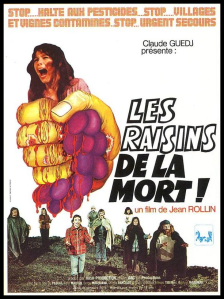
From the great Jean Rollin, it’s France’s first zombie film! In this one, people are being turned into zombies by contaminated wine. How many of your friends would become zombiefied as a result?
Finally, if you just have to watch a slasher this Halloween, why not check into the Mountaintop Motel? Evelyn will be more than happy to check you in and check you right back out.
In the 1951 film, Bride of the Gorilla, Raymond Burr plays a plantation manager who commits a murder. Unfortunately, for him, the murder is observed by a witch who promptly puts a curse of Burr. Now, every time the sun goes down, Burr transforms into a gorilla and goes wild in the jungle.
Basically, it’s kind of like The Wolf Man, just with a less sympathetic protagonist and a gorilla instead of a werewolf. Just in case we missed the similarities, Lon Chaney, Jr. plays the film’s nominal hero, a police commissioner who suspects that something weird might be happening with Burr. Apparently, the plan was originally for Chaney to play the gorilla and for Burr to play the policeman but, because Chaney was dealing with a serious alcohol problem at the time, the roles were reversed.
Also in the cast, playing the role of Dina, is Barbara Payton, the tragic actress who is best known for being at the center of a love triangle involving actors Tom Neal and Franchot Tone. In 195000, Neal attacked Tone and beat him so severely that Tone spent 18 hours in a coma. Tone was notably shaky onscreen for the rest of his film career while Neal spent a few years in prison. After the incident between Tone and Neal, Payton could only get roles in B-movies like this one. Tragically, she would pass away, in 1967, of heart and live failure. She was only 39 years old.
Apparently, the world’s ending but, fortunately, your boyfriend’s built an underground bunker!
Unfortunately, you now have to live down there with them and I don’t care how much you love someone, you still occasionally need some alone time. Perhaps if he had built a bigger bunker, you wouldn’t be going as stir-crazy but, as usual, no one asked you how big the bunker should be. Instead, they just said, “Get down there in case the world ends!”
And so, you flee. You break out. You confront the brave new world that is rising from the ashes of the old one.
Of course, a few weeks later, you lose all your hair and you die a slow and agonizing death from radiation poisoning. Fortunately, your boyfriend will probably die too. That’ll teach him to try to put you in a corner.
Anyway, this is an absolutely great video, both wonderfully directed and acted. That’s Cori Benesh and Hill Hudson as the couple in the bunker and they’re so empathetic and believable that you really do cringe when you realize how radioactive the sand between their toes probably is.
I think it’s fairly safe to say that wax museums are inherently creepy.
I mean, don’t get me wrong. If I see a wax museum off of the side of the road, I’m definitely going to visit it, if just so I can find the Hall of Presidents and give the finger to FDR. (It’s a long story.) But that said, wax museums are definitely not some place where you would want to get accidentally locked in.
Well, in tonight’s episode of Suspense, that’s exactly what happens to one unfortunate college student. AGCK!
This episode originally aired on October 4th, 1949 and it has a very impressive cast that will be familiar to anyone who has ever spent a few hours watching TCM: Anne Francis, Hume Cronyn, Ray Waltson, Evelyn Varden, and Mike Kellin are all featured.
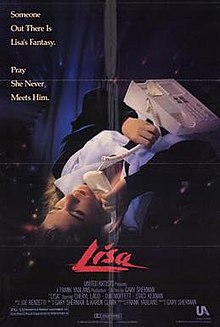
So, here’s the thing about Lisa, a horror-thriller from 1990 that shows up occasionally on This TV.
It’s got a great title.
Seriously, this film has got one of the greatest titles of all time. I would almost say that you really don’t even have to pay attention to the movie because the title itself is so perfect that the plot doesn’t even matter. The only thing that would make this title even better would be if they had added a “Marie” to the end of it but oh well. You can’t have everything.
This is a movie about a girl named Lisa and, speaking as a girl named Lisa, I have to say that it’s incredibly true to life. Lisa (Staci Keanan) is a smart and amazingly talented 14 years old and not alllowed to date by her incredibly overprotective mother, Katherine (Cheyl Holland). So, instead of dating, Lisa spends her time stalking a serial killer. See, Katherine thought she was protecting her daughter but instead, she’s only inspired her to take an even greater risk. That’s why you need to let the Lisas in your life do what they want.
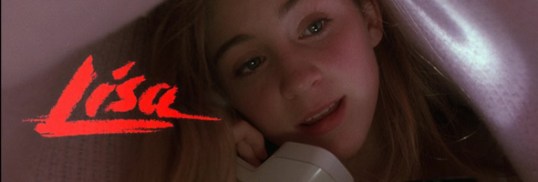
Admittedly, Lisa doesn’t know that Richard (D.W. Moffett) is a serial killer. She doesn’t even know that he owns a successful restaurant. All she knows is that he looks like a model and he drives a nice car and it’s fun to follow him around Venice Beach. When she jots down his license plate numbers, she hacks the DMV to get his name, address, and phone number. Soon, Lisa is calling him up and having flirtatious conversations with him.
It’s all good fun, except for the fact that Richard is also known as The Candelight Killer and he’s got a thing about calling people and leaving them messages right before he kills them. It’s all very ritualized. For instance, it’s very important that his victims be in the process of listening to his message when he kills them. To be honest, though, that sounds like he’s taking a lot of risks. I mean, what if someone came home and didn’t immediately check their messages? Would Richard just have to hide behind the drapes for hours until the did? Of course, Richard would be even more out of luck if this movie were made today because who has an answering machine anymore?
Anyway, Richard is obsessed with discovering who is stalking him and Katherine is obsessed with keeping Lisa out of danger and Lisa just wants to actually be allowed to full celebrate having the greatest name ever. Did you know, for instance, that Lisa may have started out as a shortened form of Elizabeth but that it became so popular on its own that it was one of the most popular names in both the United States and the United Kingdom for several decades? And, even though it’s no longer in the top ten as far as names are concerned, being named Lisa is still one of the greatest honors that can be bestowed upon anyone? Lisa means God’s Promise by the way. And….
What? Oh yeah, the movie.
Well, anyway, it all leads to pretty much what you’re expecting it to lead to. Plotwise, the movie may be predictable but the Staci Keanan, Cheryl Ladd, and D.W. Moffett all gives good performances and director Gary Sherman keeps the action moving at a steady pace. It’s dumb but entertaining, kinda like cinematic junk food. Plus, it has a great title. What more do you need?
Because her husband’s a dick who spends too much time working and not enough time taking the day off, Cassie (Mia Sara) grabs her five year-old daughter, Samantha (Kayla Buglewicz) and heads off for her sister’s house. When Cassie stops at a gas station to fill up the car, she’s spotted by seedy Roy Scudder (Burt Reynolds!). Roy puts down his cigar long enough to tamper with her car. When it breaks down a few miles down the role, Roy drives up and offers Cassie and Samantha a ride back to his place, where he can fix her car or where she can at least call for hep. Not realizing that she’s in a direct-to-video horror movie, Cassie accepts.
Big mistake! Roy’s wife, Georgina (Angie Dickinson!), has not been the same since the mysterious death of her son and Georgina and Roy’s other child, Jill (Candace Huston, daughter of the film’s director and granddaughter of John Huston), needs a playmate. Roy has decided that Samantha fits the bill. Cassie is locked in a room while Samantha is turned into Jill’s slave and Roy deals with the angry ghost of his abusive father (William Hickey!).
You have to feel bad for Burt Reynolds. He made this film at a time when his career was in decline. His TV show was no longer on the air. Boogie Nights was still two years away. The man had bills to pay. Can you blame Burt for accepting any role that came his way, especially if it meant a chance to co-star with Angie Dickinson and be directed by the son of John Huston? Reynolds was famous for hating even his good films so you can only imagine what he must have thought about The Maddening. Fortunately, since Burt was playing a total psycho in The Maddening, he could at least channel his feeling into the role. Throughout ever minute of The Maddening, Burt is totally and thoroughly unhinged and angry in the way that only the former number one star in America could be upon having to settle for a role in a direct-to-video horror film. He yells at his ghost father. He slits throats. He beats people into unconsciousness. He does everything that a normal movie psycho does but, when he does it, it’s even more memorable because he’s Burt Reynolds. Burt and Angie Dickinson playing the type of role that Bette Davis would have played for Robert Aldrich in the 60s are not just the main reasons to watch this movie. They’re the only reasons.
This was Burt’s only horror film and it’s too bad that it couldn’t have been a better one. But if it helped Burt keep the lights on during the lean years of the early 90s, good.
This piece of interactive fiction is a strange game. I’m not quite sure how else to describe it.
The premise is a simple one. Each night, you try to sleep. Every night, you are awoken by someone or something pounding on your door. Every. Single. Night. In Choose Your Own Adventure fashion, you are given a set of options. Do you try to go back to sleep or do you go to the door? Do you look through the peephole or do you return to bed? Open the door or hide? Left or right? At every step, you’re given the option to explore further or to try to return to safety. The problem is that if you make the wrong choice, you might make it back to your apartment in one piece but you’re still going to be woken up the following night. Make the right choice and something bad might still happen to you but at least you’ll no longer be woken up in the middle of the night.
What makes the game so strange is the way that it constantly loops back to the beginning, until you finally make the “right” choices. The only thing that changes is the number that lets you know how many nights you’ve been woken up by someone pounding at your door. Is someone really knocking at your door or are you stuck in some sort of time loop or permanent dream state? Having played the game and gotten to the end, I am still not sure.
The game itself is well-written and vivid enough to justify its placement in the horror genre. It can be played here.
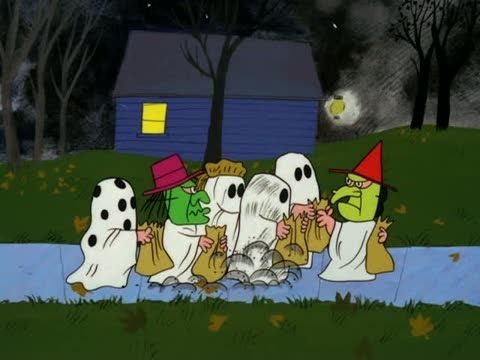
Last night, I was so excited about watching It’s The Great Pumpkin, Charlie Brown that I even missed the first 30 minutes of the World Series so that I could watch it! (Go Astros!)
I really love It’s The Great Pumpkin, Charlie Brown. (I even wrote about it!) There are a lot of scenes that I love in this special but I think my favorite moment is when Lucy, Charlie Brown, Pigpen and the rest are trick or treating. I love the spooky music in the background. I love that almost everyone’s a ghost and that Charlie Brown had trouble with his costume. And I especially love that, if you watch for it, you can actually see the rocks getting thrown into Charlie Brown’s bag.
Someday, Charlie Brown will get real candy on Halloween and Linus will see the Great Pumpkin. Until then, happy early Halloween!
Up until a few years ago, every episode of the original Twilight Zone was available on YouTube.
That always made me really happy in October because, really, what better way to end each day of the Halloween month than by watching a classic episode of The Twilight Zone, right? To Serve Man, The Monsters Are Due On Maple Street, It’s A Good Life, that episode with William Shatner freaking out on the plane and that other one with the guy entering his bedroom only to discover a lion waiting to eat him, these were all great episodes to watch in October!
Sadly, once Hulu started carrying Twilight Zone, all of the old episodes got yanked off of YouTube. And now that the Twilight Zone is on Netflix, there’s no way the show will ever show up YouTube again. We can still watch the episodes, of course. Even if you don’t have Netflix for some reason, SyFy does regular marathons of the original show and, of course, there’s the Jordan Peele revival for those who watch old episodes of the Twilight Zone and say to themselves, “This is good but I just wish it was a little more heavy-handed.”
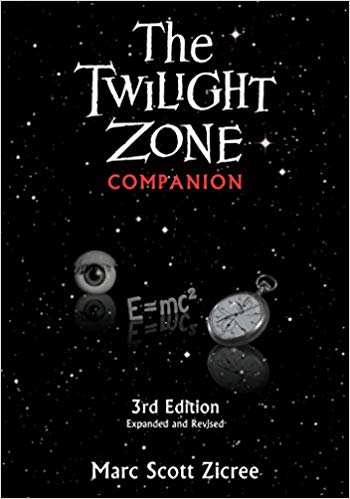
Well, I may not be able to embed any episodes this October but I can recommend that you order Marc Scott Zicree’s The Twilight Zone Companion, which is an indispensable guide to the original show. Every episode is covered, with credits, plot synopsis, and anecdotes about the production. Since a lot of important directors, actors, and writers did at least a little bit of work on Twilight Zone, the anecdotes are all very interesting and very much worth reading. Even more importantly, Zicree takes a look at the life of Twilight Zone creator Rod Serling and also some of the key people involved behind the scenes. The tragic story of Charles Beaumont will move you to tears.
So, if you’re a fan of the original show, you need this book! Order it and enjoy!