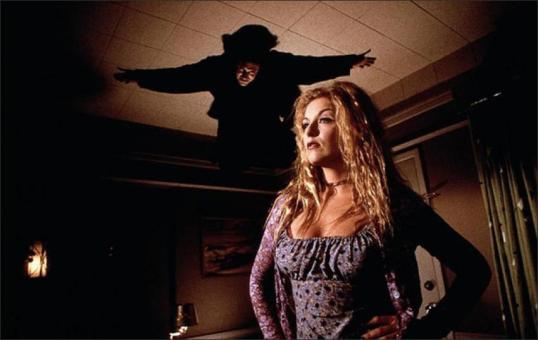
Horror Game Review: Kiss of Beth (2021, Charm Cochran)


Cordero has just knocked on the door of your home.  He’s here to take your roommate Beth on a date.  While Beth gets ready, your job is to check Cordero out.  Have a conversation with him.  Find out what he’s planning to do on the date.  Maybe ask him about his family or his plans for school.  You could even ask to see pictures of his dog if you want.  Find out all that you feel you need to know about Cordero because, towards the end of the game, you’re going to have to make a big decision.  And that decision will effect not only how Cordero views you but also your relationship with Beth.

With the exception of the final few moments of the game, Kiss of Beth is a conversation simulator.  At the start of the game, it seems like you are just being an overprotective friend but, as things progress, it becomes obvious that there is more to your relationship with Beth than just friendship.  There are two potential endings, a good one and a bad one.  I’ve discovered that it’s a lot easier to get the bad one than the good one.

Kiss of Beth can be played in less than 15 minutes and, because of the number of choices and the multiple endings, it’s a game that can be replayed several times.  After you finish the game the first time and learn the true nature of your relationship with Beth, you’ll be surprised when you play the game a second time and see that all the clues were right there for you to see.

Play Kiss of Beth.

Horror Scenes That I Love: The Party Scene From The Rage: Carrie 2


While it’s certainly not as good as the original, I still think 1998’s The Rage: Carrie 2 is underrated.

In this scene, a bunch of dumbass jocks discover that they’ve bullied the wrong girl.  Because I occasionally wear glasses, this scene freaks me out.

International Horror Film Review: Hostile (dir by Mathieu Turi)


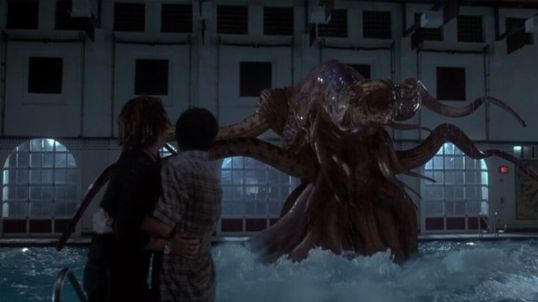
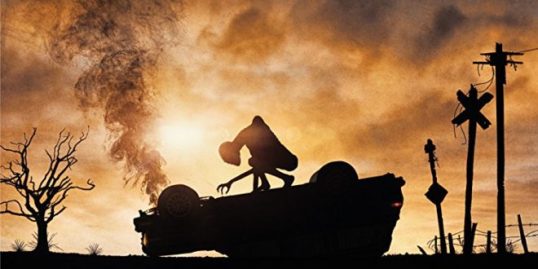
The world is ending and you’re stuck in the desert. The vehicle you were driving has flipped over. You’ve got a severely broken leg and can’t move. The few remaining humans in the city have informed you that a rescue party will not be sent out until the sun rises. And you’ve got a deformed creature circling your crashed van, trying to find a way to enter.  You have to figure out how to survive the night while being hunted by some sort of mutant and you also have to mentally work out your relationship issues while doing so.

(It may sound like a nightmare but if you ever break up with someone while on a road trip through South Texas and then you have to ask that person to give you a ride home, it can be a reality.  Not that I’m speaking for personal experience, of course….)

That’s the situation in which Juliet (Brittany Ashworth) finds herself in the 2017 French film, Hostile.  While Juliet tries to survive the night, she flashes back to the life and the world she used to know. She remembers how she was once a nearly illiterate drug addict who met and fell in love with an art gallery owner named Jack (Grégory Fitoussi). After discussing the paintings of Francis Bacon and the role of fate in everyone’s life, Jack took it on himself to lock Juliet in an apartment until she overcame her addiction. Now, that’s not something that most professionals would necessarily recommend trying, especially when the addict and the apartment owner barely know one another.  In fact, I felt it was a bit presumptuous on Jack’s part.  Who is Jack to decide that he’s going to be the one to save Juliet’s life?  Jack may think that his intentions are good but there’s something a bit too self-righteous and controlling about Jack, even if he is trying to keep someone from self-destructing.  He’s every preachy Intervention producer come to life.  He’s someone who most viewers will feel a bit of ambiguity about.

The audience might not be totally comfortable with what Jack does but, for Juliet and Jack, it all works out and they fall in love. Juliet remembers the good times with Jack and she also remembers how their relationship eventually fell apart and how the world itself eventually started to end, almost as if their relationship issues were a bit of a metaphor for the fragility of society.  Meanwhile, the creature outside the van continues to try to find its way inside.

Hostile is a claustrophobic and atmospheric end-of-the-world thriller from director Mathieu Turi. The inside of that van is a properly ominous location and it’s impossible not to sympathize with Juliet as she struggles to figures out how to survive the night. The film’s deliberate pace takes some getting used to and the final twist requires a certain suspension of disbelief but both Ashworth and Fitoussi are well-cast as Juliet and Jack. In the end, the film is a moody and interesting look at the end of the world, albeit one that is marred by the heavy-handedness of its script.

8 Shots From 8 Horror Films: 1997–1999


4 Or More Shots From 4 Or More Films is just what it says it is, 4 shots from 4 of our favorite films. As opposed to the reviews and recaps that we usually post, 4 Shots From 4 Films lets the visuals do the talking!

This October, I’m going to be doing something a little bit different with my contribution to 4 (or more) Shots From 4 (or more) Films.  I’m going to be taking a little chronological tour of the history of horror cinema, moving from decade to decade.

Today, we take a look at 1997, 1998, and 1999!

8 Shots From 8 Horror Films: 1997 — 1999

I Know What You Did Last Summer (1997, dir by Jim Gillespie, DP: Denis Crossan)


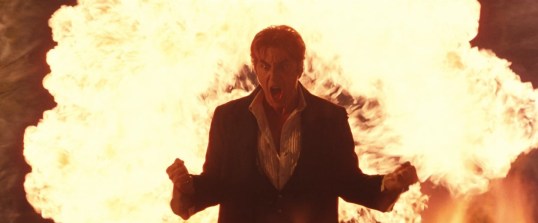
The Devil’s Advocate (1997, dir by Taylor Hackford, DP: Andrzej Bartkowiak)


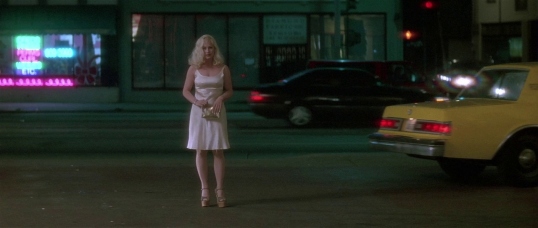
Lost Highway (1997, dir by David Lynch, DP: Peter Deming)


Vampires (1998, dir by John Carpenter, DP: Gary B. Kibbe)


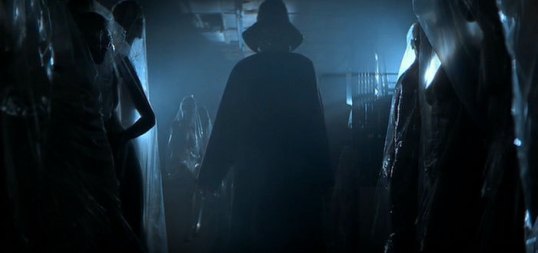
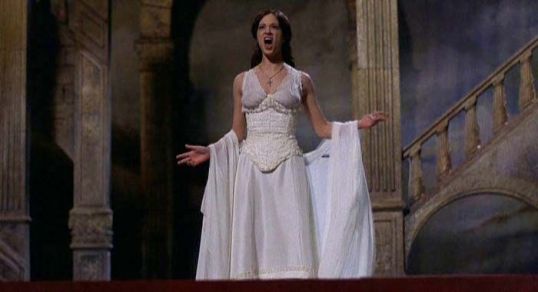
The Phantom of the Opera (1998, dir by Dario Argento, DP: Ronnie Taylor)


The Faculty (1998, dir by Robert Rodriguez, DP: Enrique Chediak)


The Rage: Carrie 2 (1999, dir by Katt Shea, DP: Donald M. Morgan)


The Sixth Sense (1999, dir by M. Night Shyamalan, DP: Tak Fujimoto)

Horror Film Review: Hellraiser (dir by David Bruckner)


Last night, I started watching the Hellraiser reboot.  I fell asleep about 40 minutes in.

That’s never a good sign, especially when it comes to a horror movie.  A horror movie is supposed to be so scary that you can’t sleep.  It’s supposed to be so intense and disturbing that it gives you nightmares, even if you actually do manage to get some rest.  A horror movie is supposed to haunt you, not bore you.  That’s especially true of the Hellraiser movies, which are defined by their grotesque imagery and the terrifying implications of the Cenobites.

This morning, I finished watching the movie.  Somehow, I did not fall asleep again.

The Hellraiser reboot asks the question: “If Doug Bradley isn’t playing Pinhead, is there any point to watching this crap?”

Based on this movie (and, to be fair, the two previous Hellraisers as well), the answer would appear to be no.  Jamie Clayton takes over the role of Pinhead in the new Hellraiser and the results are a bit underwhelming.

I mean, the Cenobites still look somewhat frightening, don’t get me wrong.  And the puzzle box is a huge part of the reboot’s plot.  And there’s still a lot of blood and a lot of talk about how suffering can be music and a lot of people get ripped apart by magical space chains.  But, with all that in mind, the Cenobites still come across as being kind of boring.  They’ve gone from being frightening creatures beyond imagination to just being generic bad guys.

A big problem is that Jamie Clayton never quite captures the all-encompassing contempt for existence that Doug Bradley brought to the role.  Bradley played Pinhead as a regal sadist, delivering his lines with a withering condescension.  As played by Bradley, Pinhead was really neither good nor evil.  He had transcended such concerns in his search for experience.  Hence, he could get away with announcing that he and the Cenobites were angels to some and demons to others.  In the original Hellraiser, Pinhead (and Bradley) made his first appearance by saying, “You called, we came,” and that pretty much summed up what made the character so frightening.  Bradley’s Pinhead had no concern as to the circumstances that led to him being  called and he certainly had no patience for anyone who thought they could talk their way out of the situation.  Bradley’s Pinhead was beyond such concerns and that made him all the more frightening.

Jamie Clayton’s Pinhead, on the other hand, is smug and not much else.  She’s playing a game with humanity but that leaves her vulnerable to losing.  That’s a mistake that Bradley’s Pinhead would not have made.  (Or, at least, he wouldn’t have made it in the original movie.  The Hellraiser sequels are a different story.)  There’s nothing particularly regal about Clayton’s Pinhead.  She’s just another horror villain.  With her demanding a sacrifice from anyone who cuts themselves on the puzzle box, she’s not that much different from the little girl in Ring.

(In Clayton’s defense, she’s not the first person to replace Doug Bradley as Pinhead.  Bradley also did not appear in the two previous Hellraiser films, Revelations and Judgment.  Bradley felt the scripts were poorly written and, perhaps more to the point, Dimension Films wanted him to take a pay cut.)

As for the reboot itself, it’s about Riley (Odessa A’zion), a recovering drug addict who, along with her boyfriend Trevor (Drew Starkey), steals the puzzle box and then cuts herself on the box which leads to the Cenobites stalking all of her annoying friends.  Riley is an incredibly unlikable character and her friends are kind of whiny so who cares?  Gordan Visnjic plays a decadent businessman who is trying to manipulate the box to his own ends.  Visnjic has a good scene at the start of the film, one that perfectly captures the privileged ennui that would lead to someone getting involved with the Cenobites.  But, eventually, even Visnjic is reduced to being a one-dimensional character.

The main lesson of this Hellraiser film (and the previous two films as well) is that things work better with Doug Bradley than without him.

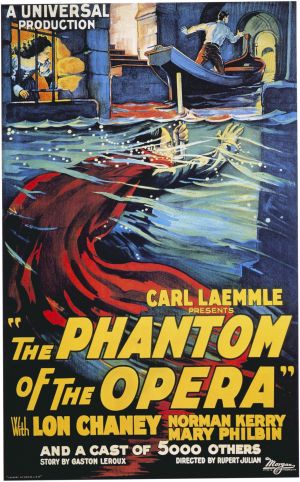
Horror On The Lens: The Phantom of the Opera (dir by Rupert Julian)


Today’s horror movie on the Shattered Lens is both a classic of silent era and one of the most influential horror films ever made.  It’s one that I previously shared in 2013, 2015, 2016, 2108, 2019, 2020, and 2021 but it’s such a classic that I feel that it is worth sharing a second (or fifth or even a sixth or perhaps an eighth) time.

First released in 1925, The Phantom of the Opera is today best known for both Lon Chaney’s theatrical but empathetic performance as the Phantom and the iconic scene where Mary Philbin unmasks him. However, the film is also a perfect example of early screen spectacle. The Phantom of the Opera was released during that period of time, between Birth of the Nation and the introduction of sound, when audiences expected films to provide a visual feast and Phantom of the Opera certainly accomplishes that. Indeed, after watching this film and reading Gaston Leroux’s original novel, it’s obvious that the musical was inspired more by the opulence of this film than by the book.

This film is also historically significant in that it was one of the first films to be massively reworked as the result of a poor test screening. The film’s ending was originally faithful to the end of the novel. However, audiences demanded something a little more dramatic and that’s what they got.

Horror On TV: Circle of Fear 1.19 “Graveyard Shift” (dir by Don McDougall)


On tonight’s episode of Circle of Fear, John Astin plays a former actor who now makes a meager living as a security guard at the studio where he once worked.  Unfortunately, the studio is shutting down.  John Astin will be out of a job but, as he discovers one night, he’s not the only one who fears being forgotten.  This is the type of story that could only have been told in the days before physical media, streaming sites, and cable.

Patty Duke, who was married to Astin at the time, plays his character’s wife.  Playing their baby is John and Patty’s newborn, future actor MacKenzie Astin.  William Castle, who served as executive producer of Circle of Fear, appears as the head of the studio.

This episode originally aired on February 16th, 1973.