Last night, around 3 in the morning, I watched the Lifetime film, Match, Meet, Murder!
Why Was I Watching It?
It was late, I had insomnia, and the title just spoke to me. What can I say? I had many reasons for my decision and I don’t regret it for a minute.
What Was It About?
Ruby (Stephanie Sy) is a lingerie designer who has been in a dating slump ever since ending her long-term relationship with independent journalist Luke (Erik Athavale). Ruby’s friend, photographer Ella (Amanda Austin), gives her a secret code for the very exclusive Rima dating app. Soon, Ruby is matched with Dylan (Jacob Blair).
Dylan, it turns out, is a bit of celebrity. He was the winning contestant on a reality show hosted by notorious matchmaker, Jules (Lisa Marie DiGiacinto). The season may have ended with Dylan getting engaged but his new fiancée mysteriously vanished. Now, Dylan is dating Ruby and he doesn’t seem to be quite stable. He still has his ex’s clothes hanging in his bedroom closet. Run, Ruby, run!
What Worked?
I absolutely loved the demented performance of Lisa Marie DiGiacinto, who played Jules the matchmaker. I can’t say too much about it without spoiling the film but I will say that DiGiacinto fully understood the importance of embracing the melodrama in a film like this.
Some of Ruby’s lingerie designs were cute. The black bralette was adorable. Of course, I’d never be able to wear it because I actually have boobs.
What Did Not Work?
I’m usually willing to suspend my disbelief when it comes to a Lifetime film because the melodrama is usually the point. That said, I had a hard time believing that any successful woman could be as clueless as Ruby. She acted as if the concepts of both dating apps and reality TV were entirely new to her. I could excuse her dating app confusion because her character was said to be coming out of a long term relationship. But, seriously — not knowing about a reality television show? The Bachelor and The Bachelorette are inescapable, whether you watch them or not. I haven’t been able to really sit down and watch Love Island but it only takes a few minutes of me scrolling twitter before I feel as if I have.
As well, it took Ruby way too long to figure out that there might be something strange about Dylan’s previous girlfriend disappearing. Discovering her clothes still hanging in his closet? That’s a bit too obvious of a red flag to be shrugged off for as long as she did.
“Oh my God! Just like me!” Moments
Lingerie designer is definitely one of my fallback options if the whole movie-watching writer thing doesn’t work out. I will also say that I related to the shock of the assistant who introduced Ruby to reality television and was shocked to discover just how little Ruby apparently knew about pop culture.
Lessons Learned
If a guy you barely know has all of his ex’s clothes still hanging in his closet, run! To be honest, you shouldn’t need a movie to learn that lesson.
Hi, everyone! Tonight, on twitter, I will be hosting one of my favorite films for #MondayMania! Join us for Psycho Party Planner!
You can find the movie on Prime and then you can join us on twitter at 9 pm central time! (That’s 10 pm for you folks on the East Coast.) See you then!
As some of our regular readers undoubtedly know, I am involved in hosting a few weekly live tweets on twitter and occasionally Mastodon. I host #FridayNightFlix every Friday, I co-host #ScarySocial on Saturday, and I am one of the five hosts of Mastodon’s #MondayActionMovie! Every week, we get together. We watch a movie. We snark our way through it.
Tonight, for #MondayActionMovie, the film will be 1984’s Children of the Corn!
If you want to join this watch party, just hop onto Mastodon, pull up Children of the Corn on YouTube or Tubi, start the movie at 8 pm et, and use the #MondayActionMovie hashtag!
Eric Roberts is in the 2013 film, Revelation Road: The Beginning of the End.
Of course, he’s only in it for a few minutes. In fact, if you blink, you will miss him. He plays Sheriff Jenson, who is in charge of enforcing the law in a small desert community. He appears long enough to tell salesman John McManus (David A.R. White) not to leave town. McManus has just killed three armed men who were attempting to rob a general store. The store’s owner (Ray Wise) invites him to dinner but the cops are curious as to how a salesman could be so proficient at killing people.
RevelationRoad plays out over the course of one long night. A group of bikers, led by the fearsome Hawg (Brian Bosworth), are seeking revenge for the death of their compatriots. Meanwhile, Iran is pushing the world towards war. In a motel, a woman asks John for money. Lighting flashes. Lights flicker on and off. The Earth shakes. It’s a fearful time, largely because the world itself is coming to an end. A little over an hour into this 88 minute film, there’s a sudden blinding light and suddenly, a fourth of the cast vanishes. One person who does not vanish runs into a kindly stranger, played by Bruce Marchiano. Marchiano will be well-known to viewers of faith-based cinema for the number of times that he’s played Jesus. So, you can probably guess what’s happened.
RevelationRoad ends with the promise of a sequel, which means that the film also ends with a lot of unanswered questions. It makes RevelationRoad difficult to really review because it’s obviously meant to be a prologue to the actual story. I will note that RevelationRoad is a surprisingly violent movie, at least by the standards of most faith-based films. Then again, most of the violence was in self-defense and the Bible itself is full of stories of violent men who found redemption. In fact, you could probably argue that it’s impossible to do an apocalypse movie that isn’t violent. We’ll just have to wait to see where this story is heading.
I’ll review the sequel tomorrow.
Previous Eric Roberts Films That We Have Reviewed:
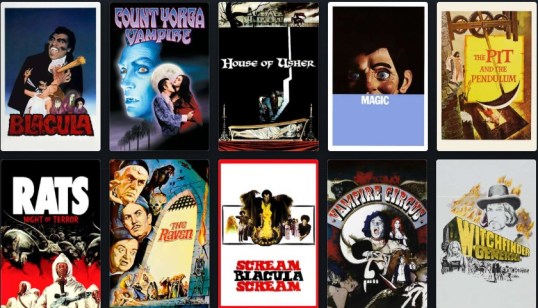
Halloween approaches! I’ll be posting another list of movies in a few days but here’s ten horror movie recommendations for between now and Wednesday!
Vampire Circus (1972) is a gloriously macabre film that I recommend to everyone. This British film takes place in a Serbian village that a vampire curses with his dying breath. Twenty years later, the village is ravaged by the plague and blockaded by other towns. With the inhabitants basically prisoners in their own home, they are easily tempted by the arrival of a circus. The circus, of course, is not what it seems. This is a stylish film, full of quirky characters, disturbing imagery, and a lot of blood. It’s perfect for Halloween. You can view it on Prime.
Speaking of vampires, Count Yorga, Vampire (1970) features Robert Quarry as a vampire in 1970s California. Apparently, the film was originally envisioned as being a soft-core film that would feature a few horror elements but Quarry insisted that the script be rewritten to emphasize the count’s vampirism. That was probably a good idea as Quarry turned Yorga into one of the most memorable movie vampires not named Dracula. Serious actor Michael Murphy appears in this film as well. It’s interesting to note that Murphy went from battling a vampire to working with Robert Altman and Woody Allen and appearing in some of the best films of the 70s. You can view Yorga here.
In Magic (1978), Anthony Hopkins plays a ventriloquist who is basically at the mercy of his foul-mouthed, foul-tempted, all together foul dummy. This is one of the best examples of a creepy ventriloquist dummy film. Hopkins’s neurotic performance is brilliant and actually far more interesting than his best-known work as Hannibal Lecter. Burgess Meredith and Ann-Margaret offer strong support. Hopefully, the dummy was used for kindling after this film was shot because seriously ….. agck! Magic is on Prime.
The Witchfinder General (1968) stars Vincent Price and was released as The Conqueror Worm in the United States but it should not be mistaken for one of Corman’s Poe adaptation. Instead, The Witchfinder General is a visually stunning and intense film that features Price is one of his best villainous roles. There’s very little camp or intentional humor to be found in this film. Instead, it’s just Price giving a genuinely frightening performance. Under its American Title of The Conqueror Worm, The Witchfinder General can be found on Prime.
Earlier, I mentioned that Robert Quarry’s Count Yorga was one of the most interesting not named Dracula. I should also mention that William Marshall made for an equally interesting vampire in 1972’s Blacula.The film may have been a bit campy but William Marshall gave a strong and dignified performance as Count Mamuwalde, who is transformed into a vampire by Dracula (who is not just a bloodsucker but a racist as well) and later finds himself in 1970s America. Blacula was followed by a sequel, 1973’s Scream, Blacula, Scream. The sequel is a mess but worth watching for the teaming of William Marshall and Pam Grier. Blacula and Scream, Blacula, Scream are both on Tubi.
Finally, I have to mention that Bruno Mattei’s 1984 masterpiece, Rats: Night of Terror can now be viewed on Tubi. The film may seem ludicrous but you’ll never get that final shot out of your head! It can be viewed on Tubi.
For today’s Horror on the Television, we have a made-for-TV movie from 1973. As you can tell from the video below, it originally aired as a part of ABC’s Tuesday Night At The Movies.
A Cold Night’s Death tells the story of two scientists (Eli Wallach and Robert Culp) who are sent to a remote research station to investigate the apparent disappearance of another scientist. They soon come to suspect that they may not be alone and soon, paranoia rears its ugly head. With its frozen landscape and its ominous atmosphere, this movie feels like a distant cousin to John Carpenter’s The Thing.
A CHINESE GHOST STORY (1987) is a landmark film in the golden age of 1980’s Hong Kong cinema. While my primary interest in the cinema of Hong Kong centers around directors like John Woo, Ringo Lam and Johnnie To, as well as the actors Chow Yun-Fat, Lau Ching-Wan and Andy Lau, I’ve been aware of this film from the very beginning. It’s been a couple of decades since I watched it, so I felt I was well past due for a revisit.
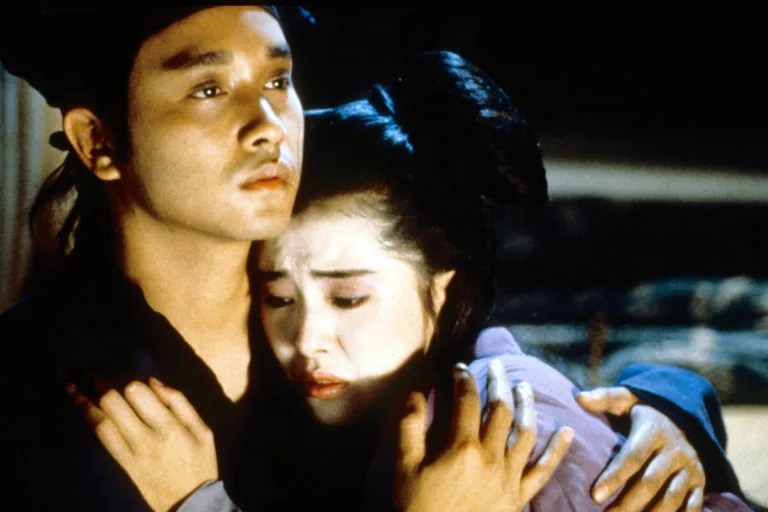
Directed by Ching Siu-tung and produced by the legendary Tsui Hark, A CHINESE GHOST STORY follows Ling Choi San (Leslie Cheung), a naive young scholar who finds himself working as a tax collector. Overly timid and a complete failure at his job, Ling is completely broke, so he seeks shelter in the only place he can afford, a haunted temple on the outskirts of a remote village. That night he encounters Lip Siu Sin (Joey Wong), a ghostly maiden who is being forced to use her feminine wiles to lure unfortunate men to their doom at the hands, or shall I say tongue, of the millennium-old, shape-shifting Tree Demoness Lao Lao (Lau Siu-Ming), who devours the life essence of its victims. Ling’s unusual and genuine kindness towards Siu Sin causes her to have pity on the young man so she decides to protect him from Lao Lao. The two soon share a night of tender romance, where Siu Sin reveals her tragic past and Ling immediately pledges to do anything he can to protect her. As part of this protection, Ling seeks the assistance of the Taoist swordsman Yin Chek Ha (Wu Ma), who initially rejects his request but eventually becomes an unlikely and powerful ally in the young scholar’s quest to keep Siu Sin safe. Ling and Master Yin soon find themselves in the underworld, battling armies of the undead and writhing tongue-tentacles, in an attempt to save Siu Sin from the evil Tree Demoness. Will they free her, or will she spend eternity setting up horny guys to have their essences sucked away and turned into zombies? It’s the age old question that will be answered by the end of the film’s 96 minute runtime.
Blending elements of horror, romance, comedy, and swordplay, while incorporating innovative special effects, A CHINESE GHOST STORY revitalized the Hong Kong fantasy film and kicked off a trend for folklore ghost films, including its own two sequels. At its core, the film is a timeless, love story, and even with all of the crazy stuff going on, that central theme kept me engaged to the very end. Director Ching Siu-tung is at the top of his game as his film contains a poetic energy that’s extremely rare in any nation’s cinema these days, including Hong Kong. Leslie Cheung, who plays the scholar Ling, had a tendency to overplay the annoying aspects of his characters at this point in his career in the 80’s (I’m looking at you A BETTER TOMORROW). Here, while I don’t love his character for the early sections of the film, I do enjoy it when he decides he’s going to do anything possible to save Siu Sin’s eternal soul and give her a chance to reincarnate. What he lacks in bravery, he makes up in sheer will and his character grows on me by the end. And then there’s Joey Wong as the ghostly seductress Siu Sin. What can I say about her other than this… if you don’t fall in love with Joey Wong in A CHINESE GHOST STORY, there’s probably something wrong with you. It’s a performance that helped propel Wong into her stardom across Asia. Her strong chemistry with Cheung elevates the film’s central love story and gives his character some much needed credibility. Wu Ma plays the cynical and brave Taoist swordsman, Yin, who gives Ling a fighting chance against the tree demoness. It’s a fun character and his mid-film, sword-training “rap” is one of my favorite scenes in the movie. Lau Siu-Ming, a man, plays the tree demoness Lao Lao. It’s an interesting character. Siu Sin continually refers to the tree demon as an “old woman,” but the demon is actually gender fluid and when we see it, it looks more like a man, which seems to enhance its power. We also see the tree demon in its monster form, which is the biggest, longest and slimiest tongue you will ever see. It’s unique and gross at the same time!
I will admit that watching any film starring Leslie Cheung, at this point in my life, is bittersweet. The man was a Canto-Pop superstar and over time, grew to become one of the best and most interesting actors from Hong Kong. That’s Cheung singing the theme song that plays over the opening credits of A CHINESE GHOST STORY. His work with John Woo and Chow Yun-Fat in the A BETTER TOMORROW film series and ONCE A THIEF are some of the first films I watched when I began my obsession with Hong Kong Cinema in the 90’s. In some ways, my love of Hong Kong movies is inseparable from Leslie Cheung. Suffering from depression, Cheung tragically took his own life on April 1st, 2003 by jumping from the 24th floor of the Mandarin Oriental Hotel, which is located in the central district on Hong Kong Island. It was a horrifically sad end for an extremely talented man.
Ultimately, in the world of Hong Kong Cinema, A CHINESE GHOST STORY is an easy recommendation in much the same way that movies like JAWS or STAR WARS are here in America. Its legacy of influence over the Hong Kong film industry has stood the test of time, making it a true classic!
“What is sacred to a bunch of goddamned savages ain’t no concern of the civilized man! We got permission!” — Buddy
Bone Tomahawk (2015) begins in quiet dread. A still horizon, the whisper of wind across rock, a hint of bone under the dust—the American frontier looms like an unfinished thought. This silence sets the tone for S. Craig Zahler’s remarkable debut, a film that wears the form of a Western only to strip it down to nerve and marrow. It’s a story of decency under siege, of men pushing past the last borders of civilization and discovering that what lies beyond is not the unknown, but the origin of everything they thought they’d overcome.
At first glance, the premise seems familiar. When several townspeople vanish from the small settlement of Bright Hope, Sheriff Franklin Hunt (Kurt Russell) leads a rescue expedition into the desert. Riding with him are three others: the injured but determined Arthur O’Dwyer (Patrick Wilson), whose wife has been taken; his tender-hearted deputy, Chicory (Richard Jenkins), whose chatter and old-fashioned kindness soften the film’s bleak austerity; and the self-assured gunman John Brooder (Matthew Fox), a man equal parts gallant and cruel. Together, they represent the moral cross-section of a civilization still trying to define itself—duty, love, loyalty, arrogance.
Their journey outward becomes one of inward descent. Zahler’s script unfolds at a deliberate pace, steeped in stillness and exhaustion. The first half moves like ritual—meandering conversations, humor worn thin by weariness, the small comforts of campfire fellowship flickering against the vast emptiness around them. It’s here that Bone Tomahawk begins its slow transformation. What starts as a rescue Western gradually becomes something deeper and older. By stripping away the romance of exploration, Zahler reveals the frontier not as a space of discovery, but as a place of reckoning—a mirror of the instincts civilization pretends to have tamed.
The film’s most haunting element is its portrayal of the so-called “troglodytes,” the mysterious group believed to be responsible for the kidnappings. They are less a tribe than an incarnation of the wilderness itself—nameless, wordless, and utterly beyond cultural translation. Covered in ash, communicating through the eerie hum of bone instruments embedded in their throats, they seem less human than ancestral, as though the land itself had dragged them upward from its own depths. Zahler refuses to frame them anthropologically or politically; instead, they represent the primal truth the American frontier sought to bury under its myths of order and progress.
Western films, for more than a century, have mythologized the wilderness as an external force—something to conquer. But the “troglodytes” in Bone Tomahawk feel like the soil’s memory of what came before conquest: the savage necessity that built the very myths used to conceal it. They are the frontier’s unspoken ancestry—what remains after all the churches, taverns, and codes of decency are stripped away. Civilization needs them to remain hidden in the canyons, out of sight and unspoken, because their existence contradicts everything the polite narrative of the Old West stands for. They are what progress denies but cannot erase.
Zahler’s restraint strengthens this allegory. He shoots the desert not as backdrop but as evidence—a geographical wound extending beyond the horizon. The wilderness looks stunning but predatory, its stillness full of threat. Even when the posse’s odyssey is free of immediate danger, there’s the growing sense of being consumed: by the sun, by exhaustion, by the quiet knowledge that the world they’re riding into has no use for their notions of law and virtue. Civilization, here, is a pocket of light surrounded by something much older and hungrier.
That hunger, the need to conquer and consume, connects Bone Tomahawk to its spiritual predecessor, Antonia Bird’s Ravenous (1999). Bird’s film transformed the Donner Party’s historical ghosts into an allegory of Manifest Destiny, equating cannibalism with American expansion—the act of devouring land, life, and self under the guise of progress. Zahler continues that lineage with deliberate starkness. For him, violence in the frontier isn’t just literal; it’s foundational, the unacknowledged currency of civilization. Where Ravenous expressed its critique with mordant humor, Bone Tomahawk speaks in solemn tones, observing how every civilized act—the enforcement of law, the defense of home—rests upon the refusal to see what was consumed to create it.
The “troglodytes” embody that refusal incarnate. They are not villains in the traditional sense; Zahler grants them no ideology or explanation, only the primal fact of their survival. In doing so, he flips the Western’s moral equation: the barbarians at the edge of civilization are not invaders, but reminders of its origins. They are ghosts of the violence that founded the frontier, the unspoken proof that the West was never as far from savagery as it claimed. To look upon them is to glimpse the beginning—the raw, lawless reality America buried beneath the idea of itself.
Kurt Russell, magnificent in his restraint, anchors this tension. His Sheriff Hunt evokes a fading kind of decency: measured, fair, and unwavering even in futility. Russell plays him not as a Western hero but as a man committed to honor in a world that no longer rewards it. His calm authority softens only around those he loves and hardens in the face of what he doesn’t understand. In that measured decency lies the film’s aching question: what happens when morality meets something that does not recognize it?
Patrick Wilson’s O’Dwyer embodies faith’s physical agony—a man driven by devotion, limping through a landscape that punishes his determination. Richard Jenkins provides heart and subtle tragedy; his rambling, almost comical musings on aging and loneliness become the story’s moral texture, the sound of humanity scraping against extinction. And Matthew Fox, in his most precise performance, gives voice to the arrogance of the civilized killer—a man who fashions violence as virtue, believing his elegance excuses his cruelty.
Together, the four men form a living cross-section of the West’s moral mythos. Their journey exposes how fragile those ideals become once separated from the safety of town limits. They embody the dream of order confronting the truth of chaos—and the cost of looking too long into the void beyond it.
Zahler’s filmmaking is remarkably self-assured for a debut, and what stands out most is his willingness to trust stillness. There is no manipulated rhythm, no swelling score to guide emotion. The soundscape is shaped by wind, hoofbeats, crackling fires, and quiet voices rattled by exhaustion. The silence itself becomes a spiritual presence, pressing down on the travelers until conversation feels like resistance. Each scene builds tension not through action, but through waiting—the dread of what remains unseen, what civilization has pretended not to hear.
The violence, when it erupts, is unforgettable. Zahler does not linger voyeuristically, yet the weight of what happens lands with moral precision. The horror feels earned—an eruption of the primal into the civilized. Its purpose is not to shock, but to remind: the line between the men of Bright Hope and the people they fear is thinner than they want to believe. The frontier, as Zahler presents it, is not an untouched wilderness but the graveyard of an ongoing denial—the myth of progress stacked atop the bones of the devoured.
In that way, Bone Tomahawk moves beyond the idea of genre blending. It is not merely a “horror Western,” but a meditation on how those two sensibilities spring from the same source. Both depend on the confrontation between safety and the unknown, belief and disbelief. Both are rituals of fear, structured to reassure yet always at risk of unveiling the truth. Zahler’s greatest achievement is the way he strips away that reassurance. By the film’s final stretch, the promises of civilization—hope, faith, righteousness—have been exposed as fragile constructions built atop an ancient void.
And yet, through all its darkness, Zahler allows a flicker of grace. The film’s humanity endures in small gestures: a conversation interrupted by laughter, a hand extended in kindness, the stubborn persistence of dignity in impossible circumstances. Bone Tomahawk never preaches or offers catharsis, but it does something harder—it bears witness. It shows men maintaining decency not because it protects them, but because it defines them. In that endurance lies the film’s quiet heartbeat.
Like Ravenous before it, Bone Tomahawk reimagines cannibalism and frontier brutality not as aberrations, but as mirrors reflecting a truth about the American project: that every step westward demanded erasure, and that what was erased refuses to stay buried. The “troglodytes” linger not only in the canyons but within the culture that feared them—proof that civilization’s polish has always covered the rough, enduring shape of appetite.
By the end, what remains is not revelation or redemption, but silence—the kind that comes after myth collapses. Zahler’s film leaves its characters and viewers alike to confront the space where civilization ends and something older begins. The desert remains untouched, vast and timeless, holding the secret at the center of all Western stories: that progress has always been haunted by the primitive, that the world we built never left the wilderness—it merely disguised it.
Measured, brutal, and strangely tender, Bone Tomahawk stands as both a reclamation and an undoing of the Western myth. It listens to the echoes of the Old West and answers them not with triumph, but with reckoning. In its dust and silence lies a truth older than law or legend: civilization may light its fires, but there will always be something in the dark watching, waiting—the part of us it never truly left behind.
Today’s horror scene that I love comes from 1970’s The Wizard of Gore. Directed by Herschell Gordon Lewis, this uniquely acted scene should be familiar to anyone who has ever watched the montage that opens most of the Something Weird video releases.
In the city of Spokane, Washington, Kevin Coe (Dale Midkiff) is a real estate agent who always tries to come across as being the slickest guy in the room. With his quick smile and his moderately expensive suits, Kevin certainly seems to fit the stereotype. It’s only when you start to look a little closer that the surface starts to crack.
For someone who goes out of his way to come across as being confident, Kevin is actually very immature and more than a little whiny. He’s living with a perfectly nice young woman named Ginny (Heather Fairfield) but it’s obvious that he’s keeping secrets from her. He comes home one morning with scratches on his face and, when she asks about them, he claims that 1) he got mauled by a dog and 2) he doesn’t need any sort of medical attention. Kevin is someone who frequently loses his job because he’s just not that good at it. When one boss fires him, Kevin replies that he’s going to start his own business and someday, maybe he’ll be the one doing the hiring and firing. It’s classic empty cope.
And then there’s Kevin’s mother. Ruth Coe (Elizabeth Montgomery) is someone who likes to present herself as being a grand diva, in the manner of a Golden Screen star. She’s extremely close to her son, at times overprotective and at times overly critical. Kevin often goes from yelling at his mom to dancing with her within minutes. Ruth makes it clear that she doesn’t like Ginny and Ginny eventually grows to dread seeing Ruth wandering around their house, uninvited. And yet, despite all of the time that Kevin spends talking about how wants to get away from his mother and to live his own life, Kevin doesn’t really make much of an effort to do that.
Meanwhile, Detective Liz Trent (Talia Balsam) is investigating a series of rapes that have been committed in Spokane. When she comes to suspect that Kevin is the rapist, Kevin claims that it’s not true and it’s just another case of the world treating him unfairly. Ruth stands by her son and eventually shocks everyone with just how far she’s willing to go to try to keep him out of prison.
SinsoftheMother is based on a true story. Kevin Coe may have only been convicted of four rapes but he is suspected of having committed at least 41. In prison, he insisted he was innocent and refused to attend any counseling programs. He also refused to apply for parole, even after he became eligible. After his criminal sentence was completed in 2008, he was sent to the Special Commitment Center on Washington’s McNeil Island, which is a institution that houses sexual predators who are likely to reoffend. I’m writing this review on September 15th. Coe, as of this writing, is scheduled to be released from McNeil on October 3rd so, by the time you’re reading this, he could already be out. Coe is 78 and is reported to be in fragile health.
As for the movie, it’s mostly memorable for Elizabeth Montgomery’s over the top performance as Ruth Coe. Sweeping into every scene and delivering her lines in what appears to be a deliberately fake-sounding Southern accent, Montgomery chews the scenery with gusto. While the rest of the cast often seems to be going through the motions, Montgomery grabs hold of this movie and refuses to surrender it.





 Through the Shattered Lens