4 Or More Shots From 4 Or More Films is just what it says it is, 4 shots from 4 of our favorite films. As opposed to the reviews and recaps that we usually post, 4 Shots From 4 Films lets the visuals do the talking!
Today, the Shattered Lens wishes a happy birthday to director Ryan Coogler! Ryan Coogler has made a star out of Michael B. Jordan, redeemed the acting career of Sylvester Stallone, introduced the rest of the world to Wakanda, and changed the way that film viewers talk about race in cinema. With all that in mind, it’s time for….
4 Shots from 4 Ryan Coogler Films
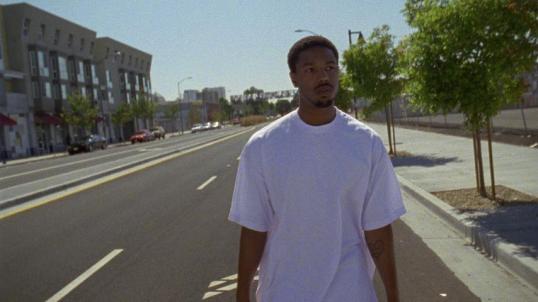
Fruitvale Station (2013, dir by Ryan Coogler, DP: Rachel Morrison)
Creed (2015, dir by Ryan Coogler, DP: Maryse Alberti)
Black Panther (2018, dir by Ryan Coogler, DP: Rachel Morrison)
Black Panther: Wakanda Forever (2022, dir by Ryan Coogler, DP: Autumn Durald Arkapaw)
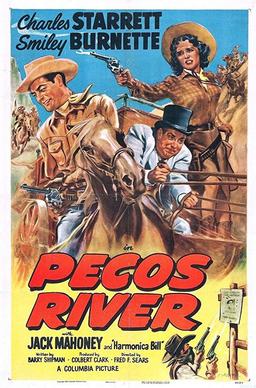
College student Jack Mahoney (Jock Mahoney) returns to his hometown on the frontier to pay a surprise visit to his father, Old Henry (Edgar Dearing). Old Henry owns a local stagecoach line and is being targeted by outlaws. When Jack reaches his father’s house, he discovers that someone has shot Henry in the back. With the help of Steve Baldwin (Charles Starrett) and Betty Coulter (Anne James), two of Henry’s employees, Jack Mahoney tries to bring his father’s killers to justice.
Also helping is the masked Durango Kid, who tells Jack that Henry was an old friend of his. Durango, who is never present at the same time as Steve for some reason, teaches Jack how to handle a gun. When Steve is framed for murder, Durango works even harder to help bring the outlaws to justice.
This late Durango Kid entry has more of an edge that some of the other Durango films. Both Durango and Jack are out for vengeance and their grim determination sets this one apart from some of Durango’s other, more jokey adventures.
Even with Durango in a serious mood, Smiley Burnette is around to provide some humor. This time, Smiley is a traveling “specs specialist” who goes from town to town and sells people glasses. (He also sings two songs while accompanied by Harmonica Bill.) At the end of the movie, Smiley breaks the fourth wall, puts on a pair of glasses that he says allow him to see the future, and he lets us know whether or not Durango, Jack, and Betty are going to be safe. Smiley says that he can see himself singing but he can’t hear the song because he only has the glasses. “Looks like a good song, too.”
One final note: this movie actually features Jock Mahoney in two roles. Not only does he play college student Jack Mahoney but he was also Charles Starrett’s stunt double in the movie’s action scenes.
Bleeding Love opens with a father (Ewan McGregor) driving his pickup truck across the desert. Sitting next to him is his 20 year-old daughter (Clara McGregor).
Over the course of Bleeding Love, we come to know quite a lot about these two. We know that the Father is divorced from the Daughter’s mother and that he has since remarried and has started a second family. We know that the Daughter has never met her Father’s new wife. We know that the Father has been sober for several years and now regularly attends AA, where he talks about the many regrets that continue to haunt him. We know that the Daughter grew up both loving her Father and also being scared of the way he would get when he was drunk. We know the Father is a landscaper. We know the Daughter is a painter who feels like she has lost whatever once inspired her. Father follows the rules. Daughter shoplifts tiny bottles of liquor from a gas station. Father talks a lot because he’s not sure what to say. Daughter is often silent for the same reason. Father is concerned about Daughter. Daughter barely survived and overdose just a few hours before Father announced they were going to see a friend of his.
We learn a lot about the Father and the Daughter but we never learn their names. (Father calls Daughter by her childhood nickname of “Turbo,” even though she specifically asks him not to.) They’re meant to be universal characters, standing in for all fathers and daughters who are trying to figure out how to relate to each other. Appropriately enough, the characters are played by an actual father-daughter team, Ewan and Clara McGregor. (Clara also had a hand in writing and producing the film.)
Bleeding Love follows Father and Daughter as they drive across the desert. (Father has told Daughter that they’re just visiting an old friend but what Daughter doesn’t know is that old friend also runs a drug rehab.) Along the way, they sometimes argue and they sometimes bond, especially over the music playing on the radio. (There’s a reason why this film is named after a Leona Lewis song.) They meet the usual collection of eccentrics that always tend to populate road movies like this. I liked Kim Zimmer’s performance as Elsie, the driver of a tow truck who takes Father and Daughter to her cousin’s birthday party. (At the party, Daughter tricks a man in a clown suit into giving her beer.) I also liked the performance of Vera Bulder, playing a prostitute named Tommy who helps Father and Daughter after the latter gets bitten by a spider. Not everyone on the road is as friendly as Elsie or Tommy, as both Father and Daughter eventually discover.
When Bleeding Love first started, I was a bit skeptical as to whether or not the film would work. There are a few moments where the film does seem to be trying a bit too hard to force an emotional response from the viewer. However, both McGregors are strong, likable, and sympathetic in their roles and their natural chemistry as father-and-daughter goes a long way towards making the relationship of their characters in the film feel real and poignant. Ewan pours himself into a scene where he talks about his past mistakes while Clara plays Daughter as someone who is angry and impulsive but not stupid. I related to Daughter and her relationship with her Father. There’s a lot of emotional truth to be found in their sometimes angry, sometime funny conversations on the road.
Thanks to Clara and Ewan McGregor, Bleeding Love works as a portrait of regret and addiction and a celebration of the bond between child and parent.
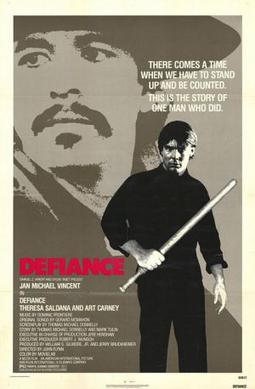
Serving out a six-month suspension, Merchant Seaman Tommy Campbell (Jan-Michael Vincent) rents an apartment on New York’s Lower East Side and passes the time painting and trying to learn Spanish in hope of getting assigned to a ship that is heading to Panama.
Tommy just wants to be left alone but he finds himself being drawn into the close-knit neighborhood. He becomes friends with Carmine (Danny Aiello) and more than friends with his upstairs neighbor (Theresa Saldana). He becomes a mentor to a street kid (Fernando Lopez) who lives with a punch-drunk boxer named called Whacko (Lenny Montana). Abe (Art Carney), who owns the local bodega, agrees to let Tommy use his phone.
Tommy also finds himself drawing the attention of Angel Cruz (Rudy Ramos), head of the local street gang. Tommy doesn’t want to get involved in any trouble. He just wants to serve his suspension and sail to Panama. But with Angel and his gang terrorizing the neighborhood and even robbing a church bingo game, Tommy and his friends finally stand up to the gang.
Defiance is more intelligent and realistic than many of the other urban vigilante movies that came out in the 70s and 80s. Tommy never becomes a cold-blooded killer, like Charles Bronson did in the Death Wish films. Instead, he spends most of the film trying to stay out of trouble and, when he does stand up for himself and the neighborhood, he does so realistically. He fights the gang members but he doesn’t set out to the kill them. About as deliberately destructive as he and Carmine get is that they destroy Angel’s car. Rather than being a typical vigilante movie, Defiance is a portrait of a neighborhood where everyone takes care of everyone else. Angel and his gang mistake the neighborhood’s kindness for weakness. The neighborhood proves them wrong.
Defiance stars two actors who never quite got their due. Theresa Saldana’s promising career was derailed when she was attacked and nearly killed by a deranged stalker in 1982. Though she recovered and went on to do a lot of television, she never became the star that she should have. Jan-Michael Vincent did become a star in the 70s and 80s but he later became better-known for his struggles with drugs and alcohol. Both of them are very good in Defiance and leave you thinking about the careers that they could have had if things had just gone differently.
4 Shots From 4 Films is just what it says it is, 4 shots from 4 of our favorite films. As opposed to the reviews and recaps that we usually post, 4 Shots From 4 Films lets the visuals do the talking!
Today is Arthur Conan Doyle’s birthday. Today, we pay tribute to Doyle’s most popular and influential creation. It’s time for….
4 Shots From 4 Sherlock Holmes Films
Sherlock Holmes (1922, dir by Albert Parker, DP: J. Roy Hunt)
The Hound of the Baskervilles (1939, dir by Sindey Lanfield, DP: Peverell Marley)
The Private Life of Sherlock Holmes (1970, dir by Billy Wilder, DP: Christopher Challis)
Sherlock Holmes (2009, dir by Guy Ritchie, DP: Philippe Rousselot)
117 years ago today, Laurence Olivier was born in Surrey. The son of a clergyman, Olivier would go on to become one of the greatest stage actors of the 20th Century. He would also have a distinguished film career, one that led to him frequently being described as being the world’s greatest living actor.
He is perhaps best-known for his Shakespearean performances. He won multiple Oscars for directing and starring in 1948’s Hamlet. Today’s scene that I love comes from that film and features Olivier at his best, as both an actor and a director.
Alexis (Leila Anastasia Scott) is a San Antonio news reporter who, while sitting in a small cafe, is approached by a man named Joe (Jason Scarbrough).
At first, Joe just seems like an appreciative fan of Alexis’s reporting, albeit a bit of creepy and pushy one. But it’s only after Joe sits down, removes his glasses, and starts to speak about his life to Alexis that the truth becomes apparent. Joe says that he’s the serial killer who has been terrorizing San Antonio for the past few months. His trademark is that he mummifies the bodies of his victims. At first skeptical and then increasingly disturbed, Alexis listens as Joe calmly discusses his life, from his childhood as the son of a mortician to his time in the Army, to his current life as a killer. As the conversation continues, it becomes apparent that Joe has a connection to Alexis and her family.
First released on January 2nd (and therefore, the first film of 2024), The Mummy Murders is a low-budget serial killer film that was filmed on location in San Antonio. I have to admit that I’m a bit weary of serial killer films, just because there have been so many of them that they can sometimes feel rather interchangeable. There’s only so many times you can sit through someone giving a long-winded explanation of their motives and their techniques before you start to wonder what the point of it all truly is. Personally, I am of the opinion that Lars Von Trier pushed the serial killer genre to its logical conclusion with The House That Jack Built. Matt Dillon plunging into the abyss was not only a fitting end for his character but also a sign that we had learned just about everything that there was to learn about what makes a serial killer tick. There’s nothing left to discover.
That said, when taken on its own terms, The Mummy Murders is effectively creepy. Again, it’s an extremely low budget movie and, towards the end of the film, the boom mic makes a presumably uninvited appearance. There’s some holes in the film’s plot and I took issue with a lot of the choices that Alexis made throughout the film. But Jason Scarbrough gives an effectively unhinged performance as Joe and the film deserves a lot of credit for not trying to make him into some sort of erudite, witty Hannibal Lecter-style murderer. Instead, Joe is a believable creep who takes pride in his crimes because they’re the only thing for which he’s ever shown any ability. Joe looks at both Alexis and the audience with a thousand-yard state, leaving little doubt that there’s zero room for kindness or empathy in Joe’s death-obsessed mind. In an especially creepy moment, Joe talks about his excitement when, as a pre-teen, he discovered that the body of a girl on whom he had a crush had been brought to his father’s mortuary. It’s icky and it’s creepy but it’s probably a more realistic portrayal of the killer’s sick mindset than what is found in most films.
As a final note, The Mummy Murders was shot on location in San Antonio. San Antonio’s a lovely city. More films should shoot down there.
Framed on charges of dumping toxic waste, Morgan (Billy Zane) accepts a CIA mission to travel to the fictional African country of Zambeze and to track down his former friend, Jim Scott (Robert Downey, Jr.). Scott is an ex-CIA agent who faked his own death and who is now leading a revolution against the oppressive government of Zambeze. Scott knows the location of several barrels of uranium. Also searching for the uranium is the ruthless Mr. Chang (Cary-Hiroyuki Tagawa). Morgan teams up with Dr. Kim Woods (Lisa Collins) but soon discovers that he has to be careful of who to trust.
There is a surprisingly lot of talent in the cast of this film. Along with Zane, Downey, Collins, and Tagawa, Ron Silver appears as the shady political operative who joins Morgan in Zambeze. The cast may be good but it doesn’t take long to see that everyone in this film was there mostly for the money. No one brings their A-game to Danger Zone and both Downey and Silver often look like they’re struggling to deliver their lines with a straight face. Downey, especially, gives a self-amused performance, delivering his lines in a thick and indecipherable Southern accent.
(It is easy to forget that there was a time when Robert Downey, Jr’s career was regularly cited as being the ultimate Hollywood cautionary tale. Everyone knew he was talented but, in the 90s, his well-publicized struggle with drug addiction and the time that he spent in jail made him practically uninsurable and unhirable. He ended up appearing in a lot of films like this one before he eventually got clean and reinvented himself as the face of the MCU. In the 90s, most people would probably have been shocked to hear that Downey would eventually win an Oscar and receive a standing ovation as he accepted it.)
Danger Zone does have some good action scenes. The movie ends with an attack on a train that is actually pretty exciting. Unfortunately, the rest of the film suffers from bad acting and an incoherent plot that makes Danger Zone almost impossible to follow. You can fly into the Danger Zone but you won’t want to stay.
4 Shots From 4 Films is just what it says it is, 4 shots from 4 of our favorite films. As opposed to the reviews and recaps that we usually post, 4 Shots From 4 Films lets the visuals do the talking!
Since, as my sister has already pointed out, today is Dinosaur Day, it only makes it sense to continue to pay tribute to everyone’s favorite prehistoric marvels. It’s time for….
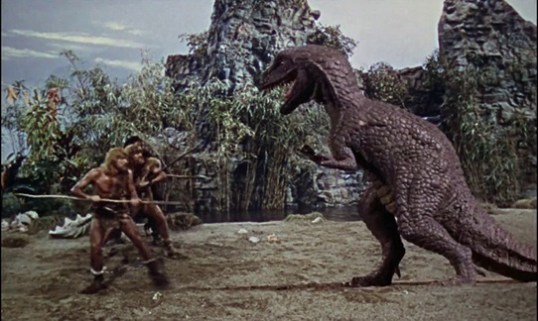
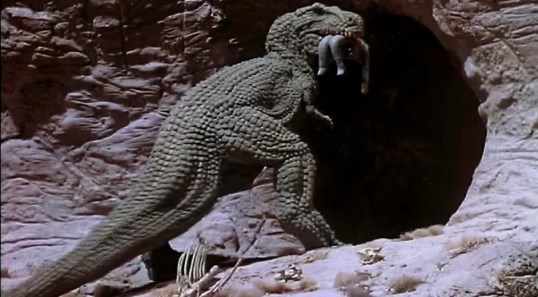
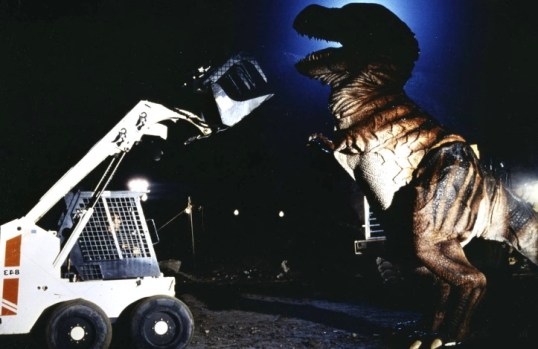
4 Shots From 4 Dinosaur Films
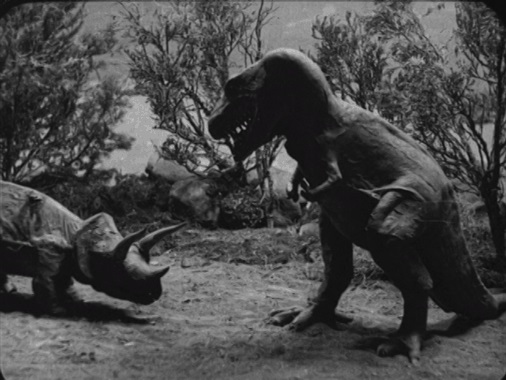
The Ghost of Slumber Mountain (1918, dir by Willis O’Brien, DP: Willis O’Brien)
One Million Years B.C. (1966, dir by Don Chaffey, DP: Wilkie Cooper)
Planet of the Dinosaurs (1978, dir by James Shea, DP: Henning Schellerup)
Carnosaur (1993, dir by Adam Simon, DP: Keith Holland)
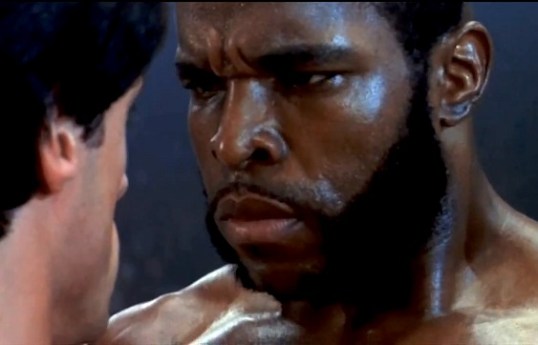
I saw that today was Mr. T’s birthday and, for a while now, I’ve been reviewing T and T, a Canadian detective show that he starred in for three seasons. I figured I could have shared a scene that I love from T and T but there really aren’t any scenes from T and T that are worth loving. Besides, we all know what we immediately think of when it comes to Mr. T.
For today’s scene that I love, here’s Mr. T as Clubber Lang in Rocky III:




 Through the Shattered Lens