4 (or more) Shots From 4 (or more) Films is just what it says it is, 4 (or more) shots from 4 (or more) of our favorite films. As opposed to the reviews and recaps that we usually post, 4 (or more) Shots From 4 (or more) Films lets the visuals do the talking.
217 years ago today, Edgar Allan Poe was born in Boston, Massachusetts. From his humble beginnings as the son of two struggling actors, Poe would go on to become one of the first great American writers. (It’s been said that, when Charles Dickens first traveled to the United States in 1842, he specifically wanted to meet Edgar Allan Poe. Unfortunately, it appears that popular story my not be true but it’s still a good story.) Poe was controversial in life and even his death generated more questions than answers but no one can deny his strength as a poet and as a prose writer. Both the detective and the horror genres owe a huge debt to Edgar Allan Poe.
Today, in honor of Edgar Allan Poe’s legacy, TSL presents 4 shots from 4 films that were inspired by the work of Edgar Allan Poe!
4 Shots From 4 Films
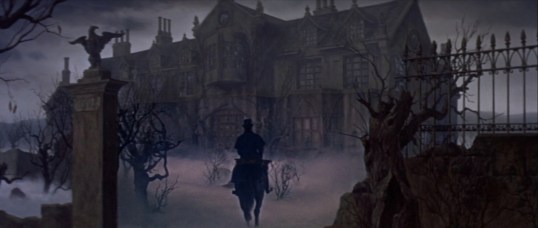
House of Usher (1960, dir by Roger Corman, DP: Floyd Crosby)
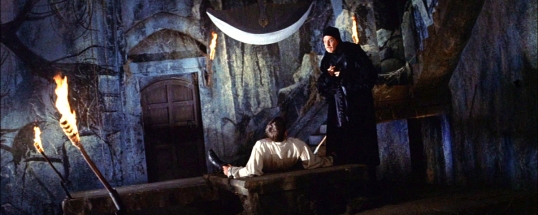
Pit and the Pendulum (1961, dir by Roger Corman, DP: Floyd Crosby)
The Raven (1963, dir by Roger Corman, DP: Floyd Crosby)
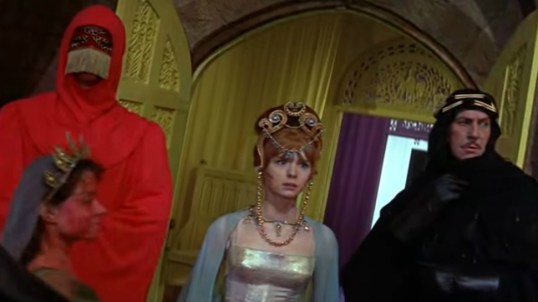
The Masque of the Red Death (1964, dir by Roger Corman, DP: Nicolas Roeg)
As some of our regular readers undoubtedly know, I am involved in hosting a few weekly live tweets on twitter and occasionally Mastodon. I host #FridayNightFlix every Friday, I co-host #ScarySocial on Saturday, and I am one of the five hosts of Mastodon’s #MondayActionMovie! Every week, we get together. We watch a movie. We snark our way through it.
Tonight, for #MondayActionMovie, the film will be 2000’s Tripfall!I picked it so you know it’ll be good.
It should make for a night of fun viewing and I invite all of you to join in. If you want to join the live tweets, just hop onto Mastodon, find the movie on YouTube, Tubi, or Prime hit play at 8 pm et, and use the #MondayActionMovie hashtag! The watch party community is a friendly group and welcoming of newcomers so don’t be shy.
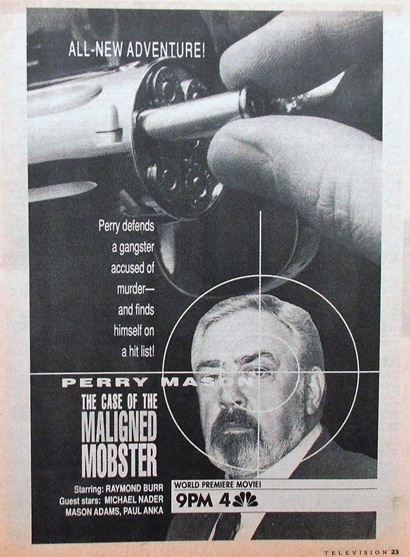
Despite being asked to take the case by an old friend (Mason Adams), Perry Mason (Raymond Burr) is reluctant to defend Johnny Sorrento (Michael Nader) in court. Johnny is a former gangster who has been credibly accused of murder in the past. Now, he’s on trial for killing his wife and not even Perry is totally convinced that he’s innocent.
Of the 18 Perry Mason films that I’ve watched so far, this was definitely the best. This is the first time that I’ve seen Perry defend someone who he both dislikes and, even more importantly, distrusts and Raymond Burr was really convincing whenever he got angry at Johnny. For once, the case wasn’t wrapped up as neatly as usual. Solving the murder of Johnny’s wife meant delving into a past murder and it uncovered a lot of dark secrets. The identity of the killer was a real surprise but there was a lot more going on than just solving the mystery of who killed Johnny’s wife. At the end of this movie, Perry looked like he was about to cry, no matter how much Della (Barbara Hale) tried to comfort him.
Sharing much more would be the same as spoiling all of the movie’s twists and turns so I’ll just repeat that this is the best of the Perry Mason movies that I’ve seen so far. The guest cast is great, especially Mason Adams and Paul Anka. The Perry Mason films always follow the same plot and sometimes, they can blend together but this one made a real impression and really took me by surprise.
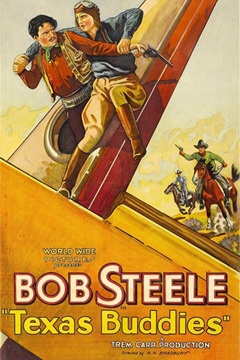
Ted “Jet” Morgan (Bob Steele) returns home from World War I. When he gets off the train in his small, western town, he’s met by Si “Old Timer” Haller (George “Gabby” Hayes). Si explains that Ted’s aunt is dead and his uncle was run out of town for being a drunk. Alice, “the girl next door” who Ted hoped to marry, married someone else. Si invites Ted to stay with him. Ted agrees and things start to look up when he meets Si’s niece, June (Nancy Drexel).
Meanwhile, a gang of outlaws led by Ken Kincade (Harry Semel) hijack a mail plane and steal the payroll that it was carrying. Ted is not nicknamed Jet for nothing. He not only know how to ride a horse but he’s good with planes too. With the help of Si and the local sheriff (William Dyer), he aims to stop those turn of the century skyjackers before they can force another unexpected landing.
Though the film takes place after World War I and features Bob Steele flying a plane and Gabby Hayes driving the same car he drove in Rainbow Valley, this is definitely a western. Before he proves himself as a pilot, Ted has to prove himself as a horseman and the movie ends with a traditional western gunfight. The postwar setting does still bring some unexpected elements to the story. Ted’s lonely arrival in his hometown reflects what it was like for many veterans returning home from Europe. At first, Ted doesn’t feel like he has a place in his old town but he soon gets a chance to prove to both himself and the townspeople that he belongs.
Bob Steele and Gabby Hayes are good heroes. Robert N. Bradbury, who was also Steele’s father, was one of the best of the B-western directors. For fans of the genre, this film is a definite treat.
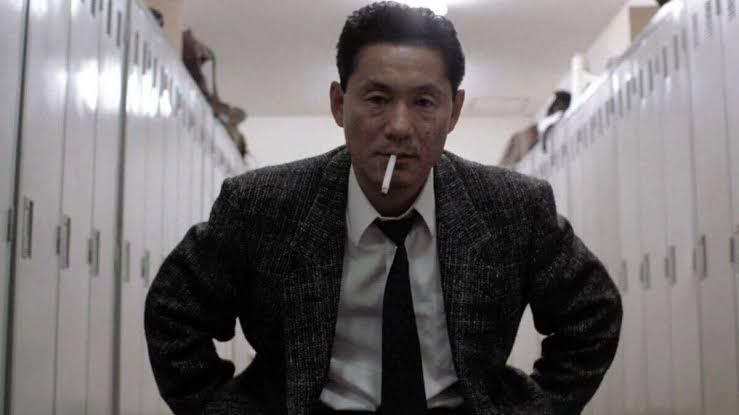
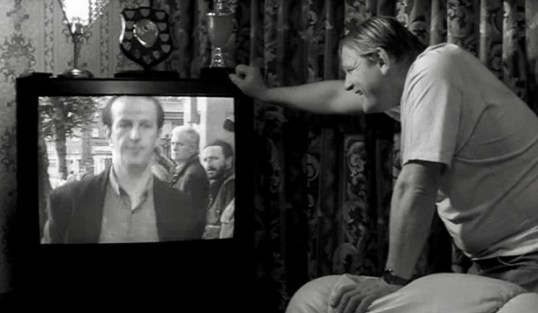
To celebrate the incredible Takeshi Kitano’s 79th birthday, I decided to revisit his directorial debut, VIOLENT COP (1989). I first discovered Kitano in the late 90’s when I saw that his film FIREWORKS (1997) was available for rent at my local Hastings Entertainment Superstore. Of course I rented it. It was slow, but it was also incredibly powerful, and I found myself paying attention to Kitano’s career. He has this incredible screen presence, and I was soon watching everything he came out with from BROTHER (2000) and BATTLE ROYALE (2000) to the update of ZATOICHI: THE BLIND SWORDSMAN (2003). I also looked back at the earlier work in his career, which brings us back to VIOLENT COP.
VIOLENT COP introduces us to Detective Azuma (Takeshi Kitano), a Tokyo cop whose methods are almost as brutal as the crimes he investigates. When his best friend, the corrupt cop Iwaki (Sei Hiraizumi), is murdered, Azuma uncovers a criminal network tied to drugs, corruption, exploitation, you name it! Through a series of beatings and threats, Azuma closes in on the professional killer, Kiyohiro (Hakuryu). Complicating matters is Azuma’s sister, Akari (Maiko Kawakami), a mental case and drug addict. When Akari is kidnapped due to his investigation, Azuma will stop at nothing to get his own, unique brand of justice.
First time director Takeshi Kitano brings an interesting and minimalist quality to VIOLENT COP through his long static shots and sparse dialogue. He’s able to create an atmosphere where the brutality of his story feels raw and natural. Actor Takeshi Kitano’s performance as Azuma follows suit. Once the violence comes, it resonates and lands extremely hard precisely because it’s presented in such a straightforward manner. Kitano’s film is way more realistic than most of us would probably care to admit.
Ultimately, VIOLENT COP doesn’t condemn or endorse Azuma, choosing to just observe him as his story leads to tragedy. As Kitano’s directorial debut, however, it introduces us to a unique and confident new voice… bleak, unsentimental, and unsettling. Kitano, the actor and the director, isn’t afraid to just stare at the camera and dare you to decide if there’s any difference between the good guy and the bad guy!
The great Cary Grant was born 122 years ago today.
In honor of Cary Grant’s legendary career and screen charm, today’s scene that I love comes from one of my favorite Cary Grant/Ingrid Bergman/Claude Rains/Alfred Hitchcock movies! From 1946’s Notorious, here is a scene that I love.
4 (or more) Shots From 4 (or more) Films is just what it says it is, 4 (or more) shots from 4 (or more) of our favorite films. As opposed to the reviews and recaps that we usually post, 4 (or more) Shots From 4 (or more) Films lets the visuals do the talking.
Today, the Shattered Lens wishes a happy 93rd birthday to British director John Boorman.
Boorman is one of those great director who sometimes doesn’t seem to get as much credit as he deserves. An undeniably idiosyncratic director, Boorman easily moved from genre to genre and who brought his own individual style to each of his films. Sometimes, critics and audiences responded to that vision and sometimes, they didn’t. And yet even Boorman’s so-called failures have come to be appreciated over the years. Zardoz is a cult classic. Even The Exorcist II: The Heretic is not quite the disaster that some insist. If nothing else, it’s one of the strangest studio productions to ever be released.
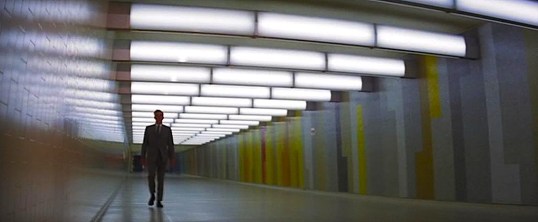
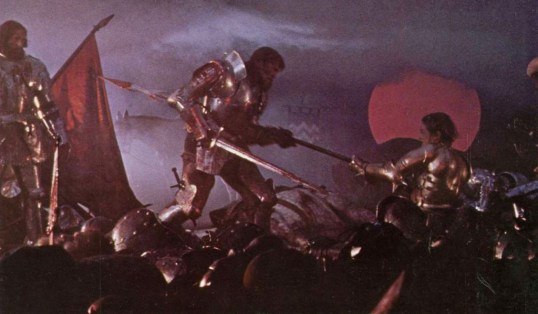
At his best, Boorman is one of the most influential directors of all time. How many neo-noirs have ripped off the look and the feel of Point Blank? The ending of Deliverance has been imitated by a countless number of horror films and, indeed, every backwoods thriller owes a debt to Boorman’s film about four businessmen spending a weekend canoeing. Excalibur is one of the most elegiac of all the Arthurian films while Hope and Glory retains its power to make audiences both laugh and cry with its portrayal of life on the British homefront during World War II. Meanwhile, films like The General and The Emerald Forest gave underrated characters actors like Powers Boothe and Brendan Gleeson a chance to shine.
So today, in honor of the career and the legacy of John Boorman, here are….
4 Shots from 4 John Boorman Films
Point Blank (1967, dir by John Boorman, DP: Philip H. Lathrop)
Deliverance (1972, dir by John Boorman, DP: Vilmos Zsigmond)
Excalibur (1981, dir by John Boorman, DP: Alex Thomson)
The General (1998, dir by John Boorman, DP: Seamus Deasy)
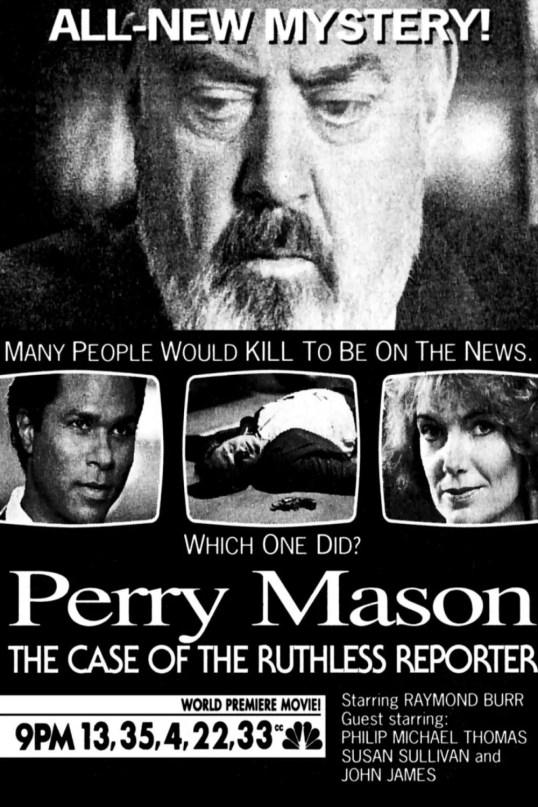
When arrogant news anchor Brett Huston (John James) is shot and killed, his co-anchor Gillian Pope (Kerrie Keane) is arrested and charged with the crime. It looks like an open-and-shut case because Brett was shot with Gillian’s gun. Luckily, Gillian is friends with Perry Mason (Raymond Burr) and soon Perry is on the case with Della Street (Barbara Hale) and Ken Malansky (William R. Moses).
Now this is how you do a Perry Mason movie! Brett’s murder is linked to a memo that he wrote in which he criticized the other members of the news team and argued that they should all be fired. All of the suspects are enjoyably eccentric. There’s a weatherman (Peter Jurasik) who wants to be a stand-up comedian. There’s the sports reporter (Philip Michael Thomas) who used and sold steroids. There’s the producer (Susan Sullivan), who was also Brett’s ex-wife. Brett even insulted the station manager (Jerry Orbach, who previously appeared as a different suspect in The Musical Murder). Ken, as usual, finds time for romance, this time with reporter Cassie Woodfield (Mary Page Keller) who appears to have someone trying to kill her as well. Along with a great cast of characters, this mystery had a solution that took me by surprise but which also made sense when I looked back on it. The final courtroom reveal was perfect. This is also probably the only Perry Mason film where the hours of a hamburger restaurant proved to be instrumental to the case.
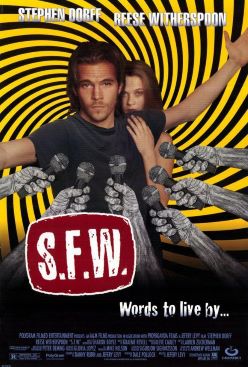
Cliff Spab (Stehpen Dorff), his friend Joe Dice (Jack Noseworthy), and teenager Wendy Pfister (Reese Witherspoon) are in the wrong convenience store at the wrong time and end up being taken hostage by a group of masked terrorists who have guns and video cameras. For 36 days straight, their ordeal is broadcast live on television. They become the number one show in the country and Cliff’s nihilistic attitude makes him a star. When the terrorists threaten to kill him, he spits back, “So fucking what!?” Alienated young people take up S.F.W. as a personal chant and credo. When Joe finally fights back, both he and the terrorists are killed in the shoot-out. Wendy and Cliff are now celebrities, even though they don’t want to be. Released into the real world, Cliff has to deal with everyone wanting to make money off of him. His alienation has been turned into a product. He just wants to be reunited with Wendy but his fans want him to tell them how to live their lives. Fandom turns out be a fickle beast.
Earlier this morning, I came across a news item that Jefery Levy, the director of S.F.W., had died at the age of 67. S.F.W. used to show up frequently on cable in the 90s but I hadn’t thought about it in years. When I first saw S.F.W., I didn’t care much for it. Cliff came across as being a poseur and Stephen Dorff came across like he was way too impressed with himself. With John Roarke playing everyone from Phil Donahue to Sam Donaldson and Gary Coleman appearing as himself, the movie seemed like it was trying too hard to be outrageous. Looking back on it now, though, I realize S.F.W. may not have been a good movie but it was still a very prophetic movie. What seemed implausible in the 90s — like the 36-day live stream from inside the convenience store hostage situation and Cliff Spab’s fans switching their allegiance to a self-righteous virgin who yells that everything matters while trying to assassinate him — feels far too plausible today.
In 1994, S.F.W. and Jefery Levy predicted the 2020s. The only thing it got wrong was having Cliff Spab not wanting to be a famous. Today, Cliff Spab would probably be presenting the Best Podcast award at the Golden Globes.
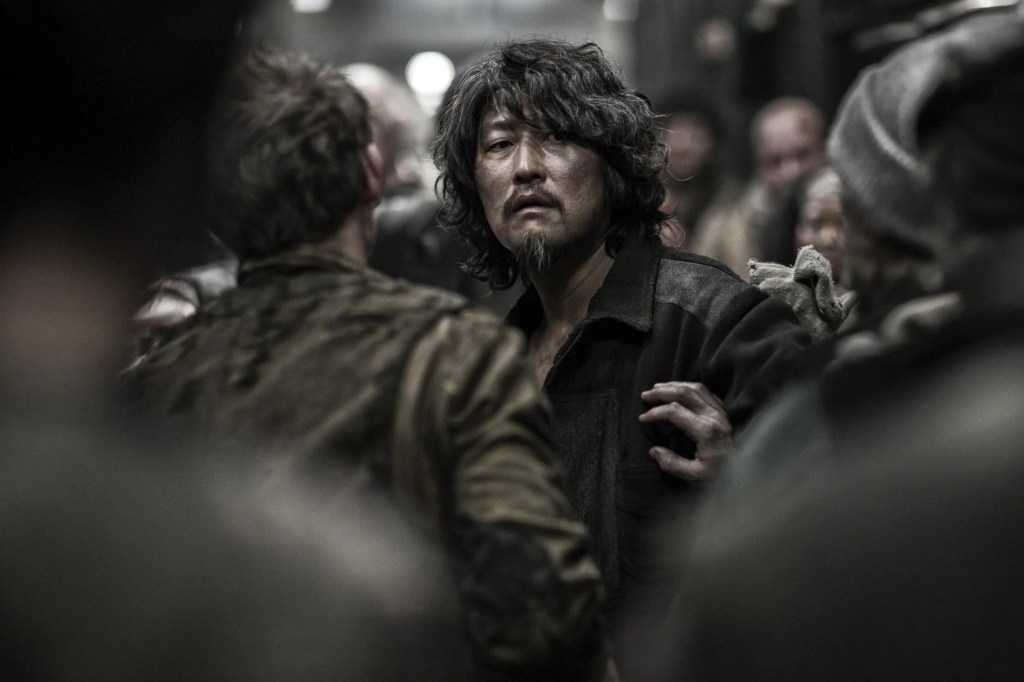
I discovered South Korean cinema when I ran across the blu ray for SHIRI (1999) at Best Buy some time around the turn of the century. Making the impulse buy, I discovered SHIRI to be an incredible action film. With my appetite sufficiently whetted, I hopped on the Internet and just started searching for more. The next movie I came across was JOINT SECURITY AREA (2000), another great film. I took notice of the actor Song Kang-ho in both films, so I started watching his career very closely. Soon he was starring in the psychological thriller SYMPATHY FOR MR. VENGEANCE (2002) and the serial killer film MEMORIES OF MURDER (2003). Not only was Song giving incredible acting performances, he was working for two of the great South Korean directors at the time, Park Chan-Wook and Bong Joon Ho. These two incredible directors were making the best films in South Korean cinema and Song’s fingerprints were all over their best work. Films like THE HOST (2006), THIRST (2009) and SNOWPIERCER (2013) soon followed, culminating in Song’s lead performance in Bong Joon Ho’s Oscar winning film PARASITE (2018), the first foreign language film to ever take home the Best Picture Oscar!
I have now been a fan of Song Kang-ho for over 25 years. He’s still working hard. I just noticed that he has a series that’s streaming on Hulu called UNCLE SAMSIK. I need to check that out. I also noticed that many of his best films are currently available for streaming on so many different platforms… Netflix, Tubi, the Roku Channel, PlutoTV, etc., etc.!
Check out this trailer for MEMORIES OF MURDER. If this doesn’t light your fire, your wood’s wet! Happy Birthday, Song Kang-ho. Thanks for a quarter century of entertainment!