So we meet again….Alex … Magana. Now look, I assume that most of my readers are good, kind, and decent, but what if you’re not?! I mean what if you’re not that great or you did one REALLY bad thing that you feel guilty about. I’m not saying putting your neighbor in a woodchipper kind of thing, but let’s just include the lessor felonies. If you just need that self-flagellation, my dear ne’er-do-well compadre, this film and Alex Magana is for you.
Alex Magana assaults the senses and art herself. In fact, from the hackneyed plots to the p*rn quality acting, he is the Ed Wood of the digital age! If you don’t believe me, check out the “Smiling Woman”… SERIES…yes, it’s a series! I refuse to call it a franchise! I won’t do it! Luckily, your misery is brief because as terrible as Alex Magana’s films are – he can’t write stories longer than 4 minutes.
“Don’t Lie” shows an influencer, who I think seems a little old for the gig; however, we must let all things slide with Alex. Typically, Alex just films out of his apartment and the hall in his apartment building. The lead actress could be homeless or just live near the building; so, she could be young, but life on the street is hard. In fact, all of the actors could be homeless and this brief filming was their only exposure to …. home. *Sheds Tear*
The story continues where her boyfriend stages her murder to gain additional subscribers, which doesn’t make sense because why subscribe to the deceased? But, Whatever. A psycho then teaches her and her boyfriend a lesson about … honesty… with a knife. Apparently, neither she nor her boyfriend understand how their legs can make them move around and even away from things or people.
If we look at “Don’t Lie” like an industrial film, like “The Importance of Good Manners”, “Why you should drive safely”, and “Don’t ever put that in your Bu..” anyway. My point is that maybe “Don’t Lie” is salvageable as a lesson film. The lesson is this: Don’t let Alex Magana have any recording devices! EVER! He’s got to be stopped! He’s really prolific! How is paying for all this very very low budget dreck?!
Captain Gary Hart (Buster Crabbe) and his sidekick, Sgt. Mike Jenkins (Paul Bryar), are sent to the jungles of Africa, where Nazi infiltrators are encouraging Chief Selangi (Jess Lee Brooks) to side with the Third Reich and allow them to set up a base. In their effort to stop the Nazis, Hart and Jenkins are aided by Kuhlaya (Ann Corio), a woman whose parents were killed by Selangi and who now lives in the jungle with a chimpanzee and a doctor (Milton Kibbee) who serves as her protector. Kuhlaya carries a bow and arrow, which she used to battle the Nazis. Hart and Jenkins have actual guns and probably could have ended the Nazi plot early just by using them as soon as they arrived but then the movie couldn’t be stretched to 68 minutes.
This is a pretty bad Poverty Row film, memorable just for Crabbe’s typically earnest and athletic performance and the presence of Ann Corio, who was a famous stripper in the 40s who tried to transition into films after Mayor La Guardia ordered the closure of New York’s burlesque houses. Corio had legs for miles but she was a terrible actress. At one point, Mike Jenkins says that if he keeps exercising, “I’ll have a physique like Buster Crabbe!” That’s about as clever as this slow-moving film gets.
As is typical of jungle films that were made in the 40s, the “tribesmen” are pretty much treated as if they’re interchangeable and the only one who is given a personality is the evil Selangi. Several of them are killed over the course of the movie, not because they were doing anything wrong but just because they were in the wrong place. (The most egregious example is an innocent native who ends up with one of Kuhlaya’s arrows in his back because he was unfortunate enough to step in front of Selangi at the last moment.) No one, our heroes included, really seems to care about them or their future. Even by the standards of the era, JungleSiren feels extremely condescending and prejudiced in its portrayal of the natives. The idea that the Nazis, with their Aryan obsession, would ever team up with Chief Selangi is just one of the film’s problems.
Director Sam Newfield was responsible for some entertaining and cheap westerns. I’ve reviewed a few of them. He should have stayed out the jungle.
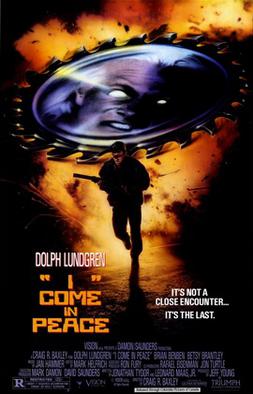
Dolph Lundgren is Jack Crain, a Houston cop who teams up with FBI agent Larry Smith (Brian Benben) to investigate who is killing criminals in H-town. The killer is a drug dealer but not your everyday drug dealer. He’s an alien named Talec (Matthias Hues) and he’s figured out how to say “I come in peace,” but the rest of the English language is beyond him. “I come in peace,” turns out to be the scariest phrase you can hear when you’re being pursued by a white-haired, intergalactic mass murderer. His targets include Jesse Vint and Michael J. Pollard. This terminator wannabe is after character actors!
On the second-tier action stars of the 90s, Lundgren was the one who could actually act. Van Damme could actually do all the acrobatic stunts his characters did but he couldn’t show emotion like Lundgren. Steven Seagal seemed like he could handle himself in a fight but he lacked Lundgren’s self-aware humor. Lundgren plays Jack as almost being a parody of the type of hard-boiled cop who is always getting yelled at by the commissioner for wasting the city’s money. Brian Benben is remembered, by some, as the star of HBO’s DreamOn, the sitcom that convinced a generation of young men that there’s nothing women love more than obscure pop cultural obsessions. Benben is actually pretty funny in IComeInPeace. He’s the everyman who can’t believe he’s having to deal with an intergalactic drug dealer. Good heroes need a good villain and Matthias Hues is just right as the drug dealing alien who literally doesn’t know what he’s saying.
If you want to see a Terminator rip-off with nonstop action, a memorable villain, frequently (and intentionally) funny dialogue, an Al Leong cameo, and Dolph Lundgren as a hero who pushes people around just because he feels like it, IComeInPeace is the movie for you!
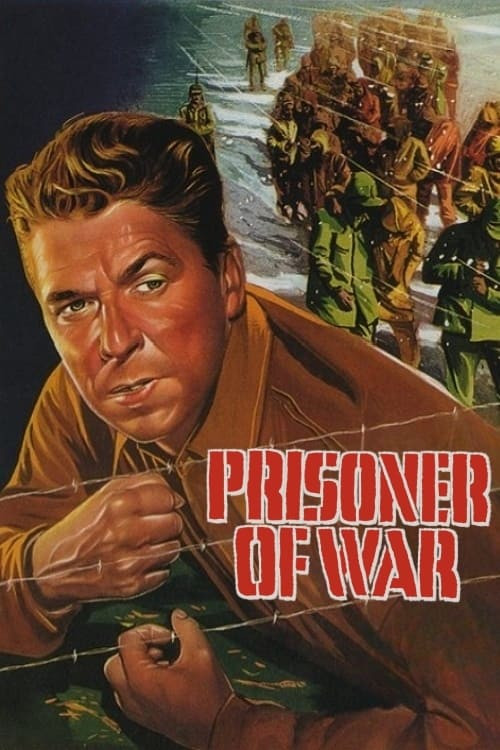
The setting is the Korean War. After getting information that American POWs are being tortured and brainwashed in North Korean prisoner-of-war camps, Major Hale (Harry Morgan) assigns Webb Sloane (Ronald Reagan) to go undercover. After parachuting behind enemy lines, Webb spots a group of POWs being marched through the snow and joins the group. From the minute that Webb joins the march, he begins to observe war crimes. The death march itself, with the POWs being forced to move in freezing weather, is itself a war crime. At the POW camp, Webb discovers the presence of an arrogant Soviet interrogator (Oscar Homolka) and a routine designed to break the POWs down until their ready to betray their native country. Some POWS, like Captain Stanton (Steve Forrest), refuse to break. Others, like cowardly Jesse Treadman (Dewey Martin), break all too quickly. Webb sends the information back to Hale and eventually tries to make his escape.
It’s not terrible. That the North Koreans and, later, the North Vietnamese tortured their POWs and forced some of them to denounce America is a matter of the historical record and, for a 1954 film, PrisonerofWar doesn’t shy away from the brutality of the torture that POWs were often subjected too. Of all of Reagan’s film, PrisonerofWar had the strongest anti-communist message, though Reagan himself feels miscast as a hard-boiled secret agent. (Reagan’s affability comes through even in a film set in a POW camp.) Sending someone undercover into a prisoner of war camp and then hoping that they’ll find a way to escape doesn’t sound like the most efficient way to determine if the Geneva Convention is being violated.
The film features a dog who is found by one of the POWs. Don’t get attached.
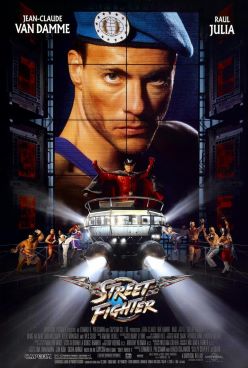
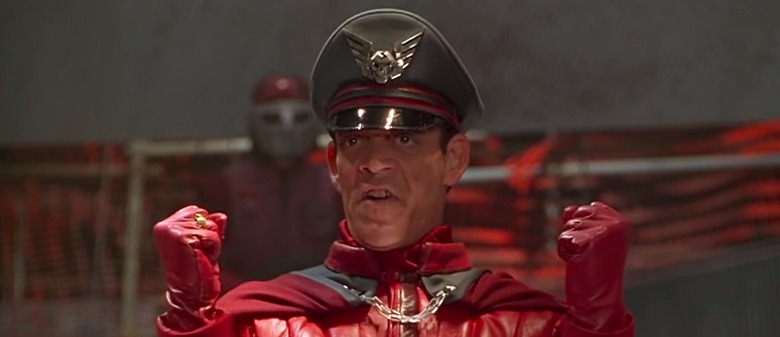
Originally, it was supposed to stand for Mike but my theory is that it stands for Marvelous because how else can you describe Raul Julia’s performance as the villain of StreetFighter? Julia was dying of stomach cancer when he played Bison, a condition reflected by his gaunt appearance. But Julia still obviously threw himself into every scene, delivering every melodramatic line as if it was the most important piece of dialogue that he had ever been trusted with delivering. As a film, Street Fighter is an overedited mess that features one of Jean-Claude Van Damme’s worst performances. Raul Julia saves it, though. He gets some of the worst lines and transforms them into the best lines through sheer determination. That man could have read the phone book and made it interesting.
Jean-Claude Van Damme is Col. Guile in this early video game adaptation. This isn’t one of Van Damme’s better performances. He doesn’t really play the Guile from the game. Instead, he’s just Van Damme with a blue beret and an American flag on his bicep. Far better are Damian Chapa as Ken and Bryon Mann as Ryu, even though neither gets to do as much as a fan of the game would want them to. Ming-Na Wen is a promising Chun Li but, instead of focusing on her fighting skill, the movie gets bogged down in trying to set her up for a sequel that would never come. Are you a fan of Cammy? Don’t get excited because all Kylie Minogue does is ask Guile if he’s okay. I did like Wes Studi as Sagat and Gregg Rainwater and Peter Tuiasosopo as T. Hawk and Honda but it still feels like only Raul Julia gives a performance that can compete with the video game version of his character.
There were four editors credited for StreetFighter and maybe that explains why the fights are a mess and the plot is impossible to follow. It’s a video game adaptation and I don’t demand much but I would like to know who is winning each fight. The film’s visual scheme, meant to duplicate the look of the game, showed some promise but the editing gave the movie a frantic feel that made it difficult to really appreciate the production design.
There’s never really been a good StreetFighter film but I still think it could happen with the right cast and crew. If MortalKombat could (eventually) be turned into a decent movie, why not StreetFighter? I still don’t think anyone will ever top Raul Julia as M. Bison, though. Raul Julia made you believe in Pax Bisonica!
“And peace will reign and all humanity will bow to me in humble gratitude.” — M. Bison
Welcome to Retro Television Reviews, a feature where we review some of our favorite and least favorite shows of the past! On Saturdays, I will be reviewing 3 By Cheever, which ran on PBS in 1979. The entire show can be purchased on Prime and found on YouTube.
This week, we finish up 3ByCheever with an adaption of one of his best-known short stories.
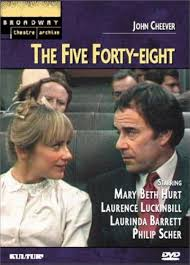
Episode 1.3 “The Five Forty-Eight”
(Dir by James Ivory, originally aired on James Ivory)
Laurence Luckinbill stars as Blake, a business executive who rides the train into the city for work and then back to the suburbs when it’s time to return to his perfect home. One day, as Blake heads to his train, he comes to be aware that he’s being followed by his former secretary, Miss Dent (Mary Beth Hurt). Blake is concerned because Miss Dent made quite a scene when she was fired from her job a little while ago. Of course, a part of the reason why she was so upset was because Blake had earlier seduced her, something that he has a habit of doing when it comes to his secretaries. On the train, surrounded by neighbors (including one that Blake can’t stand because of his long hair), Blake finds himself sitting next to Miss Dent. She explains that she has a gun in her purse. As the train heads for its destination, Blake’s confident facade crumbles and he is soon as humiliated by his former secretary as she was by him. And yet, this being a Cheever story, one wonders if Blake is even capable of realizing why any of this is happening to him.
The final episode of 3ByCheever was an adaptation of one of John Cheever’s best short stories. As directed by James Ivory, this adaptation can feel a bit overdrawn. The short story, for instance, opens with Blake on an elevator, already preparing to head home on the train. Ivory’s adaptation opens with Blake at the start of his day and we see a lot of things — like Blake’s antagonistic relationship with his long-haired neighbor — that Cheever simply mentioned. It takes a while for Miss Dent to finally sit down next to Blake and Ivory doesn’t do much to build up any sort of suspense while we’re waiting.
On the plus side, the film reveals Ivory’s skill when it comes to working with actors as both Luckinbill and Mary Beth Hurt give excellent performances. Luckinbill goes from being oily and overconfident to being a neurotic mess by the end of the show while Hurt does the opposite, going from being meek to commanding. Both the original short story and Ivory’s adaptation succeed in making you wonder what the future could possibly hold for either one of the two characters. They both seem to reach a point of no return and it’s hard to imagine Blake going back to his suburban home and his train rides and his motel hook-ups but, then again, this is a Cheever story so the implication is that he does just that, untouched by the fact that he nearly lost his life due to his own behavior. As for Miss Dent, she reclaims her self-respect by going to an extreme.
This was the last episode of 3ByCheever. This was an interesting series of adaptations, even if Cheever’s prose does seem to work best on the page than literally translated to film. Next week, a new series will being in this spot.
In this Poverty Row western, the Texas Rangers, a trio of western do-gooders who appeared in a handful of films, are sent to a small town to stop the Yackey Gang, led by the town’s saloon keeper (Ray Bennett).
The Texas Rangers are led by Tex Haines (Tex Ritter), who is known as the Idaho Kid despite apparently being from Texas. Tex goes undercover as a lawyer and tries to rally the community to stand up the Yackey Gang. Tex also sings some songs because he’s a singing cowboy along with being a cowboy who can hold his own in bar brawl. Maybe if he didn’t sing so much, there wouldn’t be as many brawls. Dave Wyatt (Dave O’Brien) is the younger Ranger who goes undercover and joins that Yackey Gang. Panhandle Perkins (Guy Wilkinson) is the comic relief, who loses a lot of money at Yackey’s casino but only to help Dave maintain his cover. The film was an obvious rush job and the plot is far more difficult to follow than any 54-minute film should be. The kids at the matinee probably enjoyed it, though. It delivers exactly what fans of the old B-westerns expect, including Charles King as yet another villain.
Tex Ritter, who appeared in a lot of these films, was also the father of actor John Ritter. In 1970, long after the days of the poverty row westerns, Tex Ritter ran for the Senate in Tennessee but he lost the primary. If he had won, he would have been the Republican candidate against Al Gore’s father. That would have been a battle for the ages.
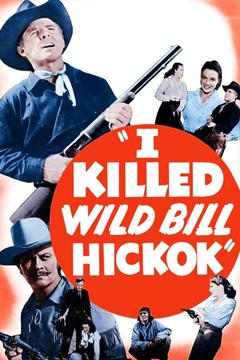
This low-budget western programmer tries to draw viewers in by using the name of an icon of the old west but it doesn’t take place in Deadwood, there’s no poker game, no dead man’s hand, and Wild Bill (Tom Brown) is presented as being a corrupt sheriff who works for evil businessman Jim Bailey (Denver Pyle). Denver Pyle, we all know him best as Uncle Jesse on theDukesofHazzard. He’s a bad guy here, the film’s Boss Hogg.
Our hero and the man who kills Wild Bill Hickok is a horse trader Johnny Rebel, who tells his story in flashback and who is often called “Mr. Rebel.” Johnny Rebel is played by Johnny Carpenter, no relation to the director. This Johnny Carpenter was a stunt man who took control of his career and wrote and played lead in a series of forgettable B-westerns, like this one. Carpenter probably could have been quite the hero in the Poverty Row days, when fast-paced westerns were being released on a weekly basis and directors and actors knew exactly what a matinee audience wanted. By the time IKilledWildBillHickok came out, westerns had started to grow up.
There’s the usual amount of stock footage. Director Richard Talmadge was himself a former stunt man so he does get a few good stunts into the last 15 minutes of the movie. Before the final gun battle, this movie about Wild Bill Hickok is nowhere near wild enough.
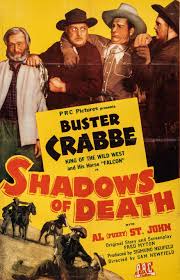
After a railroad agent is murdered and his map of the future locations of the railroad is stolen, Billy Carson (Buster Crabbe) rides into a frontier town and searches for the guilty party. Fortunately, for Billy, his best Fuzzy Q. Jones is the mayor, the sheriff, and the town barber! Unfortunately, local gunslinger Clay Kincaid (Eddie Hall) wants to make a name for himself by taking on the famous Billy Carson. Corrupt businessman Landreau (Charles King) encourages Clay by lying to him and telling him that Bully is planning on stealing Clay’s girl, Babs (Dona Dax).
A standard Poverty Row western, ShadowsofDeath was made by the same crew and cast who were involved with most of Buster Crabbe’s Billy The Kid films. I’m not sure if Billy Carson is meant to be the same character as Billy the Kid, though. Billy the Kid always had bounty hunters after him but Billy Carson works for the railroad. However, it would be strange if Fuzzy Q. Jones just happened to be the favored sidekick of two gunslingers who just happen to both be named Billy. Along with Fuzzy’s vaudeville style comedy, one thing that audiences could always take for granted was that Charles King would play the villain in these movies and Frank Ellis would always be his henchman. I always wonder if audiences in the 40s noticed that Charles King’s businessman and Frank Ellis’s gunslinger always returned from the dead with every B-western that came out.
My favorite scene in this one is Billy bursting into Landreau’s office, just for Landreau to say that he expects visitors to knock. Billy pauses long enough to knock on the door before getting down to the business of frontier justice.
Though the Academy of Motion Picture Arts and Sciences claim that the Oscars honor the best of the year, we all know that there are always worthy films and performances that end up getting overlooked. Sometimes, it’s because the competition too fierce. Sometimes, it’s because the film itself was too controversial. Often, it’s just a case of a film’s quality not being fully recognized until years after its initial released. This series of reviews takes a look at the films and performances that should have been nominated but were, for whatever reason, overlooked. These are the Unnominated.
I come here to defend Charlton Heston.
1994’s Ed Wood is a great film that has one unfortunate line. Towards the end of the film, director Ed Wood (Johnny Depp) meets his hero, Orson Welles (Vincent D’Onoforio), in a bar. They talk about the difficulties of directing a film. Wood talks about the trouble that he’s having with Plan 9 From Outer Space. Welles says that he can understand what Wood is going through because the studio is forcing him to cast Charlton Heston as a Mexican in his next movie.
And look, I get it. It is true that Charlton Heston does play a Mexican prosecutor named Mike Vargas in Welles’s 1958 film, Touch of Evil. And it is true that Heston is not the most convincing Mexican to ever appear in a film. And I understand that there are people who enjoy taking cheap shots at Charlton Heston because he did have a tendency to come across as being a bit full of himself and he was a conservative in a industry dominated by Leftists. There are people who actually think Michael Moore doesn’t come across like a self-righteous prick when he confronts Heaton in Bowling for Columbine. I get the joke.
But it’s not true and it’s not fair. When Touch of Evil was first put into production by Universal, Welles was not hired to direct. He was hired to play Hank Quinlan, the formerly honest cop with a habit of planting evidence on those who he believed to be guilty. When Charlton Heston was offered the role of Vargas, he asked who had been hired to direct. When he was told that a director hadn’t been selected, Heston was the one who suggested Welles be given the job. When, as often happened with Welles’s film, the studio decided to take the film out of Welles’s hands, Heston argued for Welles’s vision while Welles was off trying to set up his long-dreamed of film of Don Quixote. Say what you will about Charlton Heston’s career, he fought for Orson Welles, just as he later fought for Sam Peckinpah during the making of Major Dundee. Heston may not have agreed with either Welles or Peckinpah politically but he fought for them when few people were willing to do so.
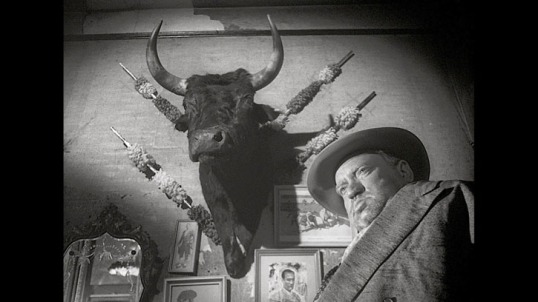
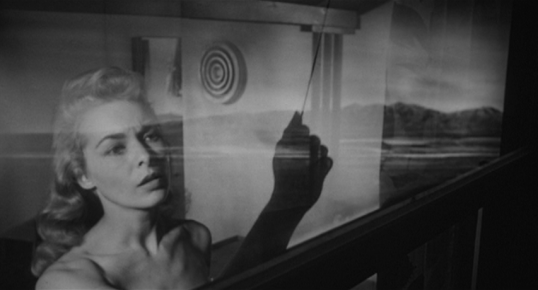
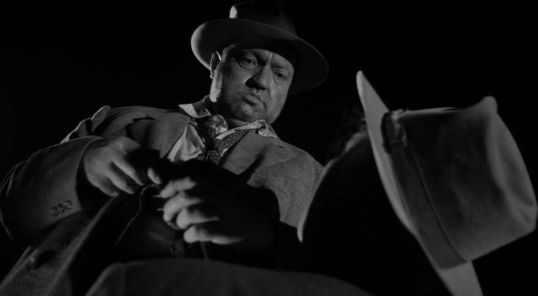
That Touch of Evil is a brilliant film is pretty much entirely due to Welles’s directorial vision. The story is pure pulp. While investigating the murder of an American businessman in Mexico, Vargas comes to believe that Quinlan is attempting to frame a young Mexican for the crime. While Vargas watches Quinlan, his wife Susie (Janet Leigh) is menaced by the crime lord Joe Grandi (Akim Tamiroff), who has his own issues with both Vargas and Quinlan. The plot may be the stuff of a B-programmer but, as directed by Welles, Touch of Evil plays out like a surreal nightmare, a journey into the heart of darkness that is full of eccentric characters, shadowy images, memorably askew camera angles, and lively dialogue. Welles and cinematographer Russell Metty create a world that feels alien despite being familiar. Just as he did with Gregg Toland in CitizenKane, Welles shapes a film that shows us what’s happening in the shadows that most people try to ignore.
There’s really not a boring character to be found in Touch of Evil and the cast is full of old colleagues and friends of Welles. Marlene Dietrich shows up as Quinlan’s former lover. Mercedes McCambridge plays a leather-clad gang leader. Dennis Weaver is the creepy owner of a remote motel. (Two years before Psycho, Touch of Evil featured Janet Leigh being menaced in a motel. Mort Mills, who played Psycho’s frightening highway patrolman, plays a member of law enforcement here as well.) Zsa Zsa Gabor shows up for a few brief seconds and it makes a strange sort of sense. Why shouldn’t she be here? Everyone else is. Joseph Cotten plays a coroner. Ray Collins plays a local official. In the film’s skewered world, Charlton Heston as Mike Vargas works. His upright performance grounds this film and keeps it from getting buried in its own idiosyncrasies. Big personalites are everywhere and yet the film is stolen by Joseph Calleia, playing Quinlan’s quiet but observant partner. Calleia’s performance is the heart of the film.
TouchofEvil was not nominated for a single Oscar and that’s not surprising. It’s not really the type of film that was noticed by the Academy in the 50s. It was too pulpy and surreal and, with its story of a crooked cop framing someone who might very well be guilty anyway, it was probably too subversive for the Academy of the 1950s. It would take a while for TouchofEvil to be recognized for being the noir masterpiece that it is. In a perfect world, Welles would have been nominated for directing and for his larger-than-life performance as Quinlan. Joseph Calleia would have been nominated for Supporting Actor and perhaps both Janet Leigh and Marlene Dietrtich would have been mentioned for Supporting Actress. That didn’t happen but it would have been nice if it had.


 Through the Shattered Lens