Embracing The Melodrama Part III #8: The Boost (dir by Harold Becker)


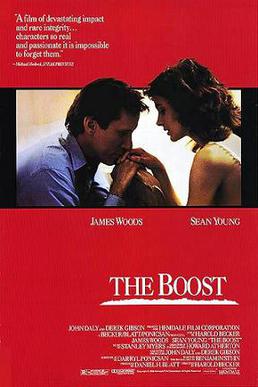
Seven days ago, we started embracing the melodrama with my review of No Down Payment, a look at lies and betrayal in suburbia.  Today, we conclude things with 1988’s The Boost, a look at lies, betrayal, and cocaine in California, with the emphasis on cocaine.

From the first minute we meet Lenny Brown (James Woods, at his nerviest best), we assume that he has to be high on something.  He’s a real estate broker and he’s one of those guys who always looks a little bit sleazy no matter how hard he tries otherwise.  His smile is just a little too quick.  He laughs a little bit too eagerly at his own jokes.  He talks constantly, an endless patter of self-serving compliments, nervous jokes, and self-affirming platitudes.  He’s a bundle of nerves but he’s also a brilliant salesman.  We may assume that he’s on coke when we first see him but actually, he doesn’t touch the stuff.  He barely drinks.

Of course, that changes when he’s hired by Max Sherman (Steven Hill).  Max is a philosophical businessman, the type who makes sure that everyone who works for him gets a nice house, a nice car, and several lectures about what’s important in life.  When Max first shows up, it’s tempting to dismiss him as just a self-important businessman but he actually turns out to be a nice guy.  He gives Lenny a ton of good advice.  Unfortunately, Lenny ignores almost all of it.

At first, life is good for Lenny and his wife, Linda (Sean Young).  Lenny is making tons of money, selling houses that can used as a tax shelter or something like that.  (I never understand how any of that stuff works.)  Lenny is making all sorts of new friends, like Joel Miller (John Kapelos) and his wife, Rochelle (Kelle Kerr).  Joel owns four car washes and he’s made a fortune off of them.  All of that money means that he can throw extravagant parties and take nice trips.  It also means that Joel has a never-ending supply of cocaine.  At first, Lenny turns down Joel’s offer of cocaine but eventually he gives in.  At the time, he says that he just needs a little boost.  Soon both Lenny and Linda are addicts.

Of course, nothing goes on forever.  The tax laws change and Max suddenly finds himself out-of-business.  Lenny and Linda lose their house.  They lose their expensive car.  They even lose their private plane.  They end up staying in a tiny apartment.  Lenny says that he can still sell anything and that they’ll be back on top in just a few months.  Of course, even while Lenny is saying this, his main concern is getting more cocaine…

Though dated, The Boost is an effective anti-drug film.  The scene where Lenny overdoses is absolutely harrowing.  Wisely, the film doesn’t deny the fact that cocaine is a lot of fun before you end up losing all of your money and having to move into a cheap apartment with shag carpeting.  It’s a bit like a coke-fueled Days of Wine and Roses, right down to an ending that finds one partner clean and one partner still in the throes of addiction.  James Woods gives a great performance as the self-destructive Lenny, as does Sean Young as his wife and partner in addiction.  And then there’s Steven Hill, providing the voice of gruff wisdom as Max Sherman.  When Max says that he feels that he’s been betrayed, Hill makes you feel as if the entire world has ended.

Speaking of endings, that’s it for this latest installment of Embracing the Melodrama.  I hope you enjoyed this mini-series of reviews and that you will always be willing to embrace the … well, you know.


Happy St. Patrick’s Day: THE IRISH IN US (Warner Brothers 1935)


gary loggins's avatarcracked rear viewer

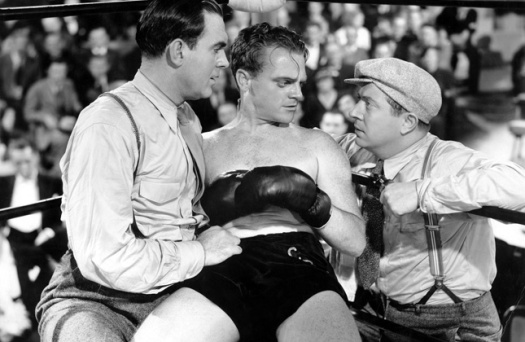
Faith and begorrah! You can’t get much more Irish than a film featuring Jimmy Cagney , Pat O’Brien , and Frank McHugh all together. THE IRISH IN US is sentimental as an Irish lullaby, formulaic as a limerick, and full of blarney, but saints preserve us it sure is a whole lot of fun! The story concerns three Irish-American brothers, the O’Hara’s, living with their Irish mum in a cramped NYC apartment. There’s sensible, levelheaded cop Pat (O’Brien), dimwitted fireman Michael (McHugh), and ‘black sheep’ Danny (Cagney), who’s a fight promoter.

O’Brien, Cagney, and McHugh

Pat announces his intention to marry pretty Lucille Jackson (19-year-old Olivia de Havilland in an early role), while Danny’s got a new fighter named Carbarn Hammerschlog ( Allen Jenkins , who’s a riot), a punchy pug who “every time he hears a bell ring, he starts sluggin”! Danny and Lucille ‘meet cute’ while he’s out…

View original post 465 more words

Embracing The Melodrama Part III #7: True Confessions (dir by Ulu Grosbard)


The 1981 film True Confessions tells many different stories.

It’s a story about Los Angeles.  It’s not necessarily a story about Los Angeles as it exists.  Instead, it’s a story about Los Angeles as we always imagine it.  It’s the late 40s and, having vanquished the Nazis in Europe, men are returning to California and looking for a new life.  Meanwhile, aspiring starlets from across the country flood into Hollywood, looking for stardom.  It’s a city where glitz and ruin exist right next to each other.  It’s the mean streets that were made famous by Raymond Chandler and, decades later, James Ellroy.

It’s a murder mystery, one that is based on one of the most notorious unsolved homicides of all time.  The bisected body of woman named Lois Fazenda has been found in a vacant lot.  When the newspapers discover that Lois was both a prostitute and a Catholic, she becomes known as “the Virgin Tramp.”  One need not have an encyclopedic knowledge of unsolved crimes to recognize that Lois Fazneda is meant to be a stand-in for Elizabeth Short, the tragic and infamous Black Dahlia.

It’s a story about corruption.  Crooked cops.  Rich perverts.  Greedy politicians.  Sinful clergy.  They’re all present and accounted for in True Confessions.  As quickly becomes apparent, Los Angeles is a city where you can do anything as long as you have the money to pay the right people off.

And finally, it’s a film about two brothers.  Tom and Des Spellacy grew up in a strong Irish Catholic family but, as they got older, their lives went in different directions.  Tom (Robert Duvall) became a detective, the type who is willing to cut corners but who, in the end, takes his job seriously.  Des (Robert De Niro) entered the priesthood and is now a monsignor in the Los Angeles diocese.  Des is ambitious and he has a powerful mentor, Cardinal Danaher (Cyril Cusack).

Though Tom and Des have gone their separate ways, they are still linked by Jack Amsterdam (Charles During).  To the public, Jack is a wealthy and respected businessman.  However, Tom and Des both know the truth.  When Tom first joined the department, he worked as a bagman for Jack and he knows that Jack made most of his money through a prostitution ring.  Des know that Jack donates to the Church as way to cover up his own corruption but Des looks the other way.  The Cardinal, after all, wants Jack’s money.

When Tom starts to investigate Lois’s death, it doesn’t take him long to figure out that Jack is probably the one responsible.  Meanwhile, Jack and his lawyer (Ed Flanders) start to pressure Des to convince his brother to let the case go.  Finding justice for Lois Fazneda could mean the end of both Tom and Des’s career.

Based on a novel by John Gregory Dunne, which was adapted into a screenplay by Dunne and Joan Didion, True Confessions is an imperfect but intriguing film.  This is one of Robert Duvall’s best performances and he brings a manic edge to the role that keeps the audience off-balance.  In the role of Jack Amsterdam, Charles Durning is the epitome of casual corruption and Burgess Meredith does a good job as an aging priest.  On the other hand, Robert De Niro seems strangely uncomfortable in the role of Des and you never quite believe that he and Duvall are actually brothers.  Director Ulu Grosbard does a good job of creating a proper noir atmosphere but, at the same time, he denies the audience the dramatic climax to which the film appears to be building up to.

That said, for whatever flaws True Confessions may have, it’s an always watchable and thought-provoking film.

Love, Simon – A Review. This Film is a MUST SEE!!!! Rating – A+!


fullsizeoutput_1483-e1516894794929-787x559

“Love, Simon” sometimes films make you exhilarated, cry, and hope because the hero is in physical peril; “Love, Simon” makes you feel those emotions through the agonizingly painful awkwardness of being a teenager and on top of that being gay.   The film has importance as having the first gay lead protagonist in a rom-com.  It’s directed by Greg Berlanti who created the best show I love to watch with dudes getting killed with arrows.

However, without a great story, you’ve got nothing. Simon, luckily, is all of us.  He’s handsome, but is painfully awkward.  This is evident in the first five-minutes when he approaches a handsome landscaper and fumbles all over himself.  These cringeworthy teenage moments happen over and over- just like high school terrible moments.

He’s young, but with a very adult secret and he doesn’t know if his friends today would be his friends tomorrow, if they knew he were gay.  That just sucks.  I don’t normally do this, but I want any readers out there to know that it’s okay to be gay.  You have a right to safety, love, and all of the wonderful things that the world has to offer.  If anyone says differently or uses their religion as a shield or sword for their bigotry against you, you can tell them fuck you right from me!

Back to Simon, he’s struggling with coming out and sees on a blog that someone else is too.  They begin an online correspondence and I prayed that it wasn’t a forty-five year old creepo writing him.  It wasn’t.  Unfortunately, his correspondence is found out by Martin, a fellow student, who threatens to out him, unless he helps set him up with one of his friends.  Martin is a horrible garbage person and is horribly awkward  as well and blunders through his terrible terrible life in the film.

Simon, fearing being outed, complies to Martin’s demand as he tries to discover the identity of his online paramour.  I don’t want to give to much away, BUT in the trailer we learn that Simon either comes out or gets outed.   Yes, he eventually gets outed, but that is as unimportant to the protagonist’s journey as being gay is in real life. It’s just you.  Simon- deals with it and if you’re a small-minded dipshit, you’ll deal with it too! The film proceeds to have many cringeworthy -oh my god,  I’m having teen flashbacks- moments and I’m so glad I’m no longer a teen.

Furthermore, the film could seem hokey or corny to a lot of cynical people that are terrible, homophobic or both.  Honestly, I have to write if you don’t like this film you are per se terrible. I’m not saying that if you gave the movie a C+ you would refuse to make a gay couple a wedding cake, but I bet you would tell there are “Two Sides” bullshit.

The film really goes beyond gay identity just as Simon does.  It is coming of age story where we grow up with simon and realize this is just who he is, but he’s still a kid.  I can tell you that 17 and 18 is still a kid.  My first assignment in the Army I was a lieutenant and had many 18 year olds in my platoon and they had childish interests, were desperate for guidance, and tried many awkward times to get acceptance.  In short, Love, Simon portrays youth accurately and we, like Simon, have to deal.

The film was making a point that these were kids struggling with being grownups and they just weren’t ready.  Adulthood is forced upon us, we don’t get to choose it on our own terms. For me, that’s what Berlanti was trying to say: we have to become adults and deal with our identity because life will force us to do so no matter what.  We don’t choose to be smart, dumb, gay, or straight- it’s just who we are and we have to face it every day because we have to do so.  The film forces us to live through Simon’s awkwardness as he becomes a Man.  Being a grown up sucks, but it doesn’t suck as much as being a teenager.

The film leaves us with uncertainty because that’s what being an adult is.  We have to be ourselves or we can never be free, or as Jennifer Gardner put it heart wrenchingly- you’ll always be holding your breath.

I would recommend that you see this film and then see it again!

Embracing The Melodrama Part III #6: The Betsy (dir by Daniel Petrie)


“Wheeeeeeee!”

— Loren Hardeman Sr. (Sir Laurence Olivier) in The Betsy (1978)

Here’s a little thought experiment:

Imagine if The Godfather had starred Laurence Olivier and Tommy Lee Jones.

That may sound strange but it actually could have happened.  When Francis Ford Coppola first started his search for the perfect actor to play Don Vito Corleone, he announced that he could only imagine two actors pulling off the role.  One was Marlon Brando and the other was Laurence Olivier.

As for Tommy Lee Jones, he was among the many actors who auditioned for the role of Michael Corleone.  At the time, Jones was 26 years old and had only recently made his film debut in Love Story.  As odd as it may be to imagine the quintessentially Texan Tommy Lee Jones in the role, Coppola always said that he was looking for a brooder as Michael and that’s definitely a good description of Jones.

Of course, as we all know, neither Olivier nor Jones were ever cast in The Godfather.  Marlon Brando played Don Vito and Al Pacino was cast as Michael.  However, a few years later, Olivier and Jones would co-star in another family saga that combined history, organized crime, and melodrama.  That film was 1978’s The Betsy and, interestingly enough, it even co-starred an actor who actually did appear in The Godfather, Robert Duvall.

Of course, now would probably be a good time to point out that The Godfather is perhaps the greatest American film of all time.  And The Betsy … well, The Betsy most definitely is not.

The film’s German poster even gives off a Godfather vibe

Based on a novel by Harold Robbins, The Betsy exposes the secrets of Detroit.  Decades ago, Loren Hardeman founded Hardeman Motors and started to build his considerable fortune.  Sure, Loren had to break a few rules.  He cut corners.  He acted unethically.  He had an affair with his daughter-in-law and then drove his gay son to suicide.  Loren never said that he was perfect.  Now in his 80s, Loren has a vision of the future and that vision is a new car.  This car will be called the Betsy (named after his great-granddaughter) and it will be the most fuel-efficient car ever made.

Since the film appropriates the flashback structure used in The Godfather Part II, we get to see Loren Hardeman as both an elderly man and a middle-aged titan of industry.  Elderly Loren is played by Laurence Olivier.  Elderly Loren spends most of the film in a wheelchair and he speaks with a bizarre accent, one that I think was meant to be Southern despite the fact that the film takes place in Michigan.  Elderly Loren gets really excited about building his new car and, at one point, shouts out “Wheeeeeee!”

Middle-aged Loren is played by … Laurence Olivier!  That’s right.  Olivier, who was 71 years old at the time, also plays Loren as a younger man.  This means that Olivier wears a hairpiece and so much makeup that he looks a bit like a wax figure come to life.  Strangely, Middle-aged Loren doesn’t have a strange accent and never says “wheeeee.”

To build his car, Loren recruits race car driver Angelo Perino (Tommy Lee Jones).  Angelo’s father was an old friend of Loren’s.  When Angelo agrees, he discovers that the Hardeman family is full of drama and secrets.  Not only is great-granddaughter Betsy (Kathleen Beller) in love with him but so is Lady Bobby Ayers (Lesley-Anne Down), who is the mistress of Loren’s grandson, Loren the 3rd (Robert Duvall).

Because he blames his grandfather for the death of his father, Loren the 3rd has no intention of building Loren the 1st’s car.  Loren the 3rd wants to continue to make cars that pollute the environment.  “Over my dead boy!” Loren the 1st replies.  “As you wish, grandfather,” Loren the 3rd replies with a smile.

But we’re not done yet!  I haven’t even talked about the Mafia and the union organizers and the automotive journalist who ends up getting murdered.  From the minute the movie starts, it’s nonstop drama.  That said, most of the drama is so overdone that it’s actually more humorous than anything else.  As soon as Laurence Olivier shouts out, “Wheeeee!,” The Betsy falls into the trap of self-parody and it never quite escapes.  There’s a lot going on in the movie and one could imagine a more imaginative director turning the trashy script into a critique of capitalism and technology.  However, Daniel Petrie directs in a style that basically seems to be saying, “Let’s just get this over with.”

The cast is full of interesting people, all of whom are let down by a superficial script.  Nothing brings out the eccentricity in talented performers quicker than a line of shallow dialogue.  Jane Alexander, who plays Duvall’s wife, delivers all of her lines in an arch, upper class accent.  Edward Herrmann, playing a lawyer, smirks every time the camera is pointed at him.  Katharine Ross, as Olivier’s mistress and Duvall’s mother, stares at Olivier like she’s trying to make his head explode.  Tommy Lee Jones is even more laconic than usual while Duvall always seems to be struggling not to start laughing.

And then there’s Olivier.  For better or worse, Olivier is the most entertaining thing about The Betsy.  He doesn’t give a good performance but he does give a memorably weird one.  Everything, from the incomprehensible accent to a few scenes where he literally seems to bounce up and down, suggests a great actor who is desperately trying to bring a spark of life to an otherwise doomed project.  It’s a performance so strange that it simply has to be seen to be believed.

Tomorrow, we take a look at another melodrama featuring Robert Duvall, True Confessions!


Film Review: Return to Savage Beach (dir by Andy Sidaris)


“I was born for water sports!”

— J. Tyler Ward (Christian Letelier) in Return to Savage Beach (1998)

Never let it be said that I’m not a completist!

About a month ago, I decided that it would be fun to write up a review of Hard Ticket To Hawaii that I could schedule to publish while I was on vacation.  At the time, I really should have realized that this would probably lead to me also watching and reviewing all of the sequels (and the one prequel) to that film.  And that’s exactly what happened!

1998’s Return to Savage Beach is the final chapter of the story of the world’s most inept intelligence agency, L.E.T.H.A.L.  (That stands for Legion to Ensure Total Harmony and Law, which is almost as Orwellian a name as Twitter’s Trust and Safety Council.)  Once again, security at L.E.T.H.A.L’s Dallas office has been breached.  This time, it done by a woman named Sofia (Carrie Westcott), who randomly showed up and passed out slices of drugged pizza.  Of course, everyone ate the pizza.  After all, why would a bunch of national security professionals be suspicious of a total stranger handing out food?  After everyone’s unconscious, Sofia steals the file on Savage Beach.

Don’t remember Savage BeachSavage Beach was a previous Andy Sidaris film, in which two other undercover agents ended up on a desert island and discovered a hidden treasure of World War II gold.  If you still don’t remember the film, don’t worry.  Return to Savage Beach contains several minutes of flashbacks from Savage Beach.

Return to Savage Beach also features a handful of flashbacks to the previous Sidaris film, Day of the Warrior.  That’s because The Warrior (Marcus Bagwell), who was previously established as being a homicidal maniac, is now suddenly one of the good guys.  Apparently, one of the people that he murdered in the previous film was actually a serial killer and, as a result, he was only given three months in prison.  Now, he’s out and he’s the newest L.E.T.H.A.L. agent.  He’s an expert on lost treasures and that’s a good thing because it turns out that there’s even more treasure on Savage Beach than anyone realized.

L.E.T.H.A.L. is determined to get that treasure, which means that Willow Black (Julie Strain) has to assign her best agents to the mission.  (Of course, the best L.E.T.H.A.L. agent is the equivalent of a bigamist who tells his second wife that he’s working for the CIA as a cover whenever he has to go on vacation with his other family.)  And so, Tyler (Christian Letelier), Cobra (Julie K. Smith), Tiger (Shae Marks), and Doc Austin (Paul Logan) are sent to explore Savage Beach.

However, L.E.T.H.A.L. is not the only organization returning to Savage Beach.  The evil Morales (Rodrigo Obegron) is determined to get the treasure as well.  Morales wears a Phantom Of The Opera-style mask because he claims that he was horribly scarred when he was blown up during his last trip to Savage Beach.  (Cue more flashbacks.)  Morales not only has Sofia working for him but he also employs three ninjas who wear kabuki makeup.

Maybe you’re getting the feeling that Return to Savage Beach is not a serious film and it most definitely is not.  Like most Sidaris films, Return to Savage Beach is cheerfully aware of its own absurdity.  Towards the end of the film, after about a dozen or so outlandish twists, one of the L.E.T.H.A.L. agents even exclaims, “How many endings can this story have!?”  The song that plays over the end credits asks the exact same question.

All in all, Return to Savage Beach is a pretty dumb movie.  I compared the acting in Day of the Warrior to Mark Wahlberg and John C. Reilly playing Brock Landers and Chest Rockwell in Boogie Nights and that’s even more true when it comes to Return to Savage Beach.  At times, the stupidity of it all is amusing and, at other times, you just find yourself checking the time.

Return to Savage Beach was Andy Sidaris’s final film.  All in all, Sidaris directed thirteen films (12 dramatic features and one documentary).  Some of them were really bad.  Some of them were amusingly over-the-top.  One of them, Hard Ticket To Hawaii, has become something of a mainstay on TCM Underground.  Good or bad, Sidaris definitely had his own style.  In the end, no one would ever mistake any of his films as having been directed by anyone other than Andy Sidaris.

Cleaning Out the DVR #18: Remember Those Fabulous Sixties?


gary loggins's avatarcracked rear viewer

There’s a lot of good stuff being broadcast this month, so it’s time once again to make some room on the ol’ DVR. Here’s a quartet of capsule reviews of films made in that mad, mad decade, the 1960’s:

THE FASTEST GUITAR ALIVE (MGM 1967; D: Michael D. Moore) –  MGM tried to make another Elvis out of rock legend Roy Orbison in this Sam Katzman-produced comedy-western. It didn’t work; though Roy possessed one of the greatest voices in rock’n’roll, he couldn’t act worth a lick. Roy (without his trademark shades!) and partner Sammy Jackson (TV’s NO TIME FOR SERGEANTS) peddle ‘Dr. Ludwig Long’s Magic Elixir’ in a travelling medicine show, but are really Confederate spies out to steal gold from the San Francisco mint to fund “the cause” in the waning days of the Civil War. The film’s full of anachronisms and the ‘comical Indians’ aren’t all that funny…

View original post 728 more words

Embracing The Melodrama Part III #5: Jacqueline Susann’s Once Is Not Enough (dir by Guy Green)


“Only in the movies, baby.” 

— Mike Wayne (Kirk Douglas) in Jacqueline Susann’s Once Is Not Enough (1975)

Jacqueline Susann’s Once Is Not Enough (for that indeed is the unwieldy title of this little movie) opens with a shot of two Oscars sitting on an end table.  Those Oscars belong to Mike Wayne (Kirk Douglas), a legendary Hollywood producer who hasn’t had a hit in way too long.  He’s struggling financially.  He may even have to fire his maid (Lillian Randolph), despite the many years that she’s spent making sure he wakes up and remembers to take a shower before leaving the house.  What choice does Mike have but to marry Deidre Milford Granger (Alexis Smith), the world’s sixth richest woman?  Mike doesn’t even mind that Deidre is having an affair with Karla (Melina Mercouri).

That makes sense to everyone by Mike’s daughter, January (Deborah Raffin).  As Mike explains it, January’s name came about as a result of January being born in January.  So, I guess if I was Mike’s daughter, I would have been named November.  Everyone in the film thinks that Mike’s being terribly clever by naming his daughter after her birthday but, to me, that just sounds lazy.

Does January have some issues?  Well, when she returns to America after getting into a serious motorcycle accident in Europe, she greets her father by cheerfully saying, “I hope nobody thinks we’re father and daughter.  I hope they think you’re a dirty old man and I’m your broad.”

Agck!  That sounds like the set up for a Freudian nightmare but instead, the film’s rather blasé about the whole incestuous subtext of January’s relationship with her father.  Mike is soon pushed to the side as the movie follows January as she tries to make a life for herself in New York City.  Fortunately, she’s able to land a job at a magazine, working for her old college friend, Linda (Brenda Vacarro).  In college, Linda was smart and homely but she has since had so much plastic surgery that January doesn’t even recognize her.  Linda’s either found the greatest plastic surgeon in the world or else January is just really, really stupid.

Linda gets all the best lines.  While talking about all of the work that she’s had done, she takes the time to brag that she had everything fixed by her navel, which she declares to be perfect.  When January comments that Linda is beautiful, Linda replies, “And now ugly is in!  I want my old nose back!”

Linda is stunned to learn that January is still a virgin but that problem is solved once January goes out on a few dates with David (George Hamilton), who is Deidre’s cousin.  David and January go out to a club and January is shocked when a random woman throws a drink in David’s face.  Later, January goes back to David’s apartment, which turns out to be the epitome of 70s tackiness.  When January asks David why the carpet and all of the furniture is red, David replies, “I wanted it to look like a bordello.”

Things don’t really work out between January and David but don’t worry!  January soon meets the world-renowned author, Chest Hair McGee (David Janssen)!  Okay, actually his name is Tom Colt.

Tom spends almost the entire movie drunk and acting obnoxious but January falls in love with him.  And, of course, it has nothing to do with the fact that he’s the same age as her father.  No, of course not.  Instead, she’s charmed by the way he slurs the line, “Forgive me, I can’t take my eyes off of your ass!”

January is convinced that she and Tom are going to be together forever.  Of course, Mike hates Tom.  And there is the fact that Tom’s married.  Literally everyone in the movie tells January that Tom is never going to leave his wife but I guess we’re still supposed to be shocked when Tom tells her that he’ll never leave his wife.  He does, however, thank her for allowing “a broken-down old man” to “feel like a stud.”  In the end, nothing really works out for January but she’s such an annoying and vacuous character that you really don’t mind.

Based on a novel by the same author who gave the world The Valley of the Dolls, Once Is Not Enough is a movie that manages to be both remarkably bad and also surprisingly watchable.  Some of that is because the film is a time capsule of 70s fashion, 70s decor, and 70s slang.  A lot more of it is because the cast is made up of such an odd mishmash of performers and acting styles that nobody seems like they should be in the same movie.  Kirk Douglas grimaces.  George Hamilton looks embarrassed.  David Janssen lurches through the film like a drunk trying to remember where he lives.  Alexis Smith and Melina Mercouri chew every piece of scenery they can find while Brenda Vaccaro shouts her lines as if hoping the increased volume will keep us from noticing what she’s actually saying.  Poor Deborah Raffin wanders through the film with a dazed look on her face.  Can you blame her?

Interestingly enough, Jacqueline Susann’s Once Is Not Enough actually was nominated for an Oscar.  Brenda Vaccaro was nominated for Best Supporting Actress.  Admittedly, Vaccaro does probably come the closest of anyone in the cast to creating an interesting character but I still have to wonder just how weak the Supporting Actress field was in 1975.

Anyway, this incredibly silly and tacky film is a lot of fun, though perhaps not in the way that it was originally intended to be.  Between the nonstop drama, the unintentionally hilarious dialogue, and the weird performances, the film plays out like a cartoon character’s dream of the 70s.

Tomorrow, we’ll take a look at another silly and tacky film from the same decade, 1978’s The Betsy!

Film Review: Day of the Warrior (dir by Andy Sidaris)


“Bring him in from the cold?  That’s real spy talk.  I love it when you do that.”

— J. Tyler Ward (Christian Letelier) in The Day Of The Warrior (1996)

Here’s two good things about the 1996 Andy Sidaris film, The Day of the Warrior:

First, a good deal of the film takes place in Dallas.  As I’ve said before, I’m always happy to see my hometown in a movie, regardless of whether the movie is good or terrible.  The Day of the Warrior not only reveals that a division of the Legion To Ensure Total Harmony And Law (a.k.a. L.E.T.H.A.L.) operates out of Dallas but also that it’s apparently headquartered on the top floor of the Bank America Plaza.  Willow Black (Julie Strain, who had previously played a villain in three separate Sidaris films) is the new head of the Dallas branch.  Apparently, her job largely consists of working out on the treadmill in her office.

The other good thing about The Day of the Warrior is that one L.E.T.H.A.L’s top agents is named Doc Austin (Kevin Light).  Unlike the Abilene cousins that appeared in Sidaris’s previous films, Doc appears to actually be good at his job.  For one thing, he can actually shoot a gun and his dialogue isn’t exclusively made up of painful double entendres.  But my reason for liking Doc Austin is because he shares his first name with my cat and his last name with one of my favorite cities.

Anyway, the film itself is pretty stupid but you probably already guessed that as soon as I mentioned that it’s an Andy Sidaris film.  The latest international super villain is a guy named the Warrior (Marcus Bagwell).  The Warrior used to be an agent with the CIA but, when the Cold War ended, he discovered that he was out of a job.  Because The Warrior’s mother was half-Native American, he decided to start wearing war paint and launched a career as a professional wrestler.  However, The Warrior’s wrestling career was really just a cover so that he could safely travel the world and set up his own black market operation.  He deals drugs.  He sells weapons.  He dabbles in human trafficking.  “The SOB is even into pirating porno flicks,” Willow says.  The Warrior takes the whole professional wrestling thing pretty seriously.  At one point, he gives orders to his henchmen while standing in the middle of a wrestling ring.

(It’s also established that The Warrior lives in “north Dallas.”  You probably actually have to be from Dallas to get the joke but, as far as Sidaris humor goes, it’s a good one.)

LETHAL has several agents working undercover in The Warrior’s organization.  Apparently, they’re so deep undercover that not even Willow Black knows how to get in contact with them.  (To be honest, that would seem to be kind of counterproductive but I’m not an international super spy so what do I know?)  However, The Warrior has employed a computer hacker known as Hard Drive.  (The Warrior calls him “Mr. Drive.”)  When The Warrior manages to compromise LETHAL’s computer systems, Willow and her agents not only have to track down the people undercover but they also have to stop whatever it is that The Warrior is planning to do.

(The Warrior’s ultimate scheme was never easy to figure out.  He seemed to spend most of his time flexing his muscles.)

As for the undercover agents, Doc Austin is investigating drug dealers in South Texas.  Scorpion (Tammy Parks) and Shark (Darren Wise) are trying to infiltrate The Warrior’s Vegas-based porn operation.  Fu (Gerald Okamura) is working as an Elvis impersonator.  Cobra (Julie K. Smith) is working as an exotic dancer in Beverly Hills because of … reasons, I guess?  Another agent, Tiger (Shae Marks) teams up with a pilot named J. Tyler Ward (Christian Letelier) because it’s not a Sidaris film without someone flying a plane over the bayous.  To be honest, it seems like most of these people are just hanging out.  I wouldn’t necessarily trust any of them with any national security secrets.

Anyway, this is pretty much a typical Sidaris film: stuff blows up, everyone gets naked, and there’s a lot of bad jokes.  Even by the standards of a Sidaris film, the acting is incredibly bad.  Remember those scenes in Boogie Nights where Mark Wahlberg and John C. Reilly played Brock Landers and Chest Rockwell?  That’s about the level of talent that we’re talking about here.  To illustrate, here’s a typical scene from Day of the Warrior:

In short, it’s no Hard Ticket to Hawaii but at least Dallas looks good.

Embracing the Melodrama Part III #4: The Grasshopper (dir by Jerry Paris)


“It’s very simple what I want to be: totally happy; totally different; and totally in love.”

— Christine Adams (Jacqueline Bisset) in The Grasshopper (1970)

Seriously, is Christine asking for too much?

Total happiness?  That may sound like a lot but trust me, it can be done.

Totally different?  That’s a little bit more challenging because, to be honest, you’re either different or you’re not.  If you have to make the effort to be different, then you definitely are not.

Totally in love?  Well, it depends on how you define love…

At the start of The Grasshopper, Christine thinks that she’s heading to America to find love.  While an oh-so late 60s/early 70s theme song plays in the background, Christine leaves her small hometown in Canada and she heads down to California.  She’s planning on meeting up with her boyfriend Eddie (Tim O’Kelly) and taking a job as a bank teller.

Of course, it soon turns out that working in a bank isn’t as exciting as Christine originally assumed.  Eddie expects Christine to just be a conventional girlfriend and that’s not what Christine is looking for. As well, it’s possible that Christine may have seen Targets, in which O’Kelly played an all-American boy who picks up a rifle and goes on a killing spree.

And so, Christine abandons Eddie and heads to Las Vegas.  Since this movie was made in 1970 and Uber didn’t exist back then, Christine’s preferred method of traveling is hitchhiking.  This gives her a chance to meet the usual collection of late 60s weirdos who always populate movies like this.  One driver crosses herself when Christine says that she plans to have a baby before getting married.  Another is a hacky Las Vegas comic.

In Vegas, Christine applies for a job as a showgirl.  As she explains to sleazy casino owner Jack Benton (Ed Flanders), she “once did Little Women in school.”

“Did you do it nude?” Jack replies.

Yep, that’s Vegas for you!  It’s the city of Showgirls, Casino, and Saved By The Bell: Wedding in Vegas, after all!

Anyway, thing do get better once Christine meets and falls in love with Tommy Marcott (Jim Brown), a former football player who is now working as a door greeter in Jack’s casino.  Everyone tells Christine not to get involved with Tommy.  One of Jack’s men, a menacing hitman who looks just like Johnny from Night of the Living Death (he even wears glasses), warns Christine to watch herself.

Through a long series of events, Christine ends up on her own again.  The usual collection of 70s events occur: murder, drugs, prostitution, and ultimately a stint as the mistress of a rich man played by Joseph Cotten.  The important thing is that it all eventually leads to Christine and a skywriter getting stoned, stealing a plane, and deciding to write a message in the sky.

That’s when this happens:

Yes, it’s all very 1970!

Anyway, The Grasshopper is one of those films that tries to have it both ways.  Establishment audiences could watch it and think, “Wow, those kids are really messed up.”  Counterculture audiences could watch it and say, “Old people are such hypocrites.”  Oddly enough, The Grasshopper was written by future director Garry Marshall and it’s an incredibly overwrought film.  There’s not a subtle moment to be found in the entire film and the film’s direction is flashy but empty.  However, for those of us who love history, it’s as close to 1970 as we’re going to get without hopping into a time machine.