30 Days of Noir #22: Woman On The Run (dir by Norman Foster)


Like many film noirs, this 1950 film opens with a murder.

On a dark night in San Francisco, a man attempts to blackmail an unseen person called “Danny Boy” and gets shot for his trouble.  The gunshot is heard by a frustrated painter, named Frank Johnson (Ross Elliott), who is out walking his dog.  Frank sees the dead body being pushed out of a car and then catches a shadowy glimpse of the killer.  When the killer open fires on him, Frank runs for it.

Like a good citizen, Frank goes to the police but, when he learns that the victim was due to testify against a local gangster, Frank panics and vanishes.  When Inspector Ferris (Robert Keith) goes to see Frank’s wife, Eleanor (Ann Sheridan), he’s shocked to discover that Eleanor isn’t shocked by Frank’s disappearance and that she doesn’t seem to care one way or the other.  As Eleanor explains it, Frank is a notorious coward and, years ago, their once strong marriage became a loveless charade.  Frank’s vanished and Eleanor doesn’t care.

Or does she?

While it quickly becomes obvious that Eleanor is telling the truth about not knowing where Frank is, she’s not being totally honest about no longer caring about him.  For instance, when she learns that Frank has been hiding a heart condition from her, Eleanor goes to the doctor to pick up his medicine, just in case he should happen to come by the house.  Of course, it’s not always easy to get out of the house, especially now that the police are watching Eleanor.

Eleanor wants to track down Frank without involving the police and it seems like there’s only one person who is interested in helping he do that..  Played by Dennis O’Keefe, this person is a tough reporter and he says that he wants to do an exclusive story on Frank.  He offers to help Eleanor track him down and he even says that he’ll pay $1,000 for the chance to interview Frank.  The reporter and Eleanor are soon searching San Francisco, retracing Frank’s day-to-day life and discovering that Frank loved Eleanor more than she ever realized….

What’s that?  Oh, did I forget to mention the reporter’s name?

His name is Danny.

That’s right.  Eleanor is trying to find Frank so that she can save his life and working with her is the one man who wants to kill him!

Needless to say, this leads to a great deal of suspense.  On the one hand, you’re happy that Eleanor is rediscovering how much she loves Frank.  On the other hand, you spend almost the entire movie worried that Eleanor is going to lead Danny right to him.  Shot on location in San Francisco and featuring all of the dark shadows and tough dialogue that one could possibly hope to get in a film noir, Woman On The Run is an underrated suspense gem.  Full of atmosphere and steadily building suspense, Woman on the Run features a great and acerbic performance from Ann Sheridan and a genuinely exciting climax that’s set at a local amusement park.  Seriously, roller coasters are super scary!

Woman on the Run was directed by Norman Foster.  If you’ve recently watched The Other Side of the Wind on Netflix, you might recognize the name.  A longtime friend of Orson Welles, Foster played the role of Billy Boyle in Welles’s final film.

30 Days of Noir #21: For You I Die (dir by John Reinhardt)


The 1947 film, For You I Did, opens with what would be the finale of many other crime movies, a daring prison break.

The psychotic Matt Guber (Don C. Harvey) has managed to escape from prison, along with a younger prisoner named Johnny Coulter (Paul Langton).  From listening to their dialogue as they flee the cops, it quickly becomes obvious that the escape was Guber’s idea and that Johnny is something of an unwilling accomplice.  Johnny only had a year left in his sentence but now, thanks to Guber, he’s a wanted man.  Making matters even worse is the fact that Guber killed a guard during the escape.  Johnny knows that if he turns himself in or if he’s captured, he’ll be considered an accessory to murder.

Guber tells Johnny to go to a nearby roadside diner and deliver a message to his girlfriend, Hope (Cathy Downs).  Guber says that he’ll come to the diner in a week to get them.  Johnny follows Guber’s orders but, when he reaches the diner, he discovers that Hope has changed her ways and no longer wants anything to do with Guber.  Using an assumed name, Johnny gets a job at the diner and soon, he and Hope are falling love.

Johnny gets to know the other workers and customers at the diner.  They include Hope’s kind but no-nonsense aunt, Maggie (Marion Kerby), and Hope’s flirtatious cousin, Georgie (Jane Weeks).  Working in the kitchen is Smitty (Roman Bohnen), an alcoholic with a tragic backstory.  There’s also Alec Shaw (Mischa Auer), a flamboyant con man, and two slow-witted cops (Charles Waldron, Jr. and Rory Mallinson) who always mention that Johnny looks familiar but they just can’t figure out where they’ve seen him before.  Johnny gets to know all of them as, for the first time in his life, he finds himself accepted as a part of a community.  However, even as Johnny finds happiness, he knows that the clock is ticking.  There’s only so long that he can hide his identity and Guber is due to show up at any moment….

Poverty Row is a term that was often used to describe the low-budget B-movies of the 40s and 50s and it’s certainly an apt description of For You I Die.  It’s not just the fact that the film is about poor and often desperate characters.  It’s also that the film itself looks like it was made for next to nothing.  However, the film’s cheap look is actually one of its greatest strengths.  Visually, the grainy black-and-white lends the film a gritty atmosphere and the limited and sparsely decorated sets serve to play up not only Johnny’s claustrophobia but to also remind us that, even if Johnny does find some temporary happiness, he still has nowhere to go.  That diner is both the beginning and the end of Johnny’s freedom.

Character actor Mischa Auer was probably the biggest name in the cast.  He was a well-known screen comedian, one who specialized in playing over-the-top eccentrics.  His comedic presence in this relatively somber film feels rather odd.  As well, Paul Langton is convincingly sullen in the role of Johnny but he’s not particularly compelling.  Far more impressive are Marian Kerby, Cathy Downs, and especially Jane Weeks.  As the gleefully amoral Georgie, Weeks steals almost every scene in which she appears while Marion Kerby is everyone’s ideal aunt.  Finally, Cathy Downs plays Hope and brings a poignant sense of regret to a role that, as written, could have just been a stereotypical “good girl.”  Hope is someone who has made her mistakes but who refuses to be defined for them.  In the end, Hope epitomizes …. well, hope.

For You I Die is a taunt and effective film noir and a reminder not to dismiss a film just because it came from Poverty Row.

30 Days of Noir #20: He Walked By Night (dir by Alfred L. Werker and Anthony Mann)


The 1948 film noir, He Walked By Night, opens with a policeman named Rawlins on his way home from work.  As he drives down the street, he sees a man walking alone at night.  Because there’s been a number of recent burglaries in the area and the man’s a stranger, Rawlins decides to pull over and ask the man for his ID.

What Rawlins doesn’t realize is that the man is Roy Morgan (Richard Basehart) and yes, Roy is indeed the burglar.  Roy is something of a mystery man.  (Needless to say, Morgan is not his real last name.)  In the pre-Internet age, he has very carefully and very meticulously avoided leaving any sort of paper trail.  He lives, by himself, in a small apartment, his only companion being an adorable dog and the police scanner that Roy uses to always stay a few steps ahead of the cops.  When Rawlins pulls him over, it’s the closest that Roy has ever come to being caught.  Roy get out of the situation by shooting the cop and then running into the night.

The rest of the film deals with the efforts of two police detectives (played by Scott Brady and James Cardwell) and their captain (Roy Roberts) to discover who shot Rawlins and bring him to justice.  It’s not easy because not only has Roy done a good job of obscuring his very existence but his police scanner always gives him advanced warning whenever they cops start to close in on him.  The only lead that the cops have is a salesman named Paul Reeves (Whit Bissell).  Reeves has been buying and reselling the electronic equipment that Roy’s been stealing from houses all over Hollywood.  When Reeves tells the cops that he had no idea the stuff was stolen, the cops all share a weary roll of the eye.  No matter whether Reeves is telling the truth or not, he’s now the key to tracking down a cop killer….

He Walked By Night is a police procedural and, while the plot may sound familiar, the film is elevated by the atmospheric direction of Alfred Werker and an uncredited Anthony Mann.  As visualized by Werker and Mann, the streets of Los Angeles have never been darker and more menacing.  Roy emerges from the fog to commit his crimes and then disappears back into the mist, like some sort of paranormal spirit.  The film reaches its high point when the police chase their quarry through the sewers of Los Angeles, a scene that will remind many of the famous finale of The Third Man.

Though the film offers up clues to Roy Morgan’s motivation, he remains an enigma for much of the film.  Richard Basehart plays him as a paranoid man who only seems to be confident and happy when he’s stealing or when he’s outsmarting the police.  In many ways, regardless of whether he escapes the police or not, Roy’s destined to spend his life trapped in a prison of his own design.  Even hiding out on the fringes of society, Roy knows that his time is limited.  There’s only so many times one person can escape their fate.  Until he’s either captured or killed, Roy is destined to always walk the night, alone.

Dark Genesis: STRANGER ON THE THIRD FLOOR (RKO 1940)


gary loggins's avatarcracked rear viewer

“Tuesdays in Noirvember” continues with what many consider to be the first film noir…

Fans of the film noir genre often cite movies like THE MALTESE FALCON or REBECCA among the first entries in this stylistic category, but a case can certainly be made for STRANGER ON THE THIRD FLOOR, a bizarre B-film made by director Boris Ingster. It features all the elements associated with the dark genre: a big city setting, interior monologues, an extended nightmare sequence, flashbacks, Expressionistic set design… hell, it’s even got noir’s favorite patsy Elisha Cook Jr ! The only thing missing is that downbeat cynicism you find in post-war films, but since America hadn’t yet entered World War II, we can forgive the happy ending and concentrate on what makes this movie the seminal film noir.

First, there’s the plot: star reporter Michael Ward is the key witness in a murder case against young…

View original post 535 more words

30 Days of Noir #19: Never Trust A Gambler (dir by Ralph Murphy)


Never Trust A Gambler is a 78-minute noir gem from 1951.

It tells the story of Steve Garry (Dane Clark) and his ex-wife, Virginia (Cathy O’Donnell).  Virginia divorced Steve because he was a degenerate gambler but that doesn’t mean that she no longer has feelings for him.  Or, at the very least, that’s what Steve is hoping when, out of the blue, he shows up at her door and tells her that he needs a place to hide out.

As Steve explains it, a friend of his had been accused of murder and Steve is being pressured to testify at the man’s trial.  In a move of pure gaslighting, Steve explains that his friend is innocent but, if Steve testifies, it will lead to his friend being wrongfully convicted.  Hence, unless Virginia wants to be responsible for sending an innocent man to death row, she has to give Steve a place to hide out.  Furthermore, Steve swears to her that he’s no longer a gambler and that he’ll only need to stay with her for a few days.  Reluctantly, Virginia agrees.

Later, while Virginia is at a grocery store, she’s approached by a police sergeant named McCloy (Rhys Williams).  At first, it seems like McCloy might be following her because he’s looking for Steve but, instead, it turns out that he used to date Virginia’s former roommate, Delores.  After clumsily trying to flirt with her at the grocery store, McCloy follows Virginia home.  When McCloy tries to force himself on her, Steve comes out of the shadows and beats McCloy to death.

So now, Virginia and Steve have a dead body to contend with.  Because Steve is hiding from the cops and Virginia’s been allowing him to hide out in her house, calling the police is not an option.  Steve promises Virginia that he’ll take care of the whole thing.  Steve’s solution is to put McCloy in a car and push it over the edge of a cliff.  Given that McCloy was a drunk, it’s reasonable to think that the police might assume that McCloy was driving drunk and cashed his car.  Now, Steve and Virginia both wait to find out whether or not Steve’s plan worked….

Technically, the protagonist of this film is Sgt. Donovan (Tom Drake), the detective who investigates McCloy’s death but, for the most part, Donavon’s something of a stiff.  Instead, the film really belongs to Dane Clark and Cathy O’Donnell.  Cathy O’Donnell gives a poignant performance as a woman whose efforts to escape the past and live a normal, drama-free life are continually made unnecessarily difficult by the selfish men surrounding her.  Meanwhile, Dane Clark tears through the film like a force of nervous nature.  Clark always seems to be on the verge of jumping out of his own skin and a good deal of the film’s suspense comes from wondering when Steve is going to lose control.  At the same time, Steve Garry is a character about whom most viewers will have mixed feelings.  On the one hand, he’s sleazy and selfish but, on the other hand, he saved Virginia from someone who was even worse.  Does Steve really love Virginia or is he just taking advantage of her?  This movie will keep you guessing.

Never Trust A Gambler is a well-done and intelligent film noir and definitely one that deserves to be better known.

30 Days Of Noir #18: C-Man (dir by Joseph Lerner)


At the center of the 1949 film, C-Man, is a man named Cliff Holden (Dean Jagger).  When we first see Cliff, he’s cheerfully walking down the street in New York City, looking pretty happy underneath his new fedora.

And really, why shouldn’t Cliff be happy?  He’s a U.S. Customs agent!  He investigates crimes and tracks down smugglers and, perhaps most importantly, his best friend is a customs agent as well!  Who wouldn’t want to work with their best friend, right?  Anyway, Cliff eventually reaches his office and he discovers that nobody else appears to share his good mood.  For that matter, Cliff’s step losing its cheerful spring when he finds out that his best friend has been …. MURDERED!

His friend was investigating the theft of a very valuable necklace.  The Treasury Department has reason to believe that an international criminal named Matt Royal (Rene Paul) will be smuggling that necklace into the United States.  Looking to not only avenge his friend but also protect the reputation of the United States, Cliff takes over the case.  Using the name William Hannah, he flies out to Europe so that he can then board the same plane that Royal will be taking to the States.

While Cliff/William is waiting at the airport, he meets a Swiss woman, named Kathe van Bourne (Lottie Elwin), who is flying to New York so that she can be reunited with her fiancée, Joe.  However, after they board the plane, Kathe is suddenly taken ill.  Luckily, there’s a doctor on the plane, a courtly gentleman named Doc Spencer (John Carradine).  Spencer takes Kathe to the back of the plane to examine her and, while no one’s looking, he hides the necklace underneath a bandage that he wraps around her head.

Back in New York, Royal is pulled off the plane and thoroughly searched.  When it’s discovered that he doesn’t have the necklace, Cliff realizes what has happened.  However, Kathe has already been taken off in an ambulance and, when Cliff goes to Joe’s apartment, he discovers that Joe has been murdered….

C-Man is a film that kind of sneaks up and takes you by surprise.  That it was an extremely low-budget production is obvious from the minute the movie starts.  The black-and-white images are grainy.  The sets are small and sparsely furnished.  The whole film has a rather cheap and ragged feel, as if it might burst into flame and dissolve at any moment.  And yet, that low-budget feel works perfectly for the story that C-Man is telling.  Despite the oddly cheery narration that’s provided by Dean Jagger, this is a sordid tale about people on the fringes of society.  Watching C-Man feels like taking a trip to all of the places that most tourists would never want to visit during their trip to New York City.  For instance, when Cliff searches for the alcoholic Doc Spenser, his search leads him from one liquor store to another and it’s obvious that some of the desperate souls that Cliff passes on the streets weren’t actors.

Gail Kubick’s pounding and relentless score adds to the film’s overall dreamlike feel and Joseph Lerner’s direction is just quirky enough to keep things interesting.  (When one character is bludgeoned to death, the film suddenly starts to spin as if the viewer has become trapped in the killer’s madness.)  Dean Jagger seems a bit miscast as a the tough customs agent but the actors playing the criminals are all properly menacing.  Harry Landers, as the most violent of the jewel thieves, makes a particularly threatening impression.

All in all, C-Man is a surprisingly effective poverty row noir.

Film Review: Hotel Artemis (dir by Drew Pearce)


Oh, Hotel Artemis.

I had such high hopes for you.

Hotel Artemis, you may remember, was initially released way back in June and, at the time, it was advertised as being some sort of nonstop action thrill ride.  The commercials made it look totally over-the-top and exciting, which was I wanted to see it.  Of course, I didn’t see it because …. well, actually I don’t remember what was happening in June that kept me from going to the movies.  But there had to have been something going on because I not only missed seeing Hotel Artemis in the theaters but I also missed Ocean’s 8 and Hereditary as well.

Well, regardless of why I missed it the first time, I did finally get a chance to watch Hotel Artemis earlier this week and, unfortunately, it turned out to not be anything special.  It’s certainly not terrible.  It has its moments and the film looks great but, at the same time, it’s hard not to feel somewhat let down by the film.  Hotel Artemis has promise but much of its goes unrealized.

The film takes place in one of those vaguely defined futures where there’s a lot of rioting and a lot of militaristic cops.  In fact, the film opens with Los Angeles in the middle of one such disturbance.  The riot scenes attempt to go for a Purge-style intensity but, for the most part, they just kind of fall flat.  There’s a lot of scenes of people yelling and occasionally, a police transport rolls by but, for the most part, there’s no danger to the film’s riot.  It’s all just a bit too obviously choreographed.  You never get the feeling that things could just randomly explode.

The Hotel Artemis is a combination of a hotel and a hospital.  It’s run by Jean Thomas, who is better known as Nurse and who is played by Jodie Foster.  Jean was once a doctor but, haunted by the death of her son, she became an alcoholic and lost her license to practice medicine.  Severely agoraphobic, Jean has spent 22 years inside of the Hotel.  She only treats criminals and other people on the fringes of society.  Helping her is Everest (Dave Bautista), who helps to keep order in the often chaotic hotel.

All of Jean’s patients are given codenames, based on which room their occupying in the hotel.  There’s Acapulco (Charlie Day), who is wealthy and short-tempered and who is waiting for a helicopter to come pick him up.  And then there’s Nice (Sofia Boutella), an international assassin who gets to beat people while wearing this red gown that is absolutely to die for.  There’s also Wakiki (Sterling K. Brown), who is a bank robber who is worried that his partner, Honolulu (Brian Tyree Henry), is going to die from the wounds that he suffered during a robbery-gone-wrong.  Further complicating things is a gangster named The Wolf King (Jeff Goldblum) and Morgan (Jenny Slate), who needs Jean’s help but who also happens to be a cop.  Zachary Quinto is also in this film, playing the Wolf King’s son, because you really can’t make a pretentious genre film without giving a role to Zachary Quinto.

Anyway, there’s a pretty good action sequence towards the end of the film but it takes Hotel Artemis forever to get there.  Before that, you have to deal with a lot of talking but, unfortunately, none of the conversations are particularly interesting.  Hotel Artemis may clock in at 94 minutes but it feels considerably longer.  On the plus side, the cast is big and interesting but, on the negative side, nobody really seems to be that invested in their role.  It’s fun to watch Charlie Day play a bad guy but otherwise, the majority of the actors struggle with their thinly drawn (though certainly verbose) characters.  The majority of them struggle to convince us that they’re anything more than a group of talented actors slumming it in an action movie.  The fact that Jodie Foster received a good deal of praise for her performance in this film has everything to do with the fact that she’s Jodie Foster and little to do with anything that actually happens in the movie.

On a positive note, the movie looks great.  Visually, the Hotel Artemis is a fantastic creation that combines the decaying luxury of The Shining with the claustrophobic sterility of an underground bunker in a Romero zombie film.  (I’m thinking of the original Day of the Dead in particular.)  The Hotel itself is so fascinating that you can’t help but kinda resent that the film seems to be more interested in the boring people inside of the building than with the building itself.

Despite the superior production design, the film itself is slackly paced and never quite as a clever as it seems to think that it is.  Hotel Artemis is not a terrible film but it is a rather forgettable one.  It’s hard not to feel that it could and should have been a hundred times better than it actually was.

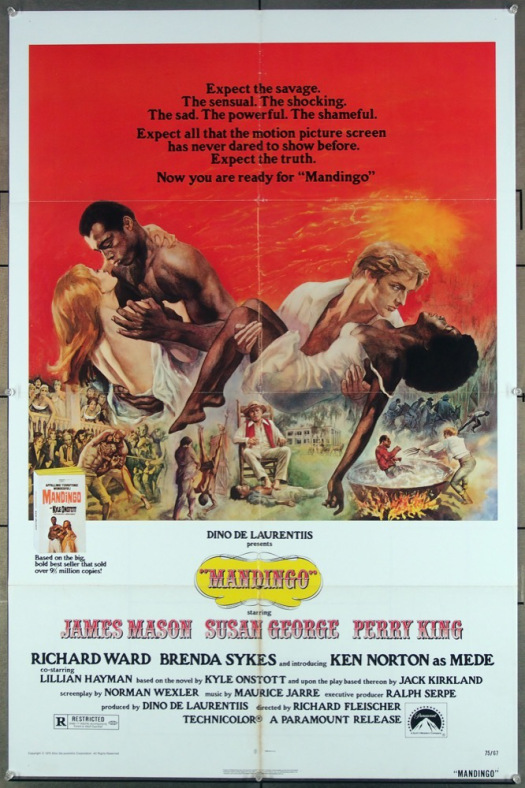
Gone With The Whaaat?: MANDINGO (Paramount 1975)


gary loggins's avatarcracked rear viewer

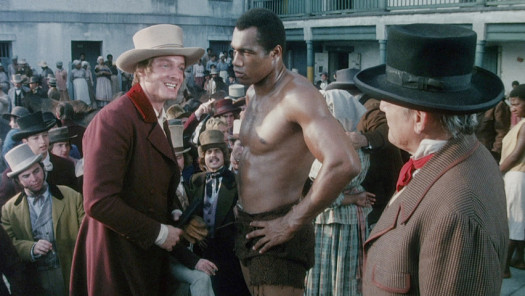
If you’ve never seen MANDINGO, be prepared for loads of gratuitous sex, violence, debauchery, depravity, racism, incest, nudity, and other such unsavory stuff! Some people today discuss the film in a scholarly manner, dissecting the sociological implications of pre-Civil War decadence in the deep South, the plight of the abused slaves, the overindulgent cruelty of the slave owners, and blah blah blah. I’m gonna talk about what the movie really is: pure, unadulterated Exploitation trash, in which some scenes will have your jaw dropping in shock, while others will leave you laughing at the exaggerated overacting and ludicrous dialog!

The movie centers around the Maxwell family and their plantation home, Falconhurst. It’s no Tara; Falconhurst is a run-down, gloomy, decrepit mansion that looks like it belongs in one of those “hillbilly horror” schlockfests of the 60’s or 70’s. Family patriarch Warren Maxwell wants a grandson to carry on the family…

View original post 771 more words

30 Days of Noir #17: Loan Shark (dir by Seymour Friedman)


The 1952 film, Loan Shark, opens with a familiar film noir situation.

A man walks down a dark city street.  Judging from the way that the man keeps looking over his shoulder, he’s obviously nervous about something.  Suddenly, we hear two sets of footsteps approaching him and it quickly becomes apparent that the man has good reason to be so nervous.  The man is being pursued by two gangsters.  (We know that they’re gangsters because of the suits and the fedoras.)  The gangsters toss the man in an alley and proceed to beat the Hell out of him.

The local tire factory has a problem.  Though its employees are highly valued, they’re not highly paid.  In order to make ends meet, many of them have resorted to gambling.  Plant foreman Charlie Thompson (Russell Johnson) always seems to have the latest tip on a sure thing.  Interestingly enough, the tips never seem to pan out and, as a result, the workers are forced to go to the local loan shark, Lou Donelli (Paul Stewart).  Lou always loans them the money but he charges exorbitant interest and, when the workers can’t pay back the loans, he sends his thugs to beat them up.  The factory’s management knows that they have to do something to take this loan shark out of commission.

Now, what would you do if you were a part of management?  Would you go to the police and maybe see if they could arrange to put a trained undercover cop in your factory?  Or would you hire an ex-con and tell him to just take care of it on his own?

The ex-con in question is Joe Gargen (George Raft).  He’s just been released from prison, though the film is quick to point out that Joe didn’t really do anything that bad.  He just hit a guy who was being obnoxious.  The guy fell back and hit his head and, as a result, Joe was charged with assault with a deadly weapon.  (As Joe explains it, he’s a former boxer and, as a result, his fists are legally considered to be deadly weapons.)  When Joe is first offered the clandestine job at the tire factory, he turns it down.  As he explains it, he’s not looking to get in any more trouble with anyone.  But then when the loan sharks kill his brother-in-law, Joe reconsiders.

Soon, Joe is working at the tire plant.  (If you’ve ever wanted to see, in meticulous detail, how a tire is made, this is the film to watch.)  After Charlie gives him a bad tip on a horse, Joe finds himself in debt to Donelli.  However, when Joe manages to beat up the thugs that Donelli sends to collect, Joe finds himself with another job offer.  Soon, Joe is working for the loan sharks!  Because he can’t reveal that he’s undercover, everyone — from the administrative assistant (Dorothy Hunt) who he once took dancing to his own sister (Helen Westcott) — is disgusted by Joe’s actions.  Joe finds himself a pariah but he’s still determined to discover the identity of Donelli’s boss.

With it’s combination of the mob and exploited blue collar workers (not to mention it’s use of an ex-boxer as its protagonist), Loan Shark lightly treads on the ground that would later be covered, in a far more exacting manner, by On The Waterfront.  Unfortunately, Loan Shark suffers a bit from the miscasting of George Raft in the lead role.  Raft was a charismatic actor but, when he made Loan Shark, he was 51 and looked about 9 years older.  When Raft shares what is meant to be a romantic dance with Dorothy Hart, he looks more like a proud father dancing with his daughter at a wedding reception than anything else.  Loan Shark is one of those films that calls out for a younger actor, a William Holden or maybe a John Garfield.  That said, Raft was a genuine tough guy and, despite his advanced age, he still looked like he could go a few rounds.

That said, Loan Shark is a tough and shadow-filled film, one that features some genuinely exciting fight scenes.  Miscast or not, when George Raft throws a punch, you believe it.

30 Days of Noir #16: I Was A Communist For The FBI (dir by Gordon Douglas)


The 1951 noir, I Was A Communist For The FBI, tells the story of Matt Cvetic (Frank Lovejoy).  The film could just as easily be called I Hate Matt.

Seriously, from the minute we first see Matt, he’s got people hating on him.  When he goes to visit his mother, his three brothers all make it clear that he’s not welcome in their house.  When he goes to the local high school to find out why his son has been getting into fights, the principal is cold and rude to him.  Even worse, his son announces that it’s all Matt’s fault!  When Matt goes to his job at a Pittsburgh steel mill, the other members of his union view him with a mix of suspicion and resentment.  When Matt attempts to give his neighbor’s son some batting tips, the boy’s father tells Matt to get away from his child and adds, “Baseball is an American game!”

As you may have guessed from the film’s title, Matt is a communist.  He’s been a member of the Communist Party for nine years and, during that time, he’s seen a lot of bad things.  He’s met wth the shady spies who secretly deliver Russian orders to their comrades in the U.S.  He’s watched as communist leader Jim Blandon (James Millican) has plotted to sow discord among otherwise loyal Americans.  He’s watched as unions have been taken over and money has been raised on the backs of the workers.  If there’s anything that Matt understands about communism, it’s that the majority of its leaders care little about the people that they claim to represent.

Because Matt’s a communist, he basically can’t go anywhere without someone calling him “a dirty red” or a traitor to his country.  However, it quickly becomes apparent that not even his fellow communists trust him.  When Matt leaves one clandestine meeting, he’s followed until he reaches home.  In order to test Matt’s ideological purity, Jim Blandon orders a school teacher named Eve Merrick (Dorothy Hart) to get to know him.  We’re told that Eve is one of many communists who have managed to land a job teaching the children of America.

As you’ve probably once again guessed just by looking at the film’s title, the communists have good reason to be suspicious of Matt.  For 9 years, Matt has been working undercover.  As much as it tears him up that he can’t even tell his family the truth, Matt is determined to do what he has to do to keep America safe.  Sadly, that means that Matt has to be a pariah.  He has to deal with his “comrades” showing up at his own mother’s funeral and sarcastically mocking her religious faith.  When his own brother punches him, he has to accept it and lie about  being “a communist and proud of it!”  As he explains it, the fact that his son hates his “communist” father just makes Matt love his son all the more….

I Was A Communist For The FBI is an interesting film.  On the one hand, it’s a very easy film to criticize.  Yes, it’s totally heavy-handed, to the extent that the film even ends with the Battle Hymn of the Republic playing in the background.  Yes, Frank Lovejoy is a bit on the bland side in the lead role.  Yes, the film does seem to be making the argument that some people are more deserving of civil liberties than others.  As someone who believes in individual freedom above all else, it’s hard for me not to take issue with the way the film glorifies not only the FBI but also government overreach in general.

And yet, it’s a very well-made film.  Director Gordon Douglas hits all the right noir notes, from the shadowy streets to the pervasive sense of unease and paranoia.  James Millican is wonderfully villainous as Jim Blandon and Dorothy Hart also gives a good performance as Eve.  The film itself portrays the communist leadership as being more concerned with profit than ideology.  At one meeting, they brag about how much money they’ve made by infiltrating the unions.  In another meeting, Blandon orders one of his stooges to start promoting fascism, the idea being to divide Americans into two extremist camps and then wait for them destroy themselves.  When the communists start a riot during a labor strike, they attempt to blame it on a Jewish newspaper.  When they’re not fanning the flames of antisemitism, they’re causally using the “n-word.”  Again, it’s all very heavy-handed but, at the same time, it’s also a reminder that there will always be grifters who will attach themselves to any ideological movement, hoping to enrich themselves off of the idealism of others.  In our current hyperpolitical climate, that’s an important lesson to remember.

Finally, if nothing else, I Was A Communist For The FBI is very much a document of its time.  It was based on a true story, though how close it sticks to the actual facts of the case I won’t venture to guess.  Oddly enough, it received an Oscar nomination for Best Documentary, even though it’s clearly not a documentary.  Don’t ask me how to explain that one.  It’s a strange world.