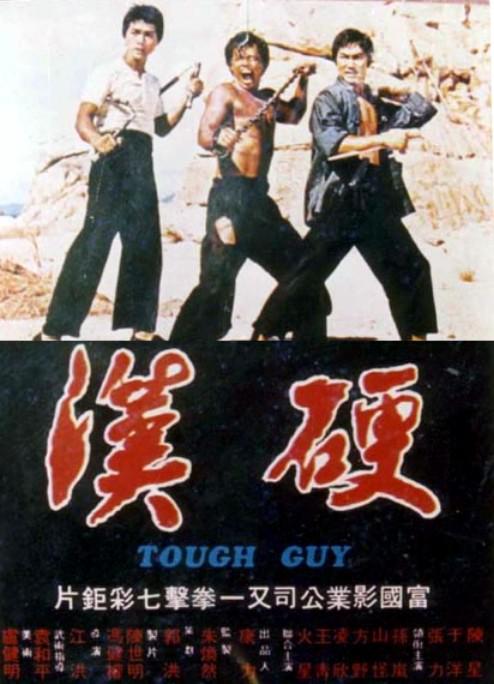
Tough Guy (1972, directed by Joseph Kong Hung)


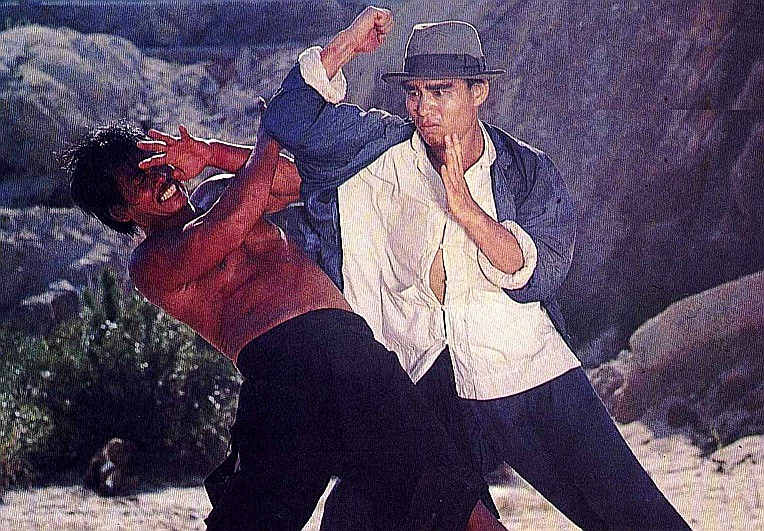
Chen Xing and Cheung Lik are two cops who have been assigned to take down a drug lord.  In order to infiltrate the criminal gang, Chen Xing goes undercover as a prisoner.  When he escapes from the prison, he does so with another member of the gang.  While Cheung Lik pretends to be a simple villager so that he can keep an eye on his partner, Chen joins the gang and immediately shocks everyone with his fighting abilities.  What sets Chen apart from other martial artists is his ability to kill his opponents just by grabbing their foreheads and smashing their skulls.  That impresses everyone who sees it.  However, when the drug lord finds out that Chen is actually an undercover cop, he captures and tortures him.  Will Chen be able to escape in time to have a climatic fight in a mud pit with the drug lord’s main enforcer?

One of my favorite martial arts films, Tough Guy is known by several titles.  When it was released in the West, it was apparently retitled — and I am not kidding — Kung Fu The Head Crusher.  When it was subsequently released on video, it was called Revenge of the Dragon, probably to try to fool people into thinking that it was a Bruce Lee film or, at the very least, that it starred Bruce Li or some other Bruceploitation star.

Whatever it’s title, Tough Guy is an often brutal film, featuring some of the most exciting fight scenes that I’ve ever seen.  What Chen Xing and Cheung Lik lacked in screen charisma, they made up for in skill and relentlessness.  When Chen Xing gets in the middle of things and starts trading blows with his adversaries, it’s like watching a wild animal suddenly go on the attack.  He doesn’t stop moving until no one’s left standing and he even manages to make the whole skull crushing thing look credible.  He’s matched by Cheung Lik, who may not have as big a role as Chen Xing but who still proves himself to be a formidable fighter.  The fights themselves are expertly choreographed and largely filmed in close-up.  There’s no cheating the camera or anything else that martial arts films sometimes did to make their stars look more skilled than they actually were.  Another thing that I appreciated is that, when Chen and Cheung have to fight multiple opponents, the bad guys usually attack all at once, as a group, instead of everyone standing around waiting for their turn to get in their punches.

There’s little intentional humor to be found in Tough Guy and there’s even less discussion of the philosophy behind the martial arts.  Instead, this is a tough and violent crime movie that wastes no time in getting down to business.

One final note: While watching Tough Guy, be sure to pay attention to the film’s score.  If it sounds familiar, that’s because it was lifted nearly note-for-note from Ennio Morricone’s score for Once Upon A Time In The West.
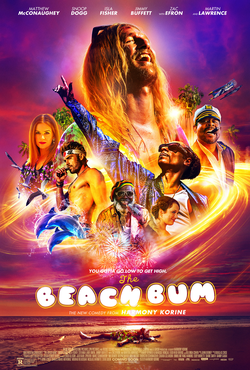
Spring Breakdown: The Beach Bum (dir by Harmony Korine)


February is over!  Welcome to March!

Now, the first two weeks of March is, traditionally, when most schools give their students a week off for Spring Break.  I have a lot of good Spring Break memories and, to be honest, I’ve always kind of resented the fact that Spring Break is something that only schools do.  To me, it should be like a national holiday where everything stops for a week and everyone hangs out at the beach for a few days.

Of course, this year’s Spring Break may be a bit of a disappointment, what with everyone freaking out about …. well, everything.  That’s a shame but fear not!  You may not be able to leave behind your fears long enough to go down to the beach but at least you can still watch movies about the beach, right?  So, with that in mind, over the next two weeks, I will be reviewing some films for Spring Break!

It’s time for Spring Breakdown!

Let’s get things started with the 2019 film, The Beach Bum.

The beach bum of the title is an always stoned, alcoholic poet named Moondog (Matthew McConaughey), who spends his time wandering around the Florida Keys.  Moondog has been working on a book for several years and he’s a bit of a local celebrity.  Everyone that he meets tends to like him, or at least they do until he ruins their lives.  Moondog is irresponsible, immature, and apparently some sort of genius as well.  Moondog is also extremely laid back.  Even when he finds out that his wife, Minnie (Isla Fisher), cheated on him with his best friend, a singer named Lingerie (Snoop Dogg), Moondog is okay with it.  He’s always loved Minnie but he’s never had a problem cheating on her so why shouldn’t she do the same to him?

After Moondog shows up late for his daughter’s wedding and goes out of his way to make a scene, he goes for a drive with Minnie.  Of course, since Moondog is drunk off his ass, he ends up crashing the car and killing his wife.  In her will, Minnie leaves half of her fortune to their daughter, Heather (Stefania LaVie Owen).  She leaves the other half to Moondog, with the stipulation that Moondog will only get the money after he finishes his book.

The rest of the film follows, in an episodic fashion, Moondog as he tries to finish his book and get his money.  Along the way, he commits crimes, dabbles with various jobs, and spends time in jail and drug rehab.  He meets a host of eccentric and destructive characters, almost all of who are the type of outsiders who seem as if they’re destined to eventually be the subject of a “Florida man” headline.  For instance, Flicker (Zac Efron) is a pyromaniac.  And Captain Wack (Martin Lawrence) hosts dolphin tours but, unfortunately, cannot tell the difference between a dolphin and a shark.

When The Beach Bum was first released in March of last year, it was eagerly anticipated because it was Harmony Korine’s first film since 2012’s Spring Breakers.  Despite the fact that Spring Breakers and The Beach Bum both take place in Florida and feature a lot of beach action, the two films might as well be taking place in separate universes.  The Beach Bum is as laid back as Spring Breakers was violent.  If Spring Breakers was a film that seemed to be fueled by ecstasy and cocaine, The Beach Bum is a celebration of getting high and enjoying life.  If Spring Breakers was all about being young, The Beach Bum is about growing old without giving up your individuality.

In many ways, The Beach Bum is the ultimate Matthew McConaughey film and how you react to the film will depend on how much tolerance you have for Matthew McConaughey at his most McConaugheyest.  Indeed, if you like Moondog, it’ll probably be because you like Matthew McConaughey.  As a character, Moondog is a jerk.  He nearly ruins his daughter’s wedding.  He drives drunk and kills his wife.  He refuses to take responsibility for being a general fuck-up and, from what little we hear of his work, he appears to be a subpar poet as well.  And yet, Matthew McConaughey brings enough of his own natural charm to the role that it’s tempting to forgive Moondog.  You can understand why some people in the film are willing to tolerate him, even though he’s basically a pain in the ass to have around.

The Beach Bum is not a film for everyone.  I appreciated Matthew McConaughey’s performance and I also appreciated the fact that Harmony Korine didn’t try to remake Spring Breakers.  At the same time, the film was a bit too loosely constructed to really hold my interest and a little bit of Moondog goes a long way.  I saw this film last year and I’ve really had no desire to rewatch it.  That said, the cinematography frequently makes Florida looks like the most beautiful place on Earth and, regardless of what you may think about his poetry, at least Moondog just keeps on L-I-V-I-N, livin’.

Add to that, Moondog’s going to enjoy Spring Break, no doubt about it.

Bolo (1977, directed by Bolo Yeung)


The plot of Bolo is almost indescribable but I shall give it a try.

As far as I can tell, the film is supposed to take place during the final days of the Ching Dynasty in China.  The sheriff of a tiny rural village has been beheaded by gangster so the decision is made to have all of the local prisoners pull straws, with the two winners getting to leave the prison and become the town’s new law enforcement officers.  The winners are the hulking but well-meaning Bolo (Bolo Yeung, for once playing a good guy) and Ma (Jason Piao Pai).  Ma is a con artist while Bolo is in prison for killing his wife because he hadn’t seen her before their arranged marriage and was horrified to discover how ugly she was.  (Ha ha, I guess?)  Bolo and Ma are told not to try to escape and are then sent on their way to the village.

After a visit to the local brothel ends in a fight, Bolo gets down to trying to clean up the village.  That’s not going to be easy because almost everyone in the village is a gangster and the village’s mayor would rather appoint the local pimp as the new sheriff.  Bolo, however, starts to get results so the mayor plots to poison Bolo.  That doesn’t work but he does frame Bolo for a crime that he didn’t commit which leads to Bolo and Ma committing a real crime.  Bolo also falls in love with a 7 foot woman.

Bolo is like a Kung Fu version of the type comedic spaghetti westerns that Bud Spencer and Terrence Hill used to make in the 70s, with the exception that it’s far more incoherent than anything that ever starred Spencer and Hill.  Friends become enemies and enemies become friends and back again with shocking regularity in Bolo and, though there’s many fights, it’s rarely clear why anyone’s fighting.  A typical scene features a woman asking Bolo to watch her baby and then stabbing him in the stomach when he makes a face about the baby’s dirty diaper.  A wounded Bolo staggers into a doctor’s office, where the doctor bandages him up and then the two of them have a fight, during which time the bandage falls off and we discover that Bolo is apparently no longer wounded.

The film is also a comedy but it’s difficult for me to judge how effective it might have been because 1) I saw a poorly dubbed version and 2) much of the humor appeared to be very specific to China and Chinese culture.  For instance, there’s a lengthy scene where Ma and a woman play something called “the numbers game.”  The film presents it as being a big deal and I think it was meant to be comedic but I have to admit that I have no idea what they were doing.  To me, it seemed like they were just shouting out random numbers while holding up their hands.  To everyone else in the movie, it appeared to mean something else.  So, I won’t judge the film’s comedy beyond saying that Belo Yeung, who also directed as well as starred, appeared to have a gift for physical comedy that he didn’t get a chance to show off in his other films, mostly because he was usually cast as a villain.  There’s also a scene where a grocer attacks someone with a cucumber and that’s funny just because cucumber’s are funny.

Even if it’s never clear why anyone’s fighting and the sound effects often don’t match the actions of the combatants, some of the fight scenes are exciting.  That’s really the main reason why anyone’s going to watch something like Bolo and in that case, the movie doesn’t disappoint.  The fights are cool.  It’s just too bad that the plot keeps getting in the way.

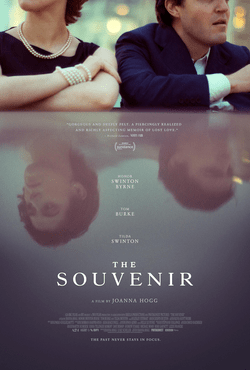
Love On The Shattered Lens: The Souvenir (dir by Joanna Hogg)


Well, here we are.  It’s the end of February and tomorrow, March begins.  That also means that it’s time to end Love on the Shattered Lens, our series of reviews of films about the wonders of love.  Tomorrow, it’ll be time to start reviewing films about Spring Break and paranoia, two topics that go together like Danny Zuko and Sandy Olsson.  Perhaps Love on the Shattered Lens will return next February.  It’s always hard to say what the future will hold but, by this time, our regular readers should know how much I love tradition.

With all that in mind, our final entry in Love on the Shattered Lens is a film that I personally considered to be the best film to be released last year, The Souvenir.

Taking place in the early 1980s, this independent British film tells the story of Julie (Honor Swinton Byne, the daughter of Tilda Swinton) and Anthony (Tom Burke).  Julie is a film student who hopes to make a documentary about a family living in a slum.  She’s very idealistic and very much concerned about the state of the world.  Though it’s not obvious at first, she’s also extremely naive and rather innocent about the world that she wants to document.  For all of her desire to capture reality on film, there’s much that she had yet to experience.

Anthony is older than Julie, though not too much older.  He’s a handsome, charming man who is always well-dressed and who has what would appear to be an exciting and interesting job with the Foreign Office.  It’s not long after first meeting that Julie and Anthony become lovers.  After her roommates abandon her, Anthony even moves into Julie’s flat.  He seems like he’s perfect, even though observant viewers will automatically have some questions about him.  For instance, if he’s so successful, why is he so quick to move into Julie’s flat?  Why is he always so vague about the details of his job?  He disappears, for one week, to Paris and when he returns, he brings the gift of lingerie.  He claims to have purchased it for her in Paris but was that really where he was?  Later, when Julie notices some strange marks on his arms, Anthony is intentionally vague about what they are.  (Of course, most people people watching the movie will immediately realize that they’re a sign that Anthony is a heroin addict.)  When the flat is broken into and Julie’s jewelry is stolen, we know what’s actually happened even if Julie doesn’t.

Just reading the paragraph above, you’re probably imagining that it’s very easy to hate Anthony but that’s not the case.  Every sign tells Julie that she should get him out her life and yet, it’s not as easy as it seems.  Even after Julie learns the truth about him, she still finds it difficult to just push him aside.  For all of Anthony’s flaws, he’s got the addict’s gift for manipulation and, at times, his love for her does seem to be real, even if it will always be second to his addiction and his need to get a fix.  Much like Julie, the viewer find themselves occasionally falling into the trap of thinking, “If only Anthony wasn’t a drug addict, he would be the perfect for her.”  Of course, the point of the matter is that Anthony is a drug addict and no amount of wishful thinking or fantasizing is going to change that.

The Souvenir is a rather low-key film.  Whenever you expect the film to go for easy drama or a showy shouting match, The Souvenir surprises you by going the opposite direction.  Instead of being a traditional “drugs-are-bad” type of film, it’s a character study of two people dealing with their addictions.  Anthony is addicted to heroin and lying while Julie finds herself addicted not so much to Anthony but instead to the fantasy that Anthony sans drugs represents.  By the end of the film, Julie is sadder but she’s wiser and, if nothing else, she’s a better artist than she was at the start of things.  If nothing else, she’s been forced to start dealing with reality.  The film’s title comes from a painting by Jean-Honoré Fragonard.  Julie thinks that the girl in the painting looks sad while Anthony says that she looks determined.  By the end of the film, Julie is both sad and determined, just like the subject of The Souvenir.

Director Joanna Hogg has described The Souvenir as being semi-autobiographical.  That said, you don’t have to be an aspiring filmmaker to relate to Julie.  Everyone has had the equivalent of an Anthony in their life, that one thing that you seemingly can’t give up even though you know that you should.  Tom Burke is both charming and heart-breaking as Anthony while Honor Swinton Byrne (in only her second film and her first starring role) gives a fearless performance as Julie.  At times, it seems like it’s impossible not to want Julie and Anthony to find some sort of happiness.  At other times, it seems like it’s just as impossible to forgive them for their flaws.  You get angry at Anthony when he falls back into his addictions and you also get angry at Julie for her inability to accept who Anthony truly is.  But, at the same time, you always feel empathy for them.  You always hope the best for them.  You always wish that they could have met under different circumstances, that things could have been different.

Though the film may be too low-key for some, the quietly powerful The Souvenir is my favorite film of 2019.

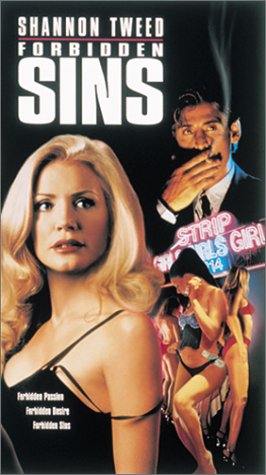
Cinemax Friday: Forbidden Sins (1999, directed by Robert Angelo)


There’s been a murder!  A stripper named Virginia Hill (Kristen Pierce) has been found dead and the evidence suggests that she died as the result of sadomasochistic sex play gone wrong.  Lead detective John Doherty (Myles O’Brien) immediately suspects that the murderer is David Mulholland (Corin Timbrook).  Mulholland is a millionaire who owns the club where Virginia used to dance.  He has a reputation for being into some kinky stuff.  (A cashier at the local adult bookstore swears that Mulholland only buys BDSM-related magazines.)  Detective Doherty is convinced that Mulholland not only killed Virginia but that he’s killed before.  For this detective, this case is personal.

It’s about to get a lot more personal because, after he’s arrested, Mulholland hires Maureen Doherty (Shannon Tweed) to defend him in court.  Maureen is John’s ex-wife and she knows firsthand how obsessive her former husband is.  For reasons that she can’t fully explain, Maureen feels that Mulholland has been set up.  Working with Virginia’s best friend, Molly Malone (Amy Lindsay), Maureen sets out to prove that Mulholland is innocent.  But is he?

Yes, it’s yet another remake of Jagged Edge, with Shannon Tweed more than capably stepping into the Glenn Close role.  The chance to see Shannon Tweed play a high-powered attorney is the main reason to see Forbidden Sins and she does a pretty good job with the role.  Among the stars of the Skinemax era, Tweed was one of the more talented and she was always as credible delivering dialogue as she was disrobing.  Other than Tweed, the rest of the cast is okay but nothing special.  For instance, one reason why Jagged Edge worked was because Jeff Bridges kept you guessing.  In this film, the same cannot be said of Corin Timbrook.  The script and the direction are all pretty much standard for what you would expect from a 90s direct-to-video sexploitation flick and, again, the main thing that elevates this film above others of its type is the conviction that Shannon Tweed brings to her role.

For those who are only watching this film for the nudity (and, to be honest, that’s probably going to be the majority of the people who go to the trouble to track down something called Forbidden Sins), Shannon Tweed has one scene while Amy Lindsay has several.

My favorite thing about Forbidden Sins is that the murdered stripper was named after Bugsy Siegel’s girlfriend.  My second favorite thing about Forbidden Sins is that the working title was apparently Forbidden By Law.  That’s one way to describe murder, I guess.

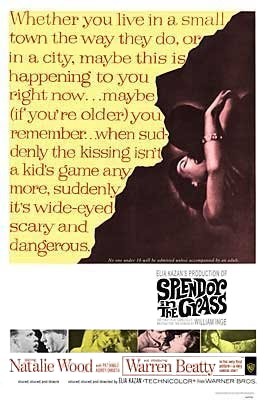
Love on the Shattered Lens: Splendor in the Grass (dir by Elia Kazan)


What though the radiance which was once so bright

Be now for ever taken from my sight,

Though nothing can bring back the hour

Of splendour in the grass, of glory in the flower;

We will grieve not, rather find

Strength in what remains behind…

— “Ode: Intimations of Immortality from Recollections of Early Childhood” by William Wordsworth

The 1962 film, Splendor in the Grass, takes place in Kansas shortly before the start of the Great Depression.  Deanie (Natalie Wood) and Bud (Warren Beatty) are two teenagers in love but, as we learn, youthful love does not always translate into adult happiness.

Bud and Deanie are idealistic and in love but they’re from different social classes.  Bud is the son of a boisterous oilman named Ace (Pat Hingle) and Ace acts much like you would expect a millionaire named Ace to behave.  Bud’s parents are determined that he attend Yale and that he marry someone else from a wealthy family.  They don’t want him to turn out like his older sister, Ginny (Barbara Loden), who drinks, smokes, and is rumored to have recently had an abortion.  Meanwhile, Deanie is repeatedly told by her mother that she must always remain a “good girl” and not give in to the temptation to have premarital sex with either Bud or any other boy.  If she does, she’ll be forever branded a bad girl and she’ll pretty much end up with a reputation like Ginny’s.

(Interestingly enough, Ace doesn’t have any problem with Bud finding  himself a bad girl, nor does he have a problem with taking his son to a speakeasy later in the film.  As far as society in concerned, being “good” and following the rules only applies to women.)

Needless to say, things don’t work out well for either Deanie or Bud.  Bud is so frustrated that Deanie won’t have sex with him that he dumps her and then has the first of several breakdowns.  When Deanie’s attempt to win Bud back by acting more like Ginny fails, she ends up going out with a classmate named Toots Tuttle (Gary Lockwood).  Nothing good ever comes from going out on a date with someone named Toots Tuttle.  That’s certainly the case here as Deanie and Bud both struggle with the demands of a hypocritical society that expects and encourages Bud to behave in a certain way but which also condemns Deanie for having desires of her own.  And, of course, the entire time that Bud and Deanie’s drama is playing out, we’re aware that the clock is ticking and soon the stock market is going to crash and change everyone’s lives forever.

It’s kind of a depressing film, to be honest.  I’ve always found it to be rather sad.  When we first meet them, Deanie and Bud seem as if they’re perfect for each other but, throughout the entire film, the world seems to be conspiring to keep them apart.  By the end of the film, they’ve both found a kind of happiness but we’re painfully aware that it’s not the happiness that either one was expecting while they were still in school.  The film suggests that type of happiness might be impossible to attain and a part of growing up is realizing that there is no such thing as perfection.  Instead, there’s just making the best of wherever you find yourself.

There’s a scene in this film where Natalie Wood nearly drowns and it always freaks me out, both because of my own fear of drowning and the fact that it foreshadows what would eventually happen to Natalie in 1982.  (The fact that Natalie Wood and Robert Wagner’s yacht was called “Splendour” doesn’t help.)  Natalie herself was also deeply scared of drowning and just filming the scene undoubtedly took a lot of courage on Natalie’s part.  But then again, Natalie Wood’s entire performance is courageous.  Natalie Wood gives an emotional and intense performance as Deanie, holding nothing back and it’s impossible not to get emotional while watching her.  Making his film debut, Warren Beatty is a bit of a stiff as Bud, though he’s certainly handsome and you can tell why Deanie would have found him attractive.  (In high school, you always assume that the boring, handsome guys actually have more depth than they let on.)  By the end of the film, you understand that Deanie deserved better than Bud.  Then again, Deanie deserved better than just about everything life had to offer her.  But Deanie survived and endured and made the best of what she was given because, really, what else could she had done?  What other choice did she have?

For her performance in Splendor in the Grass, Natalie Wood received her second Oscar nomination for Best Actress.  She lost to Sophia Loren for Two Women and …. well, actually, Loren deserved the award.  But so did Wood.  1961 would have been a great year for a tie.

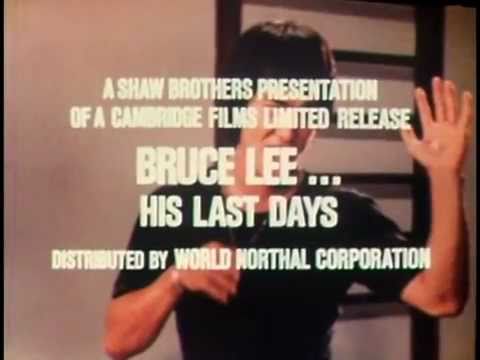
Bruce Lee: His Last Days, His Last Nights (1976, directed by John Law Ma)


Also known as Bruce Lee & I, this films stars Betty Ting Pei as herself.  At the time that the film was made, Betty was one of the most vilified women in the world.  An actress who was best known for appearing in softcore sexploitation, Betty was a “friend” of Bruce Lee’s.  It was while visiting Betty in her apartment that Bruce announced that he had a terrible headache.  Betty gave Bruce Equagesic, a powerful type of aspirin, to help him deal with his headache.  Bruce then fell asleep and, as we all know, never woke up.

Not surprisingly, after Bruce’s death, Betty was at the subject of a lot of unfavorable speculation and unsavory rumors.  Some Bruce fans accused her of poisoning Bruce, either accidentally or on the orders of the organized crime figures who wanted to take over Bruce’s career.  There was also speculation as to the nature of Bruce’s relationship with Betty.  Bruce was married and had two children and, after he died, he was recast as almost a saintly figure.  Betty’s claim that she was Bruce’s mistress did not fit in with that new reputation.

Bruce Lee: His Last Days, His Last Nights opens with Bruce (played by Danny Lee, who later won a critical respect by appearing in several John Woo films) filming a fight scene before then going to Betty’s apartment where, after the first of the movie’s many sex scenes, Bruce ends up dead in Betty’s bed.  With both the press and even people in the streets accusing Betty of being evil, Betty goes to a bar and, while drowning her sorrows, tells the bartender about her life with Bruce Lee.

In Betty’s telling, she knew and loved Bruce long before he became a star.  She met him when she was just an innocent schoolgirl and he saved her from some thugs in the streets.  Later, they both met again while pursuing their film careers and they became lovers.  Betty felt guilty about carrying on an affair with a married man but Bruce didn’t care.  Bruce mostly cared about smoking weed, getting into fights, and getting laid.

This is one of the stranger Bruceploitation films.  Most Bruceploitation films presented Bruce as being a real-life super hero who was either killed by his enemies or who faked his death so he could protect his family.  This one presents Bruce as essentially being a petulant and cocky asshole who didn’t really care about anyone but himself.  Some of that may be because the film was produced by the Shaw Brothers, with whom Bruce famously refused to work with early in his career.  (It’s rumored, though, that Bruce was thinking of leaving Golden Harvest for the Shaw Brothers at the time of his death.)  The other reason why Bruce comes across as being so unlikable in this movie is that it’s told from the point of view of Betty, who was often accused of having corrupted Bruce and of not being worthy of him.  This film makes the argument that Bruce was not worthy of Betty.

Once you get past all of the controversy about how this film presents Bruce Lee and his relationship with Betty Ting Pei, it’s still not a very good movie.  It’s too slow and they’re aren’t enough big fights.  (When Bruce does fight, it’s usually to protect Betty from an unwanted admirer.)  Bruce does don the yellow track suit but it’s just so he can debate philosophy with Betty.  We expect more from our Bruceploitation films.

Love on the Shattered Lens: Barefoot In The Park (dir by Gene Saks)


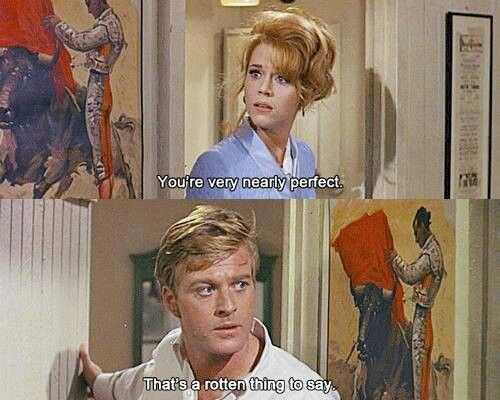
The 1967 film, Barefoot in the Park, tells the story of two newlyweds.

Paul Bratter (Robert Redford) may have a terrible last name (seriously, Bratter?) but he’s an up-and-coming lawyer with a bright future.  He’s a little bit uptight and doesn’t seem to have the greatest understanding of human nature but he’s handsome and he’s charming and he means well.  Paul has just recently married Corie (Jane Fonda).  Corie is a free spirit who cringes at the idea of conformity.  Having been raised by a judgmental mother who has always told her that she will never be good enough to make it on her own, Corie has decided to murder Paul and steal all of his money by insisting that they live in a drafty apartment that’s on the fifth floor of an New York apartment building that doesn’t have an elevator.  If climbing up the stairs doesn’t kill Paul, the fact that the skylight has hole in it probably will.  Helping Corie with her plan is her eccentric neighbor, Victor Velasco (Charles Boyer).  When Paul comes home one day to discover Victor lifting up his lingerie-clad wife, Victor says, “We are heating up the apartment.”  Corie assures Paul that they’re just trying to get the radiator to start working but we know the truth….

Okay, that’s actually the Lifetime version of Barefoot in the Park.  The real Barefoot in the Park is a charming, lighter-than-light adaptation of Neil Simon’s famous play.  (If I’m biased towards the play, it’s because I once played Corie in a heavily edited version of the play that we put on in high school.  I was the perfect Corie, if I may say so myself.)  As played by Robert Redford, Paul is charming but uptight and, as played by Jane Fonda, Corie is a free spirit who doesn’t really seem to have much common sense about the realities of living in New York City.  (Running barefoot in Central Park?  Probably not a good idea in 1967.)  They do end up living on the fifth floor and there are a lot of jokes (in fact, there’s probably too many jokes) about people getting out of breath from having to climb all of the stairs.  There’s also a broken skylight, which is a problem since it snows in New York.  However, Corie never deliberately plots to kill Paul.  Instead, she tries to set her mom (played, in an Oscar-nominated performance, by Mildred Natwick) up with Victor.

Barefoot in the Park is probably one of those films that seemed semi-daring when it was originally released in 1967 (“Look!  A honeymoon sex joke!  Look!  Corie’s walking around in Paul’s shirt!  Look!  Paul looks like he’s about to say a forbidden word!”) but today, it seems like an old-fashioned but likable fantasy about what’s like to be a newlywed in New York.  The city’s beautiful and full of romance.  The dialogue is witty and zippy.  (Zippy’s a word, isn’t it?)  Charles Boyer overacts in the most charming way possible and Mildred Natwick has some good moments as Corie’s mom.  (To appreciate Natwick’s peformance, it helps to imagine what the film would have been like if Shelley Winters had played the role.)  Most importantly, Robert Redford and Jane Fonda have got an amazing chemistry and, as they were both young in 1967 and considerably less weather-beaten than they are today, it’s hard to imagine a more beautiful couple.  Though Gene Saks’s direction is visually flat and, cinematically, the film never quite breaks out of its stage-bound origins, the chemistry of Redford and Fonda and Boyer and Natwick carry you through the occasional rough patch.

Seriously, I kind of love this movie!

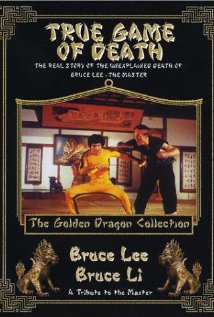
The True Game of Death (1979, directed by Steve Harries and Chen Tien-Tai)


After the death of Bruce Lee, the world cries out for another great martial arts film star.  Fortunately, Hsao Lung (Lung Tien-Hsiang) answers the call.  Hsao Lung bears a passing resemblance to Bruce and whenever he trains or looks at a magazine, he imagines stock footage from old Bruce Lee movies, suggesting that Bruce Lee’s spirit has possessed Hsao Lung’s body.

The mafia, led by George (George Stephens), wants a piece of Hsao Lung’s films but Hsao Lung refuses.  The mob then forces George’s wife, Alice (Alice Meyer), to slip a powerful drug into his coffee.  They say that it will only put Hsao Lung into a coma.  Instead, it kills him!

Soon, a new chef comes to work for Alice.  The chef looks, sounds, and moves exactly like Hsao Lung but he wears a fake beard and oversized eye glasses.  After Alice explains the circumstances of what led to Hsao Lung’s death (which means that the audience watches a flashback to a scene that happened ten minutes prior), the chef removes his beard and glasses.  It’s Hsao Lung!  He’s not dead!  Everyone is stunned except for the people watching the movie because, after all, Hsao Lung’s entire disguise consisted of glasses and a fake goatee.

The bad guys kidnap Alice and this, of course, leads to Hsao Lung putting on a yellow track suit and fighting several villains in a pagoda.  It’s basically just the end of The Game of Death all over again, except there’s no Kareem Abdul-Jabbar this time.  It should be noted that the final fight scenes are well-staged and a hundred times better than anything else in this movie.  Hsao Lung fights four motorcyclists, two sumo wrestlers, and a boxer.  The boxer and Hsao Lung discuss the philosophy of combat before fighting, just like Bruce Lee and Kareem did.

Even by the standards of the Bruceploitation genre, The True Game of Death is a shoddy production.  The plot makes no sense and Lung Tien-Hsiang is good in the fight scenes but otherwise, he can’t come close to matching Bruce Lee’s screen presence.  It’s not a good sign that the best part of The True Game of Death is an almost shot-for-shot rip-off of the best part of the original Game of Death.  Outside of the closing fight scenes, my favorite part of The True Game of Death is that, before Alice gives Hsao Lung the poison, random gangsters keep showing up everywhere she goes and reminding her to do it.  Even though he’s usually no more than a few feet away, Hsao Lung never picks up on it.

The main thing that The True Game of Death has going for it is that it’s a Bruceploitation film and will therefore only be seen by fans of that very specific genre, the majority of whom will probably have a good idea of what they’re about to get even before the movie starts.  Bruceploitation is a genre that is built on some very specific tropes and The True Game of Death doesn’t waver from a single one of them.  It doesn’t demand much from its audience and if you stick with it, you’ll get a pretty cool fight at the end of the movie.

Love on the Shattered Lens: Long Shot (dir by Jonathan Levine)


2019’s Long Shot is a film that truly took me by surprise.

I have to admit that, when I first saw the trailer for Long Shot, I had my concerns.  First off, it was an American political comedy and it’s been a while since there’s really been a good one of those.  There’s been many attempts, especially after Donald Trump was elected in 2016.  But, for the most part, the American films are always at their weakest when they try to be overly political.  There’s always a disturbing lack of self-awareness that, when mixed with the type of strident tone that can only be maintained by people who have never seriously had their ideas challenged, tends to make for a very boring viewing experience.  And, no, don’t you dare say, “What about Vice?” because Vice was freaking terrible.

Secondly, the trailer emphasized that Charlize Theron was playing the Secretary of State and that she was running to become the first woman elected President.  This led me to suspect that the film might essentially be Hillary Clinton fanfic.  Over the past few years, there’s actually been quite a few films and television show that have featured idealized versions of Hillary Clinton — i.e., all of the accomplishments without the albatross of her husband or the reputation for being casually corrupt.  (For six seasons, there was a TV show called Madam Secretary that basically only existed to present an idealized version of Hillary.)  Hillary fanfic, with its attempt to rehabilitate the image of a candidate so inept that she actually lost to Donald Trump, is always cringey.

Finally, as much as I hate to admit it, I was concerned that the film not only starred but was produced by Seth Rogen.  And don’t get me wrong.  I love Seth Rogen.  Seth Rogen is literally my favorite stoner.  I think that, with the right material, he can be one of the funniest performers around.  The problem is that, in the past, Seth Rogen has always been brilliant as long as he wasn’t talking about politics.  Whenever he started talking politics, he just turned into every other wealthy and rather self-righteous progressive.  While Rogen’s political tweets were never as banal as the thoughts of uberboomer Stephen King, there was still nothing about them that suggested that Rogen would be capable of producing one of the funniest and most good-hearted political comedies to come out in the past few years.

And so, like a lot of people, I skipped Long Shot when it was playing in theaters.  I waited until it was released on video to watch Long Shot and you know what?  It turned out that almost everything that I had assumed about Long Shot was incorrect.

Yes, it’s a very political movie but it’s also far more self-aware than I was expecting it to be.  Seth Rogen apparently knows that he has a reputation for being a very loud, knee-jerk leftie because he actually does a very good job of poking fun at his own image.  Rogen plays Fred Flarsky, a loud and crude journalist who quits his job when he discovers that the underground newspaper that he was working for has been purchased by Parker Wembley (Andy Serkis, playing a not-at-all disguised version of Rupert Murdoch).  Fred is about as far to the Left as one can be and he tends to assume that all of his associates agree with him, even though he never bothers to ask them.  One of the best scenes in the film comes when his best friend, Lance (O’Shea Jackson, Jr.), reveals to a stunned Fred that he’s not only a Republican and a Christian but that he’s been one the entire time that he’s known Fred.  Fred never caught on because he just assumed that Lance, being black, would naturally be a Democrat.  When Lance asks Fred why he thought Lance wore a cross around his neck, a befuddled Fred can only reply that he thought it was “cultural.”  It’s a great scene and one that’s wonderfully played by Rogen and Jackson and it works precisely because it remains true to what we’ve seen of both characters.  Almost everything that Lance says over the course of the movie does reflect a traditionally conservative mindset but, like Fred, we don’initially don’t notice because Lance is being played by Ice Cube’s son.  When Fred discovers that Lance is a Republican, it doesn’t change Fred’s mindset but it does teach him that progressives can be just as guilty as conservatives when it comes to making assumptions about people based on where they’re from or what they look like.  As a stunned and chastened Fred puts it, “I’m a racist, you’re a Republican, I don’t know what the fuck’s going on.”

Secondly, the film’s romance is incredibly charming.  Charlize Theron plays Charlotte Field, the Secretary of State who used to be Fred’s babysitter.  After they run into each other at a reception, Charlotte hires Fred to work as a speech writer for her nascent presidential campaign.  You would not expect Charlize Theron and Seth Rogen to have a ton of romantic chemistry but they do.  Theron is an underrated comedic actress and there’s a lot of fun to be had in just listening to her and Rogen bounce lines off of each other.  In fact, as funny as Rogen is, I’d have to say that Charlize Theron is even funnier.  One of the highlights of the film is when Fred and Charlotte sneak away to a club, where they dance and end up taking ecstacy.  Over course, as soon as the drugs kick in, a major diplomatic crisis breaks out and an extremely high Charlotte has to deal with a hostage crisis.  Theron appears to be having a ball with the role and really, this is the film for which she should have been Oscar nominated.  Theron convinces us that 1) she’s a masterful diplomat, 2) that she could be elected President of the United States, and 3) that she could fall in love with someone as messy as Fred without sacrificing her own ambitions.

Long Shot has its flaws, of course.  Andy Serkis is a bit too over-the-top in his villainy and the film has a 125-minute running time, which is way too long for what is essentially a fairly simple romantic comedy.  Some of the scenes of Fred and Charlotte traveling around the world probably could have been cut without harming the story.  There’s an environmental subplot that feels a bit too obvious and there’s a joke about Fred accidentally ejaculating on his own face that’s never as funny as the film seems to think that it is.

That said, Long Shot is often a surprisingly charming film.  (I know what some of you are saying: “Yes. Lisa Marie, Seth Rogen ejaculating on his beard sounds really charming.”  I know, I know.  But the majority of the film is charming.)  If you missed it when it came out the first time, give it another chance.