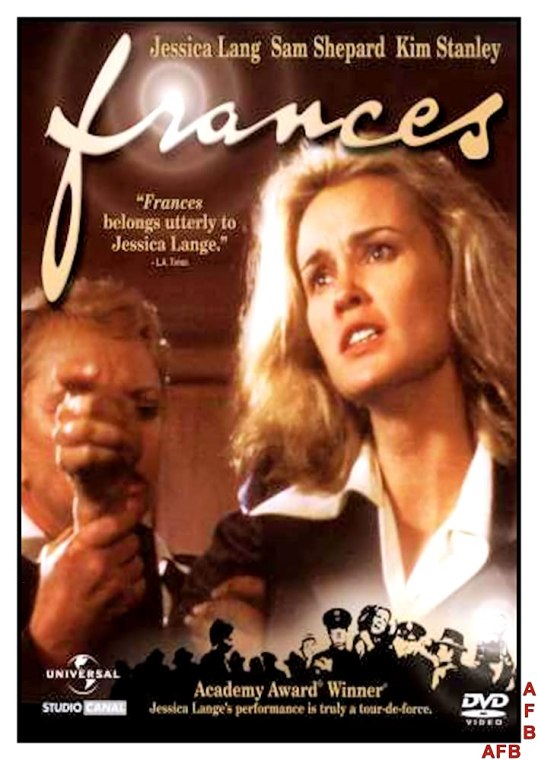
Film Review: Frances (dir by Graeme Clifford)


Frances Farmer is one of the more tragic figures to come out of Hollywood’s Golden Age.

A talented and beautiful actress, Frances Farmer came out to Hollywood in the 30s and quickly developed a reputation for being difficult.  She was politically outspoken at a time when stars were expected to either be apolitical or unquestioningly patriotic.  She criticized scripts.  She argued with directors and studio heads.  She had a well-publicized affair with communist playwright Clifford Odets and she also had numerous run-ins with the police.  Some say that she was alcoholic.  Some say that she was bipolar.  Some say that she had a mental collapse as the result of the pressure that her mother put on her to succeed.  Frances Farmer ended up in mental institution, where she was subjected to shock therapy.  After she was released, her film career was basically over, though she did end up hosting a local television program.  She died in 1970, reportedly alone and struggling to make ends meet.  In a posthumously published autobiography called Will There Ever Be A Morning?, she wrote that she was beaten, sexually abused, and eventually given a lobotomy while she was institutionalized.  Over the years, there’s been a lot of doubt about whether or not Farmer was actually lobotomized but there is no doubt that Farmer was a woman who was ultimately punished for being ahead of her time.  Frances Farmer refused to conform to the safe manufactured image that Hollywood prepared for her and, for that, she was nearly destroyed.

The 1983 film, Frances, is a biopic of Frances Farmer, starring Jessica Lange as Frances and Kim Stanley as her domineering mother.  It opens with Frances writing a school essay about why she’s an atheist and it ends with her smiling blankly at a television camera, her independent spirit broken by a lobotomy.  In between, we watch as Frances goes to Hollywood and has a self-destructive affair with Clifford Odets (played by Jeffrey DeMunn).  The infamous moment when Frances was dragged out of a courtroom while screaming at the judge is recreated and Frances’s time in the institution is depicted in Hellish detail.

We also learn about Frances’s relationship with a communist writer named Alvin York (Sam Shepard).  It seems like whenever Frances needs to be rescued or just needs someone to talk to, Alvin York pops up.  In fact, you could almost argue that York pops up too often.  Alvin York was a fictional character, one who was apparently created in order for audiences to have someone to relate to.  It’s unfortunate that the film felt that the audience would only be able to relate to Frances if it viewed her life through the eyes of a fictional character because York’s character is a bit of a distraction.  Sam Shepard does a good job of playing him and I certainly wasn’t shocked to learn that Sam Shepard and Jessica Lange were romantically involved during the filming of Frances (and for a long time afterwards) because Lange and Shepard do have a very real chemistry.  However, from a narrative point of view, Alvin York only works as a character if one accepts that he’s a figment of Frances’s imagination.  The film’s insistence that York is an actual person who just happens to show up at every important moment of Frances’s life just doesn’t work.

What does work is Jessica Lange’s performance.  Lange is amazing in the role of Frances, whether she’s playing Frances as a hopeful idealist, an out-of-control rebel, or, tragically, as a glass-eyed zombie who has been reduced to appearing on television and assuring audiences that her rebellious days are over.  Lange was nominated for Best Actress for Frances.  She lost to Meryl Streep for Sophie’s Choice.  I’ve seen Sophie’s Choice and Meryl was good but Jessica was better.

Frances was originally offered to David Lynch.  He turned the film down so he could work on Dune and instead, the film was directed by Graeme Clifford, who takes a far more straight-forward approach to the material than Lynch would have.  Still, Lynch’s interest in Frances Farmer would later lead to him working on stories that centered around a “woman in trouble.”  One of those stories became Twin Peaks.  Another would become Mulholland Drive.
Film Review: Slacker (dir by Richard Linklater)


“Wow,” I thought as I recently rewatched Richard Linklater’s first film, Slacker, “Austin hasn’t changed at all!”

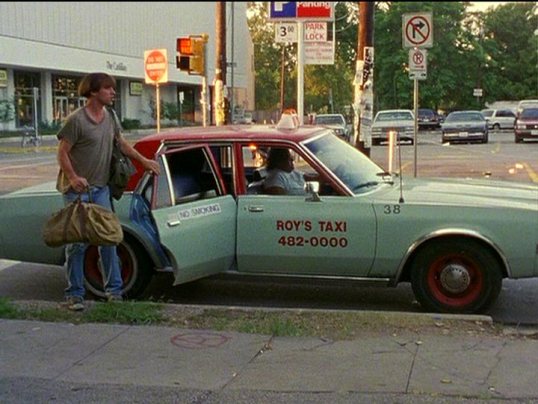
That, of course, isn’t true.  Slacker was filmed in 1990 and first released in 1991.  It’s 20 years old and the entire world — including Texas in general and Austin in specific — has changed quite a bit since then.  Slacker is a film about the people of Austin, following one person and then another as they walk down the streets of Austin and, in classic Linklater fashion, have conversations about everything from sex to pop culture to conspiracy theories.  It’s a film that was made before social media and no one carries a phone with them.  The majority of the people the we meet in Slacker would, today, probably be too busy posting 100-tweet threads to actually get outside and walk around the city.  (And, in the age of social distancing, the idea of walking up to a stranger on the street and having a conversation is not only unthinkable to a lot of people but illegal in some places up north.)  Slacker was also made long before SXSW turned Austin in a national hipster hotspot.  There are definitely hipsters in Slacker but they’re all of the Texas variety, as opposed to the Silicon Valley-on-vacation variety.

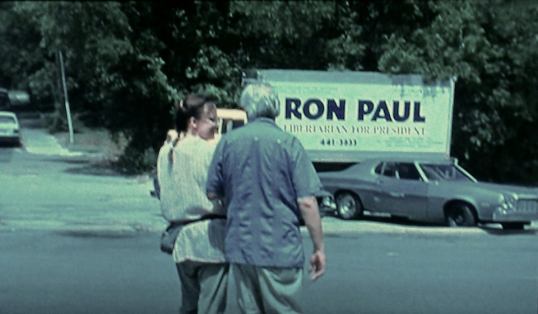
That said, Slacker does contain an essential truth about Austin that has never changed.  Austin has always been a town that has welcome the eccentrics, nonconformists, and self-styled intellectuals.  As both the capitol of the greatest state in the union and a college town, Austin has a unique style all of its own.  It’s a place where all of the contradictions of Texas — the fierce independence mixed with a strong belief in tradition — meet.  Some people refer to it as being “The People’s Republic of Austin” and the town is considerably more liberal than the rest of the state.  In general, though, Texas liberalism has never been quite as annoying or authoritarian-minded as the rest of America’s liberalism.  There’s a strong Libertarian streak that runs through even the most liberal parts of Texas and it seems somewhat appropriate that Ron Paul makes a cameo appearance of sorts in Slacker:

Slacker is one of those films that’s beloved by film students because it’s very easy to watch it and to think, “Wow, anyone could do that!”  Of course, the truth of the mater is that there is a very definite structure to Slacker.  Despite the way it may occasionally seem, the film is not just a bunch of random footage of people wandering by each other while discussing the Moon landing, the Kennedy assassination, and Madonna’s pap smear.  Instead, each conversation builds on the other until, eventually, Slacker presents a portrait of a community and a generation that has created a culture based on television, movies, and obscure historical references.  Slacker is a film that has been very carefully constructed to appear to be random but there’s a definite structure to it.  The film may look like it was made by someone who just turned on a camera and wandered around for day but Linklater definitely knew what he was doing and I’ve seen enough bad attempts to duplicate Slacker that I can definitely appreciate what Linkler accomplished.

The film, which had a largely nonprofessional cast, is full of interesting and, if you live in Texas, familiar characters.  The bitter hitchhiker, for instance, will be familiar to anyone who has ever had a conversation with an older inhabitant of a college town.  The conspiracy theorist who is writing his own book about the Kennedy assassination can be found in just about every independent bookstore in Texas.  I know people who actually took a class taught by the old man who (foolishly, in my opinion) idolized Leon Czolgosz.  As I said, the film is 20 years old but it captures the essence of Austin so perfectly that it remains timeless.

Slacker was Richard Linklater’s first film.  Appropriately, he’s also the first person to appear in the film and the first one to speak.  (He had a dream while on a bus.)  Linklater has gone on to become one of Texas’s greatest filmmakers.  At a time when cinematic and political conformity is too often celebrated, Linklater remains a unique and authentic voice.

And it all started with a film about Austin, a film called Slacker.

Police Academy 2: Their First Assignment (1985, directed by Jerry Paris)


In an unnamed city that is probably meant to be Los Angeles but which looks like Toronto, a criminal gang known as the Scullions have taken over the 16th precinct.  Led by the loud, marble-mouthed Zed (Bobcat Goldthwait), the Scullions are terrorizing the citizens and harassing one shop owner, Carl Sweetchuck (Tim Kazurinsky), in particular.  The captain of the 16th precinct, Pete Lassard (Howard Hesseman), calls his brother, Eric Lassard (George Gaynes), and asks for the best cadets to have recently graduated from the police academy.

Carey Mahoney (Steve Guttenberg) and a few other of the cadets from the first Police Academy movie end up in the 16th.  Tackleberry (David Graf) is there and so is accident-prone Douglas Fackler (Bruce Mahler).  Bubba Smith is back as Hightower and so is Michael Winslow, the human sound effects machine.  They’re determined to help Lassard’s brother but it’s not going to be easy because they have to work with Lt. Mauser (Art Metrano) who is basically a dick who wants to be captain.  Mauser is exactly like Harris from the first film, except his name is Mauser and, instead of getting his head stuck up a horse’s ass, he gets his hands super-glued to his head.

Police Academy 2 is less raunchy than the first film but still not quite as family friendly as the films that would follow.  There’s still one f-bomb dropped and a few adult jokes, as if the film wasn’t fully ready to admit that it was destined to become associated with juvenile viewers who would laugh at almost anything involving a bodily function.  There is one funny moment where Steve Guttenberg goes undercover to join Zed’s gang, mostly because he’s Steve Guttenberg and he’s even less believable as a gang member than he was as a cop.  The closest thing that movie has to a highlight is Bobcat Goldthwait’s manic turn as Zed and Tim Kazurinsky’s desperation as he watches his store get repeatedly destroyed.  Tackleberry also gets an amusing romantic subplot, where he meets a police woman (Colleen Camp) who loves guns almost as much he does.  Unfortunately, Tackleberry’s romance gets pushed to the side by all of the gang activity.

Police Academy 2 is stupid but, depending on how much tolerance you have for Bobcat Goldthwait, sometimes funny.  It’s not as “good” as the first film but it’s still better than most of what would follow.  Speaking of which, tomorrow, I will be reviewing the first Police Academy film to get a PG-rating, Police Academy 3: Back in Training.

Police Academy (1984, directed by Hugh Wilson)


God help us, it has come to this.  After a month and a half being locked down, Lisa and I watched the first two Police Academy movies last night.

The first Police Academy takes place in an unnamed city that appears to be in California.  Due to a shortage of officers, the mayor has announced that the police academy will now accept anyone who wants to apply, regardless of their physical or mental condition.  Naturally, this leads to a collection of misfits applying.  Martinet Lt. Harris (G.W. Bailey) is determined to force all of them to drop out of the academy and he has a point because I wouldn’t trust Michael Winslow’s human sound effects guy to investigate any crimes that were committed in my neighborhood.  What’s he going to do?  Make silly noises while I’m trying to figure out who stole my car?

The leader of the recruits is Carey Mahoney (Steve Guttenberg).  Mahoney is being forced to attend the academy because otherwise, he’ll have to go to jail for disturbing the peace.  Police Academy is a film that asks you to believe that a character played by Steve Guttenberg has not only frequently been in trouble with the law but would also make a good cop. Guttenberg doesn’t really do a bad job as Mahoney.  He’s a likable actor, even if his filmography has more duds than hits.  But he’s still miscast in a role that demands someone like Bill Murray, who could be both tough and funny.

The other recruits include Bubba Smith as Hightower and David Graf as the insane gun nut, Tackleberry.  Kim Cattrall is the rich girl who wants to be a cop and who falls in love with Mahoney.  George Gaynes is Commandant Lassard, who is out-of-it but not as out-of-it as he would be in the sequels.

You have to wonder how many parents, in the late 80s and early 90s, allowed their children to rent the R-rated Police Academy from the local video store without realizing the the first Police Academy is considerably more raunchy than the later sequels.  How did mom and dad react when they walked into the room and discovered their children watching Georgina Spelvin giving George Gaynes a blow job from underneath a podium?  Or how about the scene where recruit George Martin (Andrew Rubin) is spied having a threesome in the girl’s dorm?  The first Police Academy film is definitely made from the same mold as Animal House, Caddyshack, and Stripes.  It’s just not as funny as any of those films.

However, it is funnier than every Police Academy film that followed it.  There’s enough solid laughs to make the first Police Academy fun in a stupid way.  For instance, just about every scene involving accident-prone Cadet Fackler (Bruce Mahler) was funny.  Bubba Smith gets a lot of laughs just by being Bubba Smith in a stupid movie.  It’s also hard not to love it when Cadet Hooks (Marion Ramsey) yelled, “Don’t move, Dirtbag!”  Hell, I even laughed at the sound effects guy once or twice.

All of the Police Academy films are now on Netflix.  Tomorrow, we’ll take a look at Police Academy 2: Their First Assignment.

Cinemax Friday: Dangerous Indiscretion (1995, directed by Richard Kletter)


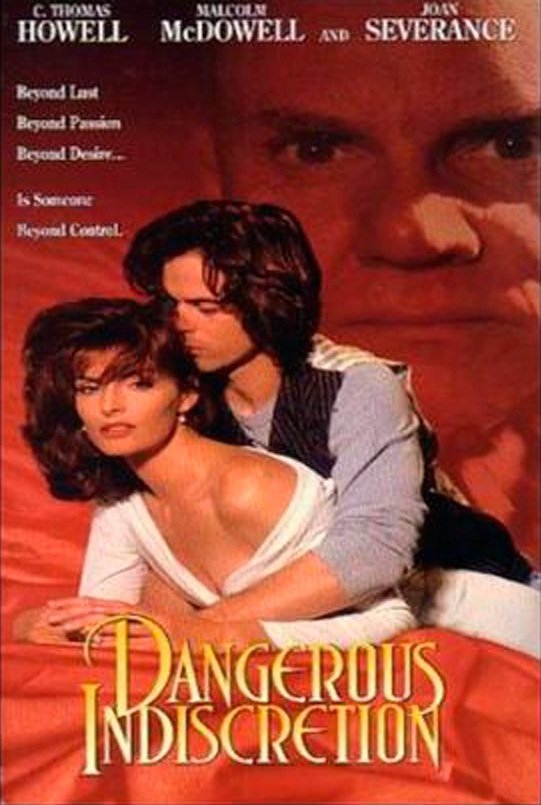
Jim Lomax (C. Thomas Howell) is an up-and-coming advertising executive who, one night, picks up the sultry Caroline Everett (Joan Severance) in a grocery store.  What starts out as a one night stand between two attractive people who both buy their own groceries turns into a full-fledged affair with Caroline asking Jim, “Who are you?” after they sleep together and Jim struggling to define his own identity.

Unfortunately, Caroline is married to Roger Everett (Malcolm McDowell), a wealthy and ruthless businessmen who likes to quote the Art of War.  Unlike Jim, Roger knows who he is and what he believes.  He’s an evil businessman who enjoys destroying other people and who gets a kick out of fooling the world into thinking that he’s actually a compassionate philanthropist.  When Roger finds out that Caroline has been cheating on him, he sets out to destroy both her and Jim.  Because Roger is an arrogant bastard, he not only plots to ruin Jim’s life but he brags about it too.  He tells Jim that he’s going to make his life unbearable and he also says tells him that there’s not a thing that he can do to stop him.  It’s not as if Jim has ever read Suz Tzu and, largely due to the commercials that have been produced by Jim’s own firm, the public sees Roger as being a benevolent and sympathetic figure.  Jim and Caroline will have to team up to figure out a way to reveal Roger for being the monster that he is.

The main problem with Dangerous Indiscretion is that it asks us to accept the idea that C. Thomas Howell could be an equal opponent to Malcolm McDowell.  Howell was one of the better actors to regularly appear in straight-to-video and Skinemax films but he’s till no Malcolm McDowell.  As played by McDowell, Roger comes across as someone who eats his enemies for breakfast while Jim is just a callow ad exec who looks like the star of The Outsiders.  It’s Caligula vs. Soul Man and there’s not much debate about who would win that match-up in the real world.  It’s unfortunate that McDowell, who played a variety of different characters at the beginning of his career, later got typecast in purely villainous roles but he’s still charismatic enough as Roger that you know there’s no way that Jim and Caroline could ever outsmart him.  Whenever Jim and Caroline do pull one over him, it doesn’t feel right.

Fortunately, Dangerous Indiscretion is better directed than the average straight-to-video neo-noir and, even if they are outclassed by McDowell, both C. Thomas Howell and Joan Severance give good enough performances that you don’t get bored when they’re on-screen.  (This was actually the second erotic thriller that Howell made with Severance and it’s a definite step-up from Payback.)  As previously stated, McDowell’s the perfect villain.  By the proud standards of late night 90s Cinemax, Dangerous Indiscretion is an entertaining film with a great bad guy.

His Name Was King (1971, directed by Giancarlo Romitelli)


During the dying days of the old west, John Marley (Richard Harrison) is the bounty hunter that they call King.  When King is hired to bring in the Benson brothers, who are thought to the head of a smuggling ring, he kills one of the brothers.  The gang takes revenge by tracking down and killing King’s brother and then raping his brother’s wife.  Now, King is the one who wants revenge.

Fortunately, the Sheriff, Brian Foster (Klaus Kinski), is an old friend of King’s and seems to be willing to give him the freedom necessary to get his vengeance.  What King doesn’t know is that Foster himself is the head of the smuggling ring and he has plans of his own.

His Name Was King is a short Spaghetti Western.  The version that I saw, which was poorly dubbed into English, only had a running time of 75 minutes.  Since most sources state that His Name Was King has a 90-minute running time, I can only assume that 15 minutes must have been edited out for the American release.  This was often done when Spaghetti Westerns were released in the U.S.  Unfortunately, it makes the plot to His Name Was King feel incoherent and I’m going to guess that the poor editing job is why Klaus Kinski was only in a few minutes of the version that I saw.  It’s unfortunate because, with Richard Harrison sleepwalking through his role, Kinski’s sinister turn was the best thing in the film.

His Name Was King does have a wonderful score from Luis Bacalov but it’s otherwise, in its edited form at least, for Spaghetti Western completists only.

God’s Gun (1976, directed by Gianfranco Parolini)


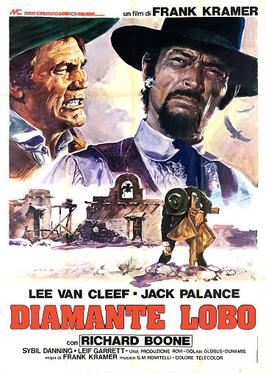
During the dying days of the old west, outlaw Sam Clayton (Jack Palance) ride into the town of Juno City and try to take things over.  Because the sheriff (Richard Boone, who reportedly walked off the film before shooting was complete) is old and ineffectual, it falls to the town priest, Father John (Lee Van Cleef), to chase them off.  Father John is hardly your typical priest.  He’s a former gunfighter who, even though he no longer carries a weapon, still knows how to throw a punch.  Though he manages to put Sam and the gang behind bars, they are all eventually released.  The first thing they do is gun down Father John in front of his own church.

A mute child, Johnny O’Hara (Leif Garrett), flees town to track down Father John’s twin brother, Lewis (also played by Lee Van Cleef).  What Johnny doesn’t know is that Sam, who years ago raped Johnny’s mother (played by Sybil Danning), might actually be his father.  When Johnny finds Lewis, he finally manages to communicate what’s happened.  Lewis and Johnny head back to town so Lewis can get his vengeance  The only catch is that Lewis promised his brother that he would no longer carry a gun so he’s going to have to use his wits to get his revenge.

God’s Gun is a strange film.  It was one of the last of Spaghetti westerns but, though the director was Italian, it was filmed in Israel and it was produced by none other than Menahem Golan.  Golan brings the same producing aesthetic to God’s Gun that he later brought to many Cannon films — a few recognizable veteran actors (Jack Palance, Lee Van Cleef), an up-and-coming star (Leif Garrett), an international sex symbol (Sybil Danning), and a spin on a popular genre.  Like many of Golan’s films, the plot is occasionally incoherent and the entire production feels cheap and rushed but, at the same time, it’s hard to resist the mix of Van Cleef, Palance, and Danning.

Adding to the film’s strange feel is that every actor is dubbed, even the ones with trademark voices like Jack Palance and Lee Van Cleef.  Palance sneers throughout the entire film and could be giving a good performance but every time he starts to speak, you hear a voice that is clearly not Jack Palance’s and it makes it hard to get into the story.  There’s also an annoying squawking sound effect that explodes on the film’s soundtrack whenever someone is shot or whenever Lewis makes an appearance.

It’s not all a loss, though.  The Israeli desert is an effective Western backdrop and there are a few good camera shots.  When Lee Van Cleef and Jack Palance have their final confrontation, the picture starts to spin around and it’s pretty cool.  Finally, if you’re a Van Cleef fan, this is a rare chance to see him playing a traditional hero.  Because he’s dubbed, it’s hard to judge Van Cleef’s dual performances but this film does show that he could do more than just be a smirking killer.  He’s actually a pretty convincing priest.  Who would have guessed?

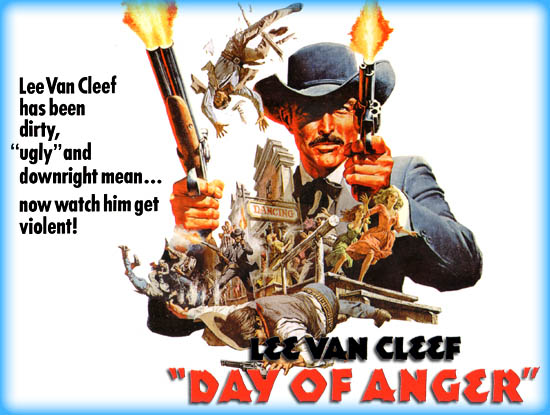
Day of Anger (1967, directed by Tonino Valerii)


During the dying days of the Old West, Clifton, Arizona is a prosperous frontier town.  The leaders of the town are wealthy and well-connected and the saloon has a strictly enforced policy when it comes to only allowing in the right people.  Frank Talby (Lee Van Cleef), the mysterious man who rides into town one day, is considered to be one of the right people.  Scott (Giuliano Gemma) is not.  Because he was born out of wedlock, Scott is looked down upon by the townspeople.  He makes a pitiful living sweeping the streets and doing odd jobs, all while trying to save up enough money to buy himself a gun.

Talby, who has his own reasons for hating the people of Clifton, takes Scott with him into the saloon.  After Scott sees Talby gun down a local roughneck, Scott begs Talby to teach him how to be a gunslinger like him.  Talby reluctantly takes Scott under his wing and teaches him how to be a real outlaw.  Scott also learns that the town of Clifton was founded by money that stolen during a robbery that Talby originally planned.  Talby now wants his money and his revenge.  Working with Scott as his enforcer, Talby takes over the town of Clifton.

At first, Scott has everything that he ever wanted.  The people who once mocked him now respect him as the second-fasted shot in town.  But when Scott’s former boss, Murph (Walter Rilla), reveals that Talby is not as benevolent a mentor as Scott thought he was, the student and teacher turn on each other.

Day of Anger is one of many Spaghetti westerns that featured an older gunslinger taking a younger one under his tutelage.  Lee Van Cleef is so confident and sure himself that it’s easy to see why Scott would idolize him.  Talby is an interesting character because, as ruthless and cold-blooded as he is, he does seem to sincerely like and care about Scott.  They’re both outsiders and they’ve both been screwed over by the town of Clifton and the movie hints that the aging Talby sees the man who he once was when he looks at Scott.  When Talby offers up one final lesson to Scott and tells him that once a man starts killing, he can never stop, Van Cleef says it with downbeat resignation, as if he realizes that Scott is now the one who will have to live his entire life alone, trusting no one, and always listening for the sound of a gun being cocked in the shadows.  Scott finally gets his gun but now he has to decide whether it was worth losing his humanity and Gemma does a good job playing his character’s arc.  Add to that an excellent score from Riz Ortolani and you’ve got a truly superior Spaghetti western.

One final note: Director Tonio Valerii would later be credited for directing another film about an aging gunfighter and his protegee, though there are rumors that the film itself was actually directed by its producer, Sergio Leone.  Starring Terrence Hill and Henry Fond, the entertaining My Name is Nobody re-imagines Day of Anger as a comedy.

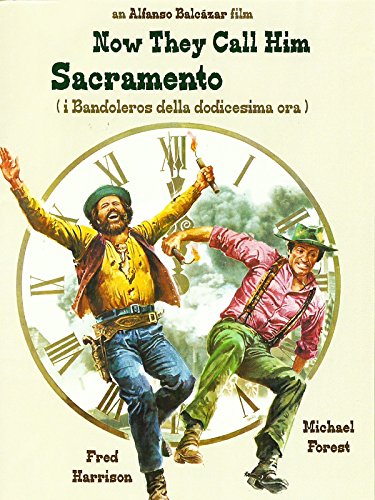
Now They Call Him Sacramento (1972, directed by Alfonso Balcázar)


Sacramento (Michael Forest) is an amiable and laid back Western outlaw who can barely ride his horse and who drifts from town to town.  When he arrives at a local saloon, he meets Big Jim (Fred Harrison) who ridicules Sacramento for only ordering a glass of milk.  What Big Jim doesn’t know is that the milk is Sacramento’s house.  After Sacramento returns, accepts a whiskey-drinking challenge, and proceeds to drink Big Jim under the table, an unlikely partnership is born.

Since it’s the old west and there’s nothing better to do, Sacramento, Big Jim, and Big Jim’s father, Old Tequila (Luigi Bonos), hold up a train and get away with a fortune.  By doing so, they thwart the schemes of an evil banker was planning on robbing the train himself in order to prevent the money from getting to a town of women who the banker wants to evict.  With the banker’s men pursuing them, Sacramento, Big Jim, and Tequila all end up in the town where Sacramento falls in love with the town’s mayor, Jenny McKinley (Malisa Longo).

Now They Call Him Sacramento is an amiable Spanish-made Spaghetti western.  It’s a comedy, one that was obviously based on the very popular series of Italian films that starred Terence Hill and Bud Spencer.  Michael Forest plays the Hill role while Fred Harrison steps into the typical Spencer part.  While Forest and Harrison may not have as strong of a humorous chemistry as Hill and Spencer, they’re still likable in their roles and Forest, in particular, scores just enough laughs to keep the movie entertaining.  (Just watch him trying to get on his horse.)  Now They Call Him Sacramento may be predictable but, like it’s title character, it’s an amiable and likable comedy and the climatic fight scene — in which a fistfight escalates into the entire town has been destroyed — is a minor classic.

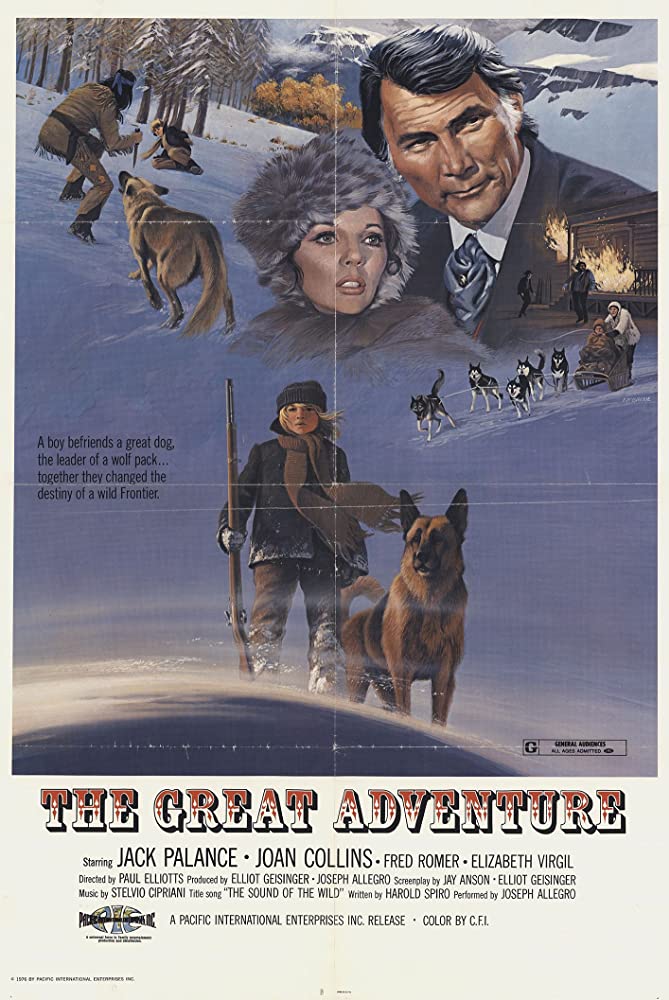
The Great Adventure (1975, directed by Gianfranco Baldanello)


During the Gold Rush, a young boy named Jim Chambers (Fernando E. Romero) rescues a German shepherd from a bear trap.  Jim’s father doesn’t want Jim to adopt the dog but then he gets killed by Indians so what is he going to do about it?  Traveling with two trappers who are also brothers (played by Manuel de Blas and Remo De Angelis), Jim, his sister, Mary (Elisabetta Virgili), and the dog move to the nearby town of Dawson City.

Jim and Mary want to take over the town’s newspaper, which was originally founded by their family.  However, both the newspaper and the town have been taken over by an evil gambler named William Bates (Jack Palance).  Bates may be willing to let the children run the paper but only if they allow him to take their dog.  Meanwhile, one of the trappers falls in love with the local saloon keeper, Sonia Kendall (Joan Collins).

Though The Great Adventure is set in Alaska and tells a typical Western story, it’s an Italian film through-and-through.  Jack Palance and Joan Collins may be top-billed but the movie itself is dominated by actors speaking in poorly dubbed English.  This was one of several films based on White Fang that was released in the 70s and, like many of them, it’s an uneasy hybrid of a treacly family film and a violent western.  On the one hand, it’s a film about two children and their dog trying to publish a newspaper and, on the other hand, Jack Palance kills people in cold blood.  The film is so badly edited to be almost impossible to follow but I’m an unapologetic Jack Palance fan and I almost always enjoy any film that lets Palance do his thing.  Unfortunately, The Great Adventure didn’t have as much Palance as I was expecting and Joan Collins is beautiful but hampered by the film’s G-rating.  (For an actress who was affectionately nicknamed The Great British Open, Collins is always a strange presence in a family film.)  At least the dog was a good actor.  He eventually abandons his newfound family so that he can rejoin a wild dog pack in the wilderness and he probably made the right decision.  He looks very happy at the end of the movie.