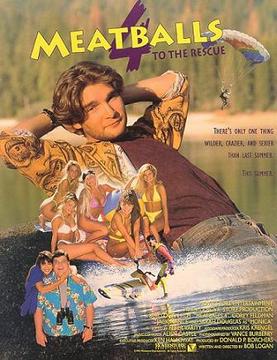
Cinemax Friday: Meatballs IV (1992, directed by Bob Logan)


Neil (Jack Nance … yes, Eraserhead Jack Nance) owns a summer camp where he teaches people how to water ski.  Unfortunately, it’s been a while since Neil’s been a success.  The camp is old and run down and Neil is just too good-hearted to enforce any discipline on his campers or his counselors.  The evil Monica Shavetts (Sarah Douglas) owns the water ski camp on the other side of the lake and she is determined to put Neil out of business.  Fortunately, Neil does have one ace up his sleeve.  One of his former campers, Ricky Wade (Corey Feldman), has gone to become one of the top water skiers in the world and he has returned to help Neil save the camp!

Meatballs IV covers all the usual summer camp hijinks.  The fat kid learns how to believe in himself.  The female counselors all appear in topless.  There’s a shower scene, of course, and there’s also a lot of humor centering around flatulence.  When you’re 11 years old, this movie is pretty cool.  Of course, saving the camp means winning a competition against the evil camp.  At least Sarah Douglas appears to be relishing her evil role.  There is one funny joke where Corey Feldman attempts to hit on a girl by telling her, “I was in Goonies.”  I guess even back then, Feldman knew which one of his movies people would actually remember.

Jack Nance is his usual eccentric self in the role of Neil but he doesn’t get to do much.  Sadly, it was while he was in upstate New York making this film that his then-wife, Kelly Van Dyke, committed suicide in Los Angeles.  Reportedly, Nance had been on the phone consoling her and trying to talk her down.  Unfortunately, a lightning storm knocked out the phones in the middle of Nance’s conversation with Kelly and she hung herself immediately afterwards.  For many of us, Jack Nance would be the main reason we would sit through something like Meatballs IV but knowing that story makes it difficult to watch him in this film.  Both Jack Nance and his wife deserved better.

Meatballs IV started out as a movie called Happy Campers, which was intended to be a low-budget rip-off of the original Meatballs.  Then, someone realized that an even better idea than ripping off a successful film would simply be to change your movie’s title and turn it into a sequel.  Meatballs IV tells the same basic story as the original Meatballs, with a bunch of plucky outsiders proving themselves over the summer.  The main difference is that Meatballs IV has a lot more T&A than the original film and that the first film has Bill Murray as a camp counselor while this one has to settle for Corey Feldman.  It’s not that Feldman’s bad in the role, of course.  Despite what happened to his career in the 90s and beyond, Corey Feldman has always been capable of giving good performances, even if he often didn’t.  (I can’t really blame him.  Would you make much of an effort if you were appearing something like Dream A Little Dream 2?)  It’s just that Corey Feldman is no Bill Murray.  When Ricky first shows up at the camp, he energizes the campers by doing an elaborate dance routine, which he ends by shouting, “Elvis has left the building!”  It has the same energy as that episode of The Simpsons where Homer is hired to voice Poochie on Itchy & Scratchy.  It feels desperate, like the film is trying too hard to convince us that Ricky Wade is as cool as everyone says he is.  If you have to work that hard to convince people that you’re cool, then you’re probably not.
Lifetime Film Review: Murder in the Vineyard (dir by Craig Goldstein)


If you’ve watched enough Lifetime films, you know that it’s rarely a good thing when you’re living near a vineyard.

I mean, sure, there’s a certain amount of romance to them.  Any single mom who lives in a house near a vineyard is guaranteed to meet at least one handsome stranger.  And, of course, living near a vineyard always means that you have a steady supply of wine so that you can have a fun girl’s night with your sassy, sex-obsessed best friend.

But, seriously, bad stuff happens in those vineyards.  It seems like people are always getting chased around the vineyards.  Often times, spending a night in the vineyards is a good way to get yourself murdered.  Even if you somehow manage to survive your night in the vineyards, there’s still a good chance that you’ll end up getting kidnapped and tied up in someone’s wine cellar.  Vineyards just aren’t worth the trouble.  As if to prove my point, Murder in the Vineyard aired on Lifetime on July 18th.  I recorded it on my DVR (which, unlike a vineyard, is always a good place to visit) and then I watched it earlier today.

Murder in the Vineyard starts off on a good note by featuring a murder in a vineyard.  Within the first few minutes, the film has already lived up to its name and that’s definitely something that I appreciated.  Once we get the first murder out of the way, we met Emma Kirk (Helena Mattsson) and her teenage daughter, Bea (Emma Fuhrmann).  Emma has just taken over the family winery and Bea is struggling to fit in at her new school.  While Emma reconnects with a childhood love, Bea strikes up a tentative relationship with the school football star.

Unfortunately, not everyone at the school is happy about the idea of Bea showing up out of nowhere and dating one of the most popular guys in the class.  The snobby cheerleaders, who we’re told have a history of hazing new students, start to target her.  Suddenly, there’s a website that’s devoted exclusively to harassing Bea.  Nasty rumors are being spread about her at school.  When she goes to a party, someone slips something into her drink.  Someone is targeting Bea and, as you might guess from that murder that we saw earlier in the movie, that someone is prepared to go to extremes.

As far as dangerous vineyard movies are concerned, Murder in the Vineyard was a good one.  There was enough suspense over who was harassing Bea that the film worked as a mystery and the scenes when Emma reconnects with Luke (Daniel Hall) were enjoyable.  Helena Mattsson and Daniel Hall made for a cute couple so you definitely hoped the best for them.  Mattsson and Emma Fuhrmann were also believable as mother and daughter and anyone who was overprotected by their mom will be able to relate to some of what Bea goes through.  Probably the best thing about the film is that the vineyard was pretty.  It was a bit like a Lifetime version of Sideways, in that as much emphasis was put on the beauty of the California landscape as on the plot.  If someone’s going to get murdered in your vineyard, it should at least be a pretty one.

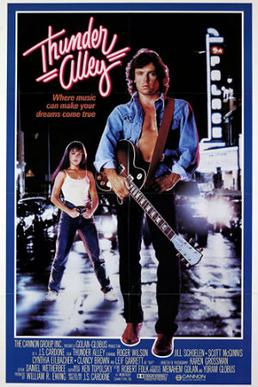
Thunder Alley (1985, directed by J.S. Cardone)


Richie (Roger Wilson) is an Arizona farm boy who can play the guitar like a riot and who, after he joins a band called Magic, discovers that success is a hideous bitch goddess.

Thunder Alley was a Cannon production and it features all of the usual rock movie clichés.  Though Richie is reluctant to join Magic and leave his family behind, he soon emerges as the most talented member of the band and he starts to overshadow the arrogant lead singer, Skip (Leif Garrett).  Donnie (Scott McGinnis), who is Richie’s best friend in the band, gets hooked on cocaine while Richie struggles to resist groupie temptation and remain loyal to his sweet girlfriend, Beth (Jill Schoelen).  The band depends on their road manager, Weasel (Clancy Bown), to get them on stage in time and to protect them from dishonest club owners.

As predictable as it may be, Thunder Alley is one of the better films to be distributed by Cannon Films in the 80s, which is saying something when you consider that Thunder Alley doesn’t feature Michael Dudikoff, Chuck Norris, or Charles Bronson.  The thing that sets Thunder Alley apart from so many other similar films is that, when you actually see Magic perform and hear their music, you actually believe that the band could be a success.  This isn’t one of those films where everyone is feigning enthusiasm for a band that sounds terrible.  Instead, Magic actually sounds like a band that could have gone all the way in 1985.  The scenes of them going from one cheap motel to another while coming together as a band feel as authentic and real as the scenes of Skip angrily realizing that Richie has replaced him as the face of Magic.

Though he was probably cast because he was one of the stars of Porky’s, Roger Wilson was also an actual musician and he’s credible whenever he’s performing on stage.  The same can be said of former teen pop idol Leif Garrett, who plays an actual rock and roller in Thunder Alley and who is surprisingly convincing in the role.  Sporting an impressive beard, Clancy Brown is the ideal road manager while Jill Schoelen brings a lot of life to her small role as Richie’s loyal girlfriend.

For a film that is all about sex, drugs, and rock and roll, Thunder Alley has an innocent side.  Even after he becomes a star and he’s got groupies going crazy every time he steps up to a microphone, Richie’s main concern is making sure that he gets home in time to help his father with the harvest.  Thunder Alley not only asks how far you would go to be a star but also suggests that there’s nothing wrong with choosing, instead, to be a loyal boyfriend or a good son.  Thunder Alley brings it own earnest approach to all of the usual rock and roll clichés and suggests that, with the right combination of talent and hard work, you can have it all, the farm and the stage.

Of course, it helps if you’ve got Clancy Brown looking out for you.


Lifetime Film Review: Mile High Escorts (dir by Sam Irvin)


Mile High Escorts aired on Lifetime on July 19th.  Because I was hosting the #ScarySocial live tweet of City of the Living Dead, I missed it but thanks to my DVR, I was able to record it and watch it earlier today.  Seriously, will there ever be a better invention than the DVR?

Mile High Escorts tells the story of Lauren (Saxon Sharbino).  Lauren is a flight attendant.  She gets to fly all over the world and she’s even put in a request to be assigned to the Paris route.  How could her life get any better?  Well, don’t ever take your happiness for granted because reality soon intrudes on Lauren’s perfect world.  The airline announces that they’re going to be cutting back on flights, which means that Lauren and her friend Ashley (Kara Royster) are going to be flying less and also making a lot less money!  But Lauren needs that money because her father is on the verge of getting kicked out of his home.  And Ashley needs the money because …. well, Hell, who doesn’t need money?  (I totally related to Ashley.)

Fortunately, a chance meeting with Hannah (Christina Moore) might be just the solution to Lauren and Ashley’s problems.  Hannah owns a private airline and she’s always looking for new flight attendants.  Because her airline is exclusively used by wealthy, handsome, and single (if just for the weekend) men, her flight attendants have to be attractive and they have to be friendly.  They also have to be willing to spend time with their clients even after the airplane has landed.  She offers Lauren a job but Lauren, at first, is reluctant.  It sounds too much like an escort service to her, largely because it is.  But then Lauren’s hours get cut and her father’s unpaid bills start to pile up and soon, Lauren and Ashley are mile high escorts!

At first, everything seems great but, as we soon discover, the life of a mile high escort is not a simple one.  Sure, at first, it’s a lot of fun.  All of the passengers are handsome and rich and like to have a good time.  Lauren even makes a connection with Thomas (Esteban Benito), who appears to be a rare nice guy.  But this is a Lifetime movie so you know the fun can’t last.  It turns out that the private airline business is indeed a shady one and someone is murdering mile high escorts.  Can Lauren and Ashley figure out what’s going on before they become the next victims?

I absolutely loved Mile High Escorts.  This movie had everything that I love about Lifetime movies.  The plot was melodramatic and full of scheming and sex.  The clothes were to die for.  The men were handsome.  Christina Moore did a great job keeping you guessing as to Hannah’s motivations and both Saxon Sharbino and Kara Royster were likable in the lead roles.  This was a fun Lifetime film.  You don’t watch a film like this and worry about whether or not the plot makes total sense.  You certainly don’t watch a film like this because you’re hoping for a realistic portrait of what it means to be a mile high escort.  You watch a film like this because it’s fun!  And Mile High Escorts definitely was.


Shell Game (1975, directed by Glenn Jordan)


Max Castle (John Davidson) is a conman who gets arrested in Florida because of a shady real estate deal.  The judge releases him into the custody of his older brother, an attorney named Stephen (Robert Castle).  Though Max is technically just a paralegal, he secretly helps out his brother’s clients but running elaborate scams on the people who have cheated them.  When businessman Lyle Rafferty (Jack Kehoe) embezzles money from his own charity and then lets one of his employees take the fall, Max decides that Rafferty is going to be his next target.

Shell Game was a made-for-TV movie.  It’s pretty obvious that it was meant to be the pilot for a weekly series, where I guess Max would have pulled a con on every different evildoer every week.  Because the show is more interested in setting up who Max is and why he cons people, there’s not much dramatic tension in Shell Game.  Max tricks Rafferty into buying a worthless gold mine and Rafferty falls for every single trick that Max pulls on him.  Unfortunately, since Rafferty is such an easy target, there’s no real pay-off to seeing him get conned.  It’s not like The Sting, where there were real stakes and dangers involved in Paul Newman and Robert Redford’s pursuit of Robert Shaw’s money.  The con is just too easy.

On the plus side, Max’s old partner-in-crime is played by Tom Atkins.  Atkins is so believable as a veteran conman with a heart of gold that he probably would have been a better pick for the lead role than the likable but bland John Davidson.  The rest of the cast is forgettable.

Would Shell Game have worked as a weekly series?  Maybe, especially if Tom Atkins was a part of the regular cast. The idea of a former conman now running scams on other con artists had the potential to be intriguing and Max hints that he was framed by his partners in Florida.  I guess a weekly series would have explored that in greater detail.  However, it was not to be.  This shell game was played once and then forgotten.

Film Review: After Midnight (dir by Jeremy Gardner and Christian Stella)


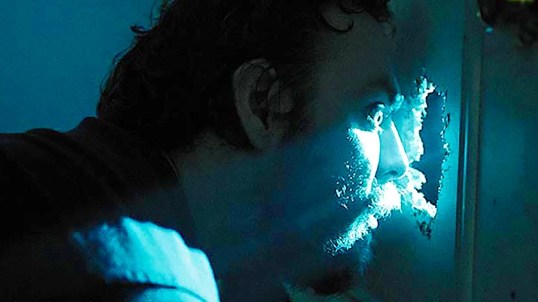
A man named Hank (Jeremy Gardner), who owns a pretty nice house out in the country, is holding a shotgun.  He’s just shot a hole through his front door.  Later, when the sun rises, he’ll walk around his land, carrying his gun and searching for anything that shouldn’t be there.  When an unfamiliar car drives down the road, he fires at it.

Hank has a few reasons for being paranoid.  He’s convinced that there’s something out there.  For the past two weeks, Hank claims that there’s been a monster scratching at the front door.  His friends tell him that it’s probably just a bear but Hank swears that it’s not.  It’s too big and strong and strange to be a bear.  It’s a monster, Hank swears.

Most of his friends assume that Hank is losing it.  It probably doesn’t help that Hank started talking about this monster around the same time that his girlfriend Abby (Brea Grant), left him.  Hanks claims that he has no idea why Abby left.  He assumes that she’s down in Florida with an old boyfriend but he doesn’t know for sure.  Whenever anyone suggests that he might want to think about why he and Abby are having problems, Hank steers the conversation back to the monster that he claims is trying to break into the house.

Hank spends his nights waiting for the monster and thinking about Abby.  We see flashbacks to his relationship with Abby and what we immediately notice is that they always seem to be happy.  In Hank’s memories, we never see them fighting or any hints that there was ever any trouble in their relationship.  Yet, no one seems to be surprised that Abby left Hank so, obviously, it was clear to everyone else that Abby wasn’t happy.  Are we seeing real memories of Hank and Abby or are we just seeing things the way that Hank has chosen to remember them?

After Midnight is a hybrid of a horror movie and a relationship drama.  It’s definitely not a film for everyone.  It moves at its own deliberate pace.  Some of the dialogue is a bit overwritten and I’m still not really sure how Hank managed to get away with firing a shotgun at a moving car.  (The film explains that he’s got a relative on the police force but it still seems like a bit of a stretch.)  There’s a very lengthy scene that is just made up of a largely static shot of Abby and Hank talking about their relationship.  It’s one of those scene that you’re either going to love or you’re going to hate.  Myself, I liked the fact that the film was just as concerned with Abby and Hank as a couple as it was with whatever was hiding in the darkness.  It helped that Gardner and Grant were a likable and believable couple.  That said, if you’re only watching this film for the horror elements, you’ll probably get annoyed.

However, After Midnight also features what is perhaps one of the greatest jump scares that I’ve ever seen.  It occurs towards the end of the film so yes, it does demand a little bit of patience on your part.  But that patience will be rewarded!  Seriously, I’m not going to spoil it but I will say that I literally fell off my couch in shock when it happened.  It was a perfectly executed moment and one that entirely justified that patience required to reach it.

After Midnight is on Prime.  It’s not for everyone but I liked it.

Film Review: Arkansas (dir by Clark Duke)


Oh, Arkansas.

As far as states go, Arkansas usually doesn’t get much respect.  In a country where much of the culture is dominated by city-dwelling secular liberals, Arkansas is a state the remains stubbornly rural, religious, and conservative.  If your grandparents were a state, they’d probably look a lot like Arkansas.  Arkansas is viewed as being old-fashioned and when it does make the news, it’s usually not for anything that anyone in the state particularly wants to brag about.  Democrats will always view Arkansas as being the home of Mike Huckabee.  Republicans will never forgive the state for springing the Clintons on the rest of the nation.  (Interestingly enough, Mike Huckabee and Bill Clinton both grew up in the same tiny town.)  Little Rock has gangs and government corruption.  Hot Springs has gamblers looking to hide out from the mob.  Fouke has the Boggy Creek Monster while Ft. Smith is best-known for having once been home to the hanging judge, Isaac Parker.  You get the idea.  When it comes to the way that the rest of the country views the state, it often seems as if poor Arkansas just can’t catch a break.

With all that in mind, I have to say that I really love Arkansas.  My paternal grandparents lived in Arkansas and I’ve still got relatives all over the state.  Arkansas was one of the many states where my family lived while I was growing up.  (The others were — deep breath — Texas, Oklahoma, New Mexico, Colorado, and Louisiana.)  We would stay in Arkansas for months at a time, depending on how well my mom and dad were getting along at the time.  It’s an unpretentious state, one that’s full of friendly, no-nonsense people and beautiful countryside.  I have a lot of good memories of Arkansas.  It’s always in the back of my mind that, wherever I’m living, I can always just go back to Arkansas and spend the rest of my life living in a small town with my cousins.  Of course, I’d probably end up miserable over the lack of movie theaters.  Whenever I’m living in the city, I find myself yearning for the simplicity and decency of the country.  Whenever I’m in the country, I find myself missing the excitement of the city.

The Natural State (as Arkansas is officially nicknamed) is not only the setting for some of my most cherished memories.  It’s also the setting for a film called, appropriately enough, Arkansas.  The directorial debut of actor Clark Duke, Arkansas tells the story of four very different men.  Kyle Ribb (Liam Hemsworth) is quiet and rather stoic.  Swin Horn (Clark Duke) is talkative, eccentric, and perhaps a bit too cocky for his own good.  They both work at a national park, where their boss is a veteran ranger named Bright (John Malkovich).  Of course, it doesn’t take a lot of effort to notice that neither Kyle nor Ribb really seem to do much work at the park.  And, for that matter, Bright certainly does own a big and impressive house for someone who has spent the majority of his life as a ranger….

Kyle, Swin, and Bright are actually drug dealers.  They transport drugs all over the southern half of the United States.  Kyle and Swin are supervised by Bright.  Bright, meanwhile, reports to the mysterious Frog.  Kyle and Swin have never actually met Frog and there are rumors that he might not even exist.  Of course, the film has already revealed to us that Frog (played by Vince Vaughn) does exist and is a local pawnshop owner.

Kyle narrates the film, informing us that the difference between Southern organized crime and Northern organized crime is that, in the South, it’s not all that organized.  As Kyle explains it, the infamous Dixie Mafia is not so much an organization as it’s just a collection of undisciplined lowlifes who have no real integrity or loyalty to anyone else.  When you become a drug dealer in the South, you’re a drug dealer for life.  There’s no going back if you change your mind.  You start out at the bottom of the ladder and, whenever someone above you if either murdered or imprisoned, you get your chance to move up.  No one is ever sure who is working for who or who can be trusted.  Every order from the boss is examined and re-examined as the two dealers try to figure out whether or not they’ve won the trust of the mysterious Frog.

Unfortunately for Kyle and Swin, a misunderstanding leads to violence and several deaths.  With no way to directly communicate with Frog to let him know what exactly happened, Kyle and Swin know that their lives could be in danger.  The film follows Kyle and Swin as they prepare for their ultimate meeting with Frog while, at the same time, detailing in flashback how Frog himself eventually came to his position of power.  Throughout the entire film, we watch as history repeats itself.  As Kyle said, once you’re a drug dealer, you’re a drug dealer for life.

Arkansas is a surprisingly low-key film.  Kyle, Swin, Bright, and Frog all manage to be both very laid back and very aggressive at the same time.  (Anyone who has spent anytime with a large group of rednecks will understand what I’m talking about.)  As a director, Clark Duke is as interested in capturing the rhythms of every day life in Arkansas as he is in orchestrating the inevitable violence that results from all of the film’s betrayals and mistakes and some of the best scenes in the film just feature Kyle and Swin talking about nothing in particular while driving down the interstate.  The film’s mix of cheerful goofiness and existential horror will be familiar to anyone who has ever gotten lost on the way to Hot Springs.

Liam Hemsworth and Clark Duke are sympathetic in the lead roles, though Hemsworth’s Southern accent does slip a few times.  Swin meets a woman (Eden Brolin) in a grocery store and their subsequent romance manages to be both creepy and touching at the same time.  John Malkovich is, as usual, wonderfully eccentric.  That said, the film is pretty much dominated by Vince Vaughn, who plays Frog as being both dangerously ruthless and also as someone who understands that his eventual downfall is inevitable.  Frog came to power by betraying his boss and, as played by Vaughn, Frog is very much aware that he’s destined to eventually be betrayed as well.  Frog has made peace with both his place in the world and the reality of his situation and, in many ways, that makes him an even more dangerous character than he would be otherwise.  He has nothing to lose and he knows it.

Obviously, I liked Arkansas, both the state and the movie.  It’s an well-done work of Southern pulp.

A Cry For Help (1975, directed by Daryl Duke)


Harry Freeman (Robert Culp) is a radio talk show host in California who specializes in abusing his listeners.  They call in and they tell Harry their problems and their opinions and then Harry tells them that they’re stupid and whiny.  Despite (or maybe because of) his abrasive style, Harry is very popular.  Everyone on the California coast listens to him in the morning.

When a depressed teenage girl named Ingrid (Elayne Heilveil) calls his show and says that she’s going to kill herself, Harry doesn’t taker her seriously and tells her to go ahead and do it.  It’s only after he hangs up on her that he realizes that she might have actually been telling the truth.  When Harry calls the cops to tell them about the call, they treat him in much the same way that he treated Ingrid.  They refuse to take him or Ingrid seriously.

Not getting any help from the police, Harry turns to his listeners.  He asks them to help him track down Ingrid and to keep her from harming herself.  The film alternates between scenes of Ingrid meeting people throughout the day and then Harry in his studio, taking calls from those people.  Since Ingrid is no longer listening to Harry’s show, she has no idea that people are looking for her and it becomes a race against time to find her before she carries out her plans.

A Cry For Help is largely a showcase for Robert Culp, a talented actor whose career was often harmed by his own independence and reputation for being abrasive.  That reputation made him the perfect choice to play Harry and Culp gives a terrific performance as a not particularly nice man trying to do the right thing for once.  Interestingly, the film keeps it ambiguous as to whether Harry has really had an attack of conscience or if he’s just trying to save Ingrid for the publicity and the ratings.  Even at the end of the film, it’s hard to know if Harry was really worried about Ingrid ending her life or if he was just looking to promote himself.

Along with Culp, the film’s cast is a who’s who of 70s television actors.  Among those who Ingrid and Harry deal with during the day: Michael Lerner, Bruce Boxlietner, Ken Swofford, Chuck McCann, Julius Harris, and Gordon Jump.  Seeing Jump in the film was especially interesting since he would later star in another production about the potential power of radio, WKRP In Cincinnati.

A Cry For Help is a suspenseful made-for-TV movie from 1975.  It’s never been released on DVD but it is on YouTube.

Cease Fire (1985, directed by David Nutter)


Tim Murphy (Don Johnson, with a huge mustache) is a Vietnam vet who is still haunted by his actions during the war. As a result, he can’t hold down a job, he’s abusive to his wife, and he’s woken up in the middle of the night by constant nightmares.  One day, at the unemployment office, he meets another vet named Luke (Robert F. Lyons) and the two of them bond over their shared experiences.  While Tim tries to come to terms with what happened during the war, his wife Paula (Lisa Blount) tries to keep the household together.

Barely released in 1985, Cease Fire is a largely but unfairly forgotten Vietnam film.  According the film’s imdb page, Don Johnson once told an interviewer that he couldn’t even remember starring in a film called Cease Fire.  That piece of trivia sounded too good to be true and, after doing a google search, I have not been able to come across any interviews where Johnson says that.  In fact, in an interview with the AV Club, Johnson says that he filmed Cease Fire in Miami shortly after doing his first audition for Miami Vice.  According to Johnson this was in the early stages of Miami Vice‘s development, before Michael Mann was even attached to the project.  Since Miami Vice premiered (with Mann producing and Johnson starring) in 1984, that probably means that Cease Fire was filmed in either 1982 or 1983.  Considering that it was a low-budget and talky film about a very unpopular war, it is not surprising to discover that it sat on the shelf for a few years before finally being released in order to capitalize on the sudden stardom of its main actor.

Even though both take place in Miami and feature Don Johnson as a Vietnam vet, Miami Vice and Cease Fire are as different as night and day.  Cease Fire is a low-key and muted character study of a traumatized man who is struggling to face what happened in the past.  There’s not much action but there is a lot of talking.  Some of the dialogue is clumsy and obvious but both Don Johnson and Robert F. Lyons give good performance as the traumatized vets and Cease Fire is honest enough to admit that, even if he does take a few steps in the right direction, Tim still has a long road ahead of him.  Cease Fire, which never got a DVD release but which is available on Amazon Prime, is a sincere look at the reality of PTSD and the struggle that many vets face when they first return home.  It’s not a perfect movie but it’s saved by its own good intentions and Johnson’s sincere performance in the main role.

Cease Fire was also the first film to be directed by David Nutter.  Nutter is today probably best known for directing several episodes of Games of Thrones, a show that has even less in common with Cease Fire than Miami Vice.

Repo Jake (1990, directed by Joseph Merhi)


Jake (Dan Haggerty) is a former Marine and sock car racer from Minnesota who comes out to Los Angeles in search of a new beginning.  A fan of John Wayne, the laid back Jake always tries to do the right thing.  His first day in L.A., he thwarts a purse snatching and gets a girlfriend named Jenny (Dana Bentley).  He also gets a job as a repo man.  He repossesses cars from people who aren’t paying their bills and he always does it with a polite smile on his face.  He’s the nicest repo man around but that doesn’t keep him from getting on the wrong side of some of the people he meets.  When he repossesses the car of a local pornographer, the mob demands that Jake take part in an illegal demolition derby.  If he wins, he’ll live.  If he loses, both he and everyone who matters to him will die.

Haggerty’s genial presence is the best thing about Repo Jake, a low-budget movie that would probably be unwatchable without him.  Haggerty’s so likable that he makes scenes work even when they shouldn’t.  My favorite moment was when he walked in on a sleazy photographer trying to manipulate a model into posing topless. “I’m here to repossess your car and I’m pissed off,” Jake politely says before knocking the photographer across the room.  If you didn’t know who Dan Haggerty was, you might think that the producers just grabbed a real repo man off the streets and made him the star of their movie.  With his big beard and his mellow vibes, Haggerty was a legitimate Hollywood character.  Though he found fame playing Grizzly Adams on television, he was arrested in 1984 for selling cocaine to an undercover police officer and his career never really recovered.  Haggerty went from being a TV star to appearing in movies like Repo Jake.

The plot of Repo Jake is pretty dumb and nearly impossible to follow.  It never makes sense that Jake would be forced to take part in the demolition derby.  Actually, nothing about the movie makes sense but a lot of cars get wrecked, a helicopter gets repossessed, and Dan Haggerty knocks a purse snatcher through a store window and it’s all so stupid and Jake’s so friendly that the end result is actually pretty cool.  Repo Jake is saved by the sheer likability of Dan Haggerty.  It’s hardly a good movie but, at the same time, it’s not a terrible way to spend 90 minutes of your life.