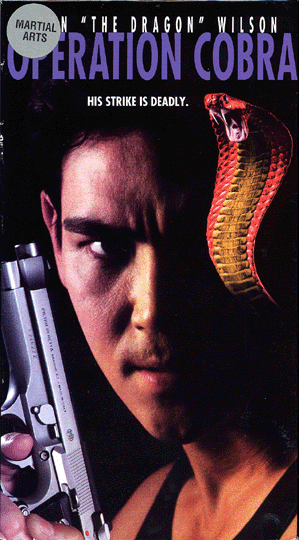
Cinemax Friday: Operation Cobra (1997, directed by Fred Olen Ray)


Interpol agent Kyle Connors (kickboxing legend Don “The Dragon” Wilson) is sent into a tailspin when his partner, Trevor (Rick Hill), is apparently killed during a failed operation.  Connors’s boss (played by the film’s director, Fred Olen Ray) orders Connors to go on leave so Connors promptly heads over to India.  Connors is planning on capturing Daveed (Evan Lurie), the drug dealer who Kyle blames for murdering Trevor.

While searching for Daveed with the help of an honest (and obviously doomed) cop named Ravi (R. Madhavan), Connors has several battles with a group of Indian ninjas who are intent on capturing a mysterious woman named Shallimar (Deepti Bhatnagar).  Connors also meets yet another mysterious woman, Callista (Tane McClure), who claims to be an intelligence agent and who tells him that Daveed’s boss is actually the enigmatic Victor Grayson (Michael Cavanaugh).  While Connors is tracking down Grayson, he finds out about yet another shadowy crime boss known as The Hydra and a computer disk that can apparently be used to hack into computer in the known world.

Can you guess who The Hydra actually is?

As any aficionado of late night Cinemax can tell you, Don “The Dragon” Wilson and Fred Olen Ray are a match made in heaven.  If you were growing up in the 90s, you knew Don “The Dragon” Wilson was cool because everyone who talked about him used both his given name and his nickname.  He was never just “Don Wilson” or “The Dragon.”  Instead, he was Don “The Dragon” Wilson.  Though Wilson never had much screen presence, he was a good on-screen fighter and the fact that he wasn’t a typically muscle-bound action hero made him more interesting than an ‘actor” like Steven Seagal.  Fred Olen Ray, meanwhile, was smart enough to get out of the way and let Wilson kickbox his way through the movie.  Though the story is nearly impossible to follow, a few good fight scenes more than make up for it.  Ray understands that is what most of his audience (maybe all of his audience) is going to be watching for.

Though the plot of Operation Cobra never makes any sense, most people will know what they’re going to get when they see who directed it and who is starring in it.  Even though the film wasn’t shot in the most photogenic areas of India (because that would have cost too much money), it still makes good use of its location footage and it’s hard not to be entertained by a film features Don “The Dragon” Wilson, Tane McClure, Rick Hill, and Evan Laurie.  That’s B-action movie nirvana.  I also liked that it was never entirely clear what the computer disk actually did but that it was extremely important than it not fall in the wrong hands.  It was the ultimate MacGuffin and because the film was made in 1997, it wasn’t necessary to go into details.  All that had to be said was that it had something to do with computers and that automatically made it a big deal.  That’s just the way things were in the 90s.
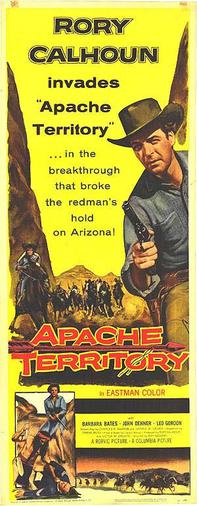
Apache Territory (1958, directed by Ray Nazarro)


In this B-western, Rory Calhoun plays Logan Cates, an old west drifter, while traveling through the desert, comes across a young woman named Junie Hatchett (Carolyn Craig).  Junie’s parents were settlers who were captured and killed by a group of Apaches.  Knowing that the Apaches will still be looking Junie, Logan takes her to a nearby canyon where there’s water and shelter.  Soon, other victims of the Apaches start to show up at the canyon.  With their supplies dwindling and the Apaches surrounding them, Logan has to keep everyone alive and lead them to safety.

Complicating matters is that one of the people who shows up at the canyon is Logan’s ex-girlfriend, Jennifer (Barbara Bates).  Jennifer is traveling with her new husband, the wealthy (and therefore cowardly) Grant Kimbrough (John Dehner).  Also seeking shelter at the canyon are a group of Calvary officers, a Pima Indian named Lugo (Frank DeKova), and a naive teenage cowboy named Lonnie (Tom Pittman).

Based on a novel by Louis L’Amour, Apache Territory is a pretty standard western.  Some of the battle scenes are surprisingly brutal — particularly when one of the Calvary officers gets hit by a flaming arrow — but otherwise, this is a typical B-western, the type of movie that would have been the second part of a double bill at a Saturday matinee.  Logan Cates is able to survive because, unlike Grant Kimbrough, he knows and respects the land and, unlike the Calvary officers, he respects his enemy.  He’s a typical western hero, though well-played by Rory Calhoun.

The main problem with the film is that, for a film about a group of people trapped in one location, it never achieves any sense of claustrophobia.  The size of the canyon seems to change from shot to shot.  The film’s finale involves a well-realized dust storm but it still never reaches the type of action-packed conclusion that most western fans will be hoping for.  It ends with a whimper instead of a bang.  It feels more like an extended episode of Gunsmoke or The Virginian than a feature film.

This one will be best appreciated by undemanding fans of the genre.

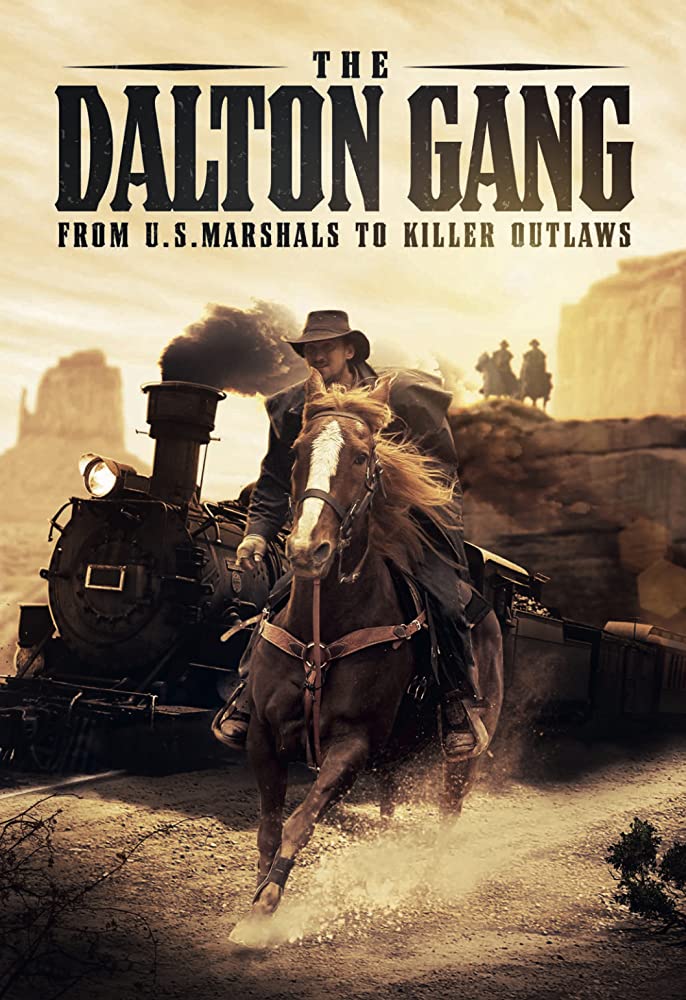
The Dalton Gang (2020, directed by Christopher Forbes)


In this western, Arkansas Sheriff Frank Dalton is gunned down by an outlaw.  Seeking justice, Frank’s three brothers — Bob, Gant, and Emmett — become members of law enforcement themselves.  They kill a wanted outlaw but when they try to collect the reward, they’re told that the reward money has already gone to fund other projects.  (It’s hinted that the new sheriff stole it for himself.)  They’re also told that, since they’ve been smuggling whiskey to the Indians, they probably won’t get paid their salary.  The Dalton Brothers quit law enforcement and decide to become outlaws themselves.

The Dalton Gang is a low-budget western that tells the true story of the Dalton Brother and their career as outlaws.  Some of the film’s wildest developments — like the Gang attempting to rob two banks in one day — are based on fact.  Unfortunately, though the film gets the facts right, it’s done in by its own low budget.  From the muddy soundtrack to the tiny cast to the overuse of slow motion, everything about The Dalton Gang reminds you that you’re watching a movie and not particularly well-produced one.  Some members of the cast have the right look for a dusty western but the performances are so inconsistent that it’s sometimes difficult to watch the film with a straight face.  Jerry Chessman plays Bob Dalton and yells his lines so loudly that it’s hard not to jump whenever he starts speaking.  Undoubtedly due to the low budget, much of the action takes place off-screen.  The Dalton brothers spend a lot of time riding up to trains and then later talking about how much money they stole from the train but it’s rare we ever get to see them actually robbing anything.

Personally, I would like to see more westerns being released.  In the modern era, it’s a genre that seems to go through brief moments of resurgence followed by long periods of being pushed to the side.  Hopefully, though, future westerns will be better than The Dalton Gang.

Wedlock (1991, directed by Lewis Teague)


This HBO film opens with a shot of an urban skyline and a title card that reads “somewhere in the future.”  However, the city looks like a present-day city and the cars don’t fly and all of the clothing is 90s fashionable and the people in the movie use pay phones.  Since Wedlock was made in 1991, I guess the movie takes place in … 1992?  Maybe 1993.

Frank (Rutger Hauer), Noelle (John Chen), and Sam (James Remar) are professional thieves who have just managed to make a big score.  They’ve stolen several million dollars worth of diamonds.  Unfortunately, Sam tripped an alarm during the theft so Frank had to make off with the diamonds.  After he hides them, Frank goes to the rendezvous point to meet up with Sam and Noelle.  His partners betray him, shooting Frank and, after discovering that he doesn’t have the diamonds him, leaving him for dead.

However, Frank survives.  He ends up getting sent to Camp Holliday, a prison run by Warden Holliday (Stephen Tobolowsky, who you’ll recognize as Ned Ryerson from Groundhog Day). The Warden explains that his prison is more progressive than most.  Not only is the prison co-ed but prisoners are allowed more freedom to move around.  The only catch is that all the prisoners wear an explosive dog collar.  Each prisoner has a randomly selected mate, someone to whom they are wedlocked, if you will.  Move more than 100 yards away from your partner and boom!  Both collars go off and two prisoners end up losing their heads.

The Warden wants to know where the diamonds are hidden so he sets about torturing Frank (who has been given the prison name of Magneta) but he soon discovers that it won’t be easy to break Frank Warren.  Even after Frank gets locked in a sensory deprivation tank, he just laughs and says the diamonds are with Santa at the North Pole.  Another prisoner, Ivory (Mimi Rogers) approaches Frank and says that she’s figured out that she’s his partner.  She wants to escape and she needs Frank to come with her.  But can Frank trust her and, if she’s wrong, won’t both of their heads explode?  Then again, who in the near future of the 1990s would turn down a chance to run off with Mimi Rogers?  Meanwhile, Frank’s partners are waiting for him to escape from the prison so that they can follow him to wherever the diamonds are located.

Though the plot may be ludicrous, Wedlock works because it has a good cast (even Danny Trejo has a small role) and it was directed by Lewis Teague, who started his directorial career under Roger Corman and who has always understood how to put together a good B-movie.  The prison scenes are more interesting than the scenes that take place in the outside world but the exploding head effects are cool and Rutger Hauer, James Remar, and Mimi Rogers are always enjoyable to watch no matter what they’re doing.

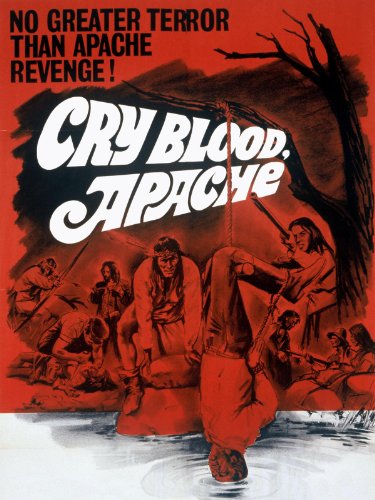
Cry Blood, Apache (1970, directed by Jack Starrett)


A group of old west outlaws stumble across an Apache camp.  Though everyone’s friendly at first, the outlaws discover that the Apaches have gold so they kill all of the Apaches except for one, Jemme (Maria Gahua).  They drag Jemme off with them, intent on having their way with her after forcing her to lead them to more gold.  Only one member of the gang, Pitcallin (Jody McCrea), is willing to protect Jemme and treat her with kindness.  (In fact, Pitcallin is such a nice and decent person that it doesn’t make any sense for him to be riding with the outlaws in the first place.)  Meanwhile, Jemme’s brother (Marcus Rudnick) discovers the camp and, upon discovering his family dead, cries and screams for several minutes.  Then he sets off for revenge against the gang.

The best thing about Cry Blood, Apache is that it opens with Joel McCrea, father of Jody, playing the elderly Pitcallin and riding his horse to the where the old Apache camp used to be.  While the old Pitcallin is looking around, he hears the voices of the former members of the gang and then the rest of the film is told in flashback.  This makes it seem like Cry Blood, Apache is going to be about an old outlaw coming to terms with the terrible things that happened in the past.  Unfortunately, Joel McCrea’s only in the movie for about two minutes and since the movie sat on the shelf for three years before it was finally released, it’s probable that his scenes were shot long after the rest of the movie.  Along with starring in the film, Jody McCrea also produced it and Joel probably only agreed to lend some star power to the movie as a favor to his son.  But teasing western fans with Joel McCrea, just to then bring out Jody McCrea is just plain unfair.

Other than the opening scenes with Joel McCrea, the rest of this film is so poorly put together that it’s a struggle to sit through.  Cry Blood, Apache is edited in such a haphazard manner that it’s nearly impossible to follow the plot.  While the gang searches for more gold, Jemme’s brother searches for the gang but the film never makes it clear how close the brother is to finding the gang so there’s zero suspense generated.  Jody McCrea was too naturally amiable to play a believable outlaw.  There was nothing tough about him.  Meanwhile, both Marcus Rudnick and Maria Gahua overact to such an extent that scenes that should be emotionally wrenching become unintentionally humorous instead.

Cry Blood, Apache was directed by Jack Starrett, who went on to direct far better movies than this one.  He also appears in the film as a member of the gang, the bible-quoting Deacon.  Even though he’s got long hair and is considerably younger in his film, most viewers will hear his voice and immediately recognize him as Galt, the sadistic cop from First Blood.

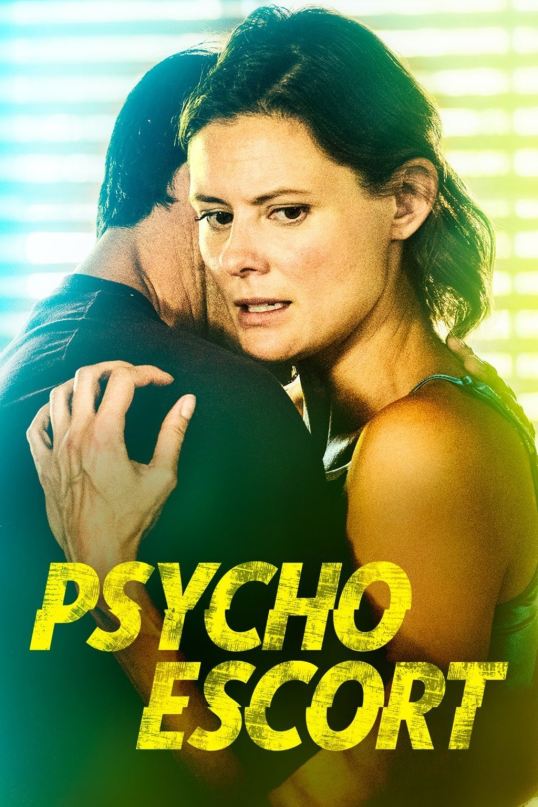
Lifetime Film Review: Psycho Escort (dir by Monika Lynn Wesley)


Psycho Escort is a film that epitomizes the concept of “It seemed like a good idea at the time.”

Put yourself in the shoes of Diane (Victoria Barabas).  She’s a widow and she’s still misses her husband so much that she can’t even bring herself to sleep in the master bedroom.  Instead, she sleeps in the guest bedroom, an exile in her own house.  She’s a single mother, trying to raise a young son who regularly comes home from school with a black eye.  On top of all that, she’s got a job that demands a lot of her time and she works with a bunch of people who are just waiting to stab her in the back.

But, it’ll all be worth it if she gets the big promotion and becomes a partner in the firm.  With a promotion, she’ll finally be making enough money to provide a little bit of security for her son.  And if that means that she has to miss an occasional soccer game and that she doesn’t get a chance to date much, so be it.

The only problem is that, in order to get that promotion, she’s going to have to suck up to the boss and that means going to company parties.  And showing up at those parties without a date would totally make her look like a boring loser.  Her sister has a helpful suggestion, though.  Why not hire an escort!?

No, not that type of escort!  Apparently, there’s a rent-a-date firm.  You send them some money and they send you a handsome man who will pretend to be your date or your boyfriend and who will basically charm everyone in your social circle and totally make all of your friends jealous.  Even though Diane is skeptical, she finally agrees to give them a call.  I mean, it seems like a good idea at the time.  They send over Miles (Nick Ballard).

At first, Miles seems perfect.  He’s charming.  He’s handsome.  Diane’s boss likes him and even invites him to play a round of golf.  In fact, Miles is such a hit that, when Diane has to go to another party, she calls the firm and requests Miles a second time.  Diane starts to open to Miles about her husband’s death.  Miles starts to open up about his wife’s death.  Soon, Miles is becoming more than just an escort.  Soon, he’s becoming a real boyfriend….

The only problem of course is that …. well, it’s right there in the title.  Miles is a psycho escort!  And soon, Miles is becoming just a bit obsessed with Diane, to the point that he’s willing to commit murder to prove his love….

Well, you know how it goes.  This is a Lifetime movie and, as I’ve said countless times, the fact that these films all follow a certain formula is one of the most likable things about them.  There’s something comforting about watching these films and knowing that someone is making a huge mistake that you would never make (except, of course, you totally would if you were in Diane’s situation).  Psycho Escort is elevated by the performance of Nick Ballard, who is dangerously likable in the role of Miles.  It’s easy to see how someone could fall for Miles and, as a result, Diane doesn’t come across as being as naive or willfully blind as one might expect.  Victoria Barabas also gives a very good performance as Diane and is especially effective when she’s talking about the death of her husband.  The trauma is obviously still with her and has left her vulnerable to someone like Miles.  As a result, you don’t quite roll your eyes as much at Diane as you might at some people who let a total stranger into their life.  There’s a reality to her situation that elevates the story.

Psycho Escort.  Watch it the next time you’re tempted to rent a date.


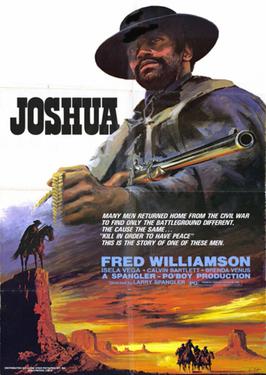
Joshua (1976, directed by Larry Spangler)


One day, as the American Civil War is drawing to a close, a group of outlaws besiege a homesteader’s cabin.  While they allow the homestead to survive, they kill his maid, Martha (Kathyrn Jackson) and they kidnap his mail order bride (Brenda Venus).  The very next day, Martha’s son, Joshua (Fred Williamson), arrives home from serving in the Union Army.  As soon as Joshua find out what has happened, he grabs his late father’s rifle, jumps on his horse, and set off for revenge.  When the sheriff warns him that the gang is violent, bloodthirsty, and large, Joshua replies, “I just finished fighting a war, Sheriff.  I’ve killed twice that.”

Joshua finds Fred Williamson doing what he does best.  Dressed in all black and not showing a hint of emotion, Williamson dominates the screen as he rides across the countryside and finds creative ways to kill the members of the gang.  Along the way, he also meets and has a brief fling with Maria (Isela Vega), a female gunslinger.  Even though Joshua proves time and again that he can handle himself while fighting several men at once, he chooses to take the members of the gang out one-by-one.  He savors getting his revenge, as only Fred Williamson could.  (Also, if Joshua took out the entire gang at one time, it would be a really short movie.)

Williamson wrote the script for Joshua and produced it through his own production company.  That probably explains why no one else in the film really has a chance against Joshua.  There’s really nothing, from firing a gun to battling a rattlesnake to tracking a group of cold-blooded killers, that Joshua doesn’t do well.   Not a lot happens in Joshua but Williamson does a good job of playing the taciturn title character and he nails the scene where he tells a naive cowboy that killing is not something to take likely.  As always, Fred Williamson is the epitome of cool.  Unfortunately, the film drags whenever Williamson isn’t on screen and the members of the gang are pretty much indistinguishable from each other.  People looking for a serious or realistic western will be disappointed but if you just want to watch Fred Williamson be Fred Williamson for 90 minutes, Joshua fits the bill.

Lifetime Film Review: Sinister Stalker (dir by Michael Feifer)


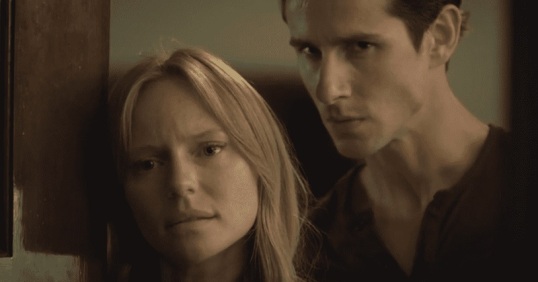
Also known as Sinister Savior, this film tells the story of Karen (Marci Miller), an emergency room doctor and a recovering alcoholic.  One night, as she’s leaving an AA meeting, she’s attacked by an apparent mugger.  Fortunately, for her, Daniel (Kelly Blatz), just happens to be walking by the scene.  He steps forward and fights off Karen’s attacker, probably saving her life in the process.  However, during the fight, Daniel’s arm gets slashed with a knife.

Being a doctor (and, according to her best friend, also being way too trusting), Karen takes Daniel back to her house so that she can take a look at his wounded arm.  Daniel seems friendly-enough.  He says that he’s in real estate and that the reason he was in the neighborhood was because he was checking out potential properties to buy and sell.  Daniel also tells Karen that he’s never been in a real fight before.

Daniel, it turns out, already has several scars.  When Karen notices them and asks about them, Daniel says that he got them in a bar fight.  But …. uhmm, Daniel ….. you said you’d never been in a real fight before.  Daniel quickly explains that he wasn’t actually in the fight, he just got stabbed accidentally.  That may make sense but, even if Daniel isn’t lying about his past history, why does he have pictures of Karen’s house on his phone?

For those of us watching, red flags start to go up as soon as Daniel shows up.  That’s because this is a Lifetime film and, if you’ve seen enough of these films, you know better than to trust any good Samaritans.  The fact that this movie is called Sinister Stalker gives us another reason not trust Daniel.  When Daniel starts to talk about how much he and Karen have in common and makes a rather awkward joke about how they must have a connection, those of us in the audience are like, “Get out of there!”

But, of course, if Karen did that, there wouldn’t be a movie.  So, instead, Karen does stuff like take a shower while there’s a complete stranger hanging out in her home.  Meanwhile, Daniel is walking around the house and basically invading her space.  Various friends of Karen come by to check on her and Daniel tries to send them all away.  We know that there’s something not right about Daniel.  It’s just a question of how long it’s going to take Karen to figure that out as well.

Though the story may be familiar, Sinister Stalker does experiment a little with the typical Lifetime format.  As opposed to most Lifetime films, which usually take place over several days and typically feature a lot of visits to the neighborhood coffeeshop and at least one yoga class, the action in Sinister Stalker takes place in one location and over the course of just one night.  The film almost seems to play out in real time, which actually pays off surprisingly well.  The film actually does a petty good job of generating some suspense as to how long it’s going to take Karen to figure out that Daniel’s motives are not exactly pure.

Kelly Blatz is perhaps a little bit too obviously sinister as Daniel but Marci Miller does a great job in the role of Karen.  She plays up Karen’s hesitation just enough to suggest that she had her doubts about Daniel from the beginning but, at the same time, she also feels that she has an obligation — as both a doctor and someone whose life was saved by Daniel — to check out the wound on his arm.  In the small but important role of an alcoholic who keeps calling Karen for help, Lew Temple makes a good and sympathetic impression.

Sinister Stalker plays with the typical Lifetime format and, for the most part, it pays off.  Watch it the next time you’re tempted to let a complete stranger hang out in your house for a few hours.

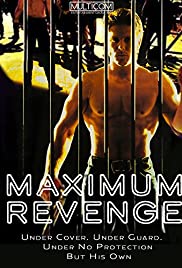
Cinemax Friday: Maximum Revenge (1997, directed by Fred Olen Ray)


When a new maximum security prison is finally ready to be opened and filled with dangerous criminals, Warden Glover (Arthur Roberts) gives a tour to reporter Tracy Quinn (Landon Hall).  Unfortunately, the tour is interrupted when a group of terrorists led by Murdock (John Lazar, who is best-known for playing the homicidal record producers in Beyond The Valley Of The Dolls) infiltrate the prison and take over.  Their plan is to set off a nuclear bomb in Los Angeles and trick the United States into a retaliatory strike against the Middle East.

Fortunately, the Warden is able to free the five prisoners who had already been transferred to the prison before it was taken over by terrorists.  It’s now up to the prisoners to defeat the terrorists and defuse the bomb.  They’ve only got an hour to prevent a war!  Fortunately, the prisoners are being led by former CIA agent, Mace Richter (Paul Michael Robinson).  Mace is only in prison because he was framed after a hostage rescue went wrong.  (It turned out that the hostage was in on the plot so Mace killed him.)  Amazingly, the terrorists from that operation are the same terrorists who have now taken over the prison.  What a coincidence!

Maximum Revenge is a Fred Olen Ray movie so you know what you’re getting.  The film rips off Die Hard by having Mace and the crew take out the terrorists one-by-one.  Despite the fact that they’ve only got an hour to stop a nuclear bomb from going off, Mace and Tracy still drop everything so that they can have sex in one of the prison offices.  It seems like that could have waited until after World War III had been prevented but then again, it’s a Fred Olen Ray film.  No matter what else can be said about Fred Olen Ray, he knows what his target audience is watching for.

Paul Michael Robinson is not an extremely compelling action star and the fight scenes are pretty rudimentary.  The prison is obviously an office building and the frequent inserts of the bomb very slowly counting down from 60:00 are good for a laugh or two.  (Most bomb timers count down in seconds but I guess this one was meant to count down in minutes.  At one point, though, the timer reads 16:86.)  Even though the prison doesn’t appear to be that big and the terrorists aren’t that impressive, the timer is still somehow allowed to get all the way down to 00:01 before anyone does anything about it.  That tells you all you need to know.  The best thing about the movie are the end credits, which are filled with joke names.  My favorite was the electrician named Sparks McGee.

Lifetime Film Review: Killer Daddy Issues (dir by Danny J. Boyle)


“What a nice ranch!” I thought as I watched the opening scenes of Killer Daddy Issues.

Listen, I live in Texas.  I’ve grown up all over the Southwest.  I’ve seen a lot of really nice ranches and I’ve seen a lot of really mediocre ranches and the ranch in Killer Daddy Issues is definitely a nice one.  The scenery is green and bountiful.  The hills are covered with beautiful trees.  There’s a big river nearby.  Majestic horses run across the fields.  This is the type of ranch that you definitely want to visit.  Unfortunately, even the best ranches have their issues.

This ranch is currently owned by Grace (Carolyn McCormick) and her daughter, Carrie (Jillian Murray).  They inherited it and a good deal of money after the death of Grace’s husband.  However, a new man has entered Grace’s life.  Carrie is shocked when Grace returns from a five-day cruise with a new husband!  Reed (Chris Riggi) is handsome and charming and young enough to be Carrie’s brother.  Carrie takes an immediate distrust to Reed.  Despite Reed assuring her that he’s already independently wealthy and that he doesn’t have a criminal record, Carrie is convinced that Reed is only after her mother’s money.  Carrie’s suspicions are not eased when Grace is seriously injured during a riding accident.

Meanwhile, Sofia (Kristina Reyes) has made a shocking discovery.  She and her mother both work at the ranch and, while Carrie treats them with superficial respect, it’s still obvious that there’s a world of difference between their lives and the lives of Grace and Carrie.  When Sofia discovers that her father was Grace’s husband and that she’s actually Carrie’s half-sister, she’s not happy at all.  She’s been cheated out of the ranch that she views as her birthright.

Meanwhile, someone is wandering around the ranch with a rifle, taking shots at people.  Hmmm …. I wonder if that could have anything to do with all the other stuff that’s going on at the ranch?

Needless to say, there’s a lot going on in this movie.  Not only do you have a mysterious new husband who might be a murderous gold digger but you also have the issue of Sofia’s paternity.  One thing that really struck me about this film was just how unlikable Carrie and Grace are.  Even though they’re the main characters, both of them seem to be a bit too secure in their positions.  In the beginning, at least, Sofia is a far more sympathetic character because she does have a legitimate complaint.  She had been denied what rightfully should belong to her.  It’s a bit subversive actually.  Even though Carrie and Grace are presented as being the protagonists, it’s clear that the audience’s sympathy is meant to go to Sofia.

Anyway, this one is okay.  It crams three hours worth of plot into a 90-minute runtime and, as a result, the film does occasionally seem to be a bit overstuffed.  There’s a lot to keep up with.  But the ranch is gorgeous and Kristina Reyes gives an excellent performance as Sofia.  This is a good movie to watch on a weekend afternoon.