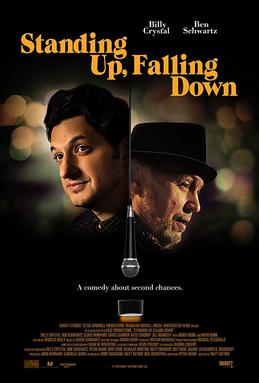
The Films of 2020: Standing Up, Falling Down (dir by Matt Ratner)


Having failed to achieve his dream of becoming a comedy superstar in Los Angeles, 34 year-old Scott (Ben Schwartz) returns home to Long Island.  How bad are things for Scott?  Consider this:

When he left for Los Angeles, he left behind Becky (Eloise Mumford), despite thinking that he was in love with her and despite her asking him to stay.  While he was in L.A., he purposefully chose to not respond to her attempts to get in contact with him because he was determined to move on with his life.  Now, he’s back and he’s wondering what could have been.  As for Becky, she’s now an acclaimed photographer and she’s married to a surfer named Owen (John Behlman).

All of his old friends are now married and have families and don’t really have time to hang out with a 34 year-old who is still struggling with adulthood.

When Scott returns home, he moves back in with his parents.  His mother (Debra Monk) spoils him while his father (Kevin Dunn) barely says a word to him.  Scott announces that, even though he knows he needs a job, there’s no way that he’s going to go to work at his father’s lumberyard.  His father says that’s not a problem because he wasn’t planning on offering Scott a job in the first place.

Scott’s sister (Grace Gummer) is also living at home and is stuck in a less than glamorous job but she’s dating Ruis (David Castaneda), an extremely charming security guard who is loved by everyone who meets him.

And, to top it all off, Scott has developed a rash of some sort in his arm!

In fact, the only positive development in Scott’s life is that he’s made a new friend.  Marty (Billy Cyrstal) is a bit older and he’s an alcoholic but he also has the best weed and he’s full of good advice.  On top of that, Marty’s also a dermatologist and is willing to just give Scott the medicine for his arm free of charge.  Marty becomes a bit of a mentor to Scott.  Of course, Marty has demons of his own.  His first wife committed suicide and his second wife died of stomach cancer.  His own son refuses to speak to him and won’t allow him to see his grandson.  Marty’s drinking isn’t the quirky character trait that it first appears to be.  Instead, it’s what he does to deal with the pain and the guilt that he carries around with him every day.

Standing Up, Falling Down is an occasionally effective and occasionally awkward mix of comedy and drama.  As a character, Scott can occasionally be a bit hard too take.  It’s one thing to have trouble accepting the fact that you’re getting older while it’s another thing to be in your mid-thirties with the maturity level of a 13 year-old.  At times, Scott seems to be so helpless that you find yourself wondering how he survived in Los Angeles for as long as he did.  Fortunately, Ben Schwartz is an appealing actor and the film doesn’t make the mistake of trying to idealize Scott’s lack of direction.  You find yourself sincerely hoping that Scott will finally manage to get his life together, even though you know he probably won’t.

The big surprise of the film is Billy Crystal, who gives a genuinely good and complex performance as Marty.  Like Crystal, Marty is a bit of an attention hog and occasionally seems a bit too satisfied with his jokes.  However, the film also explores why someone like Marty always feels the need to be “on.”  The best moments in the film are the ones where Marty quietly considers why his life has reached the point that it has.  In the film’s quieter moments, there’s a lot of sadness in Crystal’s performance.  The scene where he unsuccessfully tries to get his son to talk to him is absolutely heart-breaking, all the more so because Cyrstal downplays the scene’s potential for sentimentality.  Right when you’re expecting schmaltz, Crystal instead holds back.  With just the slightest change in his facial expression, Crystal immediately tells us everything that’s going on inside of Marty’s head.  It’s a truly good performance.

Standing Up, Falling Down is a low-key, occasionally effective dramedy.  Not all of it works (I could have done without Scott harassing his sister’s co-worker at the pretzel place) but it has a good heart and an unexpectedly great performance from Billy Crystal.
The Films of 2020: The Way Back (dir by Gavin O’Connor)


Jack Cunningham (Ben Affleck) used to be a star.  When he was in high school, he was a brilliant basketball player.  He led his high school, Bishop Hayes, to multiple championships.  Everyone expected Jack to have a bright figure but …. well, times change.

Decades later, Jack is a construction worker.  He spends every night at the neighborhood bar.  He wakes up every morning with a hangover.  He starts his day by drinking and he ends it by passing out.  He’s separated from his wife, Angela (Janina Gavankar), and he can’t even enjoy a nice Thanksgiving dinner without everyone getting on his back about his drinking.

When he gets a phone call from his old high school, he’s shocked to learn that he’s being offered a job.  The school’s basketball coach has had a heart attack.  Father Devine (John Aylward) wants to know if Jack would be interested in filling in for the rest of the school year.  Though at first reluctant and perhaps not wanting to be reminded of the future he once had, Jack eventually agrees.

The team, it turns out, is not particularly impressive.  The school hasn’t gone to the playoffs since Jack graduated and basketball is such a low priority that the team only has 6 players.  When Jack takes over, the team that has only won a single game.  The team is undisciplined and so used to being losers that they can’t even imagine what it’s like to be a winner.  You know what type of team I’m talking about because, even if you weren’t an athlete in school, you’ve probably seen a movie or two about underestimated high school teams that, under the leadership of a new coach, ended up shocking everyone by making it to the playoffs.

Working with assistant coach Dan (Al Madrigal), Jack struggles to turn the team into winners.  He’s a strict coach and, at first, the students resent him and his methods.  When he kicks one of the best players off the team for showing up late to practice, everyone thinks that Jack’s gone too far.  However, when the team actually starts to show signs of improvement, the team and the school rallies around their new head coach….

Of course, Jack still has his problems.  He’s too quick to lose his temper.  He curses a bit too often.  Despite caring about the team, he’s still weary about getting too close to them.  He’s emotionally damaged as the result of an abusive childhood and the death of his son.  A winning season isn’t going to magically change that.  However, Jack’s main problem is that he’s still an alcoholic.  To the film’s credit, it doesn’t try to sugarcoat Jack’s addictions.  Jack doesn’t magically become sober just because he’s found a purpose in life.  Even when he briefly cuts back on his drinking, the temptation is still there.  And when Jack finally does end up returning to his neighborhood bar and has too much to drink, the film is honest about the consequences of his actions.

The Way Back took me by surprise.  It started out as a well-made but rather predictable underdog sports story but it takes a turn during the third act and reveals that it’s actually a character study of a well-meaning but immature man who cannot escape his demons.  The film is honest about Jack’s problems and, to its credit, it doesn’t pretend like there are any easy solutions.  It’s going to take more than just coaching his team to the playoffs for Jack to make peace with himself and his past.  The film ends on a note that’s hopeful yet ambiguous.  Jack has a long way to go and you’re not totally convinced that he’s ever going to truly complete his journey.  But, at the same time, you’re happy that he finally got a chance to do something good with his life.

Ben Affleck was the perfect choice to play Jack and he gives the best performance that I’ve ever seen him give.  Affleck has been open about his own struggles with alcoholism but beyond that, it’s easy to see Jack’s struggles as a metaphor for Affleck’s own up-and-down career.  Like Jack, Affleck won a championship when Argo won the Oscar for Best Picture but it sometimes seems as if he’s struggled since then.  His directorial follow-up, Live By Night, was a critical and commercial failure.  His turn as Batman was appreciated by some but ridiculed by others.  When he stepped down from directing The Batman, he was the subject of the same type of uncharitable gossip that follows Jack as he coaches his team.  In the role of Jack, Ben Affleck gives a poignant, vulnerable, and honest performance.  He’s willing to be unsympathetic.  He doesn’t shy away from showing us that Jack, even at his best, can be a massive fuckup.  And yet, he holds onto our sympathy even while Jack does some very stupid things.  It’s Affleck’s performance that elevates The Way Back from being just another sports film to being something far more touching.

The Way Back may not be quite strong enough to be called a great film (though it’s certainly a good one) but Ben Affleck gives a great performance.

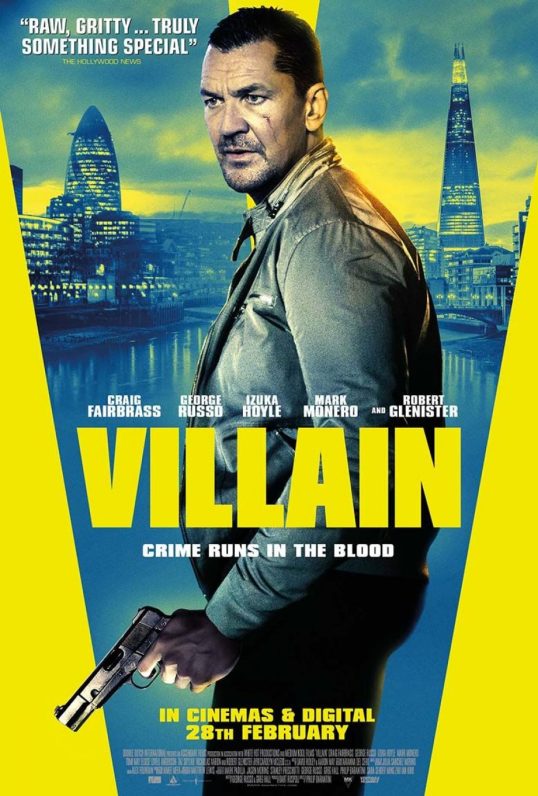
The Films of 2020: Villain (dir by Philip Barantini)


Villain is a British gangster movie.

What that means is that there’s a lot of blood and violence but, at the same time, there’s also quite a few scenes of peopled drinking tea.

It means that the dialogue is full of the casual use of the type of profanity that would get you kicked out of a store in America and yet, because all the f-words and the c-words are delivered with British accents, they still somehow sound, at least to an American ear, rather refined.

Being a British gangster film means that the good gangsters live in a tiny flat while the bad gangsters hold meetings in their poshly decorated sitting rooms.  It means that we get at least a few scenes of an aging gangster walking around London after having just been released from prison.  It means a subplot about the ownership of a pub and at least a few talkative junkies.  It means lengthy scenes of threatening dialogue, the majority of which are ended by sudden outbursts of violence.  It means gray overcast skies and downbeat endings and at least one dance scene.

As you may have guessed, Villain is not a particularly original film.  It’s well-made and some of the actors are good and it’s hard not to respect the film’s dedication to being as grim and downbeat as possible but there’s very little about Villain‘s story that will surprise most viewers.  Even the scene where the bad guys taunt the main character by asking him if he’s some sort of “villain” is expected.

Craig Fairbrass plays Eddie Franks,  Eddie is a career criminal who, having just been released from prison, is determined to go straight.  Despite the fact that daughter tells him that “everything you touch turns to shit,” Eddie is convinced that he can turn his life around.  All he wants to do is stay out of trouble and manage his family’s pub.  Of course, we know that there’s no way that’s going to happen.  After all, no one ever makes a movie about someone getting out of prison and then not being drawn back into a life of crime.

Eddie’s problem is that he has a brother named Sean (George Russo) and Sean has managed to get in debt to Roy and Johnny (played, respectively, by Robert Glenister and Tomi May).  Roy and Johnny are always mad about something and they’re definitely not people who you want to owe money too.  They want the pub and they want their money and if they don’t get it, both Eddie and Sean are going to end up in a hole in the ground.

While Eddie is trying to figure out how to deal with Roy and Johnny, he’s also trying to pick up the pieces of his life and make amends for the past.  He tries to reconnect with his daughter, Chloe (Izuka Hoyle) and he visits with an old friend named Michael (Mark Monero).  Eddie wants to be a good citizen but the world just seems to be conspiring against him.  It all leads to a downbeat conclusion, as these things often do.

Villain is a well-directed film and Craig Fairbrass has just the right look and manner to play the haunted Eddie.  Even though you can pretty much guess everything that’s going to happen to Eddie, you still hope the best for him because, as played Fairbrass, he just seems to be so achingly sincere in his desire to rebuild his life.  Unfortunately, as well-made as it is, Villain doesn’t really do anything new with the gangster genre.  It’s a bit too predictable for its own good.  That said, as familiar as it may be, it gets the job done well enough.

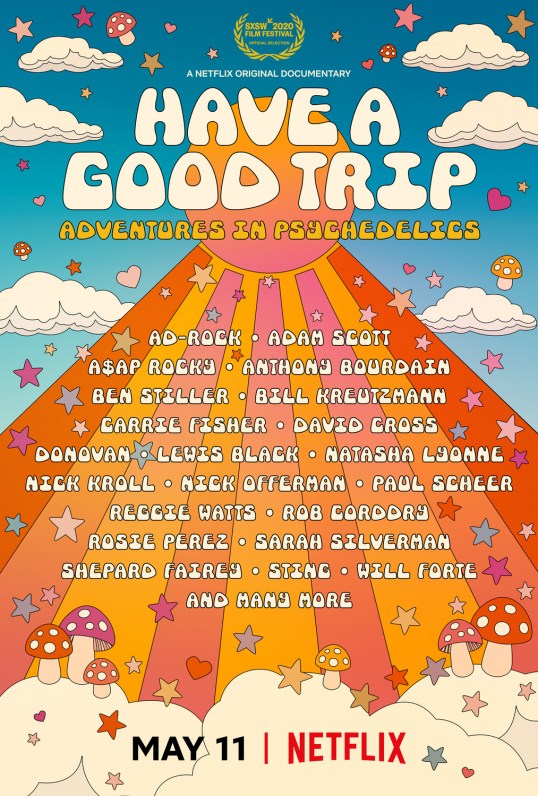
The Films of 2020: Have a Good Trip: Adventures in Psychedelics (dir by Donick Cary)


Since this Netflix documentary features people talking about their experiences with hallucinogens, I debated whether or not I should begin this review by discussing my own limited experience with psychedelics.  I went back and forth on whether or not to write about it.  It’s not that I feel any shame about having “experimented.”  Instead, it’s just that my experiences were all so damn boring.

I mean, which one should I tell you about?  Do you want to hear about the time that I went to the mall and I marveled at how all of the shoppers seemed to be moving at a different speed than me?  How about the time that I was sitting in a lecture and the professor’s voice kept getting really loud and then really soft?  Maybe I could tell you about the time my friends and I were driving around the Texas countryside and I kept seeing the same man standing on the side of every single road, watching us as we drove by?  He was wearing a black trenchcoat and a black cowboy hat and I was convinced that he was Death….

(Okay, that last experience was kinda freaky.)

Have A Good Trip is a film about people discussing their experiences with hallucinogens and some of them had more interesting experiences than I did.  Of course, all of the people who were interviewed were celebrities.  Sting talks about helping a cow give birth while tripping on peyote.  Lewis Black talks about doing acid and then forgetting his name.  Sarah Silverman recounts how she and a friend did acid and then ended up befriending a bunch of homeless people.  In interviews recorded before their death, Carrie Fisher and Anthony Bourdain both discuss their LSD experiences.  Probably the best story comes from Ben Stiller, who called his father during his first (and it’s implied only) acid trip.  Jerry Stiller is described as being very understanding, which is sweet.  “I know what you’re going through,” Jerry says, “I smoked a Pall Mall cigarette once and was sick for days.”

Have a Good Trip is 100% pro-hallucinogenic drug, which gives it a nice subversive feel.  The film humorously dramatizes the drug stories, sometimes with animation and sometimes by hiring other celebrities to play the celebrities telling their story.  In between the celebs, we get an interview with a researcher who explains how hallucinogenics can be used to help people dealing with depressing and anxiety.  The film doesn’t downplay the fact that bad trips happen but, at the same time, it also makes a convincing argument that the dangers have been overstated.

Yet, I have to admit that Have A Good Trip is never quite as much fun as you’re hoping it’ll be.  I think part of the problem is that most of the celebrities interviewed in the film are exactly who you would expect to interviewed in a film like this.  I mean, learning that Sarah Silverman, Judd Nelson, and Lewis Black have tried acid is not exactly an earth-shattering discovery.  When you’re watching a documentary in which celebrities talk about their drug experiences, you want to be surprised.  You want to see or hear about someone who you’re not expecting to see or hear about.  You want to hear about the time that the cast of Saved By The Bell went on a six-day coke binge in Vegas.  Learning that peyote makes Sting somehow even more pretentious just doesn’t have the same subversive bite as hearing from someone who you wouldn’t normally expect to have any good drug stories.

Anyway, Have a Good Trip is an amusing film, even if it’s never quite as subversive as it thinks it is.  It’s currently on Netflix.

The Films of 2020: Extraction (dir by Sam Hargrave)


Extraction is a good example of a film that most viewers and critics probably would have overlooked if not for the COVID-19 pandemic.

I mean, don’t get me wrong.  It’s not a bad film.  It’s an unapologetic action movie and it definitely gets the job done.  The fight scenes are exciting.  The car chases will get your heart pounding.  There’s an extended chase/fight scene that appears to have been filmed as one long, continuous shot and it’s unbelievably exciting to watch.  (I will admit that a friend of mine complained that some of the extras in the scene didn’t seem to be reacting realistically to all of the destruction happening around them but I was so caught up in the breathless intensity of the scene that I didn’t notice.)  Chris Hemsworth gives an effective performance in the lead role, proving that he can be a good and believable action hero even when he’s not playing the Norse God of Thunder.

The film tells the story of what happens when Ovi (played by Rudhraksh Jaiswal), the son of an Indian drug lord, is kidnapped by his father’s rivals.  Tyler Rake (played by Hemsworth) is the mercenary who is hired to rescue Ovi and return him to his father.  Rescuing Ovi isn’t much of a problem but it turns out that Ovi’s father has no intention of paying Tyler for his services  Instead, he orders his operative, Saju (Randeep Hooda), to kill Tyler’s men and save Ovi himself.  It all leads to a chase through the city of Dhaka in Bangladesh.  There’s a lot of fights.  A lot of people get shot.  Ovi and Tyler get to bond a little bit.  It’s basically a typical action film but it’s done very well.

To the film’s credit, Saju is not a typical henchman.  Instead, he’s a man with a family and he knows that if he fails in his mission, Ovi’s father will kill his family.  Indeed, I think it can be argued that the film’s heart — and, despite all of the violence, the film does have one — is with Randeep Hooda.  He’s not evil.  He’s just trying to do his job and Hooda gives an excellent performance as Saju.  Hemsworth is a likable action hero and he’s fun to watch but Randeep Hooda is the one who you really find yourself thinking about.  If Saju succeed, Tyler dies and Ovi is returned to his evil father.  If Tyler succeeds, both Sajua and his family die.  It’s a dilemma that gives Extraction a little bit more depth than the typical action movie.

Ultimately, though, the main reason that Extraction proved to be such a hit (at least with Netflix audiences) had to do with timing.  It was released on April 24th, at a time when a lot of people were still struggling to get into the new lockdown routine.  At a time when people like me were still shell-shocked at the idea of not being able to go out to a theater and see a new movie every weekend, we were glad to have a real movie to watch.  We could watch Extraction and marvel at the big screen-worthy action sequences and we could pretend like nothing had changed.  Though it may have ultimately just been another well-made action film, Extraction provided an entertaining escape from the reality of life under lockdown.

Extraction, of course, is still on Netflix, just in case we all need to escape yet again.


The Films of 2020: The Night Clerk (dir by Michael Cristofer)


“Tye Sheridan Is …. THE NIGHT CLERK!”

That’s not how The Night Clerk was advertised, though perhaps it should have been.  This is one of those overheated melodramas that’s so sure that it’s making a bigger statement than it actually is that it becomes somewhat fascinating to watch.  Usually, when we say that a film is fascinating to watch, we mean that it’s either fascinatingly good or fascinatingly bad.  The Night Clerk is fascinatingly middle-of-the-road.  It has opportunities to be good, largely due to the performances of Tye Sheridan and Ana de Armas.  And it has opportunities to be bad, largely due to the direction and script of Michael Cristofer.  Try as it might, the film never becomes truly good and yet it’s never truly bad, either.  It’s just kind of there.

The title character is Bart Bromley (Tye Sheridan), a young man who has Asperger’s syndrome and who works as a night desk clerk at a hotel.  He’s hidden cameras all over the hotel, so that he can observe the guests in their rooms.  He even watches the guests when he returns to the home that he shares with his mother, Ethel (Helen Hunt).  That’s undeniably creepy but we’re not supposed to hold that against Bart because he’s only watching the guests so that he can learn how to talk and communicate with other people.

(To be honest, the film is very lucky that Tye Sheridan was available to play Bart.  As written, Bart is not a particularly sympathetic character.  But Sheridan is such a likable actor and has such an appealing screen presence that you’re willing to overlook a lot of narrative inconsistencies where his character is concerned.)

Anyway, Bart ends up taking an interest in a guest named Karen (Jacque Gray) but, when Karen’s murdered, Bart becomes the number one suspect.  Even though Bart knows that Karen was killed by a mysterious man who had a distinctive tattoo, he can’t reveal how he knows that information.  When Bart is assigned to another hotel, he meets Andrea Riviera (Ana de Armas).  Andrea seems to take an interest in Bart but is she sincere or is she somehow involved with the murderer herself?

Do I really need to answer that question for you?

And again, the film is lucky that Ana de Arams was available to play Andrea because Andrea is another character who wouldn’t be particularly sympathetic if she had been played by a less appealing performer.  The film can never seem to make up its mind whether she’s a calculating femme fatale or a naive victim and it’s somewhat amazing that de Amas is able to give a good performance considering how badly Andrea is written.

The Night Clerk is one of those films that holds your interest while you watch it but it tends to fade from the memory as soon as it ends.  Sheridan and de Armas are appealing actors but the film’s central mystery isn’t a particularly interesting one.  When the mystery is finally solved, I was so underwhelmed that I kept waiting for another twist to suddenly pop up.  Surely, I kept saying, it can’t be that simple.  But yes, it is.  Though the hotels are impressively trashy, the film itself has a rather flat, uninteresting look and director Michael Cristofer never really brings the story together.  It’s a mess of a film but it does work as a testament to the talents of Tye Sheridan and Ana de Armas.

The Films of 2020: John Was Trying To Contact Aliens (dir by Matthew Killip)


If you were sending music into outer space in the hope of contacting aliens, what songs would you send?

That was the question that I found myself wondering as I watched the short documentary, John Was Trying To Contact Aliens.

John Was Trying To Contact Aliens is about John Shepherd, a Michigan man who became a bit of a local celebrity in the 70s with his attempts to contact extraterrestrials by beaming music into space.  John tried to send spacey music and, as far as we know, the aliens never responded.  It could be that they didn’t hear the music or maybe aliens, like all good people, just hate prog rock.  It could also be that the aliens did try to respond but they just couldn’t locate Michigan.  It happens.

Myself, if I was sending music to aliens, I’d probably send The Chemical Brothers.  Maybe The Crystal Method.  I would definitely send a lot of Britney Spears because I think that the aliens would definitely want to meet Britney.  Taylor Swift’s great but I probably wouldn’t send her music to any aliens because I think the aliens would be like, “Those humans are just going to sing about what jerks we are after we leave.”  I think the aliens would like Saint Motel so I’d probably be sure to broadcast My Type at least three times a day.  I love Big Data but I think Dangerous would scare the aliens off.  I can’t say that I’d have any more luck than John Shepherd did but, to be honest, I don’t know if I would want aliens landing in my backyard.  I’m not really a fan of unexpected guests.

Of course, John Way Trying To Contact Aliens is not really a film about aliens.  Instead, it’s a character study of a man who most people would probably consider to be an eccentric.  John starts the film telling us about why he wanted to contact aliens and what type of music he thought the aliens would like.  He seems like he’s quirky in a likable sort of way.  It’s only as the film goes on that we find out about John’s childhood and his search for extraterrestrial life goes from being quirky to being poignant.

Abandoned by his mother and raised by his grandparents, John knew he was gay from an early age.  Growing up and living in rural Michigan, he was an outsider.  As he explains it, he felt that everyone around him knew that there was something different about him and, as a result, he didn’t feel comfortable with any of them.  He felt like an alien on Earth so it only made sense that he would try to contact real aliens.  His search for aliens had less to do with making his science fiction dreams come true and more about just trying to make some sort of connection with someone who was as “different” as he felt himself to be.

Fortunately, this 16-minute documentary has a happy ending.  Though John may not have found aliens, he did find love.  It’s a sweet documentary and a moving story and it can currently be viewed on Netflix.

The Films of 2020: A Fall From Grace (dir by Tyler Perry)


Let us take a few minutes to praise Tyler Perry.

Seriously, so much time and energy has been devoted to writing about the numerous flaws that can be found in the majority of Perry’s film that I do think we can spare a few minutes to acknowledge all of the goods things about Tyler Perry.

First off, though he undeniably has an ego, Tyler Perry appears to be a decent human being and he frequently puts his money to good use.  At a time when we’ve gotten used to hearing terrible things about some of the richest and most famous men around, Tyler Perry is unique in that we don’t ever seem to hear anything particularly negative about him as a person.

Secondly, Tyler Perry has proven himself to be a far better actor than I think anyone originally gave him credit for being.  Just check out his performance in Gone Girl, for instance.  He took a stock role, the flamboyant attorney, and played it with such wit and intelligence that he become one of the most interesting characters in the film.

Third, Tyler Perry’s films — regardless of what the critics may think of them — have provided roles for a lot of talented black actors and actresses who often don’t get the type of roles that they deserve from Hollywood.

Fourth, Tyler Perry proved that there was a market out there for all sorts of films made for and by black people.  Though many are still loathe to admit, Tyler Perry has played a huge role in changing the way the film industry views black audiences.

With all that in mind, it’s kind of tragic that, for all the good things that you can say about him, he’s still an absolutely terrible director.  There’s nothing wrong with having an ego (and, as my fellow site contributors can tell you, I’ve certainly got a healthy one myself) but I sometimes think that the same ego that has allowed Perry to become a success and do so much good has also prevented him from growing as a director.  How else do you explain that, after having directed over 20 films, Tyler Perry still often seems like a very enthusiastic film student who is just now making his first feature?  How else do you explain that he’s keeps making the same rookie mistakes — i.e., boom mics slipping into the shot, continuity errors, and melodramatic tone changes that often seem to come out of nowhere — even though he’s been doing this for 16 years?

This brings us to A Fall From Grace.

A Fall From Grace was Tyler Perrry’s 21st film as a director.  It was also the first film that he made for Netflix and he also apparently shot it in 5 days.  There aren’t many directors, outside of Roger Corman, who can claim to have shot an entire film in 5 days.  Most directors, of course, would know that you need more than 5 days to shoot a film, especially one that wants to explore a serious issue.  Corman may have spent two days on Little Shop of Horrors but that’s a movie about a talking plant.  A Fall From Grace takes on the criminal justice system.

Jasmine (Bresha Webb) is a public defender who doesn’t get emotionally involved with her clients and who almost always makes a plea deal.  Her husband (Matthew Law) is a cop who is haunted by a recent suicide.  Jasmine’s latest client is Grace Walters (Crystal Fox), who has been arrested for murdering her husband (Mehcad Brooks).  Grace wants to plead guilty but Jasmine suspects that there might be more to the case than anyone realizes.  Why Jasmine suddenly takes an interest in taking Grace’s case to trial is never really that clear but it does lead to a lot of melodrama and a lot of rather clumsy flashbacks.  Eventually, Jasmine just kind of stumbles onto the truth and has to fight to reveal what really happened.

The story is nearly impossible to follow and the film’s action often seems to drag.  Probably the best thing about the film is that Perry himself plays Jasmine’s sarcastic boss.  Perry has a truly impressive beard and he seems to be having fun with the character.  Crystal Fox gives an effective performance as Grace and Phylicia Rashad has some good moments as Crystal’s friend.  Even Mehcad Brooks is convincing, even if he does get stuck with the film’s worst lines.  But Bresha Webb and Matthew Law are boring as the main couple and the story gets bogged down with flashbacks.  It’s just not a very good film.

Still, the film was reportedly one of the most viewed movies on Netflix during the weekend of its release.  The critics may not have embraced the film but Perry has shown repeatedly that you don’t need the critics on your side to be a success.


Julius Caesar (1970, directed by Stuart Burge)


In ancient Rome, under the direction of Cassius (Richard Johnson), several members of the Senate conspire to kill Julius Caesar (John Gielgud), believing that his death is the only way to preserve the Republic.  Even Caesar’s longtime friend, Brutus (Jason Robards), is brought into the conspiracy.  Unfortunately for the conspirators, after Caesar’s murder, Mark Antony (Charlton Heston) gives his famous speech asking the Romans to lend him their ears and the Roman citizens turn against Caesar’s murderers and instead look to Antony and Octavius (Richard Chamberlain) to lead them.

This was the first adaptation of William Shakespeare’s play to be filmed in color and the assassination of Caesar was portrayed much more graphically than in previous productions.  By the end of the attack, Caesar has been stabbed so many times and there’s so much blood on screen that it doesn’t seem like he should even have the strength to say, “Et tu, Brute?”  Despite the then-modern innovations, this version still feels creaky and stiff.  When Caesar makes his appearance on the Ides of March, all of the conspirators actually stand in a neat line while Caesar enters the Senate.  When Mark Anthony and Brutus make their speeches, the extras playing the Roman citizens looked bored and disinterested.

For most viewers, the appeal of this version of Julius Caesar will be for the cast, which was considered to be all-star in 1970.  Along with Gielgud, Robards, Heston, Johnson, and Chamberlain, the cast also features Robert Vaughn as Casca, Christopher Lee as Artemidorous, Jill Bennett as Calpurnia, and Diana Rigg as Portia.  Surprisingly, it’s Jason Robards, the Broadway veteran, who struggles with Shakespeare’s dialogue, delivering his lines flatly and without much emotion.  Meanwhile, Charlton Heston steals the entire film as Mark Antony, nailing Antony’s funeral oration and proving himself to be much more clever than the conspirators had originally assumed.  (Of course, Mark Antony was the Charlton Heston of his day so I guess it shouldn’t be too much of a surprise that Heston is perfect in the role.)  I also liked Diana Rigg’s performance in the small role of Portia and Robert Vaughn’s devious interpretation of Casca.

Though he plays Caesar here, John Gielgud previously played Cassius in the 1953 version of Julius Caesar, the one with James Mason and Marlon Brando.  That is still the version to watch if you want to see the definitive adaptation of Julius Caesar.

Charles Bronson, Hollywood’s Lone Wolf (2020, directed by Jean Lauritano)


How did a former Pennsylvania coal miner who was born Charles Buchinsky eventually transform himself into Charles Bronson, one of the world’s biggest movie stars?

That’s the question that’s examined in this short documentary.  Filled with scenes from Bronson’s films and clips of the tight-lipped interviews that he gave throughout his career, Charles Bronson, Hollywood’s Lone Wolf takes a look at Bronson’s life and film persona.  It attempts to explain the appeal of a notoriously inexpressive actor who, unlike many of his contemporaries, never went out of his way to win any popularity contests.  Unfortunately, the documentary struggles to tell us much that we didn’t already know about Bronson.  Even when, after years of trying, he finally became a Hollywood superstar, Bronson was still known for keeping to himself.  Much like the characters that he played, Bronson was someone who kept his feeling under wrap.  Lacking any contemporary interviews with the people who knew Bronson and who worked with him, the documentary often has to rely on what Bronson said and, unfortunately, Bronson never said much.

Another problem with the documentary is that it doesn’t seem to have been made by people who actually liked Charles Bronson’s films.  While Once Upon A Time In The West, The Mechanic, and Rider on the Rain are all rightfully praised, Death Wish is dismissed as reactionary and many of the films that he made in the 70s — including some of his best, like From Noon Till Three, Raid on Entebbe, and Telefon — are ignored all together.  While it’s true that Bronson’s films were rarely critically acclaimed, doesn’t it seem like a documentary about Charles Bronson should be made by people who actually dig his movies?

The documentary is at its best when it examines how much of Bronson’s career was fueled by his own bitterness towards his poverty-stricken childhood and the many years in which Hollywood refused to give him decent roles.  Bronson comes across as being surly, a little bit mean, and not someone to mess around with.  At the same time, when he’s with his second wife, Jill Ireland, Bronson seems like a totally different man.  He actually smiles!  Ireland brought out Bronson’s nice side.  With Ireland, Bronson relaxes in a way that most of the characters that he played would never have allowed himself to.  After Ireland’s death in 1990, Bronson is described as having been devastated but he subsequently used that pain to give one of his best performances, in Sean Penn’s The Indian Runner.

The documentary ends by noting that Quentin Tarantino dedicated Kill Bill Volume 1 to his memory.  No one, we’re told, knows how Bronson would have felt about it.  That sounds about right.  I think that really was what made Charles Bronson a superstar.  No one knew what he was thinking but everyone wanted to find out.