Horror Film Review: The Dark Half (dir by George Romero)


It will always fascinate me that Stephen King, one of the most popular writers in the world and one of the legitimate masters of horror, also has one of the least inspiring accounts on twitter.

Seriously, he may be the most popular author in the world but he tweets like a retiree who has just discovered the internet.  Go over to his twitter account and you won’t find memorable descriptions of small town hypocrisy.  You won’t find scenes of shocking psychological insight.  You won’t find moments of unexpected but laugh-out-loud dark humor.  Instead, you’ll find a combination of dad jokes, boomer nostalgia, and an unseemly obsession with wishing death on any public figure who is to the right of Bernie Sanders.  It’s odd because no one can deny that King’s a good storyteller.  At his best, Stephen King is responsible for some of the best horror novels ever written.  Everyone who is a horror fan owes him a debt of gratitude for the work that he’s done promoting the genre.  At his worst, he’s your uncle who retweets the article without reading it first.

Of course, someone can be great at one thing an terrible at something else.  I can dance but I certainly can’t sing.  Stephen King can write a best seller but a good tweet is beyond him.  That’s the dual nature of existence, I suppose.  That’s certainly one of the themes at the heart of both Stephen King’s The Dark Half and the subsequent film adaptation from George Romero.

Filmed in 1990 but not released for three years due to the bankruptcy of the studio that produced it, The Dark Half tells the story of Thad Beaumont and George Stark (both played by Timothy Hutton).  Thad is a professor who writes “serious” literature under his real name and violent, pulpy fiction under the name of George Stark.  No one reads Thad’s books but they love George Stark and his stories about the master criminal and assassin, Alexis Machine.  (Alexis Machine?  George Stark may be a good writer but he sucks at coming up with names.)  After a demented fan (played, with creepy intensity, by Robert Joy) attempts to blackmail him by threatening to reveal that he’s George Stark, Thad decides to go public on his own.  His agent even arranges for a fake funeral so that Thad can bury George once and for all.

Soon, however, Thad’s associates are turning up dead.  It seems as if everyone associated with the funeral is now being targeted.  Sheriff Alan Pangborn (Michael Rooker) suspects that Thad is the murderer.  However, the murderer is actually George Stark, who has come to life and is seeking revenge.  Of course, George has more problems than just being buried.  His body is decaying and he’s got a bunch of angry sparrows after him.  The Sparrows Are Flying Again, we’re told over and over.  Seeking to cure his affliction and to get those birds to leave him alone, Stark targets Thad’s wife (Amy Madigan) and their children.

The Dark Half has its moments, as I think we would expect of any film based on a Stephen King novel and directed by George Stark.  Some of the deaths are memorably nasty.  Hutton is believably neurotic as Thad and cartoonishly evil as Stark and, in both cases, it works well.  Rooker may be an unconventional pick for the role but he does a good job as Pangborn and Amy Madigan brings some unexpected energy to the thankless role of being the threatened wife.

But, in the end, The Dark Half never really seems to live up to its potential.  In the book, Thad was a recovering alcoholic and it was obvious that George Stark was a metaphor for Thad’s addiction.  That element is largely abandoned in the movie and, as a result, George goes from being the literal representation of Thad’s demons to just being another overly loquacious movie serial killer.  Despite having a few creepy scenes, the film itself is never as disturbing as it should be.  For all the blood, the horror still feels a bit watered down.  Take away the sparrows and this could just as easily be a straight-forward action film where the hero has to rescue his family from a smug kidnapper.  Comparing this film to Romero’s Martin is all the proof you need that Romero was best-served by working outside the mainstream than by trying to be a part of it.

Add to that, I got sick of the sparrows.  Yes, both the film and the book explain why the sparrows are important but “The Sparrows Are Flying Again” almost sounds like something you’d find in something written in a deliberate attempt to parody King’s style.  It’s a phrase that’s intriguingly enigmatic the first time that you hear it, annoying the third time, and boring the fifth time.

The Dark Half was a bit of a disappointment but that’s okay.  For King fans, there will always be Carrie.  (I would probably watch The Shining but apparently, King still hasn’t forgiven Stanley Kubrick for improving on the novel.)  And, for us Romero fans, we’ll always have Night of the Living Dead, Martin, Dawn of the Dead, and the original Crazies.  And, for fans of George Stark, I’m sure someone else will pick up the story of Alexis Machine.  It’s hard to keep a good character down.

Horror on the Lens: The Cabinet of Dr. Caligari (dir by Robert Wiene)


The Cabinet of Dr. Caligari is a film that I’ve shared four times previously on the Shattered Lens.  The first time was in 2011 and then I shared it again in 2014, 2015, 2016, 2017, 2018, 2019, and 2020!  Well, you know what?  I’m sharing it again because it’s a classic, it’s Halloween, and everyone should see it!  (And let’s face it — it’s entirely possible that some of the people reading this post right now didn’t even know this site existed in any of those previous years.  Why should they be deprived of Caligari just because they only now arrived?)

Released in 1920, the German film The Cabinet of Dr. Caligari is one of those films that we’ve all heard about but far too few of us have actually seen.  Like most silent films, it requires some patience and a willingess to adapt to the narrative convictions of an earlier time.  However, for those of us who love horror cinema, The Cabinet of Dr. Caligari remains required viewing.  Not only did it introduce the concept of the twist ending (M. Night Shyamalan owes his career to this film) but it also helped to introduce German expressionism to the cinematic world.

My initial reaction to The Cabinet of Dr. Caligari was that it simply wasn’t that scary.  It was certainly interesting to watch and I was happy that I was finally experiencing this film that I had previously only read about.  However, the film itself was obviously primitive and it was difficult for my mind (which takes CGI for granted) to adjust to watching a silent film.  I didn’t regret watching the film but I’d be lying (much like a first-year film student) if I said that I truly appreciated it after my first viewing.

But you know what?  Despite my dismissive initial reaction, the film stayed with me.  Whereas most modern films fade from the memory about 30 minutes after the end credits,The Cabinet of Dr. Caligari has stuck with me and the night after I watched it, I even had a nightmare in which Dr. Caligari was trying to break into my apartment.  Yes, Dr. Caligari looked a little bit silly staring through my bedroom window but it still caused me to wake up with my heart about to explode out of my chest.

In short, The Cabinet of Dr. Caligari passes the most important test that a horror film can pass.  It sticks with you even after it’s over.

For the curious with an open mind to watch with, here is Robert Wiene’s The Cabinet of Dr. Caligari!

Enjoy!

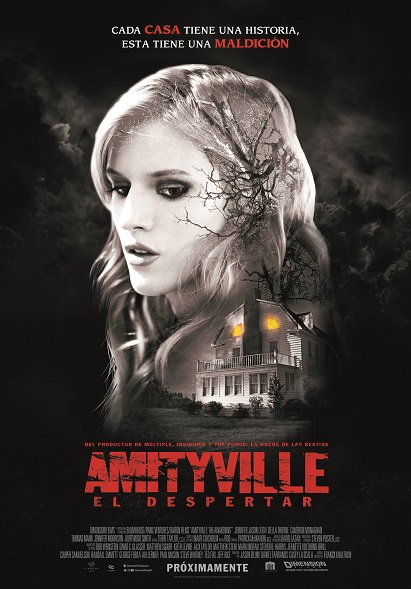
The TSL’s Grindhouse: Amityville: The Awakening (dir by Franck Khalfoun)


You have to feel bad for the DeFeo family.

Not only where they murdered in their sleep by a junkie loser who also happened to be a member of the family but, for the past five decades, their names have been slandered in a countless number of Amityville books and films.  The house’s subsequent owner, George Lutz, realized that he could make a fortune by claiming that the murder house was haunted by a demon and, working with an author named Jay Anson, he did just that.  Anson’s book, The Amityville Horror, was published in 1977.  The first film version was released in 1979.  Since then, there have been over 20 Amityville films, the majority of which feature reenactments of the DeFeo murders and all of which let Ronald DeFeo, Jr. off the hook by suggesting that it was the supernatural that led to the murders as opposed to a raging heroin habit.

With so many different films having been made by so many different directors and companies, it’s next to impossible to maintain any sort of consistent continuity from film to film.  2017’s Amityville: The Awakening acknowledges this in the most meta way possible by having the film’s lead character, Belle (played by Bella Thorne), watch the original film with two of her friends while discussing all of the sequels.  In the world of Amityville: The Awakening, the films exist and the house is both famous and infamous.  And yet, people still voluntarily live there.

The latest inhabitants are Joan (Jennifer Jason Leigh) and her three children, Belle, Juliet (McKenna Grace), and James (Cameron Monaghan).  James is on life support after having been paralyzed in an accident and Joan is fanatically devoted to him.  Though Dr. Milton (Kurtwood Smith) says that there’s no chance of James ever recovering and that he’s probably brain dead, Joan remains convinced that James will someday come back again.  As she explains at one point, she’s abandoned her faith in God but she still has faith that there will be a way for James to recover.

No sooner has the family moved in then all of the typical Amityville stuff starts happening.  Flies start buzzing around.  The dog doesn’t want to be in the house. Juliet starts talking to people who aren’t there.  One night, James flatlines but, after being dead for several minutes, his heart suddenly starts to beat again.  Suddenly, James is showing indications that, though paralyzed and unable to speak, he is aware of his surroundings.  Joan is convinced that James is recovering but is it possible that something else is happening?

If I may take the risk of damning with faint praise, Amityville: The Awakening is not bad for an Amityville film.  Yes, you do have to wonder why the house has never been torn down and yes, I’m as bored with the big Amityville flies as anyone else.  And the scenes where the characters discuss the DeFeo murders are icky and unethical as Hell.  But, with all that in mind, this is actually one of the better-made Amityville films.  Director Franck Khalfoun was also responsible for the better-than-it-had-any-right-to-be remake of Maniac and he brings a lot of energy to his direction here.  He’s smart enough to realize that the audience is going to automatically roll their eyes at yet another Amityville film and he often rolls his eyes with them.  As a result, we get some deserved digs at the shoddiness of the other films.  Khalfoun is also smart enough to understand that Bella Thorne is more effective as a personality than an actress and, as such, the character of Belle is carefully developed to fit with Thorne’s public image.  Jennifer Jason Leigh, on the other hand, is such a good actress that she actually brings some unexpected depth to the role of Joan and the film as a whole.

Amityville: The Awakening is one of the better Amityville films.  You still have to wonder why that house is still standing, though.  Seriously, tear it down already.

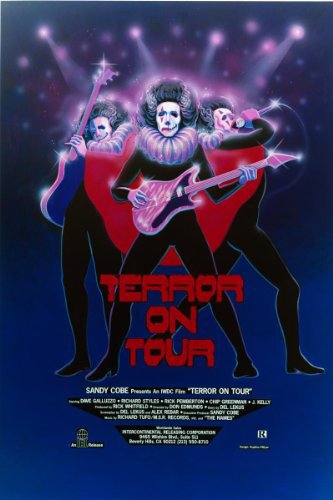
Terror on Tour (1980, directed by Don Edmunds)


It’s not easy being a Clown.

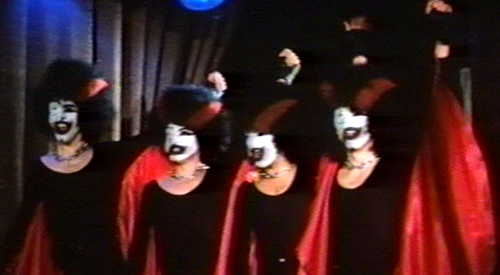
The Clowns, of course, is the name of the band that’s at the center of this sleazy slasher film.  The Clowns (who were played by a real-life band called The Names) wear clown make-up and sing songs about how they want to chop up the members of their audience and “send you home in a box.”  When Clown groupies start to turn up dead during a 24-hour Clown orgy, the police suspect that the Clowns are the murderers and they send an undercover cop to one of their performances.  It turns out that the Clowns are innocent because the murders continue even while they’re performing on stage.  But if the Clowns aren’t the killers, who is?

Terror on Tour is one of the many zero budget extravaganzas to come out in the early 1980s, trying to capitalize on the slasher boom and the popularity of bands like Alice Cooper and KISS.  It’s not every good, mostly because the members of The Names couldn’t act worth a damn and the film is so badly lit and the sound is so poorly recorded that watching the movie will make you want to sleep long before it makes you want to rock.  You won’t remember the name of a single member of the band but you will remember the groupie who says, “This cocaine is making me horny,” with all the passion of Kramer saying, “These pretzels are making me thirsty” in that Woody Allen movie.  Speaking of Seinfeld, Larry Thomas plays the band’s manager.  Years later, Thomas would receive an Emmy nomination for playing the Soup Nazi on Seinfeld.  He would also go on the imdb and post an apology for having appeared in Terror on Tour.  Larry, everyone has to start somewhere!  And you were by far the best actor in the movie.  You didn’t look straight at the camera once.

The best scene is one member of the band shouting, “I need a joint!” until someone brings him one.  That’s the advantage of being a star, I guess.

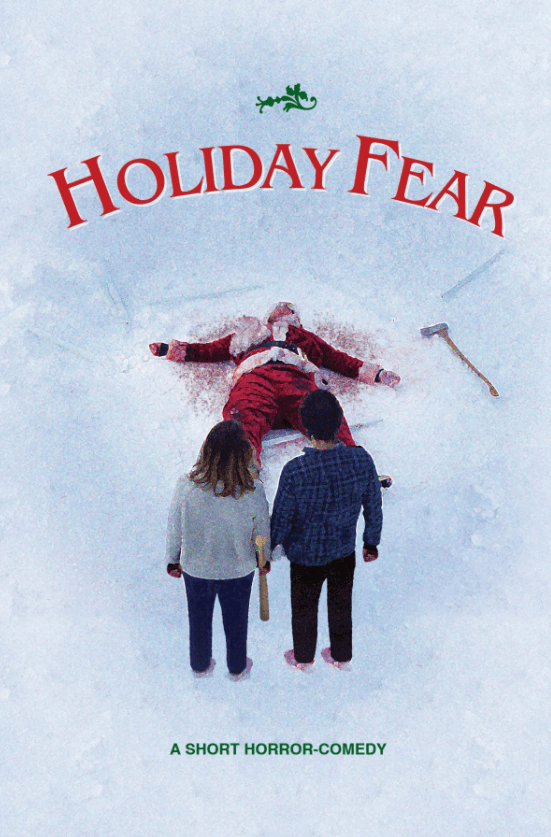
Holiday Fear, Review By Case Wright


Did you ever wonder what happens after all the action is over in a Christmas horror movie and it’s the next day- Christmas Morning? Did you further wonder if that question could be answered in just over 3 minutes? Then, this is the short for you!!!!

It’s crazy; I’m on such a roll right now because I have watched so many great shorts! I was EXTREMELY dubious that a 3.766 minute short could entertain me let alone Laugh Out Loud (as the kids say). This short delivered, therefore, these are the greatest actors of all time and the director is both the greatest director and writer of all time (Mathematical proof available upon request). If you look at the imdb pages of Rebeca Robles, Eric Whitten, and Nicholas Santos, I am once again proven correct (which is the most important thing in life).

This is another must see short. These actors are just terrific!

Horror On the Lens: Creation of the Humanoids (dir by Wesley E. Barry)


The Creation of the Humanoids (1962, dir by Wesley Barry)

What makes us human?  What does it mean to have free will?  What is love?  What is freedom?  The questions and more are asked in the low-budget (and rather odd) science fiction epic The Creation of the Humanoids, which you can view below!

Now, I should warn that Creation of the Humanoids is an extremely talky film.  And the plot is occasionally difficult to follow. There’s a lot of ennui to be found in this particular film, both from the humans and those who have been built to serve them  However, I find it impossible not to love this one because it’s just such a strange movie.  I love it for the colorful set design, the contrast between the resentful robots and the paranoid humans, and the fact that the film — despite being made for next to nothing — actually has more ambition than anything ever made by several of the more successful directors working today. And, while it may not really be a horror film in the way that some of our other October films are, it still feels appropriate for the Halloween season. It just has the perfect holiday atmosphere.

First released in 1962, Creation of the Humanoids was reportedly one of Andy Warhol’s favorite films.  Keep an eye out for Plan 9 From Outer Space‘s Dudley Manlove.

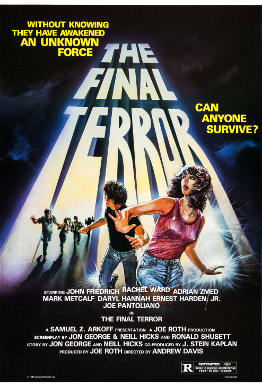
The TSL’s Grindhouse: The Final Terror (dir by Andrew Davis)


“Marco!?”

“Melanie!?”

“Margaret!?”

“Dennis!?”

“Eggar!?”

“Windy!?”

If you watch the 1983’s The Final Terror, be prepared to frequently hear the names of the film’s characters.  For a slasher film about a bunch of campers wandering through the forest, The Final Terror has a surprisingly large cast and they all spend a good deal of time walking around and yelling out each other’s names.  Somehow, people keep getting lost even though they know that there’s a killer out there and they all really should be sticking together.

Interestingly enough, for a slasher film, there aren’t that many deaths.  The majority of the cast survives.  Even the most obnoxious of the campers, the one who seems like an obvious victim, manages to make it through to the finale.  I guess we should be happy that most of them survived and this was apparently their final terror.  The majority of the campers were teenagers and if you’re having your surviving your final terror when you’re not even old enough to drink yet …. well, consider yourself lucky.

The Final Terror is set up like an entry in the Friday the 13th franchise but it’s never anywhere close to being as sleazy as those films.  Whether that’s a good or a bad thing depends on what you, as a viewer, want in terms of a wilderness slasher film.  If you want lots of sex, blood, and people making stupid decisions, The Final Terror will probably bore you to death, despite the fact that it includes all three.  If you want a relatively realistic film about being lost in the wilderness while being stalked by an unseen killer, you’ll probably appreciate The Final Terror.  This film was directed Andrew Davis, who went on to direct several big budget Hollywood action films.  Before he became an action director, though, he worked as an assistant to cinematographer Haskell Wexler on the semi-documentary Medium Cool.  Davis brings that realistic style to The Final Terror.  Even though the film does feature some familiar faces, it’s easy to believe that you’re just watching a bunch of campers trying to survive for the weekend.

As for the cast, Rachel Ward plays one of the leaders of the campers.  Joe Pantoliano makes an early appearance as the creepy Eggar.  Daryl Hannah plays Windy.  Mark Metcalf plays another camper named Mike.  The entire ensemble actually does a pretty good job.  As I said, you really do believe that the majority of the cast are delinquent teenagers who have been sent on a camping trip.  When they work together to keep someone from bleeding to death, it almost feels like an educational film.  “Because the campers worked together,” you can imagine a narrator saying, “they might survive The Final Terror.”

The Final Terror is not bad, though I have to admit that I like my 80s slashers to be a little bit more sordid.  But for what it is — an attempt to take a realistic approach to a genre that is regularly held in dismissive disdain — The Final Terror works surprisingly well.  As captured by Andrew Davis, the wilderness is both beautiful and terrifying.  You’ll never catch me camping!

International Horror Review: Robo Vampire (dir by Godfrey Ho)


Oh, hey, Robo Vampire!

Yeah, Robo Vampire.

Robo.  Vampire.

It gets less exciting every time you say or think it.  The first time you see a title like Robo Vampire, you’re all excited but then you think about it and you realize that there’s no reason for a robot to turn into a vampire because robots don’t need blood.  And the idea of a vampire becoming a robot …. I mean, how the Hell would that even work?

I watched Robo Vampire and I’m still not really sure how it all worked.  This film came out in 1988 and it was directed by Godfrey Ho, who is apparently known in some circles as being the Ed Wood of Hong Kong action cinema.  The film …. listen, I watched this thing and I don’t have the slightest idea what was actually happening for the majority of it.  The friends with whom I watched the film explained to me that Robo Vampire was actually a compilation film, compiled of scenes that were shot for several different Godfrey Ho movies.  That would explain why there was next to no continuity for scene to scene and why the plot was the most random hodgepodge of concepts that I’ve ever some across.

What little plot that there was in this mess dealt with Tom Wilde, a narcotics cop who gets blown away in the line of duty.  However, Tom’s superiors decided that they can salvage him by turning him into a robot with no memories of his past.  Before you can say “Wait a minute, what about Robocop?,” that’s exactly what they do.  Tom is now a cyborg.  For his first mission, he’s sent to the Golden Triangle to take down a drug lord who is holding another agent hostage.  

So far, we’ve got a robot.  But where are the vampires?

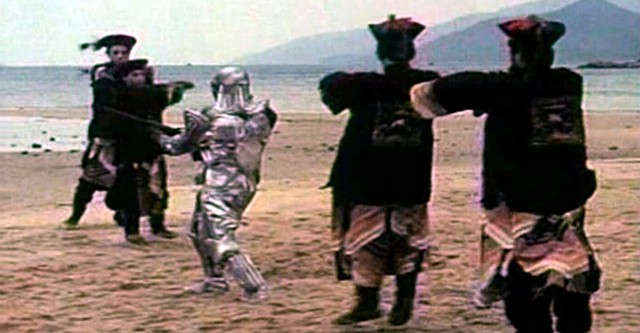
The vampires show up once the drug lord realizes that he’s going to need some help defeating a robot.  So, he has his people cast come magic and soon, there’s a bunch of zombie/vampires hopping around.  And when I say hopping, I mean that they literally hop around.  I noticed the same thing about the zombies in Kung Fu Zombie.  In the defense of that film, though, Kung Fu Zombie was kind of meant to be a comedy.  Robo Vampire seems to take itself pretty seriously.  (Watching the film, I thought I recognized a few shots that had apparently been lifted from Kung Fu Zombie but I haven’t been able to independently verify whether that’s really the case.  Some day, when I think I can handle the punishment, I’ll sit down and watch Kung Fu Zombie and then Robo Vampire and compare the two for myself.)

Eventually, Tom gets around to launching his rescue operation.  There’s a lot of shooting.  There’s a lot of scenes of Robot Tom wandering around robotically.  There’s a lot of hopping vampires or zombies or whatever they’re supposed to be.  But, as far as I can tell, there were no robot vampires.  Now, I say as far as I can tell because the film was edited so haphazardly that it wouldn’t surprise me to discover that there was like a hundred different versions of Robo Vampire floating around.  Who knows what have happened in the director’s cut?

Anyway, Robo Vampire is petty much impossible to follow and the film does itself no favors by inviting you to compare it to the original Robocop.  That said, the hopping vampires were kind of cute and this is truly a one of a kind movie.  You should watch it just so you can say that you did.

Horror Film Review: Mr. Sardonicus (dir by William Castle)


The next time that someone gives me a hard time for not being compassionate enough (and believe it or not, it does occasionally happen now that 90% of twitter has gone down the woke rabbit hole), I’m going to point out that I voted to show mercy to Mr. Sardonicus.

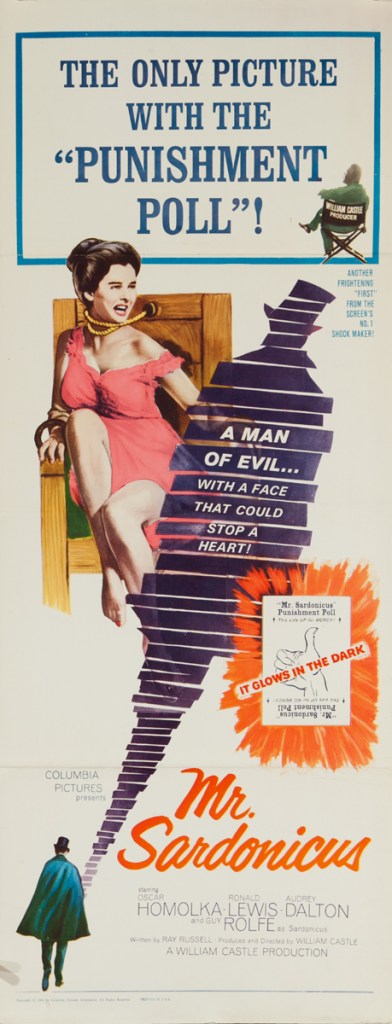
Played in villainous fashion by Guy Rolfe, Mr. Sardonicus was the title character of a 1961 film that was produced and directed by William Castle.  Castle was known for being the king of the gimmick.  His gimmick for Mr. Sardonicus was that, upon entering the theater, members of the audience were given two cards.  One card had a thumbs up.  One card had a thumbs down.  Towards the end of the film, the avuncular Mr. Castle appeared onscreen and announced that it was time for the audience to vote.  Should Mr. Sardonicus be punished for his sins or should he be shown mercy?  Thumbs up for mercy.  Thumbs down for punishment.  After taking the vote, Castle said, “Projectionist, play the reel.”

Now, of course, Castle only shot one ending and that was the ending where Mr. Sardonicus was punished.  To make sure the audience would vote the right way, Castle made Sardonicus into one of the most loathsome villains around.  Mr. Sardonicus — or Baron Sardonicus, as he preferred to be called — lived in a castle in the 1880s.  Not only did he torture his servants with leeches but he was also responsible for death of several dogs, all of which were killed as a part of his dastardly experiments.  To make it even worse, he wasn’t even a member of the nobility!  He stole his title!  It turned out that Mr. Sardonicus has once been a simple farmer who allowed his greed to get the better of him.  When his father was buried with a lottery ticket, Mr. Sardonicus dug up the old man to retrieve the ticket.  The shock of seeing his father’s skull caused Mr. Sardonicus’s face to freeze into a twisted grimace.  When the film begins, Mr. Sardonicus wears a mask and desperately wants to be cured of his affliction.

To try to convince Sir Robert Cargrave (Ronald Lewis) to cure his condition, Mr. Sardonicus is holding the woman that Sir Robert loves, Maude (Audrey Dalton), prisoner in a loveless marriage.  With the help of his evil servant, Krull (Oskar Homolka), Mr. Sardonicus torments the villagers and anyone else unlucky enough to come near the castle.

And yet, when I watched this movie last night with the Late Night Movie Gang, I voted to show compassion to Mr. Sardonicus because I’m a firm believer both in criminal justice reform and that almost anyone can be rehabilitated.  Perhaps Mr. Sardonicus just needed someone to say that they believed he could be a better man.  I was willing to do that.  However, the rest of the Late Night Movie Gang voted to punish him.  I think it was the dead dogs that sealed the deal.  So, sorry, Mr. Sardonicus.  I tried.

Even before William Castle tells everyone to vote, Mr. Sardonicus is enjoyably over-the-top and silly horror film.  It plays out like an extended episode of Twilight Zone, with every action that Mr. Sardonicus takes bringing him closer to karma’s judgment.  Guy Rolfe is properly evil and arrogant Sardonicus and Oskar Homolka gets many of the best lines as the servant who may not be as loyal as he seems.

Mr. Sardonicus is currently on YouTube.  Watch and vote for yourself!

Bats (1999, directed by Louis Morneau)


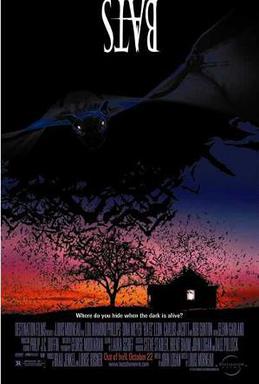
A scientist (Bob Gunton!) has genetically engineered the local population of bats in order to make them super intelligent and aggressive.  Though he says that he just wanted to make sure that the bats never went extinct, the ultimate result of his experiment is that the bats are now killing all of the citizens of a small town in Texas.  With the National Guard threatening to blow up the town, it’s up to Sheriff Emmett Kimsey (Lou Diamond Phillips!), Dr. Alexandra McCabe (Dina Meyer!), and assistant Jimmy Sands (Leon, so cool that he only needs one name!) to figure out how destroy the bats without destroying everyone’s home.

Now, this is how you make a killer bat movie!  There’s a lot of stupid things about Bats but it’s still a thousand times better than Nightwing.  I liked the idea of superintelligent bats more than the idea of just angry bats.  The bats are too clever for the humans, often seeing straight though their plans.  Nightwing took itself very seriously.  Bats does not and is therefore, better in every regard.  The bats are always on the attack, the good guys are always running from one place to another, and the National Guard just wants to blow everything up.  It’s a fun B-move, with the B standings for Bats.

You have to love that cast, too.  Any movie with Lou Diamond Phillips and Leon is going to be cooler than any movie without them.  I wouldn’t be surprised to learn that the two of them hunt bats in their spare time because they really seemed to know what they were doing.  Dina Meyer was obviously cast more because she looks like Dina Meyer than because she’s really a credible scientist but she still handles all the bat talk without embarrassing herself.  Bob Gunton is a great bad guy, as always.

Bats is dumb, silly, and terrifically entertaining.