Film Review: All The King’s Men (dir by Steven Zaillian)


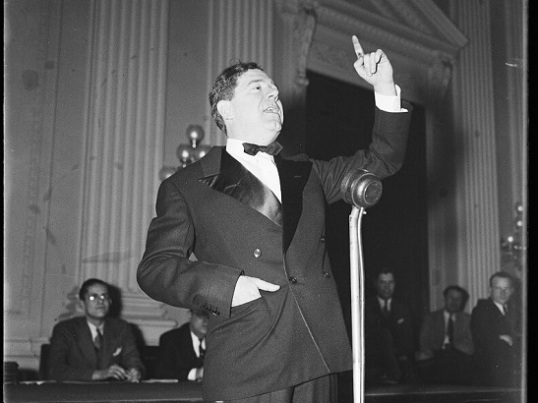
On September 10th, 1935, a Senator named Huey Long was shot and killed at the Louisiana State Capitol in Baton Rogue.

While it’s generally agreed that Carl Weiss, the son-in-law of a political opponent, approached Long, there’s still some debate as to whether or not Weiss was the one who shot Long. Did Weiss fire one shot at Long or was Long himself accidentally shot by his many bodyguards, all of whom opened fire on Weiss? (Weiss died at the scene, having been wounded at least 60 times.) There’s even some who argue that Weiss didn’t even have a gun on him when he approached Long and that Long’s bodyguards misinterpreted Weiss’s intentions. Or, as some more conspiracy-minded historians have suggested, perhaps Long’s bodyguards were themselves paid off by one of Long’s many enemies. With Huey Long, anything was possible.

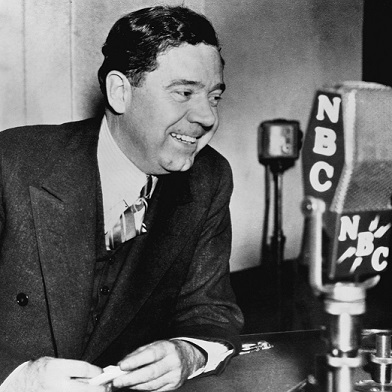
Huey Long has been described as being an American dictator, a man who ran for office as a populist and who, as governor and then senator, ruled Louisiana with an iron fist. His slogan was “Every man a king,” and he promoted a platform that mixed Socialism with redneck resentment. (In modern terms, he mixed the vapid but crowd-pleasing rhetroic of AOC with the bombastic but calculated personal style of Donald Trump.) He often played the flamboyant buffoon but he also knew how to reward his friends and punish his enemies. At the time of his death, he was planning to run for President against FDR. It’s said that, in typical Long fashion, he planned to run as a third party candidate and draw away enough votes from Roosevelt to allow Republican Alf Landon to win. Then, in 1940, Long would run for the Democratic nomination and send President Landon back to Kansas.
Huey-Long-radio-3000-3x2gty-5c2934d246e0fb00012da4a1

Whether his plan was feasible or not, they came to an end with his death. However, his legacy continued as members of the Long family dominated Louisiana politics for decades to come. Huey’s brother, Earl, served as governor of Louisiana for several contentious terms. Huey’s son, Russell, spent nearly 40 years in the Senate and, as chairman of the Finance Committee, was one of the most powerful men in the country. As late at 2020, Huey’s third cousin was serving in the Louisiana Senate. In the past few years, both Donald Trump and Bernie Sanders have been compared to Huey Long. Of course, if Huey were alive today, he’d probably be very popular online. Political Twitter has never met an authoritarian that it couldn’t make excuses for.

Among those who were fascinated by the life and death of Huey Long was a Southern poet and novelist named Robert Penn Warren. Warren used Long as the basis for Willie Stark, the man at the center of the novel All The King’s Men. In the novel, Stark is a classic and tragic American archetype, the man of the people who loses his way after coming to power. Stark starts the book as an idealist who wants to make life better for the poor but who, as he works his way up the political ladder, loses sight of why he first entered politics in the first place. He goes from fighting for the people to fighting only for himself. The book was controversial but popular and won the 1947 Pulitzer Prize. In later interviews, Warren often said that All The King’s Men was never meant to be a book about politics but instead a book about two men, Willie Stark and reporter Jack Burden, losing their way during the tumult of the Great Depression.  Regardless of Warren’s intentions, most readers and critics have focused on the book as a cynical look at American politics and the authoritarian impulse.

All-the-Kings-Men-1949

Considering the book’s popularity, it’s not surprising that All The King’s Men was turned into a movie just three years after it was published.  Directed by Robert Rossen and starring a perfectly cast Broderick Crawford as Willie Stark, the film won the Oscar for Best Picture of 1949.  Just as with the book, the film was considered to be controversial.  Many claimed that the film’s cynical portrayal of American politics was the equivalent of supporting communism, despite the fact that both the novel and the original film present Stark as being the epitome of the hypocritical Marxist dictator.  Indeed, if any character would have inspired audiences in 1949 to distrust socialism, it would have been a faux populist like Willie Stark.  Still, John Wayne was so offended by the book and the script that he very publicly turned down the role of Willie Stark.  That was all the better for Broderick Crawford, who won an Oscar playing the role.  When seen today, the original All The King’s Men holds up surprisingly well, as does Crawford’s lead performance.  Filmed in harsh black-and-white and featuring a cast of cynical, tough-talking characters, it’s a political noir.

Those who found the 1949 version of All The King’s Men to be dangerously subversive obviously had no idea what was in store for them and the country over the next couple of decades.  There’s a reason why the best-known book about the downfall of Richard Nixon was called All The President’s Men.  By the start of the current century, with all of the political corruption that was happening in the real world, the flaws and crimes of Willie Stark seemed almost quaint by comparison.  In 2006, with George W. Bush serving his second term, America embroiled in two unpopular wars, and the economy looking shaky, it was decided that it was time for a new version of the story of Willie Stark.

This version was directed by Steven Zaillian, the screenwriter whose credits included Schindler’s List, Gangs of New York, Hannibal, and American Gangster.  The role of Willie Stark was played by Sean Penn, who was both an Academy Award winner and an outspoken critic of George Bush.  (And, make no mistake about it, the new version of Willie Stark would be as much based on Bush as he was on Huey Long.)  Jude Law played Jack Burden, the reporter who narrated the story of Stark’s rise and fall.  Kate Winslet, Anthony Hopkins, James Gandolfini, Patricia Clarkson, Mark Ruffalo, Jackie Earle Haley, and Kathy Baker all had supporting roles.  This was a cast full of Oscar nominees and, indeed, the film’s trailer had that portentous, “the movie is very important and award-worthy” feeling to it that studios go with whenever they’re trying to convince audiences that they have an obligation to see a film, regardless of how boring or annoying it may look.  Entertainment Weekly predicted that All The King’s Men would be an Academy Award contender. For nearly two months, one could not see a movie at the Dallas Angelika without also seeing thee trailer for All The King’s Men.  It was a movie that was due to arrive at any minute and it was coming with an awful lot of hype.

And then, the strangest thing happened.  The film itself kind of disappeared.  It arrived and then it promptly got lost.  The reviews were overwhelmingly negative.  Audiences did not turn out to see the film.  It was a box office bomb, one that pretty much ended Steven Zaillian’s career as a director.  The film played for a week in Dallas and then left the city’s movie screens.  Even if I had been planning on seeing the film when it was originally released, I wouldn’t have had the opportunity.  The Gods of cinema, politics, and Southern accents were conspiring to protect me from suffering through a bad movie and I guess I should be thankful.  There’s nothing that makes me cringe more than hearing a bad Southern accent in a movie and the trailer for All The King’s Men was full of them.

Way back in November of last year, I noticed that the 2006 version of All The King’s Men was available on Encore On Demand.  At the time, I had politics on my mind.  The Virginia and New Jersey gubernatorial elections had bee held earlier that week.  Biden’s huge infrastructure bill had passed the House on the very same night that I came across the film.  Hell, I figured, could watching Sean Penn as Willie Stark be any worse than watching Joe Biden try to give a speech from the Oval Office?  So, I decided to give the movie a chance and I quickly discovered that watching Sean Penn’s Willie Stark was a lot worse.

In All The King’s Men, Sean Penn gives the type of bad performance that can only be given by a good actor.  Penn yells and grimaces and barks out order like the villain in a badly dubbed Bollywood movie.  When he watches a dancer, he doesn’t just look at her.  Instead, he stares with all the intensity of a cartoon wolf who has just spotted Little Red Riding Hood.  There’s nothing subtle about Penn’s performance, least of all his overbaked accent.  The only thing wilder than Penn’s accent is his hair, which often seems to be standing up straight as if he’s just removed his fingers from an electrical socket.  It’s a performance that is heavy on technique but empty on substance.  In both the book and the original film, Willie Stark is flamboyant in public but cool and calculating in private.  In the remake, Penn yells and sweats and jumps around and comes across as being so desperate that it’s hard to buy into the idea that anyone would believe a word that he said.  Broderick Crawford’s Willie Stark was believable because Crawford, with his bulky build and his plain-spoken manner, came across as being a real human being.  One could imagine voters looking at Crawford and believing that he was just like them.  Sean Penn, on the other hand, comes across like a rich man’s version of a poor man.  Penn is too obviously condescending to be an effective populist.  Voters will forgive a lot but they’ll never forgive a politician who openly talks down to them.

As for the rest of the cast, they’re a very talented group but not one of them is convincingly cast.  In fact, many of them give career-worst performances.  Anthony Hopkins does his usual eccentric routine but it doesn’t add up too much because the audience never sees him as being anything other than Anthony Hopkins using a rather spotty Southern accent.  When Hopkins’s character dies, it’s not a tragedy because the character himself never feels real.  Instead, you’re juts happy that Hopkins collected a paycheck.  Kate Winslet seems to be bored with the role of Stark’s mistress.  Mark Ruffalo is dazed in the role of Winslet’s brother.  As Jack Burden, Jude Law seems as lost as anyone, which wouldn’t be problem if not for the fact that Jack is the one narrating the film.  When your narrator is lost, you’re in trouble.

There’s really only two members of the cast who escape the film unscathed.  Jackie Earle Haley is properly intimidating as Stark’s devoted bodyguard.  Haley doesn’t get many lines but one look at his disturbed eyes tells you all you need to know about how far he’ll go to protect his boss.  On the other hand, James Gandolfini gets several lines and he does such a good job of delivering them and he plays the role of a corrupt political boss with such a perfect combination of good humor and cold pragmatism that you have to wonder just how much All The King’s Men would have been improved if Gandolfini had played Willie Stark instead of Sean Penn.

Steve Zaillian’s direction involves a lot of soft-focused flashbacks and several visual references to the Nuremberg rallies.  Just as with Penn’s performance, there’s nothing subtle about Zaillian’s direction, despite the fact that the story itself is so melodramatic that it calls for the opposite of a heavy-handed approach.  One wonders what exactly Zaillian was trying to say with his version of All The King’s Men, which presents Willie Stark as being a monster but still as the audacity to end with a clip of him giving a rousing campaign speech.  Again, the problem is that we never buy into the idea that Willie Stark was ever sincere in his desire to help the common man.  Everything about both Penn’s performance and Zaillian’s direction serves to suggest that, from the start, Stark viewed them as just being a means to an end.  Ending the film with a flashback of Willie giving a campaign speech is about as moving as a friend from high school contacting you on Facebook and then trying to get you to take part in a pyramid scheme.  There’s no sincerity to be found in any of it.

In the end, it’s a film of overheated performances and meticulously shot scenes that all add up to very little.  There are a few moments where Sean Penn’s body language and his vocal inflections suggest that he’s trying to channel George W. Bush but there’s nothing particularly shocking or subversive about that.  In 2006, every movie and TV show had to find a way to take a swipe at Bush and Penn’s never been particularly reticent when it comes to broadcasting his politics.  Though All The King’s Men was executive produced by political consultant James Carville, there’s very few moment in the film that feel authentic.  It’s like a high school senior’s view of politics.

All The King’s Men came and went quickly.  Fortunately, everyone was able to move on.  Steven Zaillian has not directed another film but remains an in-demand scriptwriter.  Sean Penn, Anthony Hopkins, and Kate Winslet all won Oscars after appearing in this film (though, it should be noted, none of them won for this film).  Mark Ruffalo and Jude Law went on to join the Marvel Universe.  Jackie Earle Haley continues to be a much-respected character actor.  Tragically, James Gandolfini is no longer with us but his performance as Tony Soprano will never be forgotten.  The second version of All The King’s Men wasted a lot of talent but, fortunately, talent always finds a way to survive.

A Blast From The Past: Better Use Of Leisure Time


Well, it’s a new year.

That means that it’s time to start thinking about what you want to make of yourself this year.  What are you going to do?  What are you going to accomplish?  How are you going to make yourself proud of who you’ve become?

There’s a lot of movies coming out.  Maybe you’ll go to them.  Or maybe you’ll be the person who spends all of their time on twitter, tweeting about how scared you are of going back to the theaters.  Both options come with their risks and their rewards.

There’s a celebrity edition of Big Brother airing in February.  Maybe you’ll watch it.  Maybe you’ll blog about it, because you like getting paid more than your dislike the show.  Or maybe you’ll spend all of your time on twitter, talking about how much you hate reality TV.

2022 is an election year.  Maybe you’ll run for office.  Maybe you’ll volunteer to work for a campaign.  Maybe you’ll spend all of your time on twitter, tweeting about how people need to vote for your candidate.  Maybe you’ll come up with the hashtag that changes the course of the election!  Maybe you’ll hang out in the paring lot of Whataburger, waiting for Beto to toll by.

Or maybe….

Eh.

You’re not going to do anything.

Let’s be honest, most of us are very lazy and we have absolutely no idea how lucky we are compared to people who lived just a few decades ago.  We take a lot of things for granted and we waste a lot of time doing nothing, precisely because we can do just about anything that we want.

(Of course, in my case, I’m have ADHD.  I spend a lot of time doing things but usually, I end up trying to do them all at once.  Reading a book and watching a TV at the same time is not difficult but when you also try to vacuum the living room while doing those other two things, it starts to get a little bit more difficult.  Still, my super power is ADHD and I’m thankful.)

Well, fear not!  A short film from Coronet Films has traveled all the way from 1950 to encourage you to make better use of your leisure time!  Why …. that’s even the name of the film!  Better Use of Your Leisure Time follows a good-for-nothing, spoiled teenager named Ken as he learns why spending all of your time moping is perhaps the worst thing that you can do.  With the help of a judgmental narrator and the ability to see alternative universes, Ken learns an important lesson.  There’s no hope with mope!  Ken discovers that some people actually have hobbies and spend their free time creating and learning and being a decent citizen.  It’s an important lesson and hopefully, it’s one that Ken will remember the next time that someone tells him that moping is no big deal.

Anyway, as far as Coronet Educational Films go, this one isn’t bad.  Ken is a bit of a loser but that’s to be expected of these type of films.  It’s very much a product of its era and, if nothing else, it stands as evidence that people wasted time even before the internet existed.  TAKE THAT, LUDDITES!

Watch, enjoy, and learn.  LEARN, GOSH DARN IT!

Lisa Reviews An Oscar Nominee: The Irishman (dir by Martin Scorsese)


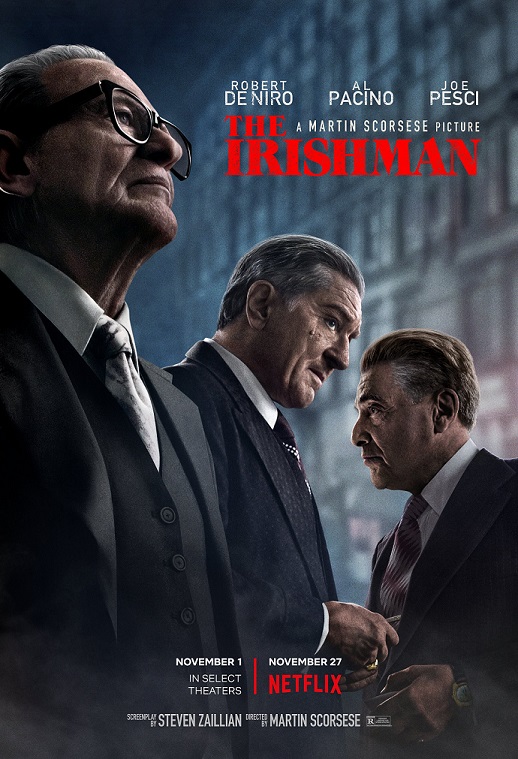
Released by Netflix in 2019 and clocking in at close to 4 hours, the Martin Scorsese-directed Best Picture nominee, The Irishman, is a film about many different things.

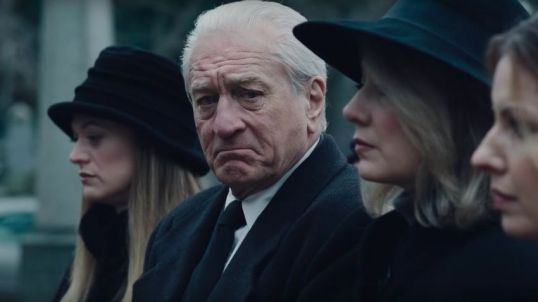
At its simplest, it’s a film about a very old man named Frank Shearan (played by Robert De Niro).  Frank is an Irish-American from Philadelphia.  Frank is a veteran of World War II and a former truck driver who was briefly a fairly important figure in the Teamsters union.  He did a few years in prison.  At the start of the film, though, he’s just another elderly man living in a retirement community.  All of his friends are dead.  His wife passed away years ago.  His children never comes to visit.  In fact, the only people interested in talking to Frank are the FBI but Frank doesn’t have much to say to them.  That’s not to say that Frank isn’t talkative.  For the first time in his life, he wants to talk to people but there’s no one left to talk to.  The only people who listen are those who are required to do so.  A nurse politely nods along as as he tells her about his old friend Jimmy Hoffa.  (She’s never heard of him.)  A priest listens to the story of Frank’s life and offers him absolution.  At times, Frank looks straight at Scorsese’s camera and appears to be talking straight to the audience.  Frank has a lot of interesting stories but who knows how truthful he’s being or if his memory can be trusted.

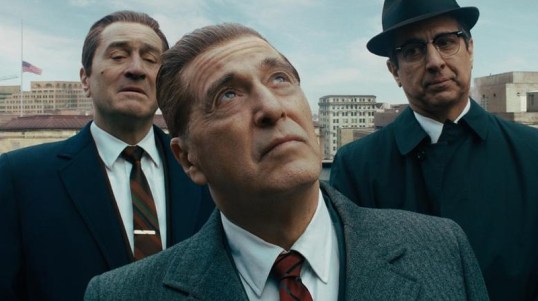
The Irishman, though, is not just the story of Frank.  It is also a secret history of America during the latter half of the 20th Century.  Frank may look old and harmless in that nursing home but, to hear him tell it, he was once acquainted with some of the most powerful men in America.  He went from executing Italian POWs during World War II to executing hits for the Mafia in post-war America.  Along the way, he became close to crime bosses like Skinny Razor (Bobby Cannavale), Angelo Bruno (Harvey Keitel) and Russell Bufalino (Joe Pesci), men who may not have been household names but who still wielded a lot of power.  These are men who, Frank flatly states, fixed the presidential election of 1960 and who later quite possibly killed the man they had elected president.  Frank also became a close associate of Jimmy Hoffa (Al Pacino), the labor leader who was reputed to have mob connections and who disappeared in 1975.

The Irishman is also a tribute to the modern gangster film, featuring role for nearly every living actor associated with the genre.  De Niro, Pacino, Pesci, Keitel, Bobby Cannavale, Domenick Lombardozzi, Gary Basaraba, they’ve all played their share of gangsters in films and television show that were both good and bad.  Having them all appear in one film together serves to remind the viewer of just how much of America’s popular entertainment has revolved around stories of organized crime.  Even as the old school Mafia has declined as a real-world power, it’s become a permanent part of pop culture.  Everyone loves a gangster, except for the people who actually have to deal with them on a daily basis.

Not surprisingly, considering the stars and the director, it’s a film full of smart, detailed performances.  When the film was originally released, Pacino and Pesci got the lion’s share of the praise and they certainly deserved it.  Pacino gets the best lines and brings some unexpected wit to his performance as Jimmy Hoffa.  Pesci, meanwhile, finally gets to play a gangster who is not psychotic and shows that he can be just as compelling when he’s not raising his voice as when he is.  Still, some of my favorite performances came from actors who one wouldn’t necessarily associate with a Scorsese gangster film.  I liked the nervous humor that Ray Romano brought to the role of a corrupt union lawyer.  I liked the seething resentment that Stephen Graham brought to the role of Jimmy Hoffa’s main rival in the union.  (The scene where Graham and Pacino argue over who is more owed an apology for all of their past disagreements is both funny and, due to the people involved, somewhat frightening.)  Jesse Plemons is poignantly dumb in his brief role as Hoffa’s stepson.  Louis Cancelmi doesn’t get a lot of screen time but he steals every scene in which he appears as a paranoid hitman.  (Cancelmi plays a character named Sally Bugs, proving that not everyone in the Mafia gets a cool nickname.)

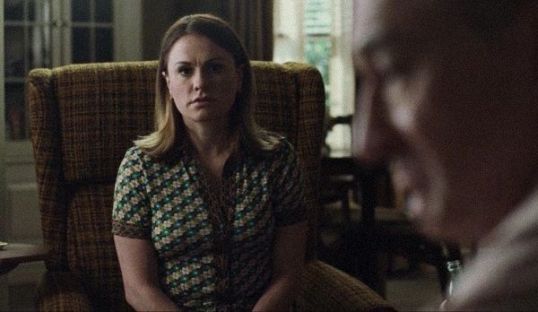
And then there’s Anna Paquin, who provides the film with its moral center.  When the film was first released, many Twitter critics complained that Paquin, who played Frank’s daughter Peggy, only a had a handful of lines.  It was one of the stupidest controversies of 2019, which is saying something when you consider how much time Film Twitter devotes to generating stupid controversies.  Peggy doesn’t say much because she’s decided that she doesn’t want to be a part of her father’s life.  From the moment that she first sees Frank beating up a store owner, Peggy knows that her father and his associates are violent men.  She not only fears them but she resents the damage that Frank does to not only her family but to the families as other as well.  The only one of her father’s associates who she likes is Jimmy Hoffa, because Hoffa cares about helping others.  When Hoffa disappears, Peggy makes a decision to disappear from Frank’s life and Paquin’s withering stare says more than any lengthy monologue could.  Peggy doesn’t say much because she knows that her words would be wasted on a man who she knows is a liar.  The scene where she silently walks away from her now elderly father tells us everything we need to know about the emotional consequences of the life that Frank has chosen to live.  Regardless of how many lines she did or didn’t have, Paquin gave one of the best performances of 2019.

Famously (or, depending on which critics you read, infamously), de-aging technology was used so that De Niro, Pacino, Pesci, and Keitel could play both the younger and the older version of their characters.  At first, it can be a bit jarring.  The de-aging works fine with Pesci and Keitel, both of whom are already supposed to be middle-aged when they first meet Frank.  (Admittedly, Keitel only has a few minutes of screen time.)  With De Niro and Pacino, it’s a bit less successful.  Even when they’re playing younger versions of themselves, De Niro and Pacino still move and stand like old men.  Fortunately, in the case of Pacino, his natural movie star charisma wins out over his obvious age.  In the end, we believe that he’s Hoffa because we want to believe that all of our important historical figures were as interesting and entertaining as Al Pacino is in The Irishman.

And yet, ultimately, even the awkward de-aging works to the film’s advantage because it reminds us that we’re not necessarily seeing what happened.  Instead, we’re seeing what Frank says happened.  We’re seeing his memories, or at least what he claims to remember.  It makes sense that, when Frank thinks about himself as a young truck driver in 1956, he would picture himself not as he was but instead as just a slightly less weathered version of who he would eventually become.  Throughout the film, there are hints that Frank’s memory should not be trusted.  Some of his stories are incredibly detailed while others — like when he transports weapons for the failed invasion of the Bay of Pigs — are a bit more vaguely presented.  Is Frank lying or is he misremembering or are we just expecting too much detail from a man who is now essentially waiting to die?  The film leaves that up for us to determine.

The Irishman is Scorsese at his most reflective.  Compared to Goodfellas and Casino, The Irishman is certainly one of Scorsese’s less “flashy” films.  But, on repeat viewings, it becomes cleat that The Irishman is the perfect conclusion to the gangster trilogy that began with Goodfellas and continued with Casino.  All three of these films deal with someone who rises up the ranks in the mob while remaining, as a result of their ethnicity, an outsider.  (Henry Hill and Frank Shearan are both Irish.  Ace Rothstein was Jewish.)  All three of them are briefly on top of the world and all three of them are left wondering how they’re going to continue their lives after their days at the top are over.  In Goodfellas, Henry Hill makes no secret of his disgust at having to live in the bland anonymity of the suburbs.  In Casino, Ace Rothstein ends the film with a mournful acceptance the fact that he will never return to his beloved Vegas.  (“And that’s that.”)  In The Irishman, Frank finally realizes that he has comes to the end of it all, alone and with nothing but death in his future.  All three of them made their decisions and, in the end, all three of them are left to deal with the consequences.  The trilogy goes from Henry’s anger to Ace’s depression to Frank’s acceptance.

It may seem strange to describe a film like The Irishman as being underrated, seeing as how it was nominated for 10 Oscars and got a Criterion release in record time.  And yet, when the film first came out, there was a vague sense of disappointment to found in even some of the positive reviews.  It was a Scorsese film that was so eagerly awaited and arrived with so much hype that there was no way it could live up to some of the expectations that had been set for it.  (And, of course, there’s also a whole set of people who were predestined to dislike the film precisely because it was a Scorsese film and it was so anticipated.)  It’s a long film and, while Netflix should be praised for allowing Scorsese the freedom to make his epic, it’s also not a film that should be viewed in bits and pieces on a tiny screen.  The Irishman is a film that should be watched in one sitting and it’s definitely a film that most viewers should watch more than once.  It takes more than one viewing to truly grasp the the world that Scorsese has recreated.

The Irishman was nominated for Best Picture.  It lost to a worthy competitor, Parasite.  Still, regardless of who took him the Oscars, The Irishman is a film that will live forever.

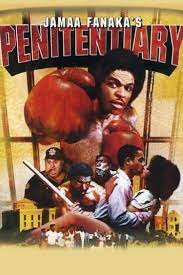
The TSL’s Grindhouse: Penitentiary (dir by Jamaa Fanaka)


In the 1979 prison/blaxploitation film Penitentiary, everyone gets a nickname.

For instance, the main character, played by Leon Isaac Kennedy, may be named Martel Gordone but everyone calls him “Too Sweet,” because he’s addicted to Mr. Goodbar candy bars.  Just because Gordone has been sent to prison for a murder that he didn’t actually commit, that’s not going to stop him from going out of his way to eat all the candy that he can.  Fortunately, all that candy has not effected his ability to throw a punch or win a fight because this prison is obsessed with boxing.

Too Sweet’s first cellmate is known as Half-Dead (Badja Dola).  Half-Dead got his name because he’s already dead on the inside.  At least, that’s what I assume the nickname means.  It could also mean that, if you find yourself sharing a cell with him, you’re already as good as dead.  Half-Dead is violent and sadistic and when he feels that Too Sweet isn’t showing him enough respect, Half-Dead attacks.  After an extremely long and grueling fight (one that is made all the more intense by the fact that it’s taking place in a cramped cell), Too Sweet succeeded in kicking Half-Dead’s ass.

Seldom Seen (Floyd Chetman) is Too Sweet’s second cellmate.  Seldom Seen is …. well, he’s seldom seen.  He has spent 50 of his 65 years in prison.  Seldom avoids all of the prison drama and instead, he spends his time in his cell, reading books while sitting in front of a poster of Malcolm X.  Seldom Seen, it turns out, used to be a boxer and, when Too Sweet decides to enter the prison boxing tournament, Seldom Seen not only serves as his trainer but also as his mentor.

Jesse “The Bull” Amos (Donovan Womack) is also entering the boxing tournament.  Jesse is know as the Bull because he’s big, he’s tough, and he never stops coming after his opponents.  He becomes angry when Too Sweet encourage the Bull’s cellmate, “Genie” (Thommy Pollard), to stand up for himself and to not let any man treat him as being “property.”  The Bull wants revenge.

Of course, there’s more to the prison boxing tournament than just getting revenge.  Win a fight and the warden will allow you an entire week of conjugal visits.  Win the tournament and you’ll get early parole and …. wait, a minute, what?  I’m all for emptying the prisons and giving people second chances but I’m pretty sure that’s not how parole works.  Oh well, it’s a movie, right?

Penitentiary was directed by Jamaa Fanaka, who also directed the very first film that I ever reviewed for this site, Welcome Home Brother Charles.  Like Brother Charles, Penitentiary is a film that is obsessed with the idea of being a prisoner of not just the legal system but also of society as a whole.  Too Sweet doesn’t just learn how to box.  He also learns, from Seldom Seen, that the key to being the “freest man in the world” is to learn how to control your desires and to exercise the self-discipline necessary to make something of yourself.  Penitentiary never quite reaches the lunatic heights of Welcome Home Brother Charles, of course.  Penitentiary is a far more straight-forward film.  Welcome Home Brother Charles featured the title character using his penis to strangle his enemies.  In Penitentiary, Too Sweet is content to just beat them up in the boxing ring.

Penitentiary gets off to a strong start.  Leon Isaac Kennedy gives a likable performance as Too Sweet and the initial fight between Too Sweet and Half-Dead is handled well.  Surprisingly enough, it’s during the boxing scenes that the film starts to run out of energy.  The boxing matches go on forever and Fanaka gets bogged down with repetitive scenes of prisoners ducking into a prison restroom to get it on while the guards are distracted by the fight.  The film’s narrative momentum stalls out long before the inevitable match between Too Sweet and the Bull.  For all the build-up, the final fight turns out to be oddly anti-climatic.

Penitentiary has some strong moments but it doesn’t really come together as a whole. Still, it did well-enough at the box office that Fanaka would go on to direct two increasingly surreal sequels.

The Life and Times of Judge Roy Bean (1972, directed by John Huston)


During the lawless day of the old west, a drifter named Roy Bean (Paul Newman) wanders into the desolate town of Vinegaroon, Texas.  When he enters the local saloon, he meets the vagrants who run the town.  They beat him, they rob him, and they tie him to the back of his horse and leave him to die.

Bean, however, does not die.  Instead, he’s nursed back to health by a beautiful young woman named Maria Elena (Victoria Principal).  Carrying a gun, Bean reenters the saloon and promptly kills nearly everyone who previously attacked him.  (“I’m not done killing you yet!” Bean yells at one fleeing woman.)  Bean sits down in front of the saloon and waits for justice.  Instead, he’s visited by a lecherous traveling preacher (Anthony Perkins), who buries the dead and gives Bean absolution.  Bean declares that he is now the “law of the West Pecos.”  As the preacher leaves, he looks at the audience and says that he never visited Bean again and later died of dysentery in Mexico.  He hasn’t seen Bean since dying so the preacher is sure that, wherever Bean went, it wasn’t Heaven.

Judge Roy Bean dispenses rough and hard justice from his saloon and renames the town Langtry, after the actress Lillie Langtry.  Bean has never met Langtry or even seen her perform but he writes to her regularly and pictures of her decorate the walls of his saloon.  Bean hires outlaws to serve as his town marshals and sentences prostitutes to remain in town and marry the citizens.  Lawbreakers are left hanging outside of the saloon.  Bean enters into a common law marriage with Maria and, for a while, they even own a bear, who drinks beer and helps Bean maintain order in the court.  Bean may be crazy but his methods clean up the town and Langtry starts to grow.  As Langtry becomes more civilized and an attorney named Arthur Gass (Roddy McDowall) grows more powerful, it starts to become apparent that there may no longer be a place for a man like Judge Roy Bean.

The real-life Judge Roy Bean did hold court in a saloon and he did name the town after Lilly Langtry.  It’s debatable whether or not he was really a hanging judge.  Because he didn’t have a jail, the maximum punishment that he could hand out was a fine and usually that fine was the same amount of however much money the accused had on him at the time of his arrest.  Because of his eccentricities and his reputation for being the “only law west of the Pecos,” Roy Bean became a legendary figure.  The Life and Times of Judge Roy Bean acknowledges from the start that it’s not a historically accurate, with a title card that reads, “Maybe this isn’t the way it was… it’s the way it should have been.”

Based on a script by John Milius and directed by Hollywood veteran John Huston, The Life and Times of Judge Roy Bean is one of the strangest westerns to ever be released by a major studio.  Featuring multiple narrators who occasionally speak directly to the camera, The Life and Times of Judge Roy Bean is an episodic mix of low comedy, graphic violence, and syrupy romance.  (The film’s sole Oscar nomination was for the song that played over scenes of Bean and Maria going on a romantic picnic with their pet bear.)  Familiar faces show up in small roles.  Along with Perkins and McDowall, Tab Hunter, Ned Beatty, Jacqueline Bissett, Ava Gardner, and Anthony Zerbe all play supporting roles.  Even a heavily made-up Stacy Keach makes an appearance as an albino outlaw named Bad Bob.

Jacqueline Bisset in The Life and Times of Judge Roy Bean

Milius has gone on the record as calling The Life and Times of Judge Roy Bean a “Beverly Hills western” and he has a point.  He envisioned the script as starring Warren Oates as a less likable and much more morally ambiguous version of Judge Roy Bean and he was not happy that his original ending was replaced by a more showy pyrotechnic spectacle.  Milius envisioned the film as a low-budget spaghetti western but Huston instead made a Hollywood epic, complete with celebrity cameos and a theme song from Maurice Jarre and Marilyn Bergman.  Milius said that his experience with The Life and Times of Judge Roy Bean is what led to him deciding to direct his own films.

Again, Milius has a point but John Huston’s version of The Life and Times of Judge Roy Bean has its strengths as well.  Though he may not be the madman that Milius originally envisioned, Paul Newman gives a good, grizzled performance as Roy Bean and the role served as a precursor for the type of aging but determined characters that Newman would specialize in during the final phase of his career.  Due to its episodic structure, the film is uneven but it works more often than it doesn’t.  The chaotic early scenes reflect a time when the west was actually wild while the later scenes are more cohesive, as society moves into Langtry and threatens to make formerly indispensable men like Roy Ban obsolete.  Even the cameo performances fit in well with the film’s overall scheme, with Anthony Perkins standing out as the odd preacher.  Finally, the young Victoria Principal is perfectly cast as the only woman that Roy Bean loved as much as Lily Langtry.

Though it’s impossible not to wonder what Warren Oates would have done with the title role, The Life and Times of Judge Roy Bean is a good end-of-the-west western.

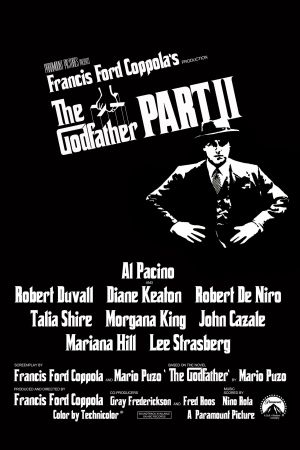
What Could Have Been: The Godfather, Part II


Years ago, I wrote a post called What Could Have Been: The Godfather, in which I discussed all of the actors and the directors who were considered for The Godfather. 

It remains one of the most widely viewed posts that we’ve ever had on this site.  I guess that shouldn’t be a surprise.  People love The Godfather and they love playing What If?  Would The Godfather still have been a classic if it had been directed by Otto Preminger with George C. Scott, Michael Parks, Burt Reynolds, and Robert Vaughn in the lead roles?  Hmmm …. probably not.  But, in theory, it could have happened.  All of them were considered at one point or another.

However, in the end, it was Francis Ford Coppola who directed The Godfather and it was Marlon Brando, Al Pacino, James Cann, and Robert Duvall who brought the Corleone family to life.  The Godfather, as everyone knows, was a huge hit and it went on to win the Oscar for Best Picture of the year.  As the film ended with the future of the Corleone family still up in the air, there was obviously room for a sequel.

When Paramount Pictures first approached Coppola about writing and directing a sequel, he turned them down.  He said he was done with The Godfather and didn’t see any way that he could improve on the story.  It’s debatable whether or not Coppola truly felt like this or if he was just holding out for more money.  It is known that Coppola did suggest to Paramount a possible director for Part II and that director’s name was Martin Scorsese.

What would Martin Scorsese’s The Godfather Part II have looked like?  It’s an intriguing thought.  At the time, Scorsese was best-known for Mean Streets and it’s probable that Scorsese’s film would have been a bit messier and grittier than Coppola’s version.  If Coppola made films about the upper echelons of the Mafia, Scorsese’s interest would probably have been with the soldiers carrying out Michael’s orders.  While Scorsese has certainly proven that he can handle a huge productions today, he was considerably younger and much more inexperienced in the early 70s.  To be honest, it’s easy to imagine Scorsese’s Godfather Part II being critically and commercially rejected because it would have been so different from Coppola’s.  A failure of that magnitude would have set back Scorsese’s career and perhaps even led to him returning to Roger Corman’s production company.  As such, it’s for probably for the best that Coppola did eventually agree to shoot the sequel, on the condition that Coppola be given creative control and Paramount exec Robert Evans not be allowed on the set.  While Coppola was busy with Godfather Part II, Scorsese was proving his versatility with Alice Doesn’t Live Her Anymore.

After Coppola was signed to direct, the next best question was whether or not Marlon Brando would return to play the role of Vito Corleone.  The film’s flashback structure would ensure that Vito would remain an important character, despite his death in the first film.  Coppola reportedly considered offering Brando the chance to play the younger version of Vito but he changed his mind after he saw Robert De Niro in Scorsese’s Mean Streets.  Still, it was felt that Brando might be willing to show up in a cameo during the film’s final flashback, in which Michael tells his family that he’s enlisted in the army.  Frustrated by Brando’s refusal to commit to doing the cameo, Coppola told him to show up on the day of shooting if he wanted to do the film.  When Brando didn’t show, the Don’s lines were instead rewritten and given to Tom Hagen.  It’s hard not to feel that this worked to the film’s advantage.  A last-minute appearance by Brando would have thrown off the film’s delicate balance and probably would have devalued De Niro’s own performance as the younger version of the character.

Brando wasn’t the only member of the original cast who was hesitant about returning.  Al Pacino held out for more money, which makes sense since he was literally the only cast member who could not, in some way, be replaced.  Richard Castellano, who played Clemenza in the first film, however learned that he that hard way that he was not quite as indispensable as Al Pacino.  In Part II, Clemenza was originally meant to have a large role in both the flashbacks and the present-day scenes.  However, when Castellano demanded more money and the right to rewrite his own lines, the older Clemenza was written out the film and replaced by the character of Frankie Petangeli (played by Michael V. Gazzo).

It’s impossible to find fault with Gazzo’s performance but it’s still hard not to regret that Castellano didn’t return.  Imagine how even more poignant the film’s final moments would have been if it had been the previously loyal Clemenza who nearly betrayed Michael as opposed to Frankie?  Indeed, even after the part was rewritten, many of Frankie’s lines deliberately harken back to things that Clemenza said and did during the first film.  Because Clemenza is a very prominent character during the film’s flashbacks, his absence in the “modern” scenes is all the more obvious.

When the role of Young Clemenza was cast, it was still believed that Richard Castellano would be appearing in that film.  One of the main reasons that Bruno Kirby was selected for the role of Young Clemenza was because Kirby had previously played Castellano’s son in a television show.  Also considered for the role was Joe Pesci, who was working as a singer and a comedian at the time.  (His partner in his comedy act was Frank Vincnet.)  If Pesci had been cast, he would not only have made his film debut in The Godfather Part II but the film also would have been his first pairing with Robert De Niro.  (Interestingly enough, Frank Sivero — who played Pesci and De Niro’s henchman, Frankie Carbone, in Goodfellas, also had a small role in Godfather Part II, playing Vito’s friend, Genco.)

As for the film’s other new major character, there were several interesting names mentioned for the role of gangster Hyman Roth.  Director Sam Fuller read for the role and Coppola also considered Elia Kazan.  Perhaps the most intriguing name mentioned as a possible Roth was that of James Cagney.  (Cagney, however, made it clear that he was content to remain retired.)  In the end, the role was offered to Al Pacino’s former acting teacher, Lee Strasberg.  Like Gazzo, Strasberg made his film debut in The Godfather Part II and, like Gazzo, he received his only Oscar nomination as a result.

The legendary character actor Timothy Carey (who was courted to play Luca Brasi in the first film) met with Coppola to discuss playing Don Fanucci, the gangster who is assassinated by Vito.  A favorite of Stanley Kubrick’s, Carey reportedly lost the role when he pulled out a gun in the middle of the meeting.

Originally, the film was supposed to end in the mid-60s, with a now teenage Anthony Corleone telling Michael that he wanted nothing to do with him because he knew that Michael had Fredo murdered.  (That famous scene of Michael bowing his head was originally supposed to be in response to Anthony walking out on him as opposed to the sound of Fredo being shot.)  Cast in the role of teenage Anthony was actor Robby Benson so perhaps it’s for the best that the scene was ultimately not included in the film.

Some of the smaller roles in Part II were played by actors who were considered for larger roles in the first film.  The young Tessio was played by John Aprea, who was also considered for the role of Michael.  Peter Donat, who played the lead Senate counsel in Part II, was considered for the role of Tom Hagen.  The rather tall Carmine Caridi, who played Camine Rosato in Part II, was originally cast as Sonny until it was discovered that he towered over everyone else in the cast.  And, of course, Robert De Niro famously read for the role of Sonny and was cast in the small role of Paule Gatto before he left The Godfather to replace Al Pacino in The Gang Who Couldn’t Shoot Straight.  (Of course, the whole reason that Pacino left The Gang Who Couldn’t Shoot Straight was so he could play the role of Michael in The Godfather.  In the end, it all worked out for the best.)

Finally, former teen idol Troy Donahue played Connie Corleone’s second husband, Merle Johnson.  Merle Johnson was Troy Donahue’s real name.

Personally, I think The Godfather Part II is one of the few films that can be described as perfect. Still, it’s always fun to play what if.

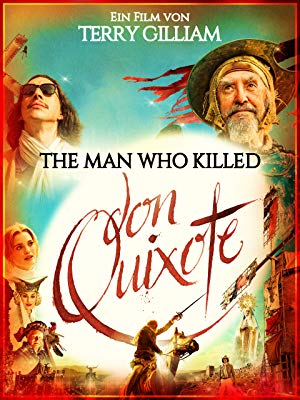
Icarus File No. 6: The Man Who Killed Don Quixote (dir by Terry Gilliam)


For many years, The Man Who Killed Don Quixote was a film best known for not having been made.

In the past, we’ve used the Icarus Files as a way to write about filmmakers who flew too close to the sun of their own ambition and who plunged down to the sea as a result.  However, in the case of The Man Who Killed Don Quixote, the sun is not director Terry Gilliam’s ambition.  Instead, the sun is a combination of shady financiers, natural disasters, and film industry silliness that seemed to all conspire to keep Gilliam from making his film.  And yet, unlike the real Icarus, Gilliam insisted on continuing to fly, regardless of how many times he crashed into the ocean.

Terry Gilliam first started to talk about adapting Migel de Cervantes’s Don Quixote into a film in the late 80s.  The tale of a Spanish nobleman who becomes convinced that he’s fighting giants when he’s actually only jousting with windmills, Don Quixote sounded like an obvious project for Gilliam.  Gilliam’s films have always dealt with the power and importance of imagination.  However, it’s often forgotten that Gilliam’s protagonists are often both saved and eventually destroyed by fantasy.  (One need only think about the end of Time Bandits, in which the young main character goes on the journey of a lifetime but then watches as his parents blow up in front of him.)  It’s easy to forget that Don Quixote dies at the end of Cervantes’s tale, having regained his sanity and having announced that his niece will be disinherited if she marries a man who has ever read a book about chivalry. 

From 1990 to 1997, Gilliam started pre-production on his version of Don Quixote several times, just for the production to be canceled.  Sometimes, this was due to Gilliam not being able to get the budget that he felt would be necessary to bring his vision to life.  Frustrated with the Hollywood studio system, Gilliam wanted to raise the money for and make his movie in Europe but this turned out to lead to a whole new set of financial and regulatory complications.

Filming finally started on the film in 2000, with Jean Rochefort playing a former film actor who thinks that he’s Don Quixote and Johnny Depp playing the director who fills the role of Sancho Panza.  Unfortunately, as shown in the poignant documentary Lost in La Mancha, the production seemed to be almost cursed from the start.  The footage from the first day of shooting was unusable, due to planes flying overhead.  The 2nd day of shooting was ruined by a flash flood that swept away much of the set.  Jean Rochefort injured himself and, despite his best efforts to act through the pain, he had to step away from the role.  Filming was suspended in 2000 and, for the next 16 years, Gilliam tried to find a way to get the stalled film started up again.  Many actors came and went, including Robert Duvall and, most promisingly, John Hurt.  Hurt agreed to play the role of Quixote but, just when it seemed that the film was finally going to go into production, Hurt passed away from pancreatic cancer.  A few months later, the original Quixote, Jean Rochefort, also passed away.  The film went back into limbo.

Finally, in 2016, a producer named Paulo Branco offered to fund the film.  Pre-production started up again, this time with Adam Driver in the Sancho Panza role and Michael Palin playing Quixote.  However, the project was soon once again stalled, as Branco wanted creative control of the film.  When Branco slashed both the budget of the film and Palin’s already reduced salary, Gilliam denounced Branco’s actions.  Branco suspended production but, by this point, Gilliam had already hooked up with another set of producers.  Jonathan Pryce replaced Michael Palin as Don Quixote and, finally, Terry Gilliam’s The Man Who Killed Don Quixote was filmed!

Once filming was complete, however, Paulo Branco popped up yet again.  Claiming that he owned the rights to the story and not Terry Gilliam, he sued to keep the film from being distributed.  The courts ruled in Branco’s favor but Gilliam countered that he hadn’t used one frame of footage that had been shot while Branco was serving as producer and that, while Branco had the rights to his version of The Man Who Killed Don Quixote, he did not have the rights to Gilliam’s.  While the lawyers argued, Amazon Studios withdrew from an agreement to distribute the film.  Once the case was finally settled, The Man Who Killed Don Quixote was finally given a haphazard release in a few countries, often in edited form.

And that’s a shame because The Man Who Killed Don Quixote is a delight.  It’s a film that is both playful and snarky, a celebration of imagination that also serves as a satire of Hollywood narcissism.  Adam Driver plays Toby Grummett, a director who returns to a Spanish village to direct an big-budget, epic adaptation of Don Quixote.  Ten years earlier, as a student filmmaker, Grummett shot a previous adaptation of Don Quixote in the same village.  When he tracks down the old shoemaker (Jonathan Pryce), who starred in his student film, he discovers that the shoemaker thinks that he is Quixote and that he’s become something of a tourist attraction.

And from there, the film follows Don Quixote as he takes Toby on a quest to fight giants and protect the helpless and to live a life of chilvary.  Along the way, Toby finds himself getting caught up in Quixote’s elaborate fantasy world.  It leads to a lot of comedy but there’s also something rather poignant about the old shoemaker’s attempts to be a hero and Toby rediscovering the love of fantasy and the imagination that he had when he was a film student.  And yet, it would be a mistake to assume that this film is simply a light-hearted fantasy.  The laughs are tinged with melancholy.  The enemies that Quixote and Toby meet are not just imaginary giants.  This a film that mixes comedy and tragedy in a way that few other films have the courage to do so.

As is typical with Gilliam’s later films, it bites off a bit more than it can chew but it’s still hard not to get caught up in it.  Driver and Pryce are both wonderfully cast and the film’s satire of the film business carries a sting to it.  Watching the film, it becomes apparent that Gilliam sees himself as being both Quixote and Toby.  The film’s ending seems to be Gilliam’s defiant message that he will always choose to fight the giants.

Previous Icarus Files:

  1. Cloud Atlas
  2. Maximum Overdrive
  3. Glass
  4. Captive State
  5. Mother!

The Unnominated: Monty Python and the Holy Grail (dir by Terry Gilliam and Terry Jones)


Though the Academy of Motion Picture Arts and Sciences claim that the Oscars honor the best of the year, we all know that there are always worthy films and performances that end up getting overlooked.  Sometimes, it’s because the competition too fierce.  Sometimes, it’s because the film itself was too controversial.  Often, it’s just a case of a film’s quality not being fully recognized until years after its initial released.  This series of reviews takes a look at the films and performances that should have been nominated but were,for whatever reason, overlooked.  These are the Unnominated.

Really, Academy?

No nominations for one of the most influential and widely-quoted films ever to be released?

Well, actually, I get it.  Monty Python and the Holy Grail was first released in 1975 and 1975 was an unusually good year for cinema.  Back in the 70s, of course, the Academy only nominated five films for Best Picture and, as a result, a lot of good films were not nominated that year.  There just wasn’t room for them.  Check out the five films that were nominated and ask yourself which one you would drop to make room for a different nominee.

Would you drop:

Barry Lyndon, which was directed by Stanley Kubrick was considered to be the most realistic recreation of the 18th Century to ever be captured on film,

Dog Day Afternoon, in which director Sidney Lumet brilliantly mixed comedy and drama and which featured wonderful performances from Al Pacino, John Cazale, Chris Sarandon, and Charles Durning,

Jaws, the Steven Spielberg-directed hit that changed the face of Hollywood,

Nashville, Robert Altman’s sprawling and ambitious portrait of a country tying to find itself after a decade of trauma,

or

One Flew Over The Cuckoo’s Nest, in which Milos Forman paid tribute to individual freedom and Jack Nicholson gave perhaps the best performance of his legendary career?

I mean, those are five great films.  Even the weakest of the nominees (which, in this case, I think would be the eventual winner, One Flew Over The Cuckoo’s Nest) is still stronger than the average Best Picture nominee.

So, I can understand why there wasn’t room for an episodic and rather anarchistic British comedy, one that largely existed to parody the type of epic and period filmmaking that the Academy tended to honor.  If there had been ten nominees in 1975 and Monty Python and the Holy Grail had been snubbed to make room for something like The Other Side of the Mountain, my feelings might be different but there weren’t.

That said, even if there wasn’t room in the Best Picture slate, what to make of the lack of nominations for a script that is so full of quotable lines and memorable incidents that even people who haven’t seen Monty Python and the Holy Grail are familiar with them?  No nominations for the costumes, the production design, or the cinematography, all of which are surprisingly good for a low-budget film that was directed by not one but two untested neophyte directors?  No nominations for the thrilling music or the Camelot song?  How about a special award for the killer rabbit?

How about at least a best actor nomination for Graham Chapman, who played King Arthur not as a comedic buffoon but instead as being well-intentioned but also increasingly frustrated by the fact that his subjects cared not about his quest or his royal title?  Though 1975 may have been a strong year for movies, it appears that the Academy still struggled to find five best actor nominees and they resorted to giving a nomination for James Whitmore’s performance as Harry Truman in a filmed version of his one-man stage show, Give ‘Em Hell Harry.  Nothing against James Whitmore or Harry Truman but I think we all know that spot belonged to Graham Chapman and his performance as King Arthur.

Monty Python and the Holy Grail is often described as being a satire of the Arthurian legends.  I think, even more than being a film about King Arthur, it’s a film about a group of people trying to make an epic despite not having the resources or the patience to do so.  Python humor has always featured characters who were both foolishly confident and stubbornly aggressive and both of those traits are on wide display in Monty Python and the Holy Grail.  The production can’t afford horses so Arthur and his knights hit two coconuts together to duplicate the sound of the hooves on the ground and when they’re confronted about it, they attempt to change the subject.  Can’t afford to shoot in a real castle?  Simply declare Camelot to be a silly place and walk away.  Can’t afford to get permits to film on a certain location? Film illegally and run the risk of getting arrested just when you’re about to start the film’s climatic battle scene.  Can’t afford to hire God for a cameo?  Use a cut-out.  Can’t afford a real knight?  Just hire some people who get carried away and then hope one of them doesn’t kill the local academic who has shown up to explain the film’s historical context.

“I just get carried away,” John Cleese’s Lancelot says more than once and he has a point.  But the entire movie is about people getting carried away.  The Black Knight is so carried away in his belief in himself that he continues to fight despite having neither arms nor legs.  The villagers are so carried away in their desire to burn a witch that they cheer when it’s discovered that she weighs the same amount as a duck.  (“It’s a fair cop,” the witch, played by Connie Booth, admits.)  Eric Idle’s Sir Robin is so carried away in his ability to answer questions that he doesn’t consider that he might be asked about the capitol of Assyria.  The Knights of the Round Table as so carried away in their dancing and their singing that no one wants to go to the castle.  Even the film’s animator gets carried away, suffering a heart attack and saving Arthur and his surviving knights from a fate worse than death.

Monty Python and the Holy Grail is a very funny film, of course.  We all know that.  (I once read a story about a woman who, having learned she only had a few weeks to live, decided to watch this film everyday until she passed.  I don’t blame her.)  But what I truly love about this film is that, in scene-after-scene, you can literally see the Pythons realizing that they were actually capable of making a real movie.  Michael Palin, especially, seems to be having so much fun playing the eternally pure Sir Galahad that it’s impossible not to get caught up in his happiness.  There’s a joie de vivre that runs through Monty Python and the Holy Grail, even at its darkest and most cynical.  The Pythons are having fun and it’s impossible not to have fun with him.

And, while the Oscars may have snubbed Monty Python and the Holy Grail, the Tonys did not.  When the film was later turned into Spamalot, it received 14 Tony nominations and won three.

Previous entries in The Unnominated:

  1. Auto Focus 
  2. Star 80

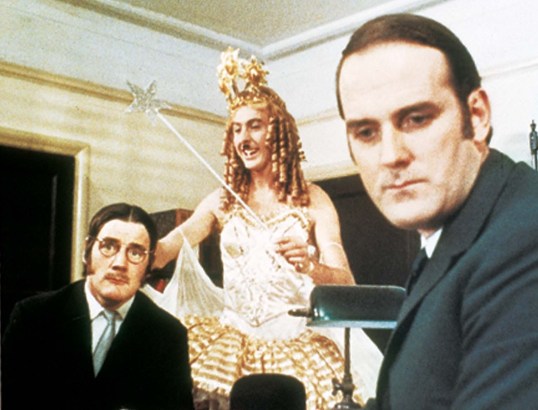
Cleaning Out The DVR: And Now For Something Completely Different (dir by Ian MacNaughton and Terry Gilliam)


A tall, dark-haired British man sits behind a desk that is rather oddly sitting in the middle of a field.  He wears a dark suit and he looks quite serious as he says, “And now, for something completely different….”

Cut to a short film about a man with a tape recorder up his nose, followed by another short film about man who has a tape recorder up his brother’s nose.

A Hungarian man tries to buy cigarettes while using an inaccurate English phrasebook.  The publisher of the phrasebook is later brought before the court.

Poor old Arthur Pewty goes to marriage counseling and can only watch impotently as the counselor seduces his wife.  Having filed to stand up for himself, Pewty is crushed by 16-ton weight.

A self-defense instructor teaches his students how to defend themselves when they are attacked by a man with a banana.

A loquacious man in a pub says “nude nudge” and “wink wink” until his drinking companion is finally forced to slam down his drink.

A man who sees double recruits a mountaineer to climb the two peaks of Mt. Kilimanjaro.  Hopefully, they’ll be able to find last year’s expedition, which was planning on building a bridge between the two peaks.

There’s bizarre, almost Dadaist animation, featuring classic works of art interacting with cartoonish cut-outs.

Uncle Sam appears to explain how communism is like tooth decay.  A toothpase commercial explains how taking care of your teeth is like racing a car.  A motor oil company shows how it can destroy darkness and grim.

A prince dies of cancer but the spot on his face flourishes until it falls in love and moves into a housing development.

A man tries to return a dead pigeon.  The store clerk insists the pigeon is merely stunned and then sings about wanting to be a lumberjack.

A general complains that things have gotten much too silly.

The narrator appears randomly, announcing, “And now for something completely different….”

Okay, okay, you get the idea.  First released in 1971, And Now For Something Completely Different was the first film to be made featuring all of the members of Monty Python’s Flying Circus.  It was their initial attempt to break into the American market, a collection of surreal sketches that they had previously performed on television for the BBC.  Unfortunately, at the time, no one in America really knew who Monty Python was and the film failed at the box office, to the extent that many in the UK advised against Monty Python even allowing their program to later air on PBS because it was felt that Americans just wouldn’t get it.  Of course, Americans did eventually get it.  The show remains popular to this very day.  Countless Americans are convinced that they can speak in a perfectly convincing British accent, as long as they’re quoting a line from Monty Python.  The previous 4th of July, when the town band played John Philip Sousa’s Liberty Bell, I saw hundreds of people stamping down their feet at the end of it.  As for And Now For Something Completely Different, it was re-released in 1974 and became a bit of a cult favorite in the States.

That said, the members of Monty Python were never particularly happy with the film.  They were convinced to make the film by Victor Lownes, who was the head of Playboy’s UK operation.  Lownes, however, alienated the members of the group by trying to exert control over the material.  He particularly objected to the character of Ken Shabby, a perv who probably had a stash of sticky Playboys back at this flat.  Lownes also put up very little money for the production, meaning that the Pythons had to resort to shooting the film, without an audience, in a deserted factory.  Apparently, even the deliberately cheap-looking special effects of the television show were considered to be too expensive to recreate for the film.  Michael Palin and Terry Jones both later complained that the film itself was series of scenes featuring people telling jokes while sitting behind desks.

Of course, Lownes’s biggest sin was trying to insinuate that he was somehow the Seventh Python.  (One can only imagine how many people were guilty of the sin over the years.  Claiming to be the Seventh Python was probably a bit like claiming to be the Fifth Beatle.)  When Terry Gilliam was animating the film’s opening credits, the names of the cast were shown in blocks of stone.  Lownes insisted that his name by listed the same way.  Gilliam reluctantly acquiesced but then redid the names of the Pythons so that they were no longer in stone.  Fortunately, Victor Lownes would not involved in the subsequent Python films.

All that said, there’s no denying that And Now For Something Completely Different is a funny movie.  I mean, it’s Monty Python.  It’s John Cleese, Michael Palin, Graham Chapman, Eric Idle, Terry Jones and Terry Gilliam, all youthful and at the heights of their considerable comedic talents.  Even if all of the sketches are familiar from the show, they’re still funny and it’s impossible not to enjoy discovering the way that the movie threads them together.  (Combining the Lumberjack song with the dead parrot sketch worked out brilliantly.  “What about my bloody parrot!?” Cleese is heard to shout as Palin walks through the forests of British Columbia.)  Personally, my favorite Python is Eric Idle but I also love any sketch that involves Michael Palin getting on John Cleese’s nerves.  Everyone knows the dead parrot sketch, of course.  But I also like the vocational guidance counselor sketch.  It’s hard not to get caught up in Palin’s excitement as he discusses his lion tamer’s hat.  Almost as wonderful as Palin’s turn as Herbert Anchovy, accountant was Michael Palin’s turn as the smarmy host of Blackmail.  Actually, maybe Michael Palin is my favorite Python.  I guess it’s a tie between him and Eric.

And Now For Something Different has been on my DVR for quite some time.  I’ve watched it several times.  I’m not planning on deleting it any time soon.

Film Review: Lost Horizon (dir by Charles Jarrott)


“Friends forever.  It’s a nice idea.”

With those words, the late Casey Kasem closed out the infamous “Rockumentary” episode of Saved By The Bell.  In this episode, Zack Morris fell asleep in his garage while waiting for his high school friends to arrive for band rehearsal.  While he was asleep, he dreamt about becoming a superstar as the result of Zack Attack’s hit song, Friends Forever.  Later, of course, Zack was led astray by a publicist who tried to sell him as being a “male Madonna.”  Zack didn’t care about the fame.  He was more concerned that the music and the lights at his concert were so excessive that the audience couldn’t even hear his lyrics.  Because, seriously, when you’re coming up with banger lyrics like “We’ll be friends forever/yes we will,” you want to make sure that they can clearly be heard.

It’s easy to make fun of the band and the show but that doesn’t make Casey Kasem’s words any less true.  Friends forever.  It is a nice idea.  It’s also a totally unrealistic and implausible idea.  People grow apart.  People develop new interests.  People move to different towns.  Sometimes, people just decided that they need to take a little break from the same old thing.  Instead of demanding that people remain friends forever, it would perhaps be more realistic to encourage people to enjoy and treasure the time that they have in the present.  But, to be honest, entertainment is not about that type of reality.  No one wants to hear, “Be friends until you get bored.”  Instead, they want to hear “Friends forever!”  It’s a simple idea and the simple ideas are the ones that usually bring us the most comfort.

Take the idea behind Shangri-La, for instance.  Shangri-La was a utopia that was hidden away in the Himalayas.  It was a place where there was no war, no greed, and everyone was in nearly perfect health.  It was a place where it was common for people to live to be well over a hundred years old.  It’s a place where people literally can be friends forever.  And while the place does have one very big drawback — i.e., once you decide to stay there, you can’t return to the outside world for even so much as a brief visit — it’s still easy to see why this idealized existence would appeal to many people.

The lamasery of Shangri-La was first introduced in a 1933 novel called Lost Horizon.  Written by James Hilton, Lost Horizon told the story of a group of westerners who, fleeing from a political uprising in India, find themselves in Shangri-La.  That the novel’s portrayal of a peaceful utopia hidden away from the “modern world” proved to be popular should not come as a surprise.  In 1933, the world was still recovering from the Great War.  Much of Europe was still in ruins, both economically and physically.  The combination of the First World War and the Spanish Flu pandemic had shaken everyone’s faith in the future.  Even as a group of idealistic activists, industrialists, and politicians tried to make war illegal, Mussolini seized power in Italy.  Spain was on the verge of civil war.  In Germany, a fanatical anti-Semite named Adolf Hitler had managed to move from being a fringe politician to being named chancellor.  The U.S. was suffering from the Great Depression.  Even the UK was so mired in political turmoil that it was no longer a reliable bulwark against chaos.  To the readers who were having to deal with all of that on a daily basis, the idea of Shangri-La was an inviting one.

(One of those readers was Franklin D. Roosevelt, who named his presidential retreat Shangri-La.  Years later, Dwight Eisenhower would rename Shangri-La after his son and it’s remained Camp David ever since.)

Not surprisingly, the book’s success led to it being adapted for the movies.  Frank Capra took the first crack at it, release his film version in 1937.  At the time, Capra’s adaptation was the most expensive film to have ever come out of Hollywood.  (It cost $1.6 million dollars!)  It also underperformed at the box office, nearly bankrupting Colombia Pictures.  Even though the film itself was nominated for Best Picture of the year, it still took five years for the film to earn back its cost.  Because Colombia edited the film to shorten its lengthy running time, Capra sued the studio and the end result was that everyone involved lost a good deal of money.  Considering all of the bad luck that befell the first production, one might wonder why Hollywood would even risk making a second version of the film.  And indeed, it would be several decades before any major studio attempted to bring Hilton’s novel back to the screen, despite the fact that the idea behind Shangri-La was probably looking more attractive with each crisis-filled day.

Ross Hunter

In 1973, producer Ross Hunter was sleeping on a mountain of cash.  Well, perhaps he wasn’t but a look at some of the films that he had produced would definitely suggest that he could have if he had so chosen.  Hunter started his career producing melodramas that starred Rock Hudson and were often directed by Douglas Sirk.  He was the type of producer who understood that importance of glitz and glamour, especially with the film industry facing a new competitor named television.  In the 60s, he made films that were totally out-of-touch with the turmoil of the decade but which still appealed to middle-aged viewers who wanted an escape from the hippies and the assassins.  In 1970, he scored his biggest hit of all time when he produced Airport.  As dull as that film seems to us today, it was the biggest hit of 1970 and it also gave birth to the disaster genre.  (It was also the only Ross Hunter production to be nominated for Best Picture.)

It was after the success of Airport that Ross Hunter decided to produce a remake of Lost Horizon.  Following the approach that he used in Airport he gathered an all-star cast.  In fact, George Kennedy appeared in both Airport and Lost Horizon!  Joining Kennedy were Oscar nominees Sally Kellerman, John Gielgud, Charles Boyer, Peter Finch, and Liv Ullmann.  Michael York, fresh off of Cabaret, and Olivia Hussey, who was best-known for playing Juliet in the wildly successful 1968 version of Romeo and Juliet, were cast as rebellious lovers who tried to escape the paradise of Shangri-La.  Larry Kramer, the future playwright and political activist, was hired to write the script.  Charles Jarrott, who specialized in big, glossy films and who had been nominated for Best Director for his work on Anne of a Thousand Days, was brought in to direct.  And Burt Bacharach was enlisted to write the song because, on top of being a literary adaptation with an all-star cast, Lost Horizon was also going to be a musical.

What could go wrong?

What indeed.

The 1973 version of Lost Horizon opens with an endless aerial view of the Himalayas.  In the background, singers sing about peace and love.  “There’s a lost horizon/waiting to be found/where the sound of guns/don’t pound in your ears/anymore,” the singers repeat several times, as if to hammer home the fact that the audience is not about to get Burt Bacharach at his best.

When the opening credits finally end, we find ourselves at an airport.  A very non-musical protest has broken out.  The characters in the film describe it as a revolution but instead, it just looks like a bunch of confused extras standing on a landing strip.  When it comes to an epic film like this, it’s always a good idea to see what the extras are doing.  In a good film, the extras will actually be a part of the world onscreen and you won’t even think of them as being a crowd of paid performers.  In a bad film, like this one, they’ll all stand around in a perfectly organized group and they’ll all do the exact the same thing at the same time, like shaking their fists at a plane.

Despite all of the “drama” at the airport, one airplane does manage to take off.  On the plane are the Conways, diplomat Richard (Peter Finch) and his younger brother, George (Michael York, whose blond prettiness suggests that there’s not a chance he could share any DNA with the much more rough-hewn Peter Finch).  There’s also a Newsweek photographer named Sally Hughes (Sally Kellerman), who pops pills and who suffers from a pronounced case of ennui.  She describes her job as “taking pictures of the headless so that people with heads can look at them in magazines while getting their hair done.”  (Damn, Newsweek apparently used to be  really messed up publication!)  Sam Cornelius (George Kennedy) is an engineer and an embezzler.  And finally, there’s Harry Lovett (Bobby Van), who introduces himself to everyone as being “Harry Lovett, the comedian.”  Harry was playing an USO show when the revolution broke out and apparently, he was abandoned in the country because his act was so bad.  Is the film suggesting that, in 1973, the United States would actually abandon a citizen in a dangerous, war-torn country?  I hope someone impeaches that President Nixon!

Our heroes may think that they’re escaping to freedom but it turns out that the plane is actually being hijacked!  One thing leads to another and eventually, as happens in all good musicals, the plane cashes in a remote area of the Himalayas.  At first, it seems like our heroes are done for but, fortunately, they’re discovered by Chang (the very British John Gielgud) and a group of Shangri-La monks.  Chang leads the party through the snowy mountains and eventually, they arrive at what appears to be a Disney resort but what we’re told is actually Shangri-La, a tropical paradise that sits in the middle of one of the most dangerous places on Earth!

Shangri-La has something for everyone:

Sally gets off drugs and discovers a library that, oddly enough, has every book ever written even though no one knows where Shangri-La is, none of the inhabitants can leave the area without running the risk of rapidly again, and Amazon wasn’t a thing in 1973.

Sam discovers a gold mine but, realizing that money doesn’t matter, he instead uses his engineering skills to help out the farmers of Shangri-La.  It really didn’t appear that the farmers of Shangri-La needed any help but whatever, I guess.  As long as Sam is happy.

Harry Lovett becomes a big star as the children of Shangri-La love his comedy.  Children are well-known for their lack of taste when it comes to comedy.

Richard not only falls in love with the local teacher (Ingmar Bergman’s muse, Liv Ullman) but he also meets the High Lama (the very French Charles Boyer).  It turns out that the High Lama is finally going to die and that he’s determined that Richard is the man who is destined to take over Shangri-Law, despite the fact that Richard has only recently arrived and isn’t even a Buddhist.

In fact, almost everyone is so happy that they start to sing and dance!  It takes 50 minutes for the film to reach its first big musical number.  Unfortunately, there’s a reason why most successful film musicals open with a big number instead of holding off on it.  It’s important to, early on, get the audience used to the idea that they’re watching a film set in a world where it’s perfectly common for people to break out into song.  From West Side Story to La La Land, good musicals have understood the importance of bringing the audience in early.  Lost Horizon waits until everyone has gotten used to the film being a somewhat rudimentary adventure/disaster film before suddenly springing the singing and the dancing on everyone.  It’s a bit jarring.  It wouldn’t matter, of course, if the songs were any good but again, this was not Burt Bacharach’s finest moment.

Unfortunately, one member of the group doesn’t want to stay in Shangri-La and dance and sing.  George Conway does not want to be friends forever.  Instead, he’s fallen in love with the local librarian, Maria (Olivia Hussey).  Maria dreams of seeing New York and London.  George is determined to grant her wish, despite being told that Maria is nearly as old as John Gielgud and will start to age as soon as she leaves Shangri-La.  Richard feels an obligation to accompany his brother.  Needless to say, things don’t go well.  (As Michael York would later put it himself, “There is noooo sanctuary….”)  Will Richard be able to find his way back to Shangri-La?

“Let’s not go to Camelot, ’tis a silly place,” King Arthur famously declared in Monty Python and the Holy Grail.  Lost Horizon suffers the opposite problem.  While Lost Horizon’s Shangri-La is occasionally a silly place, it’s usually just an incredibly boring place.  One can’t help but feel that Maria has a point, regardless how much time Sally spends singing about her hatred of the New York night life.  The film’s downfall is that it argues for Shangri-La being viewed an ideal without making Shangri-La into any place that you would want to visit.  Add in the anemic songs and the confused performances and Charles Jarrot’s inability to maintain any sort of compelling pace and you have a film that’s too dull to really even qualify as a fun bad film.  It’s just bad.

That said, much like friends forever, Shangri-La is a nice idea.