Quick Review – Grindhouse (dir. by Robert Rodriguez & Quentin Tarantino)


The following was posted on 4/6/2007 from my LiveJournal on Grindhouse (which is celebrating it’s 15th Anniversary). I’ll admit I respect Death Proof a bit more now than I did back then:

Gotta write fast. Have to jump into shower and head for work.

I got into the movie theatre at about 8pm, and spent the hour talking with a pair of film students from the School of Visual Arts. At 9 (an hour before the movie), the rest of the sold out crowd appeared. I was officially 3rd in line. Sweet. 🙂 I didn’t my preferred seat (the single one on the right reserved for patrons coming in with someone in a wheelchair), but did get a seat in the empty row (meaning I could stretch my legs, even better).

The short of it: Grindhouse is paying one low price for 2 bad movies, on purpose. You get 3 great built in trailers, and two mini movies. Between the two mini movies, I loved “Planet Terror” (the Rodriguez one) more than “Death Proof” (The Tarantino film), simply because Death Proof had too much of Tarantino’s conversational style that all of his films have. It’s like you’re listening to a conversation that absolutely doesn’t tie itself to any of the storyline’s major points. It’s just “cool” stuff, but I literally almost fell asleep until Kurt Russell showed up on screen. I think that if one knows to expect this from Tarantino, it comes across better. It’s like watching both Kill Bill volumes back to back. The first one’s cool and action packed, and the second one has some action (the chase scene alone in Death Proof had me wondering how they did that), but is so slow before getting there, you want to sigh.

Being a Charmed Fan, it was great to see Rose McGowan again, and there were so many cameos to laugh at. Fergie has a cameo, and Michael Biehn’s (“Hicks” from Aliens, Navy Seals) even in this. Where did they dig up these guys?

Grindhouse is easily a party film. I’d go see it again in the theatre, but I don’t see myself getting the DVD. It takes you back about a good 30 years, and does that really well. There are missing reels, serious jump cuts in the film and the sound sometimes cuts out. 🙂 In that sense, it’s really beautiful. The audience laughed and applauded, though there were some that at the end were like “Man, that sucked.” In the 60’s and 70’s, Grindhouse movies were pretty bad. I guess it’s like watching one of those old Hammer films, mixed in with a cheap horror flick. You have to walk into this movie not expecting “The Departed” for it to work. Just have fun with what you’re seeing and remember, this is what your parents sometimes saw in the movies (it should be noted that my parents went to something of a Grindhouse once – the movie they went to see was Night of the Living Dead. The other movie that was in the show was John Carpenter’s “Halloween”, which freaked my Dad out).

The music in particular is really great. Robert Rodriguez, Chingon, and a few friends come up with a sound for Planet Terror that’s in essence a John Carpenter like sound. If you have access to the Itunes Music Store, give it a listen (I bought it). Plus, if you’re a fan of some of the older movies out there, you’ll find references to some of Carpenter’s films in there (for example, one of the songs from “Escape from New York” is actually used in the film). The same occurs with the soundtrack from “Creepshow” – The story with the drowned couple. There are also tons of older Tarantino/Rodriguez references in there. One fellow actually yelled out a line, word for word, from what was on screen. It took me a second to realize the line came from “From Dusk Till Dawn”. Sweet.

The in betwen trailers are absolutely fantastic. If I were to get the DVD, it would probably be for this reason alone. You can tell that Rob Zombie, Edgar Wright (Shaun of the Dead) and Eli Roth (Hostel) really had fun with their pieces.

So, Grindhouse is worth seeing in theatre at least once with a bunch of friends, but know what you’re walking into. The movie can get gross at times and no young kid should even be brought near to this (we got carded to actually get into the theatre, and a Weinstein Rep. was on hand after the film to let us take surveys). Also before the movies, one of the teaser trailers is for Rob Zombie’s “Halloween”. I haven’t been so excited for a horror film like this since Zack Snyder’s version of “Dawn of the Dead”. This looks really good, and I’m wondering what Michael Myers is going to look like when someone like Tyler Mane (Sabretooth from the first X-Men movie) is playing him. That’s going to be creepy.
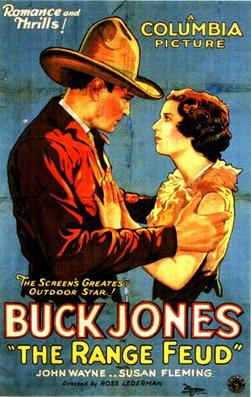
The Range Feud (1931, directed by D. Ross Lederman)


In a frontier town, two ranching families are at war.  The Turners claim that the Waltons have been stealing and reselling their cattle.  Even an attempt to hold a peace meeting at the local church just leads to more fighting.  Complicating things is that young Clint Turner (John Wayne) is in love with Judy Walton (Susan Fleming).  When someone shoots John Walton (Edward LeSaint) through the window of his office, Clint is the number one suspect.  Not helping is that Clint had an empty round in his gun.  Clint says that he fired at a coyote but he missed.  Everyone else in town says that its time to hang Clint without a trial.

Only Sheriff Buck Gordon (Buck Jones) stands between the mob and Clint.  Buck was raised by the Turner family and considers Clint to be his brother.  However, Buck still knows that Clint might be guilty but there’s no way that Buck is going to allow mob justice to rule his town!

The Range Feud was one of the many B-programmers that were released in the 30s.  Running less than 60 minutes, it is a briskly paced western that features a theme that was present in many westerns, the battle between mob justice and the law.  The townspeople who are eager to hang Clint without a trial represent the old ways of doing things while Buck represents the new way, in which everyone is innocent until proven guilty and entitled to a fair trial.

Buck Jones was one of the best of the early western heroes.  He played tough-but-fair men who could definitely handle themselves in a fight but who preferred to try to reason their way out of conflict.  Buck Jones served in a Calvary unit, worked as a cowboy, and started in the film business as a stunt man.  He had an authenticity that set him apart from others who merely pretended to be cowboys.  That authenticity serves him well in The Range Feud.  He may feel bad about having to arrest his stepbrother but any character played by Buck Jones can be guaranteed to follow the law.  In real life, Buck Jones died a hero.  In 1942, Buck Jones was at the Cocoanut Grove nightclub in Boston when a fire broke out.  Though Jones initially was able to get out of the nightclub, he subsequently reentered to help other people get out.  Severely burned, he died of his injuries two days later.

Of course, the main reason that people will track down this film is for a chance to see the young John Wayne playing a key  supporting role as Clint Turner.  It’s always a little bit strange to see Wayne playing a young man.  He’s one of those actors who you always assume was always in his 40s.  Wayne is likable as the free-spirited Clint, though it is again strange to see Wayne playing someone other than an authority figure.  For once, it’s Wayne who ends up in jail and who is dependent on someone else to save him.

The Range Feud is an entertaining and fast-moving western.  Fans of the genre and of Buck Jones and John Wayne will appreciate it.

Badlands of Dakota (1941, directed by Alfred E. Green)


This B-western takes place in the legendry frontier town of Deadwood.  It’s a town that’s patrolled by General George Custer (Addison Richards) and which is home to Wild Bill Hickok (Richard Dix) and Calamity Jane (Frances Farmer).  When outlaw Jack McCall (Lon Chaney, Jr.) and his gang start disguising themselves as Sioux and start robbing stagecoaches, young homesteader Jim Holliday (Robert Stack) is appointed town marshal.  Unfortunately, Jim’s older brother, Bob (Broderick Crawford), has gotten involved with McCall and his gang.  Bob has also never forgiven Jim for marrying Anne (Ann Rutherford), the woman that Bob loved.  Jim struggles to get the town to take him seriously.  When Jim tries to put out a fire that’s threatening to burn down several businesses, the citizens laugh at him and shoot a hole in the water hose.  No one said that the people of Deadwood were smart.  Ann wants to leave town but McCall and his gang are growing more brazen in their attacks and when one of Jim’ mentors is murdered, Jim has no choice but to get justice and revenge.  Meanwhile, the real Sioux grow tired of being blamed every time a stagecoach is robbed and they launch their own attack on the town.

Though the plot may be predictable, Badlands of Dakota is memorable for the cast that was assembled to bring its familiar story to life.  Along with those already mentioned, the cast also includes Andy Devine as a saloon owner, Hugh Hubert as the town drunk, Fuzzy Knight as the town’s stagecoach driver, and the folk band, The Jesters, as the town’s entertainment.  They all do their part to bring the town of Deadwood to life.  Frances Farmer steals the film with her tough and unsentimental portrayal of Calamity Jane and Lon Chaney, Jr. is an effectively hard-edged villain.  This was one of Robert Stack’s first films and he’s appropriately stiff and upright as Jim.  Jim is the only honest man in Deadwood, which also means that Jim is fairly boring when compared to everyone else around him.  It’s also difficult to accept him as being Broderick Crawford’s younger brother, though Crawford does a good job of portraying the personal betrayal that Bob feels when he discovers that Jim has married Anne.

Not surprisingly, Badlands of Dakota plays havoc with history.  This is especially true when it comes to Addison Richards’s sober and reasonable portrayal of a middle-aged General Custer.  (The real-life General Custer died when he was only 36 and could reportedly be slightly erratic.  Not to mention, Custer died the same year that Deadwood was founded so it’s doubtful that he ever visited the city, much less had a personal friendship with Wild Bill Hickok and Calamity Jane.)  Still, there’s a lot here to entertain fans of B-westerns.  Along with all of the familiar faces in the cast, there’s also a sequence with an out-of-control stage coach that makes good use of rear projection and the film’s final gun battle is exciting and well-directed.  It’s a quick 76 minutes, full of all the action and bad history that a western fan could hope for.

Film Review: The Bubble (dir by Judd Apatow)


Meh.

The Bubble is the latest film from Judd Apatow.  Taking place during the first year of the COVID pandemic, it follows a small group of actors as they attempt to make the sixth installment of the Cliff Beasts franchise.  The spoiled, pampered, and pretentious actors find themselves isolated, not allowed to go anywhere other than the set or the hotel.  The film becomes a disaster as the actors are driven mad by all the rules and the inconvenience that comes along with trying to make a film in the middle of the global pandemic.  When the studio hires a security team to keep anyone from escaping, things get only dumber.

Even by the standards of what we’ve come to expect from Judd Apatow, The Bubble is a notably messy and self-indulgent film.  It’s a bit of a shame really because there’s much about the Pandemic that not only deserves to be satirized but also needs to be satirized.  For much of society, satire will be an important step on the road back to sanity.  Unfortunately, the humor in The Bubble often falls flat because Apatow doesn’t seem to really be sure what his main target is.  Is he targeting COVID hysteria?  Is he targeting the pampered rich people who treated the pandemic like a two-year vacation while people who actually lived paycheck-to-paycheck were risking their health just so they could pay their bills?  Is he targeting bad action movies or pretentious indie directors or actors who think that the world revolves around them?  When Maude Apatow shows up as a TikTok star who has been given a role because she has 2,000,000 followers, is Apatow aiming at the shallowness of social media or is he poking fun at the older generation that can’t understand the kids and their wild and wacky ways?  Apatow seems to be going after everything and everyone but, at the same time, he also expects us to care about these characters when they start demanding to be allowed to leave the set.

The film’s action doesn’t really follow any sort of real storyline.  Instead, it feels like a collection of skits, all piled on top of each other and all dragging on for a bit too long.  Though The Bubble is shorter than the average Apatow film, it’s still over two hours long.  After the first hour, the film suddenly becomes obsessed with random dance scenes.  Usually, I love random dance scenes but, in this case, there’s really no humor or point to them beyond saying, “Wow, these people suck at dancing.”  It’s funny the first time but, by the fourth time, it starts to feel a bit lazy.  The film is like the improv student who, instead of building on the situation and working with his scene partners, just shouts out whatever pops into his head and begs the audience for a laugh.  The film does end on what would be a clever touch if not for the fact that it’s all pretty much lifted from the final scenes of Tropic Thunder.

Lest anyone think that I’m totally trashing the film, I did chuckle a few times.  There’s a recurring bit with Kate McKinnon’s studio exec constantly being at either the beach or on safari.  That made me laugh.  And Keegan-Michael Key, as an actor who has written a spiritual guide, delivers the majority of his lines with just the right amount of self-importance.  For the most part, though, The Bubble falls flat.  This is not the Netflix film to watch this weekend.

Film Review: Windfall (dir by Charlie McDowell)


I really hate home invasion movies.

Seriously, it’s always the same thing.  Some mysterious stranger breaks into an empty house and hangs out for a few days, trying on clothes and smoking cigars and drinking whatever’s available in the refrigerator.  Eventually, the couple who own the house comes home.  They get held hostage.  The stranger wastes a lot of time trying to be intimidating.  The husband always tries too hard to take control of the situation.  The wife tries to keep everyone calm.  The stranger is poor.  The husband is rich.  The stranger and the wife form a connection.  Secrets are revealed.  Blah blah blah.

Don’t get me wrong.  There have been a few good home invasion movies.  There are some directors who can pull it off and make a film compelling despite telling an overly familiar story.  Ruggero Deodato brought some life to the genre, with a little help from David Hess and Giovanni Lombardo Radice, in The House At The Edge of the Park.  For the most part, though, the home invasion genre has led to some of the stagiest and most dramatically inert films ever made.

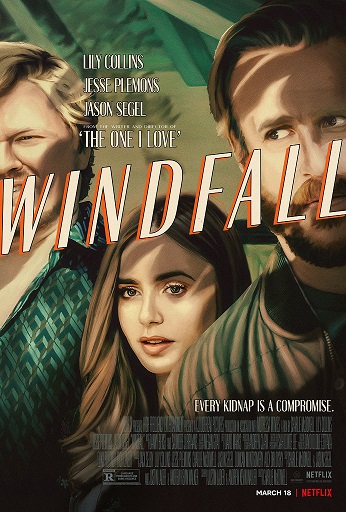
Consider Windfall, which premiered on Netflix earlier this month.  Starring Jason Segel, Lily Collins, and Jesse Plemons, the film has a talented cast.  It’s directed by Charlie McDowell, who previously made a very intriguing  film called The One I Love.  Like Windfall, The One I Love was largely confined to one location but, unlike Windfall, McDowell still managed to use that location to craft an intelligent and compelling film that never felt stagey.  The house in which Windfall takes place is lovely to look at.  The film has many of the ingredients to be a success but it doesn’t have a particularly clever or even interesting script and, as such, it falls flat.

Segel, Collins, and Plemons play three characters who aren’t actually given names.  Segel plays the home invader, who is credited as being “Nobody.”  Plemons is the CEO, a billionaire who is responsible for putting people out of work and who makes his employee signs NDAs.  Collins in the Wife, who is secretly taking birth control pills.  Segel may be a criminal but he’s not a very good criminal, as becomes clear as he continually finds himself being manipulated by his hostages.  Plemons is selfish and never stop talking down to Segel, even when the latter is pointing a gun at him.  Collins claims that she works very hard at running a charity that her husband set up but it’s obvious that she and and her husband have a strained relationship, even before Segel shows up.  There’s a few heavy-handed attempts at social relevance, with Segel and Plemons debating whether or not Plemons deserves to be a billionaire.  The film ends with a twist that Godard or Bunuel could have pulled off but here, it just falls flat.  The action is just too predictable and dramatically inert for Windfall to be anything more than a movie about three talented performers acting up a storm while trying to bring three boring characters to life.

Windfall is a very much a film of its time, both in its focus on inequality and it’s minimalist style.  Like Malcolm and Marie, it’s the type of one-location, small crew film production that was popular at the height of the COVID pandemic and the CEO and his wife heading to their vacation home to hide out from the world will undoubtedly remind some viewers of the wealthy people who were able to isolate themselves during the early part of the pandemic.  So, the film has some historical value if not much dramatic value.  In the end, Windfall serves as a reminder that, when combined with Malcolm and Marie, Netflix has pretty much cornered the market on pretentious, one-location films.

Hot Lead (1951, directed by Stuart Gilmore)


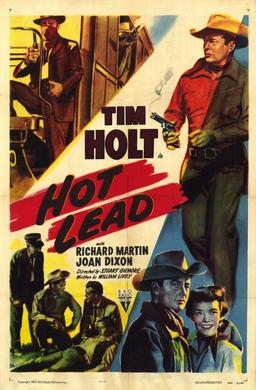
In this B-western programmer, Dave Collins (Ross Elliott) has just been released from prison.  Because he knows how to operate a telegraph, outlaw Turk Thorne (John Dehner) tries to force Dave to get a job at a local telegraph office so that Turk can use his skills to rob a train.

Despite wanting to go straight, Dave also doesn’t want to get full of hot lead.  He rides into town and gets a job at the ranch owned by Gail Martin (Joan Dixon).  He is befriended by Gail’s two ranchhands, serious cowboy Tim Holt (played, believe it or not, by Tim Holt) and his comedy relief sidekick, Chito Rafferty (Richard Martin).  Tim and Chito want revenge on Turk for killing one of their friends during a previous train robbery.  Working with Dave, they set a trap for Turk and his gang.  Meanwhile, Dave falls in love with Gail.

Hot Lead was one of the last of the 46 B-westerns that Tim Holt made for RKO Pictures.  Holt started out playing the type of prototypical happy, go-lucky cowboys who were popular in the 1930s.  At that time, he was unique as one of the few western stars to not play a continuing character who was named after him.  While the studios promoted other western stars as essentially playing themselves, Tim Holt was promoted as being a serious actor.  Holt’s films were popular with audiences but his career was put on hold while he served in World War II.  Post-war, Holt played characters who were far more world-weary than his earlier cowboys and he also started to play characters who were specifically named “Tim Holt.”

Even though most of Holt’s later films were uneven in quality, Hot Lead is one of the better examples of the genre.  Whether happy or serious, Tim Holt was always a convincing cowboy and he brings his natural gravitas to the role, playing his character as being the type of serious and no-nonsense cowboy that anyone would want in their corner.  John Dehner was always a good villain and Ross Elliott is equally good as the man struggling not to go back to his old ways.  The action scenes and the gunfights are well-directed and the story even carries an important message about giving people second chances.  Not bad for a B-western!

Oscar Counter-Programming: Llamageddon (dir by Howie Dewin)


On a distant planet, the Llamas march through the desert, their eyes glowing red and their hearts full of murder.  One of the Llamas (played, according to the credits, by Louie the Llama) ends up in a trailer that turns out to be a spaceship.  And when that trailer gets off course and crashes onto Earth, it’s time for a Llamageddon!

A nice couple in the country spot the Llama standing on the edge of their property.  It must belong to the neighbors, they say.  They consider chasing the Llama back to its home but they decided not to.  After all, it’s about rain and who wants to chase a wet Llama in the rain?  Not me!

Later that night, the Llama claims its first two victims.

Well, you can see where this is going, right?

After the funeral of that nice couple, their children decide to throw a party at the house.  They call their friends and their friends bring beer, weed, and a lot of attitude.  However, the Llama brings the horror.  It turns out that the Llama can not only stomp you to death but it can also shoot red laser beams out of its eyes.  Soon, the party is in chaos as person after person falls victim to the Llamageddon….

(And one poor soul actually turns into Llama which is horrific in theory but kind of cute to watch.)

Llamageddon is a film from 2015 and it has a running time of 69 minutes.  (“Nice,” someone out there is saying.)  Considering that the end credits are padded with a rap and also a fast-forwarded presentation of the film that the viewer has just watched, I’m going to guess that running time was deliberate.  And actually, I respect that.  Llamageddon is a film that knows exactly what it is and it has a sense of humor about its very existence.  It’s a film that fully embraces the silliness of it all.

So, look …. I could sit here and I could go on and on about the acting and deliberately cheap special effects and the way that the film hints that even the cutest of animals can actually be deadly and dangerous but here is what you need to know.

It’s about a Llama from space and the Llama has the power to blow people up.

In other words, this is a film that was made for a very select audience of people who are amused by the idea of killer space llamas.  I happen to be one of those people so I enjoyed the film.  I respected the fact that the filmmakers stuck with their silly idea and they didn’t try to fool the viewers into thinking that the film was meant to be anything more than what it was.

Will you enjoy Llamageddon?  Well, like I said, it’s only 69 minutes and it’s specifically made for people who laugh out loud at the term “space llama.”  If, like me, you’re one of those people, check it out.  It’s on Prime and Tubi and if you’re currently watching the Oscars but you’re desperate for some counter-programming, you can watch it right now with the knowledge that the movie will end before the Academy Awards.

West Side Story (dir. by Steven Spielberg)


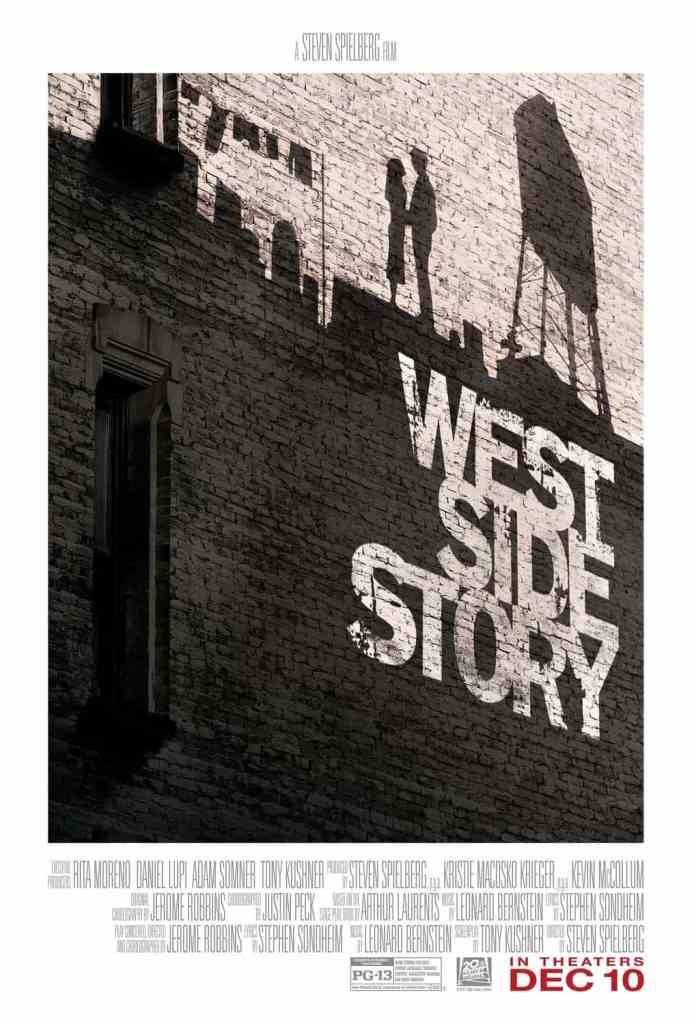
Although it lacks an Overture and an Intermission, Steven Spielberg’s rendition of 1961’s West Side Story flows well and does the story justice. Remakes are tricky things, you know. Stay too close to the source material and you end up with the line for line, shot for shot weirdness of Gus Van Zant’s Psycho. Stray too far from it and you discover something experimental and head scratching, like Luca Guadagnino’s Suspiria. West Side Story is in the middle of it all. It’s the same story you know and love, just taken from some new angles. I just wish the supporting cast hadn’t overshadowed the leads. My Aunt was a huge fan of the original, and I like to think she might have appreciated this one. It was worth catching it on the big screen back in December, and as of this writing, West Side Story is now available on Disney Plus and other streaming networks.

West Side Story is basically Romeo and Juliet, with two rival gangs (the Jets and the Sharks), fighting for territory in a battered New York City. When Tony (Ansel Elgort) meets Maria (Rachel Zegler), sparks fly between them, but it sets the stage for a dangerous confrontation between both gangs.

West Side Story marks another Spielberg production that doesn’t have John Williams at his side. While it saddens me that the two aren’t working together (and let’s face it, having just celebrated his 90th Birthday, Williams has easily earned a well deserved rest), the music for the film is in great hands. Originally composed by Leonard Bernstein and Stephen Sondheim, the music was handled by David Newman (Serenity) this time around, at Williams’ recommendation. One thing to learn here if you’re new to movies – David Newman is part of the Newman family of musicians that includes Thomas Newman (Wall-E, The Shawshank Redemption and just about any film Sam Mendes made), Randy Newman (Toy Story), and Alfred Newman, who created that 20th Century Fox fanfare you used to hear when watching Star Wars. Things remain mostly unchanged for the songs that were in the 1961 original, but there’s one additional piece (at least to me, anyway). “Somewhere” is sung by Rita Moreno’s character, rather than the leads. Not every song is exactly the same as the original (and it really shouldn’t be), but it’s very close. The only quirk I really had was for my favorite song, “Officer Krupke”, which changes things up just a little. It should be noted that everyone on screen is signing here, whereas in the original, it was mainly George Chakiris and Russ Tamblyn who sung their own parts (something I only learned just now in writing about this). I loved the whole element with Riff getting whacked over the head with the newspaper. Every other song has some magic to it, and with Janusz Kaminski as Spielberg’s Director of Photography, there are some fantastic uses of the camera in many shots. Guillermo Del Toro recently raved about the dance sequence, and it’s a great sequence. Sometimes, it’s also the subtle moments. My favorite comes in “A Boy Like That”. In the original, there was a glass door with a blue, yellow and red glass paneling. Spielberg still showcases the color pattern, but with the drapes instead. It was a cute homage to the original, I felt.

I also enjoyed what Tony Kushner did with the script. There’s a lot of Spanish in the film that’s given without any subtitles at all. I’m not sure if that was his decision or Spielberg’s, but for the most part, the feelings are clearly conveyed, whether you can understand what’s being said or not.

Writing is usually supposed to be without bias. I believe the sexual assault allegations against Ansel Elgort (Baby Driver) affected West Side Story’s success, somewhat. At my 7pm showing back in December, there weren’t many seats taken up for the film. That, or perhaps musicals aren’t as popular as they used to be (used to be being only a month prior with Lin-Manuel Miranda’s Tick Tock Boom!). Add to that a Pandemic we thought we were slowly breaking out of only to discover a return with renewed fervor and what could have been gigantic just didn’t seem so. My own biases were in part to blame for not writing about this movie sooner. I didn’t hate the film by any means – I really enjoyed it – I just didn’t want to throw in to the whole cancel culture that screamed “This person did bad things, smite him from our film and shun them from our memories.” (though I suppose by adding this, I am doing just that). Whatever the case, Elgort’s Tony isn’t terrible in any way. Based on his performance in Baby Driver, he would have been my go to pick as well. I just didn’t feel as much for the character as I thought I would, knowing that I found about the actor. Tony’s the only character in this one where I felt they could have swapped in a CGI Richard Beymer and it would have worked fine.

The opposite could be said of Zegler. She has an incredible voice and screen presence, and fits into Maria so well that you might forget you’re watching actors on screen. I hope to see her do more in the future (and while we’re on that topic, let her sit in at the Oscars. What’s one more seat, anyway?)

From top to bottom, West Side Story is stacked with a mix of veterans and young talent that we hope to see more of in the future. Rita Moreno, who played Anita in the original, returns a Doc, the owner of a store (which also makes a nice connection to the previous film). Brian D’Arcy James (Molly’s Game) is on hand as Officer Krupke. Corey Stoll (Ant-Man) plays Lt. Schrank, and that’s about the bulk of the adults you’ll run into other than teachers and the like. For the Jets and Sharks, we have Maddie Ziegler (who is Sia’s Muse) as Velma. We also have Mike Faist as Riff and David Alvarez as Bernardo, who were just fantastic. It is an absolute shame that either actor didn’t gain some kind of recognition during the award season. Thank goodness that at least Ariana DeBose (Hamilton) portrayal of Anita is getting some love. She lights up every scene she’s in, whether it’s dancing or showing grief. She’s my pick for Best Supporting Actress this year, though that position is stacked with some strong nominees.

Overall, West Side Story was a surprise for me. Spielberg hits the right marks, and I feel you can sit it next to Wise’s production. Whatever mood you happen to be in, you can pick one and enjoy. The supporting cast may overshadow the leads, but not so much that it ruins the film.

Conspiracy: The Trial of the Chicago 8 (1987, directed by Jeremy Kagan)


The year is 1969 and, in an Illinois courtroom, 8 political radicals stand accused of conspiring to disrupt the 1968 Democratic Convention.  The prosecution is putting the entire anti-war movement on trial while the defendants are determined to disrupt the system, even if it means being convicted.  The eight defendants come from all different sides of the anti-war movement.  Jerry Rubin (Barry Miller) and Abbie Hoffman (Michael Lembeck) represent the intentionally absurd Yippies.  Tom Hayden (Brian Benben) and Rennie Davis (Robert Carradine) are associated with the Students for a Democratic Society.  Bobby Seale (Carl Lumbly) is one of the founders of the Black Panthers while David Dellinger (Peter Boyle) is a longtime peace activist.  John Friones (David Kagan) and Lee Weiner (Robert Fieldsteel) represent the common activists, the people who traveled to Chicago to protest despite not being a leader of any of the various organizations.  Prosecuting  the Chicago 8 are Richard Schulz (David Clennon) and Tom Foran (Harris Yulin).  Defending the 8 are two radical lawyers, Leonard Wienglass (Elliott Gould) and William Kunstler (Robert Loggia).  Presiding over the trial is the fearsome and clearly biased Judge Julius Hoffman (David Opatoshu).

Conspiracy: The Trial of the Chicago 8 is a dramatization of the same story that inspired Aaron Sorkin’s The Trial of the Chicago 7 but, of the two films, it’s Jeremy Kagan’s The Trial of the Chicago 8 that provides a more valuable history lesson.  By setting all of the action in the courtroom and recreating only what was said during the trial, director Jeremy Kagan and his cast avoid the contrived drama that marred so much of Sorkin’s film.  Kagan trusts that the true story is interesting enough to stand on its own.  Kagan includes documentary footage from the convention protest itself and also interviews with the people who were actually there.  While Kagan may not have had the budget that Sorkin did, his film has the authenticity that Sorkin’s lacked.  Kagan also has the better cast, with Michael Lembeck and Barry Miller both making Abbie Hoffman and Jerry Rubin into something more than the mere caricatures that they are often portrayed as being.

The Trial of the Chicago 8 was a film that Jeremy Kagan spent a decade trying to make.  When he first tried to sell the idea behind the film to CBS in 1976, Kagan had Marlon Brando, Walter Matthau, George C. Scott, and Dustin Hoffman all willing to work for scale and take part in the production.  CBS still passed on the project, saying that no one was interested in reliving the 60s.  It wasn’t until 1987 that Jeremy Kagan was finally able to revive the film, this time with HBO.  It actually worked out for the best because, with HBO, there was no need to try to come up with a “clean” version for the language that was used in the courtroom or in the interviews with the actual participants.  The defendants could be themselves.

Though it has been overshadowed by Sorkin’s subsequent film, The Trial of the Chicago 8 is the definitive film about what happened in the aftermath of the the 1968 Democratic Convention.

I Watched Coffee Shop (2014, dir. by Dave Alan Johnson)


Donavan (Laura Vandervoort) owns a coffee shop in a small town.  Everyone loves her shop but she’s not making any money because she’s not a good manager and she lets her staff and her customers walk all over her.  When Ben (Cory M. Grant) comes in the shop and tries to order tea, Donavan thinks that he’s the businessman who wants to buy her shop and turn it into a parking garage.  She yells at him but then it turns out that he’s a playwright from New York who is just on vacation after his latest flop.  Donavan and Ben fall in love but then the real businessman shows up and it looks like Donavan might lose her business.  And then, on top of everything else, Donavan discovers that Ben is writing a play about her situation so she breaks up with him and tells him that he’s not welcome in her shop, even if he has the perfect plan to save it.  Who thinks like that!?  He’s so inspired by her and how much everyone in town loves her that he wants to immortalize her on stage.  How is that a bad thing?

Even though this wasn’t made for Hallmark, it basically is a Hallmark film.  There’s no profanity.  There’s no sex.  I don’t know why it was even rated PG.  I liked the small town and the coffee shop looked like it would be a nice place to hang out.  The story was too predictable and a lot of Donavan’s financial problem were due to her just being really bad at her job so I had a hard time feeling sorry for her.  She should have let someone else run the coffee shop if she was that incompetent.

On a personal note: I’d like to own a coffee shop but I would want it to be located near a baseball stadium.  Coffee and baseball is a combo I can get behind.