International Horror Review: Jack The Ripper (dir by Jess Franco)


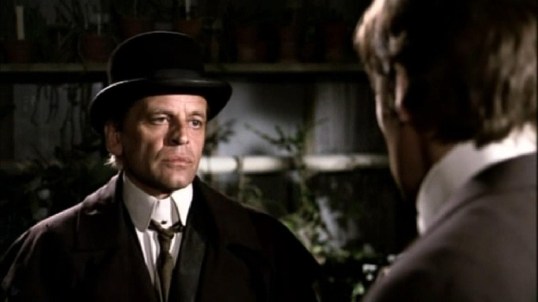
In this 1976 German film, Klaus Kinski plays Dr. Dennis Orlof.

He’s a doctor in what is supposed to be Victorian-era London.  (Some of the characters where Victorian-style clothes.  Some of them definitely do not.)  Dr. Orlof is known for being a kind and compassionate man.  He has dedicated his life to taking care of the poor and the sick.  He is one of the few doctors willing to take care of the men who fish on the Thames and the women who walk the foggy streets of Whitechapel.  Because his patients are not rich, Dr. Orlof makes very little money.  He is usually behind on paying the rent for his office but his lady doesn’t care.  Dr. Orlof is such a kind man.  Who could possibly even think of evicting a living saint?

Of course, what only he and his wife know is that Dr. Orlof is also a deviant who is haunted by hallucinations of a nearly naked woman taunting him and daring him to “come and get me.”  Dr. Orlof haunts the sleazy dance halls of London and he often offers to give the dancers a ride in his carriage.  Dr. Orlof is also the murderer who the press refers to as being Jack the Ripper.

Klaus Kinski as Jack the Ripper?  That sounds like perfect casting, right?  Actually, it’s too perfect.  Klaus Kinski is so obviously unhinged from the first minute that he appears onscreen that it’s impossible to believe that he wouldn’t automatically be everyone’s number one suspect.  Kinski plays Orlof as being someone who is in a permanently bad mood.  Even when Orlof is doing his “good deeds,” he comes across as being so annoyed with the world that the viewer is left to wonder how anyone could have fallen for his act.  Kinski himself seems a bit bored with the role.  When Kinski was invested in a character (as he often was when he appeared in the films of Werner Herzog), he was a dangerously charismatic force of nature.  When he was bored, though, Kinski made little effort to keep anyone else from noticing.  Kinski moves lethargically through Jack the Ripper.

Trying to solve the Ripper case is Inspector Selby (Andreas Mannkopf).  The film spends a lot of time on Selby’s investigation but it’s never as interesting as one might hope.  Selby spends a lot of time in his office, looking concerned.  When he actually talks to the witnesses to the Ripper’s murders, the scene seem to drag out forever.  In one unfortunate scene, he gathers all the witnesses in one room and asks each one to describe what the Ripper looked like so a sketch can be made of him.  Again, what should have been a minute or two-minute scene is dragged out to an unbearable seven minutes.  Seven minutes is a lot of time when you’re bored.

Jack the Ripper was directed by Jess Franco.  On this site, I’ve defended some of Franco’s other films.  Franco was an idiosyncratic filmmaker whose films often felt rushed but who was also capable of creating a dream-like atmosphere and occasionally coming up with an insanely bizarre plot twist.  Jack the Ripper, with its tormented title character and its dance hall scenes, in unmistakably a Jess Franco film.  Unfortunately, it’s also often excruciatingly dull.  Kinski was obviously a big name in Europe in the 70s but I kind of wish that Franco had cast his frequent star, Howard Vernon, as Jack the Ripper.  Not only was Vernon the start of the original Awful Dr. Orlof but Vernon also specialized in playing self-loathing aristocrats.  If nothing else, Vernon would have been a bit less oblivious in his madness than Kinski.

Jack the Ripper is definitely a lesser Franco film.  It’s also a lesser Kinski film and a lesser Jack the Ripper film.  There is one good sequence in which Orlof and a victim ride through the London fog in a carriage.  Otherwise, this is a Franco film that you can get away with skipping.

Horror Film Review: Night of Dark Shadows (dir by Dan Curtis)


Since I just reviewed House of Dark Shadows, it only makes sense to now take a look at 1971’s Night of Dark Shadows today!

While Night of Dark Shadows is not a direct sequel to the first film, it is still definitely a part of the same cinematic universe.  There may not be any vampires in this film but it does take place in the same house and it features two members of the family that was decimated over the course of the previous film.  At one point, it’s mentioned that Joan Bennett’s character from House of Dark Shadows died after the first film but no one goes into any details.  I guess a vampire in the family is something that’s simply not discussed amongst polite company.

Night of Dark Shadows deals with Quentin (David Selby) and Tracy Collins (Kate Jackson).  Quentin is an artist who confesses that he wasn’t particularly nice before he married Tracy.  When they move into the Collins mansion, they bring two friends with them, Alex (John Karlen) and Claire (Nancy Barrett.)  Interestingly enough, Karlen and Barrett both played different characters in House of Dark Shadows.  Grayson Hall, who played Dr. Hoffman in House of Dark Shadows, also returns for Night of Dark Shadows.  This time Hall is playing Carlotta Drake, the creepy housekeeper.  (Needless to say, all mansions comes with a creepy housekeeper.)

Soon after everyone moves in, Quentin starts acting strangely.  He becomes obsessed with the painting of a beautiful woman who was named Angelique (Lara Parker) and with the story that Angelique was hanged when it was discovered that she was having an affair with Quentin’s ancestor, Charles.  (For his part, Charles was apparently walled up in the mansion.  That sounds a bit extreme to me but I guess that’s the way they did things in the 19th century.)  Quentin starts to have visions and nightmares involving his ancestor who, it turns out, looked exactly like him!  Meanwhile, Carlotta and the groundskeeper, Gerard (Jim Storm), seem to be determined to make sure that Tracy doesn’t feel welcome in her new home.  It’s almost as if they’re trying to drive everyone but Quentin away from the house.

Night of Dark Shadows is a much more polished film than House of Dark Shadows but it also unfolds at a far more leisurely pace.  It lacks the relentless energy that distinguished House of Dark Shadows.  This wouldn’t be as much of a problem if the plot itself wasn’t so totally predictable.  From the minute that Quentin first sees that portrait of Angelique, you know that he’s going to get possessed and start acting strangely.  There are a few atmospheric scenes but, for the most part, the film just doesn’t grab the viewer’s attention the way that House of Dark Shadows did.

On the plus side, David Selby is properly intense and brooding in the dual roles of Quentin and Charles Collins while Lara Parker does an equally good job as the wonderfully evil Angelique.  Grayson Hall, who tended to go overboard in House of Dark Shadows, gives a much better and far more menacing performance here.  Night of Dark Shadows isn’t a bad film.  It’s just not a particularly memorable one.

Horror Film Review: House of Dark Shadows (dir by Dan Curtis)


There’s a lot that you can say about this vampire film from 1970 but I think it can all be summed up with one word: relentless.

A lot of this is because House of Dark Shadows is a film adaptation of a daytime drama.  Over the course of six sesons, Dark Shadows ran for a total of 1,220 episodes.  That’s a lot of story to cram into a 97-minute film but director Dan Curtis does just that.  The end result is an incredibly busy film and I mean that in the best way possible.

Seriously, there are so many twists and turns in this film’s plot that it’s difficult to even know where to begin.  This is one of the most incident-filled horror films that I’ve ever seen.  No sooner does one plotline resolve itself than another begins.  Meanwhile, a surprisingly large cast wanders through the shadows and tries not to get transformed into a vampire.  Most of them do not succeed.

See if you can keep all of this straight:

In Maine, a lowlife handyman named Willie (John Karlen, giving the film’s best performance) breaks into a mausoleum and approaches a coffin that’s covered with chains.  Willie thinks that there’s a treasure hidden in the coffin but, after he removes the chains, he instead discovers that he’s stumbled across the home of a vampire!  Barnabas Collin (Jonathan Frid, who perfectly combines old world manners with thinly veiled menace) has spent 175 years trapped in that coffin and now that he’s been released, he’s not in a very good mood.

Soon, Barnabas has introduced himself to his descendants (including Joan Bennett, as Elizabeth, the family matriarch) as a cousin from England.  Everyone is impressed with Barnabas’s charm and courtly style.  Of course, some people are a little bit skeptical.  Prof. Stokes (Thayer David) notices that Barnabas doesn’t seem to know much about London while Dr. Hoffman (Grayson Hall) flat out accuses Barnabas of being a vampire.  Barnabas admits that this is true but fear not!  Dr. Hoffman’s fallen in love with him and wants to help cure him.

Meanwhile, everyone in town is growing concerned about all of the bloodless bodies that are showing up.  They especially get worried after Elizabeth’s daughter, Carolyn (Nancy Barrett), dies and then promptly comes back to life, complete with her own set of fangs….

While the town concerns itself with what to do about Carolyn, Barnabas has fallen in love with a nanny named Maggie (Kathryn Leigh Scott), who he thinks is the reincarnation of his former lover.  Unfortunately, Maggie already has a boyfriend named Jeff (Roger Davis) but when has the ever been a problem for a vampire?  Far more of a problem than Jeff is the fact that Willie is also in love with Maggie and Dr. Hoffman is so jealous of Barnabas’s love for Maggie that she’s willing to inject him with a formula that causes him to transform into an elderly man….

And all that’s just in the first hour!

Needless to say, it all leads to one final, gore-filled confrontation.  When I say that this film is gory, I mean just that.  Blood isn’t just spilled in House of Dark Shadows.  Instead, it flows like water busting out of a cracked dam.  When Barnabas bites a victim, he doesn’t just leave two neat little puncture marks.  Instead, he literally rips their neck to shreds.  Just how savage Barnabas and Carolyn get in this film is one of the things that sets House of Dark Shadows apart from other vampire films.  As opposed to the type of tragic figure who shows up in so many vampire films, Barnabas is ruthless, cruel, and unforgiving.  He’s a genuinely frightening creation.

House of Dark Shadows is a chaotic movie but it’s also a lot of fun.  This is one of those films that you watch in amazement as it just keeps going and going, piling on one incident after another.  Does the film always make sense?  No, but it doesn’t have to.  Quickly paced and featuring nonstop gore and fog, the film has a dream-like feel to it.  Curtis and the cast attack the material with such unbridled enthusiasm that it doesn’t matter if the plot occasionally doesn’t always add up or if the dialogue is occasionally a bit clumsy.  It’s impossible not to get swept along with the film’s insanity.

Probably because of its television roots, House of Dark Shadows is often dismissed by critics.  (I’ve never seen any old episodes of the show so I can’t say how the movie compares to it.)  Well, those dismissive critics are wrong.  House of Dark Shadows is one of my favorite vampire films and it’s definitely one that deserves to be rediscovered.

(And yes, it’s a helluva lot better than that movie that Tim Burton made with Johnny Depp….)

Horror on the Lens: The Last Man on Earth (dir. by Ubaldo Ragona and Sidney Salkow)


Hi there and Happy October 28th!  For today’s treat from the ranks of horror films that have fallen into the public domain, I present to you one of the most important films in horror history.  Though it wasn’t appreciated when it was first  released back in 1964, The Last Man On Earth was not only the 1st Italian horror film but George Romero has also acknowledged it as an influence on his own Night of the Living Dead.

It’s easy to be a little bit dismissive of The Last Man On Earth.  After all, the low-budget is obvious in every scene, the dubbing is off even by the standards of Italian horror, and just the name “Vincent Price” in the credits leads one to suspect that this will be another campy, B-movie.  Perhaps that’s why I’m always surprised to rediscover that, taking all things into consideration, this is actually a pretty effective film.  Price does have a few over-the-top moments but, for the most part, he gives one of his better performances here and the black-and-white images have an isolated, desolate starkness to them that go a long way towards making this film’s apocalypse a convincing one.  The mass cremation scene always leaves me feeling rather uneasy.

The film is based on Richard Matheson’s I Am Legend and no, it’s nowhere as good as the book.  However, it’s a lot better than the Will Smith version.

If you have 87 minutes to kill, please enjoy The Last Man On The Earth.

October Positivity: Brother Enemy (dir by Russell Doughten Jr.)


This 75-minute indie film from 1981 was directed by Russell Daughten, who also directed Nite Song and Face In The Mirror.

After losing his wife and his son in a car accident, Dave Weimer (William Wellman, Jr.) rebuilds his life by starting the most successful Christian puppet show in Iowa.  He has been invited back to his hometown so that he can put on a special charity performance at the high school gym.  Unfortunately, because Dave is going to need a lot of time to rehearse, this means that basketball practice has been canceled for a month!

The town’s teenagers are not happy about this.  For one thing, they’re really not sure who Dave Weimer is and they’re convinced that they are all way too old for puppets.  Why should they have to miss out on basketball for a kid’s show!?  So, a group of them get together and break into Dave’s workshop.  They destroy all of his puppets.  They also get arrested, even the little girl who was only there because her dumb older brother was supposed to be babysitting her!

The judge wants to throw the book at them but Dave has another idea.  He wants them to be put on two months probation and he wants to be their probation officer.  He wants the kids to build their own puppets and then put on their own biblically-inspired show.  Basically, their punishment is to do the show that Dave was originally planning on doing….

At first, no one is excited about doing a puppet show.  But it’s either that or go to juvenile hall.  The teens decide to do a show based on the story of the Prodigal Son.  One-by-one, they all let their guard down and open up to Dave.  Soon, the puppet show becomes less community service and more of a bible study.  However, Todd — the leader of the gang — is still angry and he plots to destroy the puppets once again….

Uhmmm, yeah.

Well, this was an interesting one.  On the one hand, the puppets were cute and I usually like movies in which a group of people suddenly have to put on a show.  On the other hand, Dave was kind of a creepy character.  Dave was played by William Wellman, Jr, a character actor who, before he became a regular in Daughten’s films, was best-known for appearing in biker films and the occasional war film.  (He appeared in several Billy Jack films.  He was a biker in Born Losers and a national guardsman in The Trial of Billy Jack.)  Wellman was well-cast as bikers and soldiers because he always came across as being very tightly wound and intense.  From the minute Wellman showed up on screen, he always seemed like he was just a few minutes from exploding.  Again, that’s a good trait for a biker but it’s not as good a trait for the creator of a Christian puppet show.  Wellman was a good actor but he just seems miscast here and, as a result, something always seems to be a little off about Dave.

As for the cast, I imagine they were largely amateurs or else actors drawn from the Des Moines theatrical community.  For the most part, the teenagers do better than the adults.  Like other Daughten films, Brother Enemy is almost painfully sincere.  Still, it’s hard not to watch the movie and feel that a lot of trouble could have been avoided if Dave had just had enough sense to lock the door of his workshop.

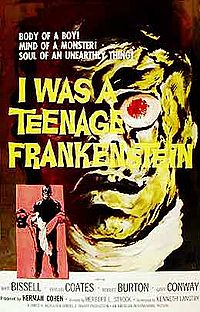
The TSL’s Horror Grindhouse: I Was A Teenage Frankenstein (dir by Herbert L. Strock)


“I was a teenage Frankenstein!”

“Of course you were, dear.”

Sadly, that dialogue does not appear in I Was A Teenage Frankenstein.  Oh well, we can’t have everything….

This 1957 film tells the story of Professor Frankenstein (Whit Bissell), an English scientist who comes to America and promptly sets about trying to create his own creature.  I guess we shouldn’t be surprised, considering that his name is Frankenstein and all.  I mean, when you’ve got a name like that, there are certain expectations that you have to live up to.  You’re not going to become a stand-up comedian or the janitor at the local grocery store.  When you’ve got a name like that, you’re expected to tamper in God’s domain and screw things up.  With a famous name comes great expectations.  Frankenstein …. Kennedy …. Kardashian …. it’s pretty much all the same.

Anyway, the professor is lucky enough to come across a fatal car crash.  This supplies him with exactly the dead body that he needs.  He takes the corpse to his laboratory where, with help of some spare body parts that he just happened to have lying around, he manages to bring the dead teenager back to life!

There’s just one problem.

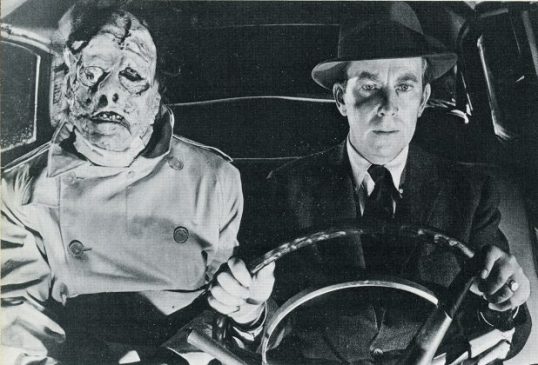
The teenager (played by Gary Conway) now looks like this:

Yep, Teenage Frankenstein is definitely not ready for his public debut.  No one’s happy about this.  Not the professor.  Not the professor’s assistant.  Even the professor’s secretary is upset about what’s going on in the laboratory.  Not even the alligator that Prof. Frankenstein for some reason keeps around the lab is particularly happy about how the operation turned out.

What’s a Teenage Frankenstein to do?  Well, he can always sneak out of the lab but, whenever he does, it seems like someone inevitably ends up dead.  Obviously, Prof. Frankenstein is going to have to find a new face for his creation but from where?  Well, luckily, there is a lover’s lane nearby….

I Was A Teenage Frankenstein was produce by American International Pictures to capitalize on the success of I Was A Teenage Werewolf.  (Whit Bissell plays a mad scientist in both movies and gets the best line in It Was A Teenager Frankenstein when he yells, “Answer me!  You have a civil tongue in your head!  I know, I sewed it in there!”)  Unfortunately, while the monster makeup is indeed impressive, I Was A Teenage Frankenstein is never as much fun as I Was A Teenage Werewolf.  While the teenage werewolf had an entire town to explore, Teenage Frankenstein is pretty much stuck in that lab.  Whereas the teenage werewolf spent his movie running wild, Teenage Frankenstein spends all of his time doing whatever the professor orders him to do.  As a result, I Was A Teenage Frankenstein is a much slower film and also lacks the rebellious subtext of I Was A Teenage Werewolf.

That said, I Was A Teenage Werewolf was enough of a box office success that both the werewolf and the Frankenstein makeup were later used in How To Make A Monster.

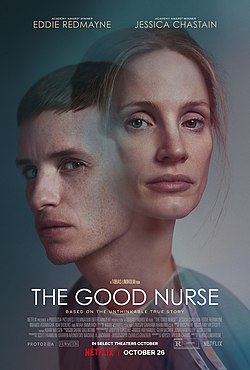
Film Review: The Good Nurse (dir by Tobias Lindholm)


It’s suspected that Charles Cullen might be the most prolific serial killer in U.S. history.

He’s currently sitting in prison, serving 18 consecutive life sentences.  (For those keeping track, he’ll be eligible for parole in the 25th Century.)  In order to avoid getting the death penalty, Cullen confessed to killing 29 people in New Jersey and Pennsylvania.  It is thought that, between the years 1988 and 2003, he actually killed over 400 people.  What made Cullen’s crimes especially horrifying is that he was a nurse and his victims were his patients.  When Cullen first confessed, he tried to portray himself as being a mercy killer, someone who only murdered those who would have no quality of life.  Cullen also claimed that he had been traumatized the first time that he saw a team of doctors fail to resuscitate a patient so he would specifically give overdoses to terminal patients so that they could die both with dignity and without leaving him traumatized.  It was subsequently discovered that few of Cullen’s victims had been terminally ill and that many of them were actually only a day or two away from being discharged from the hospital when Cullen killed them.  Cullen later said that many of his murders were impulsive acts and he wasn’t sure why he had committed them.  In the end, no one can be sure what drove Cullen to commit his murders.

Even before he was arrested, Cullen had developed a bad reputation as a nurse who lost a lot of patients.  He moved from hospital to hospital and he seemed to generate suspicion wherever he went.  Cullen would leave the hospitals whenever it became apparent that anyone was investigating any of the deaths in which he had been involved.  The hospitals were usually happy to be rid of him.  Despite all of the suspicions about him, no one ever tried to stop Cullen from getting another job.  Why risk getting sued for having had Cullen on staff when you could just dump him off on another hospital?

The Good Nurse, which just dropped on Netflix this week, stars Eddie Redmayne as Charles Cullen and Jessica Chastain as Amy Loughren, the nurse who worked with Cullen at his final place of employment.  In the film, Amy is workaholic single mother who needs a heart transplant but who still finds time to show compassion to the patients in the ICU.  She is, as the title states, the good nurse.  When Charles Cullen shows up to work the night shift, she is happy for the help and she takes an immediate liking to the polite and seemingly hardworking Cullen.  Just like Amy, Cullen has two daughters and they bond over their struggles to be both good nurses and good parents.  Cullen tells Amy about how his former coworkers were always plotting against him.  Amy, somewhat naively, invites Cullen to come to her house to meet her daughters.  But when patients start to die, Amy soon suspects that Cullen is responsible.  When she ends up as a patient in the hospital and is faced with the horrifying prospect of Charles Cullen being her nurse, Amy goes to the police and offers to to help them build their case against her former friend.

The Good Nurse is a typical Netflix true crime movie, complete with the slightly washed-out look that almost all of these films seem to share.  The film does a good of capturing the isolation of an ICU ward at night.  With only a handful of nurses and patients on the floor, it’s easy to see how someone like Charles Cullen could have committed his crimes without being caught.  Indeed, some of the film’s most disturbing moments are when Cullen appears to literally emerge from the dark shadows of the ICU ward, like some sort of ghostly hunter seeking his prey.  At the same time, there’s a few moments where the movie feels more like an extra-long episode of Law & Order than a feature film.  Noah Emmerich and Nnamdi Asomugha play the two detectives who are assigned to investigate Cullen’s crimes and their scenes often feel as if they could have been lifted from a dozen other similar true crime films.

As Amy, Jessica Chastain is well-cast, though the role itself is somewhat underwritten.  The film is stolen by Eddie Redmayne, who plays Charles Cullen with an intensity that is frightening to behold at times.  As played by Redmayne, Cullen is creepy from the first time that we see him but, at the same time, Redmayne plays the role with just enough needy charm that the viewer can understand how he was able to fool so many people at so many hospitals.  Redmayne plays Cullen as man who is incapable of compassion but who has learned how to fake it.  It’s only towards the end of the film that Cullen allows his mask to slip and what we see underneath is terrifying.  Eddie Redmayne brings to life a truly evil man, someone who is all the more nightmarish because he really exists.

In the end, The Good Nurse suffers from the same problem as Netflix’s Extremely Wicked, Shockingly Evil, and Vile.  It attempts to comprehend an evil that is beyond normal comprehension.  In the end, both films suggest that there’s no real way to understand what motivates a Ted Bundy or a Charles Cullen.  Instead, all one can do is remain vigilant and hope they’ll be stopped before they can cause any more pain. Cullen is in prison for life.  Bundy got the electric chair.  Both of them left behind many questions that will never be answered.

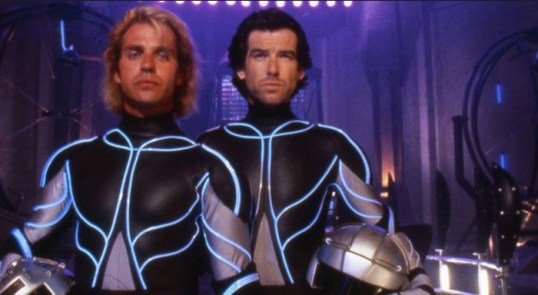
Horror Film Review: The Lawnmower Man (dir by Brett Leonard)


The 1992 horror/sci-fi hybrid, The Lawnmower Man, tells the story of two men.

Dr. Lawrence Angelo (played by Pierce Brosnan) is a scientist who is experimenting with ways to make less intellectually inclined people smarter. Dr. Angelo is kind of a burn out. You can tell he has issues because he needs to shave, he’s always sitting in the dark, and he’s never without a cigarette. You look at Dr. Angelo and you just imagine that he smells like smoke, bourbon, and lost dreams.

Jobe (Jeff Fahey) is the kind-hearted but intellectually disabled man who lives in a shack and spends his time mowing everyone’s lawn. Hence, he’s known as the …. wait for it …. THE LAWNMOWER MAN!

Together, Dr. Angelo and Jobe solve crimes!

No, not really. Instead, Dr. Angelo decides to experiment on Jobe. This leads to Jobe not only becoming smarter but also quicker to anger. Soon, Jobe is developing psychic abilities. He can move things with his mind. He can magically set people on fire. Basically, he can do whatever the script needs for him to do at the moment. Jobe is soon tormenting everyone who once bullied him. Father McKeen, the pervy priest, gets set on fire. Jake, the gas station attendant, is put into a catatonic state. An abusive father get run over by a lawnmower.

Dr. Angelo knows that Jobe is out-of-control and that the experiment has to be reversed. However, the sinister group behind Angelo’s research wants to use Jobe as a weapon because …. well, because they’re evil and that’s what evil people did back in 1992. Jobe, however, has other plans. He wants to become pure energy so that he can rule over a virtual world….

Or something like that. To be honest, it’s kind of difficult to really figure out what’s going on in The Lawnmower Man. The movie shares its name with a Stephen King short story but it has so little in common with its source material that King reportedly sued to get his name taken out of the credits. (Considering some of the films that King has allowed himself to be associated with, this is kind of amazing.) The film tries to be a satire, a slasher film, a conspiracy film, and a technology-gone-crazy film all in one and the end result is one big mess.

Along with all of that, The Lawnmower Man is also a time capsule of when it was made. A good deal of the film takes place in Jobe’s virtual reality universe, which looks a lot like a mix of Doom and Second Life. I imagine the film’s special effects may have seen impressive way back in the 20th Century but, seen today, they’re rather cartoonish, if occasionally charmingly retro.

On the plus side, the film does have an interesting cast. Pierce Brosnan is never convincing as burn-out but he tries so hard that he’s still fun to watch. Underrated actors like Jenny Wright, Geoffrey Lewis, Dean Norris, and Troy Evans all get a chance to show what they can do in minor roles. Finally, you’ve got the great Jeff Fahey, giving a far better performance than the script perhaps deserves. Though the film may be a mess, there’s something undeniably fun watching Jeff Fahey’s Jobe go from being meek to being a megalomaniac.

It’s a silly film and not one that’s meant to be watched alone. This is a film that has to be watched with a group of your snarkiest friends. Watch it the next time you’re looking for an excuse to avoid doing the yard work.

Horror On The Lens: Messiah of Evil (dir by Willard Huyck)


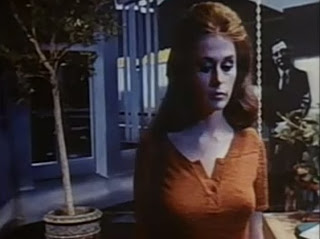
MOE Mariana HillWith only five days left until Halloween, I wanted to make sure that I shared this film with our faithful and wonderful readers.  Messiah of Evil was first released in 1973 and, since it’s in the public domain, it has since been included in a countless number of bargain box sets from Mill Creek.

I can still remember the first time that I saw Messiah of Evil.  It was on a Monday night, many years ago.  I had recently picked up a 10-movie DVD box set called Tales of Terror and I was using the movies inside to try to deal with a bout of insomnia.  I had already watched The Hatchet Murders (a.k,a. Deep Red) and The House At The Edge of the Park and, at two in the morning, I was faced with a decision.  Should I try to sleep or should I watch one more movie?

Naturally, I chose to watch one more movie and the movie I chose was Messiah of Evil.  So, there I was at two in the morning, sitting at the edge of my bed in my underwear and watching an obscure horror movie while rain fell outside.

And, seriously — this movie totally FREAKED me out!

Messiah of Evil tells the story of Arletty (Marianna Hill), a neurotic woman who drives to an isolated California town in order to visit her father.  Her father is an artist who specializes in painting eerie pictures of large groups of black-clad people.  However, once she arrives at his home, Arletty discovers that her father has vanished and left behind a diary where he claims that a darkness has overtaken the town.

Meanwhile, a mysterious man named Thom (Michael Greer) is wandering about town with two groupies (played by Anita Ford and Joy Bang) and interviewing random townspeople.  One crazed man (Elisha Cook, Jr.) explains that “the dark stranger” is returning.  After meeting Arletty, they all end up moving into her father’s house.

But that’s not all.   There’s also an odd albino man who shows up driving truck and who eats mice….

Messiah of Evil is literally one of the strangest films that I’ve ever seen.  It’s shot in a dream-like fashion and the much of the film is left open to the viewer’s interpretation.  There are two classic scenes — one that takes place in a super market and one that takes place in a movie theater and the movie’s worth watching for these two scenes alone.

Messiah of Evil is a film that will be appreciated by all lovers of surrealism and intelligent horror and I’m happy to share it with you today.

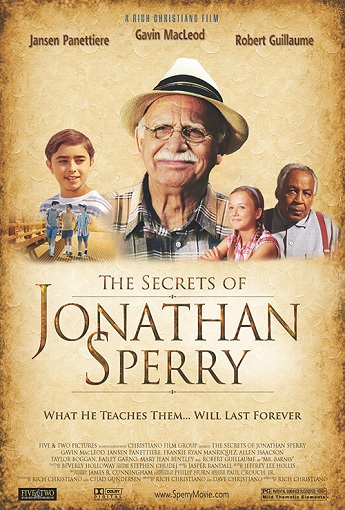
October Positivity: The Secrets of Jonathan Sperry (dir by Rich Christiano)


First released in 2008, The Secrets of Jonathan Sperry is a true rarity.  It’s a Christiano feature film that’s actually not that bad.

The film takes place in 1970, with the implication being that it’s based on a true story.  (The film ends with an epilogue, in which we learn what everyone did with their lives after the final scene.)  Three adolescent friends are trying to enjoy their summer.  One of them has a crush on the local waitress and is trying to figure out how to tell her.  All of them are trying to avoid getting on the bad side of Nick and his gang.  Nick is the type of bully who takes your last piece of pizza and then refuses to let you finish your game at the pinball machine.  He is one bad dude.

Jonathan Sperry (played by Gavin MacLeod) is a nice old man who needs his lawn mowed.  One of the three boys becomes his lawn guy and soon, all of them are hanging out at Mr. Sperry’s house.  Mr. Sperry gives them lemonade and encourages them to read the Bible.  At one point, he send the three of them on a race around the town, with the winner earning a piece of cake.  The catch is that he gives each of the boys different directions in order to highlight that you can only get what you want (in this case, the Cake) if you have the right directions.  Mr. Sperry explains that he’s teaching a lesson about how the only way to become a Christian is to read the Bible (i.e., only the Bible has the right directions).  Personally, I would think that the two boys who didn’t get cake because they were intentionally given bad directions would have every right to be extremely upset with Mr. Sperry but this is a movie so they’re not.

Eventually, Mr. Sperry sends one of the boys over to his neighbor’s house.  Even though his lawn looks awful, Mr. Barnes (Robert Guillaume) announces that he doesn’t want anyone to mow it for him.  Eventually, of course, Mr. Barnes relents and reveals that he’s not quite as fearsome as everyone thinks.  Meanwhile, Mr. Sperry takes it upon himself to minister Nick and Nick is also revealed to be not quite as fearsome as everyone thinks.

As I said, when compared to the other films that Rich Christiano’s been involved with, The Secrets of Jonathan Sperry isn’t that bad.  While the message is a bit heavy-handed and I doubt the film is going to change the mind of anyone who doesn’t already share the filmmaker’s beliefs, The Secrets of Jonathan Sperry is well-acted and good-natured.  (As opposed to other Christiano films, there’s very little talk of Hell or politics.)  The film makes good use of its two veteran performers, with both Gavin MacLeod and Robert Guillaume giving believable performances as two men who are dealing with their own mortality in very different ways.  In the end, the film may be about faith but it also celebrates friendship.  It’s all done surprisingly well.