The TSL’s Horror Grindhouse: I Was A Teenage Werewolf (dir by Gene Fowler, Jr.)


Tony Rivers (Michael Landon), the lead character in 1957’s I Was A Teenage Werewolf, is a teenager.  You probably already guessed that from the film’s title but, as we all know, titles can be misleading.  Teenagers were very popular in the 50s, after all.

But no, Tony is actually a teenager.  In fact, he’s one of those troubled teenagers that were all the rage in the late 50s.  He lives for kicks and spends too much combing his hair.  He skips school.  He stays out late.  He gets into fights with other teenagers.  He’s not dumb, mind you.  He has plenty of friends and a girlfriend (Yvonne Lime) who only wants the best for him.  He just has a hard time controlling his temper and his father (Malcolm Atterbury) isn’t sure what to do with him.

However, Detective Donavon (Barry Phillips) has a possible solution!  After the police are called to break up one of Tony’s fights, Donavon suggests that maybe Tony should seek professional counseling.  In fact, maybe he could go see Dr. Brandon (Whit Bissell)!  Dr. Brandon is a widely respected hypnotherapist and he has an office right next to the local airplane factory.  Only the best therapists are allowed to practice next to the airplane factory.  Everyone knows that.

Even though he doesn’t want to, Tony finally agrees to see Dr. Brandon.  Even if he doesn’t say it, you can tell that Tony is thinking, “This is totally squaresville.  Really melvin, maaaaaan….” the whole time.  But Brandon gets results!

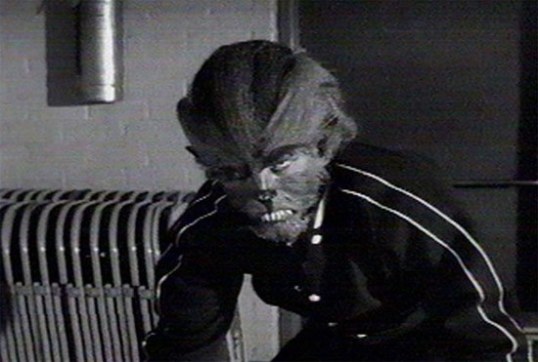
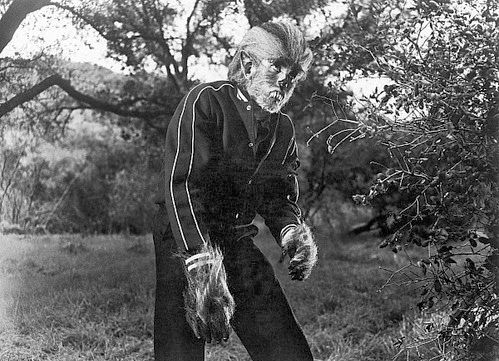
In fact, you could argue that he gets too many results.  After twice hypnotizing Tony and telling him to think of himself as being a wild animal, Tony becomes just that!  That’s right, Tony turns into a werewolf and he’s soon running around town — in his letterman jacket! — and killing anyone that he comes across.

Whenever Tony transforms back into a human, he regrets what he’s done.  Unfortunately, it turns out that almost anything can cause Tony to turn back into a wolfman.  Most werewolves need a full moon.  All Tony needs is to hear the sound of the school bell….

To be honest, I imagine that most people who watch this film do so because they want to see a werewolf creating chaos while wearing a high school letterman jacket.  Considering that this was a low-budget film made to play as half of a double feature, the werewolf makeup is actually fairly impressive and that letterman jacket adds just the right touch of weirdness to the whole affair.

Make no mistake, it’s an entertaining and deeply silly film but, at the same time, it does have an interesting subtext.  One could argue that Tony’s transformation into a werewolf serves as a metaphor for his struggle to grow up.  Neither werewolves nor juvenile delinquents can control themselves and Michael Landon gives a performance that’s just sensitive enough to justify calling this one Werewolf Without A Cause.

That said, the main appeal of this film is definitely the chance to see a werewolf in a letterman jacket.
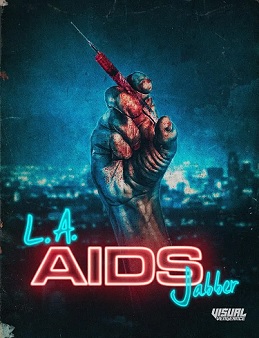
L.A. AIDS Jabber (1994, directed by Drew Godderis)


This is a real movie and that is the real title.

Jeff (Jason Majik) is an angry young man who is seeing a therapist because he has issues with women.  He worked in a furniture warehouse, where he has issues with his boss.  Jeff has issues with everyone but soon, he has an even bigger concern.  Because of a nagging stomachache, Jeff goes to see a doctor.  The doctor does some bloodwork.  He runs the results twice just to be sure.  Then he informs Jeff that he has tested positive for AIDS.  Jeff snaps.  He fills a huge hypodermic needle with his own blood and then goes on a rampage, jabbing people across Los Angeles.

The two detectives who have been assigned to the jabber case (and who appear to investigate every other homicide in Los Angeles as well) do not want the story to get into the press.  Unfortunately, a stolen boombox that belongs to the boyfriend of a local news reporter (Joy Yurada) picks up the sound of the detectives talking on their secure line.  Refusing to be intimidated, the reporter reveals the details of the investigation on the nightly news.  Jeff decides to make the reporter his newest target.

Again, this is a real movie and that is the real title.

L.A. AIDS Jabber is a shot-on-video film that was based on the urban legend about someone with AIDS going to the clubs in New York and Los Angeles and randomly pricking people with a needle.  The movie itself is pretty dire, full of bad performances and subplots that don’t lead anywhere.  To me, the most interesting thing about the movie was how little it actually seemed to know about AIDS or how it was transmitted.  For instance, no one — not even the doctor who tells Jeff that he’s tested positive — uses the term “HIV.”  The doctor tells Jeff that he has “tested positive for AIDS” and then just sends him home.  I get that this film was made in 1994 when people were still learning about this virus but the doctor could have at least informed Jeff that it can take several years for HIV to develop into AIDS.  As a last minute twist reveals at the end of the film, that’s not the only way that the doctor has failed his patient.

As for the rest of the movie, it’s all bad performances, bad acting, bad jokes, and a bad script.  Jason Majik does have one good scene where he starts punching a wall but that’s pretty much it.  This jabber’s not worth getting stuck with.

Horror Film Review: Prophecy (dir by John Frankenheimer)


First released way back in 1979, Prophecy is one of those films where a big evil corporation is selfishly polluting the environment and a group of noble Native Americans is convinced that a vengeful spirit of the forest has been awakened as a result.

We’re told that the vengeful spirit is named Katahdin and that it’s “as large as a dragon and has the eyes of a cat.” We’re also told, by someone who claims to have actually seen it, that the Katahdin is a combination of several different creatures, “a part of everything that is God’s creation.”

Sound pretty scary, right?

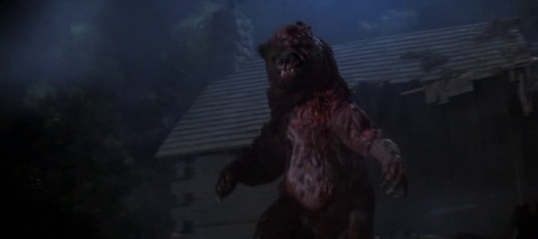
Well, it is until the bear itself actually shows up on screen. That’s when we find ourselves confronted with this:

I mean, don’t get me wrong. He certainly is ugly. But he just looks so silly and …. well, fake.

The lesson here, and it’s an important one, is that you should never put your monster onscreen unless it can actually live up to all the hype. Take a lesson from Spielberg. When it became obvious that the shark in Jaws looked like a tin model, Spielberg made the decision to not show the shark. Instead, he gave us a lot of point of view shots and, by the time the shark did appear, audiences were so frightened that it didn’t matter whether it looked convincing or not. Prophecy makes the mistake of having its monster all over the place and it just doesn’t work.

Of course, once the EPA’s Dr. Robert Verne (Robert Foxworth) shows up with his pregnant wife (Talia Shire, who somehow went from The Godfather and Rocky to this), he discovers that one reason why the Katahdinh doesn’t live up to all the hype is because it’s just a mutant bear. It turns out that all that pollution led to some crazy results and now every logger, Native American activist, and camper in the area is in danger! Can Dr. Verne and a team of disposable, forgettable characters end the threat of Katahdinh!?

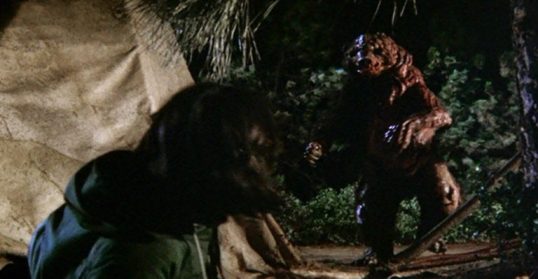
Prophecy is a big, dumb movie that’s never as much fun as you want it to be. There is one early scene that features a camper trying to hop away from Katahdinah while zipped up in a sleeping bag. That scene — which ends with one ruined sleeping back and lot of feathers floating around — is just demented enough to be kind of fun:

Otherwise, the entire film is slow-moving and rather dull. Part of the problem is that it was directed by John Frankenheimer, a major and important filmmaker who had entirely the wrong sensibility for this film. Frankenheimer was a legitimately great director (among his good credits: The Manchurian Candidate, Birdman of Alcatraz, Ronin, Seconds) but he takes the material too seriously. He spends so much time trying to sell the film’s environmental message that he forgets that the majority of the audience for a film like this isn’t watching because they want to become a better person. They’re watching for mutant bear mayhem! This is the type of film that needed to be directed by someone from the Roger Corman school of quick thrills and shameless shlock.

So, here are the twin lessons of Prophecy: know your audience and make sure your monster can live up to its reputation! Otherwise, you’ll just be known for that one scene with the exploding sleeping bag.

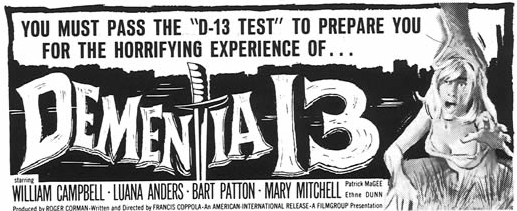
Horror on the Lens: Dementia 13 (dir by Francis Ford Coppola)


(I originally shared this film back in 2011 and 2019 — can you believe we’ve been doing this for that long? — but the YouTube vid was taken down both times!  So, I’m resharing it today!)

For today’s excursion into the world of public domain horror, I offer up the film debut of Francis Ford Coppola.  Before Coppola directed the Godfather and Apocalypse Now, he directed a low-budget, black-and-white thriller that was called Dementia 13.  (Though, in a sign of things to come, producer Roger Corman and Coppola ended up disagreeing on the film’s final cut and Corman reportedly brought in director Jack Hill to film and, in some cases, re-film additional scenes.)

Regardless of whether the credit should go to Coppola, Corman, or Hill, Dementia 13 is a brutally effective little film that is full of moody photography and which clearly served as an influence on the slasher films that would follow it in the future.  Speaking of influence,Dementia 13 itself is obviously influenced by the Italian giallo films that, in 1963, were just now starting to make their way into the drive-ins and grindhouses of America.

In the cast, keep an eye out for Patrick Magee, who later appeared as Mr. Alexander in A Clockwork Orange as well as giving a memorable performance in Lucio Fulci’s The Black Cat.  Luana Anders, who plays the duplicitous wife in this film, showed up in just about every other exploitation film made in the 60s and yes, the scene where she’s swimming freaks me out to no end.

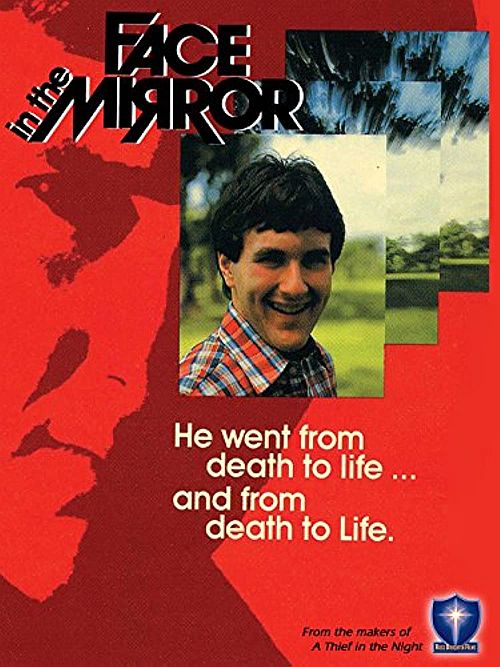
October Positivity: Face In The Mirror (dir by Russell S. Doughten Jr.)


The 1982 film, Face in the Mirror, opens with a community in crisis.

A teenager named Danny DeMarco (played by Michael Mitchell) has been shot and is being rushed to the hospital.  As we listen to the people who are following the ambulance to the hospital, it soon becomes clear that Danny shot himself and that the shooting occurred at a youth group meeting.  At the hospital, Danny is sent to the ICU.  He’s in a coma.  The doctors are not sure whether he’ll ever come out of that coma.

The first half of the 65-minute film is dominated by flashbacks as people try to figure out what could have led to Danny shooting himself.  Danny’s father remembers the time that he gave Danny a hard time for winning first place in a chess tournament.  Though I think most parents would be proud to have a son who was actually good at playing a game that required a certain amount of intelligence, Danny’s father is unimpressed.  Danny’s father was a jock in high school and he expects Danny to be the same.  Chess?  Why, that’s for wimpy youth group kids!

Speaking of wimpy youth group kids, the members of the youth group occasionally pause from the prayer to remember all of the times that they failed Danny.  They remember their own hypocritical behavior and how they would give Danny a hard time whenever he pointed it out.  They remember all of the times that Danny seemed to be confused about his faith and how they didn’t listen to his concerns.  They remember the youth group meeting in which Danny suddenly pulled out a gun and, after calling out everyone else on their hypocrisy and saying that he didn’t really believe in God, he pointed the gun at his head.  When another member of the group tried to grab the gun, it went off.  While their parents dismiss Danny as just being “a crazy kid,” the members of the youth group confront the role that they all played in Danny’s depression….

The first 30 minutes of this film is surprisingly well-acted and the theme of teen suicide is sensitively handled … up until the point that the film insinuates that Danny wouldn’t be depressed or suicidal if he was really a Christian.  I’ve known enough depressed but sincerely religious people to know that this is simply not the truth.  It’s actually a rather dangerous message to send out, as it suggests that depression is somehow a personal failing as opposed to something that everyone, to some degree, is going to have to deal with at some point in their life.

The second half of the film is all about the efforts of Danny’s friends to sneak into his hospital room so that they can pray for him and hopefully get through to him, even though he’s in a coma.  Again, the performances are sincere.  However, tonally, this half of the film is a mess.  There are some awkward moments of humor which really don’t seem like they belong in a movie about teen suicide.  The dialogue also get a bit cringey, as often happens when teenage characters are written by screenwriters who obviously were quite a bit older than the people they were writing for.

Face in the Mirror was directed by Russell Daughten, Jr.  Daughten also directed Nite Song and produced the Thief In The Night films.  Like those films, Face in the Mirror is a sincere but flawed time capsule.  The film’s tone is all over the place but I have to admit that I did kind of enjoy watching this grainy production with its amateur cast.  What can I say?  I have a weakness for low-budget indie films that feature a bunch of people who probably never made another film after this one.  Like Nite Song, watching this film is like stepping into a time machine and traveling to a simpler, if not quite innocent, past.  In the end, the film’s main message is that we should be aware that our words and our actions can hurt people without us even realizing it.  That’s not a bad one.

The TSL’s Horror Gindhouse: Flesh Feast (dir by Brad Grinter)


Oh, poor Veronica Lake.

In the 1940s, Veronica Lake was undoubtedly a star.  She appeared in Preston Sturges’s classic comedy, Sullivan’s Travels.  She played the femme fatale in a series of classic film noirs.  She proved herself to be just as capable of playing comedy as she was playing drama.  By wearing her hair down and often allowing it to fall over her right eye, she created the peek-a-boo hairstyle.  She was briefly a star and a fashion icon but she also developed a reputation for heavy drinking and being difficult to work with.  During World War II, the U.S. government actually requested that Lake change her hairstyle in order to decrease incidents of women, many of whom were working factories as a part of the war effort, getting their hair tangled in the machinery.  Lake did so, cutting her long hair and going for a more practical look.  Her career never recovered.

The years following her 1940s heyday would not easy ones for Veronica Lake.  Along with multiple divorces, she also struggled with alcoholism and with the IRS.  Lake spent much of the 50s in England.  When she returned to the States in the 60s, she was arrested several times for public drunkenness and eventually took a job as a waitress to pay the bills.  A news story about her life as a waitress renewed some interest in Veronica Lake, as did the publication of her memoirs in 1969.  As so often happened with former stars who fell on hard times, she considered taking roles in the type of low budget films that she wouldn’t have even been offered when she was at the height of her fame.

That brings us to Flesh Feast.

In Flesh Feast, Veronica Lake is cast as Dr. Elaine Frederick.  Living in a dilapidated mansion in Florida, Dr. Frederick believes that she has discovered the perfect way to not only look younger but to also reverse the aging process itself!  It involves maggots, lots and lots of maggots.  For just a few dollars, Dr. Frederick will apply maggots to your skin and, like magic, they’ll suck away the years.  That may sound disgusting but, whenever the viewer is show Dr. Frederick working in her laboratory, it’s obvious that the maggots are instead grains of rice.

Dr. Frederick is approached by a group of South American neo-Nazis who want Dr. Frederick to use her maggots to make their leader young again.  They refuse to tell her the name of their leader but you can guess who it is, right?  I mean, he’s living in Argentina.  He’s in hiding.  The rest of the world thinks that he’s dead.  He’s German.  He used to be involved in the government …. oh, okay, I’ll tell you.  It’s Hitler.  The group wants Dr. Frederick to use her maggots to make Hitler young again.  Dr. Frederick agrees but it turns out that she’s only interested in getting revenge!

There’s a lot of negative things you can say about Flesh Feast but it’s perhaps the only film to feature Veronica Lake laughing as a bunch of maggots eat Hitler’s face.  Don’t get me wrong.  It takes forever to actually reach that moment.  There’s a whole subplot about a journalist trying to investigate Dr. Franklin’s experiments.  As well, Dr. Franklin’s assistant is an undercover government agent and she keeps stumbling across dead bodies at inopportune times.  The first 70 minutes of Flesh Feast are about as draggy and boring as any movie that I’ve ever seen.  But, after all that, you get to see Veronica Lake kill Hitler.  Some would say that’s definitely worth the price of admission!

Flesh Feast was Veronica Lake’s final movie.  (She not only starred in the film but she co-produced it as well.  Director Brad Grinter was also responsible for Blood Freak.)  It was filmed in 1967 but not released until 1970, after the publication of her memoirs renewed interest in her career.  Unfortunately, Flesh Feast didn’t exactly do well at the box office.  Lake would die just three years later, at the age of only 50.  But her films and her performances will live forever.

Jack-O (1995, directed by Steve Latshaw)


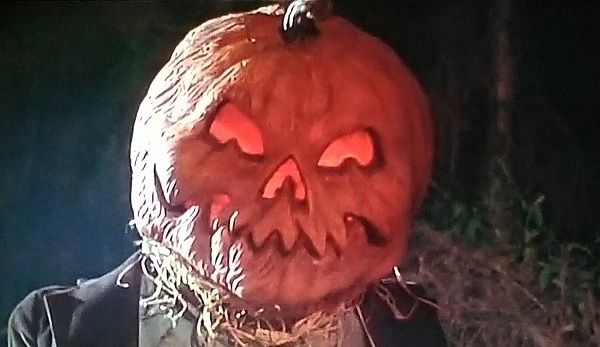
Back in frontier times, a warlock named Walter Machden (John Carradine) terrorized the citizens of the town of Oakmoor Crossing so they tracked him down and lynched him.  Before he was hung, Machden cursed the town.  A demon with a jack-o-lantern for a head terrorized the town until the Kelly Family defeated him and buried him underneath a cross.

Jump forward one hundred years.  It is Halloween night and some drunk teenagers knock over the cross.  Jack-O comes back to life and kills the teenagers.  Jack-O sets out to get revenge on the Kelly family but, for some reason, he decides to kill their neighbors, some more teenagers, and a TV cable guy before going after his targets.  It’s up to young Sean Kelly (Ryan Latshaw) to figure out how to defeat Jack-O for a second time.

The most interesting thing about Jack-O is that it features John Carradine, even though he died a full seven years before the movie was released.  That either means that Jack-O had an unusually long post-production period or the Carradine scenes were shot for another movie and were clumsily inserted into Jack-O.  Carradine was not the only deceased star to make an appearance in Jack-O.  Cameron Mitchell, who passed away in 1994, also makes an appearance as a horror movie host.  Because you can’t have a movie with Carradine and Cameron Mitchell without including Linnea Quigley, she appears as a babysitter who takes a lengthy shower.  Fortunately, Linnea Quigley is still with us.

Overall, Jack-O is regrettable.  The demon, with his Jack-O-Lantern head, is more likely to inspire laughs than screams and it never makes sense that Jack-O would take so much time to kill everyone except for the people that he is actually looking to kill.  The best death involves a toaster but Jack-O doesn’t do anything with the toaster.  Instead, someone just slips and sticks a utensil in the toaster, leading to a shocking death.  Combine the poor acting with the poor special effects with notably ragged editing that often makes it unclear how much time has passed between scenes and you have a Halloween film that is no holiday.

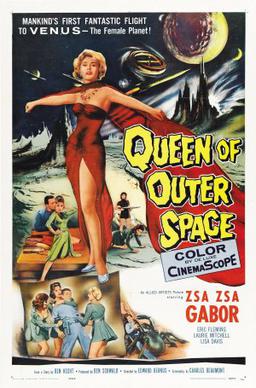
Horror Film Review: Queen of Outer Space (dir by Edward Bernds)


In 1958’s Queen of Outer Space, four rather dumb men take off in a spaceship from Earth.

There’s Lt. Larry Turner (Patrick Waltz) and Lt. Mike Cruze (David Wilcox), both of whom come across like they like to spend the weekend hanging out at their old frat house, playing beer pong. And then there’s Prof. Konrad (Paul Birch), who is smart because he knows what the word “atmosphere” means. And finally, in charge of the flight, is Captain Neal Patterson (Eric Fleming), who is upright and kind of dull.

The four men are supposed to be going to a space station but they get knocked off course by an animated laser beam and the ship crash lands on a mysterious planet that’s covered with cardboard rocks and plastic trees. Prof. Konrad takes one look at the planet and says that they’re on Venus.

Uh-oh! That’s not good! Isn’t Venus like a really bad place for human beings to find themselves?

Well, apparently not, because soon the four men are casually walking around the planet without so much as wearing a space suit or bringing along an oxygen supply. They even stop to get some sleep among the cardboard rocks. That’s when they’re captured by Venus’s inhabitants.

To the men’s shock, they discover that Venus is exclusively populated by women! The men are all like, “Hey, how you doing?” And the women are all like, “Silence, we have ray guns!”

Anyway, long story short, it turns out that Venus is ruled over by a disfigured queen (Laurie Mitchell), who hates men in general and Earth men in specific. She’s built a giant space laser that she’s planning to use to destroy Earth and it’s up to the men to stop her! Fortunately, they’ve got some help from Talleah (Zsa Zsa Gabor), a Venusian courier who has a wardrobe that’s to die for and who has apparently been waiting her entire life for men to come to Venus. When the Queen flirts with the captain, Talleah jealously exclaims, “I hate the Queen!” and that’s pretty much all it takes to start a revolution.

Needless to say, this is an incredibly sexist movie but, at the same time, it’s so goofy (in a 1950s sort of way) that you really can’t get too outraged by it. Instead, you just kinda cringe when Turner and Mike suggest that the captain needs to “turn on some of that old black magic” and invite the Queen out for a midnight stroll. Prof. Konrad quickly adds that Venus actually has several moons, though not all of them can be seen. I mean, it’s dumb but, at the same time, it’s just so 1958.

It’s really is a thoroughly ludicrous movie but, watching it, you get the feeling that the entire cast understood that it was ludicrous and they adjusted their performances accordingly. I mean, this is a movie that features Zsa Zsa Gabor putting on a mask and attempting to imitate the Queen while making absolutely no attempt to hide her trademark Hungarian accent. This is also a movie that features a giant rubber spider that pops up out of nowhere and for nor particular reason. I guess they just had the spider on set for the day and they decided to toss it in.

Queen of Outer Space is an incredibly silly movie but it’s entertaining in it’s own stupid way. Don’t take it too seriously. It’s only 80 minutes. Watch it for the experience.

Horror on the Lens: The Terror (dir by Roger Corman, Francis Ford Coppola, Jack Hill, Monte Hellman, Dennis Jakob, and Jack Nicholson)


Have you ever woken up and thought to yourself, “I’d love to see a movie where a youngish Jack Nicholson played a French soldier who, while searching for a mysterious woman, comes across a castle that’s inhabited by both Dick Miller and Boris Karloff?”

Of course you have!  Who hasn’t?

Well, fortunately, it’s YouTube to the rescue.  In Roger Corman’s 1963 film The Terror, Jack Nicholson is the least believable 19th century French soldier ever.  However, it’s still interesting to watch him before he became a cinematic icon.  (Judging from his performance here and in Cry Baby Killer, Jack was not a natural-born actor.)  Boris Karloff is, as usual, great and familiar Corman actor Dick Miller gets a much larger role than usual.  Pay attention to the actress playing the mysterious woman.  That’s Sandra Knight who, at the time of filming, was married to Jack Nicholson.

Reportedly, The Terror was one of those films that Corman made because he still had the sets from his much more acclaimed film version of The Raven.  The script was never finished, the story was made up as filming moved alone, and no less than five directors shot different parts of this 81 minute movie.  Among the directors: Roger Corman, Jack Hill, Monte Hellman, Francis Ford Coppola, and even Jack Nicholson himself!  Perhaps not surprisingly, the final film is a total mess but it does have some historical value.

(In typical Corman fashion, scenes from The Terror were later used in the 1968 film, Targets.)

Check out The Terror below!

October Positivity: Nikki and the Perfect Stranger (dir by Jefferson Moore)


The third part of The Perfect Stranger trilogy finds Nikki Comiskey at a crossroads …. again.

The film begins with Nikki (now played by Julianna Allen) recapping how, many years ago, she was a high-profile attorney who, after having dinner with Jesus (Jefferson Moore), decided to ditch her legal career and devote herself to her family.  (Nikki explains that she was a “closet agnostic” before she met Jesus.)  Ten years after having dinner with Nikki, Jesus appeared to Nikki’s teenage daughter, Sarah, and encouraged her to not abandon the faith of her parents.  However, while Sarah is off thriving at college, Nikki feels like her life is in a rut.  Though she still believes, she no longer gets much out of going to church and, once again, her marriage is starting to feel strained.

A visit with her mom doesn’t go well.  Mom wants to know why Nikki had to abandon her legal career.  Nikki gets annoyed and storms out of the house.  She gets in her car and starts to make the long drive home.  She calls her husband and explains what happened.  Her husband informs her that he’s going to busy working on the roof for a bit.  (Hmmm …. I wonder if this seemingly random bit of dialogue is going to come up again towards the end of the film?)  While Nikki is driving home, she sees a familiar figure standing on the side of the road.

Yes, it’s Jesus (though he’s currently going by Josh).

Nikki gives Jesus a ride and they discuss why Nikki is feeling so unsatisfied with her life.  Along the way, they meet a trucker with a porn addiction and they take him to dinner so that Jesus can encourage him to go to rehab.  (At the diner, Nikki tries to order a late night salad.  Needless to say, that doesn’t go well.)  Finally, Nikki gets a chance to help out a minister named Tony (Matt Wallace), who is a character in another film that Jefferson Moore made in which he played Jesus.

(In fact, I discovered that Moore also starred in a TV series called The Stranger, which was a spin-off of The Perfect Stranger films.  So really, there’s an entire Perfect Stranger cinematic universe out there.)

My main impression of Nikki and the Perfect Stranger is that it was surprisingly short.  With a running time of 63 minutes, it definitely felt more like an extra long episode of an anthology show than an actual movie.  That said, Nikki and the Perfect Stranger doesn’t feel as preachy as the previous Perfect Stranger films.  I imagine that’s because the previous two films featured Jesus “educating” an agnostic while this third one features Jesus checking up on an old friend and giving advice.  Since he’s a bit less condescending and argumentative in this film, Jefferson Moore is far more likable here than he was in the previous films.  As opposed to some of the films that I’ve watched this month, the emphasis is more on helping than on judging.  (I can only imagine the tortures to which the Christianos would have subjected that trucker.)  By the time the end credits roll, Nikki’s story has been efficiently wrapped up.