Film Review: Pain Hustlers (dir by David Yates)


I had high hopes for Pain Hustlers, largely because it featured some of my favorite actors and actresses.  Chris Evans, Emily Blunt, Andy Garcia …. how can you go wrong with that cast, right?

Unfortunately, when I watched the film, it only took a few minutes for me to lose interest.  The film opens with black-and-white interview clips of Liza Drake (Emily Blunt) and Pete Brenner (Chris Evans), in which they both claim to be the only one who can tell the true story of how a failing pharmaceutical firm became a powerhouse by bribing doctor to prescribe Fentanyl.  For lack of a better term, I refer to this as the I, Tonya approach though it perhaps would be better to name it after director Adam McKay, whose superficial but slickly made films are often mistaken for being important political statements.  It’s a style of filmmaking that may have once been exciting but now, it’s so overused that it’s come to feel a bit like a cliché.

As for the film itself, it opens with Liza working as an exotic dancer and living in a run-down motel with her daughter, Phoebe (Chloe Coleman).  A chance meeting with pharmaceutical salesman Pete Brenner leads to Liza getting a job as a sales rep despite the fact that she’s a high school drop-out who previously served time in jail for drug trafficking.  (Pete writes up a fake resume for her and lists her as being PHD, which Pete says stands for, “poor, hungry, and desperate.”)  After a rocky start, Liza is able to convince Dr. Lydell (Brian D’Arcy James) to start prescribing a powerful painkiller that was developed for cancer patients.  Of course, people get addicted to the drug and many overdose but it doesn’t matter because Liza, Pete, and Dr. Lydell are all getting rich.  The unstable head of the company, Dr. Jack Neel (Andy Garcia), is happy as long as the money keeps rolling in and as long as everyone takes off their shoes at work because he’s worried about the floors getting dirty.

As I said at the start of the review, the film attempts to take an I, Tonya-style approach to the material, mixing conflicting narrators with moments of dark humor and sudden melodrama.  Unfortunately, David Yates is exactly the wrong director for this film.  Yates is best-known for his work with the Harry Potter franchise.  Yates did a wonderful job directing the last few of the Harry Potter films but, as a director, his tendency is to be a crowd-pleaser and Pain Hustlers fails precisely because Yates always pulls back before the film can get too dark or subversive.  This is the type of film where, during the final fourth of the film, everyone starts acting in ways totally contrary to everything we’ve previously learned and seen about them so that the film can end on a traditional note of good vs evil.  Watching previously amoral characters suddenly and unconvincingly developed a conscience, I found myself thinking about Martin Scorsese’s The Wolf of Wall Street.  One reason why The Wolf of Wall Street worked is because Jordan Belfort remained an unrepentant crook through the entire film, even after all of his schemes fell apart.  Scorsese has the courage to the let the audience make up their own mind about Belfort.  Scorsese understood that suddenly having Belfort (or Henry Hill in Goodfellas or Ace Rothstein in Casino) develop a sense of right and wrong would not only feel unnatural to the character but it would also undercut the effectiveness of the story he was trying to tell.  For lack of a better term, it would feel fake.  It would feel like pandering to those who demands a cut-and-dried, easy-to-digest message.  That’s a lesson that Pain Hustlers missed, to its detriment.

It’s just not a very good film, which is a shame when you consider the amount of talent involved.  Of the cast, Chris Evans is the only one who really makes much of an impression, playing Pete as someone who might not be smart but who definitely understands how to charm enough people to get by.  Poor Emily Blunt is sabotaged by an inconsistent script while Andy Garcia is pretty much wasted as Dr. Neel.  Seriously, can we make an effort to write more decent roles for Andy Garcia?  He’s such a good actor and he keeps getting wasted in these small, pointless roles!

Pain Hustlers was a disappointment for me.  It happens.

Retro Television Reviews: Terror In The Sky (dir by Bernard L. Kowalski)


Welcome to Retro Television Reviews, a feature where we review some of our favorite and least favorite shows of the past!  On Sundays, I will be reviewing the made-for-television movies that used to be a primetime mainstay.  Today’s film is 1971’s Terror In The Sky!  It  can be viewed on YouTube.

On a flight heading from Minneapolis to Seattle, several passengers suddenly start to get ill.

Luckily, there’s a doctor on the plane.  Sporting sideburns and wearing a turtleneck, Roddy McDowall is quite chic in the role of Dr. Baird, the dedicated medical professional who comes to realize that the passengers are suffering from food poisoning.  As Dr. Baird explains it to head flight attendant Janet Turner (Lois Nettleton), everyone who had the chicken for dinner is about get severely ill.  Uh-oh …. both of the pilots had the chicken!

Is there anyone on the plane who has any flying experience?  George Spencer (Doug McClure) flew a helicopter in Vietnam but, as George explains, it’s an entirely different type of flying all together.  George has no confidence about his ability to land the plane but he’s the only chance the passengers have.

On the ground, gruff Marty Treleavan (Leif Erickson) has been summoned to the airport so that he can help to talk George through the landing.  Marty explains what all of the instruments do to George.  He tells George that he needs to stay in the air for a few hours so that he can get comfortable with the plane.  But the people on the plane are getting more ill and George says that he might be ding things up a little but he’s going to land this plane!

Does this sound familiar to anyone?

As I watched this film last night, I found myself saying, “Oh my God, this is just a serious version of Airplane!”

And actually, it is.  Terror In The Sky was based on Zero Hour, the 1957 film that also served as the basis for Airplane!  (The directors of Airplane! even bought the rights to Zero Hour so that they freely borrow whatever they wanted to from the film.)  Indeed, much of the dialogue in both Zero Hour and Terror In The Sky also shows up in Airplane!  Even the musical cues in Terror In The Sky and Airplane! are similar.

Terror In The Sky is not a bad film.  It’s an efficient made-for-TV film that features several made-for-television veterans, including Keenan Wynn and Kenneth Tobey.  Doug McClure grimaces heroically in the role of George Spencer and Roddy McDowall is as likable as ever as the doctor who hates to fly.  It’s a very earnest movie about a group of people doing everything that they can to save hundreds of lives.  They’re doing the right thing!

But it’s also totally impossible to take the film seriously because you spend the entire movie waiting for Roddy McDowall to say, “Don’t call me Shirley,” or for Leif Erickson to say that he picked the wrong week to stop sniffing glue.  Every moment and every line makes the viewer think of something funny from Airplane!

Personally, I think they bought their tickets.  They knew what they were getting into.  I say …. well, you get the idea.

And yes, I did rewatch Airplane! as soon as I finished up Terror In The Sky.

Film Review: You Are So Not Invited To My Bat Mitzvah (dir by Sammi Cohen)


You Are So Not Invite To My Bat Mitzvah is a well-acted, well-written, and sweet-natured coming-of-age film, featuring Sunny Sandler as Stacey Friedman, a Hebrew school student who is eagerly looking forward to both her Bat Mitzvah and the party after while also dreading the prospect of that party being ruined by her well-meaning but kind of embarrassing parents (Adam Sandler and Idina Menzel).

Stacey believes that the party, the first major event of her adulthood, will determine the rest of her life and therefore, it’s important that it be a huge party with a wonderful entrance video and at least one celebrity guest.  Her older sister (a wonderfully deadpan Sadie Sandler) tells her not to get her hopes up.  Her father tells her to stop obsessing on her party and concentrate on what it means to be Jewish.  Stacey can only watch in horror as her parents invite their dry cleaner to the ceremony and her mother insists on buying her a dress that Stacy says makes her look like the woman who takes sick kids out of the classroom.

Still, Stacey knows that no matter what happens, she’ll always have her BFF, Lydia Rodriguez Katz (Samantha Lorraine), at her side.  Except that, in the weeks leading up to her Bat Mitzvah, Stacey discovers that Lydia is dating Andy Goldfarb (Dylan Hoffman), the inarticulate soccer player that Stacey has had a crush on for years.  Of course, as Lydia points out, every girl at the school has had a crush on Andy for years.  In a moment of anger, Stacey announces, “You are so not invited to my bat mitzvah!”

As I said, it’s a sweet and very sincere movie, one that celebrates friendship and family.  It’s not particularly shocking that Andy turns out to be a middle school jerk but everyone’s had a crush like Andy Goldfarb and, if they’re lucky, everyone had had friends like Stacey and Lydia.  In the end, the message here is that friendship is more important than some boy who can barely speak in complete sentences and that being adult means thinking about more than just your own concerns.  It’s a good message.  This film acknowledges its debt to John Hughes by having Stacey’s father take her to a festival of Hughes’s film and, like the best of those films, You Are So Not Invited To My Bat Mitzvah is a teen comedy with heart.

Also, like the best of John Hughes’s films, it’s full of memorable characters.  It’s tempting to roll your eyes when you see just how many people involved in this film are named Sandler but everyone gives such a good performance that you quickly forget about any charges of nepotism.  We all know that Adam Sandler has made a lot of bad films over the years but he seems to finally be at a point in his career where he’s no longer embarrassed by the fact that he can actually be a good actor.  Sunny Sandler is likable and relatable as Stacey and easily carries the film’s emotional moments while Sadie Sandler’s deadpan delivery is one of the movie’s highlights.  Idina Menzel, who also played Adam Sandler’s wife in the far different Uncut Gems, is perfectly cast as Stacey’s overbearing but loving mother and Sandler’s real-life wife, Jackie Sandler, is well-cast as Lydia’s mother.  Samantha Lorraine makes both her friendship with and her anger at Stacey feel real and poignant.  Sarah Sherman is great as the quirky but ultimately quite wise rabbi.  Even Luis Guzman shows up and is responsible for some of the film’s funniest moments.

If I had seen this film two months ago, I probably would have said that it was a simply a well-made and very likable coming-of-age film.  Seeing it today, at a time when Jews are being told not to enter certain neighborhoods and to hide any external signs of their religion and their cultural background, You Are So Not Invited To My Bat Mitzvah feels very relevant.  At a time when anti-Semitism is being mainstreamed and posters of abducted Jewish children are being ripped off walls and people are openly chanting the most vile of words, You Are So Not Invited To My Bat Mitzvah feels almost defiant.  It is a film about people who proudly and unapologetically Jewish and, when Stacey reads from the Torah at her Bat Mitzvah, it’s not just the prelude to a party or a chance for her to realize that her friendships are more important than the Andy Goldfarbs of the world.  It’s a religious ceremony, it’s a cultural tradition, and it’s a proud and triumphant declaration of identity, one that defies all of the hateful bigots.  In these troubled times, You Are So Not Invited To My Bat Mitzvah is a film that takes on an entirely new importance.

Documentary Review: Sly (dir by Thom Zimmy)


Now streaming on Netflix, Sly is a documentary about the life and career of Sylvester Stallone.

The documentary opens with Stallone watching as all of his belongings in his Hollywood mansion are packed in boxes so they can be shipped to his new home in New York.  As I listened to Stallone talk about how you sometimes have to return to your roots to discover who you truly are, it occurred to me that Stallone is one of those people who is never not playing a role.  Even when he’s not Rocky Balboa or John Rambo or any of the other characters that he’s played in the movies (or, less frequently on television), he’s still playing Sylvester Stallone, the bigger-than-life movie star who has been an inescapable part of the American pop cultural landscape for longer than I’ve been alive.  Watching Stallone talk about what it’s like to go, overnight, from being an unknown to being a celebrity, I never doubted his sincerity but I was always aware of how carefully chosen his words seemed to be.  Sylvester Stallone lets the audience in but he’s still careful about how much he reveals about himself.

The same can be said of the documentary, which largely focuses on Rocky, Rambo, and The Expendables, with a little Lords of Flatbush, F.I.S.T., Paradise Alley, and Cop Land trivia tossed in as well.  Stallone admits that he’s not proud of all of the films that he’s made, citing Stop!  Or My Mom Will Shoot! as his biggest regret.  (Arnold Schwarzenegger pops up to brag about how he was smart enough to turn down the script when it was originally sent to him.)  That said, there’s not much attention given to Stallone’s films with Roger Corman or for the films that he did for Cannon.  Sorry, there’s no Over The Top trivia.  There are a few clips from Cobra and Rhinestone but not much more.  If you’re looking for a documentary about the B-movies of Sylvester Stallone, this is not it.  (Interestingly enough, even films like Demolition Man — which was one of Stallone’s better non-Rocky and non-Rambo films — are also glossed over.)  Beyond talking his troubled relationship with his father, mentioning his love for daughters, and a moment where he gets noticeably emotional while talking about his late son, there’s not much information here about Stallone’s private life.  And again, it’s not that Stallone owes anyone any of that information.  At one point, Stallone says that he hasn’t had a moment of privacy since the release of Rocky and he’s probably right.  He’s earned the right to keep some things private.

Also interviewed in the documentary are Frank Stallone, Quentin Tarantino, film critic Wesley Morris, director John Herzfeld, and Talia Shire.  Frank comes across as a lot more genuine here than he did in his own documentary while Talia does the best job of understanding the appeal of Rocky.

This is a documentary that will probably best be appreciated by people who are already fans of Stallone.  Stallone doesn’t attempt to win over his doubters but, having been a star for nearly 50 years, Stallone can definitely argue that his doesn’t owe his doubters any effort.  Watching the documentary, it became clear to me that Stallone is one of those pop cultural figures who it is impossible not to love.  Everything about him, from the rough Hell’s Kitchen childhood to his decision to write a movie for himself to his decision to move into the director’s chair, is pure Americana.  There’s a reason why Rocky Balboa often appears with an American flag.

(That said, I still think that Stallone’s best performance was in First Blood and, in this documentary, Stallone gets genuinely emotional as he discusses when he discusses why he felt it was important for Rambo to survive the end of the film.)

He’s a survivor and he’s confident enough to admit that he got a bit arrogant after the success of Rocky.  Stallone still has that confidence that borders on arrogance but he’s aging well and it’s hard not to feel that he’s earned the right to brag on himself.  (It helps, of course, that he’s become a better actor as he’s aged.)  Stallone may not totally open up but he still has his movie star charisma.  When he talks, you listen.  When he moves, you watch.  We’ll miss him when he’s gone.


Documentary Review: Ordinary Men (dir by Manfred Oldenburg and Oliver Halmburger)


In 1942, Hamburg’s Reserve Police Battalion 101 was sent to Poland.  This was not the first time that the battalion was sent to Poland and it would not be the last.  Under the command of Col. Wilhelm Trapp, Reserve Police Battalion 101 was made up of 500 men who were in their 30s and were considered to be too old to serve in the regular army.  Though they were officially assigned to the patrol the streets and keep order in the territories that had recently surrendered to Nazi Germany, their actual assignment was to round up Polish Jews and either send them to the concentration camps or to personally execute them via firing squad.

After the war ended and many (but not all) of the leaders and members of the battalion were put on trial for war crimes, it was noted that the majority of the men in the battalion were well-educated.  Before they had joined the battalion, many of them worked in office jobs and few of them had publicly expressed any anti-Semitic opinions.  Quite a few members of the battalion had families at home.  One of officers actually got married shortly before being sent back to Poland and he even brought his wife along with him so that they could have a working honeymoon.  Only a few members of the battalion were members of the Nazi Party and many had joined simply because being a part of the police meant that they wouldn’t have to go to the front lines.

Perhaps the most shocking thing that was discovered was that, before the first massacre was carried out by the battalion, Wilhelm Trapp called the men together and informed them of what their orders were.  Reportedly, he had tears streaming down his face as he told the men what they had been told to do.  He announced that any man who did not want to take part in the mass killing would not be force to nor would he be punished for refusing to do so.  Essentially, Trapp told the men that they could disobey the orders if they chose to do so and that the men who did follow the orders would essentially be volunteering to do so.  One man stepped to the side and, when another officer started to yell at him, Trapp ordered the officer to stop.  Eventually, 12 of the 500 members of the battalion would decline to take part.  The rest of the battalion, including Trapp, followed orders and gunned down 1,500 Jews from the Józefów ghetto.  The men who refused to take part were not punished, beyond the casual insults of the other members of the battalion.  That these men were allowed to continue to serve without being executed, demoted, or otherwise penalized exposed as a lie one of the major defenses offered up by Nazi war criminals, that they had no choice but to follow orders.  In the end, Reserve Police Battalion 101 is estimated to have been responsible for the death of 83,000 Jews.

Wilhelm Trapp and his superior, Otto Ohlendorf, were executed after the trial.  Trapp expressed remorse even during the war but he never refused to carry out his orders.  Ohlendorf never expressed a moment of sadness, saying that he had done everything for Germany.  Many of the other members of the battalion returned to their “normal” lives after the war, returning to the office or continuing to work as cops.  In 1964, several of them were put on trial for war crimes but only 5 were convicted and the longest sentence handed out was for eight years..

The German documentary, Ordinary Men, presents a sobering look at the men and the crimes of Reserve Police Battalion 101.  It asks a question for which there is no easy answer.  If 12 members of the battalion were willing to refuse to take part in the massacres, why couldn’t the rest of them?  The members of the battalion who took part in the firing squads reported suffering from nightmares and depression afterward, leading to the officers holding frequent parties in an attempt to keep everyone’s spirts up.  But if the killings were so traumatic to the men, why did they continue to participate in them even though they had the option to opt out?  Was it peer pressure?  Was it a misplaced sense of nationalism?  Was it a fanatical hatred of the Jews?  Or were some of the men just sociopaths looking for an excuse to kill?  Ordinary Men suggests that all of these things were factors, just as it also suggests that, for many of the men, the massacres just became a part of the job.  The documentary suggests that the battalion split into three groups.  There was the group that loved their work.  There was the group who followed orders but tried not to think about what they had done afterwards.  And then there were those who opted out and who, at worst, were given latrine duty as a result.  And yet even those who opted out did not chose to desert the battalion nor did they reportedly try to save anyone from being executed.  They refused to take part but they also didn’t do anything to stop it.

Narrated by Brian Cox and featuring interviews with historians and actual historical footage of the members of the battalion, Ordinary Men is a look at the nature of evil and also an important documentation of what human beings are capable of doing to each other.  It’s certainly more than relevant today.

Film Review: The Caine Mutiny Court-Martial (dir by William Friedkin)


The Caine Mutiny Court-Martial is a film that I wanted to like more than I actually did.

The movie, which is based on a play by Herman Wouk (which was itself based on a novel by Wouk that was adapted into an Oscar-nominated film in 1954), takes place in a Naval courtroom.  Lt. Steven Maryk (Jake Lacey) is on trial, accused of mutiny against his commanding officer.  Maryk claims that, when the ship sailed into a storm, his commanding officer, Philip Francis Queeg (Kiefer Sutherland), was giving orderss that put the entire ship at risk.  With the support of the officers, Maryk relieved Queeg of command.  Maryk claims that he did so with the knowledge that it would lead to him being court-martialed.

Maryk is assigned Lt. Greenwald (Jason Clarke) as his defense counsel.  Greenwald is not happy with his assignment because he think that Maryk is guilty and he believes in the chain of command.  When Maryk and his fellow officers claim that Queeg was showing signs of mental instability, Greenwald wonders how they came to that conclusion.  Whereas Maryk and his fellow officers, including Keith (Tom Riley) and Keefer (Lewis Pullman), claim that Queeg was dangerously unstable, Greenwald sees an insecure commander who was abandoned by his men.  Greenwald comes to realize that keeping Maryk out of the brig will mean destroying Queeg on the stand.

As I said, I wanted to like this film more than I actually did.  The Caine Mutiny Court-Martial was the final film to be directed by William Friedkin.  Friedkin started his career by directing adaptations of plays like The Birthday Party and The Boys In The Band, so another theatrical adaptation does feel like an appropriate bookend for a legendary career.  Friedkin’s best films featured troubled and somewhat obsessive individuals, people who are almost addicted to taking risks.  That’s certainly an accurate description of several of the characters in The Caine Mutiny Court-Martial, from Queeg to Keefer to even Greenwald himself.  After Friedkin passed away in August, I found myself really hoping that The Caine Mutiny Court-Martial would be one final brilliant Friedkin film.

There’s a lot of good things to be said about The Caine Mutiny Court-Martial, including the fact that Jason Clarke is well-cast as Lt. Greenwald.  But, in the end, The Caine Mutiny Court-Martial is essentially a filmed play and, despite a camera that moves frequently, it all feels rather stagey and, at a time, a bit too theatrical.  As good as Clarke is, some other members of the cast can’t break free of the film’s staginess and their performances often feel disappointingly superficial.  This is especially true of Monica Raymund as the prosecutor and, surprisingly, Kiefer Sutherland as Queeg.  Sutherland, who, when he was younger, would have been the ideal pick for the role of Lt. Keefer, gives an overly mannered performance as Queeg, one that is all tics and nerves but with little of the vulnerability that Humphrey Bogart brought to the role in the 1954 film.

Friedkin’s The Caine Mutiny Court-Martial takes place in 2022, as opposed to the World War II setting of Wouk’s original novel.  This does lead to an interesting subtext, as Friedkin’s version of the story is set during a time when many people are no longer confident in America’s military leadership.  (Wouk’s novel and play came out while America was still feeling confident after the victory of the Allies in World War II.)  Friedkin takes a direct approach to the material, allowing the audience to decide for themselves whether Maryk did the right thing.

It’s a solid enough film but one that never quite escapes its stage origins.  Friedkin’s respect for the material comes through, even if the film isn’t totally successful.

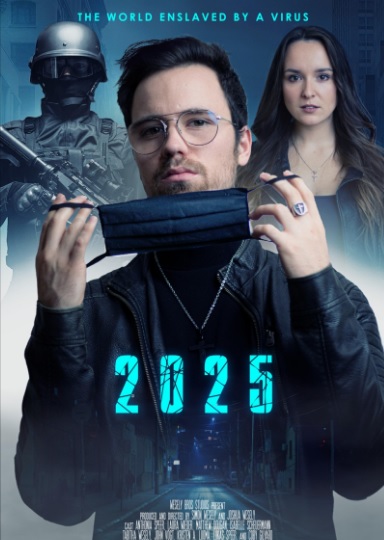
October Positivity: 2025 — The World Enslaved By A Virus (dir by Joshua Wesley and Simon Wesley)


The 2021 film, 2025 — The World Enslaved By A Virus, opens with a series of title cards.

We learn that the Coronavirus has raged out of control.

We learn that fear of the virus led to the creation of a one world government.

We learn that “communism is everywhere.”

We also learn that English is now the official language of the world.  (Yay!  Take that, French!)

Finally, we learn that Christianity has been outlawed.

It’s a scary world, one in which everyone is enslaved by the fear of the virus.  It’s a world where free thought is no longer allowed.  It’s a world where everyone is expected to pledge allegiance to the “new Constitution.”  It’s a world where former friends rat each other out to the authorities and privacy is a thing of the past.

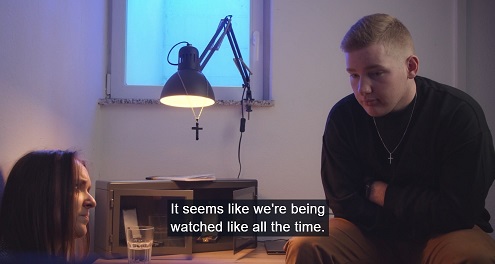
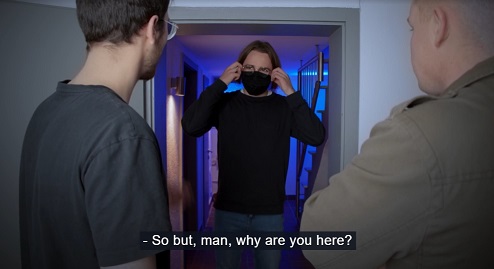
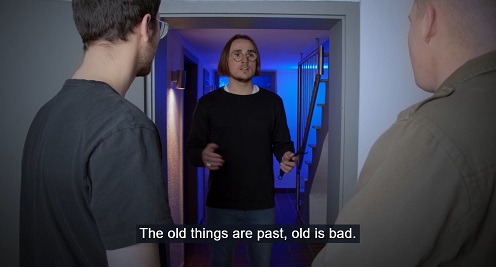
As you can probably guess from screenshot above, 2025 is not a particularly expensive-looking film.  This is the end of the world on a budget and one gets the feeling that the majority of that budget went to filming a fairly decent shoot out and car chase that occurs towards the end of the film.  As a result, this is one of those films where our characters spend a lot of time sitting in their apartment and talking about what’s going on in the world and how they feel about it.  We hear about what happens but we rarely get to see it.  Watching the film, one gets the feeling that many of the conversations were improvised, which means that there’s a lot of awkward pauses and meandering sentences.  On the one hand, that doesn’t make for a particularly compelling narrative.  On the other hand, it does capture the feelings of isolation and ennui that haunted many people during the Coronavirus lockdowns.

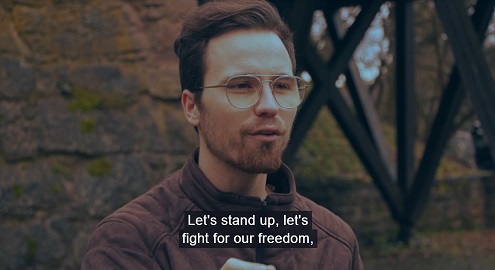
The film follows a group of Christians as they try to fight back against the one world government.  It starts with them spray painting Jesus fish onto walls and sidewalks.  (One of the sidewalks that they use as a canvas is covered by leaves so you can’t help but feel that one strong gust wind is going to totally destroy all of their work.)  Eventually, a hacker shows up at their apartment and helps them get their message out.  Christians start to meet in secret and our main character (played by one of the film’s two directors, Joshua Wesley) gives a variation of Mel Gibson’s Braveheart speech.

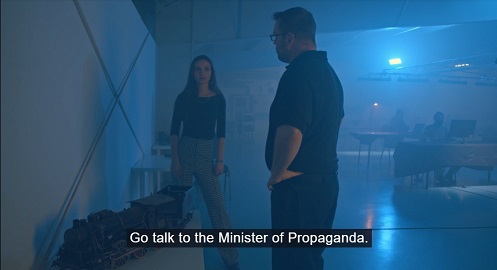
While the Christians are doing that, the government is plotting how to get more people to swear allegiance to the “New Constitution.”  Again, since this is the end of the world on a budget, the government is represented by one small office and a handful men wearing tactical vests.  They’re not extremely intimidating but, just as with the film’s sense of isolation, their incompetence tends to mirror the incompetence of the actual authorities during the lockdowns.

Eventually, even the Christians’s wussy neighbor is showing up at their door and telling them that they need to stop what they’re doing before they make everyone’s life difficult.  They need to accept the new world order.

2025 is indeed a bad movie.  The pace is slow.  The acting is terrible.  The dialogue is risible.  The film has been developing a reputation for being one of the worst ever made and there’s certainly a case to be made.  That said, much like Plan 9 From Outer Space, 2025 has worth as a historical document.  Setting aside the religious aspect of 2025,the film does definitely capture the paranoia that people were feeling during the lockdowns.  Some people were paranoid about the virus and other were paranoid about the government but the important thing is that, in the end, everyone was paranoid.  With all the gaslighting that’s going on from people who desperately want us to believe that the lockdowns actually weren’t as big or traumatic a thing as we all know they were, a film like 2025 serves as a useful historical document.  It’s a recording of the way many people felt about the world just two years ago.

Of course, that doesn’t actually make it a good film.  You can’t have everything.

Horror Film Review: Magic (dir by Richard Attenborough)


There have been many disturbing ventriloquist’s dummies over the years but I don’t know if there’s ever been one who is quite as hateful as Fats, the dummy that is used by Corky Withers (Anthony Hopkins).

Corky and Fats are at the center of the 1978 film, Magic.  When we first meet Corky, he’s an aspiring magician without a dummy.  He’s a talented magician and it’s obvious that performing is one of the only things that brings Corky happiness.  But, from the start, there’s something off about Corky.  There’s a desperation to him and his performance.  He craves the applause of the audience just a bit too much, as if he doesn’t know who he is unless people are clapping for him.  (This performance, from a youngish Anthony Hopkins, is quite a contrast to the characters that Hopkins is today known for playing.)  Corky is told that he needs to get a “gimmick” if he’s ever going to be a success and that gimmick turns out to be Fats, a ventriloquist dummy who is as confident as Corky is insecure.  Whereas Corky often seems to be struggling to find the right thing to say, Fats always has the perfect comeback ready.

Of course, Fats is Corky.  Fats is the self-absorbed and cocky “person” that Corky wishes he could be.  When Fats tells Corky that he’s a useless loser, it’s actually Corky saying that to himself.  When Corky argues with Fats, he’s arguing with himself.  With Fats, Corky has found a way to express himself but he’s also sacrificed half of his identity as a result.  Can Corky survive without Fats?  He’s not sure but he does know that Fats is a hit with audiences.

When Corky’s agent (Burgess Meredith) announces that he has gotten Corky a network television special, Corky panics.  Corky doesn’t want to take the medical or mental exams that the network would probably require before giving him a contract.  He flees to the Catskills, where he grew up.  (Corky’s obsession with performing makes sense when one realizes that he grew up in the Catskills, a region that played home to many aspiring comedians.)

Corky visits Peggy Ann Snow (Ann-Margaret), with whom Corky went to high school and who he had a huge crush on.  (Imagining Anthony Hopkins in high school — especially an American high school — is not particularly easy.)  Peggy is unhappily married to Duke (Ed Lauter) and she soon finds herself falling in love with Corky.  Corky appears to finally have a chance for happiness but Fats has other plans.  Murder follows and it says something about how well this film is done that we think of Fats as being the mastermind behind the murders even though we know that Fats is really just Corky talking to himself.

Magic is the definitive evil ventriloquist’s dummy film, one that is beautifully shot by Richard Attenborough and which features a great performance from Anthony Hopkins.  It’s a sign of the strength of his performance that we still feel sorry for Corky, even though he ends up killing one of the most likable characters in the film.  Of course, it’s a dual performance for Hopkins because he’s playing both Corky and Fats.  He is excellent and frightening in both roles.

Horror Film Review: Look Away (dir by Assaf Bernstein)


Poor Maria (India Eisley)!

Maria is a 17 year-old high school student in Canada.  She goes to a school where everyone wears a uniform, everyone plays hockey, and everyone is looking forward to a prom that is going to be held on an ice skating rink!  (Personal injury attorneys love this school!)  Everyone is obsessed with living on the ice but Maria can’t even skate.  Popular hockey player Mark (John C. MacDonald) taunts Maria for not being able to maintain her balance.  Her best friend, Lily (Penelope Mitchell) offers to teach Maria how to skate but Lily turns out to be a cruel and taunting teacher, probably because she knows that Maria has a crush on her boyfriend, Sean (Harrison Gilbertson).

Maria’s life at home isn’t any better.  Her mother, Amy (Mira Sorvino), is suffering from crippling depression and often can’t even be bothered to get out of bed or off the couch.  Her father, Dan (Jason Isaacs), is a plastic surgeon who is obsessed with the idea that he can fix any flaw through surgery.  He’s the type who cruelly critiques his daughter’s looks, despite the fact that Maria is actually a very pretty girl whenever she can find the courage to actually look up from the floor.  Dan is also cheating on his wife.  Perhaps the only good thing that Dan does is that he encourages Maria to stay home from school, though his reasoning is that she doesn’t look good on that particular day and she needs to get her “beauty sleep.”

Seriously, watching this movie, your heart truly breaks for Maria.  It’s as if the whole world has been against her since the day she was born.  Everyone gives Maria a hard time for not having more confidence but how can someone be confident when all they hear is about how much of a disappointment they are?  Maria’s only friend is her reflection in the mirror.

At first, Maria freaks out when her reflection starts talking back to her.  Airam, as Maria’s reflection calls herself, may look like Maria but she initially seems to have a totally different personality.  Airam is confident in both her appearance and her sexuality.  Airam is willing to strike back at the people that have hurt her.  Airam is confident where Maria is insecure.  When Maria talks to Airam, she ends up laughing so loudly that Amy actually comes into the bathroom and asks if Maria is smoking weed.  After Maria is cruelly humiliated at prom, Maria agrees to switch places with Airam by kissing the mirror.  Suddenly, Maria is the one in the mirror and Airam is the one who is in the real world, looking for revenge against everyone who has hurt Maria.

Or is she?  Watching the film, I found myself wondering if Maria was just imagining talking to her reflection and perhaps “the switch” was all in Maria’s mind.  Perhaps Airam isn’t some malevolent force that’s brought into the world as much as she’s just Maria having been pushed too far by the cruel taunts of her classmates and her father’s refusal to show her the consideration that he shows to his mistress.  Airam is soon doing everything that Maria wishes she could do but when people start dying, Maria begs Airam to stop.  Is Maria really trapped in the mirror and begging Airam to stop or is she just imagining a conversation with her own conscience?  India Eisley’s performance keeps you guessing.

This is an intriguing film, even if is sometimes a bit too ambiguous for its own good.  (The final shot is artfully done but it still made me want to throw something at the TV.)  The film’s greatest asset is India Eisley, who is convincing whether she’s the mousy Maria or the bold Airam.  Jason Isaacs, as well, gives a strong performance, turning his plastic surgeon into one of the all-time bad fathers.  Watching Isaacs’s performance as Dan, it’s hard not to understand why Dan’s daughter would want to hide in a mirror.

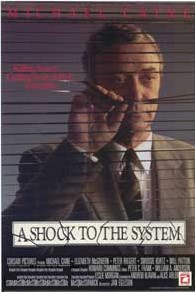
A Shock To The System (1990, directed by Jan Egleson)


Graham Marshall (Michael Caine) has spent years toiling away as an executive at an advertising firm and being nagged by his wife (Swoosie Kurtz), who claims that Graham doesn’t have enough of a killer instinct to get ahead.  When Graham is passed over for a promotion that he felt was promised to him, Graham starts to reconsider everything that he once believed.  While Graham is waiting for the train to take him home, he is approached by an obnoxious panhandler who always asks him for money.  That night, instead of ignoring the panhandler, Graham shoves him in front of the train.  When no one notices that Graham has murdered the panhandler, Graham decides to get revenge on everyone who he blames for the sorry state of his life.

With each murder, Graham rises higher in the company and he feels better about his life.  But each murder brings to Graham a new set of complications that he has to clean up.  Lt. Laker (Will Patton) thinks that Graham is responsible for all of the deaths that have recently occurred but he doesn’t have the evidence to charge him.  His murder spree brings him a chance of romantic redemption with Stella (Elizabeth McGovern) but soon, even she suspects that Graham might actually be a killer.  Luckily for him, Graham learns that he can get away with his crimes because the system is set up to protect men like him.

A Shock To The System is a pitch-black comedy that benefits from the casting of Michael Caine in the lead role.  Caine is one of the few actors who can make a resentful and bitter sociopath likable and he does that in A Shock To The System.  Graham starts out beaten down by the world and being passed over for younger executives like Bob Benham (Peter Reigert) but, by the end of the film, he’s become as ruthless a killer as Jack Carter.  Just as in Get Carter, A Shock To The System features Michael Caine making evil very compelling.