Film Review: Hitler — Beast of Berlin (dir by Sam Newfield)


1939’s Hitler — Beast of Berlin opens with a shot of Nazi stormtroopers marching down a Berlin street.  As they pass, every civilian stands and gives them the stiff-armed Nazi salute.  A couple sitting in a park does it.  A woman pushing a baby carriage does it.  A group of children do it.

Despite outward appearances, not everyone in Berlin is a supporter of Hitler or the Nazis.  Hans Memling (Roland Drew) is an intellectual and a veteran of World War I.  He knows that Germany’s economic policies are, in fact, making the country weaker.  He knows that Hitler is determined to provoke a war that Germany cannot win.  Prophetically, Hans speaks of the risk of German citizens being forced to fight in a war that is only being fought on behalf of Hitler’s ego.  He warns that Berlin and Germany will be destroyed if Hitler is not stopped.

Along with a group of other dissidents, Hans prints an underground newspaper, one that presents the truth about what is happening in Germany.  Working with him, among others, is his brother-in-law, Karl (Alan Ladd, in an early role) and a priest named Father Pommer (Frederick Giermann).  Their contact in the Gestapo is Alfred Stahlhelm (played by Hans Heinrich von Twardowski, a German actor who escaped Germany when Hitler came to power).  Stahlhelm is an alcoholic who fears that he will accidentally slip up when he’s drunk.  As he explains it, a member of the Gestapo is expected to drink and visit brothels when he is off-duty.  If he doesn’t, he will be immediately suspected of insubordination.

When the Gestapo does come for Hans’s operation, Hans finds himself separated from his wife (Steffi Duna) and imprisoned.  The only thing that keeps Hans alive is that the camp commandant is an old friend from World War I.  Hans can only watch as his allies are either executed or forced, after torture, to declare their loyalty to Hitler.  When Hans is finally given an opportunity to escape, he must decide whether to flee to Switzerland or to remain in Germany and continue to fight the Nazi regime.

The most interesting thing about this film is that it was made in 1939 and released into theaters a month after Germany invaded Poland.  The film was released at a time when America was still officially neutral and when isolationism was still a popular policy.  It was released at a time when many Americans were still dealing with the trauma of World War I and, as such, felt that Europe should be left alone to deal with its conflicts on its own.  As such, the film struggled with both the enforcers of the Motion Picture Production Code but also with local censors who felt that the film might offend the German communities within their towns.  James G. Stahlman, editor of the Nashville Banner, was moved to write an editorial calling for the film to be banned because it might inspire audiences to want to go to war with Germany.  Despite all that, Hitler — Beast of Berlin did well at the box office, though many theater owners chose to advertise it as being titled either Beast of Berlin or The Goose Steppers.

Seen today, parts of the film seem naive.  Despite the film being fervently and unapologetically anti-Nazi, it is still obviously a film made at a time when the full depravity of the Nazi regime had not yet been revealed.  The scenes in the concentration camp feel as if they could have been lifted from any 1930s prison film and they certainly come nowhere close to depicting what we now know was actually happening.  Indeed, the film barely acknowledges the anti-Semitism that lay at the heart of Nazi ideology.  But the film does do a good job of portraying life in a society where no one can be trusted and where simply saying the wrong word can lead to prison, torture, and even worse.  The film captures the fear and paranoia of living under a dictatorship and certainly, it deserves credit for calling out the Nazis and their leaders by name.  At a time when many people were living in denial about what was happening in Europe, this film took a clear and firm stand.  In 1939, the film may have been called “propaganda” but today, it feels like prophecy.  Everything that Hans predicts in this film would come to pass in reality.  The film was a warning that was heeded too late.

Bonanza Town (1951, directed by Fred F. Sears)


The frontier community of Bonanza Town has been taken over by the corrupt businessman, Krag Boseman (Myron Healey).  No one can stand up to Krag because the local judge (Luther Crockett) is under Boseman’s control.  The judge’s son (Ted Jordan) writes to the Durango Kid and asks him to come to Bonanza Town and lead a group of vigilantes to overthrow Boseman.

The Durango Kid, whose real name is Steve Ramsay (Charles Starrett) somehow receives the letter and heads into town.  As Steve, he gets a job working for Boseman and looks for evidence that Boseman is actually being bankrolled by a notorious outlaw named Henry Hardison (played by the film’s director, Fred Sears).  As the masked Durango Kid, he defuses the vigilante’s violent plan and, with the help of Smiley Burnette, he investigates what Boseman has on the judge.

Charles Starrett played the Durango Kid in 131 films.  In fact, he appeared in so many movies that the majority of Bonanza Town is made up of flashbacks from 1947’s West of Dodge City.  Despite all of the flashbacks, Bonanza Town is one of Starrett’s better films, featuring an interesting story and good performances from both Fred Sears and Luther Crockett.  Sears shows some imagination with his staging of the many gunfights and, as always, Starrett is convincing riding a horse and carrying a gun.

Bonanza Town is a fairly serious film and Smiley Burnette’s trademark comedic relief feels out of place but the kids in 1951 probably enjoyed it.  While everyone else is shooting guns and committing murder, Smiley is running his barber shop and turning a potato into a musical instrument.  While the Durango Kid dispenses frontier justice, Smiley sings a song and leaves his customers bald.  They were a good team.

Film Review: Conspiracy (dir by Frank Pierson)


The 2001 film, Conspiracy, takes place at a villa on the outskirts of Berlin.  It’s a lovely villa and, as we can see during the film’s opening moments, it’s about to play host to a meeting of very important people.

The date is January 20th and the year is 1942.  Having conquered much of Europe, Nazi Germany is now at war with the Allies.  Reinhard Heydrich (Kenneth Branagh), the young chief of the Reich Security Main Office and the man who many feel will eventually succeed Adolf Hitler as the leader of the Third Reich, has been directed to call a conference so that he and his deputy, Adolf Eichmann (Stanley Tucci), can “discuss” ways to solve “the Jewish question.”  One-by-one, representatives of the Reich’s bureaucracy show up at the villa.

At the start of the meeting, the men discuss various ways to force the Jews out of Germany and all of the occupied territories.  The men chose their words carefully, speaking in euphemisms and doing their best to sound like concerned government officials.  The men know what they’re talking about but they still seem to feel the need to avoid coming right and saying it.  As they talk, it becomes clear that everyone is trying to stay in Heydrich’s good graces while, at the same time, avoiding the fact that they understand the truth about what Germany is doing.  It’s not until halfway through the meeting that Heydrich and Eichmann reveal that Germany’s policy has already been determined and that concentration camps with gas chambers have already been designed and built.  The meeting is less about discussing the policy and more about getting each man at the meeting to sign off on it.  The unspoken subtext is that each man is being tested to determine who will support (and, if need be, help to cover up) the Final Solution and who will have to be otherwise dealt with.

Based on the actual minutes of the meeting, Conspiracy is film that is perhaps even more important now than when it was first released.  It’s a film that explores not only the banality of evil but also seeks to answer the question of why no one in Hitler’s government forcefully objected to the Final Solution.  (Many, of course, claimed not to know what was going on.  This film reveals just how little credibility that claim had.)  Some of the men go along because they understand not going along would mean the end of their careers and maybe their lives.  Some of the men agree because, as members of the military, they believe in supporting their country’s leadership, regardless of what that leadership represents.  Some of the men agree because they want to stay in Heydrich’s good graces.  These men represent a society where anti-Semitism is so normalized that it is accepted as a given and, while some of the men are not as outspoken in their prejudice as the others, it’s clear that all of them view the Jewish people as being a unique problem.  Those who do raise concerns do so only out of worry of what will happen to them if the rest of the world discovers what Germany is planning.  Heydrich insists that there is no need to worry because Germany will win the war.  Some of the men at the Conference are clearly not convinced of Germany’s pre-destined victory but not a single one has either the morality or the courage to refuse to endorse the Final Solution.  The film ends with a series of title cards, letting us know what became of the men who attended the Wannsee Conference.  Heydrich was assassinated during the war.  Eichmann fled to South America and hid there until he was captured by Israel in 1960.  Many of the men were executed for war crimes but a surprising number of them were either acquitted or never put on trial and went to live peacefully after the war.

Well-directed by Frank Pierson, Conspiracy has a distinguished cast who brings the historical characters to terrible life.  It’s one thing to read about what was said and planned at the Conference.  It’s another thing to actually hear those words spoken aloud and it’s a reminder that the evil of the Holocaust was not an accident nor was it something that took its perpetrators by surprise.  It was something that meticulously planned by human beings who were fully aware of what they were doing.  Kenneth Branagh makes for an arrogant and intimidating Heydrich while Stanley Tucci plays Eichmann as being the type of bureaucratic robot who is incapable of seeing human beings as anything more than just dwindling numbers on a report.  Colin Firth and David Threlfall make strong impressions as two of the more weary members of the Conference, as does Ian McNeice in the role of the type of crude, career-driven government functionary who has survived by pretending to be dumb.

At a time when anti-Semitism is on the upswing and Holocaust denialism is being mainstreamed, Conspiracy is an important film.  When others say that the Holocaust didn’t happen or that it doesn’t matter, Conspiracy defiantly says, “Yes, it did and yes, it does.”

Deputy Marshal (1948, directed by William Berke)


Deputy Marshal Ed Garry (Jon Hall) is pursuing two bank robbers in Wyoming when he comes across a wounded man.  Harley Masters (Wheaton Chambers) has been shot in the gut but his main concern is holding onto his hat.  Ed takes Harley into town.  They go into the local saloon, where Harley reveals a map hidden in his hat.  He slips the map to Ed before an unseen gunman shoots him a second time.  This time, Harley does not survive.

With the current sheriff “laid up,” Ed decides to stay in town and not only catch the bank robbers but also solve Harley’s murder.  Ed soon finds himself in the middle of a conflict between two rival women (Frances Langford and Julie Bishop) who own ranches and stand to make a lot of money when the railroad comes through.

Deputy Marshal is one of the B-westerns that was produced by Robert Lippert and directed by William Berke in the 40s and 50s.  This one is a step above the usual Lippert production because it combines a murder mystery with the standard western action and there are enough suspects to keep the story interesting.  Jon Hall was best-known for appearing in exotic adventure films, often playing islanders.  His career was in decline when he starred in Deputy Marshal but he makes for a surprisingly believable western hero.  It helps that Hall was older than the typical B-western hero.  His weathered looks make him convincing as an experienced lawman who understood the ways of the west.

Frances Langford, who plays the nicer of the two ranchers, was married to Jon Hall when she appeared in this film.  She gets to sing two songs because this is a Lippert production and Robert Lippert believed that every western should open with a horse chase and should feature at least one song.

While it obviously never won any awards for originality, Deputy Marshal is a better-than-average B-western with an interesting mystery story and a convincing hero.

Concert Film Review: ABBA: The Movie (dir by Lasse Hallstrom)


The 1977 film, Abba: The Movie, is really two movies in one.

One of the movies, and the one that will probably most appeal to fans of the group, is a cinema verité-style look at ABBA touring Australia.  This part of the movie not only features the band playing their best-known songs in concert but it also features some behind-the-scenes footage of the members of ABBA trying to enjoy their time Australia.  They struggle to adjust to Australian culture and the English language.  Agnetha Fältskog complains about the way the tabloids focus on her body as opposed to her singing.  The emphasis is on the members of ABBA being down-to-Earth and friendly professionals who love making music but who, even more importantly, love hanging out together and making their fans happy.

The second movie is about an Australian DJ named Ashley Wallace (Robert Hughes) who is ordered to get an interview with ABBA before they leave the continent.  It won’t prove easy.  For one thing, Ashley really isn’t sure who ABBA is, beyond knowing that they’re a famous pop band.  (Ashley’s musical tastes seem to learn towards country and western.)  Secondly, ABBA is always surrounded by a mob of fans and bodyguards and it’s very difficult to get close enough to even ask them for an interview.  Third, ABBA distrusts reporters, especially after the tabloids print a bunch of salacious articles about Agnetha.  Fourth, Ashley is an idiot.

Seriously, Ashley is his own worst enemy.  If ABBA heads to the west, you can be sure that Ashley will catch the next train heading east.  Even when Ashley does finally manage to talk to ABBA’s manager and schedule an interview, he ends up oversleeping and missing his appointment!  Seriously, just think about this.  Ashley has been told that his entire future depends on getting an interview with ABBA, a task that soon proves to be nearly impossible.  Then, when Ashley finally manages to get a chance to conduct this all-important interview, it doesn’t occur to him to set his alarm to wake him up early.  There’s a word for that type of behavior and that word is “stupidity.”

As he struggles to get some time with ABBA, Ashley also takes time to interview people on the street about the opinion of ABBA.  Surprise!  Almost everyone loves ABBA!  I guess that’s to be expected, considering that the movie is named after them.  It would probably be counter-productive to have Ashley interview a bunch of people who can’t stand ABBA and would rather be listening to Led Zeppelin.  (There are a few people who tell Ashley that they don’t like ABBA but they’re all losers.)  Ashley spends so much time talking to people who love ABBA that he soon comes to love ABBA and appreciate their music as well.  He even has a series of fantasy and daydreams.  He imagines that the two men in ABBA are his best friends.  He dreams of being loved by the two women in ABBA.  Through Ashley, the audience is provided a view of how one goes from being indifferent to being a fan.

But most viewers won’t care about Ashley.  They’ll be watching for ABBA.  The performances are strong.  The members of the band seem to truly enjoy being on stage and interacting with their fans.  Interestingly, the members of ABBA are likable but a bit bland off-stage.  They’re people who truly come alive when they’re performing but who are much more subdued and down-to-Earth offstage.  Indeed, it almost seems as if Ashley is wasting his time trying to get an interview.  In this film, to watch ABBA perform on stage is to know all that you need to know.

Retro Television Review: In Broad Daylight (dir by Robert Day)


Welcome to Retro Television Reviews, a feature where we review some of our favorite and least favorite shows of the past!  On Sundays, I will be reviewing the made-for-television movies that used to be a primetime mainstay.  Today’s film is 1971’s In Broad Daylight!  It  can be viewed on YouTube.

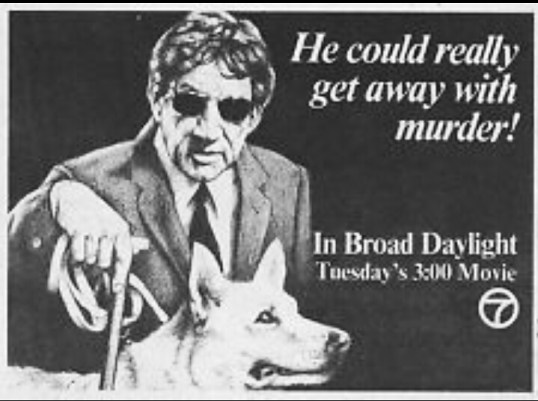
Tony Chappel (Richard Boone) is an actor who has just recently lost his sight as a result of an accident.  Released from the hospital, Tony struggles to adjust to living in a world without his vision.  When one cab driver says to him, “Didn’t you used to be Tony Chappel?,” he flinches as he realizes that his career as a famous actor is now considered to be over.  One day, he comes home early and overhears his wife (Stella Stevens) fooling around with his lawyer and “best friend” (Fred Beir).  Tony promptly decides to murder his wife and frame his friend for the crime.

Tony decides to use his acting skills to his advantage.  He memorizes the the area around him so that he can make his way through it by memory.  He puts on a fake beard, speaks with Greek accent, and makes a point of carrying a camera with him.  He starts taking public transportation and going out of his way to be talkative and social  Everyone that he meets, he tells them about how he’s been taking pictures of the city and how he can’t wait to see how they come out.  When his wife is eventually murdered, the police receive a reports of a mysterious Greek man, one who was definitely not blind, in the area.  However, Lt. Bergman (John Marley) has his doubts and comes to suspect that Tony is the killer.

In Broad Daylight was made from an early script written by Larry Cohen, who would later go on to direct films like God Told Me To.  It’s a clever script, one that sets up an intriguing premise and which ends on a properly twisty and satisfactory note.  The film works because it is as much of a character study as a thriller.  Tony’s wife not only cheats on him but also betrays him at the moment when he needs her and his friends the most.  Tony has gone from being a movie star to being a man who can barely walk from one room to another.  He’s already angry.  Discovering that his wife is laughing at him behind his back is the last straw.

Larry Cohen reportedly felt that Richard Boone was miscast as Tony.  I felt that Boone did a pretty good job, even if he did overact a bit while Tony was trying to convince everyone that he was a Greek tourist.  Stella Stevens is perfectly cast as his wife and Suzanne Pleshette is sympathetic as his nurse.  Godfather fans will be happy to see John Marley not having to deal with a horse’s head but instead playing the clever detective who attempts to solve the murder.

In Broad Daylight is a clever and entertaining thriller and character study.

Retro Television Review: The Death Of Me Yet (dir by John Llewellyn Moxey)


Welcome to Retro Television Reviews, a feature where we review some of our favorite and least favorite shows of the past!  On Sundays, I will be reviewing the made-for-television movies that used to be a primetime mainstay.  Today’s film is 1971’s The Death Of Me Yet!  It  can be viewed on YouTube.

Welcome to Middletown!

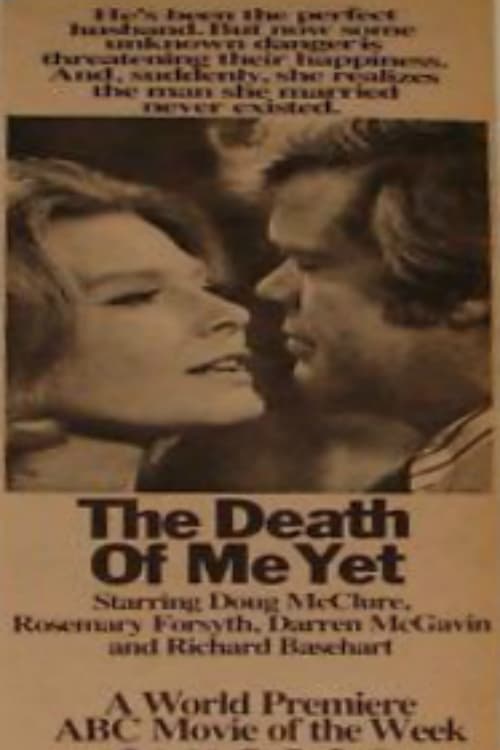
Middletown is a nice, comfy, and friendly little town.  As you might guess from the name, it seems just like the type of town that you would expect to find in the middle of the country.  Edward Young (Doug McClure) is a friendly and popular citizen of the town.  Everyone loves to see Edward walking around Middletown with his girlfriend, Alice (Meg Foster, of the otherworldly eyes).  But one day, Edward comes home to find a message waiting for him.  He has been “activated” and it’s time for him to leave Middletown and head to …. THE UNITED STATES!

You see, Middletown is in the middle of a country.  It’s in the middle of Russia, to be exact.  It’s a KGB training center, where sleeper agents learn how to pass for Americans.

Edward heads to America, where he takes on the name of Paul Towers.  Over the years, Paul settles in a town that looks a lot like Middletown.  Paul becomes a newspaper publisher and he comes to love America.  He also marries Sibby (Rosemary Forsyth), the sister of defense contract Hank Keller (Dana Elcar).  When one of Hank’s executives dies under mysterious circumstances, Hank offers to bring Paul into the business.

Paul is reluctant, both because he doesn’t know if he could pass the background check that the FBI is going to run on him and also because he suspects that someone is trying to kill him!  When he sees Alice and his former KGB handler (Richard Basehart) in town, Paul realizes that he’s going to have to pick a side and face the consequences of all of his actions.

The Death of Me Yet is an enjoyably twisty thriller, one that embraces the melodrama while having some fun with the idea of a bunch of sleeper agents doing business in a generic American town.  Doug McClure’s natural earnestness makes him an odd choice for the role of a lifelong spy but the casting works in that it explains why no one has ever suspected Paul in the past.  As always, Darren McGavin is a welcome presence as the FBI agent who assures Paul that he will be doing a thorough background check.  Richard Basehart makes for a good villain and Meg Foster’s enigmatic screen presence keeps the viewer guessing as to what her ultimate goal may be.

The film ends with the hint of continued adventures for Paul.  It wouldn’t surprise me if this movie was made with an eye on turning it into a weekly series.  As far as I know, that series never happened, though The Americans would later feature many of the same themes and ideas found in The Death of Me YetThe Death of Me Yet holds up as an entertaining espionage thriller.

Marked Man (1997, directed by Marc F. Voizard)


How much keeffe is in this film?

Miles O’Keeffe!  But that’s still not enough.

Not even the presence of Roddy Piper is enough to make Marked Man work.  Piper plays an auto mechanic who kills the drunk driver who ran over his girlfriend.  Piper is sent to prison where he learns how to kickbox because why wouldn’t the authorities teach a prisoner foot-to-foot combat?  After ten years as a model prisoner, he is forced to run for his life after he witnesses a murder committed by two corrupt guards.  Piper jumps over the fence and, after finding a clue while breaking into one of the guard’s house, heads to Albany.  Miles O’Keeffe is the mercenary who is hired by the bad guys to track Piper down.  Piper not only has O’Keeffe after him but also every cop in the northeast.

When a movie has got both Roddy Piper and Miles O’Keeffe in the cast, there’s no excuse for it to be as boring as Marked Man.  Roddy Piper gets to kickbox and show off his wrestling moves but he spends most of the movie hiding in the back of pickup trucks and running away from prison guards.  For some reason, instead of just heading for the border and freedom, Piper sticks around America and tries to prove that the dead prisoner was killed by corrupt guards.  The final confrontation between Piper and O’Keeffe is as anti-climatic as everything else in the movie.  Maybe it would have been more effective if there had been a shared history between Piper’s prisoner and O’Keeffe’s bounty hunter but instead, they confront each other as strangers and their final confrontation feels impersonal.

Considering the cast and the story’s B-movie potential, Marked Man is a definite missed opportunity.

Spring Break On The Lens: The Squad (dir by Rick Walker)


Years ago, three girls were rescued from their abusive foster parents.  Under the direction of the enigmatic Alpha (Jennifer Ferguson), Gina (Meghan Carrasquillo), Dani (Grace Evans), and Bella (Alea Hansinger) have made a lot of money and they only have to work one week out of the year.  That week is Spring Break, when they hit the beach and sell drugs to all the visiting college students.

Unfortunately, a bigtime gangster known as Frosty the Snowman (Shawnee Brittan) does not want Alpha and the Squad moving in on his business.  So, along with targeting Alpha for assassination, he also sends his people down to the beach to take out the members of the Squad.  It all leads to a lot of violence, death, and bikini shots.  Everyone has their own agenda and no one can be trusted, perhaps not even Alpha.  Can the Squad survive or will they end up being dunked in acid?

Just from reading the plot description, you might think that this was a subversive, satirical film in the style of Harmony Korine’s Spring Breakers and certainly, there are moments of deliberate humor.  The three Squad members spend a lot of time talking between jobs and making fun of the faux tough guys that they have to deal with.  There’s a slightly funny bit where one of the girls will make a snarky comment and someone else will reply by accusing them of being a very particular type of bully.  “You’re a spray tan bully,” made me laugh more than it probably should have.  (That’s probably because, as a redhead, I can’t tan to save my life.)

That said, The Squad takes itself way too seriously at certain points.  There’s all sorts of twists and turns and scenes of criminals talking about all of the unpleasant tortures that they intend to inflict until they hear what they want to hear.  This is one of those films where all the camera movements are jittery and most of the scense are so underlit that you end up straining eyes just trying to figure out who is talking to who.  For a 78-minute film, there’s a lot going on in The Squad and the plot is almost impossible to follow.  The film makes the mistake of assuming that we’ll automatically care so much about The Squad that we won’t care that their actions rarely make sense.  But since we really don’t get to know either The Squad or Alpha, it’s difficult to get emotionally involved in their attempts to corner the drug market.

For the most part, the acting is poor.  The actresses playing the members of the Squad are naturalistic and likable when they’re just lying around and gently giving each other a hard time but the minute they have to start shooting or talking tough, everyone starts trying too hard to act as if they’re in an early Tarantino film and the whole thing just feels awkward.  As Frosty, Shawnee Brittan is convincingly evil and some of the actors playing his toothless henchmen are properly creepy.  Otherwise, one would be better served by rewatching Spring Breakers.

The Unnominated: The Long Riders (Dir by Walter Hill)


Though the Academy of Motion Picture Arts and Sciences claim that the Oscars honor the best of the year, we all know that there are always worthy films and performances that end up getting overlooked.  Sometimes, it’s because the competition too fierce.  Sometimes, it’s because the film itself was too controversial.  Often, it’s just a case of a film’s quality not being fully recognized until years after its initial released.  This series of reviews takes a look at the films and performances that should have been nominated but were, for whatever reason, overlooked.  These are the Unnominated.

First released in 1980, The Long Riders is one of the many films to tell the story of the James/Younger Gang.

A group of former Confederate guerillas who became some of the most notorious bank robbers to roam post-Civil War America and who were based in Missouri, the brothers who made up the James/Younger Gang were hunted by the Pinkertons and beloved by the citizens who viewed them as being 19th Century Robin Hoods.  Following a disastrous attempt to rob a bank in Northfield, Minnesota, the Younger brothers were captured by the government while Jesse and Frank James made it back to Missouri.  Jesse was shot in the back by Bob Ford while Frank subsequently surrendered to authorities and made a good living on the lecture circuit.

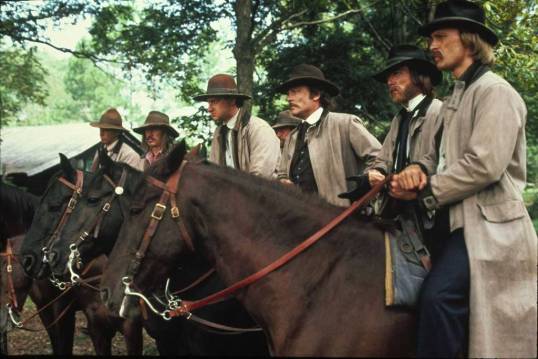
The Long Riders tells the story of the gang, from their first encounter with the heavy-handed Pinkertons to the Northfield raid to Frank’s eventual surrender.  Director Walter Hill both celebrates the legend of the James/Younger Gang while also emphasizing that all the members of the gang were also individual humans who had their strengths and their flaws.  Hill emphasizes the idea of the gang being a group of post-war rebels, still fighting a war against a government that is more interested in protecting banks than looking after people.  The Long Riders deconstructs the legend while also celebrating it.

The main thing that sets The Long Riders apart from other films about the James/Younger Gang is the fact that the brothers are played by actual brothers.  David, Keith, and Robert Carradine plays the Youngers.  Randy Quaid plays Clell Miller while Dennis Quaid assumes the role of the cowardly Ed Miller.  Nicholas and Christopher Guest make a memorably creepy impression as Charley and Bob Ford.  And finally, Jesse and Frank James are played by James and Stacy Keach.  (The Keaches also worked on the film’s script).  And while Stacy is definitely the more charismatic of the Keach brothers, the film makes good use of James’s rather stoic screen presence.  While the rest of the gang enjoys the outlaw life, James Keach’s Jesse is rigid, serious, and ultimately too stubborn and obsessive for his own good.

Now, the casting might sound like a gimmick but it works wonderfully.  When Clell chooses the gang over Ed, it carries an emotional weight because we’re watching real brothers reject each other.  The comradery between the Carradines carries over to the comradery between the Youngers and it also informs their occasional rivalry with the better known James brothers.  While it is Stacy Keach and David Carradine who ultimately dominate the film, every brother in the cast makes a strong impression.  Also giving a memorable performance is Pamela Reed as a defiantly independent Belle Starr, who loves David Carradine’s Cole Younger but marries Sam Starr (James Remar).  The knife fight between Carradine and Remar is one of the film’s highlights, as is the violent and disastrous attempt to rob the bank in Northfield.

The Long Riders is an exciting and ultimately poignant western but sadly, it received not a single Oscar nomination, not even for the stunning cinematography or Ry Cooder’s elegiac score.  Fortunately, just like the legend of the James/Younger Gang, The Long Riders lives on.

Previous entries in The Unnominated:

  1. Auto Focus 
  2. Star 80
  3. Monty Python and The Holy Grail
  4. Johnny Got His Gun
  5. Saint Jack
  6. Office Space
  7. Play Misty For Me