The TSL Horror Grindhouse: The Wizard of Gore (dir by Herschell Gordon Lewis)


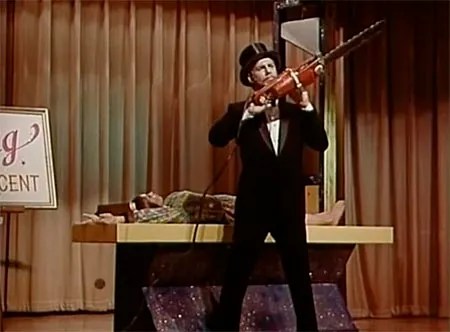
First released in 1970, Herschell Gordon’s Lewis’s The Wizard of Gore tells the story of Montag The Magnificent (Ray Sager), a magician who has a rather macabre stage show.

After lecturing his audience about how everyone secretly wants to see blood and violence, he selects a female volunteer from the audience.  Both the woman and the rest of the audience are hypnotized.  Montag’s tricks all involve mutilating his volunteers.  One volunteer is chainsawed.  Another gets a metal spike driven into her brain.  Another is drilled by a giant punch press.  (Like seriously, how does one store a giant punch press?)  The hypnotized audience only sees Montag using his various instruments of torture but they don’t see the wounds or the blood or the intestines.  (The movie audience is a bit less lucky.)  The victim is hypnotized into not realizing that she has essentially been murdered but, when the hypnosis wears off after the show, they promptly drop dead, mysteriously mutilated in the same way that everyone saw Montag miming on stage.

Naturally, the police arrest Montag and the movie ends.

No, actually, it doesn’t.  Even though it’s obvious that Montag is the murderer and that he’s hypnotizing people, the police don’t arrest him because his hypnotized audience swears that Montag didn’t really hurt anyone during his stage act.  However, television host Sherry (Judy Cler) and her lunkhead boyfriend, Jack (Wayne Ratay), both come to believe that Montag is the killer and they try set up a plot to expose him on national television,  Montag can’t hypnotize people through the television …. can he!?  And if he can do that, who is to say that he hasn’t hypnotized the people in the theater who would have been watching The Wizard of Gore when it was first released?

The Wizard of Gore appears to have been Herschell Gordon Lewis’s attempt to comment on his own status as a director who was notorious for making gory films.  (His 1963 film, Blood Feast, is often referred to as being the first gore film.)  Montag is a monster who appeals to his audience’s desire to see something extreme and forbidden.  For all of Montag’s evil, he can only exist and get more victims because people are willing to watch him torture strangers.  Lewis was not exactly known for being a particularly artful director but the shots of Montag’s victims screaming in terror while Montag’s audience silently and unemotionally watches are about as close to a genuinely powerful moment as you’re likely to find in a Herschell Gordon Lewis film.  The Wizard of Gore, with its commentary on the gore genre that Lewis himself largely invented, is one of Lewis’s more self-referential films.  And with it’s trick ending and shots of people suddenly collapsing with their intestines literally spilling out of them, it’s also one of Lewis’s stranger films and that’s saying something when you consider just how many odd films Lewis made over the course of the 60s and 70s.  (There’s a reason why one of his better films was called Something Weird.The Wizard of Gore is definitely a Lewis film, with his trademark stiff actors and non sequitur dialogue giving the whole thing a dream-like feel.

There’s a scene in Juno where Jason Bateman tells the film’s title character that Herschell Gordon Lewis is a superior filmmaker to Dario Argento and that The Wizard of Gore is scarier than Suspiria.  As soon as I heard that, I knew his character was going to turn out to be a sleaze and I was right.  The Wizard of Gore is a historically interesting film, especially for those who love the old grindhouse films.  But it’s no Suspiria.

Alarmed (2014, directed by Matt Lofgren)


Samantha stands trial, accused of killing her father, mother, and two of her sisters.  She is acquitted.  Five years later, she’s trapped on the family yacht, stranded at sea with the ship’s onboard computer ordering her to remove her limbs and slash her face.  Every morning, she wakes up and it’s as if nothing happened.  But during the evening, she goes through the entire ritual again.  Samantha feels that she is being punished for murdering her family, except that Samantha did not murder her family.  While being tortured on the boat, she thinks back and tries to figure out who the guilty party actually was.

It’s an interesting idea but a dumb movie.  You’re stuck on a boat, far from civilization and medical help.  The only other person on the boat is your husband, who can’t help you because the boat’s onboard computer has locked him out of control room.  Are you going to chop off your finger just because a computer tells you to?  Are you going to saw off your hand, just because the computer says so?  The boat is also haunted by ghosts and I wish the movie had just focused on them instead of bringing in the computer and the time loop element.

The movie just doesn’t work.  The plot is overstuffed and the acting is terrible.  Try not to laugh when you hear the dialogue between the judges and the lawyers in the courtroom scene.  The yacht is a good location but a few long shots make it obvious that the yacht is not as far away from civilization as Samantha and her husband seem to think.

All in all, a misfire.

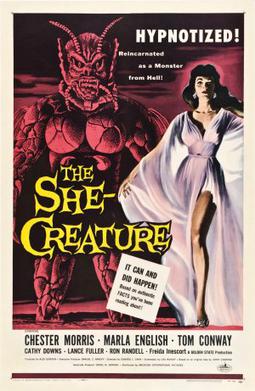
Horror Film Review: The She-Creature (dir by Edward L. Cahn)


In the 1956 film, The She-Creature, bodies are being discovered on the beach.  The murderer appears to be a bizarre, humanoid creature with gills and scaly skin.  It commits its dastardly crimes and then it disappears back into the ocean!  What could it be?  Is it a genuine monster?  Is it a psycho diver in a rubber suit?  Is it just some random murderer that hides in the shadows and stalks the night like a cat searching for mouse?

While bodies are showing up on the beach, Dr. Carlo Lombardi (Chester Morris), is trying to convince the world that his theories about reincarnation and the occult are correct.  Usually clad in a tuxedo and accompanied by his assistant, Andrea (Marla English), Dr. Lombardi swears that everyone has lived a past life and that, when under hypnosis, people are capable of reliving all of their past lives.  Dr. Lombardi theorizes that reincarnation has been going on since the beginning of time and, as a result, a hypnotized person could even relive their past life as a cave dweller or, presumably, a single-celled creature floating around in a lake.  Actually, under Lomradi’s theory, I guess it’s possible that someone could have been a dinosaur in a past life.

(It’s probably best not to give that too much thought because most people would probably be disappointed to discover that they weren’t one of the cool dinosaurs but instead, they were one of those goofy green lizards that was always running out of the way of the cool dinosaurs.  No matter how many times someone bangs a gong, not everyone can be a T-rex, sorry.  Everyone wants to be the dinosaur that eats but no one wants to be the one that got eaten.)

The scientific community scoffs at Dr. Lombardi but when he puts Andrea under hypnosis, it’s enough for Timothy Chappell (Tom Conway) to want to go into business with him.  The scientific community may scoff at Lombardi and his theories but Chappell sees him as the key to a fortune.  Who cares if his powers are real or not?  Well, Lombardi cares and he’s discovered that he can use hypnosis to cause Andrea to turn into a prehistoric monster who will kill his enemies!

(Actually, Dr. Lombardi is such a good hpynotist that he’s even able to convince a dog to kill his owner.  Then again, maybe he just offered the dog a treat for being a good boy.  Who knows how the canine mind works?)

An entertaining B-movie, The She-Creature benefits from the committed performance of veteran tough guy Chester Morris, the other-worldly beauty of Marla English (who was cast because it was correctly felt she resembled Elizabeth Taylor), and the noir-influence direction of Edward L. Cahn.  The plot makes no sense but it hold your interest and the monster is a genuinely impressive creation.

On a personal note, I’ve never bought into reincarnation but if I was anyone in a past life, I was probably either Edie Sedgwick or Alice Roosevelt.


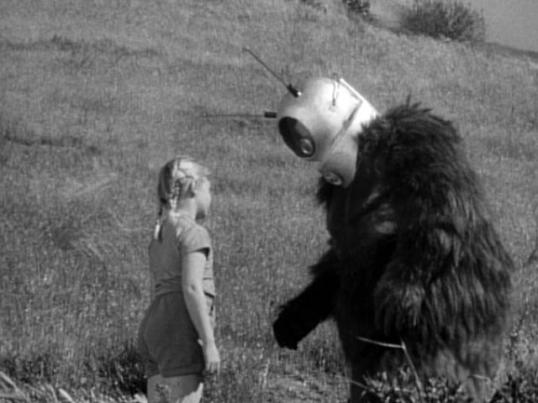
Horror on the Lens: Robot Monster (dir by Phil Tucker)


Today’s horror film is a true classic of its kind, the 1953 science fiction epic Robot Monster.

Now, I should admit that this is not the first time that I’ve shared Robot Monster in October.  I share it every year and, every year, YouTube seems to pull the video down in November.  That sucks because Robot Monster is one of those weird films that everyone should see.  So, I’m going to share it again.  And, hopefully, YouTube will let the video stay up for a while.

As for what Robot Monster is about…

What happens with the Earth is attacked by aliens?  Well, first off, dinosaurs come back to life.  All of humanity is killed, except for one annoying family.  Finally, the fearsome Ro-Man is sent down to the planet to make sure that it’s ready for colonization.  (Or something like that.  To be honest, Ro-Man’s exact goal remains a bit vague.)

Why is Ro-Man so fearsome?  Well, he lives in a cave for one thing.  He also owns a bubble machine.  And finally, perhaps most horrifically, he’s a gorilla wearing a diver’s helmet.  However, Ro-Man is not just a one-dimensional bad guy.  No, he actually gets to have a monologue about halfway through the film in which he considers the existential issues inherent in being a gorilla wearing a diver’s helmet.

Can humanity defeat Ro-Man?  Will Ro-Man ever get his intergalactic supervisor to appreciate him?  And finally, why are the dinosaurs there?

Despite the film’s reputation for being borderline incoherent, most of those above questions actually are answered if you pay attention to the first few scenes of Robot Monster.  In fact, one could even argue that Robot Monster is maybe a little bit more clever than it’s often given credit for.  Of course, it’s still a zero-budget mess of a film but it’s also undeniably fun and, in some sections, unexpectedly dark.  If you’ve never seen it before, you owe it to yourself to set aside an hour and two minutes in order to watch it.  You’ve never see anything like it before.

Finally, I should note that Robot Monster’s hero was played by George Nader, who actually did go on to appear in several mainstream films.  Despite his good looks and talent (which may not be obvious in this film but which he did have), George Nader struggled to get starring roles in Hollywood, where he was often dismissed as just being a member of Rock Hudson’s entourage.  (It’s been theorized that Nader struggled because the studios feared that giving him too big of a role would lead to the gossip magazines writing about Nader’s relationship with Hudson, though the two were just friends.  Nader was in a relationship with Hudson’s private secretary, Mark Miller, from 1947 until Nader’s death in 2001.)  Nader finally left Hollywood and went on to have a pretty successful career in Europe.  He was perhaps best known for playing secret agent Jerry Cotton in a series of films in the 60s.

Enjoy Robot Monster!

The Life of Death, Short-Film Review (Dir. Marcin Dubinec) – Repost, but perfect for Horrorthon


Death has been on my mind A LOT the past several months. I recently lost my Uncle and he was a lot closer to a Dad than what I was assigned. My uncle lived an authentic life and was OUT when it was not okay to be out, but in the words of the philosopher Bruce Springsteen- “Closets are for Hangers.” Sadly, he suffered a great deal, but he faced Death like a Man.

In this short, Death has a life- A really really really banal life. He acts out in school, gets drunk in college, marries, and gets run over by a car. Actually, how he died was the most interesting event that happened to Death.

I’m really trying to be nice here, but sometimes I just can’t. You might notice that I tagged Alex Magana; well, he makes terrible short films too and I feel like Alex should get a royalty when someone else spits out a crappy film. Apparently, Marcin won some awards for THIS??! So ugggghhh, I guess people like terrible things sometimes.

Where did the short go right? It had a beginning, middle, and an end. I can write that without a doubt that this was a film that was made. Also, this film had a script where words were written down. I can assume that real dollars were spent to make this…film, which is fine. I mean, well people can buy all sorts of things with cash. It should be noted that as a society we forbid people to spend money on certain things: murder/heroin; maybe, this could be considered to make that list…let’s not rule that out. He did murder my time and patience.

Where did it go wrong? It was boring. I really just did not care that Death had a boring life or that he had children. If anything, I thought it was tacky. I really didn’t find the writing really moving. I never cared about Death as a “Person”. I did Chuckle Out Loud COL once, but that’s it. You could say, Case, you’re down and grieving; of course, you’ll hate this, BUT I argue that this short-film is still crap and the filmmaker is not great and should do something else with his time. Decoupage? Extreme Couponing? Boxing? Whatever, just stop bothering us.

I once wrote that we could stop Alex Magana from making films – he can only be so strong and if we ganged up and brought a tall guy, we could taunt him by holding his camera up really high and make him futilely jump for it. There’s basically TWO Alex Magana’s now; so, we might have to bring more people into stopping them, but we can do this! Left, Right, Libertarian, or Vegetarian let’s stop them- TOGETHER!

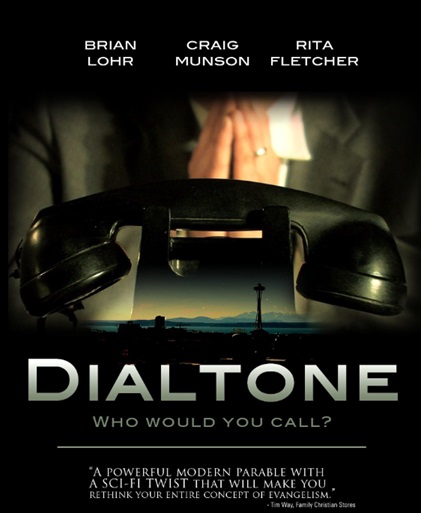
October Positivity: Dialtone (dir by Brian Lohr)


A short film from 2009, Dialtone tells the story of Greg Pleasant (played by the film’s director, Brian Lohr.)

Greg is an attorney and apparently, a pretty successful one.  He has a nice office in  a nice building in downtown Seattle and his partners all respect him and trust him with the big clients.  The big clients often ask Greg to do things that could be considered unethical and Greg says that he has no problem with it.  When the mayor demands to know if Greg’s Christian faith is going to get in the way of being a cutthroat, amoral attorney, Greg tells a joke about about how, when he was in England, he saw a gravestone that said that a man had been “a lawyer and a Christian.”  “They buried two people in that grave,” Greg’s tour guide said.

Four days after the death of his wife, workaholic Greg is back in the office and saying that he doesn’t need any time off.  He’s back and ready to help the people of Seattle continue to exploit legal loop holes and get out of paying taxes.  However, a mysterious man named Peter (Craig Munson) steps into the office and says that Greg needs to come with him,  Peter explains that he has a phone that can be used to call people in the past.  Greg is skeptical but, after getting an enigmatic phone call, Greg follows Peter to a warehouse.  Peter gives Greg a list of everyone who will die in the next two days and tells Greg to call them.  Greg isn’t sure what he’s supposed to say.  Peter tells him that he’ll have to figure that out on his own.

As I said at the start of this review, Dialtone is a short film.  It clocks in at a little over 45 minutes and the end credits run for several minutes so, in reality, Dialtone is the length of a typical sitcom.  The short-length adds to the film’s dream-like feel.  Since there’s not much time for Greg to have doubts or to argue with Peter, it seems like he manages to go from his office to the warehouse in the blink of an eye.  (And perhaps he did….)  As Greg calls the people who are going to die and encourages them to get both their material and spiritual affairs in order, he has flashback to the accident that cost his wife her life.  The effect is entertainingly surreal.  The film’s story is not always easy to follow.  I assumed that Greg was having a hallucination for the majority of the film but the ending seemed to suggest that everything happened exactly the way that we saw it happen.  The film’s message is clear enough, even if the story is sometimes muddled.

It’s a flawed film.  The acting is frequently amateurish, which is definitely a recurring problem when it comes to faith-based films.  But the weird imagery and the idea of a telephone that can call two days into the past were properly intriguing.  Who would you call if you could call someone two days in the past?  I’d probably call my neighbors and ask them to check if I left behind my favorite gold pen when I last visited.

Finally, as a sign of the times, I thought the film was being ironic by having Peter lead Greg to a landline phone.  But then I realized that this film was made in 2009, back when it wasn’t quite as unusual for people to still have a landline as it is now.  It’s amazing how quickly things change.

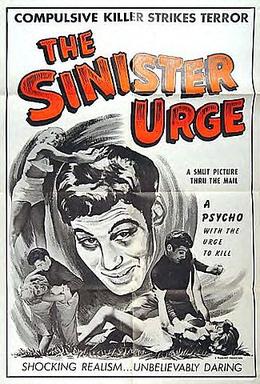
The TSL Horror Grindhouse: The Sinister Urge (dir by Edward D. Wood, Jr.)


1960’s The Sinister Urge opens with a shot of a blonde woman running down a highway while clad only her underwear.

As I watched this scene unfold, I was reminded of a chapter in Hollywood Rat Race, a non-fiction book about the sordidness of the film industry that was written by Edward D. Wood, Jr.  The chapter takes the form of a letter to aspiring young actresses who come to Hollywood, convinced that they’ll become stars.  In the chapter, Wood asks what the innocent young ingenue will do if a director tries to force her to film a scene in just her underwear.  Will you give in, Wood asks, or will you stick true to your values?  Wood seems to suggest that the actress should say no, no matter how much pressure the director puts on her.  Of course, Wood himself was a director, as well as a writer.  In fact, he directed The Sinister Urge.

The Sinister Urge is about the dark side of the film industry.  Police Lt. Matt Carson (Kenne Duncan) and Sgt. Randy Stone (Duke Moore) are investigating a series of murders.  The victims have all been women and they’ve all been killed in the same park.  Carson and Stone suspect that the murders might be connected.  Gee, guys, ya think so?

The murders are being committed by Dirk Williams (Dino Fantini), a knife-wielding teenager who works for the local pornographic filmmakers, Johnny (Carl Anthony) and Gloria (Jean Fontaine).  Dirk has become addicted to viewing pornography and it’s driven him crazy.  Johnny, who laments that he was once a serious filmmaker before he found himself reduced to directing and distributing “smut” to make money, is full of guilt and self-loathing.  Gloria doesn’t care about anything other than making money through selling smutty pictures and movies.  She doesn’t care that she’s helping to produce a product that is inspiring the sinister urge that drives Dirk to kill.

Can Dirk be stopped before he attacks innocent Mary Smith (Jeanne Willardson), who has fallen into the clutches of Gloria’s smut syndicate?  (That’s a great band name, by the way.)  And how will Dirk react when he learns that both Johnny and Gloria are thinking about sacrificing him for the greater good of their evil organization?

The Sinister Urge is an over-the-top melodrama that is clearly an Ed Wood production.  (Posters for Plan 9 From Outer Space and Bride of the Monster appear in Johnny’s office.)  Some of the actors deliver their lines stiffly.  Some of them delvier their lines with just a little bit too much emotion.  The hard-boiled dialogue is full of cliches.  The action sometimes comes to a complete stop so that the cops can discuss the threat of adult films.  The film may be sordid but it’s all presented with such an earnest DIY style that it becomes rather fascinating to watch.  At one point, Wood spliced in footage from a totally different film because why not?  Wood had the footage.  The Sinister Urge was running short.  Why not pad out the length with something totally unrelated?  That never surrender spirit is why Ed Wood remains a beloved figure 100 years after he was born in Poughkeepsie.

Sadly enough, this was Wood’s final “mainstream” film.  After this film, he could only find work writing adult novels and writing and directing the same type of movies that are criticized in The Sinister Urge.  (One has to wonder if The Sinister Urge was Wood’s attempt to satirize the moral panic of the time.)  Sadly, Wood sank into alcoholism and died 17 years after this film was released.  He was 54 years old.  His films, however, live on.

Horror Film Review: Godzilla vs Mechagodzilla II (dir by Takao Okaware)


Mechagodzilla is back!

Well, not quite.  While 1993’s Godzilla vs Mechagodzilla II does indeed feature a giant robotic Godzilla who gets into a battle with the real Godzilla, this Mechagodzilla is not the same Mechagodzilla who appeared in the previous Mechagodzilla film.  (Maybe I just like typing Mechagodzilla, who knows?)  Instead, this Mechagodzilla is a robot that was built by G-Force, the military branch of United Nations Godzilla Countermeasures Center.  (Booo!  Thanks for wasting our tax money, UN!)  This Mechagodzilla has been built out of parts left over from Mechaghidorah and it exists not to conquer the world but to protect it.

Wow, that was an exhausting paragraph to write.  On the one hand, I appreciate the fact that the Heisei era Godzilla films actually made an attempt to maintain a consistent continuity.  On the other hand, it’s difficult to keep track of all of these different monsters and robots.  I have to admit that trying to follow the plots of these movies always tends to make my ADD go crazy.  Really, the important thing is that Godzilla fights a giant robot version of himself and Rodan helps out!

That’s right.  Everyone’s favorite Pterodactyl shows up  in this film.  (The previous film in the franchise reunited Godzilla with Mothra so it just makes sense that Rodan would eventually return.)  Godzilla gets upset when he discovers that Rodan has a Baby Godzilla egg in her nest and, after an absolutely adorable mini-Godzilla hatches from the egg, the two of them fight over him.  However, Godzilla and Rodan later team up to battle Mechagodzilla.  The monsters may not like each other but they get even more annoyed with robot versions of themselves.  One thing that I really appreciate about the Godzilla films of the 80s and 90s is that they show just how exhausting it is for these monsters to constantly have to fight each other.  Godzilla and Rodan are both exhausted towards the end of this movie.  At one point, it appears that Rodan makes the ultimate sacrifice to save Godzilla and I have to admit that I got surprisingly emotional at that point.  But then I remembered that Rodan was going to show up in a later movie and immediately start fighting Godzilla again.  Seriously, monsters are like cats when it comes to showing each other appreciation.

Anyway, the main attraction here is Baby Godzilla, who is absolutely adorable in a way that horrific-looking Son of Godzilla never was.  It helps that Baby actually looks like Godzilla as opposed to looking like the bastard monster child of Godzilla’s mailman.  There’s an awe inspiring scene where Baby Godzilla runs up to Godzilla and we see that Baby Godzilla is barely the size of grown Godzilla’s big toe.  It’s both a cute scene and a reminder that Godzilla is beyond huge.

This was an entertaining entry in the Godzilla franchise.  The plot is less important than the battles and the cuteness of Baby Godzilla.  Try all you want, G-Force.  WE LOVE GODZILLA!

Previous Godzilla Reviews:

  1. Godzilla, King of the Monsters (1958)
  2. Godzilla Raids Again (1958)
  3. King Kong vs Godzilla (1962)
  4. Mothra vs. Godzilla (1964)
  5. Ghidorah: The Three-Headed Monster (1964)
  6. Invasion of the Astro-Monster (1965)
  7. Godzilla vs. The Sea Monster (1966)
  8. Son of Godzilla (1967)
  9. Destroy All Monsters (1968)
  10. All Monsters Attack (1969)
  11. Godzilla vs Hedorah (1971)
  12. Godzilla vs Gigan (1972)
  13. Godzilla vs Megalon (1973)
  14. Godzilla vs Mechagodzilla (1974)
  15. The Terror of Mechagodzilla (1975)
  16. Cozilla (1977)
  17. Godzilla 1985 (1985)
  18. Godzilla vs. Biollante (1989)
  19. Godzilla vs King Ghidorah (1992)
  20. Godzilla vs. Mothra (1992)
  21. Godzilla vs. Destoroyah (1995)
  22. Godzilla, Mothra, and King Ghidorah: Giant Monsters All-Out Attack (2001)
  23. Godzilla (2014)
  24. Godzilla: Planet of the Monsters (2017)
  25. Godzilla, King of the Monsters (2019)
  26. Godzilla vs Kong (2021)
  27. Godzilla Minus One (2023)

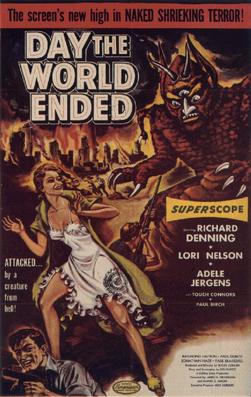
Horror Film Review: Day The World Ended (dir by Roger Corman)


“You finally did it!  You blew it up! …. Goddamn you to Hell!”

That’s right.  Just as how the original Planet of the Apes showed us what the world would look like centuries after a nuclear war, 1957’s Day The World Ended shows us what things would be like in  the weeks afterwards.  And guess what?  It wouldn’t be a lot of fun.

Day The World Ended starts with the bombs dropping and mushroom clouds forming in all of their fearsome glory.  (Oppenheimer may have hated his greatest achievement but aesthetically, the atomic bomb is still an impressive invention.)  Jim Maddison (Paul Birch) and his daughter, Louise (Lori Nelson), manage to survive by camping out in a steel bunker that Maddison built especially for the moment.  As a former Navy commander, Maddison understood that the world was on the verge of nuclear war and he also understood that only those with discipline would survive.  He’s filled with bomb shelter with supplies and he’s told Louise that only the two of them can use the shelter.  Anyone else is out of luck.

Unfortunately, people keep showing up at the shelter and asking to come in.  And while Maddison is prepared to leave them outside with the fallout and the mutants that have started to roam the desert, Louise just can’t stand the thought of leaving anyone to die.  Reluctantly, Maddison starts to allow people to join him and his daughter.  Some of them, like geologist Rick (Richard Denning), are a good addition to the group,  Rick is actually an expert in uranium mining and a potential husband for Louise.  (Louise has a fiancé but he’s missing.  She keeps his picture by her bed.  The picture, of course, is actually a photo of director Roger Corman.)  Unfortunately, not everyone is as likable and well-intentioned as Rick.  Lowlife hood Tony (Mike Connors) and his girlfriend, Ruby (Adele Jergens) show up and continue to act as if they’ve got the police after them even though the police were probably atomized with the rest of civilization.  And finally, there’s a man (Jonathan Haze) who is transforming into a mutant and who develops a strange mental connection to Louise.

No one said the end of the world would be easy!

Day The World Ended was Corman’s fourth film as a director and it was also his first film in the horror genre.  (It’s actually a mix of science fiction and horror but whatever.)  The film was enough of a box office success that it inspired Corman to do more films in the genre.  Seen today, it’s obviously an early directorial effort.  It lacks the humor that distinguished Corman’s later films.  In fact, the film is actually a little bit boring.  Watching a film like this really drives home just how important Vincent Price and his energy were to Corman’s later films.  This film doesn’t have an actor like Vincent Price or Boris Karloff or even Dick Miller, someone who could energize a film just through the power of their own eccentricities.  Instead, Mike Connors, Paul Birch, and Richard Denning all give dull performances as the survivors.  This is a historically important film because, without its box office success, Corman probably would have stuck with doing B-westerns and gangster films.  Filmgoers should be happy that audiences in the 50s were drawn in by the film’s title and their own paranoia about nuclear war.  It’s a film that one appreciates as a piece of history, even if it doesn’t quite stand up to the test of time.

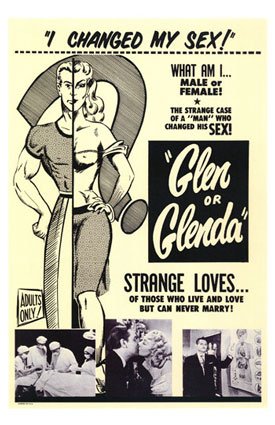
Icarus File No. 15: Glen or Glenda (dir by Edward D. Wood, Jr.)


Today is the 100th birthday of Edward D. Wood, Jr., the director who is often referred to as being “the worst director of all time.”  Personally, I’ve never really agreed with that title.  Ed Wood had a long career in Hollywood and yes, he may have worked exclusively in B-movies and yes, he eventually turned to softcore and then hardcore porn to pay the bills and yes, his life ended under rather tragic circumstances.  But, unlike most truly bad directors, his films are still being watched today and, again unlike most bad directors, his style is immediately recognizable.  You don’t need to see his name in the credits to know when a film was directed by Ed Wood.  You just have to keep an eye out for stock footage, a few familiar actors, and a lot of angora.

If anything, Ed Wood was a director whose ambitions far outweighed the money that he could usually raise for his films.  On the one hand, Plan 9 From Outer Space was a film where the strings holding the flying saucers were clearly visible and where a shower curtain was used to represent the door into an airplane’s cockpit.  On the other hand, it was also a very sincere plea for world peace and a lament that humans would rather blow themselves up with Solarnite than work out their differences.

Or you take a film like 1953‘s Glen or Glenda.  Ed Wood, who identified as a heterosexual and who was considered, by his friends, to be quite a womanizer (and it should be noted that young Ed Wood was strikingly handsome, though he was subsequently very badly aged by alcoholism and homelessness), also preferred to wear clothing designed for women and was open about it at a time when American culture was even more conformist-minded than usual.  In Glen or Glenda, Wood plays the autobiographical role of Glen, who struggles to tell his fiancée (played by Wood’s real-life girlfriend, Delores Fuller) that he dreams of being able to wear her angora sweater.  Glen’s story is told by a psychiatrist (Timothy Farrell) who is talking to a cop (veteran Hollywood character actor Lyle Talbot) who is investigating the death of a transvestite.  Among other things, Glen or Glenda is known for its bad acting, stiffly delivered dialogue, and its occasional digressions about why men go bald while women do not.  (It’s the tight-fitting hats, which cut-off blood flow to the head and not only cause men to lose their hair but also develop the Solarnite bomb.)  But, at the same time, it’s a film in which Wood attempts to handle, with sensitivity and empathy, a subject that most films in the 50s would have either ridiculed or portrayed as being a threat to the American way of life.  All of Wood’s films are sympathetic to those who are considered to be outsiders by conventional society.  This is especially true of Glen or Glenda.

Of course, Glen or Glenda is also known for Bela Lugosi randomly appearing in a laboratory and shouting things like, “Pull ze string!  Pull ze string!”  As far as I can tell, Lugosi is supposed to be playing the creator, who is not portrayed as being a stereotypical God but instead as being a mad scientist who rants and raves in his library and his laboratory.  And while it’s obvious that Bela was probably added to the film at the last minute and, more or less, allowed to do whatever the Hell he wanted, his presence adds a wonderfully bizarre touch to film’s dry style.  (I would compare him to the mysterious burned man who appears at the start of David Lynch’s Eraserhead.)  Whenever the film starts to get a bit too much like an educational film, Lugosi pops up and starts to literally shout at the audiences, frantically issuing a bunch of commands and nursery school rhymes that don’t really made any sense.  It reminds one of H.P. Lovecraft’s insistence that the universe was created by a blind idiot God who had no idea that he was actually creating anything.  The presence of Lugosi and a lengthy and increasingly surreal dream sequence in which Glen imagines himself being tormented by both his fiancée and the devil all suggest that, under different circumstances, Ed Wood could have been the American Buñuel.

Sadly, it was not to be.  Ed Wood died in alcoholic poverty and was reportedly pretty miserable during the final years of his life.  There was nothing pleasant about the end of Wood’s life.  But, on his birthday, I think the least we can do is remove the title of “worst director” from his legacy.  He was nothing of the sort.

Previous Icarus Files:

  1. Cloud Atlas
  2. Maximum Overdrive
  3. Glass
  4. Captive State
  5. Mother!
  6. The Man Who Killed Don Quixote
  7. Last Days
  8. Plan 9 From Outer Space
  9. The Last Movie
  10. 88
  11. The Bonfire of the Vanities
  12. Birdemic
  13. Birdemic 2: The Resurrection 
  14. Last Exit To Brooklyn