The Great White Hope (1970, directed by Martin Ritt)


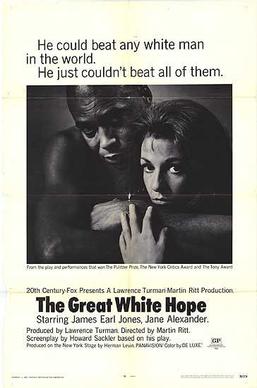
The year is 1910 and the sports world is in a panic.  For the first time, a black man has won the title of the heavyweight champion of the world.  Jack Jefferson (James Earl Jones) had to go to Australia because no American city would agree to host the fight but he came out of it victorious.  The proud and outspoken Jefferson finds himself targeted by both the white establishment and black activists who claim that Jefferson has not done enough for his community.

It’s not just Jefferson’s success as a boxer that people find scandalous.  It’s also that the married Jefferson has a white mistress, a socialite named Eleanor Brachman (Jane Alexander, in her film debut).  While boxing promoters search for a “great white hope” who can take the title from Jefferson, the legal authorities attempt to arrest Jefferson for violating the Mann Act by supposedly taking Eleanor across state lines for “immoral purposes.”  Jefferson and Eleanor end up fleeing abroad but even then, their relationship is as doomed as Jefferson’s reign as the heavyweight champ.

Based on a Pulitzer-winning stage play by Howard Sackler, The Great White Hope features Jones and Alexander recreating the roles for which they both won Tonys.  Both Jones and Alexander would go on to receive Oscar nominations for their work in the film version.  It was the first nomination for Alexander and, amazingly, it was the only nomination that Jones would receive over the course of his career.  (It surprises me that he wasn’t even nominated for his work in Field Of Dreams.)  Both Jones and Alexander give powerful performances, with Jones dominating every scene as the proud, defiant, and often very funny Jack Jefferson.  Jones may not have had a boxer’s physique but he captured the attitude of a man who knew he was the best and who mistakenly believed that would be enough to overcome a racist culture.  (Speaking of racist, legendary recluse Howard Hughes reportedly caught the film on television and was so offended by the sight of Jones kissing Alexander that he thought about buying NBC to make sure that the movie would never be aired again.)  Hal Holbrook, Chester Morris, Moses Gunn, Marcel Dalio, and R.G. Armstrong all do good work in small roles.

Unfortunately, The Great White Hope still feels like a filmed stage play, despite the attempts made to open up the action.  Martin Ritt was a good director of actors but the boxing scenes are never feel authentic and the middle section of the film drags.  Jones and Alexander keep the film watchable but The Great White Hope is never packs as strong of a punch as its main character.

Film Review: After Hours (dir by Martin Scorsese)


Directed by Martin Scorsese, 1985’s After Hours opens in an office.  This isn’t the type of office that one might expect a Scorsese movie to open with.  It’s not a wild, hedonistic playground like the office in The Wolf of Wall Street.  Nor is it a place where an aging man with connections keeps his eye on the business for his friends back home, like Ace Rothstein’s office in Casino.  Instead, it’s a boring and anonymous office, one that is full of boring and anonymous people.  Scorsese’s camera moves around the office almost frantically, as if it’s as trapped as the people who work there.

Paul Hackett (Griffin Dunne) works in the office, at a job that bores him but presumably pays him enough to live in New York.  Paul is not a typical Scorsese protagonist.  He’s not a fast-talker or a fearsome fighter.  He’s not an artist consumed by his own passion or an amoral figure eager to tell his own story.  Instead, he’s just a guy who wears a tie to work and who spends his day doing data entry.  He’s a New Yorker but he doesn’t seem to really know the city.  (He certainly doesn’t know how much it costs to ride the subway.)  He stays in his protected world, even though it doesn’t seem satisfy him.  Paul Hackett is not Travis Bickle.  Instead, Paul is one of the guys who would get into Travis’s cab and, after spending the drive listening to Travis talk about how a storm needs to wash away all of New York’s sin, swear that he will never again take another taxi in New York.

One day, after work, Paul has a chance meeting with a seemingly shy woman named Marcy (Rosanna Arquette).  Marcy lives in SoHo, with an artist named Kiki (Linda Fiorentino) who sells plaster-of-Paris paperweights that are made to look like bagels.  Marcy gives Paul her number and eventually, Paul ends up traveling to SoHo.  He takes a taxi and, while the driver is not Travis Bickle, he’s still not amused when Paul’s last twenty dollar bill blows out the window of the cab.

Paul’s trip to SoHo doesn’t goes as he planned.  Kiki is not impressed with him.  Marcy tells him disturbing stories that may or may not be true while a search through the apartment (not cool, Paul!) leads Paul to suspect that Marcy might have disfiguring burn scars.  Paul decides to end the date but he then discovers that he doesn’t have enough change on him to take the subway home.  As Paul attempts to escape SoHo, he meets a collection of strange people and finds himself being hunted by a mob that is convinced that he’s a burglar.  Teri Garr plays a sinister waitress with a beehive hairdo and an apartment that is full of mousetraps.  Catherine O’Hara chases Paul in an ice cream truck.  Cheech and Chong play two burglars who randomly show up through the film.  John Heard plays a bartender who appears to be helpful but who also has his own connection to Marcy.  Even Martin Scorsese appears, holding a spotlight while a bunch of punks attempt to forcibly give Paul a mohawk.  The more that Paul attempts to escape SoHo, the more trapped he becomes.

Martin Scorsese directed After Hours at a time when he was still struggling to get his adaptation of The Last Temptation of Christ into production.  If Paul feels trapped by SoHo, Scorsese felt trapped by Hollywood.  After Hours is one of the most nightmarish comedies ever made. It’s easy to laugh at Paul desperately hiding in the shadows from Catherine O’Hara driving an ice cream truck but, at the same time, it’s impossible not to relate to Paul’s horror as he continually finds himself returning again and again to the same ominous locations.  In many scenes, he resembles a man being hunted by torch-wielding villagers in an old Universal horror film, running through the shadows while villager after villager takes to the streets.  Paul’s a stranger in a strange part of the city and he has absolutely no way to get home.  I think everyone’s had that dream at least once.

Paul is not written to be a particularly deep character.  He’s just a somewhat shallow office drone who wanted to get laid and now just wants to go home.  Fortunately, he’s played by Griffin Dunne, who is likable enough that the viewer is willing to stick with Paul even after Paul makes some very questionable decisions and does a few things that make him a bit less than sympathetic.  Dunne and John Heard keep the film grounded in reality, which allows Rosanne Arquette, Linda Fiorentino, Catherine O’Hara, and especially Teri Garr to totally play up the bizarre quirks of their character.  Teri Garr especially does a good job in this film, revealing a rather frightening side of the type of quirky eccentric that she usually played.

Scorsese’s sense of humor has been evident in almost all of his films but he still doesn’t get enough credit for his ability to direct comedy.  (One need only compare After Hours to one of Brian De Palma’s “comedies” to see just how adroitly Scorsese mixes laughs and horror.)  After Hours is one of Scorsese’s more underrated films and it’s one that everyone should see.  After Hours is a comedy of anxiety.  I laughed while I watched it, even while my heart was racing.

The TSL Grindhouse: Solomon King (dir by Sal Watts)


In the early 70s, Sal Watts, the owner a popular chain of Oakland clothing stores, took a look at the “blaxploitation” films coming out of Hollywood and thought to himself, “I can do better.”

For two years, Watts worked on his film.  Originally titled Black Agent Lucky King, the film took place in Oakland and an unnamed Middle Eastern country.  When the evil Prince Hassan (Richard Scarro) overthrows the king and takes over the country’s oil fields, Manny King (played by “Little Jamie” Watts) is among the Americans who escape from the country.  Accompanying him is Princess Oneeba (Claudia Russo), who I guess is supposed to be Hassan’s sister, though it’s never really made clear in the film.

Who is Solomon King?  He’s a businessman.  He’s a social activist.  He’s a former Green Beret and a semi-retried agent of the CIA.  All the women love him.  All the men envy him.  He’s the coolest guy in Oakland and everyone assumes that he’s the perfect person to keep Oneeba safe.  Solomon and Oneeba fall in love.  They talk walks along the beach.  Oneeba is amazed that you can hear the ocean when you hold a shell up to your ear.  The entire time, a man with a high-powered rifle is following Oneeba.  Finally, when Oneeba steps out onto the balcony of Solomon’s penthouse, the sniper take his shot.  Oneeba falls in slow motion.  Solomon holds her as she dies and then, he tries to cry.  In this scene, we’re reminded that crying on cue is not as easy as it looks and that Sal Watts was definitely not a trained actor.

Solomon is out for revenge.  He wants to take down Prince Hassan and return the king to his throne.  He also wants to get back the oil wells that Hassan stole from him and his family.  (The film makes it sound like everyone owns an oil well.)  The CIA suggests that Solomon should get some of his Green Beret pals together and overthrow Prince Hasan.  Sure, why not?  I mean, look how well that thinking worked when the CIA and the Mafia tried to invade Cuba!

Eventually, Solomon puts together an army and invades the unnamed Middle Eastern country.  Even though the country is supposed to be in the Middle East, it’s hard not to notice that it looks a lot like Oakland.  Solomon gets his revenge but nothing can bring Oneeba back to life….

Solomon King was long-considered to be a lost film.  A few years ago, a damaged print was discovered and the film was partially resorted.  (The original film reportedly ran close to two hours.  The restoration clocks in at 85 minutes.)  Solomon King is definitely a work of outsider art.  What Sal Watts lacked in experience and ability, he tried to make up for with determination.  There are a few genuinely well-done shots of Solomon driving his car.   (As befits the coolest guy in Oakland, he’s even got a phone in his car!) The soundtrack features an appealing mix of jazz and funk.  And there are a few politically-charged lines of dialogue that suggest that Sal Watts had more on his mind than just making another action film.  That said, Solomon King is also, even in its shortened version, a rather slow-paced and difficult-to-follow film.  The acting is terrible and the fight scenes are haphazardly edited in a way that’s meant to keep you from noticing that no one in the film is actually hitting anyone but which actually has the opposite effect.  My favorite moment was when there was a close-up of Solomon kicking out his leg and then an abrupt jump cut of someone falling backwards, trying to look as if they had been kicked. It was so unconvincing that it was actually kind of charming.

Solomon King is proof that anyone can make a film but making a good one is significantly more difficult.

Lisa Marie Reviews An Oscar Nominee: The Power of the Dog (dir by Jane Campion)


It’s interesting how quickly a film can be forgotten.

Based on a novel by Thomas Savage, The Power of the Dog was one of the most anticipated films of 2021.  It was considered to be a front runner for Best Picture even before it was released.  Even though everyone knew 2021 was going to be the year that the Academy finally got around to giving Will Smith the Oscar, there was still a lot of excitement about the idea of Benedict Cumberbatch playing a sinister and closeted cowboy named Phil Burbank.  The first teaser featured Cumberbatch being wonderfully creepy.  I remember that I was certainly looking forward to it.

When it finally showed up in theaters and then premiered on Netflix, the reviews were …. respectful.  They were positive but they weren’t exactly enthusiastic.  This was the type of film where people noted that it was well-made and well-acted but it seemed to just be missing a little something.  The film was nominated for a lot of Oscars but, in the end, it only won one, for Jane Campion’s direction.  (And Campion, unfortunately, had to spend the days leading up to the ceremony dealing with a stupid controversy over a very mild joke she made to Serena and Venus Williams about how making a movie was more difficult than playing tennis.)  People admired the skill that went into The Power of the Dog but, in the end, it was CODA that captured the hearts of the Academy.  CODA may not have been as technically well-made as Power of the Dog but CODA was a film that made people cry.  And, in 2021, voters who had spent an entire year being told that they would die a horrible death if they even dared to leave their house without putting on a mask, decided to vote with their hearts.

Taking place in 1925 Montana, The Power of the Dog centers on two prominent ranchers, the Burbank brothers.  Phil Burbank is a man’s man, a bluff and hearty type who lives to conquer the land and who doesn’t have much use for women.  Phil looks down on anything that he considers to be a sign of weakness, like showing emotion or making paper flowers.  And yet, Phil is also fiercely intelligent and Ivy League-educated, a man who is capable of playing beautiful music but who has decided not to.  Phil is cruel and manipulative.  Perhaps the only person that he’s ever respected is his mentor, Bronco Henry.  Phil’s admiration for Henry and his collection of gay pornography tells us all we need to know about why Phil is so obsessed with maintaining his “manly” image.

His brother, George (Jesse Plemons), is a much more sensitive soul than Phil and yet, he allows himself to be dominated by his brother.  It’s not until George meets and marries a widow named Rose (Kirsten Dunst) that he starts to come out of his shell.  Angry that Rose seems to be freeing George from his domination, Phil goes out of his way to make her life miserable, even preventing Rose from playing the piano.  In her loneliness, Rose starts to drink.  Phil, meanwhile, sets himself up as a mentor (and potentially more) for Rose’s sensitive and introverted son (Kodi Smit-McPhee), who does like to make paper flowers but who also has an obsession with his late father’s medical books….

The Power of the Dog is a film that I had mixed feelings about.  On the one hand, I did respect the craft that went into making the film.  The Montana scenery was both beautiful and ominous.  And I thought that both Jesse Plemons and Kirsten Dunst gave award-worthy performances.  Dunst, especially, really captured the pain of Rose’s life on the ranch.  Plemons, meanwhile, made George’s gentle nature compelling, which is not always the easiest thing for an actor to do.  At the same time, Benedict Cumberbatch was miscast as Phil and Kodi Smit-McPhee’s performance was a bit too cartoonishly creepy for the film’s ending to really be as shocking as it was obviously meant to be.  Ultimately, the main problem with the film was that Campion, as a director, kept the audience from really connecting with the characters.  The film was well-made but almost as emotionally remote as Phil Burbank and it left the audience feeling as if they were on the outside looking in.  While the book leaves you feeling as if you’re actually in Montana and allows you into the hearts of all of the characters, even Phil, the movie leaves you feeling as if you’ve just watched a really carefully-made film that ultimately treated you as scornfully as Phil treated Rose.

Because it is such a well-made film, The Power of the Dog is a film worth watching but it’s not necessarily a film that leaves you with any desire to watch a second time.  For all the excitement that the film generated before it was released, it was largely forgotten after it lost the Oscar for Best Picture to CODA.

Chip of the Flying U (1939, directed by Ralph Staub)


In this B-western, Johnny Mack Brown plays Chip Bennett, the foreman of the Flying U Ranch.  The ranch is owned by J.G. Whitmore (Forrest Taylor) and his daughter (Doris Weston), who has just returned from college and who has eyes for Dusty (Bob Baker), a singing ranchhand.

Ed Duncan (Anthony Warde) and his gang are in the arms smuggling business.  To make their business a success, they need access to the ranch, which sits on the shore of a lake.  Knowing that Chip would never let them take over, Duncan tries to frame Chip for a bank robbery and murder.  Chip responds by kidnapping two of Duncan’s men, leading to a final and explosive shootout.

Chip of the Flying U is a western that doesn’t seem to know what era it’s supposed to be taking place in.  Chip, Duncan, and all of the other ranch hands dress like they’re in the late 1800s.  Doris Weston dresses like she’s just stepped out of a 1930s photoshoot.  Duncan is trying to smuggle hand grenades, which were invented in 1908 but not commonly used until World War I.  The movie’s time period is all over the place but that was frequently the case with the B-westerns of the 30s.  Shot on studio backlots and for a very low budget, these films were not concerned with historical accuracy.  Instead, they were about shootouts and a few songs.  Chip of the Flying U offers up both, along with Fuzzy Knight as the comedic sidekick who turns out to be very good with a rifle.

With lots of horse chases and bloodless shoot-outs and not too much romance, this movie may seem creaky by today’s standards but probably thrilled the kids who caught while spending an afternoon at the movies in 1939.  Today, the appeal of movies like this is that the good guys are unquestionably good and the bad guys are unquestionably bad.  They remind us of a simpler time that may have never existed but we all hope it did.

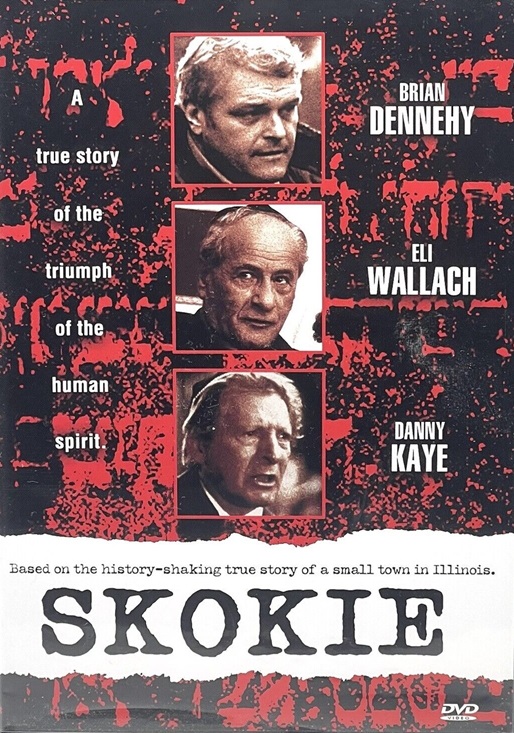
Made-For-Television Movie Review: Skokie (dir by Herbert Wise)


Skokie, a 1981 made-for-television movies, opens in a shabby Chicago office.

A group of men, all wearing brownshirts and swastika armbands, listen to their leader, Frank Collin (George Dzundza).  Collin says that they will be holding their next rally in the town of Skokie.  Collin explains that Skokie has a large Jewish population, many of whom came to the United States after World War II.  Collin wants to march through their town on Hitler’s birthday.

If not for the swastika and the brownshirt, the overweight Collin could easily pass for a middle-aged insurance salesman, someone with a nice house in the suburbs and an office job in the city.  However, Frank Collin is the head of the American National Socialist Party. a small but very loud group of Nazis who specialize in marching through towns with large Jewish populations and getting fee media attention as a result of people confronting them.  Making Frank Collin all the more disturbing is that he isn’t just a character in a made-for-television movie.  Frank Collin is a real person and Skokie is based on a true story.

The Mayor (Ed Flanders) and the police chief (Brian Dennehy) of Skokie are, needless to say, not happy about the idea of modern-day Nazis marching through their city.  Though they inform Collin that he will have to pay for insurance before he and his people will be allowed to hold their rally, they know that the courts have been striking down the insurance requirement as being a violation of the First Amendment.  While the mayor and the police chief worry about the political fallout of the rally, the Jewish citizens of Skokie debate amongst themselves how to deal with the Nazis.  Bert Silverman (Eli Wallach) and Abbot Rosen (Carl Reiner) argue that the best way to deal with Collin and his Nazis is to refuse to acknowledge them, to “quarantine” them.  As Rosen explains it, Collin is only marching to get the free publicity that comes with being confronted.  If he’s not confronted, he won’t make the evening news and his rally will have been for nothing.  However, many citizens of Skokie — including Holocaust survivor Max Feldman (Danny Kaye) — are tired to turning their back on and ignoring the Nazis.  They demand that the Nazis be kept out and that, if they do enter the city, they be confronted.

With the support of the ACLU, Collin sues for his right to march through Skokie.  The ACLU is represented by Herb Lewishon (John Rubinstein), a Jewish attorney who hates Collin and everything that he stands for but who also feels that the First Amendment must be respected no matter what.  When Lewishon is asked how he, as a Jew, can accept a Nazi as a client, Lewishon relies that his client is the U.S. Constitution.

Skokie is a thought-provoking film, all the more so today when there’s so much debate about who should and should not be allowed a platform online.  (Indeed, Collin and his Nazis would have loved social media.)  Lewishon argues that taking away any group’s First Amendment rights, regardless of how terrible that group may be, will lead to slippery slope and soon everyone’s First Amendment rights will be at risk.  Max Feldman, and others argue that the issue isn’t free speech.  Instead, the issue is standing up to and defeating evil.  The film gives both sides their say while, at the same time, making it clear that Frank Collin and his Nazis are a bunch of fascist losers.  It’s a well-acted and intelligently written movie, one that rejects easy answers.  Needless to say, at a time when so many people feel free to be openly anti-Semitic, it’s a film that’s still very relevant.

As for the real Frank Collin, he would eventually be charged with and convicted of child molestation.  After three years in prison, he changed his name to Frank Joseph and became a writer a New Age literature.  He’s looking for Atlantis but I doubt they’d want him either.

Film Review: And The Band Played On (dir by Roger Spottiswoode)


I live in a very cynical time.

That was one of my main thoughts as I watched 1993’s And The Band Played On.

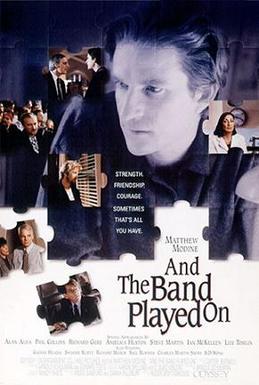
Directed by Roger Spottiswoode and featuring an all-star cast, And The Band Played On deals with the early days of the AIDS epidemic.  It’s a film that features many different characters and storylines but holding it all together is the character of Dr. Don Francis (Matthew Modine), an epidemiologist who is haunted by what he witnessed during the Ebola epidemic in Africa and who fears that the same thing is going to happen in America unless the government gets serious about the mysterious ailment that is initially called “gay cancer” before then being known as “GRID” before finally being named AIDS.  Dr. Francis is outspoken and passionate about fighting disease.  He’s the type who has no fear of yelling if he feels that people aren’t taking his words seriously enough.  In his office, he keeps a track of the number of HIV infections on a whiteboard.  “Butchers’ Bill” is written across the top of the board.

Throughout the film, quite a few people are dismissive of Dr. Francis and his warnings.  But we, the audience, know that he’s right.  We know this because we know about AIDS and but the film also expects us to trust Dr. Francis because it’s specifically stated that he worked for the World Health Organization before joining the Center For Disease Control in Atlanta, Georgia.  As far as the film is concerned, that’s enough to establish his credentials.  Of course, today, after living through the excesses of the COVID pandemic and the attempts to censor anyone who suggested that it may have begun due to a lab leak as opposed to some random guy eating a bat, many people tend to view both the WHO and the CDC with a lot more distrust than they did when this film was made.  As I said, we live in a cynical time and people are now a lot less inclined to “trust” the experts.  To a large extent, the experts have only themselves to blame for that.  I consider myself to be a fairly pragmatic person but even I now find myself rolling my eyes whenever a new health advisory is issued.

This new sense of automatic distrust is, in many ways, unfortunate.  Because, as And The Band Played On demonstrates, the experts occasionally know what they’re talking about.  Throughout the film, people refuse to listen to the warnings coming from the experts and, as a result, many lives are lost.  The government refuses to take action while the search for a possible cure is hindered by a rivalry between international researchers.  Alan Alda gives one of the best performances in the film, playing a biomedical researcher who throws a fit when he discovers that Dr. Francis has been sharing information with French scientists.

It’s a big, sprawling film.  While Dr. Francis and his fellow researchers (played by Saul Rubinek, Glenne Headly, Richard Masur, Charles Martin Smith, Lily Tomlin, and Christian Clemenson) try to determine how exactly the disease is spread, gay activists like Bobbi Campbell (Donal Logue) and Bill Kraus (Ian McKellen) struggle to get the government and the media to take AIDS seriously.  Famous faces pop up in small rolls, occasionally to the film’s detriment.  Richard Gere, Steve Martin, Anjelica Huston, and even Phil Collins all give good performances but their fame also distracts the viewer from the film’s story.  There’s a sense of noblesse oblige to the celebrity cameos that detracts from their effectiveness.  All of them are out-acted by actor Lawrence Monoson, who may not have been a huge star (his two best-known films are The Last American Virgin and Friday the 13 — The Final Chapter) but who is still heart-breakingly effective as a young man who is dying of AIDS.

Based on a 600-page, non-fiction book by Randy Shilts, And The Band Played On is a flawed film but still undeniably effective and a valuable piece of history.  Director Roger Spottiswoode does a good job of bringing and holding the many different elements of the narrative together and Carter Burwell’s haunting score is appropriately mournful.  The film ends on a somber but touching note.  At its best, it’s a moving portrait of the end of one era and the beginning of another.

Film Review: Shoot to Kill (dir by Roger Spottiswoode)


I am not one for camping.

I’m actually kind of alone amongst my family as far as that’s concerned.  All three of my sisters enjoy spending the night outdoors, listening to sounds of nature and looking up at the stars.  They know how to set up tents and make campfires and they enjoy hiking and rafting and exploring the great outdoors.  Myself, I do enjoy occasionally spending the weekend up at Lake Texoma and I like the fact that, even though we live in the city, we still occasionally get to see wildlife running around.  I think possums are cute.  A few days ago, I squealed with delight when I saw that there was a raccoon hanging out in one of our backyard trees.  (“Don’t go near that thing, Lisa Marie!” Erin snapped as I reached for the den door.)  Growing up, I spent time in both the country and the city.  While I love living in the city, there’s still a part of me that’s still a country girl.  That said, I definitely prefer sleeping inside to outside.  The inside is safe.  The inside is comfortable.  The inside is free of creepy bugs that crawl on the ground.

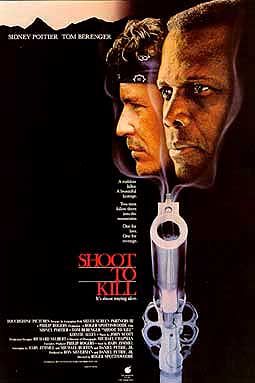
Watching 1988’s Shoot to Kill definitely did not do much to change my opinion about camping.  In this thriller from director Roger Spottiswoode, Sidney Poitier plays Warren Stantin, an FBI agent who is obsessed with capturing a sadistic criminal who blackmails people into doing his work for him.  At the start of the film, the extortionist has forced a jeweler to break into his own jewelry store by taking the jeweler’s wife hostage.  Stantin’s attempt to capture the extortionist leads to the jeweler’s wife taking a bullet in the eye.  (AGCK!  Seriously, this guy is mean!)  Stantin traces the man to Washington State, where he discovers that the extortionist has committed another murder and stolen the victim’s identity.  The extortionist is now a member of a five-man fishing party that is being led by a local guide, Sarah Renell (Kirstie Alley).  Stantin teams up with Sarah’s partner, Jonathan Knox (Tom Berenger), and the two of them attempts to track down the group before the murderer among them makes his move.

The action cuts back-and-forth, between Sarah’s party and Knox and Stantin.  Most viewers will probably be able to quickly figure out which member of Sarah’s party is the killer but director Spottiswoode still creates a little suspense by casting actors like Richard Masur, Andrew Robinson, and Clancy Brown as the suspects.  All three of the actors have played their share of sinister characters.  (Andrew Robinson was the Scorpio Killer, for God’s sake!)  While Sarah leads the murderer though the wilderness, Knox teaches Stantin how to survive in the great outdoors.  As is typical with films like this, Knox and Stantin go from disliking each other to depending on each other.  Have you ever wanted to see Sidney Poitier get into a verbal altercation with a bear?  This is the film for you!

Shoot to Kill is a superior genre film.  The story’s predictable but it’s told so well that it doesn’t matter.  Kirstie Alley, Tom Berenger, and Sidney Poitier all give good performances as sympathetic characters.  As for the actor who turns out to be the killer, he gives a performance that is, at times, absolutely terrifying.  Shoot to Kill is an entertaining thriller.  Just don’t watch it if you’re going camping the next day.

Film Review: The Last Innocent Man (dir by Roger Spottiswoode)


In 1987’s The Last Innocent Man, Ed Harris plays Harry Nash.

Harry is a criminal defense attorney, one who specializes in defending people who have been charged with committing murder.  He’s good at his job but he’s not sure that he’s happy with his life.  He went into the law to save people from Death Row but years of getting acquittals for guilty people have taken their toll on Harry’s psyche.  His most recent client was Jonathan Gault (David Suchet), a man accused of having killed his wife.  The verdict was “not guilty” but Harry suspects that Gault may have been guilty of both what he was charged with and also countless crimes for which he hasn’t been charged.  It doesn’t help that Gault confronts Harry in a parking lot and says he wants Harry to co-write a book about how he got Gault acquitted.  Gault proceeds to tell Harry that he did kill his wife, before suddenly laughing and saying that he’s only joking.

Despite all of the money and the fame, Harry needs a break from dealing with guilty people.  He tells his shocked partner that he will be temporarily stepping back from their practice.  Along with being burned out, Harry is also interested in pursuing a romantic relationship with Jenny Stafford (Roxanne Hart).  Jenny is married but she assures Harry that she is in the process of getting a divorce from her husband, Philip (Darrell Larson).

However, when Philip is arrested and accused of murdering a policewoman who was working undercover as a prostitute, Harry finds himself defending Philip in court.  Philip swears that he’s innocent of the crime and that he’s never even been with a prostitute.  He claims that, when the murdered occurred, he was at home with his wife.  Jenny is willing to collaborate Philip’s alibi, even though Harry suspects that she’s lying.

As you can probably guess, there are plenty of twists and turns to the plot of The Last Innocent Man.  Unfortunately, they’re not exactly shocking twists and turns.  The Last Innocent Man is a courtroom drama and it pretty much sticks to the rules of the genre, which means a lot of snarky comments between Harry and the prosecutor and also plenty of scenes of various lawyers snapping “Objection!” and demanding a recess.  This is the type of film where people fall apart on the witness stand and the audience in the courtroom murmurs whenever something shocking happens.  The Judge can’t pound that gavel hard enough to make The Last Innocent Man anything more than a standard courtroom drama.

That said, director Roger Spottiswoode keeps the action moving at a quick-enough pace and Ed Harris is ideally cast in the role of the morally conflicted Harry Nash.  As well, there’s an entertaining supporting performance from Clarence Williams III, cast here as a cocky pimp, and David Suchet is chillingly evil as the worst of Harry’s clients.  The Last Innocent Man doesn’t quite reach the Hitchcockian heights that it was reaching for but, still, fans of courtroom dramas will enjoy it or, at the very least, show a little leniency in their judgment.

Film Review: Noriega God’s Favorite (dir by Roger Spottiswoode)


Everyone’s an expert on the Panama Canal nowadays.

Largely, that’s a result of President-elect Donald Trump openly musing about taking the canal back from Panama.  As soon as Trump uttered those words, every self-appointed pundit on every social media site in existence immediately jumped over to Wikipedia and skimmed over the articles on Panama, the Panama Canal, and Teddy Roosevelt.  Then, after Jimmy Carter died, those same people jumped onto Wikipedia and skimmed articles about Carter selling the canal to Panama for a dollar and the controversy that followed.  For weeks, it has been impossible to look at Twitter or Bluesky or even Mastodon without seeing someone giving their opinion on the canal, the 1989 American invasion of Panama, and the connection between the CIA and Manuel Noriega, the man who served as Panama’s military dictator for most of the 80s before being deposed and tossed into prison for being a drug smuggler.

Myself, I know better than to get my information from Wikipedia.  Instead, I get my information from movies.  For that reason, I attempted to educate myself on Panama and the canal by watching 2000’s Noriega: God’s Favorite.

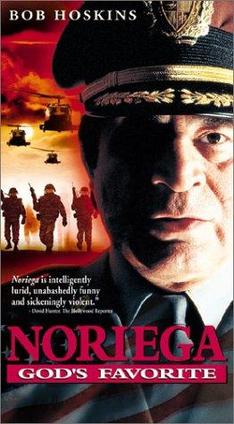
Directed by Roger Spottiswoode, Noriega: God’s Favorite opens with a title card informing us of the story so far.  Manuel Noriega was born in the slums of Panama.  He grew up in poverty and was shunned because his mother was not married to his father.  Noriega spent his youth doing whatever he had to do in order to survive.  He was clever and ruthless but it wasn’t until he entered the Panamanian National Guard that he was able to really use those skills to his advantage.  Noriega became a CIA asset and worked his way through the ranks.  In 1983, with the support of American intelligence, Noriega became the de facto dictator of Panama, even though he never officially held any sort of title or executive position.

The film follows Manuel Noriega (Bob Hoskins) over the course of his final years as Panama’s dictator.  He’s portrayed as being a ruthless man who often pretends to be a buffoon in order to get his enemies to underestimate him.  He works with the CIA but still passes along intelligence to Fidel Castro (Michael Sorich), who is seen hitting on Noriega’s wife (Denise Blasor) during a visit to Cuba.  Noriega presents himself as a family man while having a number of mistresses.  He claims to an ally in the United States’s War on Drugs while attending cocaine-fueled parties.  He presents himself as being a pragmatist while actually being very superstitious.  A CIA agent (Edward Ellis) wins Noriega’s trust by manipulatively interpreting Bible verses for him.  When an army officer (played by Nestor Carbonell) tries to lead a coup against Noriega, he can only watch helplessly as Noriega personally executed all of his co-conspirators, going so far as to even chop off one man’s hands.  By the end of the scene, Noriega is drenched in blood but he’s undeniably happy.  Everyone knows that Noriega is an impulsive and dangerous dictator but the CIA allows him to stay in power until he starts to become an inconvenience.  Once Noriega’s notoriety starts to overshadow his usefulness, the U.S. promptly invades and Noriega’s power crumbles around him.

Bob Hoskins might seem like a strange choice to play a South American dictator but he does a good job in Noriega, playing the title character as being both a charismatic dictator and also an overgrown child who has never gotten over the struggles of his youth.  (Early on in the film, he is seen getting treatments to smooth his pockmarked skin, an indication that all the power in the world can’t cure lifelong insecurity.)  In the end, Noriega has much in common with the gangster that Hoskins played in The Long Good Friday.  Noriega is ruthless enough to become powerful but he ultimately falls victim to his own hubris.  When you’re in charge of something as valuable as the Panama Canal, the last thing you should do is anger the country that built it.