The Crowded Abyss : Garresh’s “Disco Lavante”


Here’s the thing : on paper, at least, there’s no compelling reason why Scottish cartoonist Garresh’s Disco Lavante (Strangers Publishing, 2022) shouldn’t all make sense. It’s straightforward, uncomplicated, maybe even tidy. We’ve got lost souls endlessly roaming the void that exists beyond the pale courtesy of a good, old-fashioned suicide cult, and finding that — generally speaking — whatever sort of “existence” there is after this one ends probably isn’t all it’s cracked up to be. Kinda like life on Earth, I suppose, only weirder, more oppressive and, if you can believe it, even more pointless. Except —

That might not be what’s going on here at all, even if it is. Or, perhaps more accurately, it’s very likely only part of what’s going on here. Rest assured, however, that my aim here isn’t to confuse you — more to honestly convey the confusion that this nicely-done oversized comic ‘zine stirred up in me. Which, for the record, is no complaint — regular readers know I enjoy a challenge and don’t mind spending a fair amount of time wrapping my head around something. But the possibilities here are are, in spite of what the previous paragraph would have you believe, bordering on the myriad, and the same is true of the number of considered analyses one can can derive from the book . This is one of those things you’re better off, at the risk of sounding glib, feeling your way through.

Be aware, though, that the process of doing so is necessarily a pretty fucking grim one. “Feel-good” material this is not. It’s not without its humorous moments and instances, that’s for sure, but it’s “gallows humor” all the way, and to the extent that it sustains a cohesive tone, that tone is decidedly nihilistic — for the most part, at any rate. Garresh seems to be positing that there is, in fact, a way out of (or should that be beyond?) the idea that all is lost, but he certainly takes his time getting to that conclusion, and seems a bit ambivalent about it once he (sort of) arrives at it.

Of course, I could have it all wrong — I told you there were any number of ways of looking at this comic, and another perfectly plausible one is that what I take to be an afterlife is actually a post-apocalyptic wasteland that’s entirely real (as in, it exists on the physical plane) populated by displaced refugees “overseen” (if that’s the term we want to use) by a Rip Van Winkle-type who is viewed in undeservedly messianic terms by the masses. It’s hard to say for sure — but again, you might find it as simple to interpret as I have this strange, lingering feeling that it’s meant to be. Hell, I’d go so far as to say that I earnestly hope you do.

What’s not up for debate is the quality of Garresh’s cartooning — dark, evocative, nuanced, foreboding, and textured in the extreme, I may be having a hard time processing everything he’s communicating narratively, but visually his work rings loud, clear, and true. He’s definitely mining some heavy — and heady — conceptual territory, but his ravishingly grotesque artwork functions as a tonal tour guide that leads you through some uncomfortable (to put it mildly) places in such a way that you can’t help but give it your full and undivided admiration. You may not want to go where he’s leading you, but you sure won’t want to look away once you’re on the path — even if it would probably do your overall mental and emotional disposition some good to cut tail and run, trust me when I say that simply isn’t an option here.

So — where does that leave us? Hoo-boy, I wish I knew. But given that I freely admit I was in over my head from the start here, I can’t claim to be any more flummoxed by this book by the time I reached the end of it, so there’s that. I loved the art, obviously. And I appreciate the raw power of Garresh’s visuals and how they convey precisely the sort of atmosphere that’s required for this comic to work — which is an admission that it really does work. And Eddie Raymond at Strangers is to be applauded for publishing something this challenging and, frankly, demanding. But you’re going to want to make sure you approach this knowing full well how relentlessly and unapologetically dark it is. Be prepared for it to stick with you for quite some time — for good, for ill, or for some of both.

***********************************************************

Disco Lavante is available for $10.00 from Strangers Publishing at https://strangerspublishing.com/products/disco-lavante-by-garresh

Also, this review is “brought to you” by my Patreon site, where I serve up exclusive thrice-weekly rants and ramblings on the worlds of comics, films, television, literature, and politics for as little as a dollar a month. Subscribing is the best way to support my continuing work, so I’d be very appreciative indeed if you’d take a moment to give it a look by directing your kind attention to https://www.patreon.com/fourcolorapocalypse

It’s Love, Part 8!


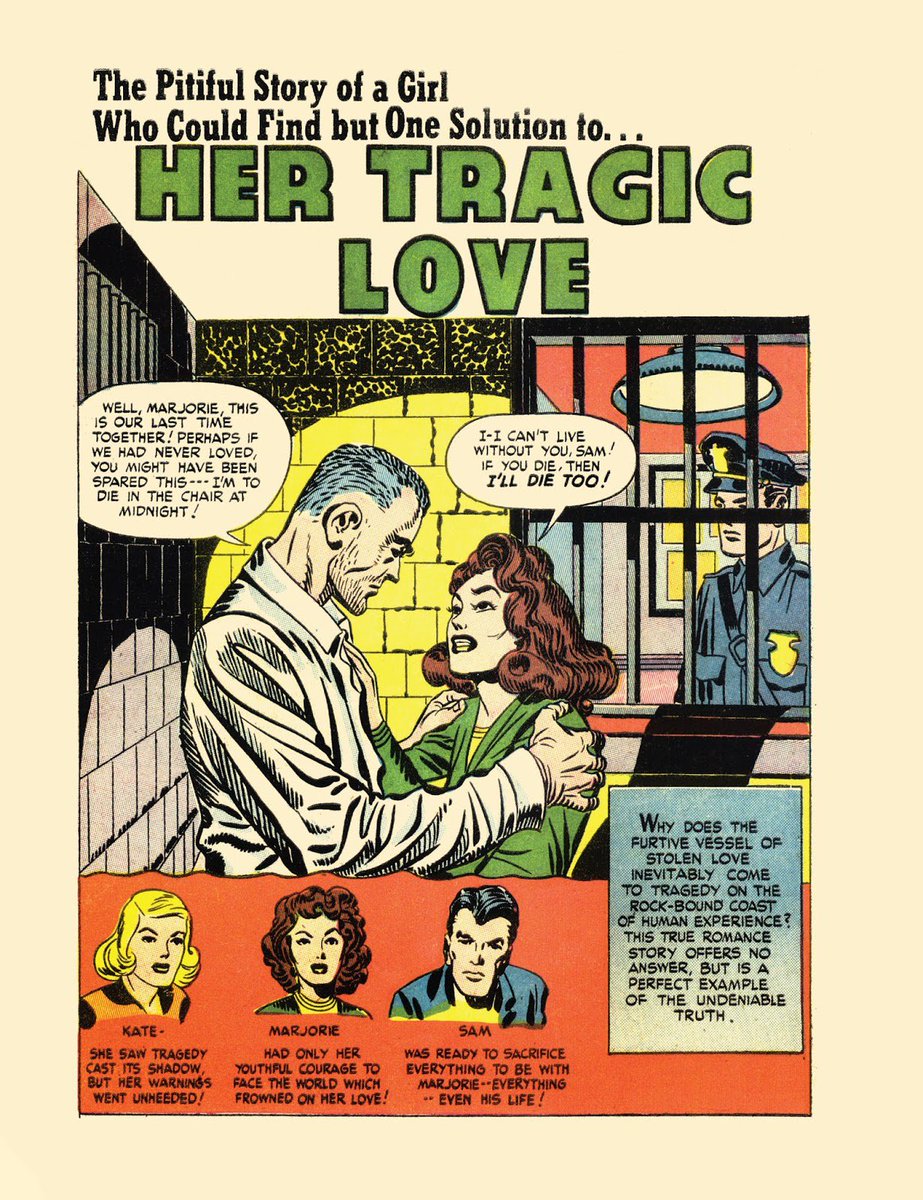
Happy Valentine’s Day! Today, we celebrate love! Love isn’t always easy! As we all know, Valentine’s Day can be difficult when you’re single. Everyone around you is bragging about how in love they are and you just want them to shut up and leave you alone. If you are among those who are single today, do not worry and do not despair.  You’re not the first person to find yourself in this situation and you won’t be the last.  Though you may feel like you, you are not alone.  The path to true love is never an easy one to travel but the destination makes the trip worth it.  To help you on your journey, here are some vintage romance comic covers.  Even in the 1950s and the 1960s and the 1970s, Valentine’s Day wasn’t for everyone.
And as difficult as it can be to find true love, it’s always worth it to look! So. if you’re alone or if you’re a part of a couple, if you’re single or married, in love or simply enjoying life, happy February 14th!  May it be a good day, no matter what it means to you.

Great Moments In Comic Book History #20: Kickers Inc. Comes To The World Outside Your Window


“The world outside your window!”

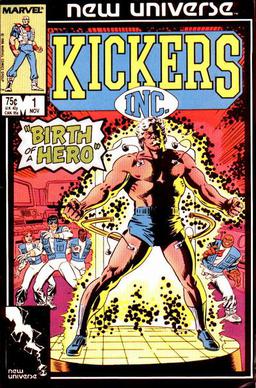
That’s how the Marvel described it’s new line of comic books, New Universe, is 1986.  The brainchild of Jim Shooter, New Universe was launched to celebrate the 25th anniversary of Marvel.  Consisting of 8 titles that were specifically advertised as not being a part of the regular Marvel universe, New Universe was advertised as featuring heroes who existed in the real world and who dealt with real world issues.  The plots would be realistic.  There would be no aliens or superhuman technology.  The superheroes would have powers but they would react to them in the same way that normal people would.  The stories would play out in real time, with a month passing from issue to issue.  It was the world outside your window!  According to Marvel: The Untold Story by Sean Howe, no one other than Jim Shooter thought New Universe was a good idea and, as Shooter became more and more obsessed with the New Universe, artists like John Byrne grew to resent Shooter’s focus on it.

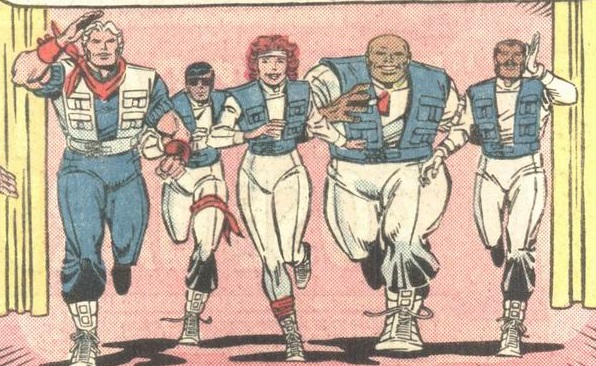
Among the New Universe titles released in 1986, there was Kickers, Inc.  According to Kickers, Inc., the world outside your window featured a football team called The New York Smashers whose top players, after retiring from football, became a crime-fighting group called Kickers, Inc.  They were led by Mr. Magnificent, who had super strength as the result of super technology (and who, therefore, featured two things that Jim Shooter said would not be present in the New Universe titles) and who became a hero after his brother was killed by gangsters who were tying to pressure Magnificent into throwing the Super Bowl.  That may not sound much like the world outside your window but, of course, Kickers, Inc. was not originally created with New Universe in mind.  Kickers, Inc. was originally envisioned as being a regular Marvel series but when Shooter learned about it, he insisted that it be modified into a New Universe title.  Creator Tom DeFalco wasn’t interested in doing a realistic comic book series about superpowered football players and he left the book after only a 3 issues.

Like almost all of the New Universe titles, Kickers, Inc. was canceled after just 12 issues.  It turned out that comic book readers, many of whom used comics to take a break from the real world, didn’t have much interest in super heroes existing in the world outside their window.  Strangely, the promise that new popular Marvel characters would appear in the New Universe books didn’t bring readers over.  (Again according to Sean Howe’s book, John Byrne and several other artists celebrated the death of the New Universe by gathering in Byrne’s backyard and setting a pile of New Universe books on fire.)  The New Universe debacle led to Jim Shooter leaving Marvel but, despite it all, the New Universe and its characters have occasionally been revived over the years and the idea of exploring how the real world would react to the presence of super heroes is one that has run through not the MCU but instead the Snyderverse.

Kickers, Inc. may not have been a success but at least it gives us some idea of what may lay in store for whichever team loses the Super Bowl this year.  The losing players may not leave with a super bowl championship but they may gain an entirely new career opportunity.

Previous Great Moments In Comic Book History:

  1. Winchester Before Winchester: Swamp Thing Vol. 2 #45 “Ghost Dance” 
  2. The Avengers Appear on David Letterman
  3. Crisis on Campus
  4. “Even in Death”
  5. The Debut of Man-Wolf in Amazing Spider-Man
  6. Spider-Man Meets The Monster Maker
  7. Conan The Barbarian Visits Times Square
  8. Dracula Joins The Marvel Universe
  9. The Death of Dr. Druid
  10. To All A Good Night
  11. Zombie!
  12. The First Appearance of Ghost Rider
  13. The First Appearance of Werewolf By Night
  14. Captain America Punches Hitler
  15. Spider-Man No More!
  16. Alex Ross Captures Galactus
  17. Spider-Man And The Dallas Cowboys Battle The Circus of Crime
  18. Goliath Towers Over New York
  19. NFL SuperPro is Here!

A Mystery “Unfolding”


I’m all for formalist experimentation — even for its own sake — but Kimball Anderson’s self-published mini Unfolding (which I think was released in the latter part of last year, but I could be wrong about that — in any case, that’s when I got it) is formalist experimentation with an added layer of purpose beyond “just” or “only” that tacked on : utilizing typed text and collage, it manages, in the space of just 12 pages, to interrogate the very nature of information-gathering and information-sharing on levels both practical and conceptual.

Consider : there is something about someone or something (or both) that’s written (whoops, typed, sorry) on a small piece of folded paper. As you slowly open it, you find out more, each outward unfolding offering up a fragment of a larger puzzle that is actually, all told, no puzzle at all. It only appears to be such due to the fragmented nature of the, to borrow a lame term, “reveal.” But what if said “reveal” was — errrmmm — revealed by other means?

Buckle up, because we’ve got to take things a couple steps further here, okay? Suppose the process I just laid out is actually reversed, and the slip of paper is being folded up, but is being read section by section as it’s folded, so that you’re well and truly learning more while seeing less — textually speaking, that is. On the other side of the paper, there’s an image, nominally related in some subtle way to what’s wri — typed! Caught myself that time! —and now suppose this process is being repeated four times over, with four different pieces of paper. Following me so far? Good, since we’re not quite done yet.

Now, further suppose that each of these paper scraps contains a discrete piece of information that tells a small “story” unto itself — but that all four descriptive passages are actually interconnected even though they’re separate. Starting to get the picture? I dearly hope so, because “getting the picture” is precisely what this innovative-yet-simple project is all about.

I’m also fully cognizant of the fact that I’m probably-to-definitely making the whole thing sound more convoluted than it really is, but perhaps the sample pages included with this review explain it all far better than my uncharacteristically (but then I would say that) linguistic fumbling is managing to accomplish. Language is a big part of what Anderson is experimenting with here (and by “a big part,” I mean half) — using it in fragmented form to draw attention to its shortcomings as a means of communication — but so are pictures, and while this may not be a traditional “comic” per se, its premise (by default and by design in fairly equal measure) teases out what comics do so well, which is to say : they convey information by means both verbal and visual. And by deconstructing the ability to do both in plain sight, this ‘zine gives readers a newfound appreciation for the inherent strengths and possibilities of illustrated sequential storytelling.

Are Anderson’s goals here ultimately — shudder! — ironic, then? Nah, I really don’t think so, I just think that there’s some “natural,” if you will, irony woven into the framework of the project’s metaphorical DNA. Sometimes you don’t know what you’ve got until it’s gone, and all that. In any case, this is a work that got me to thinking — about what it was, about what it was doing, and about how it was doing it. That’s more food for thought than you normally get out of 120 pages, let alone 12. Saying “highest possible recommendation” is a pretty formal note to end things on, admittedly, but hey, this is formalist stuff, so — if the shoe fits, right?

************************************************************

Unfolding is available for $5.00 from Austin English’s Domino Books distro at http://dominobooks.org/unfolding.html

Also, this review is “brought to you” by my Patreon site, where I serve up exclusive thrice-weekly rants and ramblings on the worlds of comics, films, television, literature, and politics for as little as a dollar a month. Subscribing is the best way to support my continuing work, so I’d be very appreciative if you’d take a moment to give it a look by directing your kind attention to https://www.patreon.com/fourcolorapocalypse

Creativity While “Isolated”


When we look on things a few years from now (assuming we make it that far), there’s a damn good chance that 2020 will be seen as a turning point for small press, self-published, and otherwise independent comics. Not only did we have the “heavy hitters” like Simon Hanselmann’s Crisis Zone and Alex Graham’s Dog Biscuits, we had diary comics galore from any number of cartoonists, as well as a smattering of “lockdown”-themed anthologies — artists, like the rest of us, were looking for anything to keep them sane while they were (by and large) stuck indoors, and new (predominantly digital) distribution methods were utilized, both by choice and necessity, to get their work out there. In many ways, sure, it seems like only yesterday, but in others it seems like a lifetime ago, so completely has the landscape shifted. And the changes to production and distribution that the pandemic engendered have proven to be every bit as resilient as has COVID-19 itself, really — I mean, how many comics are you reading on Instagram these days? I bet it’s more than you were in 2019.

I was somewhat surprised, then, to receive in the mail recently a handsomely-produced little anthology called Isolated, edited and published by Tana Oshima and featuring work produced primarily (with some exceptions) during the “height” of the lockdowns, that is available only in printed form. This is not a complaint, mind you — I made mention of Instagram comics a moment ago, but the truth is I don’t even have an Instagram account myself and prefer to keep things as “old school” as is humanly possible. I’m well aware, however, of what’s happening in the digital comics realm in a general sense, and so the idea of a a collection of pandemic-themed strips that bucks the trends and stays with the tried-and-true is inherently appealing to a stick in the mud such as myself — and even more importantly, so are the comics that Oshima is presenting here.

Of course, how could they not be given the veritable “murder’s row” of international talent she’s managed to put together? Roll call, in order of appearance : Celine Hudreaux on covers, with interior stories by Pedro Pablo Bacallao, E.A. Bethea, Angela Fanche, Ana Galvan, Jessica Garcia, November Garcia, Ness Ilene Garza, Marie Gilot, Kim Lam, Drew Lerman, Lui Mort, Roman Muradov, Hue Nguyen, Weng Pixin, Areeba Siddique, and Lane Yates. Veteran readers of my blathering will no doubt recognize many a cartoonist I’ve sung the praises of included in this list of luminaries, but there are a handful of names that I admit were new to me here as well, and lo and behold, they contribute some of the strongest entries in the book, so that admittedly shop-worn “something old, something new” axiom with regards to putting together a successful anthology? It absolutely rings true in this case.

Everyone is given four pages to work with (apart from Galvan, who only uses two), and as one would expect, pretty much all these strips are autobiographical in nature, but even the ones that aren’t in form are in spirit, given the same thing was resting heavy on everybody’s shoulders all over the world at the time — which rather brings me to my main point here : expect a uniquely unpleasant and harrowing reading experience with this as you look back on a time that absolutely no one is nostalgic for. These are all cartoonists operating at the full height of their considerable powers, so that semi-apocalyptic sense of dread we all felt in 2020? You’re gonna feel it all over again. It hangs over all in Sword of Damocles fashion, even in the strips with a nominally “lighter” tone. So if you’re understandably not yet ready to go down that road, while I’d still strongly urge you to get this book — after all, who knows how many copies are even out there — I’d likewise advise that you put it aside until you really feel up to it. Please. For your own sake.

Speaking for myself (because that’s the only person I’m remotely qualified to speak for in the first place), the predominant sensation this collection evoked in me was the strange dichotomy of those times — we were all going through the same thing, but since we were separated, we all experienced and processed it in highly personal ways. It didn’t help, I suppose, that politics did its level best to wrest control of the situation from science — and I’ll always find it as tragic as it was predictable that the same assholes who lectured us about “coming together” in the wake of 9/11 so they could pursue bloodthirsty and profit-driven wars of conquest abroad were the ones telling us to piss in the face of unity during the lockdowns — but by and large the very nature of isolation itself gave rise to myriad interpretations of both what the lockdowns meant and how best to navigate them. This book, by dint of the wide range of distinctive voices it presents, captures the essence of what it means to individually experience a collective nightmare.

Also worth noting : thanks to the efforts of Oshima and her predecessor on the project Andrew Losowsky, grant funding was secured so that all of the contributors were paid for their efforts — and we all remember how vital that was at the time. You can feel good about buying this comic, then, even if it’s not a “feel-good” collection per se — it is, however, a vital and necessary one, as well as a testament to art’s ability to help us get through the roughest of rough times.

*****************************************************************

Isolated is available for $12.00 from Austin English’s Domino Books distro at http://dominobooks.org/isolated.html

Also, this review is “brought to you” by my Patreon site, where I serve up exclusive thrice-weekly rants and ramblings on the worlds of comics, films, television, literature, and politics for as little as a dollar a month. Subscribing is the best way to support my continuing work, so I’d be very appreciative if you’d take a moment to give it a look by directing your kind attention to https://www.patreon.com/fourcolorapocalypse

Hava Nagila For “Megillah”


Toward the tail end of last year, a nice-looking squarebound anthology arrived my way courtesy of its editor, Chad (In Amsterdan) Bilyeu, and to say its contents lived up to its impressive presentation is putting it mildly — probably far too mildly, at that. Co-published by Bilyeu’s own Bistro Books imprint in association with De Stichting Openbare Bibliotheek Amsterdam (who lists one Gabriel Ercicia as the project’s “Executive Producer”), Megillah #1 eschews a central theme in favor of a central idea – giving six artists eight pages each to do with as they see fit. Did I mention already the results are impressive? I believe I did.

Underneath the appealingly disturbing cover by EKS Graphics/Iva Spasojevic we find stories that well and truly run the gamut from memoir to slapstick superhero revisionism to surreal caper to just plain old surreal, each distinct in its “stand-alone” nature, yet all combining to form a makeshift tapestry that, to drag things back to the cover, “stitches together” in a kind of haphazardly fluid fashion. Aside from the length of each contribution, they don’t have a hell of a lot of similarities other than being good, but in the end, that’s what an anthology — in this critic’s humble (I hope) estimation — should do : provide an expansive view of what’s happening in the various corners of the indie comics world and let the chips fall where they may. As a primer of sorts, then, this is about as polished as they come, and anyone new to “the scene” is sure to discover a couple of artists (at least) whose work they feel sufficiently compelled to track down more of.

“Ah,” you say, “but what about us grizzled veterans?” Never fear, our particular needs and whims are catered to, as well — I mean, who’s going to say no to new, exclusive work from favorites like James The Stanton, E.S. Glenn, and even the legendary Bernie Mireault? And while fellow contributors Eryc Why, Maia Matches, and Larie Cook are not, as yet, “household names” for many of us, they all demonstrate the chops to make a solid case that one day they will be. Yes, of course, some stories are better than others, that’s to be expected, but I kid you not in the least when I state for the record that I don’t consider there to be so much as a single, solitary “clunker” in the bunch.

If unique auteur visions are your bag, this package offers six of them, all at various points along the curve in terms of their tethering to consensus reality — what they unquestionably have in common, though, is that they’re all exceptionally well-drawn, make the most of the book’s top-quality production values (the coloring on each and every strip will impress the shit out of you), and understand how to make the most of the unique opportunities afforded by the short-form comics story. There’s some wild stuff on offer, sure, you’ve probably already figured that much out, but each is narratively-based and formally recognizable as a discrete entities unto itself — what Bilyeu has done that further sets this apart from other anthologies, though, is that he’s arranged them in a de facto “running order” that ensures for smooth transition from one to the next even when their themes don’t necessarily logically “mesh” in any concrete way. All of which is me saying read this thing cover to cover without skipping around — you’ll be glad you did.

According to the definition provided on the inside front cover, a Megillah is a “long, involved story or account,” and while some of these strips do pack a lot into a comparatively tight space, I’d be lying if I said any of them felt “long” because, well, they aren’t. What they most assuredly are, though, is involving in the extreme, to the point where you won’t be ready for some to end. That’s okay, though, right? I mean, it’s preferable to any of them over-staying their welcome, that’s for sure. And besides, you can always go back and re-read any or all as you see fit — as I’ve done myself. Twice so far. With more to come, I’m sure.

Count me as a true believer, then — and a firm one, at that — in what Bilyeu is doing here, and I’m curious (as well as anxious) to see where this project goes next. I’d love to see a rotating cast of returnee artists with newcomers mixed in, but hey — it ain’t my show. I’m more than happy to trust our tour guide. And you should be more than happy to take this inaugural trip. Bring on number two, please!

********************************************************************

Megillah #1 is available for a well-spent $12 from any number of places, but for North American readers I’ll direct you to our friends at Birdcage Bottom Books, where you can find it by clicking on https://birdcagebottombooks.com/collections/comic-books/products/megillah?variant=41235668664496

Also, this review is “brought to you” by my Patreon site, where I serve up exclusive thrice-weekly rants and ramblings on the world of comics, films, television, literature, and politics for as little as a dollar a month. Subscribing is the best way to support my continuing work, so I’d be very appreciative if you’d take a moment to give it a look by directing your kind attention to https://www.patreon.com/fourcolorapocalypse

Not So Great Moments In Comic Book History #19: NFL SuperPro Is Here!


Behold, the one Marvel super hero who will never get his own movie or even a show on Disney Plus!  Behold, NFL SuperPro!

He went from sacking quarterback to tackling crime!  That tells you all you really need to know about NFL SuperPro.  His real name was Phil Grayson.  He dreamed of being a football star until he was sidelined by a knee injury.  Working as a sports reporter, Phil one day interviewed an eccentric fan who revealed that he specialized in making special football uniforms that would turn the players into superheroes.  At that very moment, a group of burglars broke into the fan’s home.  They stole all of the fan’s memorabilia (and later set it all on fire) but, for some reason, ignored all of the super costumes on display.  The fan ended up dead but Phil Grayson ended up with a uniform and, thanks to a chemical spill, super strength!

It may sound like a parody but it was actually a very real comic book and, due to guest appearances from both Spider-Man and Captain America, NFL SuperPro was very much a part of the Marvel universe.  Marvel, back in the days when the company was always just a few months away from bankruptcy, partnered with the NFL to develop NFL SuperPro. The NFL wanted to reach news fans.  Marvel needed money.

Fabian Nicieza, who wrote the first five issues of NFL SuperPro, said that he only worked on the book because the NFL agreed to give him free tickets to all the games.  The NFL thought they would be getting some new fans.  Marvel thought they’d be getting some NFL money.  Instead, they both got years of ridicule that lasted far beyond the end of NFL SuperPro’s series.

NFL SuperPro ran for 12 issues, from 1991 all the way to 1992.  He fought a collection of villains who were all related to football.  His main enemy was a crime boss called Sanction and let’s just say that the Kingpin wasn’t losing any sleep over losing his status as Marvel’s main criminal mastermind.  NFL SuperPro also faced off against a time traveling assassin named, you got it, Instant Replay!  And then there was Quickkick, a villain who used to be a placekicker!  In one issue, NFL SuperPro fought a gang of Hopi criminals and the reaction from representatives of the Hopi Tribe was so fiercely negative that the issue itself was recalled.  That’s probably not what the NFL had in mind when it came to attracting new fans.

Along with that controversy, NFL SuperPro did not last because it wasn’t very good and an early 90s comic book reader was probably the least likely person to idolize someone who was essentially a jock.  In fact, as a character, NFL Superpro has not appeared since 1992, which is a little amazing when you consider that Marvel still occasionally trots out U.S. Trucker for a guest appearance or two.  It is tempting to think that Marvel is embarrassed by NFL SuperPro but his absence probably has more to do with NFL copyright issues.  And the NFL definitely was embarrassed.

As much as Marvel has tried to memoryhole the character, NFL SuperPro has not been forgotten.  He may never appear in a film but he will live on as long as collectors and fans debate who was the worst Marvel hero of all time.

Previous Great Moments In Comic Book History:

  1. Winchester Before Winchester: Swamp Thing Vol. 2 #45 “Ghost Dance” 
  2. The Avengers Appear on David Letterman
  3. Crisis on Campus
  4. “Even in Death”
  5. The Debut of Man-Wolf in Amazing Spider-Man
  6. Spider-Man Meets The Monster Maker
  7. Conan The Barbarian Visits Times Square
  8. Dracula Joins The Marvel Universe
  9. The Death of Dr. Druid
  10. To All A Good Night
  11. Zombie!
  12. The First Appearance of Ghost Rider
  13. The First Appearance of Werewolf By Night
  14. Captain America Punches Hitler
  15. Spider-Man No More!
  16. Alex Ross Captures Galactus
  17. Spider-Man And The Dallas Cowboys Battle The Circus of Crime
  18. Goliath Towers Over New York

Great Moments In Comic Book History #18: Goliath Towers Over New York


This is one of my favorite Alex Ross images.  I’m not sure if that’s Henry Pym or Clint Barton towering over the city but this painting captures the shock and wonder that would be generated by such a sight.  It’s from the 2nd issue of Marvels and to me, this is what the MCU films should take some times to explore, not just the activities of super-powered heroes but also of all the ordinary people who have to try to live their lives while all of the heroes and the villains fight their petty battles.

Previous Great Moments In Comic Book History:

  1. Winchester Before Winchester: Swamp Thing Vol. 2 #45 “Ghost Dance” 
  2. The Avengers Appear on David Letterman
  3. Crisis on Campus
  4. “Even in Death”
  5. The Debut of Man-Wolf in Amazing Spider-Man
  6. Spider-Man Meets The Monster Maker
  7. Conan The Barbarian Visits Times Square
  8. Dracula Joins The Marvel Universe
  9. The Death of Dr. Druid
  10. To All A Good Night
  11. Zombie!
  12. The First Appearance of Ghost Rider
  13. The First Appearance of Werewolf By Night
  14. Captain America Punches Hitler
  15. Spider-Man No More!
  16. Alex Ross Captures Galactus
  17. Spider-Man And The Dallas Cowboys Battle The Circus of Crime


Dude, That’s So Metal : Nick Bunch’s “Blood Horn”


I’ve been singing the praises of Philadelphia’s Reptile House anthology to anyone who would listen for the last couple of years, and to date no one who’s bought it on my advice has done anything other than thank me for turning them onto it — and a big part of what made the first issues (the first five issues, specifically) so special was the first serialized “adventure” of cartoonist Nick Bunch’s barely-fictitious band Blood Horn. These strips had everything you could want in a music-themed comic, in fact they had everything you could want in any sort of comic : relatable characters, quick-witted dialogue, anti-authoritarian attitude, and an unhealthy fixation on gross-out style laughs. It was a “fuck you” comic made by somebody who wasn’t making anything like “fuck you” money for writing and drawing it, and as far as I’m concerned shit doesn’t get any more real than that.

It makes perfect sense that Reptile House (the publisher, that is, not the series — although, I dunno, they’re pretty much one and the same thing) would collect this “arc” into a single volume, but what was surprising to me upon receiving it (some four or five months back — yes, I really am that far behind on reviews) was the extent to which they pulled out all the stops, production values-wise, on Blood Horn in this “stand-alone” iteration. Not only is the paper nice and thick, the cardstock cover is even nicer and thicker, and it’s printed in a really snazzy and apropos gold ink that jumps right out at you. This royal treatment couldn’t have been cheap, but the price of the comic itself still is, so hats off to RH for giving readers absolutely terrific value for money.

Of course, any book, regardless of how impressive it is purely as a physical object, is only as good as the contents it presents, and while we’ve touched on that subject already, it never hurts to elaborate further. Simply stated, Bunch is one hell of a cartoonist, and even better, while he’s clearly taking a lot of stylistic cues from the underground tradition (Spain Rodriguez, in particular, seems to be a notable influence), he’s not in any way tethered to the ethos of a bygone era. He may amp up the outrageousness to a degree that would make the Zap gang proud, but this is still a decidedly contemporary comic that reflects the concerns — as well as the sensibilities — of today’s 20-something artists, as well as their admirable lack of respect for people and institutions that aren’t worthy of any. Cops are certainly the most natural enough target in this regard, of course, but in a broader sense, Bunch is castigating the entire rotting edifice of late-stage capitalist hypocrisy, and he’s doing it with a smile on his face. This comic isn’t going to start a revolution or anything, but your average revolutionary — even of the armchair variety — is bound to get a kick out of it just the same.

In a pinch, I think irreverence sums up the tone here best, but it’s a smart, pointed, thought-through sort of irreverence that comes from lived experience. Anyone who’s ever been part of a band — or even just had friends who were in a band — is going to immediately recognize many of these characters, nod in knowing agreement at the ways in which they think, act, and speak, and generally enjoy being in their company. The plot, centering around preparations for an upcoming “battle of the bands,” is simple enough, but the road blocks (some self-generated from within, others imposed from without) our erstwhile “heroes” have to deal with are almost preposterously convoluted, so it behooves readers to pay close attention to everything on the page here, because you don’t want to be caught napping on what is a fluid and ever-changing series of strung-together absurdities.

In addition, there are any number of fiendishly clever sight gags that you likewise don’t want to miss out on. Bunch jam-packs every panel with visual information, never takes short cuts with his illustration, and is a virtuoso of cartoonish exaggeration. The social and economic margins are always a good vantage point from which to poke fun at the uptight self-importance of the “straight” world, sure, but it takes a special talent to communicate a sense of disdain for “The Man” through art every bit as much as through dialogue, and Bunch is — no BS — a bona fide master at doing exactly that. Partly he’s done his homework, partly he’s got street-smart Philly attitude to spare, and partly he’s just, to the extent that one subscribes to the idea of such a thing, a born cartoonist.

I’m of a mind that we all need more fun in our lives — even the lucky few who have plenty of fun already. And comics don’t get any more fun than this, so seriously — what the hell are you waiting for?

*******************************************************************

Blood Horn is available for the ridiculously cheap price of $6.00 from Reptile House at https://www.reptilehousecomix.com/publications/p/blood-horn

Also, this review is “brought to you” by my Patreon site, where I serve up exclusive thrice-weekly rants and ramblings on the worlds of comics, films, television, literature, and politics for as little as a dollar a month. Subscribing is the best way to support my continuing work, so I’d be very appreciative if you’d take a moment to check it out by directing your kind attention to https://www.patreon.com/fourcolorapocalypse

Swords, Sandals — And Subversion? Brian McCray’s “Krania”


Admittedly, I’m not a close follower of the mainstream comics scene and so can’t speak with any authority on what may or may not be happening in it now, but unless there’s been some sort of below-the-radar (like, way below-the-radar) resurgence of which I’m entirely unaware, it’s safe to say that the “swords and sandals” genre reached its apex in this little medium we all love (most of the time) back in the 1970s, when a bevy of four-color “floppies” and full-sized black and white magazines regaled readers month in and month out with the exploits of Conan the Barbarian, Red Sonja, Kull the Conqueror, and too many also-ran imitators to count. As newsstand distribution gave way to the direct market, though, super-hero readers found their tastes increasingly catered to while fans of Robert E. Howard-esque fantasy were nudged further and further to the sidelines, ultimately being relegated to “afterthought” status.

I’ve heard that Conan is back at Marvel these days after a long hiatus that saw the character wandering through a series of smaller publishers, but his exploits appear to be confined to only standard-format comic books now, with the “mature readers” (as in, they can show boobs and butts) B&W mag apparently a thing of the past — and while that probably makes all kinds of sense from a financial and commercial perspective, it still leaves the grizzled nostalgist out in the cold, stuck poring over dusty back issue bins to find PG-13- and R-rated tales of the Hyperborean Age. Or does it?

Art abhors a vacuum every bit as much as nature does, so leave it to our always-intrepid friends at Strangers Fanzine to fill this particular one with the late-2021 release of cartoonist Brian McCray’s Krania, a magazine-formatted collection of short-form yarns centered around the exploits of a female barbarian warrior that hews a fine line between respectful homage and revisionist re-interpretation with just enough wink-and-nod pastiche thrown in to keep readers who find this sort of crap inherently ridiculous (I’ll take the fifth on whether or not that includes me) reasonably amused and enthralled, as well. It’s hardly revolutionary stuff by any means, but it’s not designed to be : McCray has set himself a fairly specific task with this project, and he proceeds to tackle it with energy and aplomb.

All of which is to say, don’t expect anything particularly taxing here, but do expect to be entertained. McCray’s cartooning is solid, stylish, and dynamic — his villainous creatures are imaginatively designed, his protagonist looks like a tough warrior woman should, and his fight scenes are fluidly paced with the appropriate emphasis given to impact in relation to action. He’s not overly concerned with details, relying on what appears to be the digital equivalent of zip-a-tone to do a lot of the heavy lifting in that regard, but he’s got all the basics of composition down pat and isn’t afraid to get creative with perspective and placement. Throw in a smattering of entirely unsubtle hat-tips to Jack Kirby’s Kamandi, and it’s awfully hard not to like what’s being served up here.

Okay, in fairness, this is about as self-aware a comic as you’re likely to find, but it doesn’t approach its subject matter with an eye toward narratively “cashing in” on easily-arrived-at irony — rather, as the title of this review suggests, there is some delicious (if obvious) subversion going on here with regards to traditional gender roles in so-called “heroic fantasy” that’s probably long (as in decades) overdue. I get the feeling McCray has plenty to say, but that he would rather say it through his stories than in his stories, and if that sounds like a distinction without a difference on its face, rest assured that if you decide to take the plunge and read this book — as well you should — you’ll understand what I’m (perhaps clumsily) getting at more or less immediately.

Count me in as a believer in what McCray is doing here, then, and also as someone who will almost certainly be on the lookout for more of his stuff. And if I were an actual fan of this genre, who knows? I’d have probably enjoyed this comic even more than I did — which, in case you hadn’t sussed it out already, was quite a bit indeed.

**************************************************************************

Krania is available for $10.00 from Strangers Fanzine at https://strangerspublishing.com/products/krania

Also, this review is “brought to you” by my Patreon site, where I serve up exclusive thrice-weekly rants and ramblings on the worlds of comics, films, television, literature, and politics for as little as a dollar a month. Subscribing is the best way to support my continuing work, so I’d be very appreciative if you’d take a moment to give it a look by directing your kind attention to https://www.patreon.com/fourcolorapocalypse