As some of our regular readers undoubtedly know, I am involved in a few weekly live tweets on Twitter and Mastodon. I host #FridayNightFlix every Friday, I co-host #ScarySocial on Saturday, and I am one of the five hosts of #MondayActionMovie! Every week, we get together. We watch a movie. We tweet our way through it.
Tonight, at 10 pm et, #FridayNightFlix presents one of my favorite movies, Shattered Glass!
If you want to join us this Friday, just hop onto twitter, start the movie at 10 pm et, and use the #FridayNightFlix hashtag! It’s a friendly group and welcoming of newcomers so don’t be shy.
Shattered Glass is available on Prime and Pluto! See you there!
Since today is John Belushi’s birthday and I already shared a scene from Animal House, it only feels appropriate that today’s song of the day should come from the film as well. From Stephen Bishop, here is …. ANIMAL HOUSE!
Let me t-t-tell you ’bout some friends I know They’re kinda crazy but you’ll dig the show They can party ’till the break of dawn at Delta Chi you can’t go wrong
Otter, he’s the ladies man Every girl falls into his hands Boon and Katy playing “Cat and Mouse” and Mrs. Wormer, she’s the queen of the
ANIMAL HOUSE
ANIMAL HOUSE
ANIMAL HOUSE
That Pinto he’s a real swell guy Clorette was jailbait but he gave her a try Chip, Doug, and Greg, they’re second to none They studied under Attila the Hun
Mr. Jennings has got his wig on tight Flounder’s left shoe’s always on his right Babs and Mandy are having a pillow fight With D-Day, Hoover, Otis Day and the Knights
DO THE BLUTO
Come on baby, dance with me Maybe if we do the Bluto We will get an “A” in lobotomy
DO THE BLUTO DO THE BLUTO
DO THE BLUTO DO THE BLUTO
Aw, come on! Let me tell ya Dean Wormer tried to shut us down But he fell and he broke his crown He didn’t know about the Delta spunk He came in handy when we were short a skunk
Today would have been the 76th birthday of actor John Belushi.
Today’s scene that I love comes from Belushi’s first film, 1978’s Animal House. In the scene, Belushi (playing Bluto) gives the greatest motivational speech of all time. My father was quite a fan of Mr. Belushi’s. I’d like to think that this speech was the reason why.
4 (or more) Shots From 4 (or more) Films is just what it says it is, 4 (or more) shots from 4 (or more) of our favorite films. As opposed to the reviews and recaps that we usually post, 4 (or more) Shots From 4 (or more) Films lets the visuals do the talking.
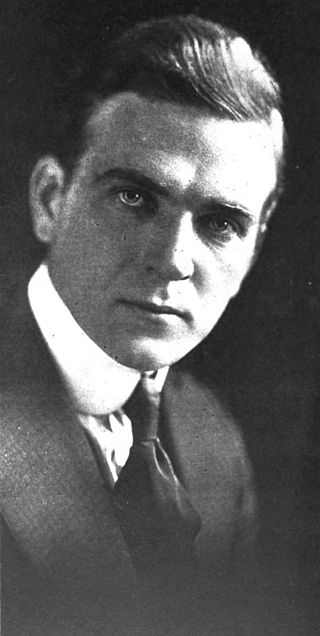
Henry King was born 139 years ago today. He was born in Virginia and, though he may no longer be a household name, he was one of the busiest and most versatile directors of Hollywood’s Golden Age. He began his career during the silent era, directing his first film in 1918. He continued to work all the way through 1962, working in every genre and directing at least 8 Oscar-nominated performances. He was also one of the founders of the Academy. In short, Henry King was an important figure in the early years of Hollywood. If you’ve ever studied classic film or just spent a weekend or two watching TCM, there’s a good chance that you’ve seen at least one Henry King film.
Like many of the top directors from Hollywood’s Golden Age, Henry King was prized for being a professional. In the years when the studios ruled Hollywood and before directors became known as auteurs, King was someone who could be trusted to make an effective film with the minimum amount of behind-the-scene drama. He was someone who could move from genre to genre and from theme to theme. He was skilled at getting the best performances from his actors and he knew how to visually tell a story and keep the action moving. He knew how to engage the audience and his best films hold up surprisingly well.
In honor of Henry King and his career and legacy, here are…
4 Shots From 4 Henry King Films
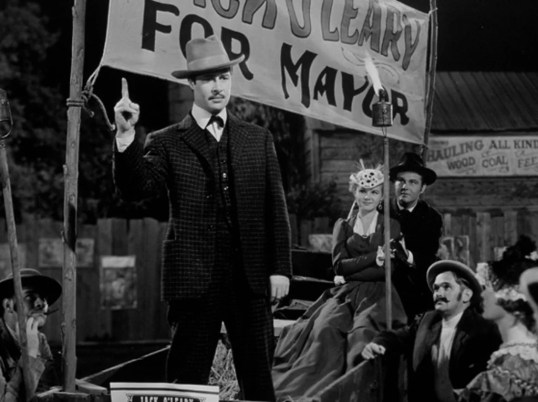
In Old Chicago (1938, dir by Henry King, DP: J. Peverell Marley)
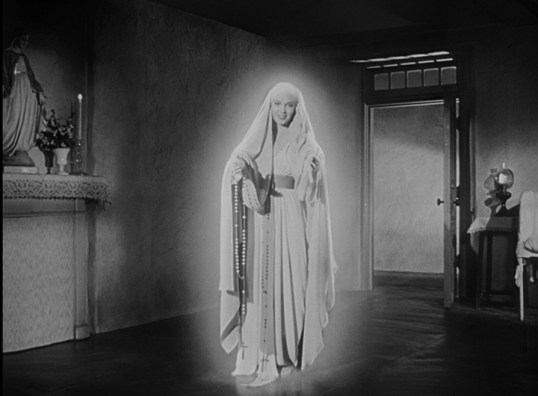
The Song of Bernadette (1943, dir by Henry King, DP: Arthur C. Miller)
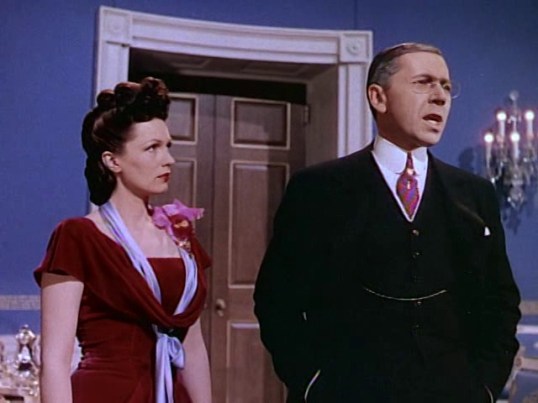
Wilson (1944, dir by Henry King, DP: Leon Shamroy)
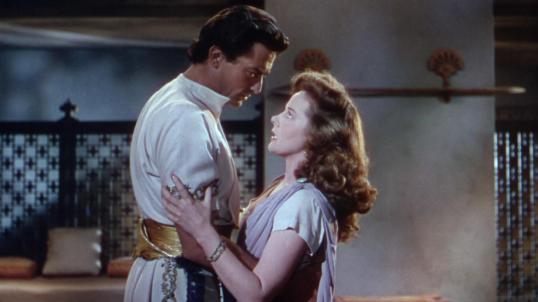
David and Bathsheba (1951, dir by Henry King. DP: Leon Shamroy)
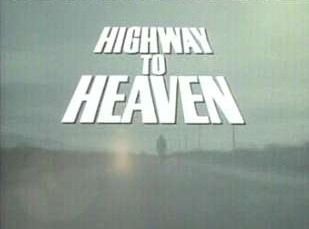
Welcome to Late Night Retro Television Reviews, a feature where we review some of our favorite and least favorite shows of the past! On Thursdays, I will be reviewing Highway to Heaven, which aired on NBC from 1984 to 1989. The entire show is currently streaming on Tubi and several other services!
This week’s episode made me cry.
Episode 3.10 “Man to Man”
(Dir by Michael Landon, originally aired on November 26th, 1986)
As so often happens on this show, the episode begins with Mark visiting an old friend. Luke Morgan (Joe Dorsey) grew up with Mark but, while Mark became a blue collar policeman, Luke went on to become a fabulously wealthy tycoon. That actually seems a bit odd to me. I mean, why has Mark never mentioned having a millionaire friend before? All of the times that Jonathan and Mark have had to deal with other millionaires, Mark has always acted like he’s had no experience being around wealthy people. Now, suddenly, we discover that Mark just happens to have a millionaire friend?
Anyway, Luke invites Jonathan and Mark to stay at his mansion and that’s a good thing because Luke is their mission for the week. Luke devoted so much time to building up his business that he often wasn’t around when his son, Gary (Lee Montgomery, the kid who got crushed by the chimney in Burnt Offerings), was growing up. Now Gary is in his twenties and his relationship with his father is strained. Gary spends all of time lifting weights and working with his computers. Luke wants to take a road trip with Gary but Gary refuses. Mark makes a bet with Gary. If Mark can lift more weight than Gary, Gary will go on the trip. Jonathan temporarily gives Mark “the stuff.” Mark wins the bet. Gary goes on the trip!
Luke, it turns out, is dying. He has Leukemia and he doesn’t have much time left. He wants to patch things up with his son before he dies but he doesn’t want Gary to know that he’s dying. Mark, realizing that Gary needs to know, tells Gary anyway. Gary accuses Mark of lying but then he realizes that his father actually is dying. Gary stops being a brat and he and his father enjoy their last road trip together. Eventually, Gary reveals that he knows the truth. He knows that Luke is dying. Gary finally says that he loves his father and Luke says the loves his child.
And that’s pretty much the episode! This was a pretty simple episode but it still made me cry. It makes me think about all the people in my life who have passed on. Every moment that you have with someone is precious and I think that people tend to take those moments for granted. You never know when someone could get into a wreck while trying to drive home from the store. I know when my Dad was in his car accident last May, I never expected him to die in August. I’d give anything to have those final moments back.
This episode is sentimental and earnest and heavy-handed but it is also an example of what Highway to Heaven does so well.
The Sundance Film Festival is currently underway in Utah. For the next few days, I’ll be taking a look at some of the films that have previously won awards at Sundance.
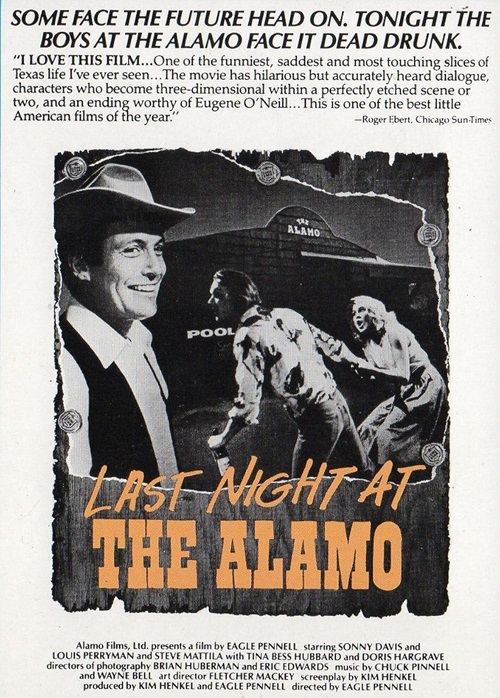
1983’s Last Night At The Alamo is the epitome of an indie film. Filmed in black-and-white and populated with performers who possess a raw authenticity, Last Night of the Alamo takes place over the course of one long day and night.
A seedy Houston bar known as The Alamo is set to close down and the regulars come by for their final drinks. It’s definitely a blue collar bar, a place where the conversations are loud and it seems like there’s always a possibility that a fight could break out at any minute. Claude (Lou Perryman) shows up after getting kicked out by his wife and spends a good deal of the movie yelling and cursing into a telephone. Ichabod (Steve Mattila), a young exterminator, spends almost the entire movie arguing with his girlfriend, Mary (Tina-Bess Hubbard). Steve (J. Michael Hammond) is an adult who still has the personality of a high school bully. For all the arguing and the taunting and the cursing that one hears over the course of the film, it’s also obvious that the regulars at the Alamo have formed a community of sorts. No one is surprised when Claude starts yelling into the telephone. That’s just Claude being Claude and he’s allowed to have his breakdown in peace. As long as he doesn’t interrupt anyone else’s drinking, he’ll be tolerated. It’s a very Texas attitude but then again, Last Night At The Alamo is a very Texas film.
It was written by Kim Henkel, who is probably best-known for writing the screenplay for the original Texas Chainsaw Massacre. (Henkel also appears in the film.) Director Eagle Pennell was one of the pioneers of the Texas film scene, making independent films about life in his home state. (Robert Redford has said that one of the main reasons he started the Sundance Film Festival was because he was impressed with Pennell’s films and wanted to create something that would bring attention to indie filmmakers like Pennell.) Much like many of the characters in Last Night At The Alamo, Pennell struggled with alcoholism and his promising career fizzled out as a result. He died at the age of 49. Legend has it that, shortly before his death, he was seen standing on a Houston streetcorner with a sign asking for either “a rich woman or a warm beer.” Again, it’s a very Texas story.
The majority of the characters in Last Night At The Alamo look up to the bar’s best-known regular, Cowboy Regan (Sonny Carl Davis). Cowboy is handsome and friendly, with a quick smile and a confident manner that makes him stand-out amongst the regulars at the Alamo. He presents himself as being successful and connected and he claims that he has a friend in Austin who is going to save The Alamo from demolition. Deep down, Cowboy is just as desperate as everyone else at the bar but he does a far better job of hiding it. The others look up to him not so much because they believe his stories but because they want to believe them.
It’s an almost plotless film but it does a great job of capturing my home state, with its blue collar culture and its frequent embrace of hucksters like Cowboy. Watching the film, one can see why it’s a favorite of Richard Linklater’s. It’s a melancholy film in many regards. Most of the characters don’t have much going for themselves. But they do have their bar and they have the community that they bult for themselves. The Alamo may be closing but life will continue just as surely as Ichabod and Mary will start and end every day yelling at each other.
Last Night At The Alamo was a prize winner at the 1984 Sundance Film Festival, winning the Dramatic Jury Prize. It can be found, in all of its grainy black-and-white glory, on YouTube.
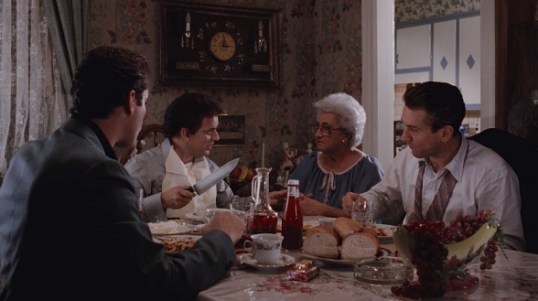
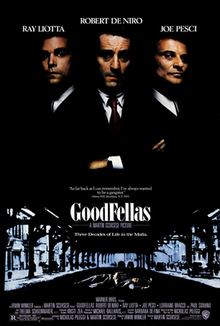
First released in 1990 and continuously acclaimed ever since, Goodfellas did not win the Oscar for Best Picture.
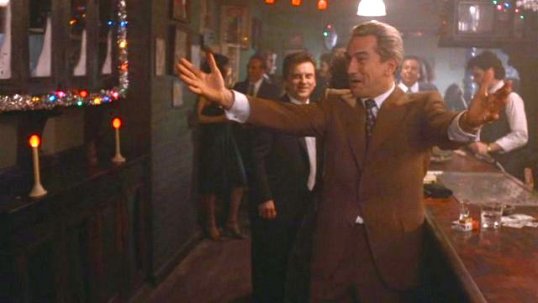
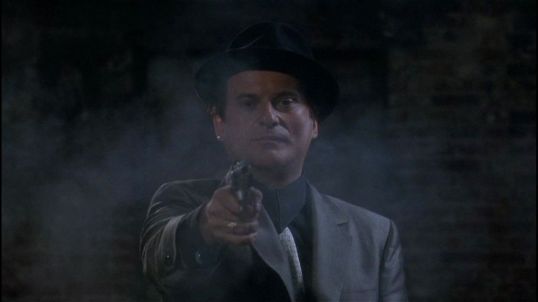
I’m always a bit surprised whenever I remember that. Goodfellas didn’t win Best Picture? That just doesn’t seem right. It’s not the other films nominated that year were bad but Goodfellas was so brilliant that it’s hard to imagine someone actually voting for something else. Seriously, it’s hard to think of a film that has been more influential than Goodfellas. Every gangster film with a soundtrack of kitschy tunes from the 6os and 70s owes huge debt to Goodfellas. Every actor who has ever been cast as a wild and out-of-control psycho gangster owes a debt to Joe Pesci’s performance as Tommy DeVito. When Ray Liotta passed away two years ago, we all immediately heard him saying, “I always wanted to be a gangster.” Robert De Niro’s Jimmy Conway remains the epitome of the ruthless gangster. For many, Paul Sorvino’s neighborhood godfather redefined what it meant to be a crime boss. Lorraine Bracco made such an impression as Karen Hill that it somehow seemed appropriate that she was one of the first people cast in The Sopranos, a show that itself would probably have not existed if not for Goodfellas. Frank Sivero, Samuel L. Jackson, Tobin Bell, Debi Mazer, Vincent Gallo, Ileana Douglas, Frank Vincent, Tony Sirico, Michael Imperioli, Tony Darrow, Mike Starr, Chuck Low, all of them can be seen in Goodfellas. It’s a film that many still consider to be the best of Martin Scorsese’s legendary career. Who can forget Robert De Niro smoking that cigarette while Sunshine of Your Love blared on the soundtrack? Who can forget “Maury’s wigs don’t come off!” or “Rossi, you are nothing but whore!?” Who can forget the cheery Christmas music playing in the background while De Niro’s Jimmy Conway grows more and more paranoid after pulling off the biggest heist of his career?
Plus, it’s a Christmas movie!
And yet, it did not win Best Picture.
Myself, whenever I’m sitting behind a garbage truck in traffic, I immediately start to hear the piano coda from Layla. For that matter, whenever I see a helicopter in the sky, I flash back to a coke-addled Henry Hill getting paranoid as he tries to pick up his brother from the hospital. Whenever I see someone walking across the street in the suburbs, I remember the scene where Henry coolly pistol-whips the country club guy and then tells Karen to hide his gun. I always remember Karen saying that she knows that many of her best friends would have run off as soon as their boyfriend gave them a gun to hide but “it turned me on.” It would have turned me on as well. Henry might be a gangster and his friends might be murderers but he doesn’t make any apologies for who he is, unlike everyone else in the world.
But it did not win Best Picture.
How many people have imitated Joe Pesci saying, “How am I funny?” How many times did Pesci and Frank Vincent have to listen to people telling them to “go home and get your fucking shinebox?” A lot of people remember the brutality of the scene where Pesci and De Niro team up to attack Vincent’s crude gangster but I always remember the sound of Donavon’s Atlantis playing on the soundtrack.
And then there’s Catherine Scorsese, showing up as Tommy’s mom and cooking for everyone while Vincent struggles to escape from the trunk of a car. “He is content to be a jerk,” Tommy says about Henry Hill. Just a few hours earlier, Tommy was apologizing to Henry for getting blood on his floor.
Goodfellas is a fast-paced look at organized crime, spanning from the 50s to the early 80s. Ray Liotta plays Henry Hill, who goes from idolizing gangsters to being a gangster to ultimately fearing his associates after he gets busted for dealing drugs. It’s a dizzying film, full of so many classic scenes and lines that it feels almost pointless to try to list them all here or to pretend like whoever is reading this review doesn’t remember the scene where the camera pans through the club and we meet the members of the crew. (“And then there was Pete The Killer….”) Goodfellas is a film that spend two hours showing us how much fun being a gangster can be and then thirty minutes showing us just how bad it can get when you’re high on coke, the police are after you, and you’ve recently learned that your associates are willing to kill even their oldest friends. No matter how many times I watch Goodfellas, I always get very anxious towards the end of the film. With the music pounding and the camera spinning, with Henry looking for helicopters, and with all of his plans going wrong over the course of one day, it’s almost a relief when Bo Dietl points that gun at Henry’s head and yells at him, revealing that Henry has been captured by the cops and not the Gambinos. Karen desperately running through the house, flushing drugs and hiding a gun in her underwear, always leaves me unsettled. It’s such a nice house but now, everything is crashing down.
There’s a tendency to compare Goodfellas to The Godfather, as their both films that re-imagine American history and culture through the lens of the gangster genre. I think they’re both great but I also think that they are ultimately two very different films. If The Godfather is sweeping and operatic, Goodfellas is the film that reminds us that gangsters also live in the suburbs and go to cookouts and that their wives take care of the kids and watch movies while the FBI searches their home. If The Godfather is about the bosses, Goodfellas is about the blue collar soldiers. The Godfather represents what we wish the Mafia was like while Goodfellas represents the reality.
Goodfellas is one of the greatest films ever made but it lost the Best Picture Oscar to Dances With Wolves, a film that left audiences feeling good as opposed to anxious. To be honest, Martin Scorsese losing Best Director to Kevin Costner feels like an even bigger injustice than Goodfellas losing Best Picture. One can understand the desire to reward Dances With Wolves, a film that attempts to correct a decades worth of negative stereotypes about Native Americans. But Scorsese’s direction was so brilliant that it’s truly a shame that he didn’t win and that Lorraine Bracco didn’t win Best Supporting Actress. It’s also a shame that Ray Liotta wasn’t nominated for playing Henry Hill. At least Joe Pesci won an Oscar for redefining what it meant to be a gangster.
Goodfellas is proof that the best film doesn’t always win at the Oscars. But it’s also proof that a great film doesn’t need an Oscar to be remembered.
Welcome to Retro Television Reviews, a feature where we review some of our favorite and least favorite shows of the past! On Thursdays, I will be reviewing Malibu CA, which aired in Syndication in 1998 and 1999. The entire show is currently streaming on YouTube!
This week, Jason and Scott do something stupid!
Episode 1.25 “The Yacht”
(Dir by Gary Shimokawa, originally aired on May 16th, 1999)
Because they’re dumbasses, Scott and Jason accidentally destroy their father’s new watch. At first, they try to do the right thing and buy him a new watch. But it turns out that watch cost $2,000!
How can they possibly raise $2,000?
Hey, here’s an idea! Maybe they can just borrow Murray’s yacht and throw a casino night! (Actually, the yacht belongs to Murray’s father but whatever.) Surely, that’ll be enough to raise $2,000!
Uhmm …. hey, guys? Let’s think about this logically. It’s a casino night. Now, admittedly, you’ve got the yacht for free because it belongs to Murray’s Dad. Still, you have to rent (or buy) all of the slot machines, roulette wheels, and poker tables that are necessary for a casino night. You have to pay the dealers at each table. You probably have to pay security to keep an eye on all the money that’s floating around. You have to pay for all the refreshments. If you have the money to put on a casino night then guess what? YOU’VE GOT THE MONEY TO REPLACE YOUR DAD’S WATCH!
Good Lord, this show is stupid!
Anyway, Murray shows up at casino night wearing a white captain’s uniform and for once, I agreed with the audiences applause. Murray looked good! Brandon Brooks has been this season’s saving grace and he was the best thing about this episode. Unfortunately, Murray panics when he hears that his father is coming home early. He tries to steer the yacht back to the docks and instead, he accidentally hits a reef. The $2,000,000 yacht sinks!
We have spent this entire season hearing about what a monster Murray’s Dad is. This is the first episode in which he actually appears and he turns out to actually be a pretty cool guy. Yes, he’s upset that his yacht sank. And yes, Murray’s in some trouble. But Murray’s dad says he’s still proud of Murray for taking responsibility. Awww, what a great guy!
And what a stupid episode!
Actually, speaking of stupid, check out the B-plot. Stads wants to star in a film about lifeguard training. Since Traycee’s an actress, she agrees to teach Stads how to perform on camera. Stads accepts Traycee’s help but doesn’t ever really seem to appreciate it. As you can probably guess, Traycee ends up with the role and Stads gets even more upset. At this point, I’m a little bit bored with episodes that center around Stads getting upset about stuff. Stads is always upset about something. Even when something good happens to her, Stads gets upset about it. Stads started out as an interesting character but, halfway through the season, the show’s writers decided to just make her into a permanent killjoy.
Speaking of killing joy, this season is nearly over! Next week, season one comes to a close.
This morning’s Oscar nominations were dominated by Netflix’s Emilia Perez, which picked up a total of 13 nominations. Though it has yet to win an Oscar for Best Picture, Netflix has definitely picked up its game over the past few years. Every year, there’s a major contender that’s produced and released by Netflix. The Irishman, Marriage Story, Power of the Dog, Maestro, they were all films that were heavily pushed by Netflix. This year, Netflix actually had many potential contenders but, in the end, it put its full weight behind Emilia Perez and it paid off this morning. Whether it will pay off on Oscar night had yet to be seen.
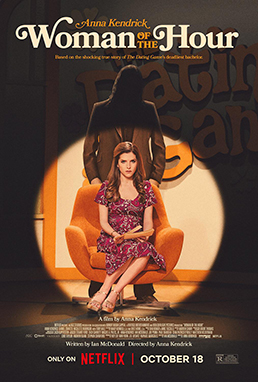
Unfortunately, that means there a few Netflix films that got pushed to the side. As many mentioned this morning, Angelina Jolie’s performance in Netflix’s Maria was ignored, despite having been viewed as an Oscar lock just a few months ago. The Piano Lesson also failed to pick up a nomination for Danielle Deadwyler. Myself, I wish that Netflix would have just spent a bit more time pushing a film called Woman Of The Hour.
Woman of the Hour is the directorial debut of Anna Kendrick and it’s about as far from the light-hearted world of Pitch Perfect as one can get. Based on a true story, the 70s-set film features Kendrick as Sheryl Bradshaw, an aspiring actress who goes on The Dating Game and asks questions to three contestants, not knowing that Bachelor #3 is actually a serial killer named Rodney Alcala (Daniel Zovatto).
The film jumps back and forth in time, mixing Sheryl’s appearance on the tacky game show with the horrific crimes of Rodney Alcala. On the show, Sheryl grows frustrated with the stupid, pre-written questions that she’s been handed and instead, she starts asking her own questions. The three “bachelors” are taken by surprise but only Alcala is able to keep up with Sheryl. Separated from Sheryl and just hearing her questions, Alcala manages to sound like an intelligent and interesting human being. (As with most serial killers, Alcala is a master manipulator and knows what to say to put people at ease.) It’s only after Sheryl selects him and they have a face-to-face meeting that Sheryl comes to realize that Alcala is not the man he presented himself as being.
The film’s style might seem disjointed to some. Woman of the Hour is full of flashbacks and flashforwards. The empty glitz of the Dating Game and Sheryl’s refusal to play dumb for the approval of the show’s producers is contrasted with the brutality of Alcala’s crimes. It’s a technique that builds a sense of dread and inevitability. Sheryl may not know who Bachelor #3 is but we do and it’s hard not to worry when it becomes obvious that he’s the bachelor she’s going to pick. Even more importantly, the film contrasts the show’s casual misogyny with Alcala’s own hatred of women. Kendrick uses the film to comment on the everyday fears women navigate, from the casual sexism of the show’s producers to the outright danger of a predator like Rodney Alcala. There’s a poignant scene where Sheryl encounters a casting director’s crass comments about her body, undoubtedly reflecting the real-life experiences Kendrick herself has faced. (“I’m sure they look fine,” one smarmy producer says after Sheryl explains that she doesn’t do nude scenes.) This is a thriller but it’s also a critique wrapped in suspense.
Woman of the Hour is a compelling watch, not just for its thrilling narrative but for its heart-wrenching look at the vulnerability of women in a predatory world. Kendrick proves herself as a director with a voice, one that’s both fresh and deeply personal. Woman of the Hour is a film worth 94 minutes of your time.


 Through the Shattered Lens