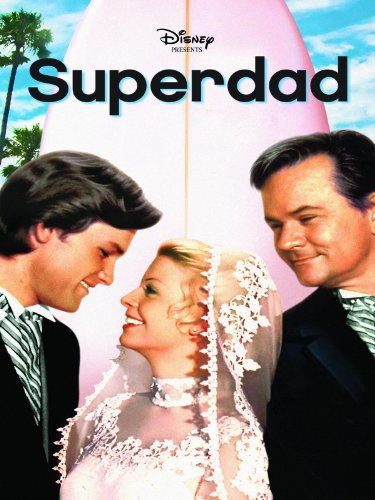
Life’s A Beach: Superdad (dir by Vincent McEveety)


In 1973’s Superdad, Disney takes on the generation gap.

Charlie McCready (Bob Crane) just can’t understand what’s going on with his daughter, Wendy (Kathleen Cody).  She’s smart, pretty, and has the potential for a great future ahead of her but all she wants to do is hang out with her friends on the beach.  Eccentric Stanley Schlimmer (Bruno Kirby) drives everyone around in a souped-ambulance.  Ed Begley, Jr. (who plays a character who doesn’t even get a name) joins in whenever the group sings a folk song.  Wendy’s boyfriend, Bart (young and likable Kurt Russell), is a surfer and water skier.  Charlie is truly convinced that this extremely clean-cut group of teenagers is going to lead his daughter astray.  In fact, Wendy wants to marry Bart!  Charlie attempts to hang out with Wendy, Bart, and his friends on the beach and he can’t keep up.  He can’t water ski, he can’t play football, he can’t play volleyball.  All he can do is scream in this weird high-pitched voice.  The entire time is Bart is extremely nice to him and doesn’t even make fun of him for not being able to hit a volleyball over a net.  I mean, even I can do that!  But because Charlie’s not dealing well with becoming middle-aged, he decides that Bart is a threat.

(I’m going to assume that Charlie also teams up with a creepy friend and starts filming himself having threesomes with groupies, though we don’t actually see that happen in the film.  The subtext is there, though!)

Charlie decides that he has to get Wendy away from this group and the best way to do that would be to trick her into thinking she’s received a scholarship to …. Yes, this is just that stupid …. a scholarship to a prestigious university.  While Bart and his healthy, non-smoking, non-drinking friends are all going to City College and living at home with their parents, Wendy will be miles away at a college where she can do anything that she wants. Charlie thinks this is a great plan.  One gets the feeling that Charlie, for all of his overprotectiveness, hasn’t read a newspaper in 20 years.  Seriously, has he not been keeping up with what was happening on most college campuses in the late 60s and early 70s?

The main problem with this film is that Charlie is an incredible jerk.  It’s one thing to be overprotective.  Fathers are supposed to be overprotective of their daughters.  It’s one thing to worry about his daughter not having a good deal of ambition.  I can even understand him getting annoyed with Stanley because Stanley is kind of annoying.  (Watching this film, it’s hard to believe that Bruno Kirby was just one year away from playing the young Clemenza in The Godfather, Part II.)  But seriously, Charlie is freaking out over his daughter dating KURT RUSSELL!  In this film, Kurt Russell plays a character who is always polite, mild-mannered, sensible, and remarkably understanding of Charlie’s attempts to keep him from marrying Wendy.  There is one scene where Bart gets upset and he barely even raises his voice.  He’s incredibly likeable and, for all of this film’s flaws, it’s still easy to see why Kurt Russell became a star.

Of course, what really makes this film a cringe-fest is that it stars Bob Crane as a family man with a secretly manipulative side and, the whole time I was watching, I kept having flashbacks to Greg Kinnear in Auto-Focus.  Wendy, to make her dad really angry, gets engaged to an actual hippie named Klutch (Joby Baker) and there’s a scene in which Klutch and Charlie get into a fight in Klutch’s artist studio.  Every time Klutch swung anything near Charlie’s head, I definitely cringed a bit.  Red paints get spilled everywhere, though luckily it ends up on Klutch and not Charlie.  Still, watching the film, I couldn’t help but think that there are worse things that could happen to someone than having their daughter marry Kurt Russell.
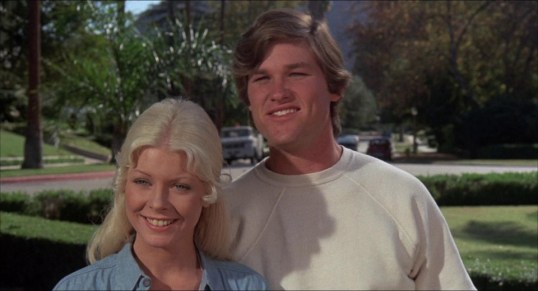
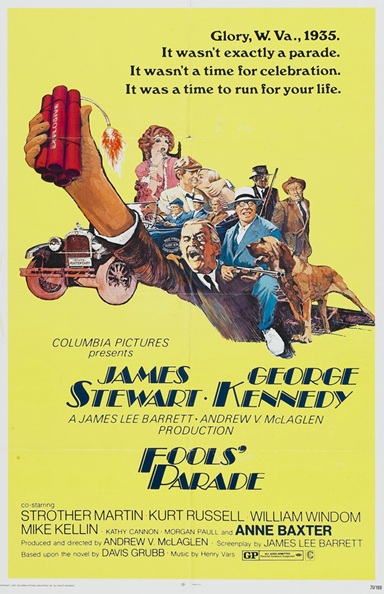
Film Review: Fools’ Parade (dir by Andrew V. McLaglen)


1971’s Fools’ Parade opens in 1935.

Three men are released from the West Virginia state penitentiary and given a train ticket out of town by the prison captain, Council (George Kennedy).  The men are a bank robber named Lee Cottrill (Strother Martin), a young man named Johnny Jesus (a young Kurt Russell), and a courtly older man named Mattie Appleyard (James Stewart).  Despite his polite tone of voice and his folksy manner, Appleyard is actually the most notorious of the three men being released.  Convicted of murdering two men, Appleyard has spent the past 40 years in prison.  Both Appleyard and Cottrill are looking to go straight.  Every day of his sentence, Appleyard worked and earned money.  Along with a glass eye, Appleyard leaves prison with a check for $25,000 dollars.  Appleyard plans to cash the money at the bank and then open a store with Cottrill.

Unfortunately, Appleyard has been released at the height of the Great Depression.  The streets are full men desperately looking for work.  People will do anything to feed their families or to make a little extra money.  Salesman Roy K. Sizemore (William Window) transports guns and dynamite.  Willis Hubbard (Robert Donner) works as a conductor on the train.  Aging prostitute Cleo (Ann Baxter) offers to sell the virginity of her adopted daughter, Chanty (Katherine Cannon).  Junior Killfong (Morgan Paull) sings on the radio and occasionally takes on deadlier work with his friend, Steve Mystic (Mike Kellin).  As for Captain Council, he’s decided that he’s going to make his money by ambushing the train carrying the three men that he has just released from prison.  After killing the men, Council will cash Appleyard’s check himself.

Of course, it doesn’t quite work out as simply as Council was hoping.  Willis Hubbard has a crisis of conscience and lets Appleyard, Cottrill, and Johnny know what Council is planning.  The three men narrowly make their escape but Council frames Appleyard for a murder that he didn’t commit.  Now wanted once again, the three men must not only get the money but also clear their names.  It won’t be easy because, as Hubbard explains, they may be free from the penitentiary but now, they’re trapped in “the prison of 1935.”

Fools’ Parade really took me by surprise.  I watched it because it featured two of my favorite actors, James Stewart and Kurt Russell.  And both Stewart and Russell give very good performances in the film.  Stewart was always at his best when he got a chance to hint at the melancholy behind his folksiness and the young Kurt Russell plays Johnny with a sincerity that makes you automatically root for him.  For that matter, the normally sinister Strother Martin is very likable as Lee Cottrill, a bank robber who is still struggling with the idea of going straight.  But, beyond the actors, Fools’ Parade is a genuinely sad portrait of desperate people trying to survive.  At one point, Sizemore and Cottrill watch as their train passes a camp of people who have been displaced by the Great Depression and it’s even implied that the villainous Council has some regret over what he’s become.  (There’s a small but poignant scene in which Council and Cleo acknowledge the passage of time and, for a minute, the viewer realizes these two people were, at one time, maybe as idealistic and optimistic as Johnny.)  It’s a well-acted film, one in which moments of humor are mixed with moments of true sadness.  I may have picked the film for Jimmy and Kurt but, in the end, the film’s story and performances drew me in.  The 63 year-old Stewart proved that he could still give a memorable performance and the 20 year-old Kurt Russell proved that he was a future star in the making.  If you haven’t seen it, this is definitely a film to check out.

Shattered Politics: The One and Only, Genuine, Original Family Band (dir by Michael O’Herlihy)


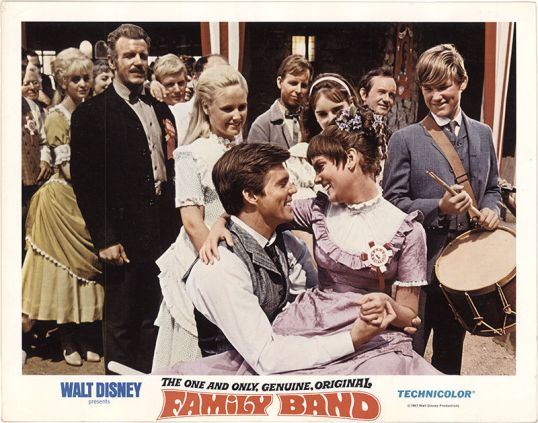
First released in 1968, The One and Only, Genuine, Original Family Band is an old school Disney family film that almost feels like a rather mean-spirited parody of an old school Disney family film.  The songs are forgettable, the film has a cheap made-for-TV look to it, and the whole thing feels a bit too manufactured to  produce any sort of genuine emotion.

That said, it’s memorable for two reasons.  First off, it may be the only film ever made that centers on the presidential election of 1888.  In the Dakota territories, the citizens wait to see whether or not Democrat Grover Cleveland will be reelected or whether he’ll be defeated by Republican Benjamin Harrison.  Those who support the Dakotas joining the Union as one state hope to see Cleveland returned to the White House.  Those who favor the creation of a North and South Dakota hope that Benjamin Harrison will win the election, allowing for four new Republican senators to be sent to Washington.

Confederate veteran Renssaeler “Grandpa” Brown (Walter Brennan) supports the Democrats and he’s got his family singing songs to promote the cause of Grover Cleveland.  Grandpa’s son, Calvin (Buddy Ebsen), is a Republican who still has no problem performing at the Democratic Convention because he, much like his children, is a born performer.  His oldest son, Sidney (Kurt Russell, who was 16 at the time of filming), is not old enough to vote but I imagine he’d probably vote for the Republican ticket because he’s Kurt Russell and it’s hard to imagine Kurt voting for a Democrat.  The other children want to keep both Grandpa and their father happy.  Meanwhile, daughter Alice (Lesley Ann Warren) has fallen in love with newspaper editor, Joe Carder (a very bland John Davidson).  Joe’s a Republican and supports Benjamin Harrison.  Grandpa’s not happy but really Grandpa should just mind his own darn business.  At least, that’s my take on it.  (Also, I gave up cursing for Lent.)

On the one hand, the Bowman sisters are pretty evenly split politically, with two voting for the Democrats and the other two tending to vote Republican so I could definitely relate to the idea of a family that didn’t always agree on politics  At the same time, this film’s premise means that there are a lot of songs about Benjamin and Grover Cleveland in this film and they’re about as memorable and exciting as you would expect a bunch of songs about two of America’s forgotten presidents to be.  If you learn anything about the election of 1888 from this film, you’ll learn that Cleveland’s full name was Stephen Grover Cleveland.  You might also note that, for all the talk about how the country have never been as divided as it is today, people were saying the exact same thing in 1888.

The other thing that makes this otherwise forgettable film stand-out is that it features the film debut of Goldie Hawn, who appears as a Republican dancer in the film’s climax.  This was not only Hawn’s debut but it was also the first film that she made with Kurt Russell.  That said, don’t panic.  Hawn was 22 to Kurt’s 16 when she made this film but the two of them didn’t become a couple until they met again in 1983, while filming Swing Shift.  I read an interview with Kurt where, when asked whether he noticed Goldie Hawn in her film debut, he said that he did but he didn’t even think of talking to her because, “I didn’t even have a car.”

Fortunately, everything worked out in the end.  Benjamin Harrison vanquished Grover Cleveland (though Grover returned in 1892, becoming the first of two president to serve non-consecutive terms) and, after their second film together, Kurt Russell and Goldie Hawn are together to this day.


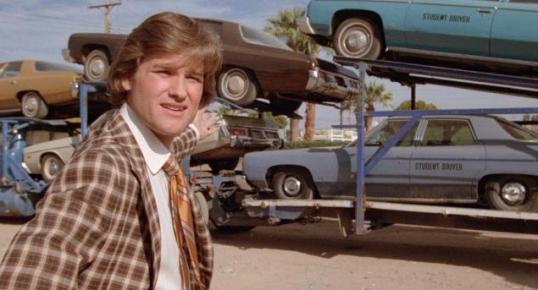
Scenes That I Love: Kurt Russell In Used Cars


Used Cars (1980, directed by Robert Zemeckis)

Today is not only St. Patrick’s Day!  It’s also Kurt Russell’s birthday!

Today’s scene that I love comes from one of my favorite Kurt Russell movies, the wonderful 1980 comedy, Used Cars!  In this scene, Kurt’s ambitious used car salesman promotes his senate candidacy and gets some important advice from his mentor (Jack Warden).  This scene features both Russell and Warden at their considerable best.  Needless to say, if you haven’t watched this film, you need to!

(Watch it with Fargo and have yourself a car salesman double feature!)


Lisa Marie Reviews An Oscar Nominee: The Banshees of Inisherin (dir by Martin McDonagh)


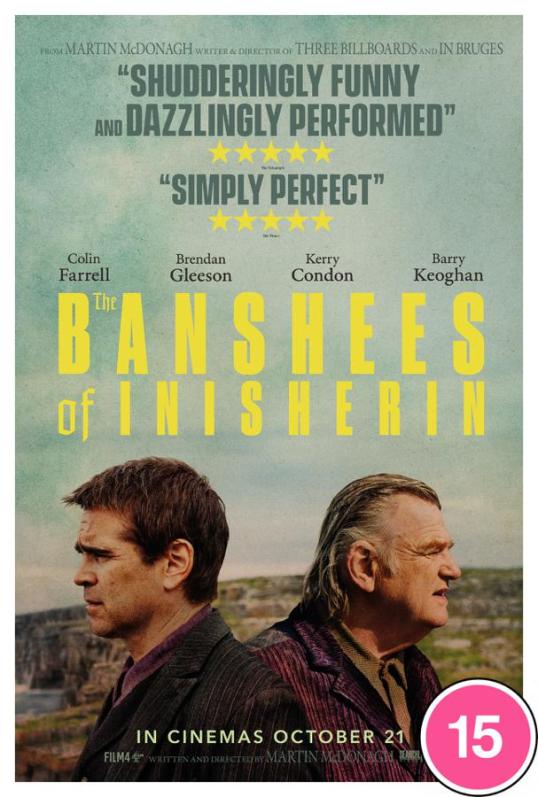
2022’s The Banshees of Inisherin takes place in 1923, near the end of the Irish Civil War.

On the fiction isle of Inisherin, the inhabitants are safe from the the fighting happening on the main land.  Occasionally, they can hear the gunfire and the explosions coming from Ireland but, for the most part, they’re content to go about their lives the same as they always have.  A few do dream of changing their routine.  Young Dominic Kearney (Barry Keoghan) has a crush on Siobhán Súilleabháin (Kerry Condon), who herself occasionally entertains the idea of leaving Inisherin and seeking something better.  But, for the most part, everyone is happy with doing the same thing over and over again.  They know exactly when they will see each other.  They know where everyone will be at any given moment of time.  They know that Colm Doherty (Brendan Gleeson) will be playing his fiddle at the pub or sitting in his cottage with his dog.  They know that every morning, he will have a drink with his best friend (and Siobhan’s brother), Padraic (Colin Farrell).

Except, one day, Colm abruptly tells Padraic that he no longer wants to be his friend.

Padraic has a difficult time understanding what Colm could possibly mean.  He and Colm have always been friends.  How can Colm suddenly no longer be his friend?  Making things even more frustrating is that Colm refuses to explain what, if anything, Padraic has actually done to make Colm no longer want to be his friend.  The closest thing to an explanation that Padraic gets is that Colm finds Padraic to be boring.  Colm, who composes music and, at the very least, seems to spend a good deal of time in contemplation, is tired of Padraic’s jokes and his simple ambitions.  He’s even tired of hearing about Padraic’s pet donkey, Jenny.  In order to show how sincere he is in his desire to no longer speak to Padraic, Colm says that he will chop off one of his fingers every time that Padraic speaks to him.  Padaic, who loves to talk and really doesn’t have anyone other than Colm and his sister to talk to, is shocked when fingers start to show up at his home.  It only escalates from there.

It’s a darkly funny movie, which is no surprise considering that it was written and directed by Martin McDonagh.  If anyone can make you smile while discussing mutilating himself, it’s Brendan Gleeson.  At heart, though, The Banshees of Inisherin is a deadly serious film with the characters of Colm and Padraic obviously meant to represent more than just two friends who are no longer speaking.  Colm, in his desire to have something more to his life than just his boring life in Inisherin, chops off his fingers and leaves you wondering how he will be able to play the fiddle that he loves so much.  It seems counter-productive but once Colm says he’s going to do it, he has no choice but to follow through.  The simple-minded but achingly sincere Padraic goes from simply being emotionally wounded to being vengeful over Colm’s rejection.  It’s easy to see that Colm originally ended the friendship because he was depressed and feeling as if he had wasted his entire life on Inisherin.  Unfortunately, by the time Colm and Padraic come to understand this very common emotion, they’re both too far gone to turn back.  While Colm and Padraic go from being friends to sworn enemies, Dominic attempts to be more assertive and Siobhan dreams of perhaps the same thing that motivates Colm, an escape from Inisherin.

The Banshees of Inisherin is a well-acted and thought-provoking film, one that mixes serious of heart-rendering drama with scenes of dark comedy.  Brendan Gleeson, Colin Farrell, Barry Keoghan, and Kerry Condon were all Oscar-nominated for their work here.  It’s hard to believe that this was Gleeson’s first nomination.  (Gleeson lost Supporting Actor to Ke Huy Quan for Everything Everywhere All At Once.  I would argue that Gleeson should have been nominated for Best Actor and that he deserved the Oscar over The Whale‘s Brendan Fraser.)  Farrell and Gleeson are believable as both lifelong friends and sudden enemies.  Farrell delivers his lines with such earnest conviction that he actually brought tears to my eyes.

Despite having received 9 nominations, The Banshees of Inisherin didn’t win in any of its categories, not even for Best Original Screenplay.  The Banshees of Inisherin lost Best Picture to Everything Everywhere All At Once, a true Oscar injustice.

Lisa Marie Reviews An Oscar Winner: Belfast (dir by Kenneth Branagh)


When it comes to the Oscar race, there will often be a film that is anointed at the front runner just to falter once it’s actually released.   It may be hard to believe now but, way back in 2013, almost every Oscar pundit spent the early part of the year predicting that George Clooney’s The Monuments Men would be a major contender.  Martin Scorsese’s Silence suffered a similar fate in 2016.  Sometimes, it’s because the films in question are truly flawed.  The Monuments Men pretty much confirmed that Clooney’s directorial instincts were aggressively middlebrow.  Sometimes, it’s because the film itself turns out to appeal to a very narrow audience.  That was the case with Silence, one of the most Catholic films ever released by a major studio.  Unfortunately, when these front runners falter, they tend to get hit by a backlash, with some critics and audience members seeming to take it personally that the film was not as much of a triumph as they were expecting.

That was certainly the case with Kenneth Branagh’s Belfast.  Released in 2021, Belfast spent much of the year being touted as the obvious front runner for Best Picture.  Seriously, how could the Academy resist it?  Not only was the film in black-and-white but it was said to be Branagh’s most personal film.  One of the best actors in the Western World, the man who had revived cinematic interest in Shakespeare, had now written and directed a film about his youth in Belfast.  The film would deal with growing up as a protestant during the early days of the  Troubles.  Jamie Dornan and Caitriona Balfe where playing Branagh’s parents.  The great Judi Dench and Ciaran Hinds were playing his grandparents.  For all the acclaim that he had received over the years, Kenneth Branagh had yet to actually win an Oscar.  Indeed, some felt that, pre-Belfast, it was a bit embarrassing that he had only been nominated for twice for his acting and once for his direction.

However, when Belfast came out, critics were complimentary but, at the same time, there was a slight undercurrent of disappointment in most of the reviews.  Belfast was good, they seemed to be saying, but it wasn’t as good as they were expecting.  Some members of Film Twitter was practically savage towards the film, as if Branagh had personally insulted them by making a nostalgic film about his childhood.  Belfast received seven Oscar nominations but it was no longer the Oscar front runner.  That role had been assumed by the technically impressive but emotionally remote The Power of the Dog.

Belfast has its flaws.  Some scene works better than others, the ending is a bit overdone, and, for a film that was sold as being a memoir, some of the scenes do feel a bit familiar as if Branagh spent his childhood imitating moments from other coming-of-age films.  That said, I liked Belfast and I don’t think it deserved all of the criticism that it received.  Young Jude Hill did a wonderful job as Buddy, the Kenneth Branagh stand-in.  Jamie Dornan proved that he was capable of more than one might have suspected based on his work in the Fifty Shades of Grey films.  He and Caitriona Balfe were a compelling couple and the actors had such a strong chemistry that I found myself wishing that the film had been even more about their marriage.  At this point, we take actresses like Judi Dench and actors like Ciaran Hinds for granted but both of them are truly wonderful in this film.  At its best, Belfast captures the feeling of being young and not realizing that the world is basically collapsing around you.  Buddy may be growing up in the shadow of The Troubles but, until the unrest literally comes into his home, he just wants to enjoy movies and have fun with his friends. Belfast is nostalgic and sometimes a bit predictable in its storytelling but it’s gorgeous to look at and the acting won me over.

In then end, the Academy honored neither Belfast nor The Power of the Dog for Best Picture but instead another film about family, the far more straight-forward CODA.  Branagh, however, did win his first Oscar for Best Original Screenplay.

Lisa Marie Reviews An Oscar Nominee: In The Name Of The Father (dir by Jim Sheridan)


One thing that I’ve come to realize is that Irish-Americans (like myself) have been guilty of idealizing the Irish Republican Army in the past.

We tend to view the IRA as being freedom fighters, battling against the occupation and standing up against religious bigotry.  The truth of the matter is that the IRA was a violent organization whose actions often made things even worse for the Catholics in Northern Ireland.  While the IRA’s American supporters always tended to present the IRA as plotting actions against the British army, the truth of the matter is that many of the IRA’s victims were Irish citizens who were judged to either be collaborators or to not be properly enthused about the IRA in general.  The popular excuse for the IRA’s terrorism is to say that the IRA usually called and gave advanced warning before a bomb went off but really, that’s kind of a weak excuse when you think about it.  Really, the only thing that the IRA had going for it was that the British were often just as bad and even more heavy-handed when it came to dealing with the Irish.

In 1993’s In The Name of the Father, Daniel Day-Lewis plays Gerry Conlon, who is sent to London by his father, Giuseppe (Pete Postlethwaite), specifically to keep him from falling victim to the IRA.  Of course, once Gerry arrives in London, he supports himself through burglaries and spends most of his time in a state of stoned bliss with his friends.  It’s while Gerry is in London that an IRA bomb blows up a pub in Guildford.  When Gerry later returns to Belfast, he is promptly arrested and accused of being one of the four people responsible for the bombing.

Gerry protests that he’s innocent and we know that he’s innocent.  We know that, when the bomb was placed, Gerry was busy getting high with Paul Hill (John Lynch).  Paul has also been arrested and the British police are determined to get a confessions out of both him and Gerry.  The interrogation stretches for hours.  Though exhausted, Gerry refuses to confess.  Suddenly, Inspector Robert Dixon (Corin Redgrave) enters the room.  He walks up to Gerry and whispers in his ear that if Gerry doesn’t confess, “I will kill your Da.”

It’s a shocking moment because the threat is delivered without a moment of hesitation on the part of Dixon.  Dixon’s voice is so cold and so direct that, when I watched this film, I actually gasped at the line.  An exhausted and terrified Gerry confesses.  Soon, Gerry is thrown in prison.  He’s joined by his sickly father, who has been accused of being a co-conspirator.  At first, Gerry resigns himself to never being free again.  He meets Joe (Don Baker), who says that he’s the one who set the bomb and that he confessed after Gerry, Giuseppe, Paul Hill, and the other members of the so-called Guildford Four had been given their life sentences.  With Giuseppe’s health faltering, Gerry finally steps up and, with the help of an attorney (Emma Thompson), fights for his freedom.

In The Name of the Father is a powerful film, one that was based on a true story.  Gerry and his father come to represent every victim of a biased justice system and an authoritarian-minded police force.  Gerry starts the movie trapped between the two sides of the Troubles.  The IRA doesn’t trust him because he’s not a bomb-thrower.  The British distrust him because he’s Irish.  Despite his innocence being obvious, Gerry finds himself sent to prison because letting him go would be viewed as a sign of weakness.  Daniel Day-Lewis gives a passionate and charismatic performance as the impulsive and somewhat immature Gerry but the film’s heart really belongs to the late Pete Postlethwaite, playing a father who refuses to give up on either his freedom or his son.

In The Name of the Father received seven Oscar nominations, including Best Picture, Director, Actor, Supporting Actor, and Supporting Actress (for Emma Thompson).  That was also the year of Schindler’s List, which took the Oscars for both Picture and Director.  Daniel Day-Lewis lost to Philadelphia’s Tom Hanks while Postlethwaite lost to Tommy Lee Jones for The Fugitive and Thompson lost to Anna Paquin for The Piano.  1993 was a good year for movies and the Oscars, though I would have voted for Day-Lewis over Hanks.

Lisa Marie Reviews An Oscar Winner: The Crying Game (dir by Neil Jordan)


Directed by Neil Jordan and first released in 1992, The Crying Game opens at a fair in Northern Ireland.  A black British soldier named Jody (Forest Whitaker) meets a flirtatious woman named Jude (Miranda Richardson).  Jude leads Jody away from the fairground.  Jody thinks that they’re going to have sex but instead, he ends up getting kidnapped by Fergus (Stephen Rea) and Peter Maguire (Adrian Dunbar).  As Peter explains it after Jody is taken to an abandoned cottage, the soldier is now a prisoner of the Irish Republican Army.

Jody is left in a dark room, tied to a chair and with a canvas bad over his head.  Fergus is often left to guard him.  Despite Peter’s explicit orders, Fergus talks to Jody and the two men strike up an uneasy friendship.  Fergus removes the bag from Jody’s head.  He even reveals his name.  Jody and Fergus talk about their lives.  Jody says he joined the Army and was immediately sent to the most racist part of the UK.  Fergus replies that his only issue with Jody is that “you shouldn’t be over here.”  Jody talks about his love of cricket.  Fergus talks about his love of hurling.  Fergus sees a picture of Jody with his lover, Dil (Jaye Davidson).  Fergus comments that Dil is attractive.  “She’s not your type,” Jody replies.

Peter warns Fergus not to become friends with Jody because there’s a good chance that they’re going to have to execute him.  And when the British refuse to exchange prisoners, the order does come down to carry out the execution.  Fergus demands that he be allowed to carry out the shooting.  However, as he leads Jody out of the cottage, Jody breaks free.  Fergus chases him but, as they reach a nearby road, Fergus realizes that he can’t bring himself to kill Jody.  Unfortunately, Jody is still killed when he’s run over by a British army truck.

Fergus flees to London and, after getting a job as a construction worker, he tries to lay low and track down Dil.  Dil, however, turns out to be not quite was Fergus was expecting.  It turns out that Jody didn’t reveal every aspect of his life while he was trapped in that cottage.  Meanwhile, Jude and Peter both show up in London and demand that Fergus help them execute “some judge.”

The Crying Game is a twisty and engaging thriller, one that is best known for the twist involving Dil’s identity but which is also a thought-provoking look at the assumptions we make about each other and the roles that people feel forced to play.  Fergus doesn’t really have it in him to be a terrorist or an assassin but it’s the role that he feels he’s been forced into by his desire to see the British leave Northern Ireland.  Jody turns out to have a few secrets of his own and, once their revealed, his eagerness to go off with Jude is seen in an entirely new light.  Jude and Peter present themselves as being honorable freedom fighters but their actions often seem to suggest the opposite.  In the end, the only character who is truly comfortable with their nature is Dil.  Both Stephen Rea and Jaye Davidson more than deserved their Oscar nominations.  Their chemistry goes a long way towards making this a thriller that sticks with you.

The Crying Game was nominated for several Oscars but lost the majority of them to Unforgiven.  (Both Stephen Rea and Clint Eastwood lost Best Actor to Al Pacino for Scent of a Woman.)  However, Neil Jordan did win an Oscar for his clever screenplay.  Rea has continued to act.  Davidson, who reportedly hated the fame that came with appearing in The Crying Game, appeared in one more film before retiring.

Lisa Marie Reviews An Oscar Winner: My Left Foot (dir by Jim Sheridan)


“This is Christy Brown, writer, genius!”

So declares Patrick Brown (Ray McAnally) as he carries his son, Christy Brown, into a Dublin pub.   It’s one of the most emotional moments to be found in the 1989 Best Picture nominee, My Left Foot.  Based on the main character’s memoir, My Left Foot tells the story of Christy Brown, wh was born into a working class Dublin  family of 15 and who grew up to become an acclaimed writer and artist.  Afflicted with cerebral palsy, Brown’s left foot was the only part of his body that he had full control over.  The film follow Brown as he learns to write, paint, and communicate with that foot.  As a child, Christy Brown is played by Hugh O’Conor.  As a young man, he’s played by Daniel Day-Lewis, who apparently stayed in character even when he wasn’t filming.  Day-Lewis won his first Oscar for his performance as Christy Brown.  Brenda Fricker won a Supporting Actress Oscar for playing Christy’s mother, Bridget Fagan Brown, making My Left Foot the first Irish film to win any competitive Oscars.  I would argue that Ray McAnally, at the very least, deserved a nomination for Supporting Actor as well.  (Sadly, McAnally passed away shortly before the release of My Left Foot.)

My Left Foot is an inspiring movie but, at the same time, it’s an honest one.  Christy Brown’s life is never portrayed as being easy and Christy himself is never portrayed as being a saint.  There are time when Christy is pissed off at the world, at one point even starting a brawl in a pub.  Even after Christy is accepted into a school for people with Cerebral Palsy and he has the first exhibition of his work, there is still heartbreak.  Christy has fallen in love with a woman named Eileen (Fiona Shaw) and when he discovers that she’s engaged, he comes close to ending his own life.  It’s a not to watch as Christy’s pain feels so real and so intense that you almost feel like an intruder while watching.  The film leaves you cheering for Christy and happy that he’s found a way to express his feelings and his intelligence but at the same time, it never fools you into thinking that Christy is going to have an easy life.  The film’s too honest to end on a note of false hope.

My Left Foot features one of Daniel Day-Lewis’s best performances.  (Though who say that every Day-Lewis performance is one of his best have obviously never seen Nine.)  Day-Lewis not only captures Christy’s physical condition but, even more importantly, he allows us into Christy’s mind.  We get to know Christy as much for his sharp wit and intellect as for his physical disability.  Brenda Fricker plays Bridget as being earthy but supportive, someone who always tries to do the best for her son.  But the performance that really makes me cry is the performance of Ray McAnally, who initially doesn’t know what to make of his son but who changes his mind once he sees Christy writing with his left foot.  “Genius!” he declares and it brings tears to the eyes of everyone watching.

My Left Foot was also nominated for Best Picture and Best Director.  Oliver Stone won Best Director for a much more grandiose portrait of disability, Born On The Fourth Of July.  Best Picture, meanwhile, went to Driving Miss Daisy.

Monday Live Tweet Alert: Join Us for Operation Lipstick!


As some of our regular readers undoubtedly know, I am involved in hosting a few weekly live tweets on twitter and occasion ally Mastodon.  I host #FridayNightFlix every Friday, I co-host #ScarySocial on Saturday, and I am one of the five hosts of Mastodon’s #MondayActionMovie!  Every week, we get together.  We watch a movie.  We snark our way through it.

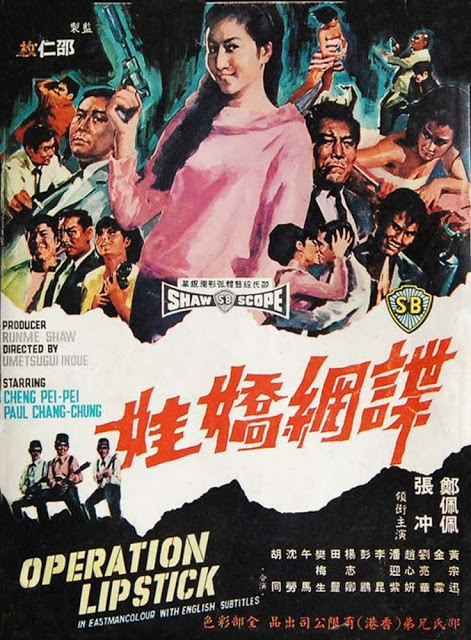
Tonight, for #MondayActionMovie, the film will be 1967’s Operation Lipstick!

It should make for a night of fun viewing and I invite all of you to join in.  If you want to join the live tweets, just hop onto Mastodon, pull up Operation Lipstick on YouTube, start the movie at 8 pm et, and use the #MondayActionMovie hashtag!

Enjoy!