A Movie A Day #24: Rebel (1970, directed by Robert Allen Schnitzer)


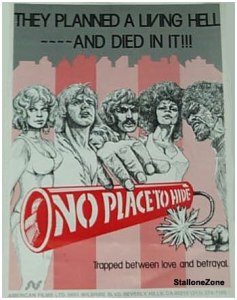
noplacetohidepressRebel opens the same way as First Blood, with Sylvester Stallone hitchhiking on a country road.  Other than that, the two films have nothing in common.  For one thing, in Rebel, Sly is wearing a big floppy hat and stops to feed some horses with a big, goofy grin on his face.  He also doesn’t get hassled by the man.  Instead, he gets picked up by a bunch of hippies in VW microbus.

Stallone is playing Jerry Savage, an anti-war activist, former college student, and probably one of the hippies that spit on John Rambo when he returned from Nam.  Disillusioned by protest marches that don’t seem to accomplish anything, Jerry is going to New York City so he can hook up with the Weather Underground.  He and his friends are planning to blow up a kitchen goods company that has accepted a contract to build bamboo cages for the government.  What Jerry doesn’t know is that the FBI is onto his scheme.  Nothing works out but the movie is mostly about Jerry sitting around and talking to people about how messed up the world is.  It all ends, as all low-budget movies from the 1960s must, with Jerry running through a green field.
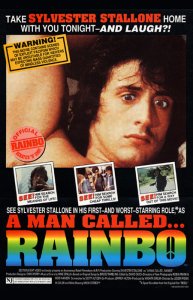
rainboThis was Stallone’s second film, after A Party At Kitty and Stud’s.  He was twenty-four years old.  The film was originally released under the title No Place To Hide and it vanished until Rocky made Stallone an unlikely star.  It was re-released in 1980, now called Rebel and re-edited to remove almost every scene not involving Jerry, making it even more of a Stallone vehicle.  This is the version that is currently available on YouTube.  In 1983, new scenes were shot and this film was released once again, this time as a comedy called A Man Called … Rainbo.

(Rambo.  Rainbo.  Get it?)

Regardless of which version you find, there’s no reason to watch Rebel beyond the strangeness of seeing Sylvester Stallone play a hippie revolutionary but, especially if you’re a fan of Sly’s 80s law-and-order phase, that’s reason enough.  Even before he was best known as Rocky, Rambo, and Cobra, Sly seems miscast as a peace-loving radical.  He delivers his lines softly, trying to hide his trademark New York accent.  Stallone is the best actor in the movie but, if you saw this movie in 1970, you would never expect its lead to one day be one of the biggest stars in the world.
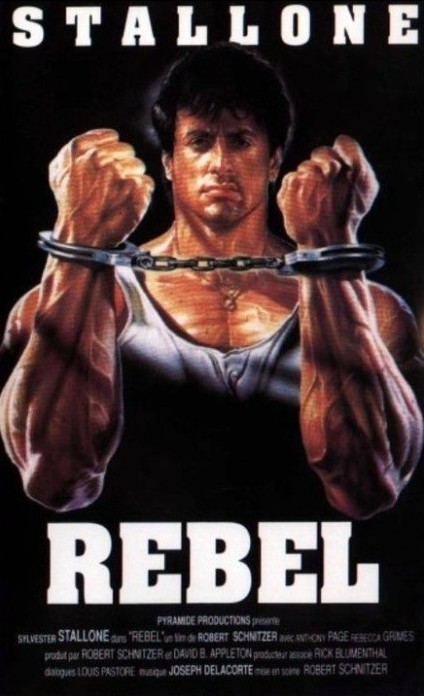
021_001

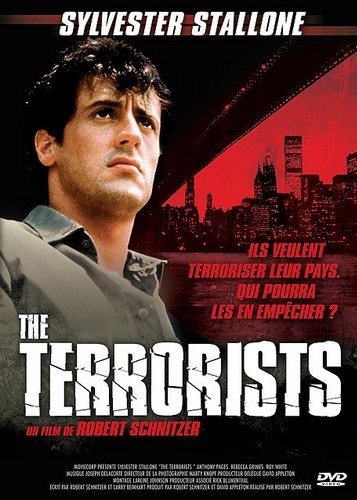
In France, it was called The Terrorists.

The international version was called The Terrorists.
 

A Movie A Day #23: The Valachi Papers (1972, directed by Terrence Young)


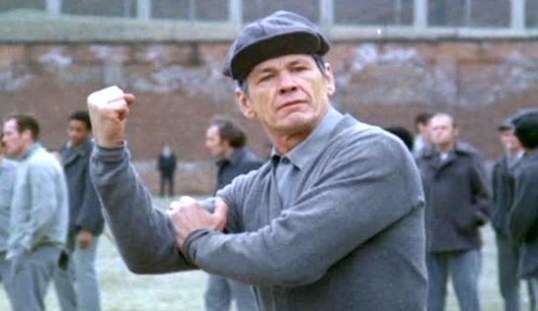
The best thing about The Valachi Papers is this:

valachi-0

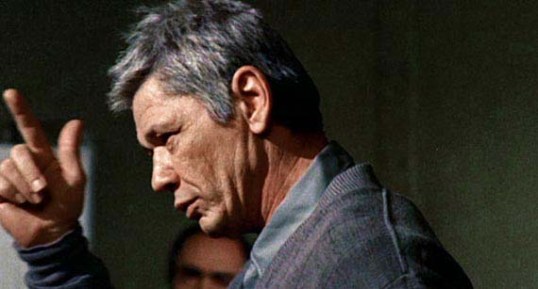
That is Charles Bronson, playing real-life mob informant Joe Valachi and making a gesture that expresses the way many people feel about the world right now.  Valachi, in both the film and real life, was a bit player in the Cosa Nostra, a driver and an occasional hitman who was lucky enough to marry the daughter (played by Bronson’s real-life wife, Jill Ireland) of one of the bosses.  In prison for smuggling heroin, Valachi runs into one of those bosses, Vito Genovese (Lino Ventura).  Genovese, convinced that Valachi has broken the code of omerta, gives Valachi the kiss of death.  Valachi kisses him right back and then becomes a rat.

Valachi’s 1963 testimony to the U.S. Senate was the public’s first glimpse into life in the Mafia.  Many of the cliches that have since appeared in every mob movie or television show were the result of Valachi’s testimony and Peter Maas’s subsequent book, The Valachi Papers.  (In the “Test Dream” episode of The Sopranos, Tony can be seen holding a copy of The Valachi Papers.)

Over the years, doubts have been raised about both the validity of Valachi’s testimony and his claim that he only turned rat because Genovese put a contract on his life.  The film version of The Valachi Papers takes Valachi’s claims at face value, telling Valachi’s story in a series of flashbacks.

The Valachi Papers is often compared to another mob movie that came out in 1972, The Godfather, though there’s really not much of a comparison to be made.  Whereas The Godfather was a family saga, The Valachi Papers is much more concerned with the day-to-day operations of the Mafia.  It never comes close to matching The Godfather‘s epic feel and the cheap production values don’t help.  (Keep an eye out for the twin towers of the World Trade Center, anachronistically towering over depression-era New York City.)

Storywise, The Valachi Papers actually has more in common with Goodfellas than with The Godfather.  Like Henry Hill, Joe Valachi is not a major player.  He’s just a working man whose employer happens to be the Mafia.  Stylistically, of course, The Valachi Papers has nothing in common with Goodfellas.  If not for the violence and some the language, it would be easy to mistake The Valachi Papers for an old made-for-TV movie.

The best thing about The Valachi Papers is Charles Bronson as Joe Valachi.  When The Valachi Papers was made, Bronson was a huge draw in Europe but was still largely unknown in the United States.  It was not until Death Wish came out, two years later, that Bronson became a star.  He does a good job as Joe Valachi.  In a way, it’s the perfect role for Bronson, who was a genuine tough guy who, like Valachi, spent decades working in the trenches before eventually becoming a household name.

I don’t think Charles Bronson ever would have turned informant, though.

Not our Chuck.

the_valachi_papers_still

A Movie A Day #22: Messenger of Death (1988, directed by J. Lee Thompson)


messenger_of_deathIn rural Colorado, the three wives and all the children of Orville Beecham (Charlie Dierkop) have been murdered.  Veteran journalist Garret Smith (Charles Bronson) discovers that Orville is the son of an excommunicated Mormon fundamentalist named Willis Beecham (Jeff Corey).  Willis, who lives on a heavily armed compound, practices polygamy and wants nothing to do with the outside world.  However, Willis’s brother, Zenas (John Ireland), long ago split with Willis and set up a compound of his own.  At first, Garret suspects that Orville’s family was killed by Zenas.  As Zenas and Willis go to war, Garret discovers that there’s actually a bigger conspiracy at work, one dealing with corporate greed and water rights.  (Forget it, Bronson, it’s Chinatown.)
Messenger of Death was the 2nd to last film that veteran tough guy Charles Bronson made for Cannon Films.  Especially when compared to the other films that he made for Cannon (10 To Midnight, Kinjite, Murphy’s Law, three Death Wish sequels), Messenger of Death features Bronson in a surprisingly cerebral role.  While there is violence, very little of it is actually the result of anything that Bronson does.  For once, Charles Bronson isn’t running around with a gun and blowing away bad guys. If Death Wish‘s Paul Kersey ever did start blowing away muggers in Colorado, Garret would probably be the first to condemn him in a carefully written editorial.  The only time he fights is in self-defense and even then, it’s hand-to-hand combat.  Instead, he spends most of the film doing research and asking questions.  As a result, Messenger of Death is never as much fun as the other films that Bronson made for Cannon but it’s still interesting to see him playing a regular guy.

A Movie A Day #21: A Case of Libel (1983, directed by Eric Till)


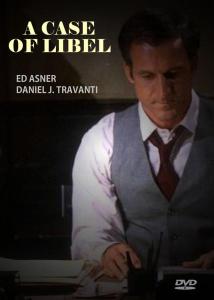
a-case-for-libelIn the 1950s, at the height of the McCarthy era, no one is more feared than Boyd Bendix (Daniel J. Travanti), an acerbic, right-wing gossip columnist.  Anyone who crosses Bendix the wrong way runs the risk of being accused of everything from sexual deviancy to communism.  Bendix’s latest victim is prominent journalist named Dennis Corcoran (Gordon Pinset).  Unlike everyone else who has been bullied by Bendix, Corcoran refuses to quietly submit.  Working with a gruff but brilliant attorney, Robert Sloane (Ed Asner), Corcoran takes Bendix to court.
A Case of Libel was made for Showtime and it is very much the type of movie that was made for teachers to show in classrooms full of aspiring Clarence Darrows.  Adapted from a Broadway play, A Case of Libel is also based on the true story of a successful lawsuit that was brought against columnist Westbrook Pegler in 1955.  A Case of Libel is basically a filmed play but is memorable for the performances of Ed Asner and especially Daniel J. Travanti.

A Case of Libel is a movie that I used to rent, on VHS, from my local video store when I was just starting to get interested in politics.  Because it was a cheap production on a cheap tape, the picture always looked terrible but I still enjoyed it.  Despite what the picture above claims, it’s never gotten an official DVD release and it probably never will be since there’s not a huge demand for old Ed Asner/Daniel J. Travanti courtroom dramas.  If it ever does come out on DVD, I’ll buy it.

A Movie A Day #20: First Family (1980, directed by Buck Henry)


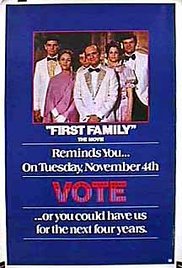
first-familyLike any newly inaugurated President, Manfred Link (Bob Newhart) faces many new challenges.  The biggest challenge, though, is keeping control of his family and his White House staff.  His wife (Madeline Kahn) is an alcoholic.  His 28 year-old daughter (Gilda Radner) is so desperate to finally lose her virginity that she is constantly trying to sneak out of the White House.  General Dumpson (Rip Torn) wants to start a war.  Press Secretary Bunthorne (Richard Benjamin), Ambassador Spender (Harvey Korman), and Presidential Assistant Feebleman (Fred Willard) struggle and often fail to convince everyone that all is well.
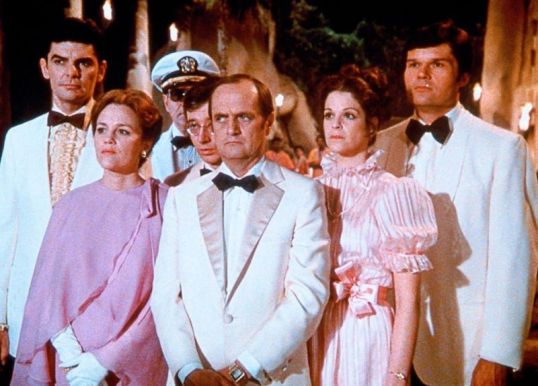
President Link needs to form an alliance with the African country of Upper Gorm, a country that speaks a language that only one man in America, Prof. Alexaner Grade (Austin Pendleton), can understand.  The President of Upper Gorm (John Hancock) orders that the kidnapping of Link’s daughter.  Holding her hostage, he demands that Link send him several white Americans so that the citizens of Upper Gorm can know what it is like to have a minority to oppress.

First Family not only featured a cast of comedy all-stars but it was also directed by one of the funniest men in history, Buck Henry.  So, why isn’t First Family funnier?  There are a few amusing scenes and Newhart can make a pause hilarious but, for the most part, First Family feels like an episode from one of Saturday Night Live‘s lesser seasons.  Reportedly, Henry’s first cut of First Family tested badly and Warner Bros. demanded that certain scenes, including the ending, be reshot.  Perhaps that explains why First Family feels more like a sitcom than a satire conceived by the man who wrote the script for The Graduate and whose off-center perspective made him one of the most popular hosts during Saturday Night Live‘s first five seasons.  Famously, during one SNL hosting gig, Henry’s head was accidentally sliced open by John Belushi’s samurai sword.  Without missing a beat, Henry finished up the sketch and performed the rest of the show with a band-aid prominently displayed on his forehead.  Unfortunately, there’s little sign of that Buck Henry in First Family.

first-family-2


A Movie A Day #19: Kill Me Again (1989, directed by John Dahl)


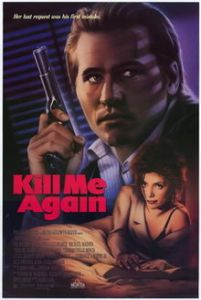
killmeagainFay Forrest (Joanne Whalley) and her boyfriend, Vince Miller (Michael Madsen), make their living stealing from the mob.  After their latest job results in the death of a made man, Fay decides that she needs to escape from the abusive Vince.  She runs away to Las Vegas, where she looks up a small-time, financially strapped P.I., Jack Andrews (Val Kilmer).  She hires Jack to help her fake her death, offering to pay him $5,000 upfront and $5,000 after she’s dead.  Jack is reluctant to get involved but he also has a loan shark threatening to break every bone in his body.  Jack helps Fay fake her death but then Fay leaves town without paying him the second $5,000.  Even worse, both Vince and the mob quickly figure out that Fay is not actually dead and join Jack in trying to track her down.
Predictable but entertaining, Kill Me Again is an early example of the type of modern neo-noir that would become extremely popular in the 1990s.  In his directorial debut, John Dahl shows some hints of the style that he later brought to films like Red Rock West and The Last Seduction.  Val Kilmer was miscast and a few years too young for his role but Joanne Whalley (or Joanne Whalley-Kilmer as she was known when Kill Me Again was filmed) fully inhabitanted the stock role of the sultry femme fatale who can never quite be trusted.  Michael Madsen goes all out as Vince, giving an early version of his performance in Reservoir Dogs.


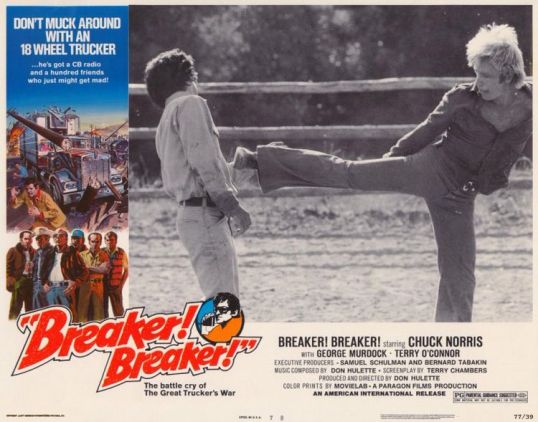
A Movie A Day #18: Breaker! Breaker! (1977, directed by Don Hulette)


breaker-breaker-lobby-card-2

Somewhere, in Southern California, there’s a small town called Texas City.  Texas City is run by a corrupt judge (George Murdock) and a sadistic cop (Don Gentry).  The residents of Texas City make their money by arresting truckers, forcing them to pay huge fines, and selling their rigs to the savage yard.  But they made a mistake when they arrested a trucker named Billy Dawes (Michael Augensten).  Billy has an older brother who is also a trucker.  His name is J.D. and he’s Chuck Norris!

After appearing as an “honorable” villain in Bruce Lee’s The Way of the Dragon and providing martial arts training to the Hollywood elite, Chuck Norris made his starring debut in Breaker!  Breaker!  This is one of those weird only in the 70s hybrid movies.  Mix in a little Deliverance, add a little Smokey and the Bandit, and then toss in Chuck Norris doing a roundhouse kick.  Shake it up and you get Breaker!  Breaker!

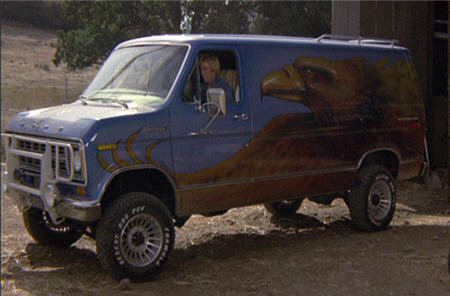
The main problem with Breaker!  Breaker! is that it does not really know what to do with Chuck Norris.  While he’s stil a step above someone like Steven Seagal, Chuck has never exactly been a great actor but, in Breaker!  Breaker!, his inexperience in front of the camera is especially noticeable.  Chuck is at his best when he’s fighting but he spends too much of Breaker!  Breaker! sitting behind the wheel of either his truck or his super groovy 70s van (check out the eagle painted on the side) and doing CB radio patter.  When he does fight, his opponents are all rednecks who, unlike Bruce Lee in Way of the Dragon, don’t stand a chance against him.

norris-van

I did like the movie’s ending, in which an army of big rigs descend on Texas City.  Don’t mess with truckers!

Two final notes: Breaker! Breaker! was edited by Steven Zaillian, who 16 years later, would win an Oscar for writing Schindler’s List.  Also, keep an eye out for Eraserhead himself, Jack Nance, as one of J.D.’s friends.

jack-nance

A Movie A Day #17: The Laughing Policeman (1973, directed by Stuart Rosenberg)


8232729_orig

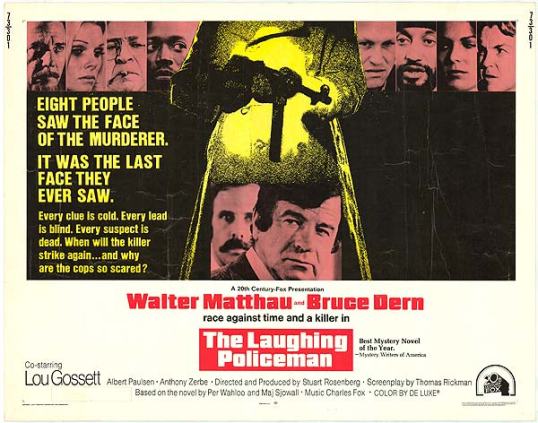
San Francisco in the 1970s.  Revolution is in the air.  Hippies are on every street corner.  A man named Gus Niles knows that he’s being tailed by an off-duty cop, Dave Evans.  Gus boards a city bus, knowing that Evans will follow him.  On the bus, an unseen gunman suddenly opens fire with an M3 submachine gun, not only killing both Evans and Gus but six other people as well.  After the bus crashes, the gunman calmly departs.  At first, it is assumed that the massacre was another random mass shooting, like Charles Whitman in Austin or Mark Essex in New Orleans.  But one San Francisco detective is convinced that it wasn’t random at all.

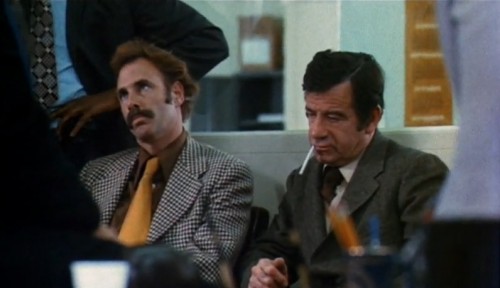
The Laughing Policeman was one of the many police procedurals to be released after the box office success of Dirty Harry and The French Connection and, despite the name, it’s also one of the grimmest.  While the complex mystery behind why Evans was following Gus and who killed everyone on the bus is intriguing, The Laughing Policeman‘s main focus is on the often frustrating nitty gritty of the investigation, complete with false leads, uncooperative witnesses, unanswerable questions, and detectives who frequently make stupid mistakes.  The movie’s first fifteen minutes are devoted to the police processing the bus, with Stuart Rosenberg (best known for directing Paul Newman in Cool Hand Luke) using overlapping dialogue to give the entire scene a documentary feel.  As Detective Jake Martin, Walter Matthau is even more cynical and downbeat than usual while Bruce Dern provides good support as a younger, more volatile detective.  The supporting cast is full of 70s character actors, like Lou Gossett, Anthony Zerbe, Gregory Sierra,and playing perhaps the sleaziest drug dealer ever seen in an American movie, Paul Koslo.

The Laughing Policeman was based on a Swedish novel that took place in Stockholm but, for the movie, Swedish Detective Martin Beck became world-weary Sgt. Jake Martin and Stockholm became San Francisco.  Rosenberg directed the entire film on location, giving The Laughing Policeman the type of realistic feeling that would later be duplicated by TV shows like Hill Street Blues, NYPD Blue, and Law & Order.  Though it may not be as well-known as either Dirty Harry or The French Connection, The Laughing Policeman is a dark and tough police procedural, an underrated classic of the genre.

Incidentally, The Laughing Policeman was one of the first films for which character actor Bruce Dern shared top billing.  According to Dern’s autobiography, Matthau generously insisted that Dern be credited, with him, above the title.

bruce_dern_walter_matthau_the_laughing_policeman_1973-500x288

A Movie A Day #16: Boycott (2001, directed by Clark Johnson)


boycott

Originally made for HBO, Boycott is one of the best and, unfortunately, least-known films made about the life of Martin Luther King, Jr.  Boycott tells the story of the Montgomery Bus Boycott, starting with the arrest of Rosa Parks for refusing to sit in the back of the bus to the eventual integration of the Montgomery public transportation system.  Clark Johnson directs Boycott in a semi-documentary, handheld style, which adds an immediacy to the oft-told story.

Boycott focuses on the role that 24 year-old Martin Luther King, Jr. (played by Jeffrey Wright) played as the leader of the Montgomery Bus Boycott and how the boycott’s success turned King into a national figure.  Jeffrey Wright does a great job playing the young King and it’s interesting to watch as the initially uncertain King finds both his voice and his strength as a leader.  Boycott works as a good companion piece to Selma, not the least because Carmen Ejogo plays Coretta Scott King in both of them.

Also giving a noteworthy performances are Terrence Howard as King’s second-in-command, Ralph Abernathy and Erik Dellums in the role of Bayard Rustin, who was one of King’s closest confidants but, because he was gay, was often left outside of the movement’s inner circle.  Before they worked together on Boycott, Dellums, the son of former U.S. Rep. Ron Dellums, co-starred with Clark Johnson on Homicide: Life on the Street.

Boycott is a tribute to not just Martin Luther King but also the entire civil rights movement.

A Movie A Day #15: Special Bulletin (1983, directed by Ed Zwick)


specialbulletin2

“We interrupt our regularly scheduled programming for a special report…”

Led by veteran anchor John Woodley, the RBS news team is providing continuing coverage of a developing crisis in Charleston, South Carolina, where terrorists are holding several members of the coast guard, a local new reporter, and his cameraman hostage on a small tugboat.  These are not typical terrorists, though.  Two of them are nuclear scientists.  One of them is a social worker.  Another one is a nationally-renowned poet.  The final terrorist is a former banker robber who was just recently released from prison.  This unlikely group has only two demands: that the U.S. government hand over every single nuclear trigger device at the U.S. Naval Base and that RBS give them a live television feed so that they can explain their actions to the nation.  If either of those demands are not met, a nuclear bomb will be detonated and will destroy Charleston.

This made-for-TV movie was shot on video tape, to specifically make it look like an actual news broadcast.  Though much of the movie seems dated when compared to today’s slick, 24-hour media circus, Special Bulletin was convincing enough that, when it was originally broadcast in 1983, it caused a mini-panic among viewers who missed the opening disclaimer:

specbull_disclaimer

Because the movie deals with the threat of nuclear terrorism instead of a U.S.-Soviet nuclear war, it still feels relevant in a way that many of the atomic disaster films of the 1980s do not.  Beyond making an anti-nuclear statement, Special Bulletin is also a critical look at how the news media sensationalizes every crisis, with the RBS news team going from smug complacency to outright horror as the situation continues to deteriorate.  David Clennon and David Rasche are memorable as the two most outspoken of the terrorists and Ed Flanders is perfectly cast as a veteran news anchor struggling to maintain control in the middle of an uncontrollable situation.  Special Bulletin won an Emmy for Outstanding Drama Special and can be currently be found on YouTube.

Keep an eye out for Michael Madsen, who shows up 57 minutes in and gets the movie’s best line: “That guy’s a total psycho ward.”

madsen-special-bulletin