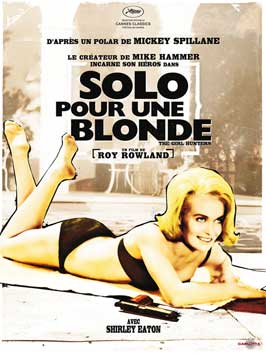
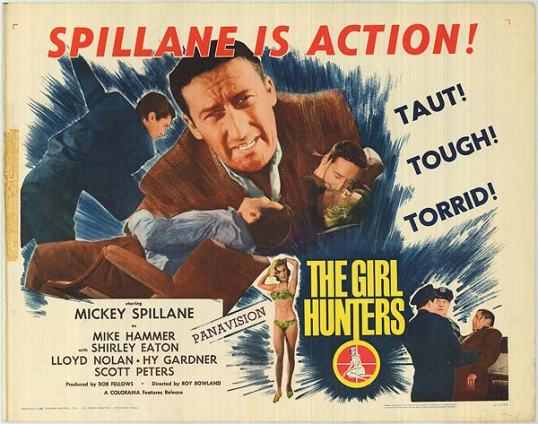
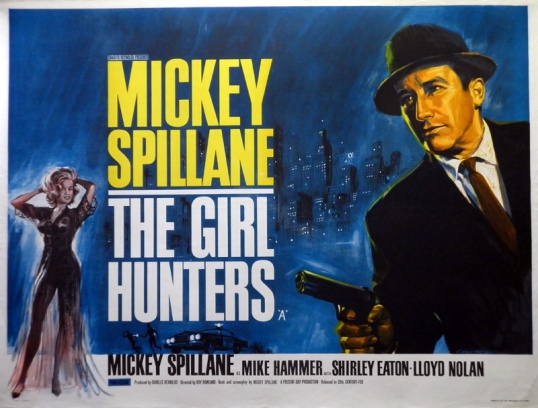
A Movie A Day #158: The Girl Hunters (1963, directed by Roy Rowland)


Private detective Mike Hammer (Mickey Spillane) has spent the last seven years in the gutter.  Ever since his secretary, Velda, disappeared, Hammer has stopped working cases and, instead, spends all of his time drinking and passing out in alleys.  That is where he is found by his old friend, Captain Pat Chambers (Scott Peters).  Pat tells Mike that there has been a shooting.  A man named Richie is dying in the hospital and want to speak to him.  According to Richie, he was shot by the Dragon, the same communist super villain that Velda is currently hiding from.  That sobers Hammer up.  In fact, Mike Hammer is so tough that it only takes him a few minutes to shake off seven years of alcoholism.  Mike discovers that Richie’s murder is also connected to the murder of a senator.  Mike’s investigation leads him to both the senator’s bikini-clad wife (Shirley Eaton) and a communist conspiracy to take over the world.  What is strange is that it never leads him to Velda.  Maybe he would have found her if The Girl Hunters had gotten a sequel.

Many films were based on Mickey Spillane’s Mike Hammer novels but The Girl Hunters is unique because it stars Mickey Spillane as Hammer.  Spillane was not much of an actor but he was a genuine tough guy who, even after he became a successful writer, still looked like he had gone a few rounds with the world so he was not necessarily miscast in the role of Hammer.  The main problem with The Girl Hunters is that the mystery is not that interesting.  Mike Hammer does not really investigate anything.  He just goes from fight to fight.  At the end of the movie, he does come up with a clever trick to catch the killer but since there is only one suspect, the killer’s identity is not a surprise.s   The Girl Hunter is worth seeing for Shirley Eaton in a bikini and the novelty of Mickey Spillane playing his most famous creation but Kiss Me Deadly is still the best Mike Hammer film.
The French poster leaves no doubt about The Girl Hunters’ main selling point.
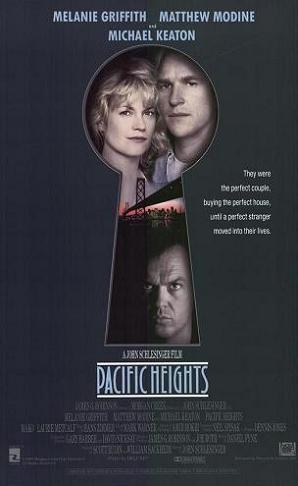
A Movie A Day #157: Pacific Heights (1990, directed by John Schlesinger)


Michael Keaton is the tenant from Hell in Pacific Heights.

In San Francisco, Patty (Melanie Griffith) and Drake (Matthew Modine) have just bought an old and expensive house that they can not really afford.  In order to keep from going broke, they rent out two downstairs apartments.  One apartment is rented by a nice Japanese couple.  The other apartment is rented by Carter Hayes (Michael Keaton).  Carter convinces Patty and Drake not to check his credit by promising to pay the 6 months rent up front.  The money, he tells them, is coming via wire transfer.

The money never arrives but Carter does.  Once he moves into the apartment, Carter changes the locks so that no one but him can get in.  At all hours of the day and night, he can be heard hammering and drilling inside the apartment.  Even worse, he releases cockroaches throughout the building.  When Drake demands that Carter leave, the police back up Carter.  After goading Drake into attacking him, Carter gets a restraining order.  Drake is kicked out of his home, leaving Patty alone with their dangerous tenant.

Pacific Heights is the ultimate upper middle class nightmare: Buy a house that you can not really afford and then end up with a tenant who trashes the place to such an extent that the property value goes down.  As a thriller, Pacific Heights would be better if Drake and Patty weren’t so unlikable.  (When this movie was first made, people like Patty and Drake were known as yuppies.)  Much like Drake’s house, the entire movie is stolen by Michael Keaton’s performance as Carter Hayes.  Carter was not an easy role to play because not only did he have to be so convincingly charming that it was believable that he could rent an apartment just by promising a wire payment but he also had to be so crazy that no one would doubt that he would deliberately infest a house with cockroaches.  Michael Keaton has not played many bad guys in his career but his performance as Carter Hayes knocked it out of the park.

One final note: Keep an eye out for former Hitchcock muse (and Melanie Griffith’s mother) Tippi Hedren, playing another one of Carter’s potential victims.  Her cameo here is better than her cameo in In The Cold of the Night.


A Movie A Day #156: Slaughter (1972, directed by Jack Starrett)


The Mafia just pissed off the wrong ex-Green Beret.

After his father is blown up by a car bomb, Captain Slaughter (Jim Brown) single handily wipes out the Cleveland mob.  Only one gangster, Dominic Hoffo (Rip Torn), escapes to South America.  The Treasury Department (represented by Cameron Mitchell) sends Slaughter and two other agents (Don Gordon and Marlene Clark) after Hoffo.  Along with being a ruthless gangster, Hoffo is a viscous racist and is convinced that he will be able to easily take care of Slaughter.  Hoffo does not understand how much trouble he’s in.  No one stops Slaughter.

Produced by American International Pictures, Slaughter is one of the classic blaxploitation films. While it may not have the political subtext of some of the best blaxploitation films, Slaughter is a fast and mean action film, directed in a no nonsense manner by B-movie veteran Jack Starrett.  There is not a wasted moment to be found in Slaughter.  It starts and ends with cars exploding and, in between, it doesn’t even stop to catch its breath.

In the 1970s, Richard Roundtree was John Shaft, Ron O’Neal was Superfly, Jim Kelly was Black Belt Jones, Fred Williamson was Black Caesar, and Jim Brown was Slaughter.  Whatever skills Jim Brown lacked as an actor, he made up for with sheer presence.  He commanded the screen.  Whether he was playing football on television or beating down the Mafia in the movies, no one could stop Jim Brown.  Slaughter is Brown at his toughest.  Rip Torn is the perfect villain, screaming out racial slurs even when Slaughter has him trapped in an overturned car.   Jim Brown has said that, of all the films he has made, Slaughter is one of his three favorites.  (The other two were The Dirty Dozen and Mars Attacks!)

Slaughter‘s cool factor is increased by the presence of Stella Stevens, playing the role of Ann, Hoffo’s mistress.  It only takes one night with Slaughter for Ann to switch sides.  Nothing stops Slaughter.

A Movie A Day #155: Out of the Fog (1941, directed by Anatole Litvak)


When two aging fishermen (Thomas Mitchell and John Qualen) attempt to buy a new boat, they run into a problem with local mobster, Harold Goff (John Garfield).  As Goff explains, if they do not pay him $5.00 a week, something bad could happen to their boat.  When one of the fisherman’s daughter (Ida Lupino) falls in love with Goff, she makes the mistake of letting him know that her father is planning on giving her $190 so that she can take a trip to Cuba.  When Goff demands the money for himself, the fishermen attempt to go to the police, just to be told that there is nothing that the authorities can do.  Goff tricked them into signing an “insurance” contract that allows him to demand whatever he wants.  The two fishermen are forced to consider taking drastic measures on their own.  Out of the Fog is an effective, early film noir, distinguished mostly be John Garfield’s sinister performance as Harold Goff.

Out of the Fog is also memorable as an example of how Hollywood dealt with adapting work with political content during the production code era.  Out of the Fog was based on The Gentle People, a play by Irwin Shaw.  In the play, which was staged by The Group Theater in 1939, Harold Goff was obviously meant to be a symbol of both European fascism and American capitalism.  In the play, the two fisherman had Jewish names and were meant to symbolize those being persecuted by the Third Reich and its allies.  In the transition for stage to film, Jonah Goodman became Jonah Goodwin and he was played by the very talented but definitely not Jewish Thomas Mitchell.   The play ended with Harold triumphant and apparently unstoppable.  Under the production code, all criminals had to be punished, which meant the ending had to be changed.  Out of the Fog is an effective 1940s crime thriller but, without any political subtext, it lacks the play’s bight.

One final note: while Out of the Fog had a good cast, with up and comer John Garfield squaring against old vets Thomas Mitchell and John Qualen, the original Broadway play’s cast was also distinguished.  Along with contemporary film stars Sylvia Sidney and Franchot Tone, the play’s cast was a who’s who of actors and directors who would go on to be prominent in the 1950 and 60s: Lee J. Cobb, Sam Jaffe, Karl Malden, Martin Ritt, and Elia Kazan all had roles.


A Movie A Day #154: The Day They Hanged Kid Curry (1971, directed by Barry Shear)


Welcome to the Old West.  Hannibal Heyes (Pete Duel) and Kid Curry (Ben Murphy) are two of the most wanted outlaws in the country, two cousins who may have robbed trains but who also never shot anyone.  After being promised a pardon if they can stay out of trouble for a year, Heyes and Curry have been living under the names Joshua Smith and Thaddeus Jones.

During a trip to San Francisco to visit his old friend, a con artist named Silky O’Sullivan (Walter Brennan), Heyes is told that Kid Curry is currently on trial in Colorado.  When Heyes goes to the trial, he discovers that the accused (Robert Morse) is an imposter and that the real Kid Curry is watching the trial from the back of the courtroom.  It turns out that the man of trial is just an attention seeker , someone who is so desperate for fame that he is willing to be hanged to get it.  At first, Curry thinks this is a great thing.  After the imposter hangs, everyone will believe that Curry is dead and they’ll stop searching for him.  Heyes, however, disagrees, especially after the imposter starts to implicated Heyes in crimes that he didn’t commit.

Obviously inspired by Butch Cassidy and the Sundance Kid, Alias Smith and Jones was one of the last of the classic TV westerns.  Though I originally assumed that it was the show’s pilot, The Day They Hanged Kid Curry was actually the first episode of the second season.  With commercials, it ran 90 minutes.  Because of its extended running time, The Day They Hanged Kid Curry was not included in Alias Smith and Jones‘s standard rerun package.  Instead, it was edited to remove the show’s usual opening credits and it was then sold as a motion picture, despite the fact that it is very obviously a television show.

As long as no one is expecting anything more than an extended television episode, The Day They Hanged Kid Curry is okay.  I have never been a big Alias Smith and Jones fan but this episode’s plotline, with Robert Morse confessing to crimes he didn’t commit just so he can have a taste of fame before he dies, feels prescient of today’s culture.  For classic western fans, the main reason to watch will be the chance to see a parade of familiar faces: Slim Pickens, Henry Jones, Paul Fix, and Vaughn Taylor all have roles.  Most important is familiar Western character actor and four-time Oscar winner, Walter Brennan, as Silky O’Sullivan.  This was one of Brennan’s final performance and the wily old veteran never loses his dignity, even when he’s pretending to be Kid Curry’s grandmother.

As for Alias Smith and Jones, it was a modest success until Pete Duel shot himself halfway through the second season.  Rather than retire the character of Hannibal Heyes, the show’s producers replaced Pete Duel with another actor, Roger Davis.  One day after Duel’s suicide, Davis being fitted for costumes.  This move was not popular with the show’s fanbase and Alias Smith and Jones was canceled a year later, though it lived on for years in reruns.

A Movie A Day #153: Blue Collar (1978, directed by Paul Schrader)


Three Detroit auto workers (played by Harvey Keitel, Yaphet Kotto, and Richard Pryor) are fed up.

It’s not just that management is constantly overworking them and trying to cheat them out of their money.  That’s what management does, after all.  What really upsets them is that their union is not doing anything to help.  While the head of the union is getting rich off of their dues and spending time at the White House, Keitel is struggling to pay for his daughter’s braces, Kotto is in debt to a loan shark, and Pryor is lying to the IRS about the number of children that he has.  (When a social worker shows up unexpectedly, Pryor’s wife recruits neighborhood children to pretend to be their’s.)  Kotto, Pryor, and Keitel plot to rob the union but instead, they just discover evidence of the union’s ties to the mob.  The union bosses will do anything to keep that information from being revealed, from trying to turn the friends against one another to committing murder.

Blue Collar was the directorial debut of screenwriter Paul Schrader.  Schrader has said that the three main cast members did not get along during the filming, with Richard Pryor apparently bringing a gun to the set and announcing that there was no way he was going to do more than three takes of any scene.  The tension between the lead actors is visible in the film, with all three of them giving edgy and angry performances.  That anger is appropriate because Blue Collar is one of the few films to try to honestly tackle what it’s like to be a member of the “working class” in America.  While management is presented as being a bunch of clowns, Blue Collar reserves its greatest fury for the corrupt union bosses who claim to represent the workers but who, instead, are just exploiting them.  The characters in Blue Collar are pissed off because they know that nobody’s got their back.  To both management and the union, the workers are worth less than the cars that they spend all day putting together and the money that can be subtracted from all their already meager pay checks.

Since it’s a Paul Schrader film from 1978, the action in Blue Collar does come to a halt, 40 minutes in, for a cocaine-fueled orgy that feels out of place.  While Keitel and especially Kotto give believable performances, Pryor sometimes seems to be struggling to keep up.  Still, flaws and all, Blue Collar has a raw and authentic feel to it, something that few other movies about the working class have been able to capture.  Perhaps because it never sentimentalizes its characters or their situation, Blue Collar was not a box office success but it has stood the test of time better than many of the other films that were released that same year.  Sadly overlooked, Blue Collar is a classic American movie.


A Movie A Day #152: Bad Company (1972, directed by Robert Benton)


Missouri during the Civil War.  All young men are being forcibly constricted into the Union army, leaving those who want to avoid service with only two options: they can either disguise themselves as a woman and hope that the soldiers are fooled or they can head out west.  Drew Dixon (Barry Brown) opts for the latter solution but his plans hit a snag when he’s robbed and pistol-whipped by Jake Rumsey (Jeff Bridges).  When Drew coincidentally meets Jake for a second time, he immediately attacks him.  Jake is so impressed that he insists that Drew join his gang of thieves.

Jake’s gang, which include two brothers (one of whom is played by John Savage) and a ten year-old boy, is hardly the wild bunch.  They spend most of their time robbing children and are, themselves, regularly robbed by other gangs, including the one run by Big Joe (David Huddleston).  Their attempt to rob a stagecoach goes hilariously wrong.  Less hilarious is what happens when they try to steal a pie from a window sill.

Bad Company was the directorial debut of Robert Benton and it has the same combination of comedy and fatalism that distinguished both his script for Bonnie and Clyde and several of the other revisionist westerns of the 1970s.  While the interplay between Drew and Jake may remind some of Butch Cassidy and the Sundance Kid, the film’s sudden bursts of violence feel like pure Peckinpah.  Fortunately, the combination of Robert Benton’s low-key direction and the excellent performances of Jeff Bridges and Barry Brown allows Bad Company to stand on its own.  Brown and Bridges make for an excellent team, with Bridges giving a charismatic, devil-may-care performance and the late Barry Brown holding his own as the more grounded Drew.  (Sadly, Brown, who appears to have had the talent to be a huge star, committed suicide six years after the release of Bad Company.)  This unjustly forgotten western is one of the best films of the 1970s.

A Movie A Day #151: Easy Money (1983, directed by James Signorelli)


Rodney Dangerfield.  He didn’t get no respect but he did smoke a lot of weed.
It’s true.  Rodney first lit up in 1942 when he was a 21 year-old struggling nightclub comic.  According to his widow, the moment meant so much to Rodney that, decades later, he could still remember the room number — 1411, at the Belvedere Hotel in New York City — where he and fellow comedians Bobby Byron and Joe E. Ross smoked that first joint.  That was back when Rodney was performing under the name Jack Roy.  (His was born Jacob Cohen.)  Rodney’s first comedy career went so badly that he quit and spent the next twenty-two years as an aluminum siding salesman until he found the courage to return to the stage.  However, whether he was selling or performing, Rodney never stopped smoking marijuana.  When he was working on his autobiography, he wanted to call it My Lifelong Romance With Marijuana.  His wife convinced him to go with a different title:  It’s Not Easy Bein’ Me: A Lifetime of No Respect but Plenty of Sex and Drugs.

There’s plenty of drugs in Easy Money, which is a problem for baby photographer Monty Capuletti (Rodney, of course).  Monty likes to gamble, drink, and smoke pot, much to the disapproval of his wealthy mother-in-law (Geraldine Fitzgerald).  When she dies, she stipulates in her will that if Monty goes for a year without indulging in any of his vices, he and his family will receive 10 million dollars.  Sounds easy, right?  The only problem is that Monty really likes to eat, drink, gamble, and get high.  His best friend (Joe Pesci) doesn’t think he can do it.  His mother-in-law’s former assistant, Quincy Barlow (Jeffrey Jones), is determined to catch Monty slipping back into his old ways so that he can inherit the money.  Monty’s determined, though, to win the money for his family, especially now that his daughter (Jennifer Jason Leigh) has married the bizarre Julio (Taylor Negron).

The episodic plot is really just an excuse for Rodney to be Rodney, spouting off one liners and making snobs like Quincy look foolish.  Rodney and Joe Pesci were a surprisingly effective comedy team.  The scene where they get stoned and try to drive home without damaging the huge wedding cake in the back of the van is a hundred times funnier than it has any right being.  Even though it is hard to imagine her being, in any way, related to Rodney Dangerfield, Jennifer Jason Leigh is always a welcome presence.  Like many comedies of that era, Easy Money is uneven, with as many jokes failing as succeeding but, for Rodney Dangerfield fans, it is a must see.

Monty Python’s Election Night Special!


As we wait for the polls to close in the UK election and for the results to start coming in, this seems like a good time to share my favorite Monty Python sketch.

Of note: Though the sketch predates the real-life party’s founding by two decades, the Silly Party appears to have the same colors at the UKIP.

As for today’s election, I’m predicting a Plaid Cymru upset.

A Movie A Day #150: Back to School (1986, directed by Alan Metter)


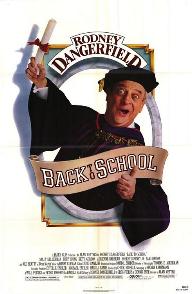
Thornton Melon (Rodney Dangerfield) started with nothing but through a combination of hard work and chutzpah, he started a chain of “Tall and Fat” clothing stores and made a fortune.  Everyone has seen his commercials, the one where he asks his potential customers, “Do you look at the menu and say, ‘Okay?'”  He has a new trophy wife named Vanessa (Adrienne Barbeau) and a chauffeur named Lou (Burt Young).  Thornton never even graduated from high school but he gets respect.

However, his son, Jason (Keith Gordon), doesn’t get no respect.  No respect at all.  Jason is a student at a pricey university, where he is bullied by Chas Osborne (William Zabka) and can’t get a date to save his life.  Jason’s only friend is campus weirdo Derek Lutz (Robert Downey, Jr.).  When Thornton sees that his son isn’t having any fun, he decides to go back to school!

Back to School is a predictable but good-natured comedy.  It is like almost every other 80s college comedy except, this time, it’s a 65 year-old man throwing raging parties and making the frat boys look stupid instead of Robert Carradine or Curtis Armstrong.  On the stand-up stage, Dangerfield always played the (sometimes) lovable loser but in the movies, Dangerfield was always a winner.  In both Caddyshack and Back to School, Dangerfield played a self-made man who forced his way into high society and showed up all of the snobs.  While Back to School is no Caddyshack, it does feature Rodney at his best.

Rodney may be the funniest thing about Back to School but a close second is Sam Kinison, who owed much of his early success to Rodney Dangerfield’s support.  Kinison plays a history professor, who has some very strongly held views about the Vietnam War and who punctuates his points with a primal screen.

Also, keep an eye out Kurt Vonnegut, playing himself.  Rodney hires him to write a paper about Kurt Vonnegut for one of his classes.  The paper gets an F because Rodney’s literature professor (Sally Kellerman) can tell that not only did Rodney not write it but whoever did knows absolutely nothing about the work of Kurt Vonnegut.

So it goes.