 “The family is like a drug and we’re all junkies.” So says Charley Warner (Vincent D’Onofrio), one of the many pissed off people at the center of Crooked Hearts.
Crooked Hearts is narrated by Charley’s younger brother, Tom (Peter Berg). When Tom drops out of college, he returns home and discovers that Charley is still living with their parents, Edward (Peter Coyote) and Jill (Cindy Pickett). Charley feels that he can only leave the family if Edward officially kicks him out but Edward refuses to give him the satisfaction of escape. Instead, Edward throws parties to celebrate his children’s failures, all of which he can recite from memory. Also caught up in this mess are the two youngest children, Ask (Noah Wyle) and Cassie (Juliette Lewis). Cassie is narcoleptic and Ask has a list of very important rules that everyone must follow to be happy, including always making sure that your socks match your shirt. By the end of the movie, one brother has set his own house on fire and another one is mercifully dead.
Tolstoy once said, “Happy families are all alike; every unhappy family is unhappy in its own way,” but he never got to see Crooked Hearts, a movie where everyone is unhappy in the most predictable way possible. Aside from an overbaked script and underbaked director, Crooked Hearts does feature good performances from Peter Coyote and Vincent D’Onofrio but Peter Berg is boring as the monotonous narrator and Noah Wyle tries too hard to be eccentric. I watched Crooked Hearts because Jennifer Jason Leigh was in it but Leigh’s role was small and could have just as easily been played by Mary Stuart Masterson, Penelope Ann Miller, Mary-Louise Parker or any of the other three-name actresses of the early 90s. Family may be addictive but this movie is not.
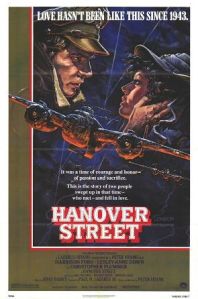 The time is World War II and, for the British, the American army is “overpaid, oversexed, and over here.” David Halloran (Harrison Ford) is a pilot who has been stationed in England. With no loved ones to worry about, David has no fear of flying over occupied France and dropping bombs on the Nazis below. But then David meets an English nurse, Margaret (Lesley-Anne Down). As David falls in love, he loses his enthusiasm for the war because he now has “a reason to live.” The only problem is that Margaret is already married to Paul (Christopher Plummer), an officer in British Intelligence. When David accepts an assignment to fly a British agent into France, he is shocked when the agent turns out to be Paul. When David’s plane crashes, he and Paul have to work together to complete Paul’s mission and escape back to Britain.
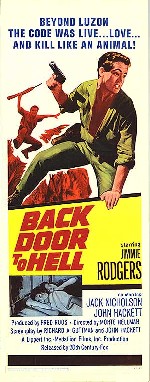 The time is World War II. The place is the Philippines, shortly before the famous return of Douglas MacArthur. Three U.S. soldiers have been sent on a very important mission to knock out a Japanese communication center before the American invasion. Lt. Craig (Jimmie Rodgers) is their leader and he worries that he might not have what it takes to kill a man. Sgt. Jersey (John Hackett) is cynical and tough. Cpl. Burnett (Jack Nicholson) is the radio man with a sarcastic sense of humor. They have been told to meet up with a rebel leader named Miguel but, shortly after arriving, they discover that Miguel has been killed and the new leader is Paco (Conrad Maga), who distrusts the Americans almost as much as he dislikes the Japanese. Meanwhile, a Japanese captain (Joe Sison) threatens to execute all of the children in a nearby village unless the Americans either surrender or are captured.
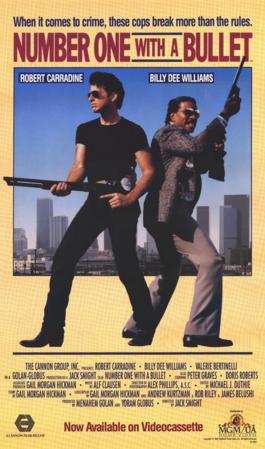 Number One With A Bullet is the story of two cops. Nick Barzack (Robert Carradine) is so crazy that the all criminals have nicknamed “Beserk.” (Who says criminals aren’t clever?) Nick’s partner, Frank Hazeltine (Billy Dee Williams) is so smooth that jazz starts to play whenever he steps into a room. Nick keeps a motorcycle in his living room, wants to get back together with his wife (Valerie Bertinelli), and has an overprotective mother (Doris Roberts). Hazeltine is Billy Dee Williams so all he has to worry about is being the coolest man on Earth. Their captain (Peter Graves!) may want them to do things by the book but Nick and Hazeltine are willing to throw the book out if it means taking down DaCosta, a so-called respectable citizen who they think is actually the city’s biggest drug lord.
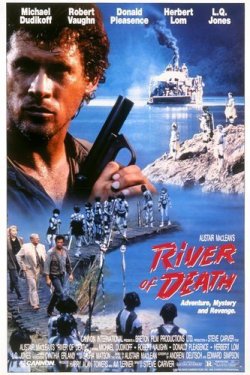 In the Amazon, natives are dying of a mysterious disease. Could it have anything to do with a German war criminal named Wolfgang (played by Robert Vaughn) who is living in a cave that is decorated with a Nazi flag? A scientist (Victor Melleney) and his daughter, Anna (Sarah Maur Thorp), are determined to find out. They hire a tough explorer, John Hamilton (Michael Dudikoff), to lead them up the river but John does not do a very good job because the scientist ends up dead and Anna ends up kidnapped.
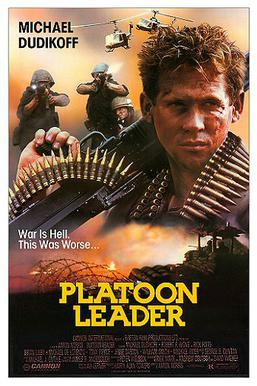 Having just graduated from West Point, Lt. Jeff Knight (Michael Dudikoff, the American Ninja himself) is sent to Vietnam and takes over a battle-weary platoon. Lt. Knight has got his work cut out for him. The VC is all around, drug use is rampant, and the cynical members of the platoon have no respect for him. When Lt. Knight is injured during one of his first patrols, everyone is so convinced that he’ll go back to the U.S. that they loot his quarters. However, Knight does return, determined to earn the respect of his men and become a true platoon leader!
 One of the best films ever made about Vietnam is also one of the least known.
 It’s life and death in the Windy City. It’s got Chuck Norris, Henry Silva, Dens Farina, and a robot, too. It’s Code of Silence.
 Through the Shattered Lens