Music Video of the Day: Doctorin’ The Tardis by The Timelords (1988, directed by ????)


Today’s music video is for the song that Melody Maker called “”pure, unadulterated agony!”

Recorded in 1988, Doctorin’ The Tardis was produced by Bill Drummond and Jimmy Cauty, who would later be better known as The KLF.  The song is a mash-up of the Doctor Who theme music, Gary Glitter’s Rock and Roll (Part Two), Sweet’s Blockbuster, Steve Walsh’s Let Get Together, and the famous Dalek war cry.  The song was Drummond and Cauty’s attempt to write a number one hit single, as opposed to the more esoteric and socially conscious work for which they were better known.

As Drummond explained it,  “We went into the studio on a Monday, thinking we were going to make a house track, a regular underground dance house track using the Doctor Who theme tune… [but] we [then] realised it was in triplet time and you can’t have house tracks in triplet time. The only beat that would work with it was the Glitter beat. By Tuesday evening we realised we had a number one and we just went totally for the lowest common denominator.”  Drummond also later said that Doctorin’ The Tardis was, “the most nauseating record of all time.”

While the critics may have agreed with Drummond, the music-buying public loved the song and Doctorin’ The Tardis spent a week as number one on the UK pop charts.  Drummond and Cauty responded by writing a book called The Manual (How To Have A Number One The Easy Way), which was advertised as being a guide to how to have a number one hit record without having any musical talent whatsoever.  Among The Manual‘s advise: Be on the dole and, if you’re already a musician, stop playing your instrument and sell it.  The Manual also warned that all of its advice will be obsolete within twelve months.

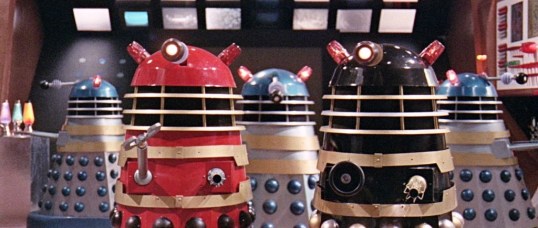
The video, which cost £8,000 to make, was filmed in Wiltshire and features Cauty’s 1968 Ford Galaxie police car being pursued by some poorly constructed Daleks.

Exterminate!

This is what a real Dalek looks like, son.


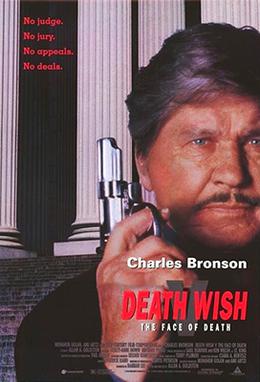
Bronson One Last Time: Death Wish V: The Face of Death (1994, directed by Allen Goldstein)


To quote Geoffrey Chaucer, “All good things must come to an end.”

Death Wish V: The Face of Death marked the end of the original Death Wish franchise, concluding the violent saga of Paul Kersey 20 years after it began.  It probably should have ended sooner.

After the box office failure of Death Wish IV and the subsequent bankruptcy of Cannon Films, future plans for the Death Wish franchise were put on hold.  After the collapse of Cannon, Menahem Golan started a new production company, 21st Century Film Corporation.  In 1993, needing a hit and seeing that the previous Death Wish films were still popular on video, Golan announced that Paul Kersey would finally return in Death Wish V: The Face of Death.  Charles Bronson also returned, though he was now 72 years old and in poor health.  Death Wish V would also mark the end of Bronson’s feature film career.  He would make appearances in a few television movies before subsequently retiring from acting.

Death Wish V finds Paul in the witness protection program.  His latest girlfriend, Olivia (Lesley-Anne Down), just happens to be the ex-wife of a psychotic mobster named Tommy O’Shea (Michael Parks).  Throughout the entire franchise, the Death Wish films argued that crime is so out of control that no one was safe and that Paul had no choice but to pick up a gun and shoot muggers.  But, judging from Death Wish V, Paul just seems to have incredibly bad luck.  What are the odds that a mild-mannered architect would lose his wife, his maid, his daughter, his best friend from the war, his next two girlfriends, and then end up dating the ex-wife of New York City’s craziest gangster?

The district attorney’s office wants Olivia to testify against her ex-husband so Tommy gets his henchman, the dandruff-prone Freddie Flakes (Robert Joy), to kill her.  Looks like it’s time for New York’s favorite vigilante to launch a one-man war against the Mafia!

The only problem is that New York’s favorite vigilante is too old to chase people down dark alleys and shoot them.  He has to get creative, which means using everything from poisoned cannoli to a vat of acid to take out his targets.  One gangster is killed by an exploding soccer ball!

With both Bronson and Lesley-Anne Down giving an indifferent performances, it is up to the supporting cast to keep the movie interesting.  Appearing here after his bravura turn as Jean Renault in Twin Peaks but before Robert Rodriguez and Quentin Tarantino introduced him to a whole new generation of filmgoers, Michael Parks is flamboyantly evil as Tommy O’Shea and injects the movie with what little life that it has.  Speaking of Twin Peaks alumni, Kenneth Welsh (who played Windom Earle in the last few episodes of season 2) plays this installment’s understanding police detective.  Saul Rubinek plays the district attorney who is willing to look the other way when it comes to killing gangsters.

Dull and cheap-looking, Death Wish V was a box office bomb and it brought the original franchise to a definite end.  Will the Eli Roth/Bruce Willis reboot of Death Wish also lead to a reboot of the franchise?  Time will tell!

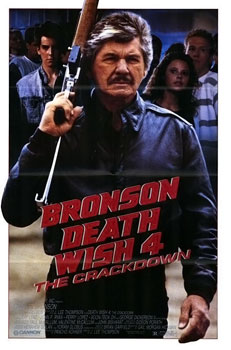
Bronson’s Rich: Death Wish 4: The Crackdown (1987, directed by J. Lee Thompson)


To quote The Main With No Name, “When a man’s got money in his pocket, he begins to appreciate peace.”

Two years have passed since Paul Kersey (Charles Bronson) last visited and cleaned up New York.  He is back in Los Angeles, the president of his own successful architectural firm.  Now a rich man, he has retired from killing criminals, though he still has dreams where he shoots muggers in parking garages.  Paul has a new girlfriend, journalist Karen Sheldon (Kay Lenz).  When Karen’s teenage daughter, Erica (Dana Barron), dies of a cocaine overdose, it’s time for Paul to get his gun out of storage and blow away a drug dealer.

Shortly after shooting that drug dealer, Paul finds a note on his front porch.  “I know who you are,” it reads.  Paul then gets a call from a mysterious man (John P. Ryan) who identifies himself as being a reclusive millionaire named Nathan White.  Nathan explains that his daughter also died of a cocaine overdose.  He wants to hire Paul to take out not just the drug dealers but also the men behind the dealers, the bosses.  Using his vast resources, Nathan has prepared a file on every major drug operation in Los Angeles.  He offers to share the information with Paul.

“I’ll need a few days to think about it,” Paul says but we all know he’s going to accept Nathan’s offer just as surely as we know that Nathan White has an ulterior motive that won’t be revealed until the movie’s final twenty minutes.

For the first time, Paul is no longer just targeting muggers and other street criminals.  This time, Paul is going after the guys in charge and trying to bring an end to drug trade once and for all.  (The idea that the best way to win the war on drugs was just to kill anyone involved in the drug trade was a very popular one in the late 80s.)  L.A.’s two major drug cartels are led by Ed Zacharias (Perry Lopez) and the Romero Brothers (Mike Moroff and Dan Ferro).  Along with their own activities, Paul and Young work the turn the two cartels against each other.

It’s not just the criminals that have changed in Death Wish 4.  Paul has changed, too.  Paul used to just shoot criminals and run away.  In Death Wish 4, he gets more creative.  He sneaks into Zacharias’s mansion and bugs the phone so that he can keep track of what’s going down.  When it comes time to kill a table full of drug dealers (one of whom is played by Danny Trejo), Paul doesn’t shoot them up.  Instead, he sends them a bottle of champagne that explodes when they open it.  By the end of the movie, Paul is blowing away the bad guys with a grenade launcher!  How many former conscientious objectors can brag about that?

The biggest difference between Death Wish 4 and the films that came before it is the absence of director Michael Winner.  Winner and Bronson had a falling out following Death Wish 3 and, as a result, Winner had little interest in returning to the franchise.  Instead, Winner was replaced by J. Lee Thompson, who had already directed Bronson in several other Cannon films.  As a result, Death Wish 4 is less “heavy” than the previous Death Wish films.  Whereas Winner’s direction often felt mean-spirited and exploitive, Thompson plays up the film’s sense of airy adventure.

Though it barely made a profit at the box office and has been dismissed by critics, Death Wish 4 is an enjoyable chapter in Paul’s story.  If you’re looking for mindless 80s mayhem, Death Wish 4 gets the job done with admirable efficiency.  It would have made a great ending for the franchise but Bronson would return to the role one last time.

Tomorrow: Death Wish V: The Face of Death!

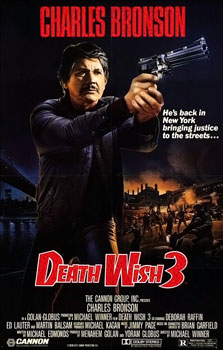
Bronson’s Old: Death Wish 3 (1985, directed by Michael Winner)


To quote Roger Murtaugh, “I’m too old for this shit.”

It has been ten years since Paul Kersey (Charles Bronson) left New York City and the place has gone to Hell.  It’s no longer just muggers that you have look out for.  Now, there are roving street gangs of directionless teenagers, terrorizing the elderly and forcing them to live like prisoners in their own apartment building.

One street corner now looks like a war zone, controlled by spiky-haired, face-painting punks who look like something from a Mad Max movie.  Manny Fraker (Gavan O’Herlihy) rules this street corner, supported by a gang that worships him as if he was some sort of god.  Manny thinks that he is immortal but he’s just targeted the wrong person.  The gang may think that Charley (Francis Drake) is just a defenseless old man but what they don’t know is that, when Charley served in Korea, his best friend was Paul Kersey.

The past few years have been busy for Paul.  He’s killed muggers and rapists in Los Angeles, Chicago, and Kansas City and now he’s returned to New York City, to visit his old friend Charley.  Paul arrives at Charley’s apartment just in time to witness Fraker’s gang murdering him.  The gang flees and when the police arrive, they take Paul into custody.

While public defender Kathryn Davis (Deborah Raffin) tries to figure out why Paul is being held in jail, Paul has a conversation with Lt. Shriker (Ed Lauter).  Shriker remembers Paul as being the New York vigilante and he has a proposition for him.  Paul can kill as many members of Fraker’s gang as he wants, as long as he allows the police to take the credit and reports everything that he discovers to Shriker.  Paul agrees.

In the neighborhood, Paul starts to put Fraker and his gang (one of whom is played by pre-Bill and Ted Alex Winter) in their place.  In a scene borrowed from Brian Garfield’s original Death Wish novel, he uses a used car as bait to gun down two aspiring car thieves.  When Paul gets a new gun, he tests it out on a depraved mugger known as the Giggler.  Though some might call him a serial killer, Paul is soon a hero to the entire neighborhood.  Though Charley may be gone, Paul befriends the other residents of the apartment.  He shows the elderly Kaprovs how to catch anyone trying to climb through their window.  He protects Maria Rodriguez (Marina Sirtis) from the gang.  Best of all, he befriend Bennett Miller (Martin Balsam), a World War II vet who still remembers how to load a machine gun.

(Balsam and Bronson previously co-starred in The Stone Killer, though in that one Bronson was a cop and Balsam was on the other side of the law.)

He also finds time to pursue a relationship with Kathryn Davis.  This is one recurring element in the Death Wish franchise that has never made sense to me.  Paul always has a new girlfriend, despite the fact that almost every woman that he ever gets involved with ends up getting killed.  Paul also only seems to go out with women who would be upset to discover that they were dating a notorious vigilante.  In Death Wish II, he went out with a crusading journalist who was against the death penalty.  In Death Wish 3, he falls for a public defender whose job is to provide legal counsel to the very people that Paul is trying to kill.  After Death Wish 3, Paul would date yet another crusading journalist and, finally, the ex-wife of a notorious mobster.  Maybe Paul should just give up and concentrate on mourning his wife.

Michael Winner returned to direct Death Wish 3 and, this time around, he imagines New York City as being a post-apocalyptic wasteland, full of abandoned buildings and murderous scavengers.  Imagine A Clockwork Orange if Charles Bronson suddenly showed up to shoot Alex and the Droogs.  As played by Gavan O’Herlihy, Manny Fraker is the type of seemingly indestructible bad guy who can actually give Paul Kersey a challenge, something that was missing from the previous films.

The other thing that distinguishes Death Wish 3 is that it was one the only film in the franchise to directly confront an obvious truth.  Charles Bronson was 53 when the first Death Wish was released.  By the time he made Death Wish 3, he was 64 and decades older than the typical action star.  (As way of comparison, Clint Eastwood was 55 when Death Wish 3 was released and was already experimenting with less action-orientated roles.)  By partnering him with Martin Balsam and the other elderly residents of the neighborhood, Death Wish 3 not only acknowledged Bronson’s advanced age but also took advantage of it.  Death Wish 3 is a film where the old folks finally get to teach the young punks a thing or two.  If the other Death Wish films were about one man fighting a lonely war, Death Wish 3 is about a community refusing to be silenced.  The chance to put those kids in their place even seems to perk up Charles Bronson, who gives one of his best performances in Death Wish 3.

Death Wish 3 may have been roundly despised by the critics but it’s the best of the Death Wish sequels.  It made a fortune at the box office so naturally, another sequel would follow.

Tomorrow: Death Wish 4: The Crackdown!

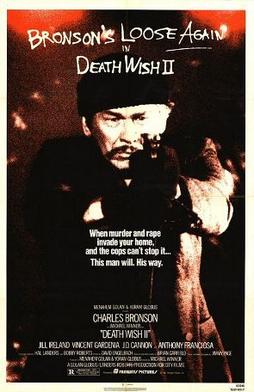
Bronson’s Back!: Death Wish II (1982, directed by Michael Winner)


To quote John McClane, “How can the same shit happen to the same guy twice?”

It has been eight years since Paul Kersey (Charles Bronson) lost his wife and single-handedly cleaned up New York City.  The first Death Wish ended with Paul in Chicago, preparing to gun down a new group of criminals.  I guess Chicago didn’t take because, at the start of Death Wish II, Paul is in Los Angeles and he’s working as an architect again.  He has a new girlfriend, a bleeding heart liberal reporter named Geri (Jill Ireland, Bronson’s real-life wife) who is against the death penalty and who has no idea that Paul used to be New York’s most notorious vigilante.  Having finally been released from the mental institution, Carol (Robin Sherwood) is living with her father but is now mute.

Crime rates are soaring in Los Angeles and why not?  The legal system is more concerned with the rights of the criminals than the victims and Paul has retired from patrolling the streets.  But when a group of cartoonish thugs rape and kill his housekeeper and cause his daughter to fall out of a window while trying to escape them, Paul picks up his gun and sets out for revenge.

Death Wish II was not the first sequel to Death Wish.  Brian Garfield, the author of the novel on which Death Wish was based, never intended for Paul to be seen as a hero and was disgusted by what he saw as being the film’s glorification of violence.  As “penance,” he wrote a sequel called Death Sentence, in which Paul discovered that he had inspired an even more dangerous vigilante.  When Menahem Golan and Yoram Globus bought the rights to produce a second Death Wish film, they decided not to use Garfield’s sequel and instead went with a story that was co-written by Golan.

It’s the same basic story as the first film.  Again, Paul is a mild-mannered architect who is a liberal during the day and a gun-toting reactionary at night.  Again, it’s a home invasion and a death in the family that sets Paul off.  Again, Paul gets help from sympathetic citizens who don’t care that the police commissioner (Anthony Franciosa) wants him off the streets.  Jeff Goldblum played a rapist with a switch blade in the first film.  This time, it’s Laurence Fishburne who fills the role.  (Fishburne also carries a radio, which he eventually learns cannot be used to block bullets.)  Even Detective Ochoa (Vincent Gardenia) returns, coming down to Los Angeles to see if Paul has returned to his old ways.

The main difference between the first two Death Wish films is that Death Wish II is a Cannon film, which means that it is even less concerned with reality than the first film.  In Death Wish II, the criminals are more flamboyant, the violence is more graphic, and Paul is even more of a relentless avenger than in the first film.  In the first Death Wish, Paul threw up after fighting a mugger.  In the second Death Wish, he sees that one of the men who raped his daughter is wearing a cross, leading to the following exchange:

“Do you believe in Jesus?”

“Yes, I do.”

“Well, you’re going to meet him.”

BLAM!

Death Wish II is the best known of the Death Wish sequels.  It made the most money and, when I was a kid, it used to show on TV constantly.  The commercials always featured the “You believe in Jesus?” exchange and, every morning after we saw those commercials, all the kids at school would walk up to each other and say, “You believe in Jesus?  Well, you’re going to meet him.”  It drove the teachers crazy.

Overall, Death Wish II is a lousy film.  Michael Winner, who was always more concerned with getting people into the theaters than anything else, directs in a sledgehammer manner that makes his work on the first film look subtle.  He obscenely lingers over every rape and murder, leaving no doubt that he is more interested in titillating the audience than getting them to share Paul’s outrage.  The script is also weak, with Geri so poorly written that she actually gets more upset about Paul going out at night than she does when she learns that Paul’s daughter has died.  When Paul sets out to track down the gang, his method is to merely wander around Los Angeles until he stumbles across them.  It doesn’t take long for Paul to start taking them out but no one in the gang ever seems to be upset or worried that someone is obviously stalking and killing them.

There are a few good things about the film.  Charles Bronson was always a better actor than he was given credit for and it’s always fun to watch Paul try to balance his normal daily routine with his violent night life.  Whenever Geri demands to know if he’s been shooting people, Paul looks at her like he is personally offended that she could possibly think such a thing.  Also, the criminals themselves are all so cartoonishly evil that there’s never any question that Paul is doing the world a favor by gunning them down.  For many otherwise sensible viewers, a movie like Death Wish II may be bad but it is also cathartic.  It offers up a simple solution to a complex issue.  In real life, a city full of Paul Kerseys would lead to innocent people getting killed for no good reason.  But in the world of Death Wish II, no one out after nightfall is innocent so there’s no need to worry about shooting the wrong person.

Finally, the film’s score was written by the legendary Jimmy Page.  The studio wanted Isaac Hayes to do the score but Winner asked his neighbor, Page.  Page took the film, retreated into his studio, and returned with a bluesy score that would turn out to be the best thing about the movie.  The soundtrack was the only one of Page’s solo projects to be released on Led Zeppelin’s record label, Swan Song Records.

Tomorrow, Bronson returns with Death Wish 3!

Bronson’s Revenge: Death Wish (1974, directed by Michael Winner)


To quote “Dirty” Harry Callahan, “I’m all broken up about his rights.”

In 1972, a novel by Brian Garfield was published.  The novel was about a meek New York City accountant named Paul Benjamin.  After Paul’s wife is murdered and his daughter is raped, Paul suffers a nervous breakdown.  A self-described bleeding heart liberal, Paul starts to stalk the streets at night while carrying a gun.  He is hunting muggers.  At first, he just kills the muggers who approach him but soon, he starts to deliberately set traps.  Sinking into insanity, Paul becomes just as dangerous as the men he is hunting.  Garfield later said that the book was inspired by two real-life incidents, one in which his wife’s purse was stolen and another in which his car was vandalized.  Garfield said that his initial response was one of primitive anger.  He wondered what would happen if a man had these rageful thoughts and could not escape them.

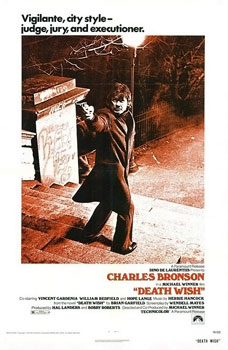
The title of that novel was Death Wish.  Though it was never a best seller, it received respectful reviews and Garfield subsequently sold the film rights.  At first, Sidney Lumet was attached to direct and, keeping with Garfield’s portrayal of Paul Benjamin, Jack Lemmon was cast as the unlikely vigilante.
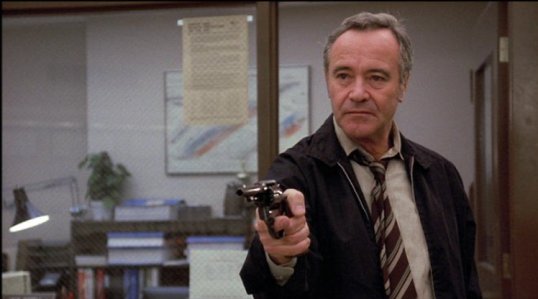
Lumet, ultimately, left the project so that he could concentrate on another film about crime in New York City, Serpico.  When Lumet left, Jack Lemmon also dropped out of the film.  Lumet was replaced by Michael Winner, a director who may not have been as thoughtful as Lumet but who had a solid box office record and a reputation for making tough and gritty action films.

Winner immediately realized that audiences would not be interested in seeing an anti-vigilante film.  Instead of casting an actor with an intellectual image, like Jack Lemmon, Winner instead offered the lead role (now named Paul Kersey and no longer an accountant but an architect) to Charles Bronson.  When Winner told Bronson that the script was about a man who shot muggers, Bronson replied, “I’d like to do that.”

“The script?” Winner asked.

“No, shoot muggers.”
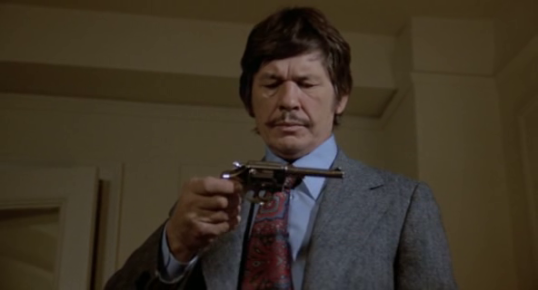
At the time that he was cast, Charles Bronson was 52 years old.  He was the biggest star in the world, except for in America where he was still viewed as being a B-talent at best.  Bronson was known for playing tough, violent men who were not afraid to use violence to accomplish their goals.  (Ironically, in real life, Bronson was as much of an ardent liberal as Paul Kersey was meant to be at the beginning of the movie.)  Among those complaining that Charles Bronson was all wrong for Paul Kersey was Brian Garfield.  However, Bronson accepted the role and the huge box office success of Death Wish finally made him a star in America.

To an extent, Brian Garfield was right.  Charles Bronson was a better actor than he is often given credit for but, in the early scenes of Death Wish, he does seem miscast.  When Paul is first seen frolicking with his wife (Hope Lange) in Hawaii, Bronson seems stiff and awkward.  In New York City, when Paul tells his right-wing colleague (William Redfield) that “my heart does bleed for the less fortunate,” it doesn’t sound natural.  But once Paul finds out that his wife has been murdered and his daughter, Carol (Kathleen Tolan), has been raped, Paul gets mad and Bronson finally seems comfortable in the role.

In both the book and the original screenplay, both the murder and the rape happened off-screen.  Never a subtle director, Winner instead opted to show them in a brutal and ugly scene designed to get the audience as eager to shoot muggers as Bronson was.  Today, the power of the scene is diluted by the presence of Jeff Goldblum, making his screen debut as a very unlikely street thug.  Everyone has to start somewhere and Goldblum got his start kicking Hope Lange while wearing a hat that made him look like he belonged in an Archie comic.

With his wife dead and his daughter traumatized, Paul discovers that no one can help him get justice.  The police have no leads.  His son-in-law (Steven Keats) is a weak and emotional mess.  (As an actor, some of Bronson’s best moments are when Paul makes no effort to hide how much he loathes his son-in-law.)  When a mugger approaches Paul shortly after his wife’s funeral, Paul shocks himself by punching the mugger in the face.

When Paul is sent down to Arizona on business, he meets Ames Jainchill (Stuart Margolin), a land developer who calls New York a “toilet” and who takes Paul to see a wild west show.  Later at a gun club, Paul explains that he was a conscientious objects during the Korean War but he knows how to shoot.  His father was a hunter and Paul grew up around guns.  When Paul returns to New York, Ames gives him a present, a revolver.  Paul is soon using that revolver to bring old west justice to the streets of New York City.

As muggers start to show up dead, the NYPD is outraged that a vigilante is stalking the street.  Detective Frank Ochoa (Vincent Gardenia) is assigned to bring the vigilante in.  But the citizens of New York love the vigilante.  Witnesses refuse to give an accurate description of Paul.  When Paul is wounded, a young patrolman (Christopher Guest, making almost as unlikely a film debut as Jeff Goldblum) conspires to keep Paul’s revolver from being turned over as evidence.

The critics hated Death Wish, with many of them calling it an “immoral” film.  Brian Garfield was so disgusted by how Winner changed his story that he wrote a follow-up novel in which Paul is confronted by an even more dangerous vigilante who claims to have been inspired by him.  Audiences, however, loved it.  Death Wish was one of the top films at the box office and it spawned a whole host of other vigilante films.

Death Wish is a crude movie, without any hint of subtlety and nuance.  It is also brutally effective, as anyone who has ever felt as if they were the victim of a crime can attest.  In a complicated and often unfair world, Kersey’s approach may not be realistic or ideal but it is emotionally cathartic.  Watching Death Wish, it is easy to see why critics hated it and why audiences loved it.

It is also to see why the movie made Bronson a star.  Miscast in the role or not, Bronson exudes a quiet authority and determination that suggests that if anyone could single-handedly clean-up New York City, it’s him.  An underrated actor, Bronson’s best moment comes after he punches his first mugger and he triumphantly reenters his apartment.  After he commits his first killing, Bronson gets another good scene where he is so keyed up that he collapses to the floor and then staggers into the bathroom and throws up.  Garfield may have complained that the Death Wish made his madman into a hero but Bronson’s best moments are the ones the suggest Paul has gone mad.  The real difference between the book and the movie is that the movie portrays madness as a necessary survival skill.

This Friday, a new version of Death Wish will be playing in theaters.  Directed by Eli Roth, this version starts Bruce Willis as Dr. Paul Kersey.  Will the new Death Wish be as effective as the original?  Judging from the trailer, I doubt it.  Bruce Willis or Charles Bronson?  I’ll pick Bronson every time.

Tomorrow, Bronson returns in Death Wish II!
Music Video of the Day: Separate Ways (Worlds Apart) by Journey (1983, directed by Tom Buckholtz)


The song is an anthem but the music video is widely considered to be one of the worst of all time.  What happened to Journey when they gathered on a wharf in New Orleans and shot the video for Separate Ways (Worlds Apart)?  Let’s break it down:

0:00 — The video starts with a shot of the Louisa Street Wharf in New Orleans.  Where’s Journey?

0:03 — There, they are.  But where are their instruments?

0:04 — Yes, Jonathan Cain is playing air keyboards.

0:08 — Journey has their instruments now so they look a lot less ridiculous.  Still, Jonathan Cain will never live down those air keyboards.

0:21 — A woman in a black leather skirt walks down the wharf.  The members of Journey jump out at her.  This will prove to be a reoccurring theme throughout the video.  The woman was played by a local girl named Margaret Olmstead.

0:35 — Again, Journey has lost their instruments and Jonathan Cain is forced to play air keyboards.

0:41 — If Steve Perry looks more annoyed than usual here, it is probably because he wasn’t happy while shooting this video.  This was the first Journey video to have a “storyline,” as opposed to just being edited footage of the band performing.  Perry was opposed to the idea.  According to Cain, Perry said, “We’re performers, we’re entertainers, but we’re not actors.”

0:51 — Who has stolen Journey’s instruments?

0:54 — At this point, Jonathan Cain’s air keyboards are truly out of control.  Is he playing an imaginary synthesizer or is he pretending to be a tiger stalking his prey?  Your guess is as good as mine.

0:58 — Not only has Journey lost their instruments but Steve Perry has lost his sleeves.

1:13 — Eagle-eyed viewers will notice that Journey is performing in front of a mattress warehouse.  This detail will pay off at the end of the video.

1:27 — At least Jonathan finally found his keyboards.

1:32 — The salesman who sold me my very first used car looked just like Ross Valory.

1:47 — The video was shot on a very cold morning.  In between takes, Perry would rush into his camper to try to get warm.

1:57 — The shoot was also tense because of the presence of Perry’s then-girlfriend, Sherri Swafford.  Swafford took an intense dislike to Margaret Olmstead and demanded that she be removed from the video.

2:22 — I worked in a warehouse one summer and I can tell you that one thing you never want to do is walk backwards through a maze of palettes.

2:29 — Do you think Steve Smith likes foosball?

2:34 — The members of Journey jumping back and forth and singing while Margaret ignores them is my favorite part of the video.

3:04 — What did they do to Steve’s drums?

3:37 — As if the video hadn’t already flown off the rails, here’s a few minutes of gratuitous slow motion.

4:15 — Say what you will about the video, no one could belt it out like Steve Perry.

4:18 — It was all a dream!  That explains so much.

In 1999, MTV named this video as the 13 worst video of all time.

Enjoy!

Music Video of the Day: Hungry by Winger (1988, directed by ????)


What do we have here?

00:12 — Newlyweds speeding on a curvy mountain road?  What could go wrong?

00:23 — There go the brakes!

00:31 — That sharp turn will look familiar to anyone who has ever seen the Duke boys outrun old Roscoe.

00:36 — It’s true what they say.  Right before you die, you hear the opening of a bad 80s song.

00:50 — I’ve gotten worst cuts from bumping my head on a low doorway.

00:57 — Dude, did you just leave your wife behind in the car?

00:59– This is Winger.  Kip Winger got his start as a backup musician and was a member of Alice Cooper for two years.  Until Nirvana changed the face of music, Winger was responsible for some of the most generic hits of the 1980s.

01:21 — How long until we get a shot of the man sitting alone on that same swing?

01:32 — “Look, I’m spinning around with my guitar!  Just like we did in practice!”

01:50 — “I remember how much we loved this wall.”

01:59 — It took 37 seconds to go from swinging together to swinging alone.

02:08 — Nobody came to the wedding but she’s going to go ahead and throw the bouquet anyway.

02:20 — It might be easier for the first responders to do their job if Winger would get out of the way.

02:46 — GUITAR!

03:07 — “My wife’s dead.  Time to learn how to play an instrument!”

03:15 — Watch out, he’s driving again.

03:22 — Did he ever figure out why his brakes out went out in the first place?  This might be a case for Jim Rockford.

03:36 — They still haven’t put out the fire?  Is this what my tax dollars are paying for?

03:38 — I would be pissed off too.  Put out the damn fire!

03:58 — That dude cannot drive.

04:12 — How does he keep doing this shit without getting a scratch on him?

04:27 — “How am I going to get home?”

To call Winger a “hair metal” band is probably an insult to hair metal bands but they did have a few hits.  They also got on the nerves of Metallica’s Lars Ulrich and Mike Judge, the creator of Beavis and Butthead.

Enjoy!

Music Video of the Day: Hobo Humpin’ Slobo Babe (1994, directed by Mark Pellington)


Whale was a Swedish alternative band, made up for Gordon Cyrus, Henrik Schyffert, and Cia Berg.  During the mid-90s, they were big in Europe while, in America, they were best known for this video.

00:00 — When we first see Whale, they’re performing in the type of gravel pit that should be familiar to anyone who has ever watched any Tom Baker-era episodes of Doctor Who.

00:31 — What’s Cia Berg doing right here?

00:55 — Check out Henrik Schyffert walking like an Egyptian.

01:14 — YASSSSSS! ROCK!

01:17 — This moment here is the reason why Beavis and Butt-Head loved this video.

02:03 — WON’T SOMEBODY THINK OF THE CHILDREN!?

02:17 — ROCK!

2:35 — Cia looks dangerous.

3:00 — Henrik’s trying to save the children.

3:26 — YEAH!

When this video was first released, there was a lot of confusion as to what was meant by Hobo Humpin’ Slobo Babe.  Everyone knew what a hobo and a babe were.  Everyone understood humpin’.  But what did slobo mean?  According to the band, they misheard the British term “sloane.”  A sloane is a type of fashionable, upper class person.  I guess that means this song is about a rich girl who likes to hump hobos.

Mark Pellington won the inaugural MTV Europe Music Video Award for best video for Hobo Humpin’ Slobo Babe.  Whale broke up in 1999, though all three members remain active on the Swedish entertainment scene.

Enjoy!

My Super Bowl Prediction


It’s only a few hours until kickoff so I guess I should make my Super Bowl predictions.

The Eagles are a good team.  Even people who hate Philadelphia have to admit that.  They’ve earned their right to play in the Super Bowl this year.  Ever since he stepped in and replaced the injured Carson Wentz as quarterback, Nick Foles has been defying the odds and proving the haters wrong.

But the New England Patriots are the best team in the league right now.  The Patriots have got Tom Brady, perhaps the greatest quarterback of all time.  I expect the Eagles will put a good fight but my final prediction is:

Patriots — 31

Eagles — 17

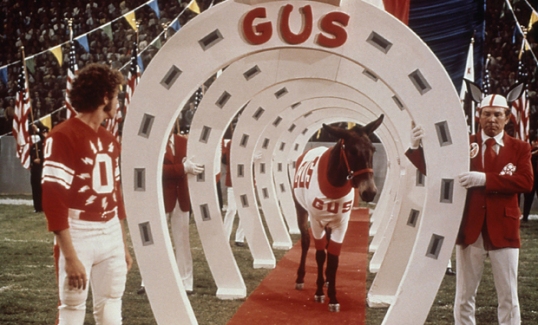
As always, the final field goal will be kicked by Gus, the field goal-kicking mule.