Fire Alarm (1932, directed by Karl Brown)


When their cat climbs to the top of a power pole, Pat (Noel Francis) and Gertie (Marjorie Beebe) call the entire fire department to come help them bring the kitty down.  The fire chief isn’t amused but two firemen, Charlie (Johnny Mack Brown) and Fishey (George Cooper), both catch the eye of Pat and Gertie.  Soon, Charlie is dating Pat and Fishey dating Gertie.  While Fishey and Gertie provide the comic relief, Charlie and Pat provide the drama.  Charlie thinks that Pat’s boss (Richard Tucker) is putting the moves on her and he responds by punching him.  Charlie and Pat break up but a fire that breaks out next door to Pat’s building brings them back together.

There’s not much to this programmer but it’s a chance to see western star Johnny Mack Brown in a “modern” role.  He’s convincingly tough as the headstrong Charlie while veteran actor George Cooper (who usually went uncredited in the 220 films that he appeared in) provides able support as his eccentric best friend.  Noel Francis and Marjorie Beebe are both likable as the two secretaries who end up with firefighter boyfriends and it’s had not to regret that neither had a bigger career in Hollywood.  As for the fire scenes, they are actually pretty effective for a 1930s film.  There are a few shaky shots but I imagine they were still good enough to thrill afternoon matinee audiences in 1932.

This film is often known as Flames, which provides a double meaning.  The characters fight flames while being flames themselves.  Personally, I think Fire Alarm is better.

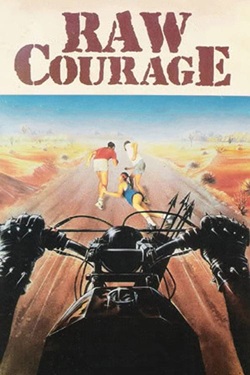
Raw Courage (1984, directed by Robert L. Rosen)


Three friends (Ronny Cox, Art Hindle, and Tim Maier) leave their families behind and go on a 72-mile run through the desert of New Mexico.  They’re marathon runners and they are trying to survive the ultimate challenge.  Instead, they run into a right-wing militia led by “Colonel” Crouse (M. Emmet Walsh) and Sonny (William Russ).  Soon, the joggers are being chased through the desert.  Their survival depends on if they have the raw courage to make it back to civilization.

Raw Courage was written and produced by Ronny Cox and I like to think that he made this movie as his way to get back at everyone who typecast him as a victim after Deliverance.  Cox’s jogger never gives up in Raw Courage, even while being chased through the broiling desert by a bunch of madmen on motorcycles.  Cox and Art Hindle both give good performances and their well-matched by Walsh and Russ.  (Unfortunately, Walsh’s role in pretty small.  Most of the actual villainy is committed by William Russ.)  Cox and Hindle both play intelligent men who just happened to find themselves in the wrong place at the wrong time.  That the victims are sympathetic and you actually care about whether or not they make it back to their families elevates the film.

The film does start to run out of gas towards the end.  The scenes of our heroes running through the desert start to get repetitive.  Raw Courage is still an exciting action film and it’s flat, made-for-TV look is probably less of a problem when viewed on YouTube than it was when the movie was initially released.  The film provides a rare starring role for Ronny Cox, four years before Robocop typecast him as everyone’s favorite corporate villain.  Cox delivers.  It’s a shame he didn’t get to play more heroes.

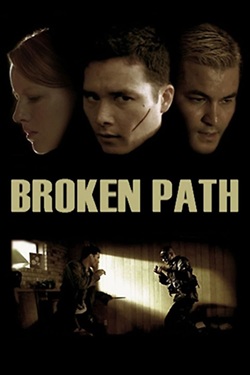
Broken Path (2008, directed by Koichi Sakamoto)


Jack Ellis (Johnny Yong Bosch) spends all of his time moving from town to town, never staying long enough to make lay down permanent roots.  His wife, Lisa (Pamela Walworth), finally convinces him to stop running and to move into a ranch house with her.  That turns out to be a mistake because the ranch house is soon overrun by ninjas who have some sort of grudge against Jack and who appear to have lascivious intentions towards his wife.

Once the movie deals with a few talky sequences at the beginning, Broken Path becomes one long fight sequences with Jack taking on the home invaders one-by-one.  The fight scenes are all exciting choreographed and appropriately brutal, with a lot of blood being spilled by both Jack and his enemies.  This is not one of those martial arts film where people somehow manage to survive the most brutal of beatings without having a scratch on them.  The entire home invasion plays out, more or less, in real time.  This is a movie with a 70-minute fight scene.  If that’s the sort of thing that you’re into, Broken Path is extremely exciting.  If you want more nuance than just people fighting, this might not be the film for you.

From what I understand, Broken Path never got a proper theatrical or video release in the United States but it can be found on YouTube.


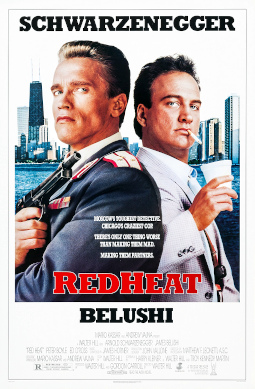
Red Heat (1988, directed by Walter Hill)


Ivan Danko (Arnold Schwarzenegger) is a Russian who lives in Moscow.  Art Ridzik (James Belushi) is an American who lives in Chicago.  They have two things in common.  They’re both cops and they both recently lost their partners while pursuing Russian drug lord Viktor Rostavali (Ed O’Ross).  When Danko comes to Chicago to bring the recently arrested Rostavali back to Moscow, Ridzik is assigned to be his handler.  When Rostavali escapes from custody, Ridzik and Danko team up to take him down.

Directed by Walter Hill, Red Heat may not be as well-remembered as some of Arnold Schwarzenegger’s other action films from the 80s but it’s still a good example of Schwarzenegger doing what Schwarzenegger did best.  Danko may not have been the quip machine that Schwarzenegger usually played but the movie gets a lot of comedic mileage out of his straight-to-the-point dialogue and the culture clash that Danko, a proud Soviet, experiences in Chicago.  It’s also an exciting action film, featuring a classic bus chase that perfectly complements Schwarzenegger’s bigger-than-life persona.

It gets a lot of mileage from the comedic chemistry of Arnold Schwarzenegger and James Belushi.  The always-talking Belushi provides a good comic foil to the steely Schwarzenegger.  Made in the waning years of the Cold War, Red Heat featured Belushi learning that the Russian cops didn’t worry about Miranda warnings and Schwarzenegger learning about “decadent” capitalism.  Belushi does a good job defending the honor of America.  Schwarzenegger, an anti-communist in real life, does an equally good job defending the Soviet Union.  Ultimately, they put aside their differences and show that even people on opposite sides can work together.

(We all know who won ultimately won the Cold War, though.)

Walter Hill specialized in buddy action movies.  Red Heat isn’t up to the level of 48 Hrs but it’s still an entertaining East-meets-West action film that packs a punch.

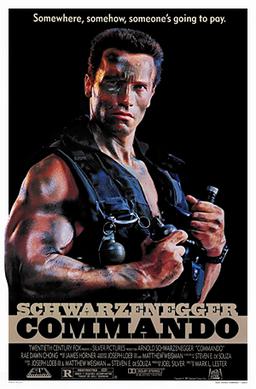
Commando (1985, directed by Mark L. Lester)


John Matrix (Arnold Schwarzenegger) is a former colonel in the U.S. Amy Special Forces.  He was one of the best at what he did but he’s now retired from all that and lives in the mountains of California with his young daughter, Jenny (Alyssa Milano).  When Capt Bennett (Vernon Wells), Martix’s former comrade-in-arms, kidnaps Jenny, Matrix is told that he has 11 hours to assassinate the leader of the country of Val Verde so that General Arius (Dan Hedaya) can launch a coup.  Knowing that the bad guys are planning on killing both him and Jenny no matter what he does, Matrix instead takes out Arius’s men as he makes his way to where Jenny is being held captive.

Commando is one of my favorite Schwarzenegger films.  It has some of the best one-liners (“I like you, Sully, I kill you last,”), some of the best character actors (Sully is played by David Patrick Kelly), and also one of Schwarzenegger’s best performances.  In Commando, Schwarzenegger shows that he’s willing to poke fun at himself, which was something that set him apart from many of the action heroes of the 80s.  (Stallone eventually learned how to poke fun at himself but it took a very long time.)  At his California home, Matrix chops down and carries a tree without breaking a sweat.  During a chase through a mall, Matrix easily lifts up a phone booth.  Matrix may be trying to save the life of his daughter but he still takes the time to come up with one-liners and fall in love with flight attendant Cindy (Rae Dawn Chong).  Commando is essentially just a big comic book brought to life and Schwarzenegger understands that and gives a very knowing, self-aware performance.  Director Mark Lester wastes no time getting to the action and the result is one of the most entertaining action films of the 80s.

Believe it or not, Commando was originally envisioned as being a Gene Simmons picture.  When the KISS frontman turned down the film, the script was rewritten for Arnold Schwarzenegger.  Schwarzenegger made this film after The Terminator and it was another box office success.  As for Gene Simmons, he would have to wait for Runaway to make his action debut.

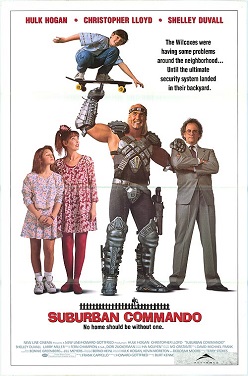
Suburban Commando (1991, directed by Burt Kennedy)


After screwing up a mission to save the leader of his planet from the intergalactic gangster Suitor (William Ball), Shep Ramsey (Hulk Hogan) is ordered to take a vacation.  When Shep gets mad and accidentally damages the controls of his spaceship, he’s forced to hide out on Earth while his ship repairs itself.  After stealing some clothes from a biker, Shep rents a room from Charlie (Christopher Lloyd) and Jenny Wilcox (Shelley Duvall).  Charlie is an architect who hates his job, his boss (Larry Miller), and a malfunctioning traffic light in the middle of town.   Charlie doesn’t trust Shep but when Suitor comes to Earth in search of his number one foe, Charlie and Shep are going to have to work together to save Charlie’s family.

Suburban Commando was originally envisioned as being an Arnold Schwarzenegger/Danny DeVito film.  Schwarzenegger and DeVito decided to do Twins instead and Suburban Command was (eventually) made with Hulk Hogan and Christopher Lloyd.  The idea behind the film had potential but the film itself never comes to life, thwarted by a low-budget and a cast that generates little in the way of chemistry.  Things start out well when Hogan is in outer space and the film parodies Star Wars but, once Hogan goes on vacation, the story crashes down to Earth in more ways than one.  Hogan was more of a personality than an actor and it’s impossible to see him as being anyone other than Hulk Hogan, even if he is flying through space and wearing intergalactic armor at the start of the movie.  Hogan getting angry in space is funny because space is not where you would expect to find him.  Hogan getting angry in the suburbs just feels like a half-baked sitcom.  Lloyd is too naturally eccentric to be believable as someone trapped in a go-nowhere job.  It’d hard to buy Christopher Lloyd as someone who would be scared to tell off his boss or who would need an alien warrior to come down and show him how to loosen up.  There’s a lot talented people in the cast but the ensemble never really gels.

This was the last film to be directed by veteran filmmaker Burt Kennedy.  Kennedy was best-known for his westerns, including Welcome to Hard Times, Support Your Local Sheriff, and Hannie Caulder.  He was not known for his wacky comedies and this film shows us why.

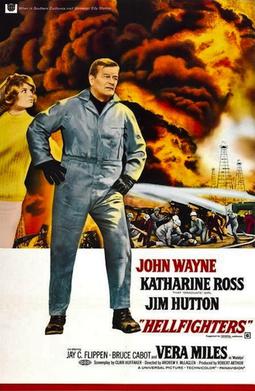
Hellfighters (1968, directed by Andrew McLaglen)


Chance Buckman (John Wayne) is the best there is when it comes to fighting oil fires.  Along with Greg Parker (Jim Hutton), Joe Horn (Bruce Cabot), and George Harris (Edward Faulkner), Chance travels the world and puts out fires that the regular authorities can’t handle.  Chance loves his job but he also loves his ex-wife, Madelyn (Vera Miles).  When Madelyn indicates that she wants to remarry Chance but only if he pursues a less dangerous line of work, Chance retires from firefighting and becomes an oil executive.  He leaves his firefighting company to his new son-in-law, Greg.  When Greg and Chance’s daughter (Katharine Ross) head down to Venezuela to battle a fire and find themselves not only having to deal with the flames but also with a band of revolutionaries, Chance is the only one who can help them.

When I was growing up, Hellfighters was one of those movies that seemed to turn up on the local stations a lot.  The commercials always emphasized the idea of John Wayne almost single-handedly fighting fires and made it seem as if the entire movie was just the Duke staring into the flames with that, “Don’t even try it, you SOB” look on his face.  As a result, the sight of John Wayne surrounded by a wall of fire is one of the defining images of my childhood, even though I didn’t actually watch all the way through until recently.  When I did watch it, I discovered that Hellfighters was actually a domestic drama, with an aging Wayne passing the torch to youngster Jim Hutton but then taking it back.

The fire scenes are the best part of Hellfighters and I wish there had been more of them.  The movie gets bogged down with all of Chance’s family dramas but it comes alive again as soon as John Wayne and his crew are in the middle of a raging inferno, putting their lives at risk to try to tame the fire.  Wayne was always at his best when he was playing strong, no-nonsense men who were the best at what they did.  Hellfighters is slow in spots but the fire scenes hold up well.  There’s no one I’d rather follow into an inferno than Chance Buckman.

Six Gun Gospel (1943, directed by Lambert Hillyer)


Marshals Nevada Jack McKenzie (Johnny Mack Brown) and Sandy Hopkins (Raymond Hatton) are sent to the frontier mining community of Goldville to determine who is responsible for hijacking all of the gold that should be coming out of the town.  Not surprisingly, it’s all the work of another dastardly saloon owner (Kenneth MacDonald) who is planning on stealing all the gold, chasing off all the settlers, and then selling their land to the railroad company.  While Sandy goes undercover as the town’s new preacher, Jack agrees to ride shotgun on a gold shipment, along with with Dan Baxter (Eddie Drew).  Dan is in love with Jane Simms (Inna Gest), the daughter of honest miner Bill Simms (Kernan Cripps).

Johnny Mack Brown made a countless number of westerns for several different production companies but it seems like they always featured a crooked saloon owner and a plan to sell the land to a railroad company.  Luckily, nobody watches these movies for the plots and that was probably true even when they were first released.  People watch these movies for the nostalgia value of watching a movie where it’s good vs evil and good always triumphs without leaving any sort of lingering doubt about whether or not the heroes did the right thing.  Johnny Mack Brown is as authentic on a horse and carrying a gun as he ever was and there’s a scene where he manages to get a gun despite being tied up that’s pretty cool.  The appeal of Johnny Mack Brown was that he always seemed like he could do the things that he did in the movies in real life as well.  Raymond Hatton provides comic relief, pretending to know the hymns being sung by his congregation and providing some songs of his own.  There’s enough gun fights and horse chases to provide nostalgic happiness for fans of the genre and that’s the important thing.

The Wild Pair (1987, directed by Beau Bridges)


A police detective named Benny Avalon (Bubba Smith) and an FBI agent named Joe Jennings (Beau Bridges) are assigned to work together to take down a drug dealer named Ivory Jones (Raymond St. Jacques).  Avalon and Jennings don’t immediately get along.  Avalon is tough and streetwise while Joe is a good example of what used to be called a yuppie.  When they discover that Ivory is connected to a white supremacist gang led by Col. Hester (Lloyd Bridges), Avalon and Jennings have to set aside their differences and work together.

The Wild Pair starts out as a standard buddy cop film until things take a sudden serious turn and it instead becomes a violent and blood-soaked revenge thriller.  It tries to mix comedy and action in the style of Beverly Hills Cop but it doesn’t work.  Beverly Hills Cop understood that you could only take the violence so far without losing the laughs.  The Wild Pair has the bad guys killing several innocent (and likable) people and also murdering Avalon’s cat.  Maybe Walter Hill could have pulled off what this film was going for.  He certainly managed to do so with 48 Hours.  But this film was the directorial debut of Beau Bridges, a good actor who, as a director, was no Walter Hill.  As for Bubba Smith, he was always more of a personality than an actor.  That served him well in the Police Academy films but here he’s actually supposed to be playing someone other than Bubba Smith and his limitations of an actor become especially glaring once the film turns serious.  Lloyd Bridges also seems miscast as the villain but that may just be because I’ve watched Airplane! and Hot Shots too many times.

The pair may be wild but they’re also forgettable.

Girl You Know It’s True (2023, directed by Simon Verhoeven)


In 1988, a German music producer named Frank Farian (Matthias Schweighofer) has already recorded and produced a song called Girl You Know Its True.  He just needs to find two performers who are more photogenic than the middle-aged studio musicians who actually sang it.  Frank discovers Rob (Tijan Njie) and Fab (Elan Ben Ali), two friends who are trying to make it as dancers.  Rob is German and biracial.  Fab is French.  Frank tells them that all they have to do is lip-synch along with the record whenever they’re “performing” the song.  After Frank assures them that this type of thing is done all the time, they agree.  Frank also tells them that they will be known as Top Shelf.

The song becomes a hit and Rob and Fab become stars but they’re not known as Top Shelf, a name that is dismissed as being too German.  Instead, they find superstardom as Milli Vanilli.  With their popularity comes money, groupies, and drugs.  But when word gets out that neither Rob nor Fab actually sang on their record, everything collapses into one of the biggest entertainment scandals of the past 40 years.

I never would have guessed that a good movie could be made about the fall of Milli Vanilli but Girl You Know Its True is a surprisingly compelling and well-acted retelling of the familiar story.  The movie is as much as about the business of fame as it is about the band itself with Frank realizing and explaining that a band’s image is much more important than the music itself.  Rob and Fab are presented as being incredibly naive and trusting when it comes to Frank and his promises, with Rob also sabotaged by a need for acceptance that came out of his troubled childhood.  The villain in this story is not the band but instead a music industry that knowingly looked the other way on Frank’s deception and then scapegoated Rob and Fab when the truth came out.  Rob and Fab each deal with going from being superstars to being pariahs in their own individual way.  It leads to tragedy for one and regret for the other.

Even though I was familiar with the story, Girl You Know It’s True took me by surprise.  It’s a genuinely good film.