Music Video of the Day: Bop ‘Til You Drop by Rick Springfield (1984, directed by David Fincher)


When you think of which 1980s pop singer was most likely to fuse his music with a science fiction epic about a group of intergalactic prisoners being enslaved by some sort of smirking lizard king, Rick Springfield is probably not the name that immediately comes to mind.  But that’s just what happens with the music video for his song, Bop ‘Til You Drop.

Not surprisingly, this video was directed by David Fincher.  Before Fincher moved into feature films, he specialized in music videos that took artists to new and unexpected places.  According to both the Internet Movie Database and the Internet Music Video Database, this was Fincher’s first music video.  A year earlier, he had worked as an assistant cameraman on Return of the Jedi and both the slaves and the aliens in this video feel like they would not have been out of place as a part of Jabba the Hutt’s entourage.  Visually, the video also has much in common with Fincher’s feature directorial debut, Alien 3.

This song was recorded for the soundtrack of Hard To Hold, an apparently unsuccessful attempt to turn Rick Springfield into a film star.  I haven’t seen Hard to Hold but Wikipedia offers up the following plot description:

James “Jamie” Roberts (played by singer-songwriter Rick Springfield), being a pop idol, is used to having his way with women. He meets child psychologist Diana Lawson (Janet Eilber) in a car accident, however, who not only doesn’t swoon at his attention but has also never heard of him. He tries to win her affection but complicating things is that his ex-lover, Nicky Nides (Patti Hansen), remains a member of his band.

It sounds like the music video was more interesting than the movie.

Enjoy!

After The French Connection: Popeye Doyle (1986, directed by Peter Levin)


In this made-for-television movie, a pre-Married With Children Ed O’Neill takes over the role that won Gene Hackman an Oscar.

Popeye Doyle (played by O’Neill) is a hard-drinking, hard-living Irish police detective working out of New York City.  Along with his more emotionally stable partner, Tony Parese (Matthew Laurence), Doyle spends his time busting drug dealers, going on stakeouts, and chasing junkies through the mean streets of NYC.  When Jill, a beautiful young model (Audrey Landers) turns up dead, everyone assumes that it was an overdose.  Doyle, however, has his doubts.  All of her friends say that Jill never used drugs and, when Popeye searches her apartment, he doesn’t find any evidence that would point to her being junkie.  Instead, he finds tapes that Jill made for various wealthy men.  Convinced that Jill was murdered, Popeye is soon investigating the type of powerful people who are not used to being investigated.

In 1986, someone at NBC thought it would be a good idea to launch a series based on The French Connection.  Since Gene Hackman was busy making movies and hadn’t come anywhere close to appearing on television since losing the role of the father on The Brady Bunch to Robert Reed, the role of Popeye was given to Ed O’Neill.  At that time, O’Neill was an unknown who had appeared in a handful of plays, two movies, and one Red Lobster commercial.  The movie, Popeye Doyle, was meant to serve as a pilot for the proposed television series.  Needless to say, the film did not lead to a series.  If it had, Ed O’Neill probably wouldn’t have been available to take the role of Al Bundy on Married With Children.

O’Neill is probably the main reason that anyone today would want to see Popeye Doyle, which is otherwise a routine cop movie.  Except for a few scenes where he seems to be trying too hard to imitate Hackman’s iconic performance, O’Neill brings authentic working class swagger to the role.  He drinks too much, he often says the wrong thing, and he pisses off all the right people.  There are some scenes where O’Neill seems to blend right in with the pilot’s gritty visual style.  (It was shot on location in Ed Koch-era New York.)  There are other scenes where he gets so manic that he seems to be a man possessed.  In the scene where he watches Candy Clark do an impromptu striptease, O’Neill as Doyle gets so excited that you worry about him.  Interestingly, Doyle wanders through the film dressed like a slob and acting like a schlub but every beautiful woman he meets wants to have sex with him.  In that regard, it is easy to imagine the movie as being some sort of elaborate daydream that Al Bundy had while selling shoes.

As for the events in The French Connection, they’re mentioned briefly at the start of the movie, when a reporter asks Doyle about that time he accidentally shot and killed a federal agent.  Popeye Doyle still has many scenes that are meant to remind viewers of the first film.  There’s a stakeout scene, where Doyle and Parese sit out in the cold while their target enjoys a nice night.  There’s a scene where Doyle works undercover as a bum.  And, of course, there’s a car chase, though it’s nowhere near as exciting as the one from The French Connection.

Popeye Doyle has never been officially released on DVD (or even VHS), though it is available on YouTube.

The First Police Story: Slow Boy (1973, directed by William A. Graham)


Long before The Wire, Homicide, Chicago PD, NYPD Blue, or even Hill Street Blues, there was Police Story.

Co-created by cop-turned-writer Joseph Wambaugh, Police Story aired on NBC from 1973 to 1978.  It was an anthology series, with each episode following a different member of the LAPD as they deal with crime and social issues in Los Angeles.  For its time, it was ground-breaking in its realistic approach to the life and work of the police.  Interestingly, the show wasn’t always blindly pro-cop.  Often the cops featured were deeply flawed and the war on crime was frequently portrayed to be unwinnable.  Over the course of its run, Police Story was a regular Emmy nominee and won the award for Best Drama Series in 1976.

Police Story started, in 1973, with a two-hour TV movie.  At the time it aired, the pilot was called Stakeout but it has since aired in syndication under the title Slow Boy.  Vic Morrow stars as Sgt. Joe LaFrieda, a plainclothes detective who can’t keep his marriage together but who can take criminals off the street.  LaFrieda is the second-in-command of a special squad of detectives who specialize in watching and taking down high-profile criminals.  Their methods frequently come close to entrapment but they usually work.  Their current target is Slow Boy (Chuck Conners), the son of a mafia chieftain, who enjoys robbing stores.  When LaFrieda’s first attempt to put Slow Boy in jail is thwarted by a liberal judge and departmental bureaucracy, he and the squad come up with a second, less-than-legal plan to take Slow Boy down.

Considering the involvement of Joseph Wambaugh, it’s no surprise that plot is secondary to exploring the day-to-day lives of the blue-collar cops trying to take Slow Boy down.  The heart of the movie is in the scenes of the cops shooting the breeze and trying to keep each other amused during length shakeouts.  Their humor is often grim and the fascinating dialogue is cynical, dark, and, even by today’s standards, surprisingly raw.  One of the detectives (played by Harry Guardino, who specialized in loud-mouth city cops) is an unapologetic racist.  Though he gets a comeuppance of sorts, the way the film and the rest of his squad handle his racism will undoubtedly make modern audiences uncomfortable, even if it is authentic to the era in which Slow Boy was made.

The underrated Vic Morrow gives one of his best performances as the tough but sympathetic LaFrieda, who is bad at everything but his job.  He is ably supported by a host of familiar character actors.  Ed Asner plays LaFrieda’s reactionary lieutenant while Sandy Baron is great in the role of an informant.  Diane Baker was also perfectly cast as LaFrieda’s potential girlfriend.  (She first meets the detective while Slow Boy is holding a gun to her head.)  Finally, Chuck Conner is as intimidating as always as the sadistic Slow Boy.

Slow Boy is a tough and uncompromising police procedural and it provided a great start for Police Story.  Reruns of Police Story currently air on H&I on Sunday morning.

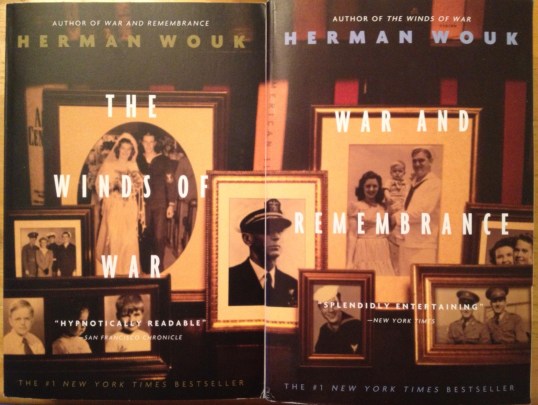
A Herman Wouk Double Feature: The Winds of War (1983, directed by Dan Curtis) and War and Remembrance (1988, directed by Dan Curtis)


When the great American novelist Herman Wouk passed away earlier this month at the age of 103, he left behind a rich and varied literary legacy.  From 1947, the year that his first novel was published to 2016, the year that he published his memoirs, Wouk wrote about religion, history, science, and even the movies.  However, Wouk will probably always be best remembered for the three novels that he wrote about World War II.

Based on his own Naval service during World War II, The Caine Mutiny was published in 1951 and was later adapted into both a successful stage play and an Oscar-nominated film.  It also won Wouk a Pulitzer Prize and established him as a major American writer.  Nearly 20 years later, Wouk would return to the history of the Second World War with two of his greatest literary works, The Winds of War and War and Remembrance.  (Originally, Wouk was only planning on writing one book about the entire war but when it took him nearly a thousand pages to reach Pearl Harbor, he decided to split the story in two.)  Beginning in 1939 and proceeding all the way through to the end of the war, the two books followed two families, the Henrys and the Jastrows, as they watched the world descend into war. Along the way, the book’s fictional characters rub shoulders with historical characters like Hitler, Churchill, FDR, and even Stalin.  Carefully researched and meticulously detailed, the books were both critically acclaimed and popular with readers and, despite some soapy elements, they both hold up well today.

Given their success, it’s not a surprise that both The Winds of War and War and Remembrance were adapted for television.  Today, HBO would probably give the books the Game of Thrones treatment, with 8 seasons of war, tragedy, romance, and Emmys.  However, this was the 1980s.  This was the age of of the big-budget, all-star cast network miniseries.  Wouk’s epic history of World War II was coming to prime time.
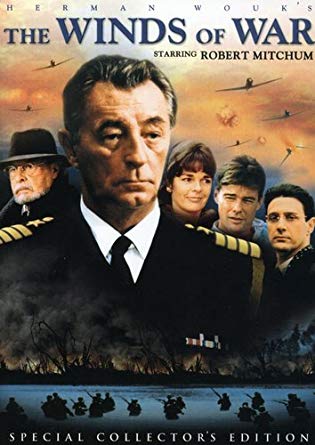
With a total running times of 15 hours, The Winds of War originally aired over seven evenings in 1983.  Produced and directed for ABC by Dan Curtis, The Winds of War had a 962-page script, a 200-day shooting schedule, 285 speaking parts, and a then-record budget of $35,000,000.  It also had Robert Mitchum, starring as Victor “Pug” Henry, an ambitious naval officer who somehow always managed to be in the right place to witness almost all of the events leading up to America’s entry into World War II.  Jan-Michael Vincent played Pug’s son, Byron, while John Houseman took on the pivotal role Aaron Jastrow, a Jewish scholar though whose eyes the home audience would witness the rise of fascism in Europe.  Terribly miscast as Natalie, Aaron’s niece and Byron’s lover, was 44 year-old Ali MacGraw.  Among those playing historical figures were Ralph Bellamy as FDR, Howard Lang as Churchill, and Gunter Meisner as Hitler.

I recently watched The Winds of War on DVD and, despite some glaring flaws that I’ll get to later, it holds up well as both a history of World War II and a tribute to those who battled Hitler’s evil.  Like Wouk’s novels, the miniseries does a good job of breaking down not only how Hitler came to power but also why the rest of the world was often in denial about what was happening.  Watching the entire miniseries in one setting can be overwhelming.  It’s a big production and it is also unmistakably a product of a time when the major networks didn’t have to worry about competition from cable.  It takes its time but, in the end, you’re glad that it did.  All of the little details can get exhausting but they’re important to understanding just how Hitler was able to catch the world off-guard.
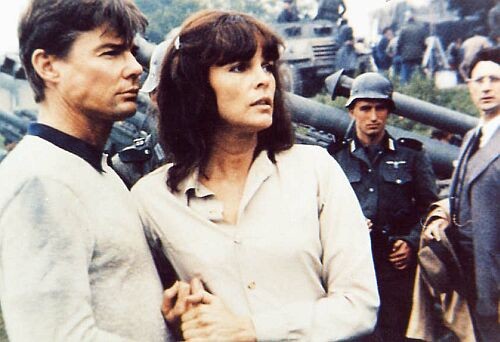
Jan-Michael Vincent and Ali MacGraw in The Winds of War

The miniseries does suffer due to the miscasting of some key roles.  Both Jan-Michael Vincent and Ali MacGraw were far too old for their roles.  Vincent was 38 and MacGraw was 44 when they were cast as naive and idealistic lovers trying to find themselves in Europe.  It’s perhaps less of a problem for Vincent, who had yet to lose his looks to alcoholism and who looked enough like Robert Mitchum that he could pass as Mitchum’s son.  But MacGraw is simply terrible in her role, flatly delivering her lines and looking more like Vincent’s mother than his lover.  It’s particularly jarring when she mockingly calls diplomat Leslie Sloat “Old Sloat,” because Sloat was played by David Dukes, who was six years younger than MacGraw.
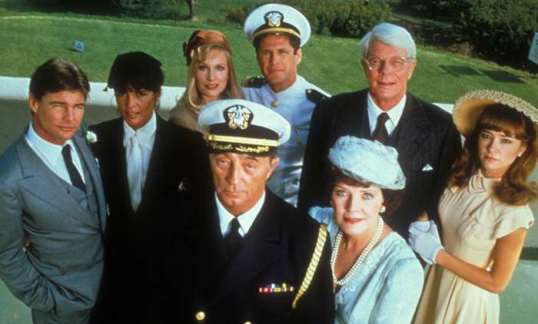
67 year-old Robert Mitchum was also much too old to play an ambitious junior officer, one whose main goal in life is still to ultimately become an admiral.  When he ends up having an affair with a younger British journalist played by 30ish Victoria Tennant, the difference in their ages is even more pronounced than in Wouk’s novel.  (Pug was in his 40s in The Winds of War.)  However, Mitchum overcomes his miscasting by virtue of his natural gravitas.  With his weary presence and authoritative voice, Mitchum simply is Pug.
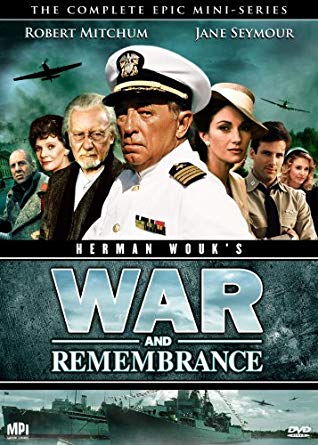
A ratings hit and a multiple Emmy nominee, The Winds of War was followed up five years later by War and Remembrance.  Like its predecessor, War and Remembrance set records.  The script ran 1,492 pages and featured 356 speaking parts.  The production employed 44,000 extras and filming took nearly two years, from January of 1986 to September of 1987.  With a budget of $104 million, it was the most expensive television production to date.  The final miniseries had a 30-hour running time, which was divided over 12 nights.  War and Remembrance not only made history because of its cost and length but also as the first major production to be allowed to film on location at the Auschwitz concentration camp.  For many members of the generation born after the end of World War II, War and Remembrance would serve as their first introduction to the horrors of the Holocaust.

Director Dan Curtis returned and with him came Robert Mitchum, now in his 70s and still playing a junior naval officer.  David Dukes once again played the hapless diplomat, Leslie Sloat.  Ralph Bellamy also returned as FDR as did Victoria Tennant as Mitchum’s lover, Polly Bergen as Mitchum’s wife, and Peter Graves as Bergen’s lover.  However, they were the exception.  The majority of the original cast was replaced for the sequel, in most cases for the better.  With John Houseman too ill to reprise his role, John Gielgud took over the role of Aaron Jastrow while Hart Bochner replaced the famously troubled Jan-Michael Vincent.  Robert Hardy took over the role of Churchill while Hitler was recast with Steven Berkoff.  Best of all, Jane Seymour replaced Ali MacGraw in the role of Natalie and gave the best performance of her career.  Other characters were played by a mix of up-and-comers to tv veterans, with the cast eventually including everyone from Barry Bostwick and Sharon Stone to E.G. Marshall and Ian McShane.
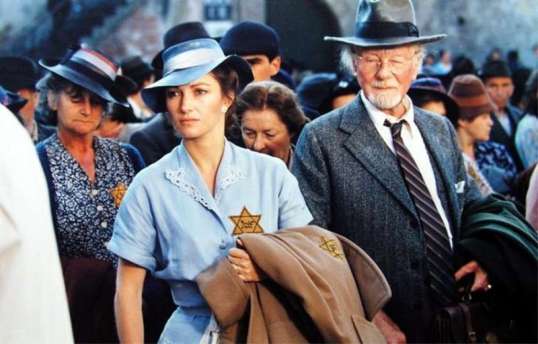
Jane Seymour and John Gielgud

With a stronger cast and (ironically, considering the running length) a more focused storyline, War and Remembrance is superior to The Winds of War in every way.  That doesn’t mean that it’s perfect, of course.  The scenes featuring Barry Bostwick as a submarine commander feel as if they go on forever and Robert Mitchum still seems like he should be preparing for retirement instead of angling for a promotion.  But none of that matters when the miniseries focuses on Aaron and Natalie Jastrow and their struggle to survive life in the Theresienstadt Ghetto and eventually Auschwitz.  At the time that War and Remembrance was initially broadcast, the concentration camp scenes were considered to be highly controversial and many viewers complained that they were so disturbing that they should not have been aired during prime time.  (This was four years before Schindler’s List.)  Seen today, those scenes are the most important part of the film.  Not only do they show why the war had to be fought but they also demand that the world never allow such a thing to happen again.

Though it was considered by a rating disappointment when compared to its predecessor, War and Remembrance was still a multiple-Emmy nominee.  Controversially, it defeated Lonesome Dove for Best Miniseries.  Both Winds of War and War and Remembrance have been released on DVD and, like the books that inspired them, they both hold up well.  They pay tribute to not only those who fought the Nazis but also to the humanistic vision of Herman Wouk.
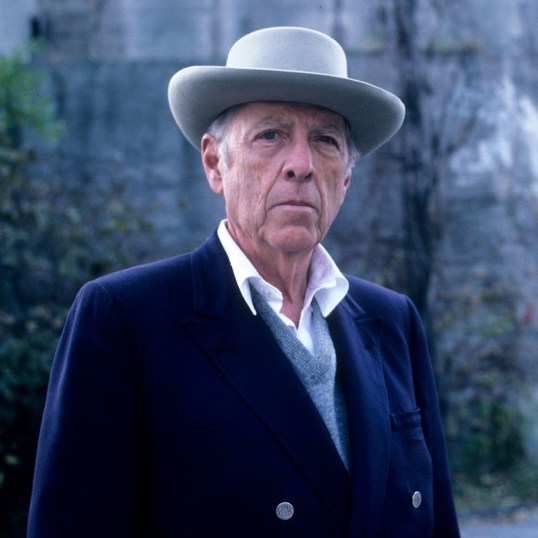
Herman Wouk (1915-2019)

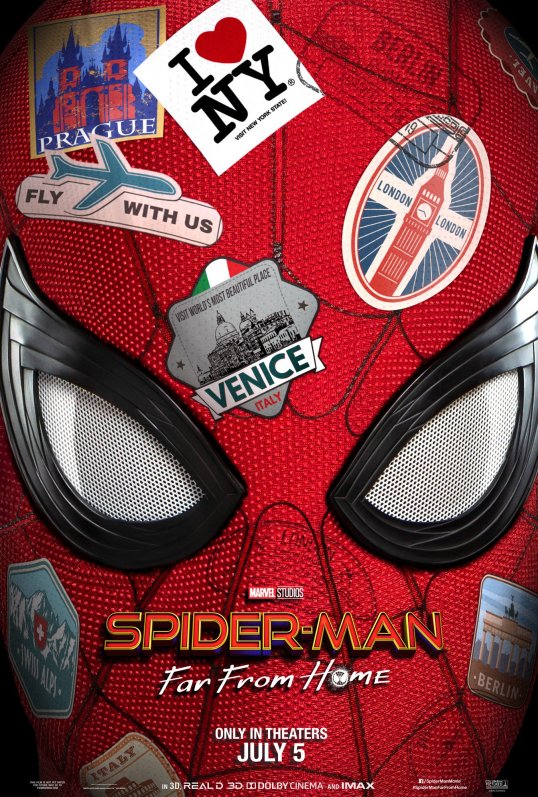
Spider-Man Meets Mysterio In The New Spider-Man: Far From Home Trailer


The new trailer for Spider-Man: Far From Home opens with a warning from Tom Holland.  Do not watch this trailer if you have not seen Avengers: Endgame and you want to avoid spoilers.  It should also go without saying that, if you are avoiding Endgame spoilers, do not read any further on this post.

Spoilers below:

Judging from the trailer, Spider-Man: Far From Home finds Peter Parker mourning the loss of his mentor, Tony Stark.  Looking to get away from the pressures of crime fighting and saving the world and also wanting to pursue his crush on Zendaya’s MJ, Peter joins his classmates on a trip to Europe.  Were all of Peter’s classmates from Spider-Man: Homecoming wiped out by the Snap?  According to Avengers: Endgame, bringing everyone back did not change anything that happened over the previous five years.  Peter got lucky that MJ apparently wasn’t around to graduate high school and move away while he was non-existent.

Peter may want to escape from it all but Samuel L. Jackson’s Nick Fury has other ideas.  Judging from the trailer, it appears that Peter has replaced Tony with three new mentors, Nick Fury, Happy Hogan (Jon Favreau, making the transition over from the Iron Man films), and Jake Gyllenhaal’s Mysterio.  Of course, anyone who is familiar with Mysterio’s history knows that Peter should be careful about trusting him.

The trailer also introduces the concept of the Multiverse.  With all the questions that Endgame raised about time travel and alternate realities, the Multiverse is surely going to be an important factor moving forward.  For instance, it may explain how there’s both a Loki TV show and a Black Widow movie in production when both of those characters were apparently very dead at the end of Avengers: Endgame.

Spider-Man: Far From Home opens on July 2nd.


All Hail Jan-Michael Vincent: Red Line (1996, directed by John Sjogren)


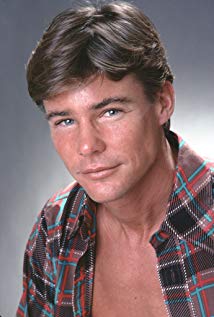
Jan-Michael Vincent, back in the day

When Jan-Michael Vincent died on February 10th, we lost a legend.

For obvious reasons, the life and career of Jan-Michael Vincent is often held up as a cautionary tale.  Vincent went from being a rising star in the 70s to being nearly unemployable in the 90s.  When you watch Vincent in one of his early film, like The Mechanic or Big Wednesday, you see an actor who had both the talent and the looks to be a major star.  He was such a natural and deceptively low-key performer that it is not a surprise that he was twice cast as Robert Mitchum’s son.  He could play everyone from a hippie to a cowboy to a surfer to an assassin.  Unfortunately, once the 80s rolled around, Vincent became better known for his struggles with drugs and alcohol than for his talent.  After a brief but profitable stint starring in Airwolf, Jan-Michael Vincent found himself appearing mostly in straight-to-video action films.  By the mid-90s, he was a mainstay on late night Cinemax.  Even though the films had gotten smaller and his famous good looks had been ravaged by years of hard living, Vincent was still capable of giving a good performance.

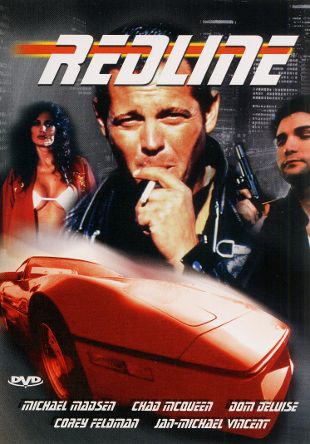
It is impossible to talk about the legend of Jan-Michael Vincent without talking about Red Line.  In this direct-to-video car chase film, Vincent was cast as a gangster named Keller.  When an auto mechanic named Jim (Chad “Son of Steve” McQueen) makes the mistake of taking one of Keller’s cars for a joyride, Keller blackmails Jim into stealing a corvette from a police impound lot.  Red Line was typical of the type of films that Vincent was usually offered in the 90s, an action-filled crime film with a handful of recognizable faces.
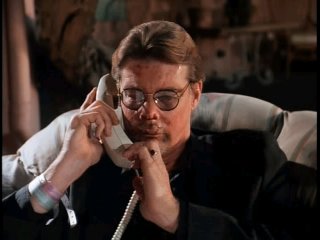
It was also a film that Vincent nearly didn’t live to make.  Two days before filming was to begin, Jan-Michael Vincent was nearly killed when he crashed his motorcycle.  Vincent suffered severe facial lacerations and he would later tell Howard Stern that his eye was nearly popped out of his head as a result of the accident.  Vincent was rushed to the hospital and put in intensive care.

However, Jan-Michael Vincent still had a movie to make.  So, what did he do?  Two days after his accident, he checked himself out of the hospital and, unexpectedly, showed up on set.  With his face noticeable bruised and swollen and with the stitches and sutures still visible, Vincent played the role of Keller.  If you watch carefully, you can even spot his hospital ID, still hanging around his wrist.  The script was hastily rewritten to explain Vincent’s injuries and, though he could barely speak or walk, he still delivered his lines and filmed his scenes.  And goddamn if Jan-Michael Vincent didn’t steal the entire movie.  Even after years of hard-living (not to mention just two days after nearly dying), Jan-Michael Vincent still had it.  Even though he had to whisper his lines and film most of his scenes sitting down, Vincent was still credibly threatening in the role of Keller. He even points out his own injuries, saying, “I’m sick of looking like Frankenstein!”

Jan-Michael Vincent in Red Line

The rest of the cast was made up of an eclectic collection of familiar faces.  Dom DeLuise played Chad McQueen’s boss.  Michael Madsen and Corey Feldman (!) both played rival gangsters while Roxanna Zal played the young woman who becomes McQueen’s partner in crime.  B-movie fans will want to keep an eye out for Julie Strain, Robert Z’Dar, and Chuck Zito.  None of them make as much of an impression as Vincent, though.

Red Line was meant to be an homage to the type of car chase films that Steve McQueen made famous.  Chad McQueen even gets to drive a replica of the car that his father drove in Bullitt.  Some of the chase scenes are exciting but Chad doesn’t have his father’s screen presence and the film never overcomes its low-budget.  Watching the movie is a lot like watching someone else play Grand Theft Auto.  Red Line is a forgettable movie but it will always be remembered as an important chapter in the legend of Jan-Michael Vincent.

Jan-Michael Vincnet, RIP

My Super Bowl Predictions


God may hate football but he loves Tom Brady.

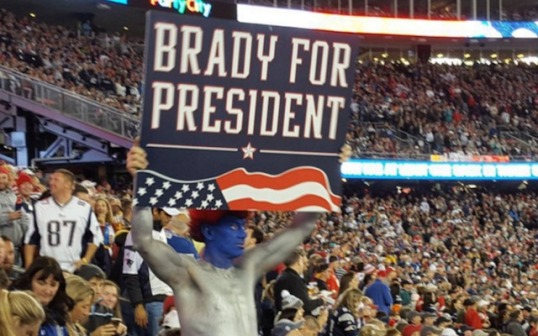
Over the past 20 years, while football has struggled, Tom Brady has thrived.  While other quarterbacks have come and gone, Tom Brady probably has the most secure job in the league.  Brady is currently the winningest quarterback in NFL history and he doesn’t appear to be anywhere close to retiring.  If you’re playing against Tom Brady, you better not let the game get into overtime because Brady will come at you like a machine.

It’s interesting to take a look back at the 2000 NFL Draft and see the quarterbacks who were selected before the Patriots finally picked Tom Brady in the 6th round.  Chad Pennington, Giovanni Carmazzi, Chris Redman, Marc Bulger, and Spergon Wynn were all selected before Brady.  Pennington went on to have a successful career but otherwise, they’re a forgettable group of players.  Of the group, only Tom Brady would eventually lead his team to multiple Super Bowl appearances and only Brady is still playing in the NFL.

Tom Brady played in his first Super Bowl on February 3rd, 2002, leading the New England Patriots to a 20-17 victory over the favored St. Louis Rams.  Later today, Brady will again be facing the Rams.  Things are a little different now.  For one thing, the St. Louis Rams are now the Los Angeles Rams.  For another thing, the Patriots are favored to win this time.

People love to hate on Tom Brady and the Patriots.  It’s understandable.  Most NFL quarterbacks are lucky if they’re still playing after their 34th birthday.  Tom Brady is 41 and still going strong.  Ever since Brady took over for Drew Bledsoe, he and the Patriots have played in 8 Super Bowls and they’ve won 5.  People love rooting for the underdog and, when it comes to football, that often means rooting against Brady and the Patriots.

But let’s get real.  The Rams aren’t going to beat the Patriots.  The Rams wouldn’t even be in the Super Bowl if not for a blown pass interference call.  Maybe the Saints could have beaten the Patriots but the Rams?  I don’t think so.

After losing to the Eagles last year, the Patriots have got something to prove this year.  I think they’re going to do just that.

My Super Bowl Prediction:

Patriots — 31

Rams — 17

A Late Review of PS4’s Spider-Man


It took me a little over a month to make my way through PS4’s Spider-Man.

I started playing around the middle of December and I finally completed the game on January 30th.  I didn’t play every day, of course.  There was one week when I was so busy with the real world that I didn’t play at all.  Most days, when I did play, I would spend maybe 60 to 90 minutes on the game, sometimes more and sometimes less.  All told, I’d estimate that it took about a total of 25 hours for me to finish the game’s story.  That’s not counting the time that I spent on side quests or the times when I would just swing through New York and appreciate the massive amount of work and detail that went into recreating Manhattan Island.

The first half of the game is probably one of the best advertisements for New York City that’s ever been put together.  Whether you’re swinging through Central Park or taking in the sights in Times Square, it’s hard not to get drawn into the game’s depiction of New York as being the most exciting city in the world.  Both Spider-Man and Mary Jane Watson get scenes in which they talk about how much they love New York.  At the start of the game’s third act, a major disaster happens and New York is suddenly trashed and no longer as friendly a place.  While the streets are controlled by the paramilitary mercenaries of Sable International, the rooftops are populated by snipers who think nothing of trying to shoot you while you’re trying to swing from mission to mission.  And yet, even when things are at their worst, the indomitable spirit of New York survives.  Even though a biological weapon has been detonated and there’s been a massive prison break, you can still find people taking a stroll through Central Park.  (Of course, now they’re wearing surgical masks and some of them are stopping to cough.)  Even after martial law is declared, you can still drop in on the quad at Empire U and find students hanging out.  J. Jonah Jameson (who, in this game, hosts Spider-Man’s favorite podcast) may be a braying fool most of the time but he’s right when he says that New York will never surrender.

(The game’s action is limited to Manhattan.  As much as I would have loved to have visited the Bronx, I understand that there’s only so much that one game can do.  When I tried to swim to Staten Island, I discovered that swimming is the one thing that Spider-Man does not do well.  When I tried to cross the Brooklyn Bridge, I got a warning telling me that I was “leaving the game.”  Maybe the sequel will take Spider-Man into the outer boroughs.)

Spider-Man is voiced by Yuri Lowenthal and, after playing this game, it’ll be impossible for me to ever think of Spider-Man as sounding like anyone else.  Whether he’s telling a bad joke or, when the game takes a detour into Spider-Man’s subconscious, battling his own demons, Lowenthal simply is Spider-Man.

The game features many of the members of Spider-Man’s supporting cast, with Yuri Watanabe, Mary Jane, Miles Morales, and Aunt May all making welcome appearances.  (Four of the story’s missions require the player to take on the roles of either MJ or Miles.)  As for the game’s villains, Doctor Octopus, Kingpin, Tombstone, Taskmaster, Norman Osborne, Mr. Negative, Electro, Vulture, Rhino, Scorpion, Screwball, and Shocker all play roles of varying importance.  Doctor Octopus is reimagined as being, before he goes bad, almost a surrogate father to Peter.  When Spider-Man battles him, he’s not only fighting Doctor Octopus but he’s also battling his own guilt.  We all know the old saying: “With great power, comes great responsibility.”  PS4’s Spider-Man is one of the few adaptations of the character that actually understands what that means.

While I liked the way that the villains were depicted and I think that this is one of the few Spider-Man adaptations to actually capture what makes Electro such an *ahem* electrifying character, I do wish that some of the boss battles had been more difficult.  While they do provide some challenge, they can also often be won just by pushing the dodge button until your opponents eventually tire themselves out.  For one battle, Spider-Man debuts a new suit designed to give him an advantage.  I won the battle without ever using the advantage.  Another battle can be won by finding a high place to perch on while your two opponents defeat themselves with friendly fire.

To anyone playing the game for the first time, my main warning would be to hold off on talking to a homeless man named Howard.  It’s tempting to go over and speak with him because his sidequest is located right next to the building where you go to visit Aunt May.  When you see the little blue diamond inviting you to visit with Howard, it’s hard to resist.  However, when you talk to Howard, you eventually end up agreeing to help him find all of his pet pigeons.  Those pigeons are located across the city and, as soon as you find yourself near any of them them, they’ll take off flying and, regardless of whatever else you may have going on, you’ll be expected to chase after them.  When it comes to Howard, hold off on talking to him until after you’ve taken care of the game’s main story.

Flaws aside, Spider-Man captures the spirit of its main character.  It’s not just about fighting crime, though there is a lot of that to do.  It’s also about making sure that Aunt May isn’t wearing herself out with her volunteer work.  It’s about trying to find time to cook dinner for MJ without neglecting the demands of being a super hero.  It’s about the sidequest where you rescue a civilian who, because he’s wandering around New York dressed like you, has attracted the wrong type of attention.  It’s about checking in on the research stations that Harry Osborne set up around the city before he mysteriously disappeared.  Sometimes, it’s just about taking the time to stop and take a selfie with a fan.  There’s plenty of action but, for me, the game was at its best when it was simply about Spider-Man swinging across Manhattan, looking for old backpacks and sometimes taking pictures of landmarks.

Spider-Man is one of the most enjoyable games that I’ve played in a while and I look forward to replaying it.  Next time, though, I’m telling Howard to collect his own pigeons…

Music Video of the Day: The Bubblemen Are Coming! by The Bubblemen (1988, directed by ????)


The Bubblemen are coming!

Who are the Bubblemen?

According to this video, the Bubblemen lived in London and looked like they might be offshoots of the infamous killer bees who used to appear during the early seasons of Saturday Night Live.  Underneath the Bubblemen costumes were Daniel Ash, Kevin Haskins, and David J, three former members of Bauhaus who later formed a band called Love and Rockets.

The Bubblemen were a side project of Love and Rockets.  They only released one single and video but they later made cameo appearances in the videos for Love and Rockets’ No New Tales To Tell and Yin and Yang (The Flowerpot Man).

The Bubblemen Are Coming was issued by Beggars Banquet Records and came with three additional tracks, Bubblemen Rap, Bubblemen Rap (Dub Version), and Bees.  The video perhaps achieved its greatest exposure when it was featured on an episode of Beavis and Butthead.  It’s been a while since I’ve seen it but, if I remember correctly, this video really freaked out Beavis.

Game Review: Deadline (1982, Infocom)


Wealthy industrialist Marshall Robner has been found dead in his study, with the door locked.  The autopsy says that he died of an overdose of antidepressants.  Was it suicide or was it murder?  And, if it was murder, who was responsible?  That’s the mystery that you’ve been given a limited amount of time to solve.

In Deadline, you play a police detective who has 12 hours to investigate and solve the mystery behind the death of Marshall Robson.  The game starts with your arrival at the sprawling Robner estate.  Do you immediately start interviewing the suspects or do you look for clues around the grounds?  Do you attend the reading of Robner’s will or do you search the study where he died?  It’s up to you but just remember that the clock is ticking!

Written by Marc Blank and released by Infocom, Deadline is a classic text adventure from 1982.  From the minute, you enter the Robner estate, you are interacting with suspects like Robner’s adulterous wife and his irresponsible son.  Their actions and their responses to your questions are determined by how you go about investigating the crime and one of the joys of the game is seeing how people react to different approaches.  (When it comes time to read Robner’s will, one character will either show up early or late, depending on whether or not you’ve shown them a key piece of evidence.)

The mystery is complex.  I played through the game a handful of times before realizing that one thing that I felt was very important was actually just a red herring.  The mystery can be solved but you’re going to have to play the game several times and experiment with being in different places at different times and showing different clues to different suspects.  Or you can just type “Deadline Walk-Through” into Google like I eventually did.

Like many other good games from the past, Deadline can currently be found in the Internet Archive.