Operation: Mindcrime is the title track from Queensrÿche’s third studio album. The album was considered to be the band’s breakthrough album and, unlike a lot of heavy metal from the 80s, it still has a good critical reputation to this day. I’m not a huge Queensrÿche fan but I have to admit that the bass line in the title track is pretty awesome.
The album was a concept album, about a junkie named Nikki who was turned into an assassin by the evil Dr. X. (As with most concept albums, the plot was actually much more complicated but I’ve only got so much space for this post.) For the album, this song was about how Dr. X could program Nikki to kill simply by saying, “Mindcrime.” The video, while containing all of the themes from the overall album, simplifies things to two men playing Russian Roulette while sitting in an office that’s decorated with a portrait of Stalin.
This video was directed by Chris Painter, who directed several other Operation: Mindcrime videos and who also did the video for Rush’s Roll The Bones.
Ship of Fools was the second single to be released from Robert Plant’s fourth solo album, Now and Zen. Now and Zen was the most financially and critically successful of all of Planet’s solo albums, though Plant himself has said that he feels that the album’s music “got lost in the technology of the time.” I would be disappointed if Robert Plant didn’t decry “the technology of the time” but, in this case, he’s being too hard on himself. Now and Zen is a very good album.
This song is mood piece, a love song. In the video, Plant appears to be singing in the rain and it works. The song was later used in “Freefall,” the final episode of Miami Vice, the show that epitomized the 80s and the technology of the time like no other.
It was a story that he told often, about how he was a struggling, 30 year-old actor with a few film credits to his name when he was offered the lead role in The Graduate. Even though producer Lawrence Turman said the role would make him a star, Grodin turned it down because of the low salary that Turman offered. The role was then offered to Dustin Hoffman, who went on to become a star and spend several decades as an unlikely box office draw.
It’s easy to imagine Grodin in the role of Benjamin Braddock. He probably wouldn’t have been as insecure as Hoffman was in the role. He would have been a less passive Benjamin. Grodin’s Braddock would probably have been more obviously frustrated with Mrs. Robinson and his parents. Nobody played frustration quite as well as Charles Grodin. Audiences might not have been as quick to sympathize with Benjamin if Grodin had played the role but I think he would have eventually won them over. Grodin was an actor with a talent for making unlikable characters somehow funny and relatable.
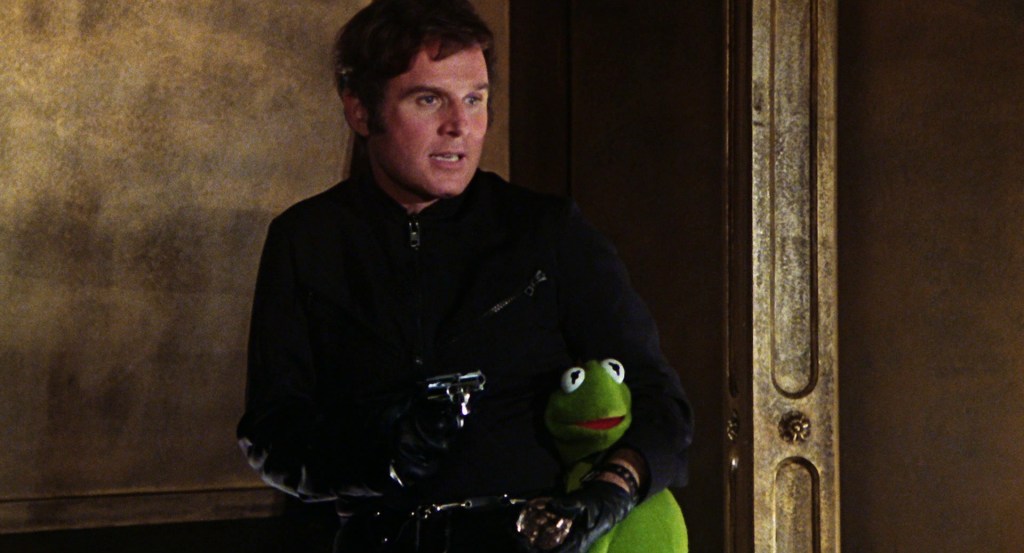
Though Grodin may not have played Benjamin Braddock, he still went on to establish himself as one of the funniest character actors in the business, a master of deadpan humor. He was often the best thing in the moves in which he appeared. In Heaven Can Wait, he was funny even while he was trying to kill Warren Beatty. In Real Life, he was a suburban father who found himself trapped in an early version of reality television. In Seems Like Old Times, he gets more laughs with one annoyed expression than Chevy Chase gets in the entire film. In The Great Muppet Caper, he fell in love with Miss Piggy and tried to kill Kermit. He was one of the few actors to make it through Ishtar with his dignity intact. In Midnight Run, he was the perfect comedic counterbalance to Robert De Niro. In Dave, he taught the government how to balance a budget. Though he was often cast in supporting roles or as a co-lead (as in Midnight Express), he proved that he could carry a film with his starring turn in The Heartbreak Kid.
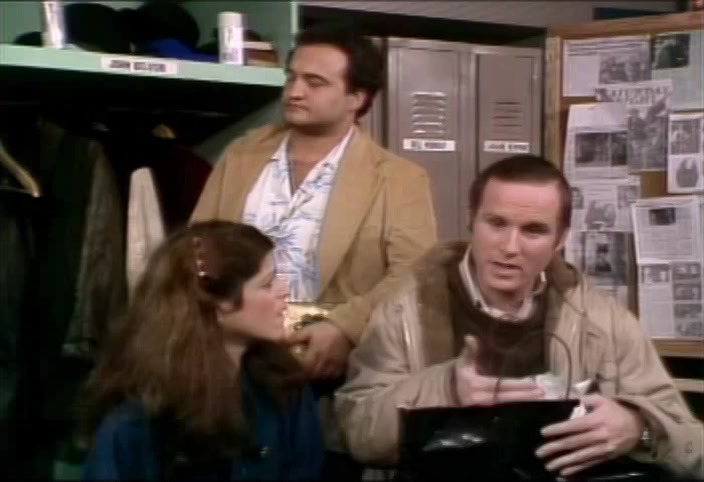
A lot of people knew Grodin best as a late night talk show guest, where he always seemed to be annoyed about something. He would get into mock arguments with the hosts and leave audiences confused as to how serious any of it was. (According to David Letterman, none of it was.) He briefly hosted his own talk show, from 1995 to 1998. Legend has it that Lorne Michaels banned him from Saturday Night Live after he hosted the show, apparently because he was so difficult to work with. How much of that is true and how much of that was just Grodin doing a bit, no one knows. I’ve seen Grodin’s episode. It’s fine. He’s funny.
Charles Grodin died today of bone marrow cancer. He was 85 years old. I’m going to miss him.
Gilda Radner, John Belish, and Charles Grodin on Saturday Night Live
This lengthy music video finds Phil Collins playing a drummer-turned-singer in the 1930s. With the help of his friend, a guitar player named Eric (and played, of course, by Eric Clapton), Collins auditions for a demanding theater owner (Jeffrey Tambor). While he auditions, he imagines what his life would be like if he becomes a success. He might even win an Oscar, probably for writing a song for a Disney film.
This video is more like a short film than a traditional music video, with over two minutes of “acting” before the singing even begins. This video came out at the time when Collins was still trying to make a career as an actor. I like the video but I wouldn’t be surprised to find out that, for some people, it probably represents everything that they didn’t like about Phil Collins back in the day.
This video was directed by Jim Yukich, who directed several videos for Collins. Yukich’s name can be spotted on a clapboard when Collins is imagining what it would be like to be a film star.
In the scenes in which Collins is acting opposite of Humphrey Bogart, Bogart is played by Robert Sacchi. Sacchi built an entire career out of his resemblance to Humphrey Bogart. Whenever a sitcom in the 80s or the 90s needed Humphrey Bogart to appear in a dream sequence, the call went out to Sacchi. Sacchi also appeared in several movies, playing characters with names like Sam Marlowe, Inspector Bogie, and The Bogeyman. According to the imdb, he also appeared in The Erotic Adventures of Three Musketeers as Athos. I’m not sure if I believe that.
Today is Tax Day here in the States so this music video of the day feels especially appropriate.
George Harrison originally wrote this song in 1966. It appeared on Revolver. The song was inspired by the fact that, even tough the Beatles were making a huge amount of money, they were also expected to give a huge amount of that money to the government. Harrison said that the music was inspired by the theme song for the Batman TV series and once you learn that, it’s impossible to listen to this song without thinking, “Batman!”
This performance is from a 1991 concert in Japan and features Harrison’s frequent collaborator and friend, Eric Clapton. Eric Clapton has said that he originally disliked the Beatles because he felt that they were too “poppy,” and that he preferred the blues. Clapton, of course, went on to collaborate with all four of the Beatles on several different projects. When it appeared that Harrison had left the Beatles during the tense recording of the album that would become Let It Be, John Lennon briefly speculated about replacing him with Clapton. Harrison, however, returned to the band and the Beatles broke up shortly afterwards.
(Clapton, for his part, says that if Lennon ever had made the offer, he would have refused because of his friendship with Harrison.)
In 1969, following his famous spiritual awakening, George Harrison would tell BBC Radio, “”No matter how much money you’ve got, you can’t be happy anyway. So you have to find your happiness with the problems you have and you have to not worry too much about them.”
Every story has to end somewhere and for Survivor, it was pretty much with the release of this single. Though Across The Miles was one of their biggest hits, the album from which it came, Survivor’s seventh studio album Too Hot To Sleep, was not. The album was considered to be a commercial disappointment and the band went on hiatus after it was released. There would not be another Survivor album until 2006’s Reach.
To date, Across The Miles is Survivor’s final original single. (Eye of Tiger reentered the singles chart in 2007, coinciding the release of Rocky Balboa and the Best of Rocky soundtrack compilation.) The video for Across the Miles does feature one woman waiting for a phone call in a lonely room but it’s mostly just a clip of the band performing. Like many of the videos from the time, it’s shot in noirish black-and-white.
Director Jim Yukich directed music videos for almost everyone. If you were a band whose music appeared on the Adult Contemporary charts, it’s probable that Jim Yukich did a video for you.
Yes, that’s a youngish and less crazed-looking Randy Quaid, playing the truck driver who asks the Bangles if they want to walk like an Egyptian. It can sometimes be surprising to remember that, before he dedicated his life to exposing the Star Whackers, Randy Quaid was a busy and popular character actor.
Little Richard also shows up towards the end of this video. There’s no chance of ever mistaking Little Richard for being anyone other than Little Richard.
This video was directed by Gary Weis, who is best-known for directing short films for the first few seasons of Saturday Night Live. You know that black-and-white film where John Belushi goes to a cemetery and talks about how he outlived the entire cast? Weis directed that. He also directed Steve Martin’s first stand-up special and several concert films.
Back in the 1980s, you never knew when a glam metal band might suddenly drive by your home or your office, inviting you to rock out to the thundering beat of the band and the vibrato-laden lyrical stylings of a lead singer like Don Dokken.
This video for Dokken’s It’s Not Love has everything:
An opening shot of a hot blonde getting into a truck? Check!
A dancing homeliness man? Check!
The band rocking out as they’re driven through Los Angeles? Check!
Groupies? Check!
A shout-out to pioneering underground radio station KMET 94.7? Double check!
Originally, I was going to post this on Sunday but this is probably not an appropriate Mother’s Day song. One rumor is that this song is about a young Satanist telling his parents not to try to lead him away from the lifestyle that he wants. Danzig, himself, once said that the mother he was singing to was meant to be Tipper Gore, who was big on banning heavy metal music and whose then-husband, Albert Gore, was actually a part of a Senate committee looking into “obscene” music.
This is the first video for Mother. Danzig redid the song in 1993 and came out with a second video as well. I prefer the first video because Danzig doesn’t dance. As Beavis and Butthead said when they viewed Danzig shaking his hips in the second video, “That little dance wasn’t very cool.”
One day, while defending Gotham City, Batman (Adam West) and Robin (Burt Ward) learn that there is a plot to abduct Commodore Schmidlap from his yacht. Quick! To the batcopter! Flying over the ocean, they locate the yacht but it turns out that the whole kidnapping plot was a ruse for a shark to attack Batman!
“Holy sardine!” Robin exclaims!
With the help of porpoise who bravely sacrifices its life to protect the Caped Crusader, Batman manages to escape. Back at police headquarters, Batman, Robin, Commissioner Gordon (Neil Hamilton), and Chief O’Hara (Stafford Repp) wonder which member of Batman’s rogue’s gallery of villainy could have been responsible for the ruse.
Batman says that it was pretty “fishy” what happened and that could possibly mean The Penguin (Burgess Meredith) was involved!
Robin points out that it happened “at sea” and C stands for Catwoman (Lee Meriweather)!
Batman then says that the shark was “pulling my leg” and that might mean it was working for The Joker (Cesar Romero)!
Chief O’Hara says that it all adds up to “a sinister riddle,” which can only mean one thing: The Riddler (Frank Gorshin)!
“The four of them,” Batman says, “working together…”
“Holy nightmare!” Robin exclaims!
As you can probably guess, the tone of 1966’s Batman: The Movie is far different from the tone of more recent Batman films. That’s because Batman: The Movie was based on the light-hearted 60s TV show that made Batman a household name even while transforming the character from being a shadowy vigilante to being a comedic straight arrow, a proud square who regularly lectured the citizens of Gotham about respecting the forces of law and order.
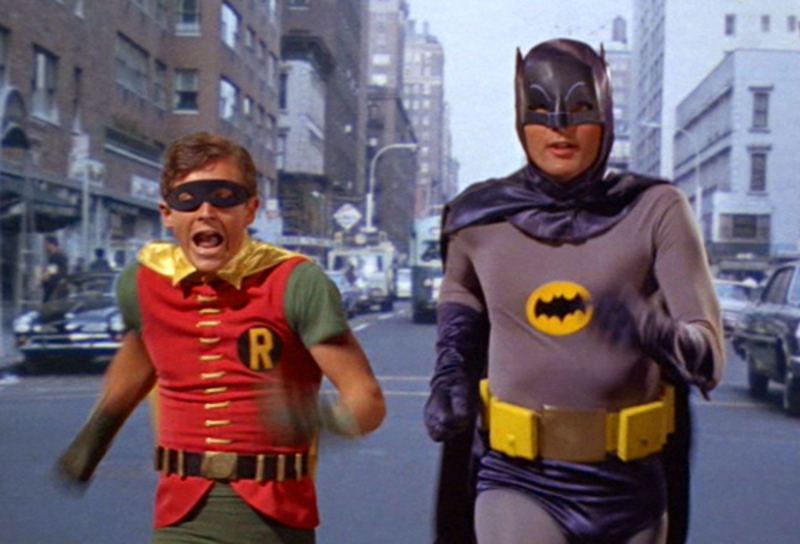
Batman: The Movie was released after the conclusion of the first season of the Batman televisions series and it featured nearly the entire cast of the show. (Lee Meriweather replaced Julie Newman in the role of the purring Catwoman.) The movie feels like an extended episode of the show, still using the same famous music and featuring scenes of Batman and Robin running in place with a street scene projected behind them. The attitude is one of affectionate parody, as opposed to the more cynical campiness of Joel Schumacher’s infamous films from the 90s. Adam West expertly deadpans his way through the main role while the underrated Burt Ward energetically plays the naïve and easily amazed Robin. Of the villains, Lee Meriweather is a sexier Catwoman than Anne Hathaway and there’s never been a better Riddler than Frank Gorshin. (Of the many actors who played Batman’s villains on the TV series, Gorshin was always the only one who seemed to understand that he was supposed to be playing someone dangerous.) At 104 minutes, Batman: The Movie runs out of steam before it ends but there’s still much here to entertain fans of the television show.
Of course, when I was growing up in the 90s, there was no easier way to lose credibility with most diehard Batman films than to admit to liking anything about the television series. The Batman TV series was widely blamed for people thinking that comic books were only meant for kids. Tim Burton was a hero for treating Batman seriously. Joel Schumacher was hated for taking the opposite approach. Batman and Robin was criticized for being too much like the TV show, right down to George Clooney doing a poor man’s Adam West impersonation in the main role. Despite the acclaim that greeted Batman: The Animated Series, It wasn’t until Christopher Nolan took control of the character that the cinematic Batman truly returned to his grim roots.
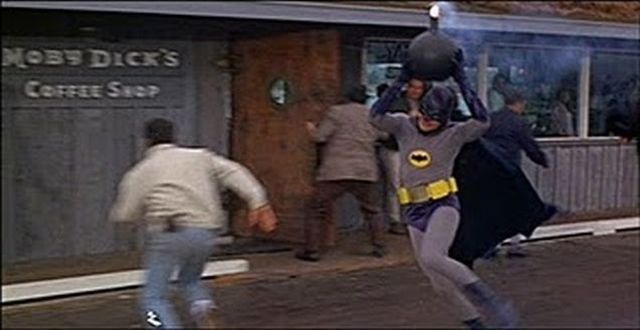
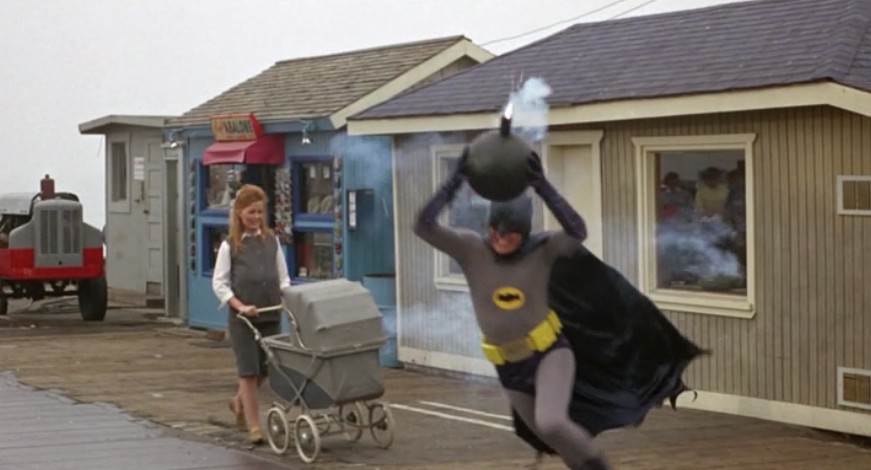
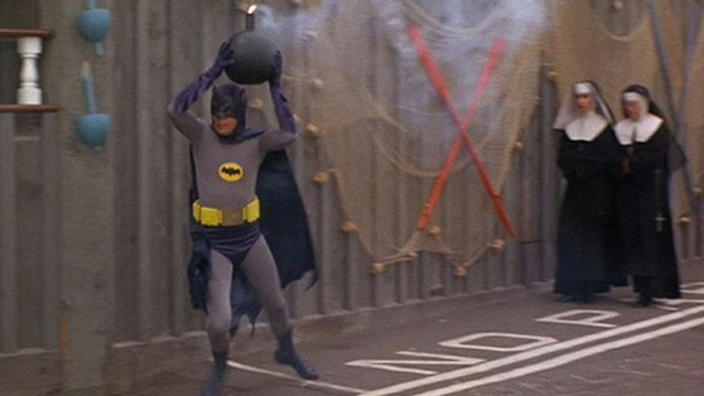
Since the conclusion of Nolan’s Dark Knight trilogy, there have been several versions of Batman. Ben Affleck took over the role for two films. Young Bruce Wayne and his doomed parents briefly appeared in Joker. Robert Pattinson is set to take over the role in The Batman. Now that everyone knows Batman as a grim avenger and countless actors have bragged about how they prepared for their roles in the Batverse by reading either The Killing Joke or The Dark Knight Returns, it’s easier to appreciate the more light-hearted approach of something like Batman: The Movie. After two decades of grim and serious Batmans being used as a metaphor for everything from PTSD to the surveillance state, the sight of a paunchy Adam West trying to find a place to safely dispose of a ridiculously oversized bomb can be a relief.
“Sometimes,” Batman says, “you just can’t get rid of a bomb!”
 Through the Shattered Lens