Great Moments In Comic Book History: The Death of Doctor Druid


Dr. Druid never got much respect.

First introduced in 1961 and originally known as Dr. Droom (his name was changed to prevent anyone from mixing him up with Dr. Doom), Anthony Ludgate Druid was a magic user who hunted monsters and who had studied the mystic arts with a Tibetan lama.  Later, the lama was retconned into the Ancient One and it was said that Dr. Druid was the runner-up for the position of Sorcerer Supreme.  This was a way of acknowledging an obvious truth, that Dr. Druid was an unsuccessful dry run for Dr. Strange.

With Dr. Druid’s monster hunting activities never becoming popular with readers, he was eventually just used as a host for Weird Wonder Tales, a series that reprinted old monster comics from the 50s.  One look at Dr. Druid at this time shows why he was never able to seriously challenge Doctor Strange for the role of Marvel’s most popular sorcerer.

Eventually, Dr. Druid did enter the mainstream Marvel universe.  He joined the Avengers and distinguished himself by getting himself elected Avengers chairman while possessed by a villainous and then disbanding the team.  Even after Dr. Druid got his mind back, no one wanted much to do with him and he faded into obscurity.

He remained forgotten until 1995.  That was when he was resurrected for a series that lasted for four issues.  To this day, there’s debate over whether the series was meant to be a miniseries or a continuing series.  What everyone can agree on is that Warren Ellis radically challenged what everyone though they knew about Dr. Druid.

Now, heavily tattooed and simply calling himself Druid, the former hero was an embittered alcoholic who embraced the dark side of his powers.  For four issues, Druid roamed through London and killed almost everyone who he met.  Druid was a dark and brutal series and it’s probably not surprising that it only lasted four issues.

The final issue featured Druid doing his usual killing and destroying until, in the final pages of the issue, Daimon Hellstrom suddenly appeared and announced, to Druid: “You’re a lunatic, a religious maniac, a bad idea. You should have been stamped on at birth. And, in the end, you’re a failure.”  Hellstrom proceeded to burn Druid to a crisp and what I’ve always remembered about that issue were the final lines announcing that Druid’s corpse was left in a trash can.

When you’re a kid just reading a comic book, that’s some pretty heavy stuff!  Those last moments of Druid have always stuck with me.  I’ve always felt bad for Dr. Druid.  He went from being a failed Sorcerer Supreme to a failed Avenger to eventually getting tossed in a trash can.  He’s also one of the few Marvel characters not to return from the dead. He’s gone, never to return.  He probably won’t even get to appear in a movie.

Alas, poor Druid.  He was the Rodney Dangerfield of second-tier Marvel heroes.  He never got any respect.  No respect at all.

Druid (Vol. 1 #4, August, 1995)

“Sick of it All”

  • Writer — Warren Ellis
  • Penciler — Leonardo Manco
  • Inker– Leonardo Manco
  • Colourist — D’Ireali
  • Letterer — Jon Babcock
  • Cover Artist — Leonardo Manco

Previous Great Moments In Comic Book History:

  1. Winchester Before Winchester: Swamp Thing Vol. 2 #45 “Ghost Dance” 
  2. The Avengers Appear on David Letterman
  3. Crisis on Campus
  4. “Even in Death”
  5. The Debut of Man-Wolf in Amazing Spider-Man
  6. Spider-Man Meets The Monster Maker
  7. Conan The Barbarian Visits Times Square
  8. Dracula Joins The Marvel Universe

Game Review: BYOD (2020, n-n)


BYOD is an entrant in the 2020 Interactive Fiction Competition.  All of the entries can be browsed and played here.

You are a university student who has just been given an internship at a prestigious company.  You don’t know much about what the internship involves, you just know that you’re supposed to show up.  However, when you do show up, the secretary tells you that the person you’re supposed to meet is not there.  What do you do now?

BYOD is described as being a “micro interactive fiction” and that’s certainly the perfect way to put it.  This is a simple game that takes place in one room.  There’s really only one thing that you have to do to get the “okay” ending.  If you can figure out how to use your phone in the game, you’ll be fine.

However, if you want to get the “good” ending, you’ll have to be more observant of that room.  You’ll have to look at everything and put the clues together and eventually, you’ll get your chance to help out the secretary.  It’s all pretty simple but it was still emotionally satisfying to help someone out and get the good ending.

BYOD can be played here.

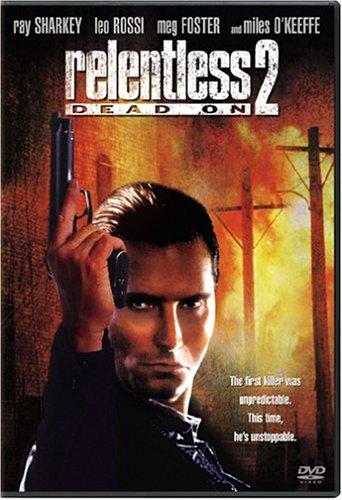
Dead On: Relentless II (1992, directed by Michael Schroeder)


Still struggling to recover from having to act opposite Judd Nelson in the previous Relentless film, Los Angeles homicide detective Sam Deitz (Leo Rossi) finds himself investigating another string of seemingly random murders.  This time, the killer is Gregor (Miles O’Keeffe), a master of disguise who hangs his victims, decorates the crime scene with Satanic graffiti, and takes a lot of ice baths.  Deitz is forced to team up with a condescending FBI agent named Kyle Valsone (Ray Sharkey), who has his own reasons for wanting to capture Gregor and who might not have the best interests of the case in mind.  As if having to deal with killer Russians and crooked FBI agents isn’t bad enough, Deitz is also having to deal with the collapse of his married to Meg Foster and the everyday irritations of being an intense New York cop in laid back Los Angeles.

Relentless II is a better than the first Relentless, mostly because Miles O’Keeffe is a better villain than Judd Nelson.  Whereas Nelson was too twitchy to be taken seriously in the first Relentless, O’Keeffe is cold as ice and believably dangerous.  He’s a worthy opponent for Rossi and Sharkey.  How much Keeffe was in this movie?  Just enough to make it work.

Whenever O’Keeffe isn’t doing his thing, the movie focuses on Deitz and Valsone.  To a certain extent, their relationship mirrors the relationship that Deitz had with Malloy in the first Relentless except, this time, the mentor turns out to be just as bad the killer.  Ray Sharkey was a good actor whose career nosedived because of his own addictions.  He was always at his best playing streetwise bad guys, like Sonny Steelgrave in Wiseguy.  He’s good as Valsone, giving a performance that indicates that, even if mainstream Hollywood wasn’t willing to take a chance of him, he could have carved out a direct-to-video career as a poor man’s Michael Madsen.  Unfortunately, Sharkey contracted HIV as a result of his heroin addiction and he died of AIDS just a year after the release of Relentless II.

Leo Rossi gives another good performance as Sam Deitz.  Rossi was usually cast as abusive boyfriends and low-level mobsters and it’s obvious that he enjoyed getting to play a hero for once.  Meg Foster may not get to do much as Deitz’s wife but her otherworldly eyes are always a welcome sight.

Relentless II was the high point of the Relentless films.  It made enough money to lead to a sequel.  Sam Deitz’s days of hunting serial killers were not over.

Game Review: Congee (2020, Becci)


This story is an entrant in the 2020 Interactive Fiction Comp.  All of the stories can be browsed and experienced here.

You have recently moved from Hong Kong to the United Kingdom, leaving behind both your mother and your culture.  One night, you find yourself suffering from a fever, missing your mom (and the time difference makes it inconvenient to call her), and, worst of all, craving congee.

(From the game: Congee /ˈkɒndʒiː noun  (in Chinese cooking) broth or porridge made from rice. Meat, fish, and flavourings are added while preparing the congee, and it is most often served as a meal on its own, especially for those who are feeling unwell.)

Like a lot of Twine Interactive Fiction, Congee is less of a game and more of a story with choices.  You can click to get more details and to learn more about the world and the lives of the characters in the story but ultimately, the story is the thing.  It’s a good story, though.  Even though it’s written through the eyes of someone who is dealing with a very specific experience, the themes are universal.  It made me homesick in a good way.

Congee can experienced here.

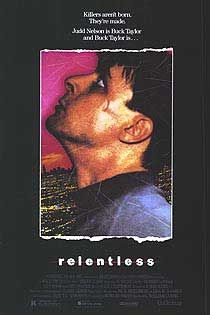
Relentless (1989, directed by William Lustig)


Buck Taylor (Judd Nelson) is the son of an LAPD cop who has never gotten over the bitterness he feels over being rejected by the force himself.  Determined to get revenge on a world that refuses to look beyond the dark circles under his eyes, Buck becomes a serial killer.  He picks his victims at random from the phone book.  Because his father was a cop and he studied to join the force, Buck knows all the tricks of the trade.

Pursuing Buck are two cops.  Bill Malloy (Robert Loggia) is a veteran detective who is supposed to be laid back though Robert Loggia was one of those actors who never seemed like he had been laid back a day in his life.  Malloy’s new partner is Sam Dietz (Leo Rossi).  Dietz has just transferred to Los Angeles from New York and he’s having a hard time adjusting.  Everyone is just too laid back.

When Buck starts to target the two cops who are investigating him, the case gets personal and relentless.

Relentless is a movie that I’ve been meaning to review for five years now.  In the past, I’ve always been deterred by the fact that reviewing Relentless would mean rewatching Relentless.  But, having just spent two weeks watching all of the Witchcraft films, I now feel like I can handle anything.  Relentless is a movie that I always remember as being better than it actually is.  The murders are creepy but Judd Nelson gives such a one-note performance as the killer that it’s impossible to believe that he could have gotten away with them.  As played by Nelson, Buck Taylor is such an obvious serial killer that I’m surprised that he wasn’t already in jail, having been accused of every single unsolved murder on the books.  There’s nothing compelling about this killer and films like this pretty much live and … ahem … die based on the quality of their villain.

Why do I always remember Relentless as being better than it is?  Most of the credit for that probably goes to Leo Rossi, an underappreciated character actor who gives such a good performance as Sam Dietz that he makes the entire movie better.  Rossi even got a brief franchise out of his performance in Relentless, as Dietz returned for three sequels.  Robert Loggia is also good as Malloy and it’s unfortunate that the movie doesn’t do as much with the character as it could have.

Rossi and Loggia aside, Relentless doesn’t live up to its potential.  But it was still popular enough to launch a direct-to-video franchise.  Tomorrow: Relentless 2.

Great Moments In Television History: The Autons Terrify The UK


In 1971, for the entire month of January, children across the UK were terrified of the Autons.

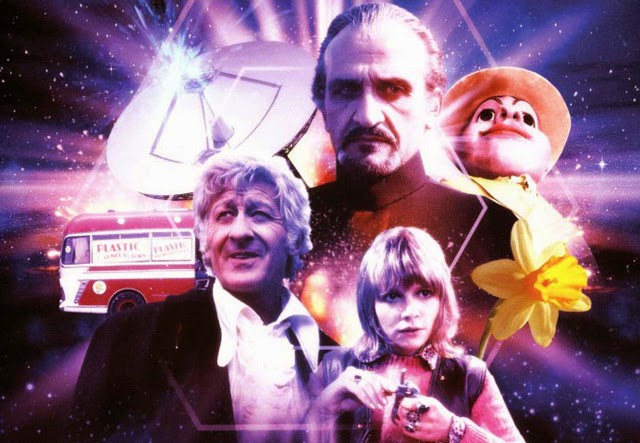
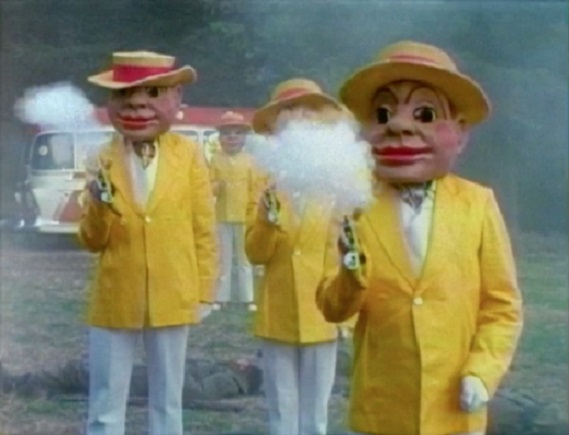
That was because Doctor Who began its eighth season with a four-part story called The Terror of the Autons.  Previously seen in Spearhead From Space, the Autons were plastic aliens who could disguise themselves as anything.  That mannequin in the store?  It might be an Auton.  That strange looking man handing out flowers?  Might be an Auton.  Your favorite plastic doll?  It might be an Auton waiting to kill you in your sleep.

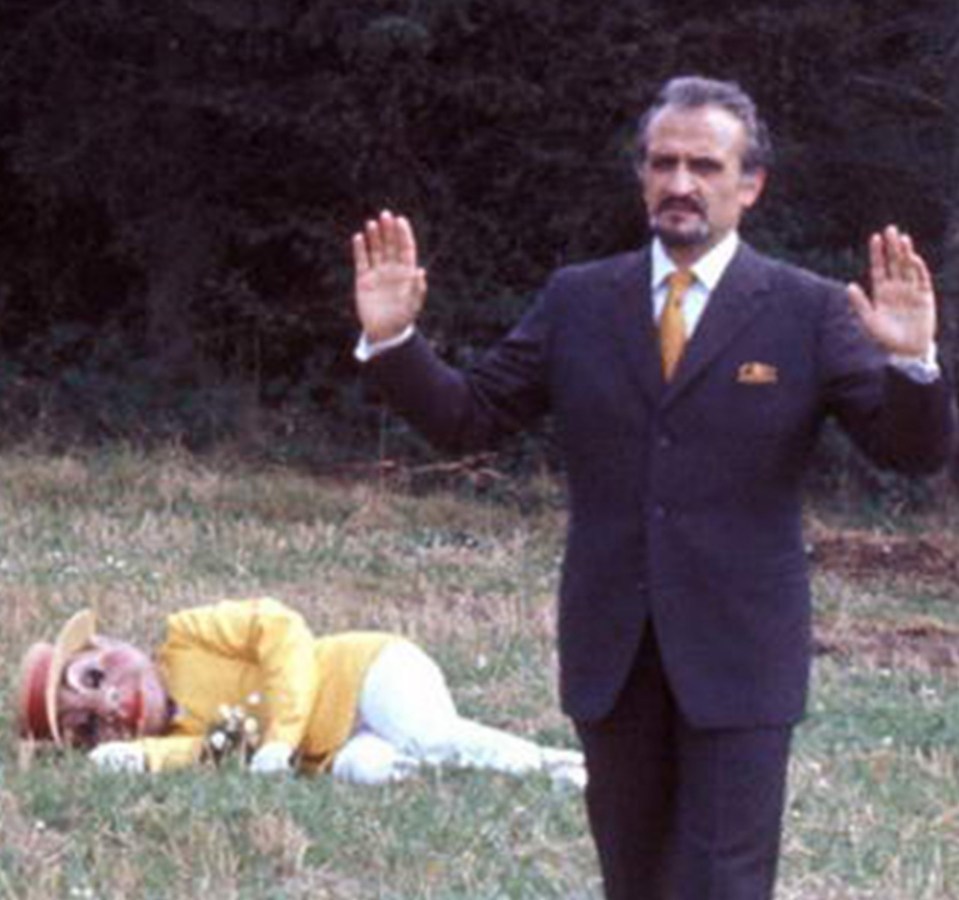
In this case, the Autons had returned to Earth because of the machinations of the Doctor’s greatest foe, The Master.  This serial featured the first appearance of The Master, with the Roger Delgado playing the role and becoming the series’s most popular villain since the Daleks.  (This serial also featured the first appearance of Katy Manning as Jo Grant, who went on to become popular for entirely different reasons.) But as evil as The Master was, it was the Autons who reportedly kept viewers awake at night.  Even after The Doctor (played, at that time, by Jon Pertwee) defeated them for a second time, you could never be sure whether that mannequin was harmless or if it was an Auton stalking you whenever your back was turned.

For modern viewers, it can seem strange to hear that people were ever scared by Doctor Who.  But the Autons are an exception.  The Autons are actually creepy.

The Master doesn’t seem to be too scared of them, though.

The Terror of the Autons would go on to be the first episode of Doctor Who to be cited in the House of Lords, when it was listed as a recent programme that might have a dangerous effect on the minds of the people watching.  But who knows?  Was that Lord Beaverbrook or was it…?

Previous Great Moments In Television History:

  1. Planet of the Apes The TV Series
  2. Lonely Water
  3. Ghostwatch Traumatizes The UK
  4. Frasier Meets The Candidate

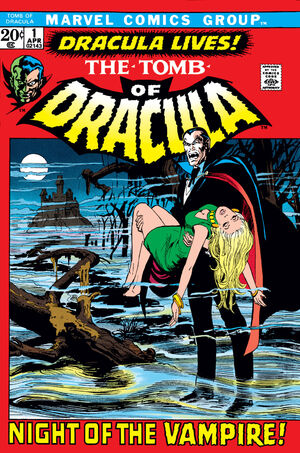
Great Moments In Comic Book History: Dracula Joins The Marvel Universe


The year was 1972 and, nearly 20 years after Dr. Fredric Wertham had declared them to be a menace to young minds, horror comics were making a comeback.

The Comics Code Authority, which had been established in response to Wertham’s claim that comic books were creating deviants, had long banned not only horror-centric comic books but also vampires in general.  However, with times changing and creators regularly challenging the antiquated rules of the code, the CCA relaxed its rules about horror comics.  Monsters could once again exist alongside super heroes.

Marvel was among the first to launch a new line of horror comics.  Using Dracula was no-brainer.  Not only was he the world’s most famous vampire but he was also in the public domain so Marvel could use him without having to pay a cent for the rights.  (When you’re a kid, you always think that comic book artists and writers get to do whatever they want.  It’s when you grow up that you realize your favorite comic books only existed as long as they were financially viable.)  Tomb of Dracula was launched in April of 1972 and, despite a shaky beginning, it would go on to become a classic.  Speaking as a collector, it’s also one of my personal favorite titles from the so-called Bronze Age of Comics.

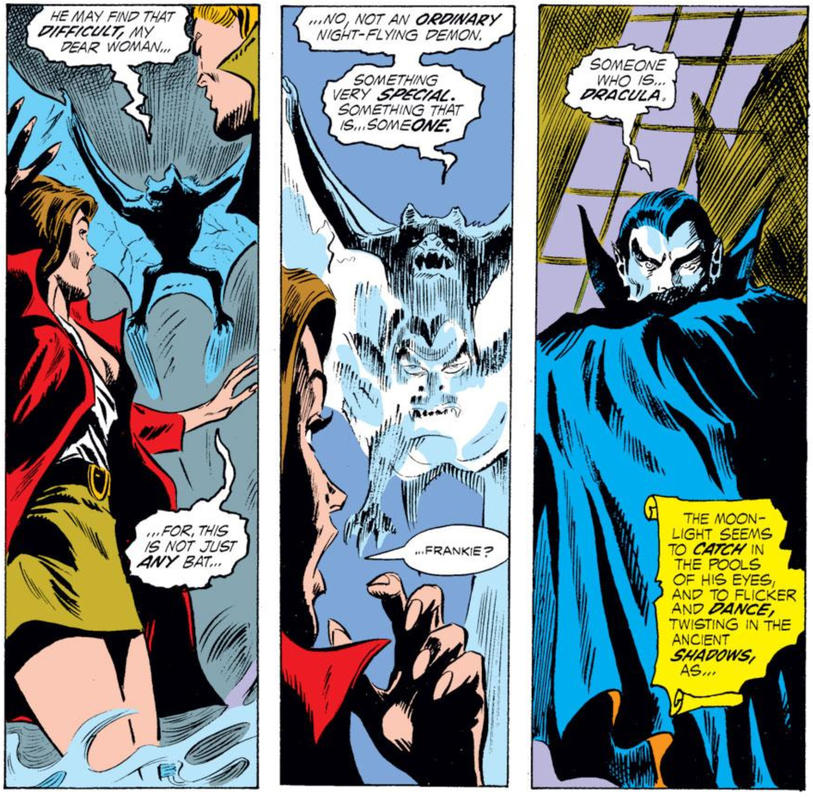
The 1st issue of Tomb of Dracula features Frank Drake traveling to Transylvania with his girlfriend Jean and his best friend, Clifton Graves.  Drake is an irresponsible playboy who has lost millions due to his own bad luck.  However, he is also one of the last living descendants of Dracula.  He and Graves have decided to turn Dracula’s castle into a tourist attraction.  What they didn’t count on was that Dracula would still be alive, trapped in the castle and waiting for someone to set him free.  20 pages later and Grave is dead, Jean is a vampire, Dracula has escaped, and angry villagers are surrounding the castle.

Other than featuring the characters of Drake and Dracula, the first issue of Tomb of Dracula doesn’t offer many hints of what would follow.  There’s no mention of Rachel van Helsing or Hannibal King or, everyone’s favorite, Blade.  It doesn’t even firmly establish that Dracula is a part of the canonical Marvel universe, though later issues featuring Dr. Strange and a host of others would clear up that mystery.  Despite not being anywhere near as good as what would follow, it does what it needs to do.  It sets Dracula free and set him on the road to becoming one of Marvel’s best villains.  Subsequent issues of Tomb of Dracula would provide Dracula with a better supporting cast than just Drake, Graves, and Jean.  They would also provide a more rounded view of everyone’s favorite vampire.  By the time the series ended in 1979, Dracula had become a tragic hero and his story had gone from being just a modern vampire tale to being an epic of good and evil.

And it all started with three Americans flying to Translvania.

Tomb of Dracula (Vol. 1 #1, April 1972)

“Dracula”

  • Writer — Gerry Conway
  • Penciler — Gene Colan
  • Inker– Gene Colan
  • Letterer — John Costanza
  • Cover Artist — Neal Adams

Previous Great Moments In Comic Book History:
  1. Winchester Before Winchester: Swamp Thing Vol. 2 #45 “Ghost Dance” 
  2. The Avengers Appear on David Letterman
  3. Crisis on Campus
  4. “Even in Death”
  5. The Debut of Man-Wolf in Amazing Spider-Man
  6. Spider-Man Meets The Monster Maker
  7. Conan The Barbarian Visits Times Square

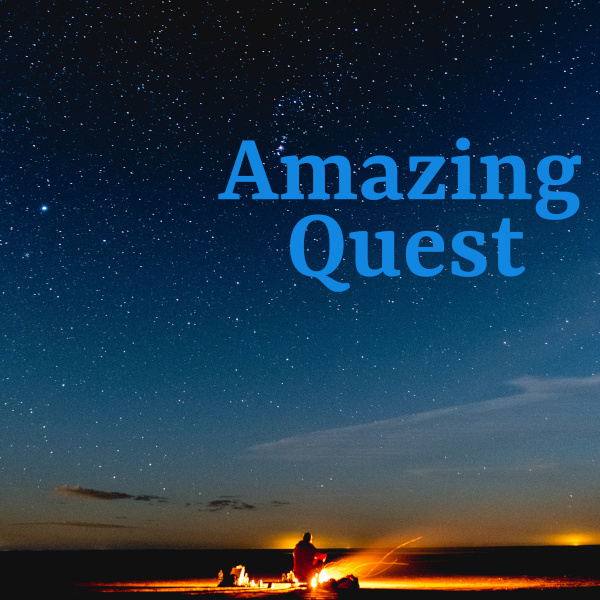
Game Review: Amazing Quest (2020, Nick Montfort)


Sorry for the lack of reviews yesterday.  After spending two weeks watching Witchcraft movies, I had to take a day off.

This game is an entrant in the 2020 Interactive Fiction Competition.  All of the games can be browsed and played here.

Amazing Quest is a throwback to the vague but addictive PC games of the 80s.  You are returning from a quest.  What quest?  That’s for you to imagine.  Are you a Viking?  Are you a space explorer?  Are you Odysseus, trying to make your way home after the fall of Troy?  Again, that is all for you to imagine.

Each turn, you get a new situation and a prompt.  You’ve come across a new land.  Do you send gifts?  Do you attack?  Click y or n.  The results are as vague as the situation, leaving it to the player to imagine what it all means.  When you send gifts to a recently discovered land and you get to see the sun rise as a result, is it our sun or some other planet’s sun?  The choice is yours.

Amazing Quest is simple and random but also very addictive.  It’s a game that’s designed to spark your imagination.  Play it and seen what story you create.

Amazing Quest can be played here.

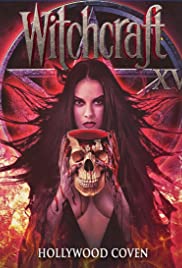
Witchcraft 16: Hollywood Coven (2016, directed by David Palmieri)


The Witchcraft series comes to an end (?), with this the 16th installment in the bizarrely long-lived franchise.

This one is weird, though.  All of the actors from the previous three installments return.  (The final three films were, more or less, shot simultaneously.)  They’re still playing people named Will Spanner, Lucy Lutz, Rose, Sharon, Samuel, and Garner.  But they’re no longer witches and warlocks.  Instead, they are all actors and production associates who are working on the latest Crystal Force movie.  Crystal Force is a long running series of low budget, softcore films about a warlock.  So, basically, this is a film about the making of a Witchcraft movie but, in this universe, Witchcraft is known as Crystal Force.  Got it?  It turns out that the director of this latest Crystal Force film is a Satanist and he needs to complete one of those overly complicated rituals that are so popular in the Witchcraft films (and apparently the Crystal Force films as well).

Once you get beyond the film-within-a-film aspect, it’s a pretty standard Witchcraft plot but the plot really isn’t important.  Instead, Witchcraft 16 is more of a meta commentary on both the Witchcraft franchise and low budget movie making in general.  When the cast gets together, they talk about the indignities of low-budget horror filmmaking and the fact that no one’s career has been made by appearing in a Crystal Force movie.  (When they say that, you can’t help but wonder what has happened to all the other actors who have played Will Spanner over the years.  Hopefully, they didn’t suffer the same fate as some of the actors in Crystal Force.)  This film is really an elaborate in-joke for people who have a nostalgic attachment to the other films in the series.  Witchcraft 16 is not a film that’s meant to be taken seriously.  It’s also not terrible, which is maybe the best thing that you can say about a Witchcraft film.  It looks and sounds cheap but Berna Roberts does what she can with the role of Lutz and the meta joke works a lot better than I think anyone would expect it to.  It’s actually a clever way to to acknowledge that the Witchcraft movies are never going to be critically acclaimed but that they did have a good run and there are certain people who will have fond memories of checking them out from Blockbuster.

Will Spanner gets zapped out of existence during Witchcraft 16 so I guess the franchise has finally come to an end.  Of course, who knows?  There are still warlocks and witches out there so it could be that the world is going to need Will Spanner again someday.  He already came back from the dead once so who knows what the future might hold.


Great Moments In Television History: Frasier Meets The Candidate


On November 8th, 1994, NBC aired an episode of Frasier called “The Candidate.”

Unlike the actor who played him, Frasier Crane was a committed liberal.  Of course, he was the type of liberal who lived in an impossibly large apartment and who had little interest in spending any time with anyone who didn’t have an Ivy League degree.  As a popular radio psychiatrist, Frasier Crane usually refused to endorse politicians or even give his opinion on the issues of the day.  The one time he made an exception was when he endorsed Phil Patterson, the earnest progressive who was running to defeat right-wing Congressman Holden Thorpe.  (Rewatching the episode earlier this week, it was impossible not to hear the voice of Donald Trump when Thorpe called into Frasier’s show to taunt him.)

Fraiser’s father, Martin (John Mahoney, how we miss you!) had already filmed a commercial for Thorpe, one in which he said that his career as as a cop was ended by the type of criminals that would be released on the streets if a bleeding heart like Phil Patterson was elected.  Hoping to counter their father’s endorsement, Frasier and his brother, Niles, arranged to film a commercial for Phil Patterson right in Frasier’s apartment.

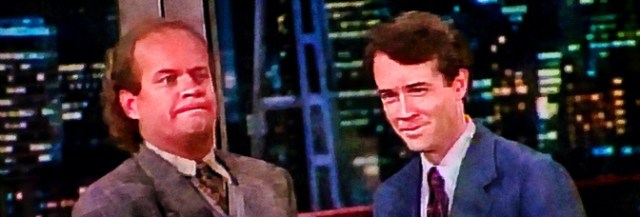
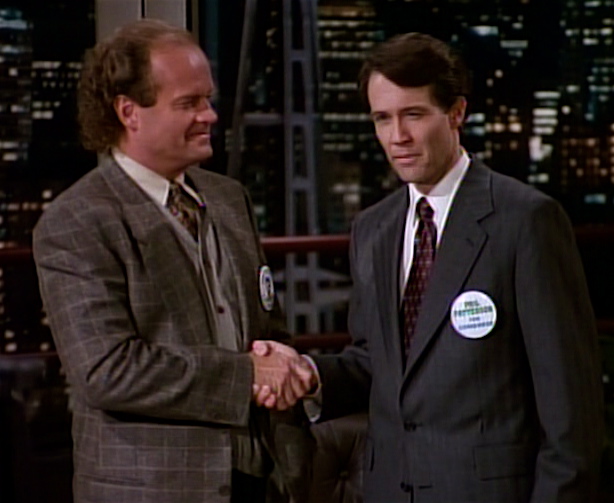
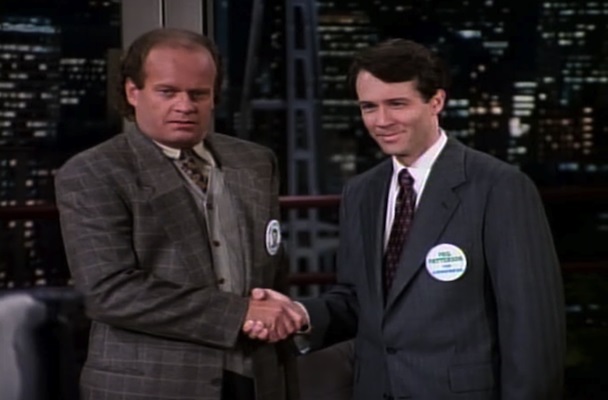
In the commercial, Frasier was scripted to endorse Phil Patterson because he “cares about the little people” and “I like the way his mind works.”  After shaking Patterson’s hand, Frasier was to proclaim him to be “the sane choice.”  The rehearsal went well.  Before shooting the actual commercial, Phil and Frasier stepped out on the balcony.  Phil admitted that he needed someone to talk to.  Frasier assured Phil that anything Phil said would fall under patient-doctor confidentiality.  Relieved, Phil explained that he had recently been abducted by aliens and that he hoped that, once in Congress, he hoped he could serve as a sort of intergalactic ambassador.

Frasier and Phil before they stepped out on the balcony:

Frasier and Phil, after the conversation on the balcony:

Fortunately, with the help of his brother, Frasier was able to eventually shoot the commercial.  Of course, the next day, Frasier heard that it was all over the news about “Patterson and the aliens” so he went on his radio show and announced that it didn’t matter that Phil Patterson believed in aliens.  Every leader had his eccentricities.  “Even J. Edgar Hoover let his slip show occasionally!”  Of course, the aliens that were all over the news were a group of Guatamelan exchange students whom Patterson was giving free room and board.

In the end, Holden Thorpe was reelected to Congress but Phil Patterson at least got 8% of the vote and was making plans to relaunch his political career in California.

Along with being one of the funniest episodes of one of television’s best sitcoms (Kesley Grammer’s response to the story about the aliens is absolutely brilliant), “The Candidate is an episode that still feels relevant today, nearly 16 years after it first aired.  Of course, in 1994, it was a given that a candidate thinking he had met with aliens would be viewed as a political disqualifier.  I’m not so sure if that would be the case in 2020.  Would you vote for the candidate who believed he had been beamed aboard a space ship?  Maybe you already have.

If you need a salve to help deal with the burn of 2020 politics, this episode is currently available to be viewed on Hulu.

Previous Great Moments In Television History:

  1. Planet of the Apes The TV Series
  2. Lonely Water
  3. Ghostwatch Traumatizes The UK