Great Moments In Television History #13: The A-Team Premieres


39 years ago today, television viewers who were watching NBC primetime met a group of four former members of the Special Forces who, during the Vietnam War, were framed for a crime they didn’t commit.

The pilot for the A-Team first aired on January 23rd, 1983.  No one had much hope for the pilot, with the exception of star George Peppard who predicted the show would be a hit as soon as he read the script.  Producer Stephen J. Cannell hadn’t had a hit in a while.  When Cannell was hired by NBC, network president Brandon Tartikoff asked for one thing: “Mr. T driving a car.”

Despite what the critics thought and despite the skepticism of the network brass, The A-Team was an immediate success.  Audiences loved the four misfits who somehow always managed to win the day despite Face’s womanizing, Murdock’s insanity, and B.A.’s fear of flying.  A week after the pilot aired, the show’s first regular episode was broadcast directly after the Super Bowl.  The rest is history.

If you have a problem, the A-Team can help.  You just have to find them.

Previous Great Moments In Television History:

  1. Planet of the Apes The TV Series
  2. Lonely Water
  3. Ghostwatch Traumatizes The UK
  4. Frasier Meets The Candidate
  5. The Autons Terrify The UK
  6. Freedom’s Last Stand
  7. Bing Crosby and David Bowie Share A Duet
  8. Apaches Traumatizes the UK
  9. Doctor Who Begins Its 100th Serial
  10. First Night 2013 With Jamie Kennedy
  11. Elvis Sings With Sinatra
  12. NBC Airs Their First Football Game

Great Moments In Comic Book History #17: Spider-Man and The Dallas Cowboys Battle The Circus of Crime


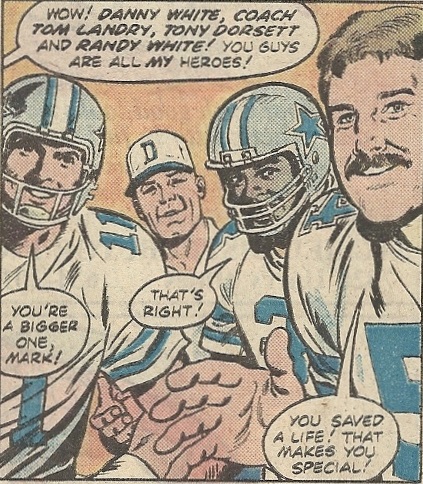
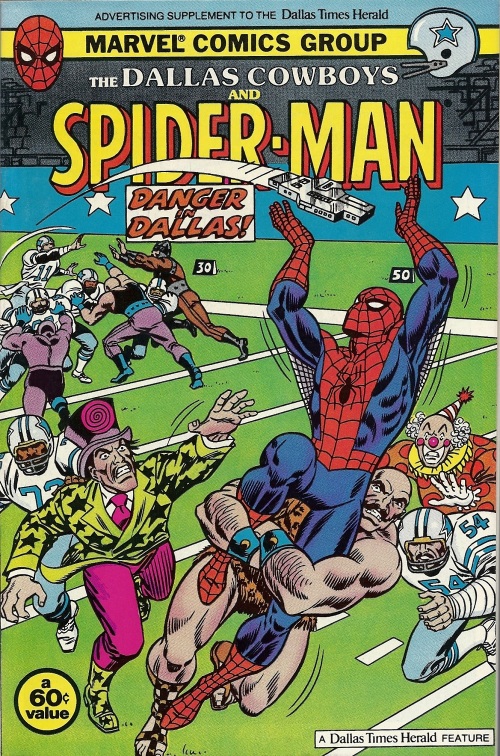
Spider-Man meets the Dallas Cowboys!

In 1983, Marvel comics teamed up with local newspapers to produce inserts that would feature heroes like the X-Men and Spider-Man visiting towns outside of New York, meeting with local celebrities, and, of course, providing ad space for local businesses.  One of the newspapers that they teamed up with the now-defunct Dallas Times Herald, which was also the original home of Texas’s own drive-in movie reviewer, Joe Bob Briggs.

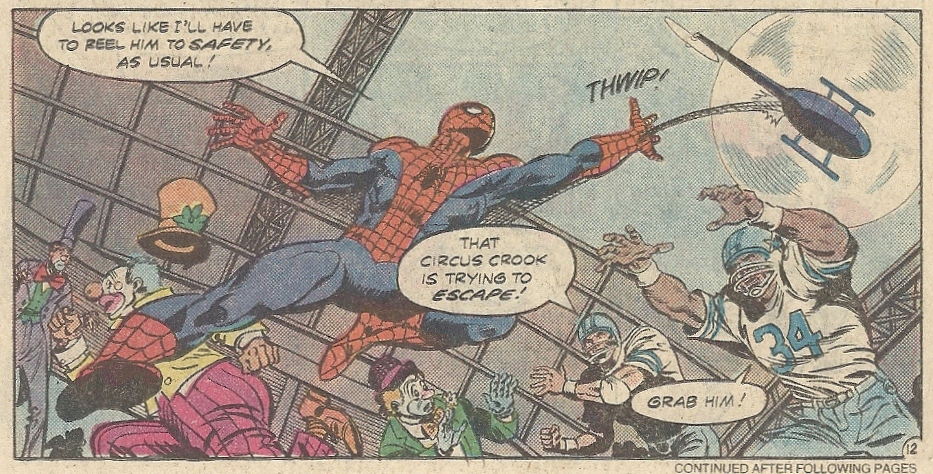
Marvel ended up doing three inserts for the Dallas Times Herald, one with the X-Men at the State Fair and then two featuring Spider-Man.  In “Danger in Dallas,” Peter Parker accompanied J. Jonah Jameson and Dr. Mudge to Dallas so that Dr. Mudge’s wheelchair-bound son could meet his heroes, the Dallas Cowboys.

Dr. Mudge had also developed an anti-gravity device and the Circus of Crime was determined to steal it for themselves.  Spider-Man had to stop them but to fight an entire circus, he would need some help.  Good thing that Cowboys didn’t have anything to do that day!

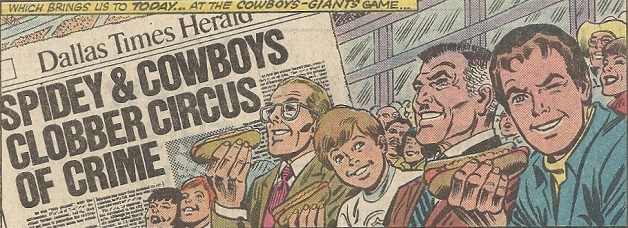
Once the Cowboys had tackled the Circus of Crime, Peter and even Jonah were able to enjoy opening day.  Peter even proved his courage by eating a Texas Stadium hot dog!

Spider-Man wished the Cowboys a good game, letting us know that even super heroes from New York were rooting for America’s Team in the 80s.

Out of curiosity, I decided to see how the Cowboys did during the 1983 season.  They went 12-4 and were second in the NFC East.  They earned a wildcard spot but lost to the Rams, 17-24.  Despite Spider-Man’s blessings, it was not the Cowboys who went to the Super Bowl but instead the team currently known as Football Team.  (Full disclosure: By default, that was my family’s team until Baltimore finally got the Ravens.)  Fortunately, Washington lost to the Raiders, 9-38.

According to the cover, this was a 60 cent value in 1983.  Currently, it sells for $18.00 online.

The Dallas Cowboys and Spider-Man #1 “Danger in Dallas” (1983)

Writer Marie Severin and David Kraft
Pencilers Marie Severin and Kerry Gammill
Inker Mike Esposito
Colorist Stan Goldberg
Letterer R. G. O’Shaw

Previous Great Moments In Comic Book History:

  1. Winchester Before Winchester: Swamp Thing Vol. 2 #45 “Ghost Dance” 
  2. The Avengers Appear on David Letterman
  3. Crisis on Campus
  4. “Even in Death”
  5. The Debut of Man-Wolf in Amazing Spider-Man
  6. Spider-Man Meets The Monster Maker
  7. Conan The Barbarian Visits Times Square
  8. Dracula Joins The Marvel Universe
  9. The Death of Dr. Druid
  10. To All A Good Night
  11. Zombie!
  12. The First Appearance of Ghost Rider
  13. The First Appearance of Werewolf By Night
  14. Captain America Punches Hitler
  15. Spider-Man No More!
  16. Alex Ross Captures Galactus

Game Review: Locked Door (2022, Cody Gaisser)


(SPOILER WARNING)

You are in a room. A wooden door leads north. That’s the only exit. But, the door is locked!

This is a puzzle that has faced many a player of Interactive Fiction. We’ve all had to deal with the locked room scenario, where you have to find the solution for how to get that door open. You can play guess the verb. You can look for things to examine. You can check your inventory to see if you have something on you that could be used in some clever way to unlock the door.

Or you could just pick up the iron key and see what it does.

To quote the game itself:

Room A
A plain white room. A wooden door leads north.

You can see an iron key here.

Can it be that simple? Why not? One side effect of playing too much interactive fiction is that you reach a point where you assume that every solution has to be complicated. Sometimes, you can just pick up the key.

There is another room, though. Be sure to go in the other room and read what you find.

Keep in mind, this is only the first Locked Door game. There are at least three other adventures, all asking if you can unlock more doors. I’ve been playing the fourth one. I’ll review it as soon as I figure out how to open up the damn door.

Play Locked Door

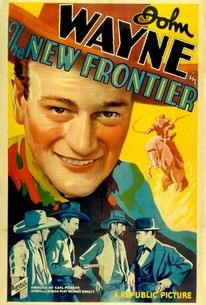
The New Frontier (1935, directed by Carl Pierson)


In 1889, wagon master Milt Dawson (Sam Flint) rides into a western town. He is planning on meeting his son John, who is also a wagon master. However, when a friend of Milt’s is killed by gambler Ace Holmes (Warner Richardson), Milt announces that he’s going to clean up the town and Ace is the first piece of trash that Milt is going to toss out. Ace responds by having his henchmen shoot Milt in the back.

After Milt’s death, his son finally arrives in town and you know that Ace is going to be in trouble because John Dawson is played by John Wayne! Seeking to avenge his father’s death, John teams up with an outlaw named Kit (Al Bridge) and declares war on Ace and his gang.

This is a typical western programmer, one that would probably be forgotten if not for the presence of John Wayne in an early starring role. This was before Stagecoach so the budget is low and the plot is simple. Even in his early 20s, John Wayne has the natural authority that would later make him a star but it’s still strange for me to see him in any film where he’s playing a young man who still has parents. There are some actors who you can’t picture as ever having been anything less than middle-aged and John Wayne is one of them. While most of the other actors are stiff and awkward, Wayne seems right at home in the dusty streets of The New Frontier. Interestingly, given Wayne’s identification with law-and-order, he plays a character here who has no problem working with outlaws and who understands that sometimes, the law can be unfair.  Ace is the most powerful man in town and John has no choice but team up with those on the outs of what was then considered to be respectability.  Another memorable scene juxtaposes a gun battle with the town’s citizens praying in church, a reminder that innocent people were often caught in the middle of the old west’s grudge matches.  These are interesting themes, though they’re not very deeply explored.  

Though the gunfights are nicely choreographed and shot, the chance to see a pre-stardom John Wayne clean up the old west is the main reason to watch The New Frontier.

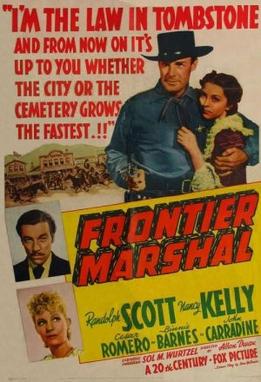
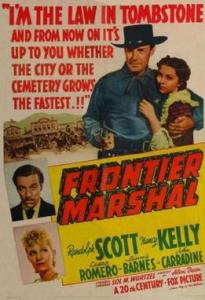
Frontier Marshal (1939, directed by Allan Dwan)


When Wyatt Earp (Randolph Scott) arrives in the town of Tombstone, he takes the law in his own hands by preventing a local outlaw named Indian Charlie (Charles Stevens) from destroying the saloon owned by Ben Carter (John Carradine).  For his trouble, Earp is beaten up by Carter’s men.  Earp, however, does get a  job as the town’s new marshal.

After some initial weariness, Wyatt befriends an alcoholic dentist and gunfighter named Doc Holliday (Cesar Romero).  While Earp keeps the peace in Tombstone, Doc is torn between two women, dancehall girl Jerry (Binnie Barnes) and his ex-girlfriend, Sarah (Nancy Kelly).

With Carter and his man planning on robbing a payroll train and also kidnapping frontier performer, Eddie Foy (played by the real Foy’s son, Eddie Foy, Jr.), it is only a matter of time before Earp takes on Carter at the legendary O.K. Corral.

Frontier Marshal was only the second sound film to be made about Wyatt Earp’s time in Tombstone and it was the first to use Earp’s name.  (In the first film version of the story, also called Frontier Marshal, Earp’s name was changed to Michael Wyatt.)  This was because Wyatt’s widow was offended by some of the material that was included in the biography that served as the basis for Frontier Marshal and threatened to sue anyone who wanted to make a movie out of it.  In order to get her permission to make the film, 20th Century Fox agreed that no reference would be made to Wyatt’s marriage in the film.  Mrs. Earp ended up suing anyways.  20th Century Fox settled.

As for the film, it’s in no way historically accurate and it pales in comparison to My Darling Clementine, Gunfight at the O.K. Corral, Tombstone, and the Star Trek episode where Kirk, Spock, and McCoy thought they were in the old west.  It is, however, better than The Gunfighters episode of Dr. Who.  Randolph Scott is convincing as an upright and law-abiding Wyatt Earp, quite a contrast to the real Wyatt.  The movie though is stolen by Cesar Romero, who plays Doc Holliday as being pathologically self-destructive.  Cesar Romero is not necessarily the first name that comes to mind when you think of a great western actor but he’s very convincing here.  John Carradine is a perfect villain and keep an eye out for Lon Chaney, Jr. as one of his henchmen.  Unfortunately, the final gunfight feels rushed and, for all the build up, it isn’t as exciting as it should be.  Frontier Marshal will mostly be of interest to those curious to see how Doc Holliday, Wyatt Earp, Tombstone and the Gunfight at the O.K. Corral were portrayed in films before they became a sacrosanct part of the mythology of the Old West.

Frontier Marshal was later remade, as My Darling Clementine, by John Ford.  Ward Bond, who played Morgan Earp in Ford’s film, plays the original town marshal in Frontier Marshal.  Charles Stevens, who plays Indian Charlie in Frontier Marshal, was often falsely described by the Hollywood publicity mill as being the real-life grandson of Geronimo.  He also appeared in My Darling Clementine, once again playing the role of Indian Charlie.  It was one of the nearly 200 films he made before he died in 1964.
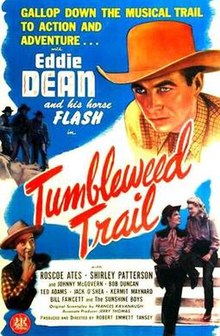
Tumbleweed Trail (1946, directed by Robert Emmett Transey)


I know that I said yesterday that I was done with Eddie Dean westerns but I decided to watch one more, just because it was short and, based on the other Eddie Dean films I had seen, I assumed that it would be undemanding. 

(I was right.)

Tumbleweed Trail opens with Brad Barton (Bob Duncan) and his group of colorfully named henchmen (one is named Dead-Eye) ambushing and apparently killing a rancher named Bill Ryan (Kermit Ryan), who also happens to be Barton’s half-brother.  Barton wants to take control of Ryan’s ranch and he’s even forged a will to to convince the land office to give it to him instead of Ryan’s children.  If this plot sounds familiar, it’s because much of it was recycled for Black Hills.

What Barton did not count on was the arrival of singing cowboy Eddie Dean (played by real-life singing cowboy Eddie Dean) and his sideick, Soapy (Roscoe Ates).  Eddie and Soapy get jobs working on Ryan’s ranch.  Eddie finds time to sing a few songs and to fall for Bill’s daughter, Robin (Shirley Patterson).  Everyone loves Eddie’s singing but he’s not make much progress when it comes to proving that Barton’s will is a fake.  Just when it seems like not even Eddie and Soapy will be able to stop Barton, there’s a “surprise” ending that you’ll see coming from a mile away.

This one is uninspired, though some of my reaction could be due to having already seen Eddie Dean go through a similar plot in Black Hills.  Eddie sings a lot but that’s about all he does in this routine poverty row western.  Bob Duncan is a generic villain.  Of the three Eddie Dean films that I’ve watched, Tumbleweed Trail was the most forgettable.  It’s for fans of the genre only.

Eddie’s horse in Tumbleweed Trail is played by Flash.  Flash gets second billing, above Roscoe Ates.

This, I’m pretty sure, was my final Eddie Dean movie.

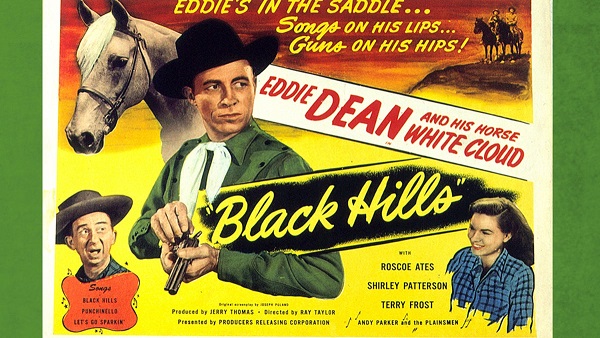
Black Hills (1947, directed by Ray Taylor)


Times are hard and rancher John Hadley (Steve Clark) is running the risk of losing his ranch. When Hadley finds gold on his property, he think that all of his problems have been solved. He makes the mistake of revealing the existence of the gold to his friend, Terry Frost (Dan Kirby). Terry’s not much of a friend because he shoots and kills Hadley and then, working with a corrupt county clerk (William Fawcett), he tries to steal Hadley’s property away from the rancher’s children and rightful heirs.

Luckily, singing cowboy Eddie Dean (played by real-life singing cowboy Eddie Dean) rides up and, with the help of his comic relief sidekick (Roscoe Ates), helps to get things sorted out. Even with Terry trying to frame Eddie for a murder he didn’t commit, Eddie still finds time to sing a few songs.

This was Eddie Dean’s final feature film before he moved into television. Black Hills is better than Romance of the West, the Eddie Dean movie that I reviewed yesterday. The plot actually has a few interesting twists and, though it doesn’t appear that he was ever much of an actor, Eddie Dean appears to be more comfortable with his role here than he was in Romance of the West. Black Hills emphasizes that Eddie could throw a punch just as well as he could sing and veteran western actor Dan Kirby is a credible villain. It makes Black Hills into an entertaining if not exactly memorable western diversion.

One final note about Black Hills: Eddie’s horse, White Cloud, gets second billing in the credits.

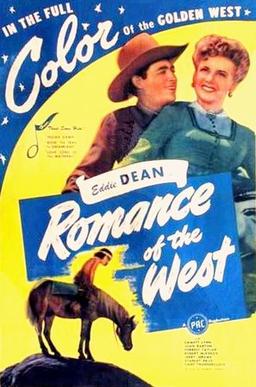
Romance of the West (1946, directed by Robert Emmett Tansey)


In California’s Antelope Valley, the local Indian tribe lives peacefully alongside the recently arrived white settlers.  However, some of the settlers want to end that peace and deliberately try to provoke the Indians into raiding a nearby town.  When the Indian village is attacked and a young boy is turned into an orphan, the tribe prepares or war.  It falls on the new Indian agent, a singing cowboy named Eddie Dean (played by real-life singing cowboy Eddie Dean) to capture the real culprits and maintain peace in Antelope Valley.

Romance of the West was the first of many films that Eddie Dean made in which he played a character named Eddie Dean.  Dean had a good singing voice and an amiable screen presence but he was also a pretty stiff actor.  That’s particularly obvious in Romance of the West, where he breaks out into a huge grin whenever he has to deliver any of his dialogue.  Even when he talks about something as serious as finding a home for an orphan, he still smiles like someone who has found a month’s worth of moonshine.   With the exception of Forest Tucker (who plays a sympathetic priest), the rest of the cast isn’t much better.  Eddie looks convincing in a gunfight and on a horse but whenever he has to speak or show emotion, the action comes to a halt.

Compared to other westerns of the period, Romance of the West is sympathetic to the Indians, with Dean speaking up for them every chance he gets and telling one bad guy that the Indians are more American than he’ll ever be.  But the movie also features a lot of scenes of the Indians speaking in exaggerated broken English.  After an Indian child is orphaned, Eddie refuses the chief’s offer to raise the child, saying that it would be better that the child go to the church orphanage so he “can be raised right.”  The film should be commended for rejecting the “savage” stereotype but then it goes too far in other direction, portraying the Natives as being almost child-like and without any agency of their own.  Always, it falls on Eddie Dean to explain things to everyone and hold together the fragile peace.

Seen today, the most interesting thing about Romance of the West is that it was shot in color, at a time when that was a rare occurrence.  Unfortunately, Eddie Dean was just as boring in color as he was in black-and-white.

On a final note, the singing cowboy genre has always been a strange one to me.  Did no one in the old west find it strange that men were riding through the wilderness and singing songs of love to their horses?  For some reason, singing cowboys were always appointed to positions of importance, like town marshal or Indian agent.  Were people that impressed by a banjo?

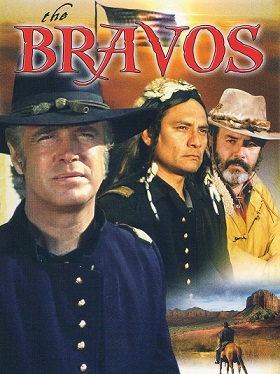
The Bravos (1972, directed by Ted Post)


Major John David Harkness (George Peppard) is the commander of Fort Bravo, a small and ill-equipped frontier fort.  Despite having only 77 soldiers and not many supplies, Harkness has managed to keep an uneasy peace between the local Indian tribes and the settlers who move through the area.  The peace, however, is disturbed when an arrogant wagon master (Pernell Roberts) kills the son of the tribal chief.

That’s not all that Harkness has to worry about.  A German outlaw (Bo Svenson) is hiding out at the camp.  His head scout (L.Q. Jones) suspects that something is forcing the local tribes out of the area.  Two settlers from Missouri (played by Barry Brown and Belinda Montgomery) are at the fort and trying to decide whether they should continue westward or return to Missouri.  Finally, Harkness’s 12 year-old son, Peter (Vincent Van Patten), has been expelled from his New England boarding school and is being sent to Fort Bravo to live with his father.  When Major Harkness refuses to turn the wagon master over to the Indians, they kidnap his son instead.

The Bravos was made for television and originally aired on ABC in 1972.  It was apparently meant to serve as the pilot for a television series, one that would have followed the daily adventures of the Major, his son, and all of the men at Fort Bravo (who were played by television mainstays like Dana Elcar, Randolph Mantooth, and George Murdock.)  For all intents and purposes, Pernell Roberts, Bo Svenson, Belinda Montgomery, and Barry Brown are all “special guest stars” and are meant to serve as examples of the type of television-friendly actors who would visit Fort Bravo on a weekly basis.  That the pilot didn’t lead to a series isn’t surprising.  TV westerns may have dominated the ratings in the 50s and the 60s but they quickly went out of fashion in the 70s as networks realized that they could make more money selling ad space for Norman Lear sitcoms and cop shows.  In the 70s, the people that advertisers were wanting to reach were watching Archie Bunker and Starsky and Hutch, not George Peppard.

Because of its TV origins, The Bravos is a fairly bland western.  It would be a few years before George Peppard would reinvent himself as a grizzled character actor and he’s sincere but fairly dull here.  Pernell Roberts is more effective as the headstrong wagon master and perhaps The Bravos would have worked better if Roberts and Peppard had switched roles.  In the end, the main reason to see the film is for the chance to see L.Q. Jones play a heroic role for once.  A member of Sam Peckinpah’s stock company, Jones brings some authentic grit to his role as the fort’s only scout.  Jones played a lot of villains but I always preferred him as one of the good guys.

The Bravos ends with a few major subplots unresolved.  Maybe they would have been resolved during the show’s first season but it was not to be.

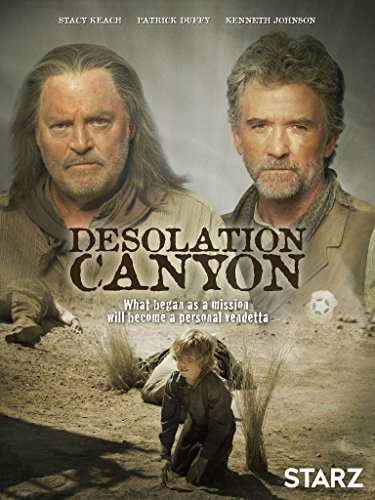
Desolation Canyon (2006, directed by David Cass)


After robbing a bank in a small western town, an outlaw stops by the home of his estranged wife and takes his own son hostage.  The town’s aging sheriff (Patrick Duffy) teams with the boy’s grandfather (Stacy Keach) to take the outlaw down and save the child’s life.  Accompanying them is the bank president, Edwin Bornstein (David Rees Snell).  Edwin may be a city boy who talks about how much he’s always wanted to say “I reckon,” but it turns out that there’s more to him than meets the eye.  He’s also good with a gun.

I probably should have given up on Desolation Canyon as soon as I saw that it was a “Hallmark Presents” film but I like westerns and Stacy Keach has always done well whenever he’s been cast as a gunslinger so I decided to give it a try.  Starting with a bank robbery and endings with a duel, Desolation Canyon is about as old-fashioned as an old-fashioned western can be.  Because it was made by Hallmark, there’s nothing dangerous or edgy about the film.  A few people do get shot but there’s no blood.  The shoot outs in Red Dead Redemption are more violent and suspenseful than anything to be found in this film.  (Of course, that’s because most of the shootouts in Red Dead Redemption occur because the play pushed the wrong button while trying to greet someone.  I still feel bad for accidentally shooting the kindly old homesteader who just wanted someone to help him collect some flowers for his wife.)  This is the type of western that you can safely watch with your grandparents, since that’s who the film was made for.  That’s not bad because grandparents need movies to but if you’re looking for a complex or an unpredictable western in the style of a Larry McMurtry novel or a later Eastwood film, I reckon this ain’t it.

Giving some credit where credit is due, Stacy Keach, David Rees Snell, and even Patrick Duffy are credible in their roles.  Stacy Keach is especially convincing a former gunfighter who can still outdraw anyone.  Stacy Keach is 81 years old and still working.  Someone needs to write a great Stacy Keach role and they need to do it now.