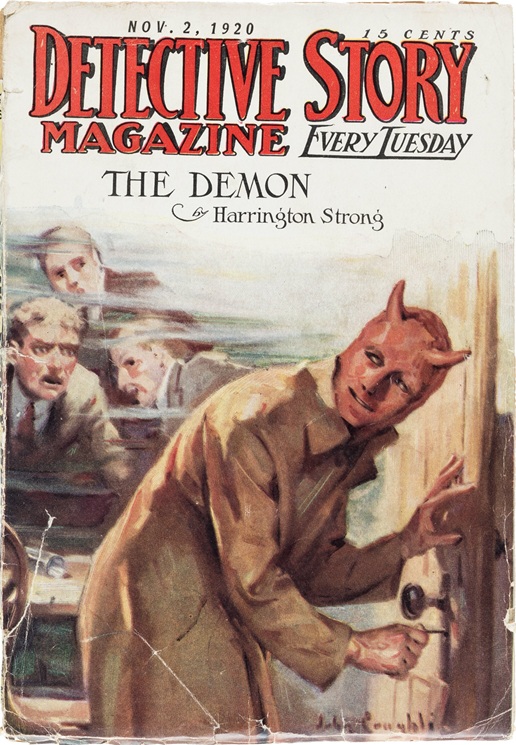
by John A. Coughlin
This creepy cover is from 1920.
by John A. Coughlin
This creepy cover is from 1920.
Even if you did not already know it, you could probably guess who directed this video. Everything from the back lighting to the color filters to the fog machine to the leather jackets and the gang of shirtless body builders identifies this video as being the work of Joel Schumacher.
This video, which was filmed in Balboa, California, was made during Schumacher’s Lost Boys/Flatliners phase. His infamous Batman films were still several years away. INXS guitarist Kirk Pengilly has gone on record as disliking this video because he felt that, unlike the other videos that INXS was doing at the time, it was “too American.” He was probably right. The video’s mix of strippers, bikers, yuppies, and rent boys feels more appropriate for a film adaptation of a Bret Easton Ellis short story than an INXS song. Even if it isn’t an ideal INXS video, Devil Inside is still probably one of the better entries in Joel Schumacher’s filmography. If I have to choose, I will always pick this video over watching Batman and Robin.
With the video’s help, Devil Inside was one of INXS’s most popular songs in America, reaching the number two spot on the Billboard Hot 100. By comparison, it peaked at #6 in the band’s native Australia and only reached #47 in the UK.
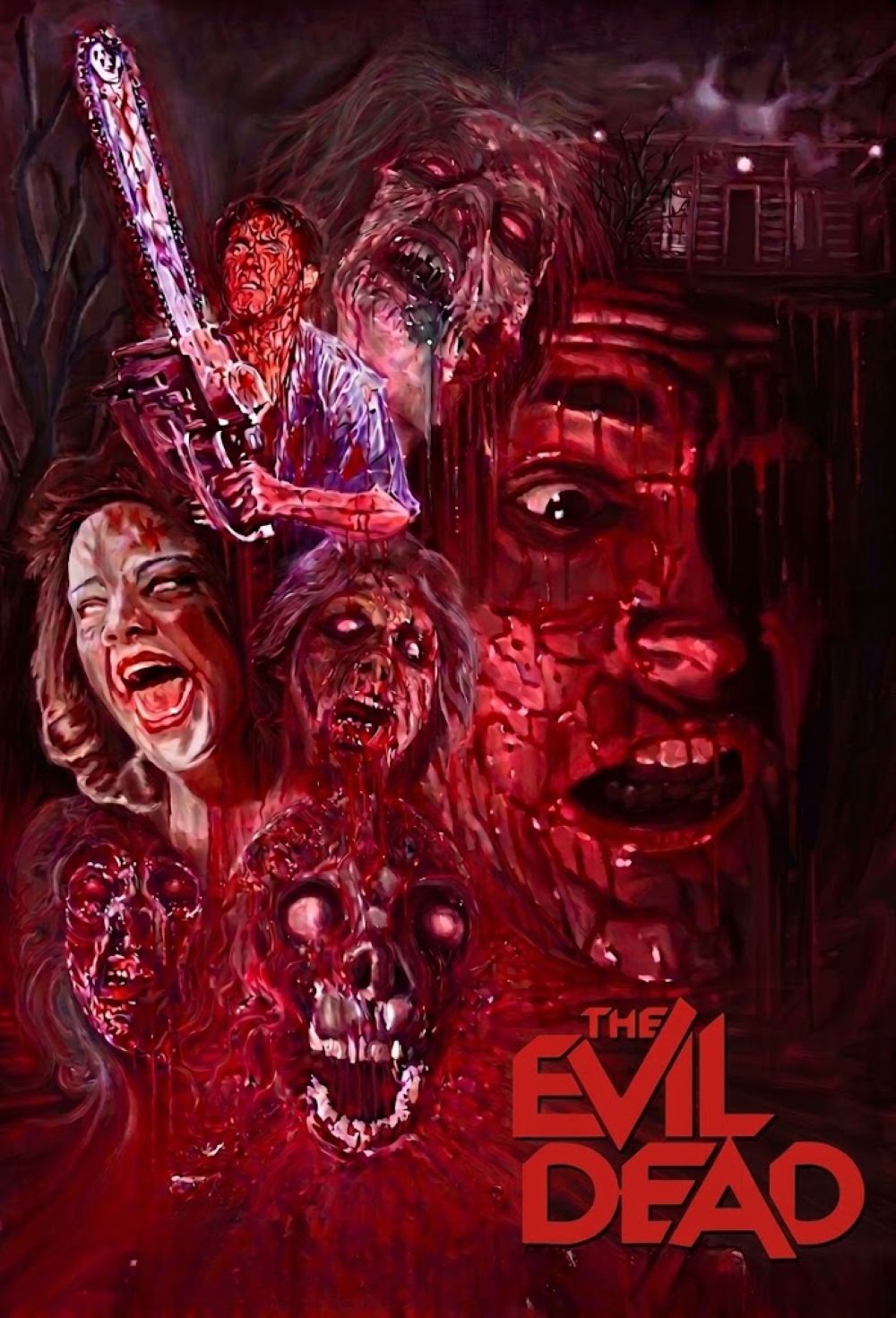
“I fear that the only way to stop those possessed by the spirits of the book is through the act of… bodily dismemberment.” — Professor Knowby
The Evil Dead is the kind of movie that feels like it should not have become a classic, at least not by conventional standards. It was made cheaply, filmed under brutal conditions, packed with unknown actors, and built around an extremely simple premise: five college friends head to an isolated cabin in the woods, unwittingly awaken an ancient evil, and spend the rest of the night being torn apart by demonic forces. Yet more than four decades later, Sam Raimi’s 1981 horror debut remains one of the most energetic, inventive, and genuinely nasty independent films ever made. It is rough around the edges in ways that are impossible to ignore, but those rough edges are a major part of its appeal. The Evil Dead feels handmade, hungry, and a little bit unhinged.
The story starts with Ash Williams, his girlfriend Linda, Ash’s sister Cheryl, and their friends Scotty and Shelly arriving at a remote Tennessee cabin for what is supposed to be a relaxing getaway. It is one of the most familiar setups in horror history now, but Raimi and his collaborators made it feel threatening before the real violence even begins. The cabin is decrepit, damp, and isolated to an almost absurd degree. There is no real sense of civilization nearby. The forest itself seems hostile, with tangled trees, strange sounds, and an atmosphere that makes the woods feel less like a location and more like a living organism surrounding the characters.
The group soon discovers a cellar beneath the cabin, where they find an ancient book bound in flesh, a dagger, and a tape recording left by an archaeologist. The recording describes the Necronomicon, a book of demonic incantations, and naturally the characters make the worst possible decision by playing the tape aloud. That act releases the evil presence that has been lurking in the forest, and the movie moves quickly from creepy cabin story to all-out supernatural nightmare. The concept is simple, but it gives Raimi room to focus on mood, visual invention, and escalation rather than complicated mythology.
What makes The Evil Dead special is how aggressively Raimi directs it. Even in his first feature, he had a style that was impossible to mistake for anyone else’s. The camera is constantly moving, lunging through the woods, creeping around corners, tilting at unnatural angles, and racing toward people as if the audience has become the demon’s point of view. The famous “demon-cam” shots are still startling because of how physical they feel. The camera does not glide elegantly. It charges. It crashes through the environment. It feels like something has broken loose and is hunting the characters.
That restless filmmaking gives the movie a personality far larger than its budget. Raimi turns limitations into an advantage. The cabin becomes a maze of shadows, floorboards, trap doors, windows, and hidden spaces. A cheap-looking hallway can suddenly become terrifying because the editing, sound design, and camera movement make it feel unstable. Raimi understands that horror does not always come from seeing a monster clearly. Sometimes it comes from the sense that the camera itself has stopped behaving normally, that the space around the characters is warping, and that even the trees outside are watching them.
The special effects are another major reason the film still has such a devoted following. They are obviously practical, often messy, and occasionally so exaggerated that they cross into dark comedy, but they have a tactile quality that modern digital effects often lack. The possessed characters look genuinely diseased and wrong: pale skin, dead eyes, rotting makeup, distorted faces, and unnatural movements. When the deadites attack, they do not simply become generic zombies. They taunt their friends, laugh at them, imitate their voices, and enjoy causing emotional pain. That cruel playfulness makes them more disturbing than ordinary monsters.
The makeup work on the possessed Cheryl, Shelly, and Linda remains especially effective because it turns familiar faces into grotesque masks. Ellen Sandweiss, Betsy Baker, and Theresa Tilly bring an unsettling intensity to those transformations, switching from frightened victims to shrieking, mocking demons. The performances are broad and theatrical, but that is exactly what the material needs. Nothing in The Evil Dead is subtle for very long. The film keeps pushing the characters past the point of normal human behavior until they are laughing, screaming, convulsing, and bleeding all over the cabin.
Bruce Campbell’s Ash is interesting because he is not yet the wisecracking, chainsaw-handed cult hero he would become in the sequels. In The Evil Dead, Ash is mostly an ordinary young man who slowly realizes he is trapped in a situation beyond comprehension. Campbell is still charismatic, and there are flashes of the physical comedy and wild-eyed determination that would define the character later, but this version of Ash is more vulnerable. He panics, hesitates, and suffers. By the end, he looks exhausted in a way that feels earned, covered in sweat, dirt, blood, and trauma.
That difference gives the original movie its own identity within the larger Evil Dead series. Evil Dead II would remake and expand many of the first film’s ideas with more money, more comedy, and a much more overtly cartoonish sensibility. Army of Darkness would take Ash into full fantasy-adventure mode. Those later films are arguably more polished and more immediately entertaining, especially for viewers who love Campbell’s comedic performance. But The Evil Dead has a rawness that the sequels never tried to reproduce. It is a horror movie first, even when its excesses become funny.
The film’s tonal shifts are one of its most fascinating qualities. Raimi clearly understands that grotesque violence can become absurd if it is pushed far enough, and the movie occasionally seems aware of its own madness. A possessed hand reaches through a window. A character gets stabbed with a pencil in one of the film’s most infamous scenes. Bodies erupt in streams of colored goo rather than realistic blood. The final destruction of the deadites is so elaborate that it feels like Raimi and his effects team were determined to empty every container of slime they had available. It is disgusting, but it is also gleefully imaginative.
At the same time, The Evil Dead can be more unpleasant than people remember. Its treatment of Cheryl in the woods is difficult to watch and remains one of the film’s most controversial moments. The scene is meant to establish the cruelty and violation associated with the demonic force, but it is not necessary to enjoy the movie, and it has aged badly compared with the more comic-book brutality of later entries. Raimi himself would move away from that kind of material in the sequels. It is worth acknowledging because the scene changes the tone of the film and may be a deal-breaker for some viewers.
The sound design helps make the movie feel more oppressive than its modest production would suggest. The woods groan, doors bang, voices echo from impossible places, and the demonic chants on the tape recording create a sense that something ancient has been invited into the cabin. Joseph LoDuca’s score adds another layer of unease, using shrill strings and harsh musical stabs to make even quiet scenes feel unstable. The soundtrack is not trying to be elegant. It is trying to make the viewer tense up, and it succeeds.
There is also something inspiring about the movie’s independent spirit. Raimi, Campbell, producer Robert Tapert, and their crew famously made the film through determination, ingenuity, and a willingness to endure conditions that sound miserable in retrospect. You can feel that effort on screen. Every strange camera angle, handmade prop, and splattering effect carries the energy of filmmakers trying to prove they can do something bigger than their resources should allow. The Evil Dead does not hide its budget. It turns that budget into part of its legend.
For horror fans, the movie is essential not because it is flawless, but because it is so alive. It captures the feeling of discovering a forbidden VHS tape or stumbling into a midnight screening where the audience is laughing, cringing, and yelling at the screen. It is scary in places, silly in others, and relentlessly committed to its own bizarre nightmare logic. Raimi would go on to make superhero movies, westerns, thrillers, and studio blockbusters, but the wild visual imagination that defined his career is already fully visible here.
The Evil Dead is a scrappy, blood-soaked supernatural horror movie that earns its reputation through pure filmmaking nerve. Its story may be basic, its acting may be uneven, and some of its material has not aged gracefully, but the movie’s pace, practical effects, demonic imagery, and manic camerawork remain unforgettable. It feels less like a carefully manufactured horror product than a curse someone managed to put on film. That is why it still works: Raimi and his team did not just make a movie about evil invading a cabin. They made the entire movie feel possessed.

2024’s Operation Unite opens with a man standing at the front of a church and announcing that God has told him that one of the members, a blank-faced young man named Brent (Greg Carnes), is going to be a very important person in the future. Everyone in the church is really excited, despite the fact that Brent comes across as being a little goony.
Meanwhile, at another church, Pastor Friar (Brian Scott Gilmore), peaches against “charismatic” churches. His daughter, Kaitlyn (Kaylee Keller), feels somewhat dissatisfied with her father’s sermon but she can’t really put it into words. Kaitlyn is 20 and she knows that she should be free to pick her own church to attend but, since she’s living at home, she has to do what her father wants. Her father wants her to attend his mainstream Protestant church. So be it.
When Brent sees Kaitlyn in a coffeeshop, he tells his friend that God has just told him that he’s meant to be with Kaitlyn. Normally, I’d say “Yikes!” but this film presents this as being a positive development. Kaitlyn leaves without talking to Brent but Brent says it doesn’t matter. If God wants them to be together, he’ll run into Kaitlyn again. Double yikes!
And Brent does run into Kaitlyn again. Soon, they’re dating! But how will Pastor Friar react when he discovers that his daughter is dating the newly-appointed youth minister of a charismatic church?
This film is about the conflict between different branches of Protestantism. That’s actually kind of an interesting idea and that’s certainly something you would never expect to see a mainstream film attempt to tackle. Most movies just tend to assume that all protestants are a part of the same generic church. In this film, Friar views the charismatics as being heretics and the charismatics view Pastor Friar and his congregation as being not in touch with God. Myself, I’m a Catholic so, as far as I’m concerned, they’re all heretics.
Interesting premise aside, this has all of the problems that one usually finds with low-budget religious films. The pace is deadly slow, the acting is amateurish, and the script is full of little character moments that ring as being either forced or hollow. I’ve seen a few Donald James Parker films and this definitely is one. Conversations tend to go on forever. It’s obvious that the filmmakers had no idea how to use something editing to create narrative momentum. Nearly every shot is static and uninteresting. It’s honestly difficult to watch.
Like a lot of Parker’s film, there are moments in the film when a surprising and rather disagreeable hostility bubbles up. When Brent’s youth group singing a hymn, Brent responds by scolding them for not sounding properly enthusiastic and it really does seem to go on forever. When Brent and Pastor Friar debate their beliefs, Brent comes across as if he’s about to take a swing at the man who he wants to be his future father-in-law. Self-righteous, perpetually angry, and kind of dull to look at, Brent is simply not a likable character. Not even taking into account their religious differences, I felt like Kaitlyn needed to get as far away from Brent as possible.
This movie is all about building a bridge across denominations. I just hope they eventually found a more reliable engineer than Brent.
Welcome to Late Night Retro Television Reviews, a feature where we review some of our favorite and least favorite shows of the past! On Sunday, I will be reviewing the Canadian series, Degrassi: The Next Generation, which aired from 2001 to 2015! The series can be streamed on YouTube and Tubi.
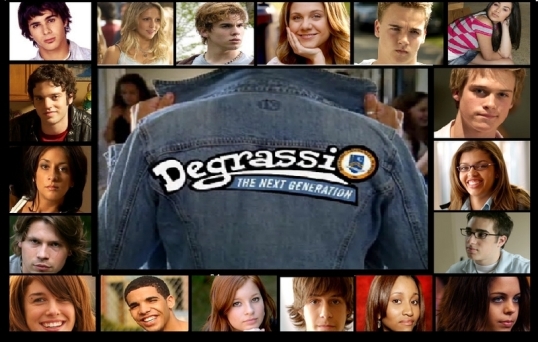
If you’re a fan of the Emma Nelson death stare, this episode is for you. Emma spends the entire episode giving Sean the death stare.
Episode 3.13 “This Charming Man”
(Dir by Stefan Scaini, originally aired on December 10th, 2003)
Emma says she’s ready to move on from Sean, and for her, that means dating Chris (Daniel Keith Morrison). Chris is happy to finally be with Emma, but it soon becomes obvious that she’s not done being obsessed with Sean. Convinced that Sean and Jay are responsible for stealing both Snake’s laptop and the school’s DVD player, Emma tells Mr. Raditch that she and Chris saw Sean and Jay putting the DVD player into Jay’s car. When Sean learns he’s been fingered by an anonymous tipster, he figures out it was Emma. “You know I’m on probation!” he shouts at her. Raditch tells Sean to calm down. Sean tells Raditch to go to hell. Sean gets two months of morning detention, while Emma smiles.
This is a good example of how Emma is never really held responsible for any of her actions. The truth of the matter is that Jay and Sean are the ones stealing stuff from the school. However, Emma still lied about seeing Jay and Sean with the DVD player. Chris calls Emma out for lying and breaks up with her. After Emma apologizes to him (but not to Jay, Sean, or Mr. Raditch), Chris takes her back. Chris doesn’t seem too worried that Emma literally tried to send her last boyfriend to jail.
From the start of this season to her final appearance on the show, the perpetually self-righteous Emma really did become insufferable. Fortunately, this episode has an amusing B-plot in which Spinner, Paige, Hazel, and Jimmy all take driver’s education together. The problem is that their instructor, Mr. Falcone (Jim Thorburn), is a total hunk, and Paige gets so distracted by his presence in the car that she runs over several orange cones. Spinner, meanwhile, gets so jealous that when it’s his turn to drive, he runs over a cardboard cutout of a family trying to cross the road.
“Really, Spin!?” Paige says from the back seat. “A family!?”
Spinner then accidentally crashes into a parked car. No license for him!
Oh, this plot made me smile. I had such a hard time with driver’s ed, and it was mostly because the instructor wouldn’t stop talking. “Both hands on the steering wheel.” “Watch the road.” “You’re on the wrong side of the street.” “YIELD!” Bleh!
I actually came home from driving school in tears once. My mom immediately went down to the school and yelled at the instructor. Then the owner of the school rode with me to see if I was really as bad a driver as the instructor claimed. Her verdict was that I had a lazy eye, which I definitely don’t. Anyway, the important thing was that I eventually got my license and now I speed everywhere.
Where was I? Oh yeah, Degrassi. Emma’s the worst, but at least this episode featured some quality time with Paige and Spinner.

Photographed by Erin Nicole
Happy October!
Four days ago, we launched our annual Horrorthon and I am already exhausted. That said, it’s totally worth it. It’s the exhaustion that comes from staying up late, writing your heart out, and creating something in which you can take pride. I’m thankful to my collaborators here at the TSL Bunker for their hard work and I am thankful to you for reading. This is going to be a great October.
With the return of Horrorthon comes the return of my full-scale weeks in review. Believe it or not, Horrorthon is the entire reason why I started posting these reviews. When a team of writers is posting over 200 times a week, it can sometimes be easy to miss something. This review is not meant to be just a link of lists. Instead, it’s your weekly guide to our favorite time of year.
Here’s what I watched, listened to, and read this week.
Films I Watched:
Music To Which I Listened:
Links From Last Week:
News From Last Week:
Live Tweets:
4 Shots From 4 Films:
Scenes That We Love:
Songs of the Day:
Artworks of the Day:
Music Videos of the Day:
Horrors On The Lens:
Horrors On TV:
Links From The Site:
More From Us:

Photographed by Erin Nicole
And so the first four days of Horrorthon come to a close. Why not celebrate with an AMV?
Song: Thriller by Michael Jackson
Anime: Aria the Scarlet Ammo, Dance in the Vampire Bund, Everyday Life with Monster Girls, High School of the Dead, Interviews With Monster Girls, Rosario + Vampire, Rosario + Vampire Capu 2
Creator: mmcmahan11
Past AMVs of the Day

On tonight’s episode of Fear Itself, a family man (Colin Ferguson) and a serial killer (Clifton Collins, Jr) both have near-death experiences and end up switching bodies. Before you can say “I’m going to take his …. face …. off,” the family man finds himself in prison and the serial killer finds himself living with a family! Why, it would be almost be funny if not for the fact that the killer specializes in killing families.
This episode aired on June 19th, 2008. Ronny Yu also directed Freddy vs Jason.

2026’s Sorority House Guillotine does not feature a guillotine or a sorority house. It does, however, feature a lot of footage from Bikini Guillotine and a monologue about John Cassavetes.
The majority of the film features a group of young women in bikinis hanging out at the pool. One of the women announces that she owns the house and that she’ll be having a party every weekend. Everyone says, “Whooo!” and raises their red Solo cups. Most of the footage is lifted directly from Bikini Guillotine, but it’s also obvious that a lot of it was taken from outtakes that weren’t included in that film. There are a lot of scenes where the women clearly aren’t acting, but are instead just sitting around waiting for the next shot to be set up. Members of the crew appear in the background. The shadow of the director is visible more than a few times. The camera rig is sometimes visible. There are also quite a few scenes where the women aren’t filmed from the best possible angle, and that feels rather unfair to them.
(Everyone, regardless of how attractive, has at least one unflattering angle. I’m usually pretty happy with how I photograph, but I know that if someone snaps a picture while my head is turned a certain way, all anyone is going to notice is my nose. A good director — especially one who is directing a movie in which the entire cast is half-naked for the entire running time — doesn’t include unflattering angles in the finished film.)
Because Bikini Guillotine had a nearly incoherent soundtrack, this film handles things by just featuring voice-overs over the scenes of the girls hanging out by the pool. We hear about how, when you’re young, you don’t worry about anything. “Someone says fried chicken and everyone laughs.” We’re also told that, “Gina asks Tina, ‘Why is everything so blue?’ Tina says, ‘Because you’re looking at it too long.’ ‘No, why is everyone blue?’” Wow, that’s deep. It’s the type of weed-fueled nonsense that I thought was profound during my senior year of high school.
When the voice-over isn’t talking about life, it’s talking about the movies. We’re told that the girls are talking about Charlie Chaplin and Josef von Sternberg. Eventually, they start to talk about how much they love Deep Red and the scene where David Hemmings sees his reflection in a pool of blood. Then we’re told that one of the girls is talking about how much she loves the work of John Cassavetes because Cassavetes just captured life without any studio-imposed drama. These are not the type of things that a bunch of 20-year-old girls are going to be talking about while hanging out at the pool. When I was 20, I loved movies, but I still didn’t talk about them while I was rocking a bikini next to a swimming pool. I was usually too busy trying to make sure I was giving everyone my most flattering angle.
The killer eventually shows up about 55 minutes into this 77-minute film. As opposed to the killer in Bikini Guillotine, he just wears a medical mask and carries a knife in this one. At first, I wondered if maybe the girls had been called back to shoot all-new death scenes, but as I watched, it became obvious that the scenes were actually either filmed auditions or rehearsals for the first film. The kills are once again bloodless.
What an odd movie! For all of its flaws, I do have to admit that the out-of-place voice-overs did add a bit of a surreal edge to the action. With the frequent appearances from the film crew and the cameras, one gets the feeling that Hatanaka was either trying to say something about the filmmaking process or, even more likely, he was trying to fool people into thinking he was saying something about the filmmaking process.
This film mostly just made me want to go hang out by the pool on a nice sunny day. Maybe I’ll even talk about Argento.

The city of Braddock has a problem.
1993’s City of the Vampires opens with a news report about Braddock. The city appears to be dying, and no one is sure why. The population numbers have plunged. People are scared to go out at night. Most of the people interviewed for the news story talk about how they can’t wait to get out of Braddock. As I watched, I found myself wondering if this was the same Braddock that would later elect John Fetterman as mayor and appear in those Levi’s commercials. The commercials aired around 2009–2010 and were all about how important it was to save the city of Braddock. I remember watching them and thinking, “Why is some Yankee city more worthy of a commercial than the cities that are struggling in the South?”
(Fetterman, at the time, was branded “America’s coolest mayor” by The Guardian. People forget just how much the media loved Fetterman when he was just another predictable liberal.)
As for the movie, it follows Sam Helling (Matthew Jason Walsh) as he explores the city of Braddock at night. He’s looking for his girlfriend Christine (Anne-Marie O’Keefe), but instead he finds himself in a city that has been taken over by vampires. I should mention that some online sites insist the character is named Sam Helsing, which would seem to be a callback to Dracula’s Dr. Van Helsing. Watching the movie, though, it’s made clear that Sam’s last name is indeed Helling. Leave the Van Helsings out of this.
City of the Vampires is a shot-on-video horror film, and it definitely deserves some credit for its ambition. Whereas most SOV horror films were content to just rip off the latest slasher and zombie pictures, City of the Vampires was obviously meant to be a low-budget action epic. There are a few interesting camera angles. There’s a deliberate echo effect on some of the dialogue, the better to give it a supernatural, dreamlike feel. There are several fairly convincing shots of melting faces. Despite the low budget, the filmmakers were obviously trying to make something memorable. One could easily imagine an alternate universe where City of the Vampires launched a whole franchise about vampires taking over American cities in decline. Look out, Gary, Indiana. The bloodsuckers are coming.
That said, it’s still a shot-on-video horror film, and the low budget really does show in more than a few scenes. The film takes place largely at night, it appears to have been shot at night, and there are several scenes so darkly lit that it’s a struggle to make out what’s happening. As cool as the echo effects were, the soundtrack is generally not that clear, and I sometimes found myself straining to hear what people were talking about. Proper lighting and sound recording have been the downfall of many SOV films. They’re the kind of thing people take for granted until they’re gone.
Still, I’ll give this film credit for its ambition. I always appreciate the effort, even if it’s not fully successful.

