October Positivity: Redeemed (dir by David A.R. White)


In 2014’s Redeemed, Ted McGinley plays Paul Tyson.

Paul is married to Beth (Teri Copley) and is a respected businessman who is in charge of a cybersecurity firm.  His latest project is Jericho which, if successful, could revolutionize the way that information is protected online.  A Brazilian firm is interested in buying Paul’s company, which could make Paul a very wealthy man.

However, Paul has some secrets.  Work on Jericho has not gone as smoothly as one might hope and Paul suspects that it might be due to corporate espionage.  Paul is several thousand dollars in debt and the bank has been sending him threatening letters.  When Paul’s friend David (David A.R. White, who also directed) splits with his wife, Paul starts to wonder whether any marriage can survive the modern age.  How do you keep a marriage strong in an increasingly complicated world?  Paul and Beth are supposed to be renewing the vows in the near-future but Paul is preoccupied with both his job and what appears to be a massive mid-life crisis.

Temptation arrives in the form of Julia (Ana Ayora), a beautiful woman who has been sent from Brazil to check out the company.  Paul finds himself attracted to Julia and they bond over many a night of corporate intrigue.  Paul finds himself growing distant from Beth.  Is Paul going to cheat and destroy his marriage?

(Actually, David explains that Paul is already cheating just by spending time with a woman other than this wife.  David also explains that he’s not the one who cheated in his marriage.  Instead, his wife met some guy in an Internet chatroom and she’s been talking to him nonstop.  They haven’t even met but it’s enough for David to move out of his house and into a hotel.  So, remember — if you’re married and you have any close friends of the opposite sex, you’re just a cheatin’ whore.  Sorry, I didn’t make the rules.)

Will Paul remain faithful to Beth?  And will he ever discover who is trying to sabotage Jericho?

On the positive side, Redeemed features Ted McGinley in a dramatic lead role and McGinley does a pretty good job with it.  There are a few times when Paul is simply too naive to be believable but that’s due to the script and not due to McGinley’s performance.  McGinley does the best he can with the material that he’s been given to work with.  I will also point out that the stock footage of Brazil was lovely.  Finally, David A.R. White is a pleasant-enough actor and his direction here gives the entire film a comfortable Lifetime sort of fell.

On the negative side …. ugh, that plot.  The corporate espionage stuff was hokey and Paul’s indecision about whether or not to commit adultery made his character seem more than a little flakey.  Paul’s married to a very tolerant and understanding woman and he has a beautiful family.  The fact that Paul was so easily tempted to throw all that away makes it difficult to have much sympathy for his character and it also makes his eventual “redemption” a bit difficult to buy.  I think most genuinely good husbands would be able to decide not to cheat on their wives without having to fly off to Brazil to think about it.  In the end, the film is very forgiving of Paul but it doesn’t convince the audience to feel the same way.

Redeemed is a film that celebrates marriage and leaves one appreciating divorce.

Late Night Retro Television Review: Degrassi: The Next Generation 1.10 “Rumors and Relationships”


Welcome to Late Night Retro Television Reviews, a feature where we review some of our favorite and least favorite shows of the past!  On Sunday, I will be reviewing the Canadian series, Degrassi: The Next Generation, which aired from 2001 to 2015!  The series can be streamed on YouTube and Tubi.

This week, Emma tries to destroy someone’s life.

Episode 1.10 “Rumors and Relationships”

(Dir by Paul Fox, originally aired on May 20th, 2002)

This episode features Spinner at his best and Emma at her worst.

Let’s get Emma out of the way first.  When Emma happens to see Liberty and Coach Armstrong alone in a classroom together, she assumes that Armstrong is hitting on Liberty.  She tells Manny about her suspicions.  Terri overhears and tells Sean.  Sean tells Spinner.  Spinner tells Jimmy.  Jimmy tells Paige.  Paige tells Hazel (Andrea Lewis).  Hazel tells Ashley.  Ashley tells Liberty.  Liberty gets upset.  When Emma sees Liberty crying, Emma ask Liberty about her and Armstrong.  Liberty swears on her life that Armstrong was not hitting on her.  Emma wonders how the rumor got started–

Uhmm, Emma …. YOU STARTED IT!

Emma promises Liberty that she will work her backwards to find the person who started the rumor–

IT WAS YOU, EMMA!  YOU STARTED THE RUMOR!

Because Emma is apparently incapable of remember what she said earlier in the day, she goes from Ashley to Hazel to Page to Spinner (she skips Jimmy) to Sean and eventually she confronts Terri.  Emma says that the rumor is all over the school and it’s all Terri’s fault.

Terri, quite sensibly, points out that Emma is the one who started the rumor.

Now, in her defense, Emma does feel bad about starting the rumor.  When Mr. Raditch calls Coach Armstrong out into the hall to tell him about the rumors, Emma walks up and confesses that it’s her fault.  But one thing Emma doesn’t do is really apologize.  In fact, when she later talks to Liberty, she instead acts as if it is somehow Liberty’s fault for not telling Emma why she was in a classroom alone with Armstrong in the first place.  Liberty finally admits that she had dyscalculia (which is dyslexia but with numbers) and that Armstrong — THE MATH TEACHER — has been tutoring her and helping her not to feel bad about it.  Emma again asks why Liberty just didn’t tell her that to begin with.

Hey, Emma — maybe Liberty didn’t tell you because IT’S NONE OF YOUR FREAKING BUSINESS!

The episode ends with Liberty telling Emma that, when it comes to helping people, Emma sucks.  And Liberty certainly has a point.

Meanwhile, in the cafeteria, Spinner discovers a bug in his food.  “Boycott the caf!” he yells, “it has earwigs!”  Unfortunately, no one believes Spinner.  So, the next day, Spinner collects a bunch of bugs and takes them into the cafeteria.  He thinks that if someone else sees a bug and reports it, they will be believed and someone will call an exterminator.  Of course, the only thing that anyone sees is Spiner carrying a tub of bugs.  The bugs get free and Spinner is sentenced to work in the cafeteria until he’s paid off the $300 that it’s going to cost the school to have the cafeteria exterminated.

“But it needed to be exterminated anyways!” Spinner says.

This was classic Spinner.  Even when he cares about Degrassi, no one listens.  It’s a little bit gross that he was carrying around a tub of living bugs but his heart was in the right place.

Spinner’s the best!

The ALCS Is Tied Again


Dear Mariners,

You had one job!  You just needed to win Game 6 of the ALCS.  If you had won tonight, you would be going to the World Series and you would have kept the Blue Jays out of the World Series.  Instead, you lost and now the ALCS is tied 3-3.  The Dodgers only needed four games to win the NLCS.  The Mariners and the Blue Jays are having to go to a Game 7!

For me, this has been a frustrating season.  My Rangers started out strong and then fell apart before rallying towards the end of the regular season and then falling apart again.  Now, I’m depending on the Mariners to keep my least favorite team out of the World Series.  And if the Mariners lose tomorrow’s game, it’ll be up to the Dodgers to keep the Blue Jays from winning the World Series.

It’s frustrating but a championship series going all the way to Game 7 is actually what baseball is all about.  This is a big moment for both teams.  Go Mariners!  You’re our only hope!  But if the Blue Jays do win, I’ll be gracious because they earned the victory.  They went from trailing 0-2 to tying things at 3-3.  I’ll congratulate the Blue Jays, right before I start cheering for the Dodgers.

Horror On TV: The Great Bear Scare (dir by Hal Mason)


I came across this old cartoon on YouTube.  Apparently, it aired in October of 1983.

It’s about bears living in Bearbank.  Halloween is approaching and they’re worried about getting invaded by the monsters who live on Monster Mountain.  Well, that makes sense.  My question is why would you buy a house near a location called Monster Mountain?  And really, shouldn’t the monsters be in the houses and the bears in the mountains?  This cartoon is weird.

Anyway, the bears are getting ready to feel the city but little Ted E. Bear sets out to confront his fears!  Woo hoo!

I don’t know.  It’s from 1983.  That was a strange year, I guess.

Enjoy!

Forever Knight – S1:E4 – “Last Act”


“He was brought across in 1228. Prayed on humans for their blood. 
Now, he wants to be mortal again.To repay society for his sins. 
To emerge from his World of Darkness. From his endless Forever Night.”

The Prologue has a young doctor named Marilyn (Gillian Vanderburgh, The Stupids)who fails to save a patient. Troubled by guilt, she’s reassured by Dr. Cole (who rubs her shoulders) that it just comes with the job. This puts her at ease. As she takes a shower, someone pulls back the drapes. She smiles, saying “You’re crazy, you know that?” only to find her hands grabbed by gloves. With her arms pinned above her, the doctor’s wrists are slashed, her eyes go wide as she screams in terror.

A young woman walks the streets of Toronto, late at night. Heading to a nearby pier, she takes a seat on a park bench, admiring the view of the city. Pulling a hood over her head, she watches the sunrise, smoke billowing from her clothes. Within moments, her body is engulfed in flames, leaving behind her clothing on the bench. 

Nick Knight is struggling with his workload. With 8 other cold cases in his backlog, he’s becoming jaded with it all. He’s also grown a bit snappy with the Captain. Before he can apologize, Schanke calls out to him from another room. They have to roll, there’s a body to identify. At the crime scene, a bystander mentions someone was talking about “spontaneous human combustion” to Schanke. In the clothing, Nick discovers a ring that’s familiar to him. We’re given a flashback of Nick on a theatre stage, fencing with the young woman, who he easily defeats. After a round of applause, the cast all bow. Backstage, among an array of lit candles, the woman approaches Nick…”You, sir, are very skilled with your sword. Do you wish to run me through again?” He scoops her up in a kiss and they talk about leaving for Gloucester. She tells him there’s no rush. They’ve all the time in the world. Running her fingers through her hair, Nick kisses the woman briefly before baring his fangs, taking a bite.

“Suicide.” Schanke says, pulling Nick back to the present. “Yes.” he mutters, his focus on the ring. Schanke asks him if he’s okay, since he’s referring to a suicide at the hospital. At the Hospital, Schanke explains how he’d approach his own suicide, which would involve a full meal, fabulous lovemaking and nitroglycerin. Nick interviews Dr. Cole (Laura Press, The Pit), who explains that the shower was still running when she found her, the water scalding. Dr. Cole explains the doctor was on duty for 20 hours and that she’s seen doctors snap like that before, with all the pressures the role demands. The three catch sight of Carl Janns (Robert Bockstael, North of 60), a med student at the university and the victim’s fiancé. Schanke pull Janns aside to take him home.

At the Morgue, Natalie states the incisions are perfect and quick. When asked why, Natalie responds that only the victim really knows, and that unfortunately, there are no fast rules for suicide. Nick again reflects on the ring, and we return to the past. Erica (Torri Higginson, Stargate: Atlantis & Stargate SG-1), now a vampire, tells Nick what she saw in his memories of him in the Crusades. Nick is concerned that her memories show an obsession with death and dying, something he’s surprised to find. She tells him that there’ll come a time where her lust for life will wane, something Nick can’t believe. Erica believes that once that happens, once she can’t give back to the world, it would be best to leave and not be a burden. If this were a Vampire: The Masquerade tale, she’d make an interesting Giovanni, or an even better Cappodocian. “Are you going to take on the investigation?” Natalie asks, pulling Nick’s attention. “Yeah. If I can fit the case in.”

Knight returns home, thinking about Erica. He hears her ask whether he feels he’s a burden. This causes him raise one of the shutters and dab a pinky finger into the sunlight, listening to the sounds of sizzling flesh. Could Nick be pondering the unimaginable?

Going over his evidence in his apartment, he again hears Erica’s voice. He even sees her this time in a beautiful white dress. “Maybe it’s time to join me.”, she says. “Why did you do it? You had so much life.”, he asks. Her response was that she was a burden, and that she wasn’t giving anything back. She asks him to join her in the light, taking a few steps away before disappearing from view. Even Knight seems a bit frightened. 

Back at the hospital, Nick speaks with some of the nurses, who have nothing but wonderful things to say about Marilyn (the deceased). They add that they feel something more was going on, that perhaps she was murdered, but the conversation is interrupted by Dr. Cole. The Doctor asks if there’s other things they could be doing other than spreading rumors. Nick steps in an apologizes for the nurses, and that he was interviewing them. He asks one last question on if there was anyone else to speak to. They point him to Dean (Mackenzie Gray, Man of Steel). Dean works as a clown, cheering up the sick kids in the pediatric ward. He’s also a patient undergoing chemotherapy, living in the hospital. When asked about Marilyn, Dean becomes defensive, angry at someone who would throw away their life so carelessly when he is valuing every second of the 2 to 3 months he has left. Knight accepts Dean’s photos, and leaves, wishing him well. 

On the drive back to the precinct, Erica appears beside him, commenting on the beauty of rainy nights. She adds the crowded world is noise and makes her feel out of step with the times. Erica asks Knight if he feels the same way. Nick doesn’t respond, and just keeps driving.

At the precinct, Captain Stonetree tells Knight he’s going to pass some of his cases along to another Detective. Nick snaps at the Captain, but Stonetree remains cool as always. He informs Knight that he’s not happy the administrator of the hospital is leaving messages with him saying an apparent suicide isn’t being considered as such. Knight argues that there’s more to Marilyn’s demise, but Stonetree adds that he can’t afford to care why she ended her life. All the evidence says it’s what happened, but he gives Nick 24 hours to close the case or he’ll close it for him. 

Knight heads to Janette’s nightclub, showing her Erica’s ring. “So, she finally did it.” Janette says. Nick asks Janette about why Erica didn’t come to him for help. Janette’s response is that she didn’t want to ‘infect’ him with her ‘disease’. Together, Nick and Janette head to Erica’s place, which appears in disarray. Dead flower, a typewriter and covered furniture decorate the place. Janette asks Nick what he expects to find here..”The passionate tomboy with the fiery spirit? Well, she grew old, Nicholas, she couldn’t keep up.” Picking up a doll, Nick has a flashback where Erica confesses that mortals can revitalize their lives with each new generation. “Their children are their mortality.” All she has are her plays. A teenager enters the apartment, looking for Erica. She mentions that Erica had a new play she was going to premiere called “The Last Act” and that she was excited about.

Nicholas arrives home to find Natalie waiting for him as she closes the shudders from the morning rays. “Cutting it a little close, are we?” Nick explains Erica’s theory on contributions, he reopens one of the shutters and reaches for Erica’s doll. As his hand begins to smoke, Natalie pushes him away from the sunlight and they argue over Nick’s desire to see the sun. She offers a new clue into Marilyn’s death in that the doctor was pregnant. The new information comes just in time, as Schanke knocks on Knight’s door. They let him in and they discuss Marilyn’s pregnancy. Schanke bemoans Knight’s lack of food in the fridge, but decides to help interview Carl Janns during the day. 

Karl tells Schanke that Marilyn was depressed and distant, though Schanke notes that her coworkers said she was bright and energetic. Karl becomes defensive, causing Schanke to both back down and mention the baby. This throws Karl for a loop, though he says she didn’t seem to want to have a baby. Schanke, Stonetree, Natalie and Nick go over the details, though Stonetree still isn’t particularly convinced. Knight, however, seems inspired. Getting up to follow another lead, Stonetree looks on with pride with a smile…”Let him go. I like him like this. Thinking again, on the case. Cop doing his job with some passion.” 

Knight sits in the audience, watching Erica’s play. An old woman and a young girl dance, with the woman asking the girl to squeeze every breathing moment out of life, to enjoy it. The girl asks the woman to stay, to teach her. The old woman tells her to simply live her life and that she’ll always be there, living on through the girl’s accomplishments. A pensive Knight watches along. At the same time the play is going on, someone goes into Dean’s room at the hospital and overdoses him with a needle full of morphine. 

Knight and Schanke return to the hospital, where Doctor Cole informs them about Dean. He’s not dead, but the doctors are able to stabilize him. The detectives manage to speak with Dean and discover that Marilyn’s baby was indeed his, done for him to “live on” in a way. They set up a trap, telling Karl about Dean and the baby and that he’s still alive. Additionally, Knight takes Dean’s place in his room to wait for the murderer to strike again. 

Laying down in Dean’s bed, Erica comes to visit him. She asks him to follow her, but Nick refuses. “I still find life exciting and I think I’ve got more to give.” he says. Erica admires this in him, but scoffs at the idea of becoming mortal. If he dies, he says, it won’t be by his hand. Erica steps out of the door, but tells him she’ll be waiting. A nurse then enters the room and stabs Knight, who pulls the knife free. They struggle and in pulling off the wig, we find it’s Karl, who breaks through the fight and runs off, knocking Schanke off balance and darting into another room. Knight easily catches up to him and flings him around the room before holding him out a window, baring his fangs. Karl freaks out, begging not to be let go while Schanke steps into the room behind Nick, his gun at the ready but not able to see Nick’s face. He reminds Knight of the added paperwork if he lets the fellow go. Pulling Karl inside, Knight flings him to the floor, with Schanke making the arrest. 

The episode wraps with our heroes at the theatre. Erica’s play isn’t a success, but Natalie and Nick enjoyed it. Schanke admits he fell asleep through it. The girl form the play thanks Nick for attending. Nick gives the girl the ring, telling her Erica wanted the girl to have it. The girl mentions that Erica had an old soul. “Not as I knew her.”, Knight responds with a smile. Natalie, Schanke and Knight leave, his spirit a bit renewed. 

Doctor Who — The Talons Of Weng-Chiang (1977, directed by David Maloney)


The TARDIS materializes in Victorian-era London.  Accompanying the Fourth Doctor (Tom Baker) is his new companion, Leela (Louise Jameson).  After returning Sarah Jane Smith to her own time (more or less) and saving the Time Lords from being destroyed by the Master, the Doctor meet Leela on an unnamed planet in the far future.  Though Leela, with her short animal-skin outfit and her very large knife, seemed like a savage, she was actually the descendant of a group of Earth astronauts who had crashed on the planet centuries before.  Leela insisted on traveling with the Doctor and the Doctor reluctantly decided to try to civilize Leela or, at the very least, get her to stop carrying that big knife around with her.

Hence, the trip to London.  The Doctor wants her to see where her ancestors came from.  The Doctor’s plan is to take her to the Palace Theater, owned by Henry Gordon Jago (Christopher Benjamin), so that they can see a performance by the magician Li Hi’sen Chang (John Bennett).  Instead, they end up getting caught up in a series of murders that involving Chang, a giant rat in the London sewers, a miniature killer named Mr. Sin (Deep Roy) who snorts like a pig, and a 51st century war criminal named Magnus Greel (Michael Spice).

The Talons of Weng-Chiang is not only one of the best of the Fourth Doctor’s adventures but it’s also one of the best Doctor Who serials ever.  Victoria London, with its foggy streets and its collection of eccentric rogues, proves to be a perfect fit for Tom Baker’s Doctor, allowing Baker to try out the Sherlock Holmes persona that he would later use when he played the great detective himself in a BBC production of Hound of the Baskervilles.  Louise Jameson is also a delight in this story, with Leela’s naturally independent nature befuddling all of the very proper Victorians that she comes into contact with.  Louise Jameson had the unenviable task of trying to follow in the footsteps of the beloved Elisabeth Sladen.  (The show’s writers helped out by making Leela the opposite of Sarah Jane is almost every way.)  Supposedly, Tom Baker had not wanted a new companion and initially treated Louise Jameson very coldly, though he eventually warmed up to her.  With her performance in this serial, Louise Jameson proved that she definitely deserved to be a part of the Doctor’s adventures.

Of course, for many, the real highlight of this serial is the chemistry between Henry Gordon Jago and Professor Lightfoot (Trevor Baxter), the coroner who has been investigating a number of strange murders in London.  The blustery Jago and the reserved Lightfoot are almost as important to defeating Magnus Greel than the Doctor and Leela and the scenes in which they become an unlikely detective team are so enjoyable that it’s not a surprise that the BBC considered giving them a series of their own.  (From 2010 to 2017, the pair did star in an audio drama, one that imagined them investigating other mysteries and even teaming up with other Doctors.)  Of course, when I first saw The Talons of Weng-Chiang, I was just happy that Jago and Lightfoot managed to survive all six chapters.  After you watch enough Doctor Who, you learn not to get to attached to any of the supporting characters.  That Jago and Lightfoot did not fall victim to Mr. Sin was cause for celebration.

The Talons of Weng-Chiang actually has a pretty interesting story, one that justified its 6-episode length.  Magnus Greel is one of the great Doctor Who villains, a time traveling war criminal who pretended to be a God.  For the most part, Michael Spice was convincing as Greel, though his over-the-top delivery of a threat to “rip your flesh,” is one of the serial’s few unintentionally funny moments.  Another false step was the “giant rat,” which was clearly a normal-sized rat shot on a miniature set.  The rat looked bored.  When the rat has to interact with the Doctor and Leela, it becomes a giant rat dummy that looks very little like the normal rat.  And finally, a stuntman had to do a few scenes inside a rat costume.  All of the rat stuff doesn’t do much other than leave you wondering whether the story really needed a giant rat at all.   Of course, it’s really not Doctor Who if there isn’t at least one notable case of special effects failure.

The rat aside, there is another thing that has to be discussed when it comes to The Talons of Weng-Chiang.  When I was a kid, I didn’t really notice it because I was too busy enjoying the action set pieces, Tom Baker’s tongue-in-check performance, the Jago/Lightfoot team-up, and everything about Louise Jameson.  Rewatching The Talons of Weng-Chiang as an adult, the thing I immediately noticed was that, for an episode that featured a lot of Chinese characters (the majority of whom were not presented in a particularly positive light), there weren’t many Chinese actors in the cast.  The most prominent Chinese character was played by John Bennett, in full yellowface.  Reading about the production of the serial, I was not surprised to see that one of the inspirations was Sax Rohmer’s notoriously racist Fu Manchu novels.  While The Talons of Weng-Chiang may not be as flat-out racist as Rohmer’s novels, it still has its share of negative racial stereotypes.  (Of course, the story’s main villain is not Chinese.  Magnus Greel is described as being “the butcher of Brisbane,” make of that what you will.)  The Talons of Weng-Chiang is well-acted, well-directed, and well-written and there’s no way it would be made today, at least not in the same way that it was made in the 70s.  I’m not saying that’s a bad thing or a good thing.  It just a reminder of how much things have changed since 1977.

The final serial of the 14th season, The Talons of Weng-Chiang was a triumph and also proof that the Doctor could still have worthwhile adventures, even if he was no longer traveling with Sarah Jane.

Brad reviews SESSION 9 (2001), starring David Caruso and Peter Mullan!


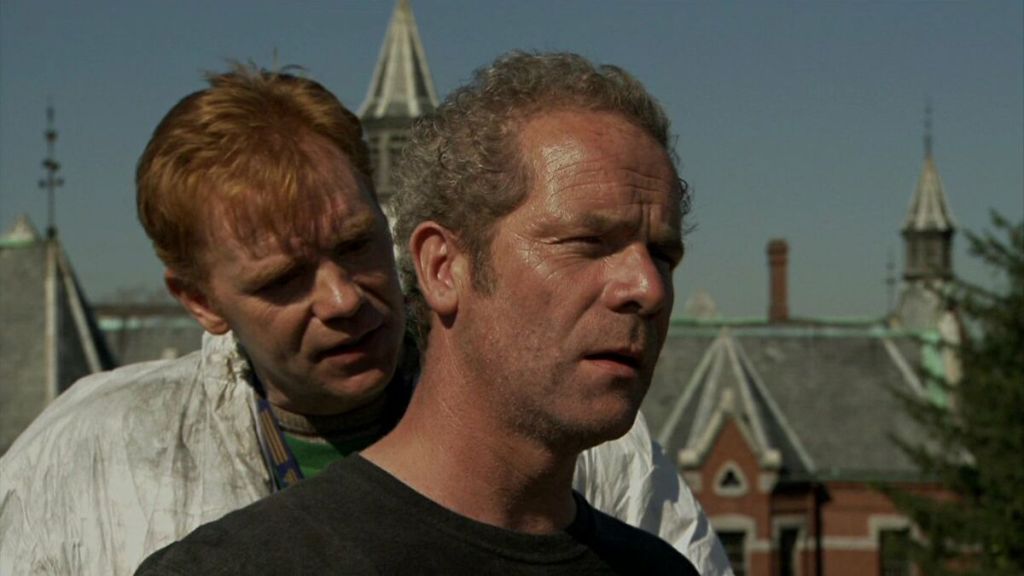
Gordon Fleming (Peter Mullan) the owner of a company that removes asbestos from old buildings, makes a bid for the work at the Danvers State Hospital in Massachusetts. In a desperate need for cash in his personal life, Gordon promises that his crew can complete the job in only one week, even though a job like this should normally take at least three weeks. His crew… Phil (David Caruso) is Gordon’s right hand man who tries to keep everyone else in line. This isn’t very easy these days considering that another member of the team is Hank (Josh Lucas), who’s currently “dating” (not the word Hank uses) Phil’s ex-girlfriend. The crew is rounded out by Mike (co-writer Stephen Gevedon), a law school dropout who seems to be way too smart to be doing this kind of work, and Jeff (Brendan Sexton III), Gordon’s nephew. As you might expect, once they begin the job, strange things start happening as the crew members find various items in the gigantic mental institution that once housed up to 2,400 people. Mike finds a box of tapes of nine therapy sessions detailing the case of Mary Hobbes, a patient with many personalities who may have murdered someone decades before. Meanwhile, Hank finds a stash of coins and other valuable items in one of the walls. A gambling addict, Hank goes back late that night when no one is around to collect his discovery. Things don’t go well and Hank doesn’t show up for work the next day. We’re led to believe that Hank has headed off to Florida for “casino school,” and this is where things start really getting weird as the pressure of the job and the strange events seem to be getting to the entire crew. When Jeff spots a very oddly acting Hank in the building a couple of days later, the sinister events at the Danvers State Hospital begin to completely unravel! 

Director Brad Anderson’s SESSION 9 is a creepy, slow burn that’s best described as a psychological horror film. It’s one of those movies where you can’t trust what you’re seeing on screen because the story is about the disturbed and damaged human mind. In my opinion, this is the most haunting kind of horror film because there are so many examples in the real world of mentally disturbed people committing horrific acts of violence. My wife has spent the last decade of her nursing career in the area of forensic psychology where she takes care of mentally ill individuals who have committed these types of horrible atrocities, often against the very people in their lives who take care of them. This is real world stuff. And the film’s setting, the actual Danvers State Hospital, also known as the Danvers Lunatic Asylum, in Danvers, Massachusetts, which operated from 1878 to 1992, adds a lot to the atmospheric feel of dread in the film. The Neo Gothic architecture of the facility, and the labyrinth of tunnels connecting the various buildings are a perfect setting for the creepy elements of Anderson’s story, and he takes full advantage of the location. The story and the setting set the stage for what feels like true terror, and I have to admit that SESSION 9 has stayed with me after my initial viewing. 

The cast of SESSION 9 is very effective. Though David Caruso receives top billing, the story really revolves around Gordon Fleming, portrayed by Peter Mullan. I primarily recognized Mullan from his interesting role as Jacob Snell in the excellent Netflix series OZARK, but he’s had quite a career as both an actor (TRAINSPOTTING, THE VANISHING) and director (THE MAGDALENE SISTERS). His quiet, internal performance is a solid anchor for the strange things going on around his crew. Caruso’s character is experiencing his own share of problems in his personal life, and the actor’s edgy intensity is a nice counterbalance to Mullan’s stillness. His life seems to be getting a little out of control and that dynamic works well for the moody paranoia of the film. Of the remaining performances, Josh Lucas seems to fair the best. His character isn’t really all that likable, but he does bring some humor to the role, and it’s ultimately the revelation of his character’s fate that begins to bring the story’s horrifying events to light. 

As I mentioned earlier, SESSION 9 is a slow burn of a film. Brad Anderson takes his sweet time setting the story up by introducing us to the dynamic of the main characters and placing them in the spectacular environment of the institution’s decaying buildings. It takes a bit for the doom and gloom to really start kicking in, so it’s possible that impatient or distracted viewers could lose interest as not much seems to be happening. I also wasn’t very surprised when the revelations of the story finally came to light. If you’re paying attention, the end moments of the movie aren’t as big of a “gotcha” as they could have been. But that’s all okay, because the brilliance of SESSION 9 is ultimately the mood it creates and the impending sense of dread we feel for the final discovery of what some of our characters may be capable of. In those aspects, SESSION 9 is a resounding success. 

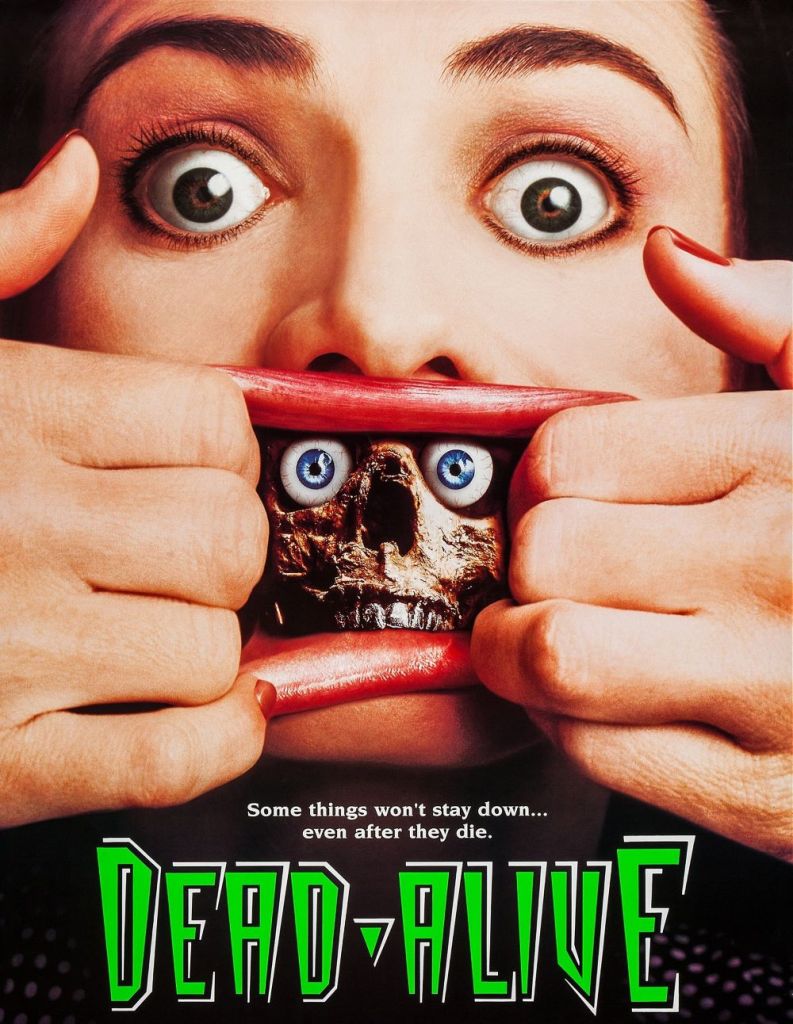
Horror Review: Dead Alive aka Brainded (dir. by Peter Jackson)


“I kick ass for the Lord!” — Father McGruder

Peter Jackson’s Dead Alive (or Braindead, if you’re fancy about it) is what happens when deranged genius meets a barrel of fake blood and zero self-restraint. It’s equal parts grand guignol and Saturday morning cartoon—one of the bloodiest and funniest films ever made. Long before Jackson became the cinematic architect of The Lord of the Rings, he was a scrappy splatter artist, weaponizing gore and absurdity with childlike glee. And while his first two features, Bad Taste and Meet the Feebles, showcased raw chaos and puppet debauchery, Dead Alive marks his evolution—still insane, but sharpened, confident, and shockingly heartfelt in its bizarre way.

The film opens on Skull Island, that mythic symbol of cinematic imperialism, where bumbling white explorers snatch a grotesque hybrid creature—the infamous Sumatran Rat-Monkey. When one of them is bitten, the native tribesmen panic, shrieking “Singaya! Singaya!” while pointing at the wound. It’s grotesquely hilarious—dark humor rooted in colonial parody. For a few fleeting moments, Jackson seems to flirt with serious themes: the toxicity of imperial arrogance, cultural desecration, and the viral consequences of exploitation. You could easily write a twenty-page graduate thesis connecting this opening to the cannibal panic of 20th-century western adventure cinema. But then the movie rolls into prosthetic carnage and butt jokes, and you realize—thankfully—that Dead Alive is no place for academic solemnity.

The story moves to Wellington, New Zealand, where Lionel Cosgrove (Timothy Balme) lives under the suffocating grip of his passive-aggressive mother, Vera. She’s the kind of matriarch who vacuum-seals her son’s adulthood. When Lionel starts falling for Paquita (Diana Peñalver), a kind-hearted shop girl whose grandmother insists destiny has chosen them, Vera’s jealousy leads her to sabotage the romance—and right into a bite from the cursed Rat-Monkey. That’s when everything turns gleefully revolting.

Vera’s infection transforms her into a dripping monument of decay, devouring neighbors and spewing black sludge at tea parties. Lionel, too timid to kill her, instead tries to sedate and hide the growing zombie horde in his basement. Naturally, this plan collapses with the speed of a B-movie funeral, leading to an escalating chain reaction of undead madness. By the one-hour mark, Jackson isn’t directing a film anymore—he’s conducting a symphony of splatter.

Part of what makes Dead Alive endure is just how expertly it moves between the grotesque and the hilarious. Every melted face and gory evisceration is framed like a punchline. Jackson’s camera zooms, tilts, and spins through crimson chaos with joyous purpose. The gore isn’t meant to horrify; it’s kinetic comedy, pure visual rhythm. By the time Lionel revs up his lawnmower for the film’s final massacre—quite possibly the most ambitious use of landscaping equipment in film history—Dead Alive has transcended genre. It’s no longer horror or comedy. It’s delirium art.

Of course, the cast of oddballs steals plenty of the show. Father McGruder, the kung-fu priest, delivers the film’s single most quoted line—“I kick ass for the Lord!”—before dropkicking zombies with ecclesiastical authority. The zombie baby, born from two reanimated corpses who just couldn’t keep their limbs off each other, is another masterstroke of twisted creativity. Lionel’s attempt to civilize the infant, leading to a playground brawl between man and monster-stroller, might be the most deranged slapstick sequence ever shot.

It’s the tactile nature of Dead Alive that makes it timeless. The production team drenched every set in homemade latex, goo, and fake blood—over 300 liters for the finale alone. No digital shortcuts, just pure craft and chaos. You can see Jackson’s imagination fermenting into the precision that would one day fuel his massive fantasy epics. Every scene here, beneath its slime and slapstick, demonstrates an intuitive cinematic intelligence.

If someone wanted to, they could absolutely load an academic essay with postcolonial readings, Freudian analyses, or references to Julia Kristeva’s theory of abjection—arguing that Vera embodies the grotesque maternal figure polluting the symbolic order. You could apply Deleuze and Guattari, Lacan, or even Foucault if you were persistent (and a little delusional). But Dead Alive doesn’t invite theory—it belly-laughs in the face of it. This isn’t a film to decode; it’s a film to experience, preferably with popcorn and zero pretension. Jackson knows exactly what he’s making and relishes every revolting frame of it.

More than thirty years later, Dead Alive remains the filthiest funhouse in horror history—an outrageous blend of low-budget energy, visual wit, and pure imagination. It might gesture briefly toward colonial rot and unchecked power, but ultimately, this movie isn’t about guilt or grandeur. It’s about having the best possible time making the worst possible mess.

For scholars, it’s a nightmare to analyze. For horror lovers, it’s cinematic nirvana. And somewhere in between all the entrails and laughter, you realize Peter Jackson’s greatest early lesson: sometimes, the most profound statement a film can make is “Relax—it’s just blood.”

Retro Television Review: Law and Order 6.13 “Charm City” and Homicide 4.11 “For God And Country”


Welcome to Retro Television Reviews, a feature where we review some of our favorite and least favorite shows of the past!  On Sundays, I will be reviewing Homicide: Life On The Street, which aired from 1993 to 1999, on NBC!  It  can be viewed on Peacock.

This week, Homicide crosses over with Law & Order.

Law & Order 6.13 “Charm City”

(Dir by Ed Sherin, originally aired on February 7th, 1996)

Homicide 4.11 “For God and Country”

(Dir by Ed Sherin, originally aired on February 9th, 1996)

This week, we have a two-part cross-over between Law & Order and Homicide.

On Law & Order, things start in New York City.  A chemical attack on a subway train leaves 20 people dead.  Because the train was specifically heading into Harlem and all of the victims were black, it is suspected that the attack was racially motivated.  In Baltimore, Frank Pembleton and Tim Bayliss hear about the attack and are reminded of a similar attack on a black church, which occurred five years prior.  Pembleton was the primary on the church attack.  He and Bayliss head to New York City, where they meet and quickly get on the nerves of Detectives Lennie Briscoe (Jerry Orbach) and Rey Curtis (Benjamin Bratt).

Pembleton’s investigation uncovers that a man from Baltimore, Brian Egan (Kevin Geer), not only had access to the chemicals used in both attacks but also that’s he currently in New York.  When Briscoe and Curtis arrest Egan and fail to get him to confess, Pembleton asks for permission to interrogate him.  Pembleton, being Pembleton, rather easily gets Egan to confess to having committed the church bombing.  However, before getting the confession, Pembleton pretends not to hear Egan say that he no longer wants to continue talking.  In typical Law & Order (if not Homicide) fashion, the confession is tossed out.

Jack McCoy (Sam Waterston) and Claire Kincaid (Jill Hennessy) still get their conviction.  (And Claire gets an admirer in the form of Tim Bayliss.)  However, it’s obvious that Egan was not working alone.  Egan says that he will never name names.

That changes when his wife is murdered and his teenage son goes missing.  Homicide opens with Bayliss investigating the poisoning of Egan’s wife.  He and Pembleton eventually track down Egan’s son and they get him to admit that he saw his uncle, former NSA agent Col. Alexander Rausch (J.K. Simmons), murder his mother.  Because Brian Egan has said that he’ll only reveal the truth of the conspiracy if his son is brought to New York, Briscoe and Curtis show up in Baltimore.

While Curtis, Bayliss, and Pembleton track down Colonel Rausch, Briscoe hangs out with Munch.  Their friendly banter goes south as soon as Briscoe mentions that he once knew a Gwen Munch in New York.  Gwen is John Munch’s ex-wife and John is not happy when he finds out that Briscoe slept with Gwen.  John Munch spends the rest of the episode drinking heavily.  Stanley Bolander would not approve.

As for Col. Rausch, he is captured and he turns out to be a smug snake.  (He’s played by J.K. Simmons, after all.)  Pembleton wants to see Rausch prosecuted for the church bombing and he especially wants to see racist Rausch publicly humiliated.  New York, however, wants to prosecute him for the subway attack.  Claire comes down to Baltimore and gets a judge to agree that Rausch should first be sent to New York.

Rausch doesn’t care.  He has a heart condition so he simply stops taking his heart pills and then drops dead while waiting for the train to take him to the Big Apple.  The episodes ends with Pembleton sobbing as he realizes Rausch will never be humiliated at a trial.  The New York cops shrug and say, “Sorry, Frank.”

I enjoyed this crossover quite a bit.  It was interesting to see two police dramas, each with a very different style, come together to tell one big story.  As Homicide always celebrated the lengths that Pembleton would go to get a confession in the Box, it was amusing to see what would actually happen to one of those confessions if it was brought to court.  Jack McCoy is not at all amused by Pembleton’s tactics.  Meanwhile, Briscoe, Curtis, and Claire was allowed to loosen up a bit when they went to Homicide and I enjoyed watching them shed their “just-the-facts” personas.  If the Law & Order episode was ultimately superior to the the Homicide episode, that’s just because the Law & Order episode featured an actual mystery to be solved whereas the Homicide episode occasionally felt as if it was padded out a bit.  On Homicide, it was obvious that Colonel Rausch was guilty and, from the minute he started to cough during the interrogation, it was easy to guess what his ultimate fate would be.

(I also have to say that it was interesting to compare this episode of Law & Order to watch Law & Order has become today.  How this show went from featuring McCoy confidently doing his job to Nolan Price essentially begging his co-counsel, on a weekly basis, to actually do her job is something that is worth considering.)

Overall, this was a good crossover.  For those who want to watch it, the Law & Order episode is available on Hulu and Disney+ while Homicide can be found on Peacock and Tubi.

Horror Scenes that I Love: Tor Johnson In The Unearthly


We honor the birthday of Tor Johnson with today’s scene of the day.

Even though Tor Johnson is playing a character named Lobo, today’s scene that I love isn’t from Ed Wood’s 1955 film, Bride of the Monster. Instead, it’s from 1957’s The Unearthly. In this film, Lobo is now John Carradine’s servant. (Lobo made quite a career out of working for mad scientists.) The Unearthly was directed by Boris Peftroff, a friend of Wood’s, so it’s not improbable that this film’s Lobo was meant to be the same Lobo as the one who appeared in Bride of the Monster and Night of the Ghouls.

Anyway, in this scene, Tor does his usual Lobo stuff while John Carradine plays the piano. “Time for go to bed,” Lobo says at one point, a much-mocked line but one that is delivered with a bit of gentleness by Tor Johnson. My point is that Tor did the best that he could and bless him for it.