4 Shots From 4 Films is just what it says it is, 4 shots from 4 of our favorite films. As opposed to the reviews and recaps that we usually post, 4 Shots From 4 Films lets the visuals do the talking!
Today, on what would have been his 72nd birthday, we celebrate filmmaker Albert Pyun!
It’s time for….
4 Shots From 4 Albert Pyun Films
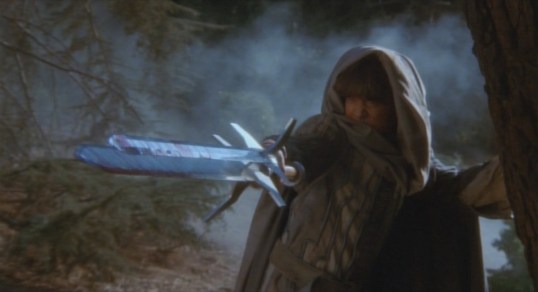
The Sword and the Sorcerer (1982, dir by Albert Pyun, DP: Joseph Margine)
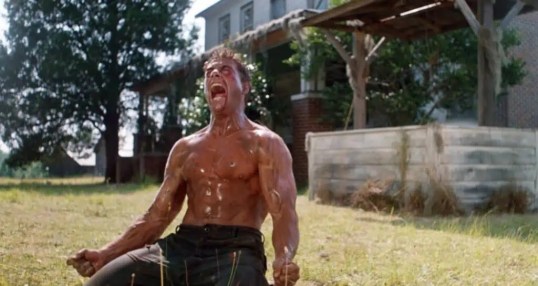
Cyborg (1989, dir by Albert Pyun, DP: Philip Alan Waters)
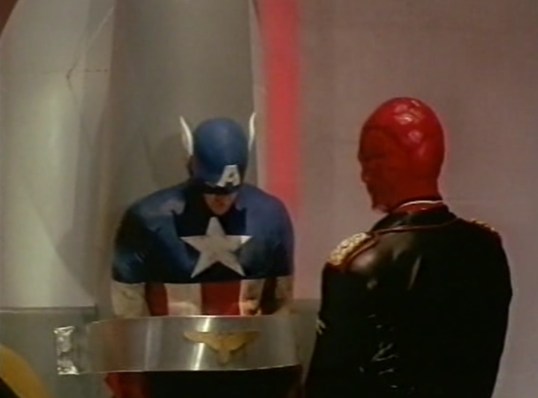
Captain America (1990, dir by Albert Pyun, DP: Philp Alan Waters)
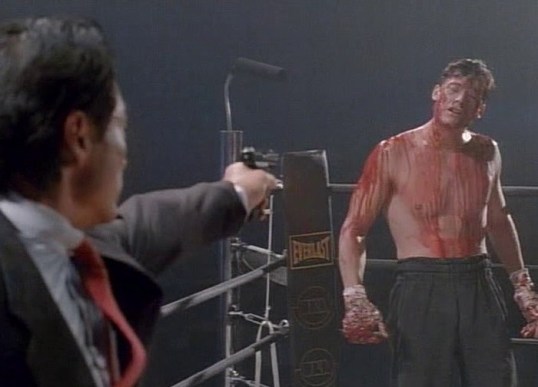
Kickboxer 2 (1991, dir by Albert Pyun, DP: George Mooradian)
Watching this video reminded me that 1) glasses can be cool and 2) I need to make an appointment with the eye doctor soon and see if my vision has gotten any worse. I’m pretty sure it has but I’ve been putting off the visit.
Welcome to Late Night Retro Television Reviews, a feature where we review some of our favorite and least favorite shows of the past! On Sunday, I will be reviewing the Canadian series, Degrassi High, which aired on CBC and PBS from 1989 to 1991! The series can be streamed on YouTube and Tubi
Just when Lucy thinks that she’s out, they pull her back in.
Episode 2.5 “Body Politics”
(Dir by Phillip Earnshaw, originally aired on December 3rd, 1990)
Lucy is depressed because the big dance is coming up and no one has asked her. She makes another one of her video diaries for L.D., in which she says, “I know I can be kind of mouthy.” That’s true but being “kind of mouthy” is a Degrassi tradition and screw anyone who can’t handle someone having an opinion!
Anyway, Lucy does get a date with Dale (Cameron Graham), a jock with a cute smile. But when the Girls Volleyball Team discovers that the Boys Basketball Team has been given all of the best practice slots in the gym (basically, the basketball team gets to practice in the afternoon for as long as they want while the volleyball team only gets a few minutes in the morning), Lucy finds herself starting another protest. However, when she discovers that Dale is the captain of the basketball team, Lucy starts to wonder if she should back off. She wants to go to the dance!
The creepy Farrell twins insist that Lucy has to be their leader and their spokesperson. This episode was the first time that the Farrells were prominently featured in the second season and I had forgotten how annoying they could be with their constant demand that Lucy lead every single protest. Seriously, I’m kind of sympathizing with Lucy’s desire to avoid getting involved.
Lucy does eventually step up and make her argument about the girls deserving equal time to the Phys Ed. department. It doesn’t do any good. It turns out that, when Dale said that no one cares about Girls Volleyball, he was right. Lucy loses her fight and her date. But the president of the senior class, the never before-seen Bronco (L. Dean Ifill), is impressed by Lucy’s fighting spirit and asks her to the dance. So, things work out.
(Lucy, of course, is destined to be crippled and blinded by Wheels in an auto accident but that’s a while off.)
As for the other plots in this week’s episode, Patrick, the Irish guy who was dating Spike at the end of last season, is single again and asks Liz out on a date. Spike says she’s fine with it but actually she’s jealous. Hey, it happens! And Alexa and Michelle finally decide to be friends again. Yay! Seriously, it’s always nice when friendships are saved.
This episode could have been better. The main problem was that I didn’t buy a lot of the Lucy story. I mean, how come there wasn’t a coach or anyone supervising the gym while the basketball players and the volleyball players were having their argument? How come the athletic teams didn’t already have a set schedule for when they would practice? Since when are the Farrell twins athletic and why can’t they ever do anything without demanding that Lucy be their spokesperson? How exactly is L.D.’s father getting away with traveling around the world with his daughter who I imagine is legally required to be in some sort of school? There were just too many unanswered questions.
First released in 1975, Mitchell does not have a great reputation. It’s often described as being one of the worst of the 70s cop films and Joe Don Baker’s performance in the lead role is often held up to ridicule. A lot of that is due to the fact that Mitchell was featured on an episode of Mystery Science Theatre 3000. Last year, for my birthday, my friend Pat McCurry actually hosted a showing of the MST 3K version of Mitchell. I laughed all the way through it. It was a funny show and most of the jokes uttered by Joel and the Bots landed. That said, I wish they hadn’t been so hard on Joe Don Baker. Baker was an outstanding character actor, one whose good ol’ boy persona sometimes kept people from realizing just how fiercely talented he actually was.
Here’s the thing with Mitchell. Just because a film is snarkable, that doesn’t mean that it’s a bad film. Just because there are moments in a film that inspire you to talk back to the screen, that doesn’t make it a bad film. Some of the most enjoyable films that I’ve ever watched were enjoyable specifically because they were made to inspire the audience to talk back to the characters. Whatever flaws you may want to find in Mitchell, it’s an entertaining film. The plot may be impossible to follow but who cares? When you’ve got Joe Don Baker, John Saxon, and Martin Balsam all in the same film, does the plot really matter?
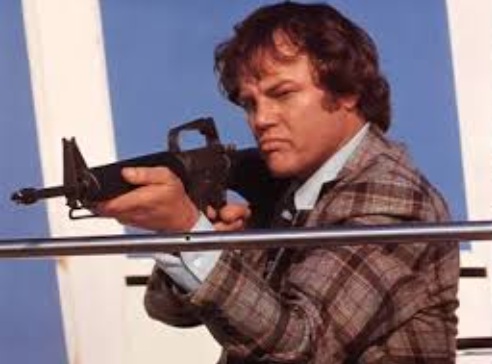
This is a film that you watch for the personalities involved. Balsam plays a wannabe drug lord who always seems to be somewhat annoyed. Someone once describes Bernie Sanders as always coming across as if he was about send his meal back to the kitchen because it was too cold and that’s a perfect description of Balsam’s performance in Mitchell. John Saxon plays a sleazy rich guy who murders a burglar and then tries to cover up his crime. Saxon is calm, cool, collected, and completely confident that his wealth will get him out of anything. And then you’ve got Joe Don Baker as Mitchell, wearing an ugly plaid suit, drinking beer the way that I drink Diet Coke, and continually pretending to be dumber than he actually is. There’s an interesting subtext to these three characters and how they interact. Saxon and Balsam play criminals who are both rich and who both think they can get away with anything because they’ve got money. Mitchell is a complete and total slob, a guy with a cheap apartment, a cheap suit, and absolutely no refinement at all. Mitchell uses his good old boy persona to get the bad guys to continually underestimate him. He ultimately turns out to be smarter and actually more ruthless than any of them.
Joe Don Baker throws himself into the role of Mitchell and there’ actually a lot of intentional humor to be found in his performance. Baker doesn’t play Mitchell as being a supercop. Instead, he plays Mitchell as being a blue collar guy who gets absolutely no respect. Even when he’s on a stakeout, a random kid starts arguing with him. (Mitchell loses the argument.) Mitchell’s a jerk who busts his hooker girlfriend (Linda Evans) for having weed on her but he’s also the only one who could stop Balsam from doing whatever it is that Balsam thinks he’s trying to do. (Again, don’t spend too much time trying to understand the plot.) Mitchell’s super power is that he’s a slob who doesn’t give up. To paraphrase Road House‘s Dalton, he plays dumb until it’s time not to be dumb.
As I said, it’s an entertaining film. Where else are you going to see a not particularly high-speed chase between two station wagons? Where else are you going to see John Saxon in a dune buggy or Joe Don Baker in a helicopter or Martin Balsam as the captain of a yacht? Where else are you going to see a film that features its hero saying, “Yep, that’s grass,” before arresting his lover? Mitchell is fun and entertaining and I’ll always defend both the movie and its star.
Early in THE SEVENTH CURSE, Dr. Yuan (Chin Siu-Ho) tells a story to his mentor and friend Wisely (Chow Yun-Fat). It seems he had visited Thailand exactly one year earlier on a medical research mission. This turned out to be an eventful trip. While walking along a lake, a beautiful woman in a see through top emerges from the clear waters. The two visit for a moment before she runs into the jungle in fear. Later that evening, Yuan hears the sounds of native drums which seem to signal human sacrifices are about to take place by the local “Worm Tribe.” Deciding to investigate the situation, he sees that same beautiful woman in need of a hero as she’s about to be sacrificed to the “Old Ancestor” by the tribe’s sorcerer (Elvis Tsui). He is able to rescue the lady, but he’s also damned with a blood curse that will periodically burst through his legs. Luckily, the grateful beauty was able to slice a tumor out of her ample bosom that provided an antidote for one year. Well the time is up and the bursts are back. Back in present time, Wisely, who puffs on his pipe and seems to be an expert on everything, advises Yuan to head back to Thailand and find a permanent cure before the final burst kills him. With help at various times from the badass Black Dragon (Dick Wei), the beautiful tribe woman we now know as Betsy (Tsui Sau-Lai), the annoying reporter Rainbow (Maggie Cheung), and Wisely, Yuan must find the cure before the final burst comes straight from the heart. It won’t be easy as they will have to defeat the evil sorcerer of the Worm Tribe, a demon baby animated by the blood of ground up children, and “Old Ancestor” himself, a powerful skeleton with glowing eyes who likes to suck out spinal chords before transforming into something really ugly.
Back in 1986, Chow Yun-Fat essentially filmed an extended cameo for this crazy film that could have only been made in Hong Kong. 1986 was also the same year that Chow Yun-Fat became a megastar all across Asia based on his success in John Woo’s A BETTER TOMORROW. Of course, the film was sold on his name, but he’s not in it very much, even if he does show up at the end with a bazooka. With that said, for those in the right frame of mind THE SEVENTH CURSE is an entertaining film, and I like Chin Siu-Ho in the lead role as Dr. Yuan. Part Indiana Jones style adventure and part jungle-terror, this film goes completely over the top with its gratuitous nudity and gore. “Restraint” for this movie means not showing children actually getting ground up so their blood can revitalize a demon baby, although we do see them being placed in the grinder and the blood coming out and being collected in bowls. The same restraint isn’t shown for the men who are torn apart by booby traps and Old Ancestor, impaled by spikes, rip their own faces off and have their spinal cords sucked out. For those of “WTF am I watching” cinema, this should be a fun viewing. The special effects aren’t particularly realistic looking which makes it easier for me to watch.
Overall, THE SEVENTH CURSE is definitely not a film for everyone. The budget is low, the acting isn’t great, it’s gory as hell, and Chow Yun-Fat may have ten minutes of screen time at most. But if my description of the gore doesn’t scare you away and you enjoy crazy cinema, this is probably a movie for you. Enjoy the trailer below:
Raymond Chandler’s detective classic, The Big Sleep, has twice been adapted for film.
The first version came out in 1946, just seven years after the book’s publication. That version starred Humphrey Bogart as detective Philip Marlowe and Lauren Bacall as Vivian, the daughter of a man who has hired Marlowe to discover who is trying to blackmail him. Directed by Howard Hawks and co-written by William Faulkner, this version of TheBigSleep is considered to be a classic noir, one that was cited as being a major influence on director Akira Kurosawa.
The 1978 version was directed by Michael Winner, takes place in London in the 1970s, and features Robert Mitchum as Marlowe. Despite a strong ensemble cast and an excellent lead performance from Mitchum, this version of TheBig Sleep still features one of the worst performances ever put on film.
Sarah Miles plays the role of Charlotte Sternwood Regan, the eldest daughter of General Sternwood (James Stewart). Miles is playing the role that Lauren Bacall played in the first film and, despite the fact that they both earlier co-starred to a certain amount of acclaim in Ryan’sDaughter, Miles and Mitchum do not have a hint of chemistry in this film. Actually, Miles doesn’t have chemistry with anyone in this film. She seems detached from the action and her frequent half-smiles come across as being not mysterious but instead somewhat flakey, as if she doesn’t quite understand that she’s in a noir. Sarah Miles is not a bad actress (as anyone who has seen Hope and Glory can tell you) but her performance here is incredibly dull. That said, she is not the one who gives the worst performance in the film.
Instead, that honor goes to Candy Clark, playing General Sternwood’s youngest daughter, Camilla. Camilla is meant to be mentally unstable and potentially dangerous. Clark plays the role like a giggly teenager, constantly fidgeting and literally hissing in more than a few scenes, as if she’s been possessed by a cat. Clark overacts to such an extent that you’ll be more likely to laugh at than be disturbed by her antics. It doesn’t help that she shares nearly all of her scenes with Robert Mitchum, a man who was a master when it came to underacting. If you’re going to give a bad performance, you don’t want to do it opposite someone who will make you look even worse by comparison.
The mystery of who is blackmailing General Sternwood is twisty and full of disreputable people. At times, the film feels like a a parade of character actors. Edward Fox, Joan Collins, Richard Boone, Oliver Reed, Harry Andrews, Richard Todd, and John Mills all show up throughout the film and, as a viewer, I was happy to see most of them. They all brought their own sense of style to the film, especially the menacing Oliver Reed. That said, director Michael Winner was never known for being a particularly subtle director and the film gets so mired in its own sordidness that it becomes be a bit of a slog to sit through. As a filmmaker, Winner was a shameless. That sometimes worked to a film’s advantage, as with the original DeathWish. That film needed a director who would dive into its Hellish portrayal of New York City without a moment’s hesitation and that’s what it got with Michael Winner. With Winner’s adaptation of The Big Sleep, however, the film gets so caught up in trying to shock and titillate that it’s hard not to miss the wit that made the first adaptation so special.
That said, TheBigSleep does feature the truly special opportunity to see Robert Mitchum and James Stewart acting opposite each other. Both give good and heartfelt performances, with Mitchum plays Marlowe as a cynic with a heart and Stewart capturing the pain of knowing that your children don’t deserve all that you do for them. Stewart and Mitchum bring a lot of emotion and sincerity to their scenes and, for at least a few minutes, The Big Sleep becomes about something more than just bloody murders and revealing photographs. It becomes about two aging men trying to find their place in a changing world. TheBigSleep was one of Stewart’s final feature films and he shows that, even late into his career, he was always one of the best.
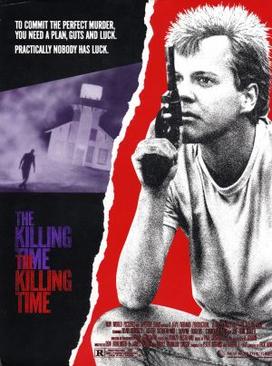
After she is raped and beaten by her husband, Jake (Wayne Rogers), Laura Winslow (Camelia Kath) and her lover, Deputy Sam Wayburn (Beau Bridges), plot to murder him. Sam and Laura come up with a plan to shoot Jake and frame another deputy, the recently hired Brian Mars (Kiefer Sutherland), for the crime. What Sam doesn’t know is that Brian isn’t Brian. Instead, “Brian” killed the real deputy and stole his identity. Fake Brian has his own reasons for wanting to kill Jake but he also doesn’t appreciate Sam and Laura trying to set him up.
This is a typical 80s neo-noir, with an interesting premise that is sabotaged by subpar execution. A big problem is with the casting. Beau Bridges, whose stock-in-trade has always been a natural human decency, is miscast as a deputy who would conspire to not only murder someone but also frame an innocent man. Camelia Kath doesn’t have the style necessary to be a compelling femme fatale. Sutherland is good when he’s playing a psychopath but he’s less convincing when he has to pretend to be Brian. It’s hard to believe that Sutherland’s obviously unstable killer would be able to fool anyone.
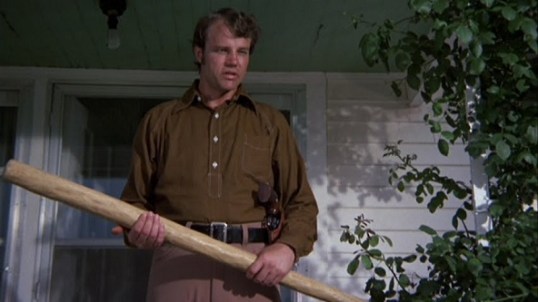
Instead, the film is stolen by Joe Don Baker and Wayne Rogers. Joe Don Baker plays the sheriff who gives up his retirement plans so that he can solve the biggest crime that’s ever been committed in his jurisdiction, Baker’s role isn’t huge but he still gives one of the better performances in the film. If anyone was born to play a small-town sheriff, it was Joe Don Baker. Meanwhile, Rogers is very much cast against type as the evil Jake but the film uses Rogers’s good guy persona to its advantage.
The other big problem is that, other than Baker’s sheriff, there’s no one likeable to be found in this movie. The movie tries to generate sympathy for Sam but once you decide to frame an “innocent” man for murder, it’s impossible to then go back to being a sympathetic character. Brian may be a killer but Sam didn’t know that when he and Laura decided to frame him for killing Jake.
Movies like this used to be a HBO mainstay. Even though the movies themselves often weren’t that good, I still miss those days.
Welcome to Retro Television Reviews, a feature where we review some of our favorite and least favorite shows of the past! On Sundays, I will be reviewing Homicide: Life On The Street, which aired from 1993 to 1999, on NBC! It can be viewed on Peacock.
This week, the bar finally opens!
Episode 3.12 “Partners”
(Dir by John McNaughton, Originally aired January 20th, 1995)
As you can tell by the title, this episode was all about partners.
For instance, Megan Russert realized that her former partner from narcotics, Douglas Jones (Robert Clohessy, with his Bronx accent), has been beating up his wife, Natalie (Lily Knight). He regularly puts her in the hospital, though Natalie always insists that she either fell down the stairs or walked into a door. Jones, who is now working homicide during the night shift and under Russert’s command, insists that he would never hurt his wife. When Russert asks Jones’s former boss if Jones had been having any trouble while working narcotics, he refuses to give her specifics. It’s a boys club and the boys protect each other. Eventually, Natalie ends up shooting Jones with his own gun, probably killing him. (We’re told that he’s barely holding on.) This storyline was well-acted and well-written but watching it, I was reminded of just how awkwardly this show tends to use Russert. Because she commands a different shift, she doesn’t really get much interaction with the other main characters. Her affair with Beau Felton has never really made sense. From what I understand, Russert was created by NBC demanded more personal drama and some glamour. Isabella Hofman does about as good a job as anyone could with her often underwritten character but there’s really just not much for her to do.
Meanwhile, with Pembleton under suspension and threatening to quit, Bayliss doesn’t have a regular partner. His attempt to partner up with Lewis ends in disaster when Lewis’s bad (albeit hilarious) driving leads to Bayliss getting a minor concussion. Fortunately, Pembleton does return to the Homicide Department, though not before nearly burning down his kitchen while trying to make dinner. Unfortunately, before Pembleton can return to his job, he has to take the fall for offering to drop the investigation into Congressman Wade’s false kidnapping report. Andre Braugher perfectly plays the scene in which Pambleton testifies in court. It’s easy to see the emotional and mental pain that Pembleton feels as he essentially commits perjury, taking the blame and letting Commissioner Harris of the hook. Pembleton is forced to compromise and it eats away at his soul. At the same time, he also gets to return to doing what he does best. Early on in the episode, Giardello acknowledges that he and Pembleton are not friends. “I’ve never been to your house, I’ve never met you’re wife …. I am not your friend ….” but Giardello explains that Pembleton is a good detective. He turns “red names black” and that’s why he wants and needs Pembleton to return.
Bayliss, Lewis, and Munch finally open their bar and, at the end of the episode, it looks like the entire city of Baltimore has turned out. Bolander even looks like he’s having a good time! Munch raises a glass in a toast to the best partners that anyone could hope for and I got tears in mismatched eyes. Seriously, I was so happy to finally see that bar open! It was also nice to see everyone else happy for once. That doesn’t often happen on Homicide.


 Through the Shattered Lens