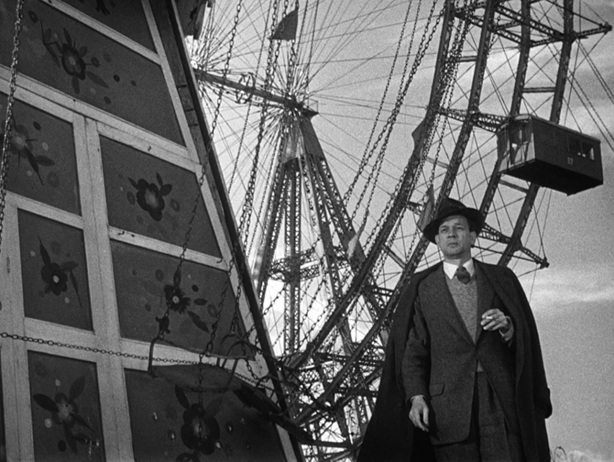
Late Night Retro Television Review: Highway to Heaven 3.23 “Heavy Date”


Welcome to Late Night Retro Television Reviews, a feature where we review some of our favorite and least favorite shows of the past!  On Thursdays, I will be reviewing Highway to Heaven, which aired on NBC from 1984 to 1989.  The entire show is currently streaming on Tubi and several other services!
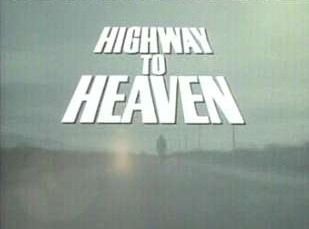
This week, Jonathan and Mark are back in Los Angeles.

Episode 3.23 “Heavy Date”

(Dir by Michael Landon, originally aired on March 18th, 1987)

Jonathan and Mark’s latest assignment finds them in Los Angeles, where they share an apartment in a building that is managed by Marge Davis (Peggy Pope).  Marge, a widow, is upset that her son, Gary (Patrick O’Bryan), doesn’t seem to have any direction in life.  When Gary loses his job, Marge kneels down and puts her head in the oven.  Uhmm …. okay.  Suicide humor, that’s great, I guess.

Alice Hartman (Lorie Griffin) shows up in Los Angeles and takes an apartment in the building.  Alice is seven months pregnant.  Her mother has created a cover story, that Alice has gone to Europe for the summer.  Instead, Alice has gone to Los Angeles so she can have the baby and give it up for adoption without her father finding out.  Jonathan works his magic and manipulates Gary and Alice into falling in love.  When Alice has her baby, Gary asks her to marry him and says that he wants to help her raise the baby.  So, I guess the nice couple who wanted to adopt the baby are just out of luck.

This episode was a bit odd.  When Alice first comes to Los Angeles, she says she’s seven months pregnant.  The episode takes place over  a longer period of time than usual and Alice eventually has the baby.  At no point does Alice ever appear to be pregnant.  She wears baggy clothes but still, there’s only so much that an extra-large sweater can conceal when you’re that pregnant.  There was also a weird scene where Gary, pretending to be the baby’s biological father, lied to the adoptive parents and claimed that he was on probation and that his mother was in a mental institution.  The show played it for laughs but again, the couple seemed so nice and happy about the idea of adopting that Gary’s lies just felt cruel.  And, for a show that was all about an angel on a mission from God, it’s interesting that Gary’s actions went unpunished.  If anything, he was rewarded for them.

(Seriously, the couple that wanted to adopt Alice baby, they were so nice!  That the episode just kind of pushed them aside really didn’t feel right.  I get that Jonathan and Mark’s assignment was to help Alice and Gary but Gary is kind of a jerk and Alice is kind of immature.  Whose going to help the Wallaces, who sincerely wanted to give the baby a good home?)

This episode was obviously heartfelt.  For once, Michael Landon is the sole credited writer so one gets the feeling that this episode’s story and message both meant a lot to him.  (That said, Landon’s approach to the story makes the message come across as being less pro-family and more anti-adoption.)   In the end, the main problem is that neither Gary nor Alice really seem worthy of all of the effort that Jonathan is putting into the assignment.  It’s hard not to feel that maybe Jonathan and Mark needed to help everyone out and not just Alice and Gary.
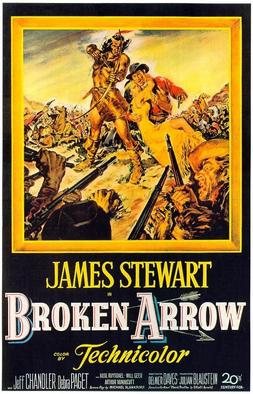
 

Film Review: Broken Arrow (dir by Delmer Daves)


The 1950 film, Broken Arrow, takes place in the years following the Civil War.

Having survived the war, frontier scout Tom Jeffords (James Stewart) just wants to get away from his fellow countrymen for a while.  During the Civil War, Jeffords saw the worst that humanity had to offer and the experience has left him cynical about the idea of bringing civilization to the American frontier.  Tom just wants to be left alone.  Still, when he comes across a 14 year-old Apache who has been shot in the back, Tom stops to help.  Though wounded, the Apache still tries to attack him.  He’s learned not to trust the white man.  Broken Arrow is a film that suggests that he has good reason not to.  Indeed, Broken Arrow was one of the first major Hollywood productions to attempt to treat the American Indians with sympathy and fairness.

Tom saves the Apache’s life and reunites him with his tribe.  When the Apaches attack and kill a group of nearby gold prospectors, they allow Tom to live but they warn him to stay out of their territory.  However, circumstances make it impossible for Tom to do that.  When Tom arrives in Tucson, the citizens are incredulous that he allowed the Apache child to live.  When Tom learns the Apache language and customs and marries an Apache woman named Sonseeahry (Debra Paget), it causes the other whites to distrust him even more.  However, it is Tom’s eventual friendship with the Apache chief Cochise (Jeff Chandler) that eventually lands Tom in the middle of the conflict between the Apaches who want to preserve their way of life and the white men who want their land.

Broken Arrow is a well-intentioned film, in the way that mildly liberal films from the 50s tended to be.  The U.S. government and its citizens are criticized for breaking their promises and their treaties to the Apache but the film’s ultimate message is one of compromise and understanding.  The bigoted whites may be the villains but then again, so is Geronimo (Jay Silverheels) for refusing to accept Cochise’s desire for peace.  Cochise is the film’s hero specifically because he calls for setting aside differences and living in peace with the white man, despite his own distrust of their leaders.  The majority of the extras were Apache, though Neither Jeff Chandler nor Debra Paget were of Native descent.  Both of them give good performances that largely avoid the stereotypes of the time.  Chandler received his only Oscar nomination, for Best Supporting Actor, for his performance in this film.

That said, the unnominated Jimmy Stewart dominates the film and that’s not really surprising.  (It should be noted that, while Stewart was not nominated for this film, he was nominated for his performance in Harvey, that same year.)  Stewart may have first found fame as the happy and go-lucky face of Middle America but his experiences in World War II left a definite mark on him.  He returned from the war a much more serious figure and every character that he played (even the lovable Elwood in Harvey) had more than a hint of melancholy to him.  Stewart plays Tom as being a troubled soul, someone who is still struggling to come to terms with the destruction and cruelty that he saw during the Civil War.  There’s an authenticity to Stewart’s performance, leaving little doubt that he understood exactly what Tom was going through.  Broken Arrow ends on a note of compromise and racial harmony but it’s a sad film because we know what waits in the future for Cochise and his people.  Tom Jeffords fights to bring peace to the frontier but it’s a peace that won’t last.  And, as played by Stewart, Tom seems to understand that better than anyone.

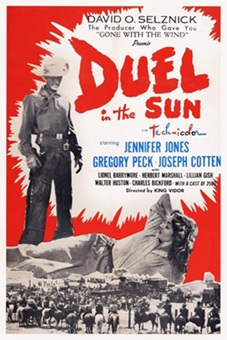
Duel In The Sun (1946, directed by King Vidor)


After her father is executed for killing her mother and her mother’s lover, “half-breed” Pearl Chavez (Jennifer Jones) is sent to live with her father’s second cousin, Laura Beth McCanles (Lillian Gish).  Laura is the wife of rancher, politician, and all-around racist Senator Jackson McCanles (Lionel Barrymore).  Worried that Pearl’s beauty and uninhibited manner will get her into trouble, Laura arranges for Pearl to meet with a minister known as The Sinkller (Walter Huston) who instructs Pearl on how to be a “good” girl.

Wanting to make Pearl bad and his, Lewton “Lewt” McCanles (Gregory Peck) becomes obsessed with Pearl and is soon forcing himself on her on a regular basis.  When the good McCanles brother, Jesse (Joseph Cotten), leaves the ranch despite being in love with Pearl, Pearl tries to find a good husband in the form of Sam Pierce (Charles Bickford).  Lewt responds by gunning Sam down and then goes on the run.  It all leads to an overwrought duel in the sun as the two doomed lovers take aim at each other.

Duel In The Sun is credited to veteran director King Vidor and there are a few shots of the western landscape that do feel typical of Vidor’s work.  However, Duel In The Sun’s true auteur was its producer, David O. Selznick.  Still looking to recapture his earlier success with Gone With The Wind and eager to make his future wife, Jennifer Jones, into an even bigger star than she was, Selznick obsessed over every detail of Duel In The Sun, pushing Vidor and a host of other directors (including Josef von Sternberg, William Dieterle, William Cameron Menzies, Otto Brower, and Sidney Franklin)  to make the film more steamy, more melodramatic, more violent, and more visually epic.  Reportedly, while Video was trying to shoot the film’s titular duel, he had to call cut several times when Selznick ran into the scene with a water bottle to spray more “sweat” onto Jones and Peck.  Today, the stiff Peck seems miscast as the black sheep of the family, the reserved Jones is even more miscast as a mestiza, and the plot is clearly too simplistic to carry the film’s epic ambitions.  A few impressive shots aside, Duel In The Sun is just boring,  In the 40s, though, the film’s relative openness about sex generated enough controversy to make Duel In The Sun into a box office hit.  It was one of the two top-grossing westerns of the 40s, beating out Red River, My Darling Clementine, Fort Apache, The Ox-Bow Incident, and several other films that were actually good.

Unlike Jones, Peck, and even usually reliable stalwart like Lionel Barrymore and Walter Huston, Joseph Cotten at least emerges from this film with his dignity intact.  Playing the good brother, Cotten gets to underplay while everyone else is overplaying and it turns out to be the right approach for him.  Surviving Duel In The Sun was no easy feat but Cotten pulled it off.

Retro Television Review: Malibu, CA 2.12 “Jason’s Deal”


Welcome to Retro Television Reviews, a feature where we review some of our favorite and least favorite shows of the past!  On Thursdays, I will be reviewing Malibu CA, which aired in Syndication in 1998 and 1999.  Almost the entire show is currently streaming on YouTube!

Yes, this is from the first season. I don’t care. I refuse to waste my time looking for a second season advertisement.

Jason humiliates himself again.

Episode 2.12 “Jason’s Deal”

(Dir by Gary Shimokawa, originally aired on January 22nd, 1990)

I guess Jason’s supposed to be a rock star now.  His CD has been released and he’s given a $20,000 advance by a guy (Christian Zimmerman) from the record company.  He proceeds to rent out an apartment of his own and spends a ton of money decorating it.  Will success spoil Jason Collins!?

Actually, failure spoils Jason Collins.  His CD only sells 70 copies and he’s dropped by the label.  He has to move back home.  Scott, Murray, and Alex are all angry because of the way he treated them when he thought he was a star.  He even lied so that he throw an industry party rather than hang out with his brother and their dorky friends.  Of course, the party was attended by Jason’s record company boss so maybe some understanding is in order here.  Scott, Murray, and Alex forgive him but only after reading, in the paper, that Jason has been dropped by the record company.  Would an obscure, generic singer getting dropped by a record company really be front page news?

(Speaking of which, maybe Jason’s CD would have sold if he and the record company had actually done something to …. oh, I don’t know, PROMOTE IT!?  Jason doesn’t go on the radio.  He doesn’t go on tour.  He doesn’t go on TRL.  Seriously, Jason, what did you think was going to happen?)

Meanwhile, Lisa (the character, not me) acts like a total bitch because her friends is dating Traycee.  Believe me, I don’t like tossing that word around (especially as an insult) but there’s really no other way to describe Lisa’s behavior.  Lisa’s friend, Curtis (James Castle Stevens), really likes Traycee and Lisa’s reaction is to act like a stuck-up snob.  Curtis is an environmentalist and Traycee is keeping him from saving the rain forest!  Or maybe Curtis is just realizing that there’s nothing one person can do to save the rain forest and, since he’s kind of a wimpy nerdy guy, he should enjoy life while he’s still young.  Either way, it’s really none of Lisa’s business.

Oh, this storyline annoyed me!  It’s a little bit difficult to fairly judge anyone’s performance on Malibu CA.  That said, Brandon Brooks, Priscilla Inga Taylor, and Edward Blatchford all manage to give decent performance despite the bad dialogue and dumb plotting.  Trevor Merszei (who played Scott) is giving a considerably better performance during the second season than he did during the first.  Meanwhile, Marquita Terry (who plays Lisa) is consistently terrible in a way that’s noticeable even by the standards of a Peter Engel-produced sitcom.

Eventually, Tracyee encourages her friend to go to the rain forest and Jason moves back home.  So, Jason will not be a rock star and Scott will not be going to the Olympics.  Instead, they’re destined to forever be busboys in their father’s restaurant.  It couldn’t happen to a group of more deserving people.

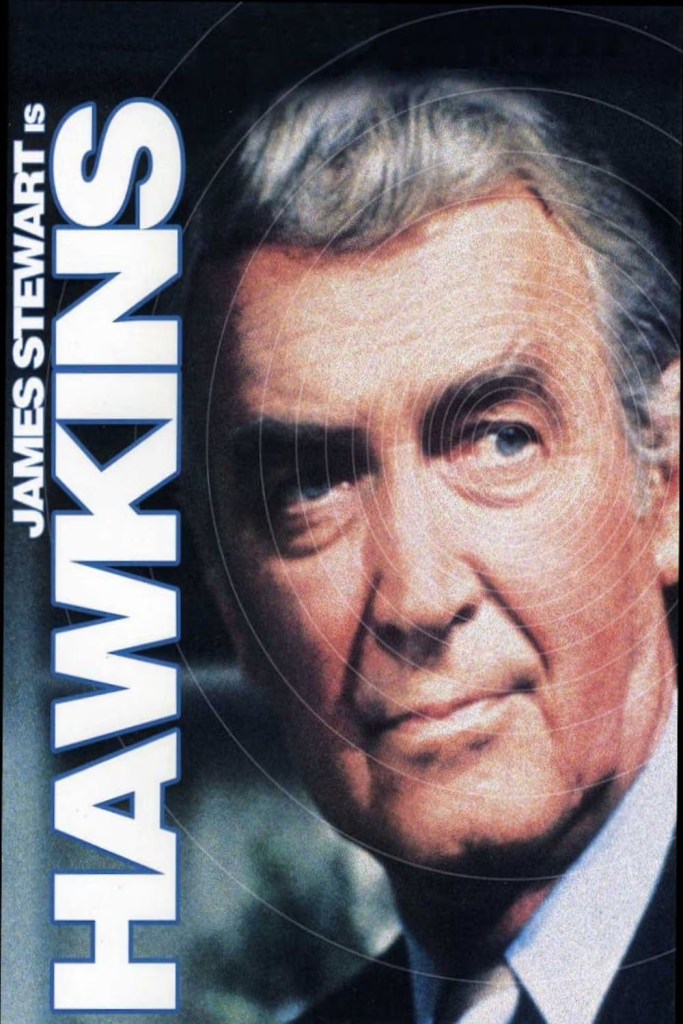
HAWKINS: Death and the Maiden (1973) – starring Jimmy Stewart!


In this pilot episode of the TV-Movie series HAWKINS, Jimmy Stewart plays Billy Jim Hawkins from the fictional town of Beauville, West Virginia, who just happens to be the best defense lawyer in the business. A former prosecutor who changed sides, he has a perfect record for getting his clients off. Billy Jim gets a call to come out to Los Angeles when an heiress, Edith Dayton-Thomas (Bonnie Bedelia), is charged with the murder of her dad, stepmom, and stepdaughter. Billy Jim and his team, which is basically just his cousin R.J. Hawkins (Strother Martin), set about getting to know all the people in her life. There’s the family lawyer Carl Vincent (Robert Webber) who’s been dipping his hand in the family till while also carrying on an affair, much to the chagrin of his wife Vivian (Antoinette Bower). There’s Edith’s aunt Julia (Kate Reid), who doesn’t seem to have a very strong opinion of her now deceased brother in law and was seen arguing with him on the day of his murder. And there’s Edith herself, whose diary would indicate that she hated her dad and her stepmom so much that she wanted them dead. She also just happens to have the reputation for being a little strange and / or crazy. The evidence seems to be stacked against Edith, but Billy Jim doesn’t get to charge those extremely high legal fees for nothing. If anyone can get to the bottom of the case, it’s him. 

I’ll just go ahead and say that Jimmy Stewart and the character of Billy Jim Hawkins are a match made in heaven. Any person who has seen him in the classic Otto Preminger film ANATOMY OF A MURDER (1959) knows how great he is at playing a down home defense attorney. He excels in the role, and he’s reason alone to invest in the DVD collection from Warner Brothers Archive like I did several years back. It’s so fun watching him question people in his easy going, slow talking, country boy way which almost always leads to the discovery of exactly what he needs to know. And Strother Martin is perfect as his cousin and associate, one of 174 first cousins, according to Billy Jim himself. You see, one of the interesting things about Billy Jim’s family is that he’s one of 14 kids, with 52 nieces and nephews to go along with all those first cousins. That’s some fun character history for a guy like me, whose mom is one of 15 kids, and I also have tons of first cousins. Stewart and Martin are a perfect duo, and their sharing of different theories as the episodes progress make up some of the best scenes. Add to Stewart and Martin a solid group of guest stars in this episode including Bonnie Bedelia (DIE HARD), Robert Webber (THE DIRTY DOZEN), Kate Reid (THIS PROPERTY IS CONDEMNED), and Antoinette Bower (THE EVIL THAT MEN DO), and you can’t help but have an entertaining show. There’s never any doubt that Stewart is going to uncover the murderer, but the fun of course is in seeing how he puts all the clues together. 

HAWKINS: Death and the Maiden is the first of eight “Hawkins” TV movies starring Jimmy Stewart in 1973 and 1974. The character of Billy Jim Hawkins is a clear pre-cursor to the character of Matlock that Andy Griffith would have so much success with a little over a decade later. In a strange move at the time, CBS chose to alternate HAWKINS on Tuesday nights with a series of SHAFT TV movies. Imagine wanting to watch SHAFT only to turn on your TV to discover Jimmy Stewart and Strother Martin solving murder mysteries, or Vice-Versa. Conventional wisdom suggests that this release strategy was probably confusing to the respective audiences for the shows based on their vastly different demographics. I personally think they both sound awesome, but I can see how pairing such different shows in this way could have been a problem for the ratings. Regardless of its short lived tenure, if you’re a fan of Jimmy Stewart, you need to watch HAWKINS. Each episode is a joy to behold. 

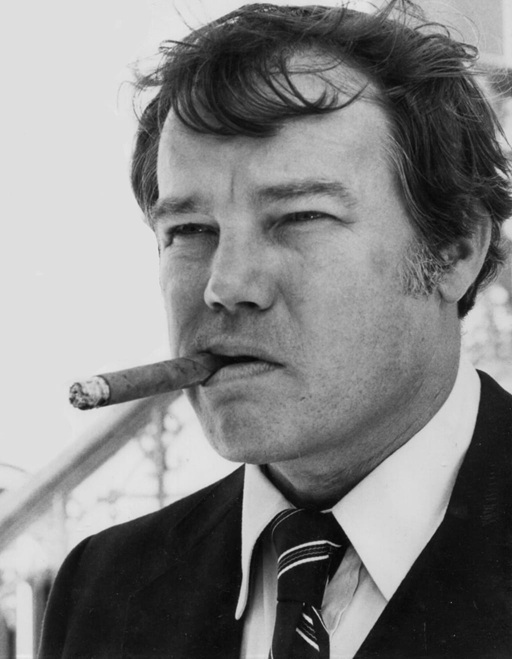
Rest in Peace, Joe Don Baker


I knew this day was going to come, due to his advanced age and the fact that it had been a while since he had appeared in a film (his final appearance was a wonderful supporting role in Jeff Nichols’s Mud), but it’s still pains me to say goodbye to Joe Don Baker.

As a fan of grindhouse cinema, as a fan of the classic Bond films, as a fan of Texas actors, and as a fellow graduate of UNT who used to enjoy eating at that Denton Whataburger that had his picture painted on the wall, I will have a special place in my heart for Joe Don Baker and the entertaining, if often ridiculous, films that he made.

He was 89 years old when he was passed away on May 7th.  They don’t make ’em like Joe Don anymore.

Here he is in 1973’s Walking Tall, enforcing justice with a big stick.

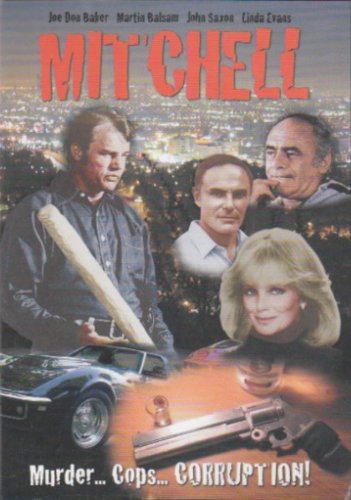
Rest in peace.  I’ll be watching Mitchell in your memory.

Song of the Day: Wannabe by Spice Girls


Last night, Lisa Marie and I were talking about the songs we used to sing during road trips and this was one that we kept coming back to.

I think everyone, from our mom to our two older sisters to the gas station attendants to the people just trying to get some sleep in the hotel room next door, got sick of listening to us sing, “If you want to be my lover…”  Too bad!  We loved this song and still do.

I’m so glad we had fun, non-angsty pop stars to look up to when we were kids.  It’s such a difference from today.

Ha ha ha ha ha
Yo, I’ll tell you what I want, what I really, really want
So tell me what you want, what you really, really want
I’ll tell you what I want, what I really, really want
So tell me what you want, what you really, really want
I wanna, (ha) I wanna, (ha) I wanna, (ha) I wanna, (ha)
I wanna really, really, really wanna zigazig ah

If you want my future, forget my past
If you wanna get with me, better make it fast
Now don’t go wasting my precious time
Get your act together we could be just fine

I’ll tell you what I want, what I really, really want
So tell me what you want, what you really, really want
I wanna, (ha) I wanna, (ha) I wanna, (ha) I wanna, (ha)
I wanna really, really, really wanna zigazig ah
If you wanna be my lover, you gotta get with my friends
(Gotta get with my friends)
Make it last forever, friendship never ends
If you wanna be my lover, you have got to give
Taking is too easy, but that’s the way it is

Oh, what do you think about that?
Now you know how I feel
Say you can handle my love, are you for real?
(Are you for real?)
I won’t be hasty, I’ll give you a try
If you really bug me then I’ll say goodbye
Yo, I’ll tell you what I want, what I really, really want
So tell me what you want, what you really, really want
I wanna, (ha) I wanna, (ha) I wanna, (ha) I wanna, (ha)
I wanna really, really, really wanna zigazig ah

If you wanna be my lover, you gotta get with my friends
(Gotta get with my friends)
Make it last forever, friendship never ends
If you wanna be my lover, you have got to give
(You’ve got to give)
Taking is too easy, but that’s the way it is

So, here’s a story from A to Z
You wanna get with me, you gotta listen carefully
We got Em in the place who likes it in your face
You got G like MC who likes it on a
Easy V doesn’t come for free, she’s a real lady
And as for me, ha you’ll see

Slam your body down and wind it all around

If you wanna be my lover, you gotta get with my friends
(Gotta get with my friends)
Make it last forever, friendship never ends
If you wanna be my lover, you have got to give
(You’ve got to give)
Taking is too easy, but that’s the way it is

If you wanna be my lover
You gotta, you gotta, you gotta, you gotta, you gotta
Slam, slam, slam, slam (make it last forever)

Slam your body down and wind it all around
Slam your body down and wind it all aroundHa, ha, ha, ha, ha
Slam your body down and wind it all around
Slam your body down and zigazig ah
If you wanna be my lover

Songwriters: Emma Bunton / Geri Halliwell / Matthew Paul Rowbottom / Melanie Brown / Melanie Chisholm / Richard Stannard / Victoria Beckham


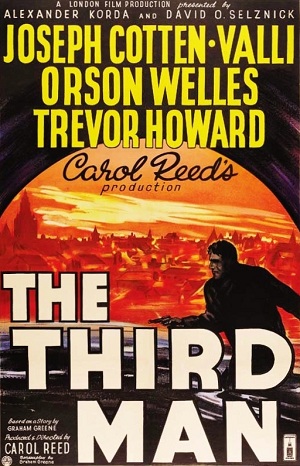
Scenes That I Love: Joseph Cotten In The Third Man


Imagine being Holly Martins.  You’re in Vienna, investigating the death of your best friend, getting chased by an angry mob and threatened by British intelligence, and suddenly you’re reminded that you, an author of dime-store novels, agreed to give a lecture on post-war literature.

That’s what happens in this scene that I love (featuring Joseph Cotten as Holly Martins) from The Third Man.

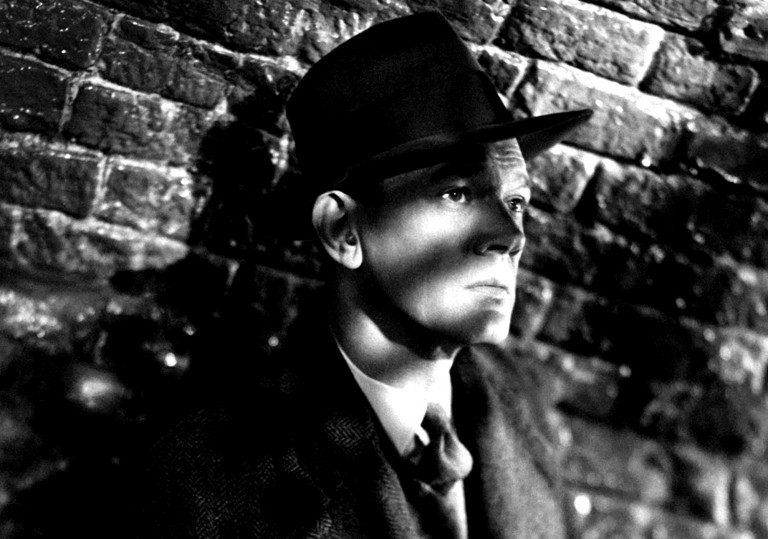
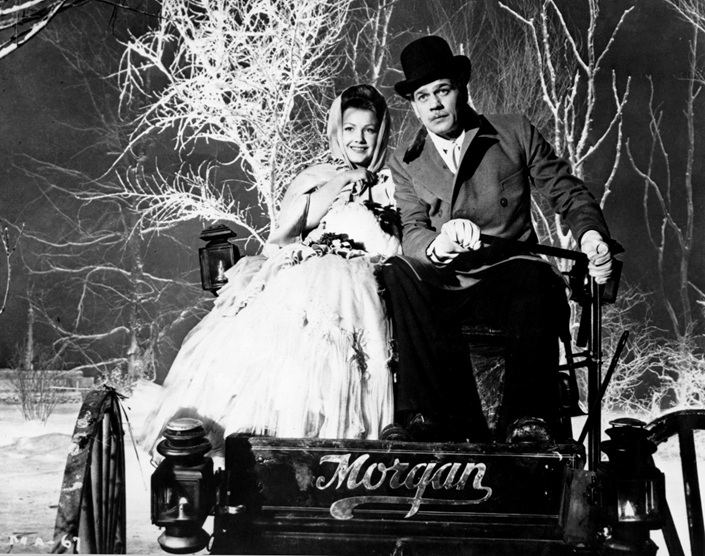
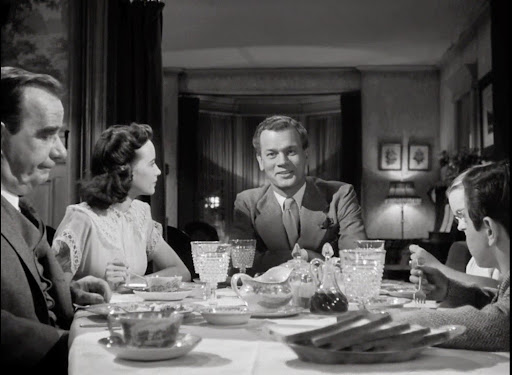
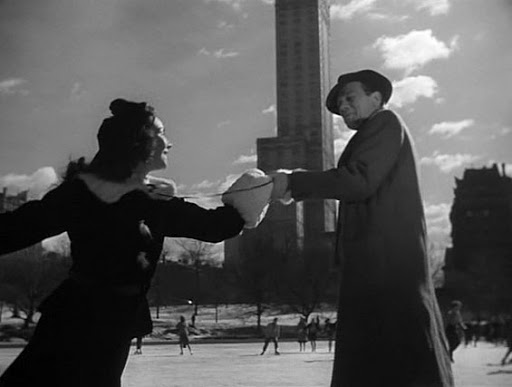
4 Shots From 4 Films: Special Joseph Cotten Edition


The Third Man (1949, directed by Carol Reed)

4 Shots From 4 Films is just what it says it is, 4 shots from 4 of our favorite films. As opposed to the reviews and recaps that we usually post, 4 Shots From 4 Films lets the visuals do the talking!

As you can probably guess from my pen name and my profile pic, Joseph Cotten is one of my favorite actors.  Cotten may be best known for his association with Orson Welles but he worked with several great directors over the years.  Along with playing Jedediah Leland in Welles’s Citizen Kane, he starred in Hitchcock’s Shadow of a Doubt and Carol Reed’s The Third Man.  Even while his film career was flourishing, Cotten continued to appear on the Broadway stage and, during the early days of television, he frequently appeared on anthology series, the majority of which were broadcast live.

In honor of Cotten’s birthday, here are four shots from four of his best films.

4 Shots From 4 Films

The Magnificent Ambersons (1942, directed by Orson Welles)

Shadow of a Doubt (1943, directed by Alfred Hitchcock)

Portrait of Jennie (1948, directed by William Dieterle)

The Third Man (1949, directed by Carol Reed)