For years, banker Jack Dundee (Robin Williams) had been haunted by a pass that he dropped in high school. The pass was perfectly thrown by quarterback Reno Hightower (Kurt Russell) but Jack couldn’t bring it in and, as a result, Taft High lost to its rival, Bakersfield. Adding to Jack’s humiliation is that he now works for The Colonel (Donald Moffat), a confirmed Bakersfield fan who also happens to be Jack’s father-in-law. When Jack visits a “massage therapist” (Margaret Whitton) and tells her about his problems, she suggests that he needs to replay the game. Getting everyone interested in replaying the game is not easy. No one wants to be humiliated a second time and Reno, who now fixes vans for a living, fears the he’s lost his edge. Jack dresses up in the Bakersfield mascot’s uniform and vandalizes the town. Finally, everyone is ready for the game. Now, it’s a matter of town pride.
The Best of Times is a likable comedy about getting older and wishing you could have just one more chance to be young again and to have your entire future ahead of you. Jack is haunted by that one dropped pass, feeling that it has cast a cloud over his entire life. Reno is still a town hero but he’s struggling financially and in debt to Jack’s bank. Replaying the game isn’t going to fix their lives but it is going to give them one last chance to relive their former glory and maybe an opportunity to learn that, even if they are getting older, they’re still living in the best of times. The world that these two men live in is skillfully drawn and believable, with character actors like Moffat, M. Emmet Walsh, R.G. Armstrong, and Dub Taylor adding to the local color. Jack and Reno’s wives are played by Holly Palance and Pamela Reed and they are also strong and well-developed characters. Finally, Robin Williams and Kurt Russell are a strong comedic team. Russell is perfectly cast as the aging jock and Williams gives one of his more restrained performances as Jack, allowing us to see the sadness behind Jack’s smile.
The stakes aren’t particularly high in The Best Of Times. It’s just a football game between some middle-aged men looking to regain their youth. But the story sticks with you.
1984’s Swing Shift begins in 1941. Kay (Goldie Hawn) and Jack Walsh (Ed Harris) are a young married couple in California. At first glance, they seem to have the perfect life. Jack works all day and comes home and has a beer and tells his wife how much he loves her. Kay spends her day cleaning up around the house and when her husband comes home, she sits down next to him and tells him how much she loves him. Whenever their neighbor, Hazel (Christine Lahti), walks by their bungalow, Jack mutters that she’s a tramp. Hazel sings in a sleazy nightclub and dates a shady fellow named Biscuit (Fred Ward) and that’s just not what respectable people do!
When the Japanese bomb Pearl Harbor, Jack enlists in the Navy. Kay suggests that she could get a job while he’s gone but Jack is firm. He doesn’t want his wife working. However, after Jack leaves, Kay is motivated by both boredom and her patriotic duty to apply for a job in an armaments factory. With all of the men overseas fighting, their wives have been implored to do their part for the war effort.
Kay works the swing shift, along with Hazel and a trumpet player named Lucky (Kurt Russell). (Lucky sweetly declines to explain why he’s called Lucky.) Despite some early antagonism, Hazel and Kay becomes friends. Kay starts to come out of her shell, especially where Lucky is concerned. How will Jack react when he returns home?
The late director Jonathan Demme described directing Swing Shift as being one of the worst experiences of his career. Demme’s original cut of the film was an ensemble piece that was a drama with comedic moments. Star Goldie Hawn was reportedly not happy with Demme’s original cut and the film was essentially taken away from the director. Screenwriter Robert Towne was brought in to write some additional scenes. (Even before Towne was brought in, at least four writers had written a draft of the script and the screenplay itself was finally credited to a non-existent “Rob Morton.”) Some scenes were reshot. The film itself was reedited. The end result was a film that focused primarily on Kay and made her relationships with Hazel, Jack, and Lucky far less complex. Jonathan Demme walked away from the film, retaining his directorial credit but pointedly requesting that the film not be advertised as a “Jonathan Demme film.” Later in life, Demme declined to discuss either Swing Shift or the experience of working with Goldie Hawn.
Watching the studio cut of Swing Shift on Prime, I could understand many of Demme’s objections. It’s a film that’s full of good performances and some stylish visuals but it really doesn’t have much narrative momentum and, especially when it comes to Kay’s friendship with Hazel, it does feel like certain scenes are missing. Hazel is remarkably quick to forgive someone who she believes has spent years calling her a tramp. As well, there’s a lot of interesting characters in the background, many of whom are played by regular members of the Jonathan Demme stock company. (Charles Napier, Susan Peretz, Holly Hunter, Roger Corman, Lisa Peilkan, Sudie Bond, and Stephen Tobolowsky all have small roles.) Watching the film, one gets the feeling that they all probably had more to do in Demme’s original cut.
That said, I have to admit that I still enjoyed the studio cut of Swing Shift, flaws and all. A lot of that is due to the performances of Hawn and Russell. (Christine Lahti received a Supporting Actress Oscar nomination for her performance in this film. She’s okay, though I don’t really think she deserved a nomination over someone like Elizabeth Berridge in Amadeusor Tuesday Weld in Once Upon A Time In America.) Hawn does a wonderful job portraying Kay’s transformation from being a rather meek housewife to someone who can put a plane together without a moment’s hesitation. Hawn and Russell began their legendary romance on the set of Swing Shift and their chemistry is strong enough to carry the film over plenty of rough spots. At its best, Swing Shift inspired me to wonder what I would have done if I had been alive in the 1940s. Would I have ended up cutting my hair and working in a factory? Would I have waited at home from my ‘husband or sweetheart” (as the film refers to them) to come home? Or would I have run off with Lucky and followed him from town to town? Swing Shift is a good film that could have been great and, by many accounts, actually was great before it was recut. (Even with the reediting, enough of Demme’s trademark humanity comes through to make the scenes in the factory memorable.) In the end, Swing Shift isn’t perfect but I still enjoyed it.
As a person who sees his love of movies through a lens of “Bronson connections,” I have a special fondness for Kurt Russell. In 1963 and 1964, Charles Bronson worked on a television series with Kurt Russell called THE TRAVELS OF JAIMIE MCPHEETERS. The series itself is the story of twelve year old Jaimie McPheeters (Kurt Russell) who, along with his ne’er-do-well doctor dad (Dan O’Herlihy) and a ragtag group of pioneers, travel westward from Paducah, Kentucky to the California gold fields in 1849. Charles Bronson first appeared on episode 10 of the series, and would stay with the series until it ended after 26 episodes. Russell was the star, with Charles Bronson riding along in the important role of Linc Murdock, the guide who gets them through all sorts of dangerous situations. 1964’s GUNS OF DIABLO is an interesting concoction, using the final episode of the series, “The Day of Reckoning” and adding some new scenes shot specifically for a movie release.
GUNS OF DIABLO opens with Linc Murdock (Charles Bronson) leading the wagon train across a raging river. The group constructs a wooden barge, and most of the group makes it across safely. Unfortunately for one of the groups, a tree floating down the river smashes into the barge, causing it to sink along with the wagon and the man on top of it. Murdock jumps into the river and is able to save the man who unfortunately suffers a broken leg. Needing to rest for a few days, Murdock decides to go into the local town, Devil’s Gap, to get supplies. Jaimie (Kurt Russell), a boy with the wagon train, asks his dad if he can go with him. Dad says yes under one condition, Jaimie gets a real bath while he’s in town. So Linc and Jaimie head off together. When they get to town, Linc immediately goes to the saloon to get a beer, where he sees the beautiful Maria (Susan Oliver), a woman with whom he has a dangerous past. Via flashback, we learn the story of Linc and Maria falling in love while he was working as a hand on the Macklin ranch five years earlier. But it was a doomed love affair as Maria had been promised to the eldest son of the family, Rance Macklin (Jan Merlin). When Linc and Maria plan to elope and get married, Rance and his brothers get the drop on them. A big gunfight ensues, with Rance taking a shot in the arm, and Maria being shot in the crossfire. Believing her to be dead, Linc barely escapes with his own life.
Back in the present time we meet a Maria who is stuck in a loveless marriage to a one-armed Rance. Rance and his brothers have lost the ranch and are always trying to stay one step ahead of the law. That’s why Maria’s been reduced to working as a waitress at the saloon. She also believes that Linc ran out on her five years ago, so she’s mad at him. But soon those old feelings start stirring up deep within her when Linc talks sweet to her. When the duplicitous bartender Ives (John Fiedler) sees Linc go into Maria’s room, he sends word to Rance. Soon the Macklin Brothers are on their way back to town to settle their old score with Linc. What they didn’t count on was the 12 year old Jaimie McPheeters, with all of his youthful exuberance and ingenuity, being there to swing the odds in Linc’s favor! I made up that last line, but Jaimie does help Linc a couple of times.
I mentioned earlier that GUNS OF DIABLO was assembled together using the final episode of THE TRAVELS OF JAIMIE MCPHEETERS, along with some new footage added specifically for the movie. I’ve never seen the final episode of the series that this movie was based on, but I have seen some of the earlier episodes and I did notice one key difference. The TV series revolves mostly around the trials and tribulations of Jaimie and his dad, Dr. Sardis McPheeters. Dan O’Herlihy played Dr. McPheeters in the series, but actor Russ Conway plays him in this movie. He’s not a big part of the movie, just appearing at the beginning and the end, but it was odd seeing a different actor portraying Jaimie’s dad. It sure would be great if the series were to become more widely available at some point in time. I’d love to compare the TV version to this movie version.
Charles Bronson was not a big movie star when GUNS OF DIABLO was released, but he was a well respected character actor. He had already headlined his own TV series, MAN WITH A CAMERA (1958-1960), and he had prominent roles in the massive box office hits THE MAGNIFICENT SEVEN (1960) and THE GREAT ESCAPE (1963). This movie heavily focuses on his character, and Jaimie McPheeters takes a back seat. Bronson, already 43 years old, was more than up to the challenge. He comes across as a decent, hardworking man, who’s capable of taking care of himself. In other words, he shows the strength and charisma that would make him the most popular actor in the world just a few years later. Susan Oliver is quite beautiful as Maria. Although primarily known as a blonde, blue eyed beauty, her hair is dark here. She’s so beautiful that I can understand why a man with such limited options would be willing to fight to the death for her. And what can you really say about Kurt Russell?! He’s such a good child actor. While Jaimie McPheeters may not be the focus of the movie, he’s still so good in the role, showing kindness, loyalty and bravery in equal measure. In a world where so many child actors can’t adjust to life as an adult, Russell has made it look easy for the last six decades. In my opinion, he’s one of the all time greats.
Overall, GUNS OF DIABLO will never be confused with HIGH NOON (1952) or RIO BRAVO (1959), but for a movie assembled from a 60’s TV western and a few newly shot scenes, it’s actually quite enjoyable. And the storyline may not be the most original, but the time tested tale of true love and honor winning out over greed and evil will always make for compelling viewing. I got my first VHS of this film in the 80’s and I still own it to this day. I even watched it multiple times while I was writing up this review. As far as I’m concerned, GUNS OF DIABLO is well worth watching for fans of westerns or fans of the stars.
Rather than sharing a trailer for the film I thought I’d share this heartwarming story of the time Kurt Russell bought Charles Bronson a birthday gift while they were working together on this series. It’s a classic. Enjoy, my friends!
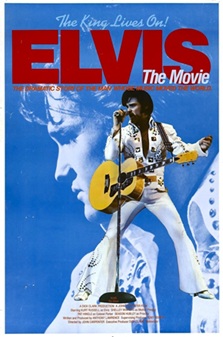
Made for television, it was the first of many biopics to be made about the King of Rock and Roll. Seeing as how it went into production just a year after Elvis’s death and that its script was vetted and approved by Priscilla Presley herself, it’s not surprising that Elvis doesn’t really delve into the darker aspects of his life. Elvis shoots a television, gets frustrated with his bad movies, and wonders who he can trust but we don’t see him get fat nor do we see him popping pills. The movie ends with Elvis making his comeback in 1969, allowing a happy ending for the title character.
The film was directed by John Carpenter. It was his first film to be released after the monster success of Halloween, though Carpenter actually started work on Elvis before Halloween was released. Though the film’s television origins means there aren’t many examples of Carpenter’s signature style in Elvis, Carpenter does a good job recreating Elvis’s performances and, most importantly, he comes up with a film that holds your interest for three hours.
Finally, the role of Elvis is played by Kurt Russell, who was at the time still struggling to prove himself as being something more than just a Disney star. Russell, who made his film debut kicking Elvis in the shins, throws himself into playing the role and captures the look, the swagger, and the voice of Elvis without ever descending into caricature. His singing voice is dubbed for the performances but Russell is still convincing as the King. It takes skill to wear that white jumpsuit without looking like you’re wearing a bad Halloween costume. While this film showed that Russell was capable of more than just Disney films, it even more importantly launched his friendship with John Carpenter. Escape From New York, The Thing, and Big Trouble In Little China all began with Elvis.
The movie doesn’t really tell us anything that we didn’t already know about Elvis but its entertaining and it has a big, colorful cast that include Pat Hingle as Tom Parker, Shelley Winters as Elvis’s mother, and Bing Russell (Kurt’s father) as Elvis’s father. Priscilla is played by the beautiful Season Hubley, who married Kurt Russell shortly after filming. (They divorced in 1983.) Joe Mantegna, Ed Begley Jr., Ellen Travolta, and Dennis Christopher all appear in small roles and do their part to bring Elvis’s world to life. Elvis is a fitting tribute to the King of Rock and Roll, one that gave Elvis a happy ending and started a great collaboration between a director and his star.
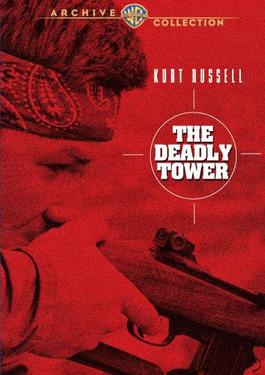
Made for television, The Deadly Tower is a recreation of the terrible day in 1966 that a 25 year-old former Marine named Charles Whitman shot his wife and mother and then climbed to the top of the tower at the University of Texas in Austin and started to indiscriminately firing on the people below. It was one of the first mass shootings of its kind. What drove All-American boy Charles Whitman, who was eventually taken down by the police, to start his rampage is not known though the autopsy revealed that he did have a small brain tumor at the time of his death.
The Deadly Tower focuses mostly on the efforts of the policeman Ramiro Martinez (Richard Yinguez) and civilian Allan Crum (Ned Beatty) to get to the top of the tower and stop Whitman’s shooting rampage. (Pernell Roberts, John Forsythe, and Clifton James all appear as other police officials, trying to deal with what was then an almost unheard of occurrence.) Martinez risks his life to stop Whitman’s rampage while Allan worries that other shootings will follow. One of the first examples of a true crime event being turned into a movie for television, The Deadly Tower a tense and effective docudrama. Kurt Russell, who was then still known for being Disney’s top-paid star, plays Whitman. Russell doesn’t have much dialogue in the film. He’s blandly friendly while buying bullets and, when he’s sitting up in the tower with his rifle, he could just as easily pass for a teenager out hunting with his father during deer season. Russell’s clean-cut appearance made him ideal for playing the role of someone who no one would have ever suspected could be capable of committing such a terrible crime. It took courage to cast an actor then known for Disney films as one of America’s worst mass murderers and it also took courage for Russell to accept a role that was the total opposite of his family-friendly image.
The Deadly Tower used to show up on television frequently when I was a kid. It’s still a scary movie, even if you know how it’s going to end. Whitman may have been one of the first of his kind but sadly, he wouldn’t be the last.
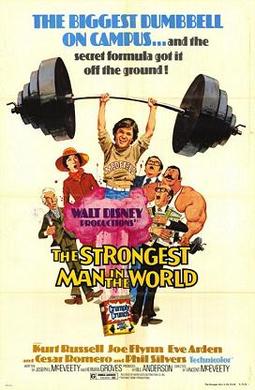
Dexter Riley (Kurt Russell) is back, again! He still hasn’t graduated from Medfield College and Medfield is still on the verge of going broke. Dean Higgins (Joe Flynn) discovers that the reason Medfield can never get out of the red is because the science class and students like Dexter are spending so much money on their experiments. The Dean fires the science professor and threatens to expel Dexter! But when Dexter’s latest experiment develops a type of milk that gives the drinker super strength, the Dean might have to change his mind.
A cereal company wants to buy the supermilk, which would get Medfield out of the hole. But a rival cereal company just wants to steal the formula for the milk so they hire disgraced businessman and gangster A.J. Arno (Cesar Romero) to once again try to thwart the best laid plans of Medfield College. Meanwhile, Dexter competes in a contest to prove that the supermilk has truly made him into the strongest man in the world.
The plot of the last Dexter Riley movie somehow manages to be even dumber than the first two and it was high time for Dexter to graduate and get on with his life but The Strongest Man In The World did make me laugh a few times. Because this entry in the series involved super strength instead of invisibility or merging with a computer, it allowed for more physical comedy and it felt less dates than the other two movies. The action is pretty much nonstop, as Dexter gets into one scrape after another and the cast is likable even if they all were getting a little old to still be playing college students. Like the other Dexter Riley films, The Strongest Man In The World is too innocent and good-natured not to enjoy on some level.
I guess Dexter finally graduated after this movie. Both he and Kurt Russell went on to better things.
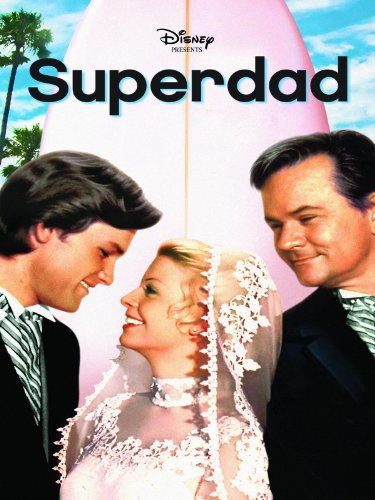
In 1973’s Superdad, Disney takes on the generation gap.
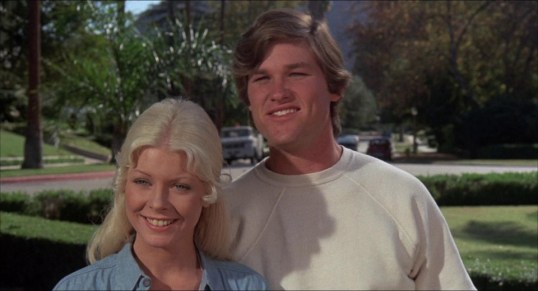
Charlie McCready (Bob Crane) just can’t understand what’s going on with his daughter, Wendy (Kathleen Cody). She’s smart, pretty, and has the potential for a great future ahead of her but all she wants to do is hang out with her friends on the beach. Eccentric Stanley Schlimmer (Bruno Kirby) drives everyone around in a souped-ambulance. Ed Begley, Jr. (who plays a character who doesn’t even get a name) joins in whenever the group sings a folk song. Wendy’s boyfriend, Bart (young and likable Kurt Russell), is a surfer and water skier. Charlie is truly convinced that this extremely clean-cut group of teenagers is going to lead his daughter astray. In fact, Wendy wants to marry Bart! Charlie attempts to hang out with Wendy, Bart, and his friends on the beach and he can’t keep up. He can’t water ski, he can’t play football, he can’t play volleyball. All he can do is scream in this weird high-pitched voice. The entire time is Bart is extremely nice to him and doesn’t even make fun of him for not being able to hit a volleyball over a net. I mean, even I can do that! But because Charlie’s not dealing well with becoming middle-aged, he decides that Bart is a threat.
(I’m going to assume that Charlie also teams up with a creepy friend and starts filming himself having threesomes with groupies, though we don’t actually see that happen in the film. The subtext is there, though!)
Charlie decides that he has to get Wendy away from this group and the best way to do that would be to trick her into thinking she’s received a scholarship to …. Yes, this is just that stupid …. a scholarship to a prestigious university. While Bart and his healthy, non-smoking, non-drinking friends are all going to City College and living at home with their parents, Wendy will be miles away at a college where she can do anything that she wants. Charlie thinks this is a great plan. One gets the feeling that Charlie, for all of his overprotectiveness, hasn’t read a newspaper in 20 years. Seriously, has he not been keeping up with what was happening on most college campuses in the late 60s and early 70s?
The main problem with this film is that Charlie is an incredible jerk. It’s one thing to be overprotective. Fathers are supposed to be overprotective of their daughters. It’s one thing to worry about his daughter not having a good deal of ambition. I can even understand him getting annoyed with Stanley because Stanley is kind of annoying. (Watching this film, it’s hard to believe that Bruno Kirby was just one year away from playing the young Clemenza in The Godfather, Part II.) But seriously, Charlie is freaking out over his daughter dating KURT RUSSELL! In this film, Kurt Russell plays a character who is always polite, mild-mannered, sensible, and remarkably understanding of Charlie’s attempts to keep him from marrying Wendy. There is one scene where Bart gets upset and he barely even raises his voice. He’s incredibly likeable and, for all of this film’s flaws, it’s still easy to see why Kurt Russell became a star.
Of course, what really makes this film a cringe-fest is that it stars Bob Crane as a family man with a secretly manipulative side and, the whole time I was watching, I kept having flashbacks to Greg Kinnear in Auto-Focus. Wendy, to make her dad really angry, gets engaged to an actual hippie named Klutch (Joby Baker) and there’s a scene in which Klutch and Charlie get into a fight in Klutch’s artist studio. Every time Klutch swung anything near Charlie’s head, I definitely cringed a bit. Red paints get spilled everywhere, though luckily it ends up on Klutch and not Charlie. Still, watching the film, I couldn’t help but think that there are worse things that could happen to someone than having their daughter marry Kurt Russell.
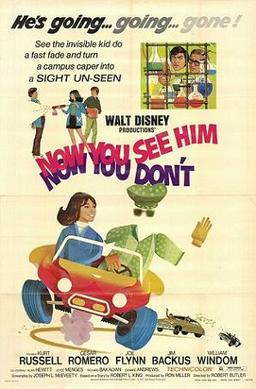
Dexter Riley (Kurt Russell) is back and just in time because Medfield College is on the verge of getting closed down again.
In The Computer Wore Tennis Shoes, buying a computer was supposed to be the solution to all of Medfield’s financial problems. I guess it didn’t work because Medfield is broke again and corrupt businessman A.J. Arnoe (Cesar Romero) is planning on canceling the school’s mortgage so that he can turn it into a casino.
There is some hope. Dexter has accidentally created an invisibility spray. Not only does it tun anything that it touches invisible but it also washes away with water so there’s no risk of disappearing forever. Dexter and his friend Schuyler (Michael McGreevey) know that they can win the science fair with their invention but the science fair doesn’t want to allow small schools like Medfield to compete unless they really have something big to offer. Dexter tells the Dean (Joe Flynn) that he has a sure winner but Dexter also refuses to reveal what it is because he doesn’t want word to leak before for the science fair. The Dean decides to raise the money to pay off the mortgage by becoming a golfer, as one does. Schulyer works as the Dean’s caddy while Dexter uses the invisibility spray to help the Dean cheat. That’s a good message for a young audience, Disney! But when Arno finds out about the spray, he wants to steal it so he can rob a bank.
This was even dumber than The Computer Wore Tennis Shoes but it was also hard to dislike it. The comedy was too gentle, Kurt Russell and the rest of the cast were too likable, and the special effects were too amusingly cheap in that retro Disney way for it to matter that the movie didn’t make any sense. When a bunch of college kids learn the secret of invisibility and use it to cheat at golf, you know you’re watching a Disney film.
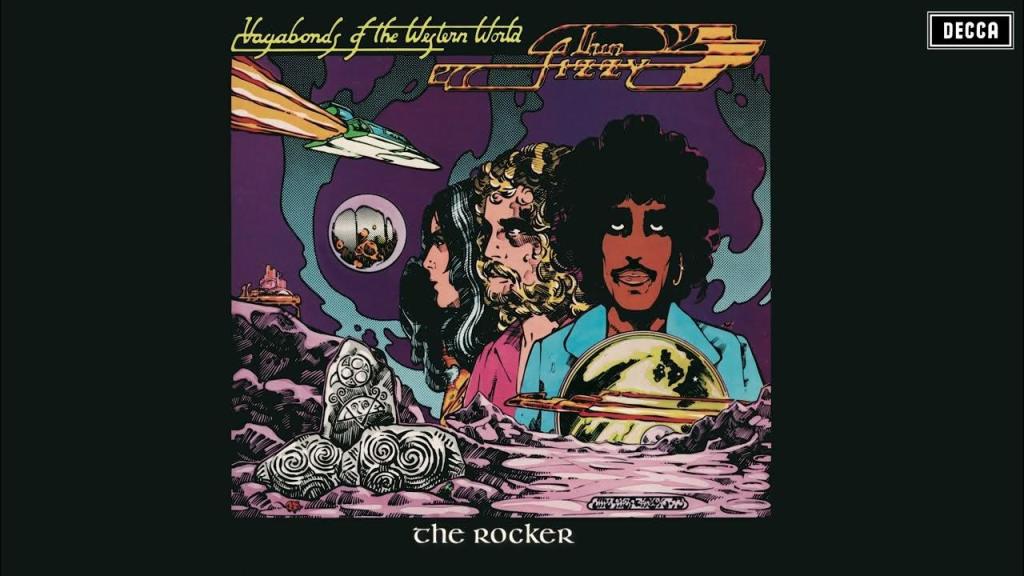
So, it looks like it’s St. Patrick’s Day here in Through the Shattered Lens. For my lone contribution to all things Irish I present “The Rocker” by Dublin, Ireland’s very own Thin Lizzy.
A song that was part of their 1973 album release Vagabonds of the Western World and it features the Dublin trio of Phil Lynott on bass guitar, Eric Bell on lead guitar and Brian Downey on drums. The song itself has the Thin Lizzy rock sound with Irish folk music influence.
I’ve chosen this song as my choice since it also qualifies as having one of the great rock guitar solos in history. Eric Bell’s guitar solo actually occurs throughout the length and breadth of the song. It’s sometimes hard to hear that there’s even a guitar solo but the whole song could be looked at as being a guitar solo from start to finish with Eric Bell being the lead and only guitar with Phil supporting on bass.
“The Rocker” by Thin Lizzy is not a song that many fans today would ever think is a major classic, but rock aficionados, especially of music of the late 60’s through the 70’s would not hesitate to have this song as one of the classics.
The Rocker
I am your main man if you’re looking for trouble I take no lip, no one’s tougher than me I’d kick your face, you’d soon be seeing double Hey, little girl, keep your hands off of me
I’m a rocker I’m a rocker I’m a roller too, baby I’m a rocker
Down at the juke joint, me and the boys are stompin’ Bippin’ and boppin’ and telling a dirty joke or two In walked this chick and I knew she was up to something And I kissed her right there, out of the blue
I said, “Hey baby, meet me, I’m a tough guy Got my cycle outside, you wanna try?” She just looked at me and rolled them big eyes “Said, I’d do anything for you, for you’re a rocker”
I’m a rocker I’m a roller too, honey I’m a rocker
I love to rock and roll I get my records at the Rock On stall Sweet rock and roll Teddy boy, he got them all
Rocker
I love to rock and roll I get my records at the Rock On stall Sweet rock and roll Teddy boy, he’s got them all
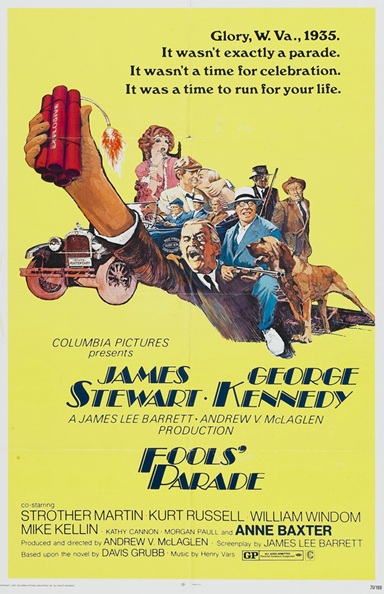
Three men are released from the West Virginia state penitentiary and given a train ticket out of town by the prison captain, Council (George Kennedy). The men are a bank robber named Lee Cottrill (Strother Martin), a young man named Johnny Jesus (a young Kurt Russell), and a courtly older man named Mattie Appleyard (James Stewart). Despite his polite tone of voice and his folksy manner, Appleyard is actually the most notorious of the three men being released. Convicted of murdering two men, Appleyard has spent the past 40 years in prison. Both Appleyard and Cottrill are looking to go straight. Every day of his sentence, Appleyard worked and earned money. Along with a glass eye, Appleyard leaves prison with a check for $25,000 dollars. Appleyard plans to cash the money at the bank and then open a store with Cottrill.
Unfortunately, Appleyard has been released at the height of the Great Depression. The streets are full men desperately looking for work. People will do anything to feed their families or to make a little extra money. Salesman Roy K. Sizemore (William Window) transports guns and dynamite. Willis Hubbard (Robert Donner) works as a conductor on the train. Aging prostitute Cleo (Ann Baxter) offers to sell the virginity of her adopted daughter, Chanty (Katherine Cannon). Junior Killfong (Morgan Paull) sings on the radio and occasionally takes on deadlier work with his friend, Steve Mystic (Mike Kellin). As for Captain Council, he’s decided that he’s going to make his money by ambushing the train carrying the three men that he has just released from prison. After killing the men, Council will cash Appleyard’s check himself.
Of course, it doesn’t quite work out as simply as Council was hoping. Willis Hubbard has a crisis of conscience and lets Appleyard, Cottrill, and Johnny know what Council is planning. The three men narrowly make their escape but Council frames Appleyard for a murder that he didn’t commit. Now wanted once again, the three men must not only get the money but also clear their names. It won’t be easy because, as Hubbard explains, they may be free from the penitentiary but now, they’re trapped in “the prison of 1935.”
Fools’ Parade really took me by surprise. I watched it because it featured two of my favorite actors, James Stewart and Kurt Russell. And both Stewart and Russell give very good performances in the film. Stewart was always at his best when he got a chance to hint at the melancholy behind his folksiness and the young Kurt Russell plays Johnny with a sincerity that makes you automatically root for him. For that matter, the normally sinister Strother Martin is very likable as Lee Cottrill, a bank robber who is still struggling with the idea of going straight. But, beyond the actors, Fools’ Parade is a genuinely sad portrait of desperate people trying to survive. At one point, Sizemore and Cottrill watch as their train passes a camp of people who have been displaced by the Great Depression and it’s even implied that the villainous Council has some regret over what he’s become. (There’s a small but poignant scene in which Council and Cleo acknowledge the passage of time and, for a minute, the viewer realizes these two people were, at one time, maybe as idealistic and optimistic as Johnny.) It’s a well-acted film, one in which moments of humor are mixed with moments of true sadness. I may have picked the film for Jimmy and Kurt but, in the end, the film’s story and performances drew me in. The 63 year-old Stewart proved that he could still give a memorable performance and the 20 year-old Kurt Russell proved that he was a future star in the making. If you haven’t seen it, this is definitely a film to check out.
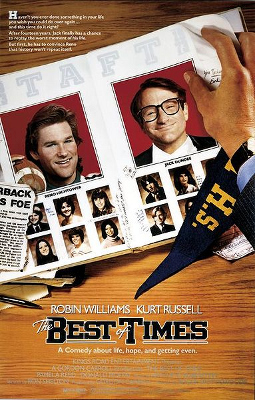 For years, banker Jack Dundee (Robin Williams) had been haunted by a pass that he dropped in high school. The pass was perfectly thrown by quarterback Reno Hightower (Kurt Russell) but Jack couldn’t bring it in and, as a result, Taft High lost to its rival, Bakersfield. Adding to Jack’s humiliation is that he now works for The Colonel (Donald Moffat), a confirmed Bakersfield fan who also happens to be Jack’s father-in-law. When Jack visits a “massage therapist” (Margaret Whitton) and tells her about his problems, she suggests that he needs to replay the game. Getting everyone interested in replaying the game is not easy. No one wants to be humiliated a second time and Reno, who now fixes vans for a living, fears the he’s lost his edge. Jack dresses up in the Bakersfield mascot’s uniform and vandalizes the town. Finally, everyone is ready for the game. Now, it’s a matter of town pride.

 Through the Shattered Lens