Late Night Retro Television Review: Highway to Heaven 3.14 “All That Glitters”


Welcome to Late Night Retro Television Reviews, a feature where we review some of our favorite and least favorite shows of the past!  On Thursdays, I will be reviewing Highway to Heaven, which aired on NBC from 1984 to 1989.  The entire show is currently streaming on Tubi and several other services!
This week, a conman seeks refuge in a church.

Episode 3.14 “All that Glitters”

(Dir by Michael Landon, originally aired on January 7th, 1987)

There’s a fire raging in the city and elderly homeowners are being forced to evacuate.  “Father” Jonathan and “Father” Mark open up an abandoned church so that the people have some place to stay while the fires are burning.  Good for them and also good for this show for finally acknowledging Catholicism.

Also hiding out in the church and disguised as a priest is Charley Trapola (John Pleshette), a con artist who, despite his criminal profession, actually has a good heart.  Charley has a briefcase with him, one that is full of money.  A group of criminals want the briefcase back but, at least initially, they know better than to try anything in the church.  Instead, they decide to wait for Charley to come out.  Inside the church, Charley gets to know Wanda (Didi Conn), a shy but kind-hearted woman who goes to Confession every day.

This episode was okay.  Usually, when Jonathan and Mark go undercover as clergyman, they’re portrayed as being wishy-washy Episcopalians or vaguely liberal Methodists so I was happy that they were Catholic for this episode.  John Pleshette and Didi Conn were both well-cast as this episode’s guest stars.  They eventually made for a very sweet and likable couple.  My main issue with this episode is that it tried to do a bit too much.  Not only did we have Charley being chased by the gangsters but we also had Wanda dealing with her shyness and Mark and Jonathan dealing with the people were seeking shelter and looking for their loved ones.  This episode — and not that weird marriage counseling episode — would have benefitted from an extra hour.  As it was, it just felt a bit overstuffed.  As well, this is another episode in which Jonathan reveals early on that he’s angel and, oddly enough, Charley has no hesitation about believing him.  I always prefer the episodes where Jonathan doesn’t reveal who he really is.  When Jonathan reveals that he’s an angel, it almost seems like cheating.  The show is always more effective when people decide to open up their hearts on their own as opposed to doing so because they feel they’ve been ordered to.

There’s an odd scene where the three thugs break into the church and pull a gun on Jonathan.  After Jonathan gives them fair warning about “the boss,” the main thug attempts to shoot Jonathan.  Needless to say, the bullets don’t have any effect on an angel.  However, a sudden blue lights fills the church and suddenly, the three men are apparently zapped out of existence.  Jonathan later jokes that he’s not sure where the three men are but that they probably aren’t happy.  So, did the three men go straight to Hell?  Are they dead?  I understand the logic behind the scene but it’s not really something you expect from a show where the main theme is usually that everyone has a chance for redemption.

Next week, Dick Van Dyke plays a homeless puppeteer …. uh oh.  This sounds like it could a little bit cringey …. well, we’ll see.


14 Days of Paranoia #6: The Player (dir by Robert Altman)


1992’s The Player tells the story of Griffin Mill (Tim Robbins).

It’s not easy being Griffin Mill.  From the outside, of course, it looks like he has the perfect life.  He’s a studio executive with a nice house in Hollywood.  He’s young.  He’s up-and-coming.  Some people, especially Griffin, suspect that he’ll be the president of the studio some day.  By day, he sits in his office and listens to pitches from respected screenwriters like Buck Henry.  (Henry has a great idea for The Graduate II!)  During the afternoon, he might attends dailies and watch endless takes of actors like Scott Glenn and Lily Tomlin arguing with each other.  Or he might go to lunch and take a minute to say hello to Burt Reynolds.  (“Asshole,” Burt says as Griffin walks away.)  At night, he might go to a nice party in a big mansion and mingle with actors who are both young and old.  He might even run into and share some sharp words with Malcolm McDowell.

But Griffin’s life isn’t as easy as it seems.  He’s constantly worried about his position in the studio, knowing that one box office failure could end his career.  He fears that a new executive named Larry Levy (Peter Gallagher) is after his job.  Two new screenwriters (Richard E. Grant and Dean Stockwell) keep bugging him to produce their downbeat, no-stars anti-capitol punishment film.  His girlfriend (Cynthia Stevenson) wants to make good movies that mean something.  Even worse, someone is sending Griffin threatening notes.

It doesn’t take long for Griffin to decide that the notes are coming from a screenwriter named Dave Kahane (Vincent D’Onofrio).  Griffin’s attempt to arrange a meeting with Dave at a bar so that Griffin can offer him a production deal instead leads to Griffin murdering Dave in a parking lot.  While the other writers in Hollywood mourn Dave’s death, Griffin starts a relationship with Dave’s artist girlfriend (Great Scacchi) and tried to hide his guilt from two investigating detectives (Whoopi Goldberg and Lyle Lovett).  Worst of all, the notes keep coming.  The writer, whomever they may be, is now not only threatening Griffin but also seems to know what Griffin did.

After spend more than a decade in the industry wilderness, Robert Altman made a critical and commercial comeback with The Player.  It’s a satire of Hollywood but it’s also a celebration of the film industry, featuring 60 celebrities cameoing as themselves.  Everyone, it seems, wanted to appear in a movie that portrayed studio execs as being sociopathic and screenwriters as being whiny and kind of annoying.  The Player both loves and ridicules Hollywood and the often anonymous men who run the industry.  Largely motivated by greed and self-preservation, Griffin may not love movies but he certainly loves controlling what the public sees.  In the end, only one character in The Player sticks to her values and her ideals and, by the end of the movie, she’s out of a job.  At the same time, Griffin has a social life that those in the audience can’t help but envy.  He can’t step out of his office without running into someone famous.

The Player is one Altman’s most entertaining films, with the camera continually tracking from one location to another and giving as a vision of Hollywood that feels very much alive.  Tim Robbins gives one of his best performances as Griffin Mill and Altman surrounds him with a great supporting cast.  I especially liked Fred Ward as the studio’s head of security.  With The Player, Altman mixes melodrama with a sharp and sometimes bizarre comedy, with dialogue so snappy that the film is as much a joy to listen to as to watch.  That said, the real attraction of the film is spotting all of the celebrity cameos.  (That and cheering when Bruce Willis saves Julia Roberts from certain death.)  Altman was a director who often used his films to explore eccentric communities.  With The Player, he opened up his own home.

Previous entries in 2025’s 14 Days Of Paranoia:

  1. The Fourth Wall (1969)
  2. Extreme Justice (1993)
  3. The Lincoln Conspiracy (1977)
  4. Conspiracy (2007)
  5. Bloodknot (1995)

Film Review: The Caine Mutiny Court-Martial (dir by Robert Altman)


In the 1980s, director Robert Altman found himself even more outside of the Hollywood system than usual.  A series of films that confused critics and repelled audiences had led to Altman becoming something of a pariah.  As no studio was willing to give Altman a chance to make the type of quirky feature films that he made his name with in the 70s, Altman instead directed a series of low-budget theatrical adaptations.  These films may not have gotten the attention of his earlier films but they allowed Altman to show off his talents, especially when it came to working with actors.

1988’s The Caine Mutiny Court-Martial was one of those films.  Made for television and based on the play by Herman Wouk, The Caine Mutiny Court-Martial was a courtroom drama that Altman brought to life with his usual flair.  Anyone who has read either the play or Herman Wouk’s original novel (or who has seen the 1953 film version, The Caine Mutiny) will know the story.  In the final days of World War II, Lt. Steven Maryk (Jeff Daniels) has been court-martialed for mutiny.  During a particularly violent storm, Maryk took command of the USS Caine away from Lt. Commander Queeg (Brad Davis).  Maryk and his fellow officers, including aspiring novelist Lt. Thomas Keefer (Kevin J. O’Connor), claim that, after several incidents that indicated he was mentally unstable, Queeg froze up on the bridge and had to be relieved of command.  Queeg claims that everything he did was to enforce discipline on the ship and that he never froze.  Prosecuting Maryk is Lt. Commander John Challee (Peter Gallagher).  Defending him is Lt. Barney Greenwald (Eric Bogosian), who is determined to win the case even though he doesn’t necessarily agree with Maryk’s actions.

The Caine Mutiny Court-Martial is very much a filmed play.  Almost all of the action takes place in one location, a gymnasium that has been converted into a court of military law.  We don’t actually see what happened on the Caine when Maryk took control.  Instead, we just hear the testimony of those involved.  Queeg defends himself, ably at first but soon he starts to show signs of the pressure of being in command.  Maryk explains his actions and we want to believe him because he’s played by fresh-faced Jeff Daniels but, at the same time, there’s something a little bit too smug about his declaration that Queeg was not fit for command.  The other officers on the Caine testify.  Under Greenwald’s skillful cross-examination, Queeg is continually portrayed as being a flawed officer.  But only Greenwald understand that Queeg was isolated not only by the loneliness of being in charge but also by members so his own crew, like Keefer, who hated the Navy and didn’t want to take their part in the war effort seriously.  As a Jew who is very much aware of what’s at stake in the war, Greenwald has mixed feelings about the way that Queeg was treated.  It ends with a party, where a drunk Greenwald calls out the true architect of The Caine Mutiny.  As opposed to the way the scene was portrayed in the 1953 film or in Willam Friedkin’s recent adaptation), Altman focuses not so much on Greenwald but on the party occurring around him.  If the other versions of this story ended on a note of triumph for Greenwald, this one ends on a note of sadness with Greenwald’s words being almost unheard by the officers of the Caine.

Altman gets excellent performances from the entire cast and, even more importantly, he avoids the downfall of so many other theatrical adaptations.  The Caine Mutiny Court-Martial may be a talky film and it may largely take place in only one location but it’s never boring.  Altman’s camera is continually prowling around the makeshift courtroom, reflecting the tension of the case in every movement.  The end result is one of Altman’s best theatrical adaptations.

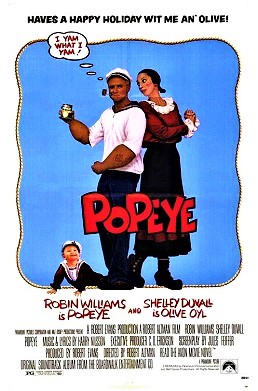
Popeye (1980, directed by Robert Altman)


I like Popeye.

Sometimes, I feel like I’m the only one.  Popeye got such bad reviews and was considered to be such a box office disappointment that director Robert Altman didn’t make another major film for a decade.  Producer Robert Evans, who was inspired to make Popeye after he lost a bidding war for the film rights to Annie, lost his once-sterling reputation for being able to find hits.  This was Robin Williams’s first starring role in a big screen production and his career didn’t really recover until he did Good Morning Vietnam seven years later.  Never again would anyone attempt to build a film around songs written by Harry Nilsson.  Screenwriter Jules Fieffer distanced himself from the film, saying that his original script had been ruined by both Robert Evans and Robert Altman.  Along with Spielberg’s 1941 and Michael Cimino’s Heaven’s Gate, Popeye was one of the box office failures that signaled the end of the era in which directors were given a ton of money and allowed to do whatever they wanted to with it.

I don’t care.  I like Popeye.  I agree with the critics about Nilsson’s score but otherwise, I think the film does a great job of capturing the feeling of a comic strip come to life.  Altman was criticized for spending a lot of money to construct, from scratch, the seaside village that Popeye, Olive Oyl (Shelley Duvall), Bluto (Paul L. Smith), Wimpy (Paul Dooley), and everyone else called home but it does pay off in the movie.  Watching Popeye, you really are transported to the world that these eccentric characters inhabit.  If the film were made today, the majority of it would be CGI and it wouldn’t be anywhere near as interesting.  Featuring one of Altman’s trademark ensemble casts, Popeye create a world that feels real and lived in.

Mumbling the majority of his lines and keeping one eye closed, Robin Williams is a surprisingly believable Popeye, even before he’s force fed spinach at the end of the movie.  Paul L. Smith was an actor who was born to play the bullying Bluto and there’s something very satisfying about seeing him (literally) turn yellow.  As for Shelley Duvall, she is the perfect Olive Oyl.  Not only does she have the right look for Olive Oyl but she’s so energetic and charmingly eccentric in the role that it is easy to see what both Popeye and Bluto would fall in love with her.  Though the humor is broad, both Williams and Duvall bring a lot of heart to their roles, especially in the scenes where they take care of their adopted infant, Swee’Pea.  Popeye may be a sailor but he’s a father first.

Popeye deserves a better reputation than it has.  It may not have been appreciated when it was originally released but Popeye has a robust spirit that continues to distinguish it from the soulless comic book and cartoon adaptations of today.

Retro Television Review: Malibu CA 2.3 “Aloha”


Welcome to Retro Television Reviews, a feature where we review some of our favorite and least favorite shows of the past!  On Thursdays, I will be reviewing Malibu CA, which aired in Syndication in 1998 and 1999.  The entire show is currently streaming on YouTube!

Yes, this is from the first season. I don’t care. I refuse to waste my time looking for a second season advertisement.

Even by Malibu CA standards, this week’s episode is incredibly stupid.

Episode 2.3 “Aloha”

(Dir by Gary Shimokawa, originally aired on October 23rd, 1999)

Peter can’t figure out why no one is coming to his restaurant.

Gee, Peter, maybe it’s because your idiot sons work there and are constantly screwing everything up.  Maybe it’s because your only waitress is constantly complaining about everything in the most overdramatic way possible.  (Seriously, after only three episodes, Lisa — the Malibu CA character, not me! — is perhaps the most annoying human being ever.)  Maybe that all has something to do with it….

No, actually, it’s because there’s a new restaurant called Aloha, which features the Cocoanuts, a group of girls who wear bikinis and dance while the patrons are eating.  I can’t imagine anyone going to this restaurant on a date but apparently, all of the single men on the beach love it.  Murray has eaten at the restaurant 21 times in a row!  Jason and Scott go down to Aloha with their father and Jason immediately starts dancing with the girls.  Peter accuses both Jason and Murray of betraying him.

It’s easy to laugh at Peter’s misfortune, especially since it’s his own damn fault for being a terrible business owner.  But when he announces that he might lose the restaurant because he stupidly took out a loan, Jason and Scott bully Murray into using his trust fund to invest in The Lighthouse.  Co-owner Murray wants to have a pirate night.  “Arggh!” Peter says.

Anyway, Jason and Scott eventually bully Murray into applying to be one of the Cocoanuts and after Murray is hired, everyone stops going to Aloha and they return to the Lighthouse because there are only two restaurants in Malibu.  Myself, I’m wondering how exactly Murray got hired.  On the show, it’s suggested that Murray was hired because, otherwise, he would have sued the owner of Aloha for sex discrimination.  That’s not exactly how that law works, though.  Even if the owner did hire Murray to work at Aloha, he wouldn’t be required to make Murray one of the dancers.  He could have just used Murray as a waiter or dishwasher or …. WAIT ON MINUTE!  Murray already has a job!  Just two episodes ago, he was working at The Lighthouse!  What the Hell!?

There’s an equally stupid B-plot.  Traycee wants to date the guy who changes out the coke machine on the beach.  He’s not into flashy celebrities who Traycee works a dark wig and glasses and pretends to be a librarian.  It all seems to be working until he sees Traycee in a bikini and realizes that she’s not actually a librarian …. WHAT!?  Why would Traycee, whose entire life is about being famous, like this guy in the first place?  And why are Lisa (the character, not me!) and Stads still on the show when its obvious that the show really doesn’t have anything for either of them to do?  It would perhaps help if Lisa and Stads didn’t both have exactly the same killjoy personality.  Anyway, Traycee ends up single again but she lands on the cover of Soap Opera Digest.

God, this show was stupid.

Film Review: Buffalo Bill and the Indians, or Sitting Bull’s History Lesson (dir by Robert Altman)


1976’s Buffalo Bill and the Indians, or Sitting Bull’s History Lesson takes place in the waning years of the Old West.  Civilization is coming to America and the “wild” west’s days are numbered.  And yet, even as the days of outlaws and gunslingers come to an end, America is already in the process of building up its own mythology.

Buffalo Bill (Paul Newman) owns a popular wild west show, one where his stars put on a show that claims to recreate the great moments of western history.  The show is made up of a motely collection of performers, some of whom are more talented than others.  This is a Robert Altman film and, as usual, the emphasis is more on watching how his large ensemble of actors interact as opposed to highlighting any one actor.  Indeed, it can be hard to keep everyone in the film straight and one gets the feeling that this was intentional on Altman’s part.  Buffalo Bill and the Indians may be a revisionist western and a satire of American history but it’s also a showbiz film.  The emphasis is on people continually coming and going, sticking around long enough to either prove their worth as a performer or moving on to a hopefully more receptive audience.

Geraldine Chaplin plays Annie Oakley, the sharp shooter who takes joy in firing her gun and who barely seems to notice that her husband (John Considine) is terrified of getting shot.  Joel Grey serves as the unflappable manager of the show while Harvey Keitel is miscast as Buffalo Bill’s somewhat nerdy assistant.  (Keitel, with his natural intensity, seems like he’s desperately waiting for a chance to explode, a chance that never really comes.)  Burt Lancaster plays Ned Buntline, the writer who made Buffalo Bill into a celebrity and who provides a somewhat sardonic commentary as Bill’s current activities.  Shelley Duvall shows up as the wife of President Grover Cleveland (played by Pat McCormick), who comes to the show and is amused until an Indian points a gun towards the president.

Throughout it all, Buffalo Bill enjoys his fame and pushes his vision of the Old West on those who come to see his show.  Newman plays Bill as being a blowhard, an eccentric who is obsessed with opera and whose entire persona is a fake.  He can’t shoot straight.  He can barely ride a horse.  His trademark long hair is actually a wig.  The only people who take Bill seriously as those who come to see his show.  Those who know him view him as being a buffoon but they also understand that he’s a very successful and very famous buffoon and that ultimately matters more than any sort of historical truth.

What conflict there is in the film occurs when Sitting Bull (Frank Kaquitts) and his translator (Will Sampson) arrive on the scene.  Sitting Bull has agreed to appear in the show but only under his own terms.  Buffalo Bill grows frustrated with Sitting Bull and his refusal to pretend to be a savage but he also knows that this audience wants to see the last remaining great Indian chief.

It’s a big and sprawling film and it’s really not entirely successful.  Altman was an intelligent director who was willing to take risks and no one deserves more credit for popularizing the idea of the ensemble film.  That said, he could also be a bit heavy-handed and that’s certainly the case here.  It takes a certain amount of courage to cast a star like Paul Newman as a thoroughly unlikable character and it also took a bit of courage on Newman’s part to give the performance that he did.  At the same time, neither the shallow Buffalo Bill nor the dignified Sitting Bull are really compelling enough characters to carry a film that runs for more than two hours.  The film’s message is an obvious one and it’s also one that Altman handled in a much more memorable way with Nashville.

That said, the film is a memorable misfire.  It’s at its best when it abandons the politics and just concentrates on the community of performers that popular Buffalo Bill’s show.  The film’s best moments are not the ones with Paul Newman growling but instead the ones with John Considine hoping that Geraldine Chaplin won’t accidentally shoot him.  As with many of Altman’s film, Buffalo Bill and the Indians works best when it focuses on the misfit community at the center of its story.


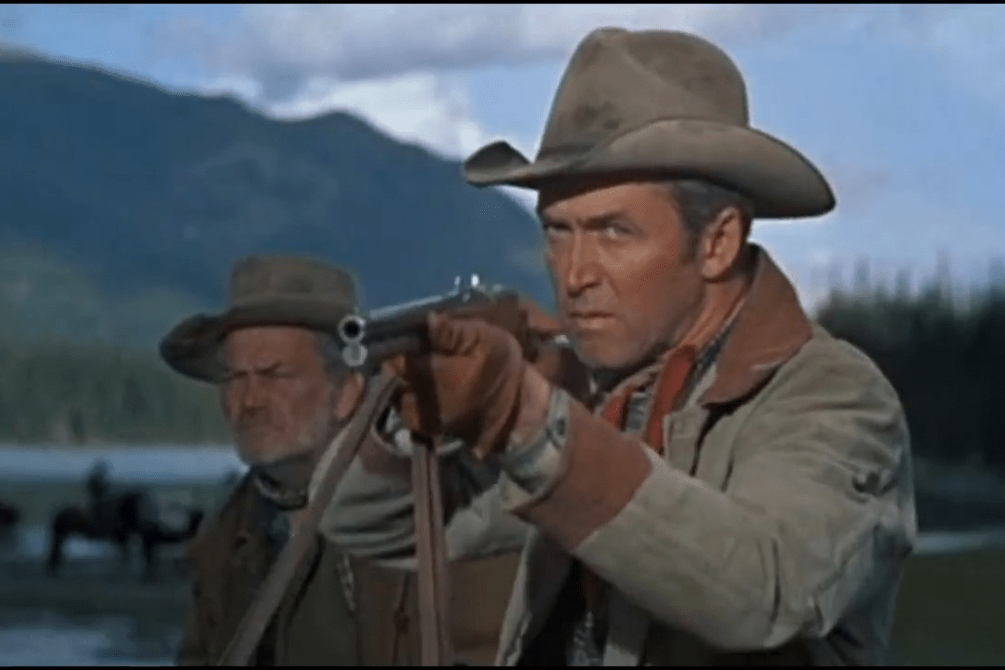
THE FAR COUNTRY (1954) – James Stewart and Walter Brennan head North to make their fortune!


James Stewart is one of the great movie stars of all-time. His work with Frank Capra (MR. SMITH GOES TO WASHINGTON, IT’S A WONDERFUL LIFE) and Alfred Hitchcock (REAR WINDOW, VERTIGO) is legendary. In my household, Stewart’s work with director Anthony Mann is celebrated just as much as those other classics. Mann and Stewart made five classic westerns, beginning with WINCHESTER ‘73 in 1950 and ending in 1955 with THE MAN FROM LARAMIE. I own them all on DVD and watch them quite often. It’s very cold in Arkansas today, so I decided to write about the Yukon-set THE FAR COUNTRY, from 1954. 

Jeff Webster (James Stewart) and his crusty ol’ coot of a partner Ben Tatem (Walter Brennan) head North towards Dawson City, in the Yukon Territory, with a herd of cattle. The two men encounter a variety of problems along the way, with the biggest being the corrupt Judge Gannon (John McIntire) of Skagway, Alaska. When Jeff finds himself in front of the judge for killing two cowhands who tried to steal his herd, Gannon acquits him on the charges but decides to keep his herd as payment for the court fees. With their cattle taken away from them, Jeff and Ben sign up to help business lady Ronda Castle (Ruth Roman) take supplies to Dawson City, where she plans to set up shop. After their first day on the trip, Jeff and Ben double back to Skagway and re-take their herd and take off towards Dawson as fast as they can go, with Gannon and his men in hot pursuit. They’re able to make it into Canada, so Gannon and his goons turn back, determined to hang the men if they ever come back through Skagway.

So Jeff and Ben make it to Dawson City with their cattle where they sell them off for $2 per pound to Ronda. Suddenly flush with cash, the two partners buy a gold claim and proceed to find some nice golden nuggets! When they head back into town, they find that Judge Gannon has now come to Dawson City and is in partnership with Ronda. Of course, that bastard immediately starts cheating the miners out of their claims, this time with gunman Madden (Robert J. Wilke) by his side, enforcing his corrupt actions with lead. Jeff and Ben decide they’re going to sneak out of town with their loot, but Gannon finds out about it and sends his men to stop them. Ben is killed in the process and Jeff is seriously injured. Jeff has tried his best up to this point to not get involved with the mess in Dawson City, but with his best friend now dead, he decides it’s time for Judge Gannon and his thugs to be stopped. 

James Stewart is just so good as Jeff Webster. The best thing about his work with Mann is how each of the movies would give him a meaty role that capitalized on his basic decency, while simultaneously making him a more complex, layered man, miles away from the likes of Mr. Smith or George Bailey. In THE FAR COUNTRY, he’s as tough as nails, but he really doesn’t want to get involved with the people around him. It takes the death of his best friend for him to finally commit to helping them stand up against the bad guys. Stewart’s work here, and in the other Mann westerns, ranks with his very best. 

The remainder of the cast is uniformly excellent. Three time Oscar winner Walter Brennan is always a welcome presence in a movie I’m watching. While he’d pretty much settled into the “old coot” role that would come to personify the later part of his career, his character is a valuable conscience for Stewart a couple of times in the story. I thought that John McIntire and Ruth Roman really stood out in their respective roles as the corrupt Judge Gannon and the stubbornly, independent businesswoman Ronda Castle. Both give excellent performances. The cast is rounded out with a who’s who of character actors like Jay C. Flippen, Harry Morgan, Robert J. Wilke, Royal Dano, and Jack Elam. It’s always nice seeing these familiar faces pop up in these old westerns.

I love it when movies are filmed on location in beautiful places. THE FAR COUNTRY was filmed at the Jasper National Park in Alberta, Canada, which added another interesting element to the film. The final thing I want to say about the film is that the screenplay for THE FAR COUNTRY was written by Borden Chase, who had penned RED RIVER a few years earlier. Not only would Chase write this movie, he would also write the screenplays for WINCHESTER ‘73 and BEND OF THE RIVER, both westerns that paired Anthony Mann and Jimmy Stewart. Chase was an excellent writer of western material, and his strong work in this group of films is crucial to their enduring success. 

Overall, I confidently recommend THE FAR COUNTRY to any person who enjoys westerns or Jimmy Stewart. I might rank THE NAKED SPUR and THE MAN FROM LARAMIE slightly above this one in the Mann / Stewart westerns, but the truth is that you can’t go wrong with any of them. 

I’m sharing the trailer for THE FAR COUNTRY below:

The Unnominated #10: The Long Goodbye (dir by Robert Altman)


Though the Academy of Motion Picture Arts and Sciences claim that the Oscars honor the best of the year, we all know that there are always worthy films and performances that end up getting overlooked.  Sometimes, it’s because the competition too fierce.  Sometimes, it’s because the film itself was too controversial.  Often, it’s just a case of a film’s quality not being fully recognized until years after its initial released.  This series of reviews takes a look at the films and performances that should have been nominated but were, for whatever reason, overlooked.  These are the Unnominated.

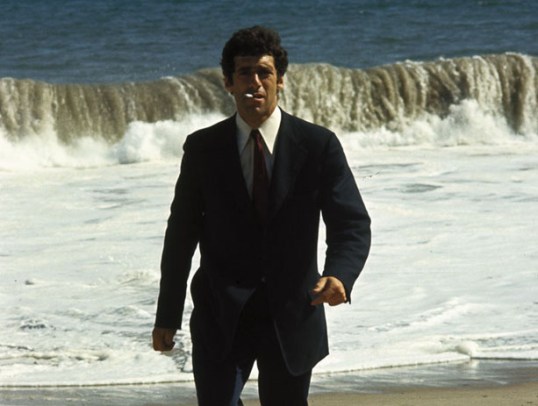
Elliott Gould is Phillip Marlowe!

If I had to pick one sentence to describe the plot of 1973’s The Long Goodbye, that would be it.  Robert Altman’s adaptation of the Raymond Chandler detective novel loosely follows Chandler’s original plot, though Altman did definitely make a few important changes.  Altman moved the story from the 50s to the then-modern 70s, replacing Chandler’s hard-boiled Los Angeles with a satirical portrait of a self-obsessed California, populated by gurus and hippies.  And Altman did change the ending of the book, taking what one could argue is a firmer stand than Chandler did in the novel.  In the end, though, the film really is about the idea of Chandler’s tough detective being reimagined as Elliott Gould.

Rumpled, mumbling, and with a permanent five o’clock shadow, Gould plays Marlowe as being an outsider.  He lives in a shabby apartment.  His only companion is a cat who randomly abandons him (as cats tend to do).  With his wardrobe that seems to consist of only one dark suit, Marlowe seems out-of-place in the California of the 70s.  When Marlowe’s friend, Terry Lennox (Jim Bouton), asks Marlowe to drive him to Mexico, one gets the feeling that Lennox isn’t just asking because Marlowe’s a friend.  He’s asking because he suspects Marlowe would never be a good enough detective to figure out what he’s actually doing.

After Terry’s wife is murdered, Marlowe is informed that 1) Terry has committed suicide and 2) Marlowe is now a suspect.  Convinced that Terry would have never killed himself, Marlowe investigates on his own.  He meets Marty Augustine (Mark Rydell), a gangster who demands that Marlowe recover some money that he claims Terry stole.  Marty seems like an almost reasonable criminal until he smashes a coke bottle across his girlfriend’s face.  (One of Marty’s bodyguards is played by a silent Arnold Schwarzenegger.)  Meanwhile, Terry’s neighbors include an alcoholic writer named Roger Wade (Sterling Hayden) and his wife, Eileen (Nina van Pallandt).  Like Marlowe, Roger is a man out-of-time, a Hemingwayesque writer who has found himself in a world that he is not capable of understanding.  Henry Gibson, who would later memorably play Haven Hamilton in Altman’s Nashville, appears as Wade’s “doctor.”

Marlowe, with his shabby suits and a cigarette perpetually dangling from his mouth, gets next to no respect throughout the film.  No one takes him seriously but Marlowe proves himself to be far more clever than anyone realizes.  Elliott Gould gives one of his best performances as Marlowe, playing him as a man whose befuddled exterior hides a clear sense of right and wrong.  Gould convinces us that Marlowe is a man who can solve the most complex of mysteries, even if he can’t figure out where his cat goes to in the middle of the night.  His code makes him a hero but it also makes him an outsider in what was then the modern world.  The film asks if there’s still a place for a man like Phillip Marlowe in a changing world and it leaves it to us to determine the answer.

Frequently funny but ultimately very serious, The Long Goodbye is one of the best detective films ever made.  Just as Altman did with McCabe & Mrs. Miller, he uses the past to comment on what was then the present.  And, just as with McCabe & Mrs. Miller, The Long Goodbye is a film that was initially released to mixed reviews, though it would later be acclaimed by future viewers and critics.  Whereas McCabe & Mrs. Miller received an Oscar nomination for Julie Christie’s performance as Mrs. Miller, The Long Goodbye was thoroughly snubbed by the Academy.  Altman, Gould, Hayden, and the film itself were all worthy of consideration but none received a nomination.  Instead, that year, the Oscar for Best Picture went to The Sting, a far less cynical homage to the crime films of the past.

The Long Goodbye (1973, directed by Robert Altman)

Previous entries in The Unnominated:

  1. Auto Focus 
  2. Star 80
  3. Monty Python and The Holy Grail
  4. Johnny Got His Gun
  5. Saint Jack
  6. Office Space
  7. Play Misty For Me
  8. The Long Riders
  9. Mean Streets

Film Review: McCabe & Mrs. Miller (dir by Robert Altman)


First released in 1971, McCabe & Mrs. Miller takes place in the town of Presbyterian Church at the turn of the 19th Century.

Presbyterian Church is a mining town in Washington State.  When we first see the town, there’s not much to it.  The town is actually named after its only substantial building and the residents refer to the various parts of the town as either being on the right side or the left side of the church.  The rest of the town is half-constructed and appears to be covered in a permanent layer of grime.  This is perhaps the least romantic town to ever appear in a western and it is populated largely by lazy and bored men who pass the time gambling and waiting for something better to come along.

When a gambler who says that he is named McCabe (Warren Beatty) rides into town, it causes a flurry of excitement.  The man is well-dressed and well-spoken and it’s assumed that he must be someone important.  Soon a rumor spreads that McCabe is an infamous gunfighter named Pudgy McCabe.  Pudgy McCabe is famous for having used a derringer to shoot a man named Atwater.  No one is really sure who Atwater was or why he was shot but everyone agrees that it was impressive.

McCabe proves himself to be an entrepreneur.  He settles down in Presbyterian Church and establishes himself as the town’s pimp.  Soon, he is joined by a cockney madam names Mrs. Miller (Julie Christie).  The two of them go into business together and soon, Presbyterian Church has its own very popular bordello.  Sex sells and Presbyterian Church becomes a boomtown.  It attracts enough attention that two agents of a robber baron approach McCabe and offer to buy him out.  McCabe refuses, thinking that he’ll get more money if he holds out.  Mrs. Miller informs him that the men that he’s dealing with don’t offer to pay more money.  Instead, they just kill anyone who refuses their initial offer.

Three gunmen do eventually show up at Presbyterian Church and we do eventually get an answer to the question of whether or not McCabe killed Atwater or if he’s just someone who has borrowed someone else’s legend.  The final gunfight occurs as snow falls on the town and the townspeople desperately try to put out a fire at the church.  No one really notices the fact that McCabe is fighting for his life at the time and, as befits a revisionist western, there’s nothing romantic or dignified about the film’s violence.  McCabe is not above shooting a man in the back.  The killers are not above tricking an innocent cowboy (poor Keith Carradine) into reaching for his gun so that they’ll have an excuse so gun him down.  McCabe may be responsible for making Presbyterian Church into a boomtown but no one is willing to come to his aid.  The lawyer (William Devane) that McCabe approaches is more interested in promoting his political career than actually getting personally involved in the situation.  Mrs. Miller, a businesswoman first, smokes in an opium den with an air of detachment while the snow falls outside.

It’s a dark story with moments of sardonic humor.  It’s also one of director Robert Altman’s best.  The story of McCabe and Mrs. Miller and the three gunmen is far less important than the film’s portrayal of community growing and changing.  Featuring an ensemble cast and Altman’s trademark overlapping dialogue, McCabe & Mrs. Miller puts the viewer right in the heart of Presbyterian Church.  There are usually several stories playing out at once and it’s often up to the viewer to decide which one that they want to follow.  Yes, the film is about Warren Beatty’s slick but somewhat befuddled McCabe and Julie Christie’s cynical Mrs. Miller.  But it’s just as much about Keith Carradine’s Cowboy and Rene Auberjonois’s innkeeper.  Corey Fischer, Michael Murphy, John Schuck, Shelley Duvall, Bert Remsen, and a host of other Altman mainstays all have roles as the people who briefly come into the orbit of either McCabe or Mrs. Miller.  Every character has a life and a story of their own.  McCabe & Mrs. Miller is a film that feels as if it is truly alive.

As with many of Altman’s films, McCabe & Mrs. Miller was not fully appreciated when initially released.  The intentionally muddy look and the overlapping dialogue left some critics confused and the film’s status as a western that refused to play by the rules of the genre presented a challenge to audience members who may have just wanted to see Warren Beatty fall in love with Julie Christie and save the town.  But the film has endured and is now recognized as one of the best of the 70s.

Icarus File No. 18: Brewster McCloud (dir by Robert Altman)


First released in 1970, Brewster McCloud takes place in Houston.

A series of murders have occurred in the city.  The victims have all been older authority figures, like decrepit landlord Abraham Wright (Stacy Keach, under a ton of old age makeup) or demanding society matron Daphne Heap (Margaret Hamilton, who decades earlier had played The Wicked Witch in The Wizard Of Oz).  The victims all appear to have been killed by strangulation and all of them are covered in bird droppings.  Perplexed, the Houston authorities call in Detective Frank Shaft (Michael Murphy) from San Francisco.  Shaft only wears turtlenecks and he has piercing blue eyes.  He looks like the type of guy you would call to solve a mystery like this one.  It’s only later in the film that we discover his blue eyes are due to the contact lenses that he’s wearing.  Frank Shaft is someone who very much understands the importance of appearance.  As one detective puts it, when it comes to Shaft’s reputation, “The Santa Barbara Strangler turned himself in to him.  He must have really trusted him.”

Perhaps the murders are connected to Brewster McCloud (Bud Cort), who lives in a bunker underneath the Astrodome and who seems to be fascinated with birds.  Brewster dreams of being able to fly just like a bird and he’s spent quite some time building himself a set of artificial wings.  A mysterious woman (Sally Kellerman) who wears only a trenchcoat and who has scars on her shoulder blades that would seem to indicate that she once had wings continually visits Brewster and encourages him to pursue his dream.  However, she warns him that he will only be able to fly as long as he remains a virgin.  If he ever has sex, he will crash to the ground.

Brewster thinks that he can handle that.  Then he meets a tour guide named Suzanne Davis (Shelley Duvall, in her film debut) and things start to change….

Brewster McCloud is a curious film.  The story is regularly interrupted by a disheveled lecturer (Rene Auberjonois) who is very much into birds and who, over the course of the film, starts to more and more resemble a bird himself.  The film is full of bird-related puns and there are moments when the characters seem to understand that they’re in a movie.  Frank Shaft dresses like Steve McQueen in Bullitt and his blue contact lenses feel like his attempt to conform to the typical image of a movie hero.  (A lengthy car chase also feels like a parody of Bullitt’s famous chase scene.)  When the old woman played by Margaret Hamilton dies, the camera reveals that she’s wearing ruby slippers and a snippet of Somewhere Over The Rainbow is heard.  As played by Bud Cort, Brewster is the perfect stand-in for the lost youth of middle class America.  He knows that he’s rebelling against something but he doesn’t seem to be quite sure what.  Brewster, like many idealists, is eventually distracted by his own desires and his once earnest plans come cashing down.  Brewster becomes an Icarus figure in perhaps the most literal way possible, even if he doesn’t come anywhere close to reaching the sun.  As with many of Altman’s films, Brewster McCloud is occasionally a bit too esoteric for its own good but it’s always watchable and it always engages with the mind of the viewer.  One gets the feeling that many of the film’s mysteries are not necessarily meant to be solved.  (Altman often said his best films were based on dreams and, as such, used dream logic.)  With its mix of plain-spoken establishmentarians and quirky misfits, Brewster McCloud is not only a classic counterculture film but it’s also a portrait of Texas on the crossroads between the cultures of the past and the future.

Though it baffled critics when it was released, Brewster McCloud has gone on to become a cult film.  It’s a bit of a like-it-or-hate-it type of film.  I like it, even if I find it to be a bit too self-indulgent to truly love.  Quentin Tarantino, for his part, hates it.  Brewster McCloud was released in 1970, the same year as Altman’s Oscar-nominated M*A*S*H.  (Both films have quite a few cast members in common.)  Needless to say, the cheerfully and almost defiantly odd Brewster McCloud was pretty much ignored by the Academy.

Previous Icarus Files:

  1. Cloud Atlas
  2. Maximum Overdrive
  3. Glass
  4. Captive State
  5. Mother!
  6. The Man Who Killed Don Quixote
  7. Last Days
  8. Plan 9 From Outer Space
  9. The Last Movie
  10. 88
  11. The Bonfire of the Vanities
  12. Birdemic
  13. Birdemic 2: The Resurrection 
  14. Last Exit To Brooklyn
  15. Glen or Glenda
  16. The Assassination of Trotsky
  17. Che!