October True Crime: Summer of Sam (dir by Spike Lee)


First released in 1999, Summer of Sam is Spike Lee’s sprawling, frustrating, flawed, occasionally compelling, and ultimately rather intriguing film about the summer of 1977 in New York City.

As one can guess from the title, it was a summer that was dominated by the reign of terror of the serial killer known as the Son of Sam.  While New York suffered one of the hottest summers on record, the Son of Sam shot couples while they sat in their cars.  Because all of his victims had been women with long, dark hair, women across the city wore blonde wigs.  While the police searched for the killer, the city was also caught up in the World Series.  Club 57 was the hottest club in New York but a growing number of rebels, inspired by the news that was coming out of the UK, eschewed the glitz of disco for the gritty and deliberately ugly aesthetic of punk and the Mud Club.

Though the film is centered around the murders of the Son of Sam, he remains a largely shadowy figure in the film.  Played by Michael Badalucco, David Berkowitz spends most of his time in his filthy home, yelling at the dog across the street and writing cryptic messages on the walls.  He only gets a few minutes of screen time because the film is ultimately less about the Son of Sam’s crimes and more about how one Italian-American neighborhood in New York deals with the atmosphere of fear and paranoia created by those crimes.  It’s a neighborhood that’s ruled over by the ruthless but benevolent Luigi (Ben Gazzara).  When the two detectives (Anthony LaPaglia and Roger Guevener Smith) come to the neighborhood in search of information, they know that Luigi is the man to see.

Vinny (John Leguizamo) is one of the neighborhood’s citizens, a hairdresser who hasn’t let his marriage to Dionna (Mira Sorvino) stand in the way of his compulsive womanizing.  Vinny is the type who cheats on his wife and then goes to Confession to get forgiveness.  He’s the type who gets angry whenever Dionna wants to have sex with the lights on or do anything other than a quick three minutes in the missionary position.  When he realizes that the Son of Sam was watching him while he was having sex in a car with Dionna’s cousin and that he could have been one of his victims, Vinny starts to spin out of control.  Vinny’s childhood friend is Ritchie (Adrien Brody), who shocks everyone when he spikes his hair, puts on a Union Jack t-shirt, and starts speaking with a fake British accent.  Ritchie and his girlfriend, Ruby (Jennifer Esposito), embrace the punk lifestyle and even put one the Son of Sam’s letters to music when they perform at the Mud Club.

It’s an ambitious film but it’s also an overlong film, one where the slow spots can truly test the viewer’s patience.  With a 142-minute running time, Summer of Sam finds the time to touch on almost every trope of the late 70s.  Vinny and Dionna hit the clubs, where the usually quiet Dionna truly comes to life as she dances.  (Vinny’s moves are far less impressive.  Tony Manero would have laughed at him.)  Ritchie not only embraces punk rock but he also makes his money by performing in live sex shows.  When a mysterious man offers to give Vinny and Dionna a ride in his limo, it’s hard not to smile when it’s revealed that he’s taking them to the infamous sex club, Plato’s Retreat.  One can respect Lee’s ambition while still finding the film itself to be a bit too self-indulgent for it’s own good.

Spike Lee, for all of his other talents, has never been a particularly subtle director.  Vinny and his friends spend a lot of time hanging out at the end of street, strategically placed in front of a sign that loudly proclaims, “DEAD END.”  At one point, Vinny is inspired to run to his window and start screaming insults at the Son of Sam and Leguizamo’s histrionic delivery of the lines make it impossible to take his anguish seriously.  At the same time, there are moments that work brilliantly.  I particularly liked the scenes that took place during the blackout of 1977.  Luigi automatically knows how to keep control in his neighborhood and he sends his men out with baseball bats, channeling their aggression into a search for the phantom serial killer.  For every scene that doesn’t work, there’s a scene like the Baba O’Riley montage or Vinny, Dionna, Ritchie, and Ruby having a candlelit dinner.

“We really dig your vibe.”

John Leguizamo is shrill and miscast as Vinny, though I’m not sure if anyone could have made much of such a one-dimensional characters.  I preferred the performances of Mira Sorvino, Adrien Brody, and Jennifer Esposito, who all brought their characters to authentic life.  (I especially liked how Brody switched from being tough to being a wounded child at the drop of a hat.)  As is so often the case with Lee’s films, it’s the supporting actors who make the strongest impression.  I loved Mike Starr’s earthy performance as Ritchie’s father and Ben Gazzara’s sly turn as the neighborhood mobster.  Bebe Neuwirth is underused but memorable as Vinny’s boss.

The film is overstuffed and overlong but it effectively portrays a community in the grips of paranoia and anger.  In the end, the film is epitomized by a scene in which the neighbor’s dog enter David Berkowtiz’s living room and starts yelling at him in the voice of John Turturro.  It’s a scene that’s so ludicrous that it somehow becomes effective.  It’s a scene that most directors would have left on the editing room floor but Spike Lee included it.  It takes courage to write, film, and keep a scene like that.  Summer of Sam is a wreck of a film but it’s also ultimately a compelling portrait of a community coming apart.  In the end, just as in real life, Berkowitz is brought to justice and a community is left wondering what to do now.

Summer of Sam features some of Spike Lee’s best work and also some of his worst.  The film opens with columnist Jimmy Breslin describing New York as being the city that he both loves and hates and that’s the way that I feel about this film.  For all of its flaws, there’s enough strengths to make up for them.  It’s a New York story and, appropriately, it’s just as messy as the city that it is about.

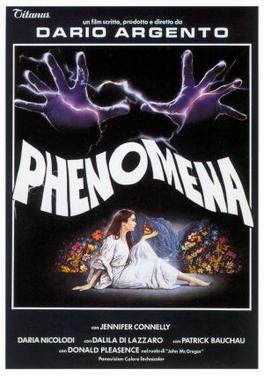
The Films of Dario Argento: Phenomena


First released in 1985, Phenomena is the Dario Argento film with all the insects.

Phenomena is one of the most divisive of Argento’s film.  Throughout the years, many critics have cited Phenomena as being the first Argento film to not really work.  Some have called it Argento’s worst and most self-indulgent film and the first sign that he had lost his way.  At the same time, I know quite a few people who consider Phenomena to be among Argento’s best films.  The one thing that both camps seem to have in common is that their takes are all inspired by the film’s use of insects.

That said, Argento has always claimed that Phenomena is less about the insects and more about a world in which the Nazis conquered Europe.  Much as with Argento’s claim that Tenebrae is actually a science fiction film, the idea that Phenomena takes place in a Europe controlled by Nazis can be found but only if you specifically look for it.  For instance, the film is set in the Swiss countryside, with a similar emphasis on the mountains and the forests that were present in the German propaganda pictures that were taken of Hitler and his inner circle “relaxing” at his mountain residence.  Much of the film takes place at a private school that is named after Richard Wagner, where the privileged students — with their always crisp uniforms and their haughty attitude — feel as if they could be descendants of the kid who sang Tomorrow Belongs To Me in Cabaret.  One of the chaperones at the school is a German woman named Frau Bruckner (Daria Nicolodi).  Again, much as with Tenebrae, Argento has said the Phenomena takes place in a world where terrible things have happened but the population has collectively decided to forget about them.  Willfully forgotten seems to have been a major theme for Argento in the years following his unhappy experience with Inferno.

The film opens with the murder of 14 year-old Danish girl named Vera Brandt (played by Fiore Argento, the director’s daughter) who is a part of a tour group but who misses her bus.  When she walks through the Swiss countryside in search of help, she comes across a house that’s not as abandoned as it originally.  She is attacked and beheaded by the house’s resident.  Eight months later, Vera’s decaying and maggot-covered heard is discovered and taken to forensic entomologist John McGregor (Donald Pleasence).  Though McGregor uses a wheelchair, he has a monkey named Inga who takes care of him.  Inga is quite capable with a straight-razor.

Meanwhile, chaperoned by Frau Bruckner, Jennifer Corvino (Jennifer Connelly) has just enrolled in the Richard Wagner Academy For Girls.  Jennifer is the daughter of a Hollywood star.  (Argento originally wanted Jennifer to be Al Pacino’s daughter, with Pacino playing himself.  Pacino reportedly turned Argento down.)  Jennifer is also a sleepwalker who has an intense mental connection with insects.  Insects do her bidding and, in return, Jennifer protects them.  When Frau Brucker and her chauffeur attempt to kill a bee, Jennifer is able to calm down the bee and set it free from the limo.

Jennifer struggles to fit in at the Academy.  Much like Jessica Harper’s Suzy Banyon in Suspiria, she discovers that the other students are an idiosyncratic and not particularly friendly group.  Whereas poor Suzy Banyon just had to accept her situation, Jennifer has an army of insects on her side and she’s willing to call them down on her snooty classmates.  Of course, when Jennifer isn’t communing with the insects, she’s having to deal with the fact that she witnessed a murder while she was out sleepwalking.  Haunted by images of the murder and being stalked by the murderer, Jennifer also learns that Frau Bruckner wants to send her to a mental hospital for being “diabolic.”

Jennifer’s only real friend in Switzerland is John McGregor and it must be said that Donald Pleasence, who was so misused in so many horror films in the 80s and 90s, is perfectly cast as the eccentric but kindly entomologist.  Pleasence was one of those actors who could deliver even the strangest of lines with enough gravity to make them memorable and McGregor’s easy acceptance of the idea that Jennifer has a psychic connection with insects make it much easier for the viewer to accept it as well.  As well, McGregor’s friendship with the monkey is far more touching than it has any right to be.

Phenomena is an odd mix of giallo and fantasy, with the brutal and violent murders uneasily playing out with more lyrical scenes featuring the beauty of Switzerland and the loyalty of the animal kingdom.  Perhaps the best way to view Phenomena is as being an extremely bloody fairy tale, with Jennifer as a Cinderella-figure who depends on nature to stay safe from the adults and the students who stand in for the wicked stepmother and the ugly stepsisters.  Visually, there are moments of haunting beauty in the film.  There are other moments in which Argento seems to be determined to test how long the audience would be willing to accept the idea Jennifer and her insect army.  Because of the whimsical insects, the film is often described as being an oddity in Argento’s filmography but actually, psychic insects and animals would pop up in future Argento films, so it seems that this was something that had obsessed him for a long time.  Either that or the negative reaction afforded to Phenomena inspired Argento to continue to use the insects as his way of letting the critics know his true opinion of their worth.

I have to admit that I am amongst those who like Phenomena.  It’s such a strange film that it’s hard for me not to admire it and, much as with Suspiria, the film benefitted from having a strong female protagonist in Jennifer Calvino.  (For her part, Jennifer Connelly has said that she’s not particularly a fan of Phenomena.)  Finally, this is a film that gave Donald Pleasence a chance to show what an engaging actor he could be when he had the right role.  Critics be damned, I like this movie!

The (Reviewed) Films of Dario Argento:

  1. The Bird With The Crystal Plumage
  2. Cat O’Nine Tales
  3. Four Flies on Grey Velvet
  4. Deep Red
  5. Suspiria
  6. Inferno
  7. Tenebrae

4 Shots From 4 Horror Films: Special Curtis Harrington Edition


4 (or more) Shots From 4 (or more) Films is just what it says it is, 4 (or more) shots from 4 (or more) of our favorite films. As opposed to the reviews and recaps that we usually post, 4 (or more) Shots From 4 (or more) Films lets the visuals do the talking

Today, we pay tribute to experimental surrealist and horror director, Curtis Harrington!  It’s time for….

4 Shots from 4 Curtis Harrington Films

Night Tide (1961, dir by Curtis Harrington, DP: Vilis Lapenieks)

Queen of Blood (1966, dir by Curtis Harrington, DP: Vilis Lapenieks)

The Killing Kind (1973, dir by Curtis Harrington, DP: Mario Tosi)

The Dead Don’t Die (1975, dir by Curtis Harrington DP: James Crabe)

Horror Movie Review: When A Stranger Calls Back (dir by Fred Walton)


The 1993 film, When A Stranger Calls Back, opens with the recreation of an urban legend.

A teenager babysitter named Julia Jenz (Jill Schoelen) arrives at a big suburban house for a routine baby-sitting gig.  The two children are already asleep in bed.  All Julia has to do is sent in the living room and do her homework until the parents return from their party.  Julia settles in.  She gets one mysterious phone call but hangs up.

Then, someone knocks on the door.

The man on the other side of the door explains that his car has broken down and he asks if he can come inside to call his auto club.  (This is one of those films that could have only worked in the age of landline phones.)  Julia doesn’t want to let the man into the house but the man is insistent that he needs Julia’s help.  Finally, Julia says that she’ll call the auto club for him but, when she goes to the phone, she finds that the line is dead.  Rather than tell the man the truth, Julia lies to him and says that she called the auto club.  The man thanks Julia and says that he’s returning to his car.

(What is an auto club?)

Eventually, the man returns, knocking on the door and asking if Julia really called the auto club.  Julia continues to lie, even as the man becomes increasingly belligerent.  What Julia doesn’t know but soon discovers is that the man is not outside talking to her but he’s actually inside of the house.  And he’s abducted the children!

The opening scene, which of course harkens back to the original When A Stranger Calls, is a genuinely well-done and suspenseful sequence.  Again, much like as if with the first film, the opening of When A Stranger Calls Back is so strong that the rest of the film can’t really keep up.

When A Stranger Calls Back is indeed a sequel to When A Stranger Calls, which means that, after Julia’s terrifying night of babysitting, the film jumps forward five years.  The children are never found and the man who knocked on the door is never identified.  Julia is now a college student but she’s still traumatized by the night and has a difficult time trusting anyone.  When she starts to suspect that someone has been in her apartment, she turns to Jill Johnson (Carol Kane), who is a counselor at the college and also the protagonist from When A Stranger Calls.  Jill helps Julie out, teaching her how to shoot a gun and also calling in the man who killed her stalker, John Clifford (Charles Durning).  Clifford figures out that Julia’s stalker is probably a ventriloquist.  Personally, I think the film made a huge mistake by making the stalker a ventriloquist instead of the ventriloquist’s dummy.

Despite strong performances from Carol Kane, Charles Durning, and Jill Schoelen, When A Stranger Calls Back suffers from the same problem as When A Stranger Calls.  After a scary and effective opening sequence, the rest of the film just feels like a letdown.  The killer in When A Stranger Calls Back is not quite as wimpy as the phlegmatic British guy from the first When A Stranger Calls but still, how intimidated can you be by a ventriloquist?  An even bigger problem is that When A Stranger Calls Back cheats at the end, suddenly revealing that a character who we had every reason to believe to be dead is actually alive.  It feels a bit as cop out on the part of the film, an attempt to slap an improbable happy ending on a film that would otherwise be pretty dark.

These films make me happy that I was never responsible enough to be a babysitter.

Horror Film Review: Monster From The Ocean Floor (dir by Wyott Ordung)


Are you ready to go in the water?

That’s the question asked by the 1954 film, Monster From The Ocean Floor.  Taking place in a Mexican fishing village and artist’s colony, Monster From The Ocean Floor features a lot of underwater action.  It also features a monster who lives on the ocean floor and who has been terrorizing fisherman, swimmers, and divers.  Unfortunately, despite being featured in the title, there’s not really much of the Monster in this film.  It takes a while for the Monster to even be acknowledged and, when the Monster finally does show up, it’s over all too quickly.  I guess we shouldn’t be too surprised by any of that, seeing as how this is a 1950s Roger Corman production that was apparently made on a budget of $20,000.  Producer Corman and director Wyott Ordung had to choose between devoting screen time to a potentially expensive monster or to a one-man submarine that they could use for free as long as they listed the submarine’s manufacturer in the opening and end credits.  They went with the submarine.

In fact, the submarine was apparently the main reason that Corman decided to make this film, his first as a producer.  He read an article about it in the Los Angeles Times and decided that it sounded like the perfect thing to feature in a movie.  In what would become typical Corman fashion, Corman got the submarine first and then built a movie around it.

As for the movie, it features Stuart Wade as Steve Dunning, the hunky Marine biologist who loves the ocean and frequently pilots the submarine.  When Steve and his submarine first emerge from the ocean, they briefly frighten Julie Blair (Anne Kimbell), an artist who is at the village in search for inspiration.  Later, when Julie actually does briefly see the monster rising from the ocean, Steve and Dr. Baldwin (Dick Pinner) theorize that the Monster From The Ocean Floor is actually a prehistoric creature that was in a Cthulhu-like slumber until it was reawakened by atomic bomb testing on the nearby Bikini Islands.

The people at the village don’t really care where the Monster came from or what the Monster might mean for the cause of science.  They just want the Monster go away so that they continue their lives in peace.  Pablo (played by the film’s director, Wyott Ordung) and Tula (Inez Palange) think that the solution might be a human sacrifice and they make plans to summon a shark to eat the diving Julie.  Agck!

As I mentioned earlier, this film was Roger Corman’s debut as a producer.  Corman was only 25 at the time and he didn’t direct the film but still, everything about Monster From The Ocean Floor — from the low budget to the casting of Jonathan Haze (and Corman himself!) in a small role — easily identifies this as being a Corman film.  It has its fun moments and, for a 1954 film, Anne Kimbell’s Julie Blair is a refreshingly independent and liberated character.  Unfortunately, the overall film is a bit slow and it does seem to take forever for the monster to actually show up.

Ultimately, Monster From The Ocean Floor‘s main importance is as a piece of B-movie history.  With this movie, the glorious filmmaking career of Roger Corman began.

Live Tweet Alert: Watch The Torture Chamber of Dr. Sadism With #ScarySocial!


As some of our regular readers undoubtedly know, I am involved in a few weekly live tweets on twitter.  I host #FridayNightFlix every Friday, I co-host #ScarySocial on Saturday, and I am one of the five hosts of #MondayActionMovie!  Every week, we get together.  We watch a movie.  We tweet our way through it.

Tonight, for #ScarySocial, I will be hosting 1969’s The Torture Chamber of Dr. Sadism!  I can’t wait to watch Christopher Lee in this film with everyone!

If you want to join us on Saturday night, just hop onto twitter, start the film at 9 pm et, and use the #ScarySocial hashtag!  The film is available on Prime and Tubi.  I’ll be there co-hosting and I imagine some other members of the TSL Crew will be there as well.  It’s a friendly group and welcoming of newcomers so don’t be shy.

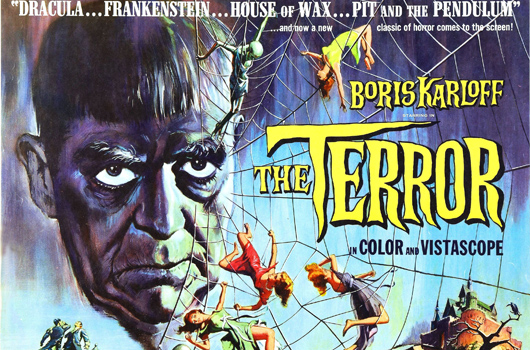
Horror on the Lens: The Terror (dir by Roger Corman, Francis Ford Coppola, Jack Hill, Monte Hellman, Dennis Jakob, and Jack Nicholson)


Have you ever woken up and thought to yourself, “I’d love to see a movie where a youngish Jack Nicholson played a French soldier who, while searching for a mysterious woman, comes across a castle that’s inhabited by both Dick Miller and Boris Karloff?”

Of course you have!  Who hasn’t?

Well, fortunately, it’s YouTube to the rescue.  In Roger Corman’s 1963 film The Terror, Jack Nicholson is the least believable 19th century French soldier ever.  However, it’s still interesting to watch him before he became a cinematic icon.  (Judging from his performance here and in Cry Baby Killer, Jack was not a natural-born actor.)  Boris Karloff is, as usual, great and familiar Corman actor Dick Miller gets a much larger role than usual.  Pay attention to the actress playing the mysterious woman.  That’s Sandra Knight who, at the time of filming, was married to Jack Nicholson.

Reportedly, The Terror was one of those films that Corman made because he still had the sets from his much more acclaimed film version of The Raven.  The script was never finished, the story was made up as filming moved alone, and no less than five directors shot different parts of this 81 minute movie.  Among the directors: Roger Corman, Jack Hill, Monte Hellman, Francis Ford Coppola, and even Jack Nicholson himself!  Perhaps not surprisingly, the final film is a total mess but it does have some historical value.

(In typical Corman fashion, scenes from The Terror were later used in the 1968 film, Targets.)

Check out The Terror below!

Music Video of the Day: Photograph by Def Leppard (1983, directed by David Mallett)


This video was controversial when it was first released with some people wondering if the video would promote violence with its story of a Marilyn Monroe look-alike being photographed while a killer tossed around a knife and newspaper headlines announced that a movie star had been murdered.  Controversy sells and the video was put in heavy rotation on MTV, helping Photograph to reach number one on the charts and to stay there for several weeks.

Director David Mallet is one of those directors who has done videos for just about everyone, from AC/DC to Olivia Newton-John to Peter Gabriel.

Enjoy!