
My summer job as a Big Brother recapper started this week! So, guess what I’ve been watching a lot of? Along with the Big Brother live feeds, I’ve also been doing the last bit of work to get caught up on all of the potential Emmy nominees.
Here’s my thought on what I watched this week:
The Andy Warhol Diaries (Netflix)
I watched this Ryan Murphy-produced docuseries throughout the week. Essentially, the documentary takes a look at the last few decades of Andy Warhol’s life. Warhol kept a diary over those years and we actually hear an AI-generated voice reading Warhol’s thought in Warhol’s voice. It makes for an interesting documentary. At times, in this diary, Warhol is surprisingly open and honest. At other times, it’s obvious that he’s playing for an audience for he surely knew that his diaries would be read after his death.
The Beatles: Get Back (Disney Plus)
I watched the final two episodes of this documentary on Sunday, Monday, and Tuesday. Yes, it took me two days to get through two episodes. To be honest, it’s a bit of an exhausting documentary but, at the same time, its undeniably fascinating to watch The Beatles working together, working separately, love each other and hating each other at the same time. I’d be lying if I said that I wasn’t a little emotional by the end of it all. The documentary both celebrated the group while also showing why the time had come for them to go their separate ways, George Harrison was my favorite at the end of the first episode. Paul McCartney was my favorite by the end of the series.
Big Brother 24 (All Week, CBS and Paramount Plus)
You can read my thoughts on Big Brother over at the Big Brother Blog!
The Challenge USA (Wednesday Night, CBS)
The Challenge comes to the USA, featuring teams made up of veterans from other reality shows. I watched the first episode on Wednesday but I have to admit that I didn’t really pay much attention to it. Maybe next week’s episode will have more success capturing my attention.
Euphoria (HBO)
I watched the second episode of Euphoria. As much as I’ve made fun of “visionary Sam Levinson” over the past two years (mostly due to Malcolm and Marie), Euphoria is a well-done show. Fortunately, it’s very well-cast. It’s impossible it working with Zendaya, Sydney Sweeney, Jacob Elordi, and the rest. They somehow manage to strike the right balance so that the show works even at its most excessive.
Goliath (Amazon Prime)
I watched a few episodes of Goliath’s fourth and final season. This episode features Billy Bob Thornton as an attorney and it’s perfect casting. This season also featured Bruce Dern and you really haven’t lived until you’ve seen Thornton and Dern, two actors who have no fear when it comes to embracing eccentricity, acting opposite of each other.
Hanna (Amazon Prime)
As much as I love the original movie, I was never really been able to get into Hanna the series. The third and final season features a nicely villainous turn from Ray Liotta and it ended on a satisfying note, with Hanna hopefully finally getting to live a life of her own.
Inspector Lewis (YouTube)
Inspector Lewis and Hathaway investigated a murder that had religious overturns. Hathaway considered returning to the seminary but, perhaps realizing the show would end if he did that, he didn’t.
Invasion (Apple TV+)
The Earth is being invaded by aliens! I watched the first episode of this show on Thursday. It was a bit slow but Sam Neill gave an excellent performance as the sheriff of a small town in Oklahoma.
Nine Perfect Strangers (Hulu)
Eh. Another over-written David E. Kelley production. At least Nicole Kidman had a good role, as the somewhat enigmatic owner of a wellness resort. I have to admit that I kind of zoned out on this one.
Ozark (Netflix)
I watched the finale of Ozark. To be honest, this show has never done as much for me as it’s done for others. To me, it owes a bit too much to Breaking Bad and Better Call Saul. Despite moving the action to Ozarks, it simply cannot escape the shadow of those two shows. That said, Jason Bateman and Julia Garner both gave excellent performances.
Phoenix Rising (HBO)
In this two-part documentary, Evan Rachel Wood talks about the abuse that she says she suffered at the hands of Marilyn Manson and her efforts to create and lobby for the Phoenix Act. The documentary was perhaps a bit overlong but compelling nonetheless.
Severance (Apple TV+)
An absolutely brilliant mind-bended of a show, Severance is brilliantly odd and moving. I wonder how many people heard that Ben Stiller was directing and Adam Scott was starring and assumed that this would just be another Judd Apatow-style comedy? Severance is a wonderful series about emotional and intellectual freedom, memories, and …. well, life itself. Christopher Walken and John Turturro are both such quirky actors that it’s good to have a show like this that allows them to remind audiences that they happen to be brilliant as well.
Succession (HBO)
Eh. The media’s favorite television drama has never done much for me. I watched two episodes. It’s a talented cast but I got bored fairly quickly.
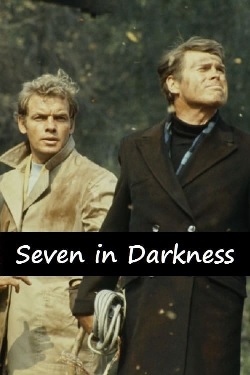 A group of blind people, led by teacher Alex Swain (Barry Nelson), are flying to a convention for the blind in Seattle. When their flight is knocked off-course by an unexpected storm, the plane crashes into a remote forest. The plane’s crew and the one sighted passenger are all killed in the crash, leaving the eight blind passengers to fend for themselves. The plane is perched on the edge of a mountain, there are wolves all around, and no one can see the surrounding terrain. And one of the passengers is pregnant and could give birth at any minute! To Alex’s resentment, the group turns to Mark (Sean Garrison) to help them survive in the wilderness. Mark was blinded while serving in Viet Nam and he’s still haunted by what happened during the war. At first, he resists being thrust into a leadership role but finally, it becomes clear that he has no choice. Under Mark’s leadership and despite Alex’s protestations, the eight survivors try to find their way back to civilization.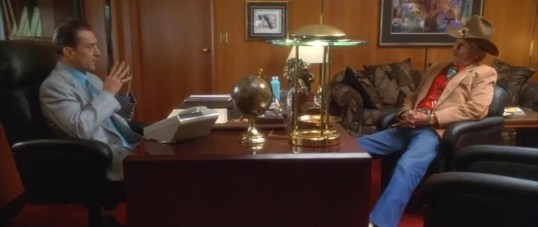


 Through the Shattered Lens