Scenes That I Love: Peter Fonda Explores The City In The Trip


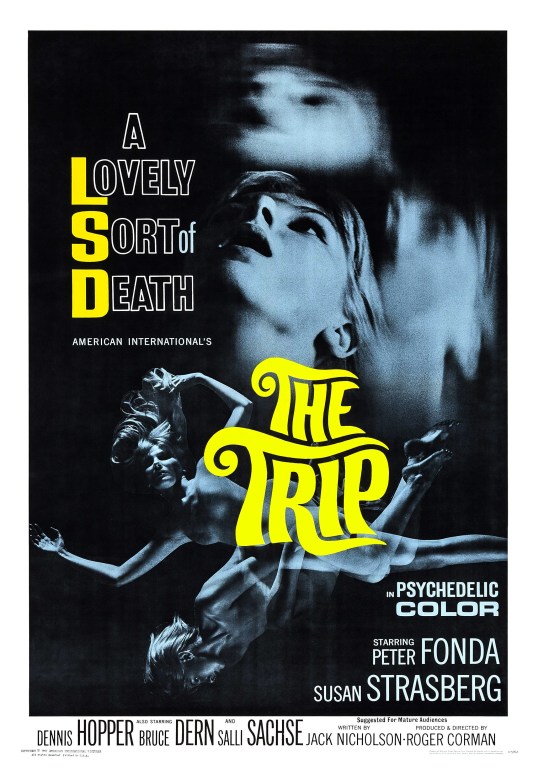
Today’s scene is from Roger Corman’s 1967 film, The Trip. Corman dropped acid himself before filming Peter Fonda doing the same thing in this film. Regardless of how one views Corman’s cinematic recreation of Fonda’s experience with acid, The Trip is considered to be one of the first nuanced drug films. While it doesn’t endorse drug use, it also doesn’t descend into the hysterics of a film like Reefer Madness. Interestingly enough, the script was written by Jack Nicholson.

Here is Peter Fonda, exploring the city on LSD, in The Trip:

Horror Novel Review: The Knife by R.L. Stine


I thought I was done with reading R.L. Stine this October when I finished up Trapped but then I noticed that his 1991 YA novel, The Knife, was still sitting on my desk. Being a completest, I decided to go ahead and read it now, as opposed to leaving it for next year’s Horrorthon. Afterall, it was short and the title promised all sorts of grisly Fear Street fun. It’s not like a title would be misleading, right?

Well, there is indeed a knife in The Knife. It’s being wielded by a man who is chasing the book’s main character, Laurie, at the start of the story. And, later on, a bitchy nurse ends up getting a scalpel shoved in her throat and a scalpel is a type of knife so I guess the title isn’t completely misleading. That said, the book’s use of knives is actually a fairly minor detail. Stine could have just as easily called the book “The Teddy Bear” after the gift that Laurie tries to give to the boy at the center of the book’s plot.

Laurie is volunteering at Shadyside Hospital. She works in the Fear Wing, named after the Fear Family. She becomes attached to a patient named Toby. When Toby is discharged, Laurie is happy that he didn’t die but she is disturbed when Toby tells her that the woman taking him home is not his mother. Laurie decided to investigate Toby’s homelife on her own and, after doing a lot of stalking and basically repeatedly beaking the law, she stumbles across one of those huge crime rings that always seemed to popping up all over Shadyside.

It’s an okay book. If you’ve seen enough Lifetime films, you’ll be able to figure out what’s going on with Toby and his fake mother. And you’ll also figure out who murdered the nurse. There aren’t many surprises to be found but it’s a quick read and it’s kind of fun to watch Laurie try to balance getting a new boyfriend with cracking the case of an international crime ring. It’s like those weird episodes of Saved By The Bell where Lisa Turtle worked at her mom’s hospital. Technically, there are knives in the book so let’s give Stine credit for that.

And now, I think I’m done with reading about Fear Street for this month.

Book Review: If Chins Could Kill: Confessions of a B-Movie and many other books by Bruce Campbell


Everyday, we should give thanks to Bruce Campbell is not a jerk.

Seriously, can you imagine how disappointing it would be to discover that Bruce Campbell — ASH!  GROOVY BRUCE! — was not a laidback, blue collar actor who appreciated his fans, had a sense of humor about his films, and who enjoyed ending the day with maybe a can of beer and a nicely rolled joint?  It would be awful!  Bruce Campbell going on and on about the method while telling people not to see his early films?  Unthinkable!  Bruce Campbell demanding a huge trailer and bad-mouthing his co-stars?  That’s not our Groovy Bruce!

No, Bruce Campbell is pretty likable and appears to be downright nice.  That’s a huge part of his appeal.  He’s an actor but he’s also a fan.  He’s talented but he’s also level-headed.  He loves his films but he doesn’t pretend that they were anything that they weren’t.  Other actors would hide the chin.  Bruce shows it off every chance he get.  He even named his first memoir after the chin!

And it’s quite a good memoir too, If Chins Could Kill is,  Bruce discusses growing up.  He discusses the first films that he made with Sam Raimi.  The Coen Brothers make an appearance.  There’s stuff about Bubba Ho-Tep and Maniac Cop.  Really, it’s the definitive overview of the first part of Bruce Campbell’s amazing career and it’s a fun read.  Campbell has a sense of humor about both himself and his movies but, at the same time, he also has a deep love and appreciation for indie filmmakers.  It’s the humor that makes the book entertaining but it’s the love that will keep your reading.  And, after you finish the first memoir, move on to Campbell’s subsequent books — How To Make Love the Bruce Campbell Way, Hail to the Chin, and The Cool Side of My Pillow.  They’re all good books.  They’ll make you appreciate not only Bruce and the movies but also the art of writing about yourself without acting like a pompous jackass.  Bruce pulls it off and we’re all the better for it!

International Horror Film Review: Lisa and the Devil (dir by Mario Bava)


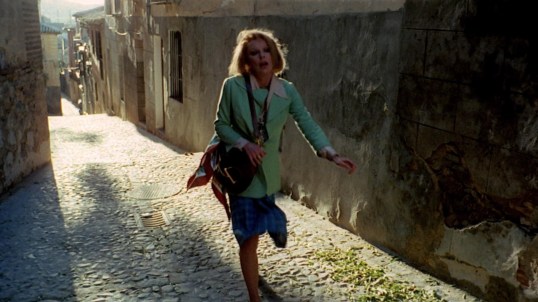
Originally filmed in 1972 and tragically not seen the way it was intended to be seen until years after Mario Bava’s death, Lisa and the Devil tells the story of Lisa (Elke Sommer), a tourist who is visiting the city of Toledo, Spain with a friend.  From the first minute we see Lisa walking through the streets of the city, something seems to be off.  The city seems strangely deserted.  The streets themselves seem menacing, in much the same way that streets of Vienna did in The Third Man.

Lisa leaves her tour group and goes in a store.  A menacing, bald man (Telly Savalas) gives Lisa a strange look as he buys a dummy.  The man resembles a portrait of the devil that Lisa saw earlier.  Running from the shop, Lisa runs into another man (Espartaco Santoni) who appears to be following her.  The man appears to fall to hi death but, despite that, the man will return later.  People have a way of returning in Lisa and the Devil.

Lisa’s tour group appears to have vanished.  She eventually runs into a seemingly friendly couple (Sylvia Koscina and Eduardo Fajardo) who, along with their driver (Gabriee Tinti), agree to take Lisa back to her hotel.  But instead, they somehow end up outside of a dilapidated, mannequin-filled mansion.  When the car breaks down, the group is invited to spend the night by the Countess (Alida Valli, who also appeared in The Third Man), who lives in the mansion with her strange but handsome son, Maximilian (Alessio Oriano).  Maximilian is still mourning his ex-girlfriend, Elena.  Elena, we’re told, bore a striking resemblance to Lisa.

However, it turns out that the Countess and Maximilian are not alone in the mansion.  Also living in the house is the Countess’s second husband, Carlos, who just happens to be the same man that was following Lisa in the city!  And finally, there’s the butler, Leandro, who is the same man who Lisa earlier saw in the shop!

Lisa and the Devil is one of my favorite Italian horror films.  Yes, some of that is because I shared the same name as the movie’s main character and I love it when people say my name a lot.  But I would love this film even if Elke Sommer was playing someone named Annalise or Tiffany.  Mario Bava said that this film, or at least his version of the film, was one of his most personal works and the entire movie does feel like a puzzle that only one person could possibly solve.  In the movie, only Leandro seems to full understand what’s happening in both the city and the house.  In real life, it’s likely that only Mario Bava understood everything that happened in the film.  The film mixes a giallo mystery (because people do soon start to die the mansion) with a surreal exploration of memory, regret, sin, and guilt.  The movie plays out like a waking dream, leaving us to wonder just who exactly Lisa truly is and who the Devil of the title might be.  It’s easy to spot the Devil.  It’s less easy to spot which parts of the film are meant to be reality and which parts might simply be happening in Lisa’s mind.

Unfortunately, the film’s producer had no idea what to do with Bava’s surreal masterpiece.  The few people who saw the film were baffled.  The Italian censors demanded massive cut for both sex and violence and, as a result, Lisa and the Devil was one of the few Bava films not to get a theatrical release in his native country.  It apparently did play in South Korea and Spain, though the Spanish version did not feature Bava’s original, mind-twister of an ending.

Even worse, for the film’s American release, the film’s producer requested that Bava add some exorcism scenes so that the film could take advantage of the popularity of The Exorcist.  By now realizing that his preferred version of the film would probably never be seen, Bava agreed.  With the help of his son, Lamberto, Mario Bava shot several scenes featuring Elke Sommer acting possessed while a priest played by Robert Alda tried to exorcise the demon.  The original Lisa and the Devil footage was presented as being scenes from the dimension Lisa’s soul had been sent to while the demon controlled her body.  The film was retitled House of Exorcism in Amercia.  And here’s the thing — House of Exorcism is hardly a bad movie.  Bava is Bava, afterall.  Sommer does a convincing job acting possessed and the mix of new and old footage is edited together fairly well.  But it’s still not the film that Bava set out to make.

Sadly, Bava’s original version of Lisa and the Devil would not get a proper video release until decades after his death.  It’s not always an easy film to follow.  I’ve seen it several times and there are still things about it that I still don’t fully understand.  It’s a surreal masterpiece, one that is perhaps not meant to be fully understood and the type of dream-film that shows why Bava is one of the few directors that David Lynch has regularly cited as being an influence on his own work.  Lisa and the Devil is a trip through a world dominated by dark and disturbing things and it’s one of the best Italian horror films to come out of the 70s.  Thankfully, it can now be seen the way that Bava intended.


A Blast From The Past: Halloween Safety (dir by Herk Harvey)


Director Herk Harvey

Tomorrow, we will be sharing the classic film Carnival of Souls. That means that today, it’s for us to show our last Herk Harvey short film of the 2021 Horrorthon. And appropriately enough, it’s all about Halloween!

This short film was made in 1977, long after the release of Carnival of Souls. In it, safety tips are offered up to make sure that all the kids have a safe Halloween. Make sure you can see clearly, even if you’re wearing a mask. Don’t wear dark clothing. Grab a flashlight. Don’t trick or treat alone! Hey, it’s all good advice. And Herk Harvey seems like someone who knew a little something about having a good Halloween!

From 1977, here’s some lessons on Halloween Safety!

4 Shots From 4 Roger Corman Films


4 Or More Shots From 4 Or More Films is just what it says it is, 4 shots from 4 of our favorite films. As opposed to the reviews and recaps that we usually post, 4 Shots From 4 Films lets the visuals do the talking!

Today, we pay tribute to the legendary director and producer, Roger Corman!  It’s time for….

4 Shots From 4 Roger Corman Films

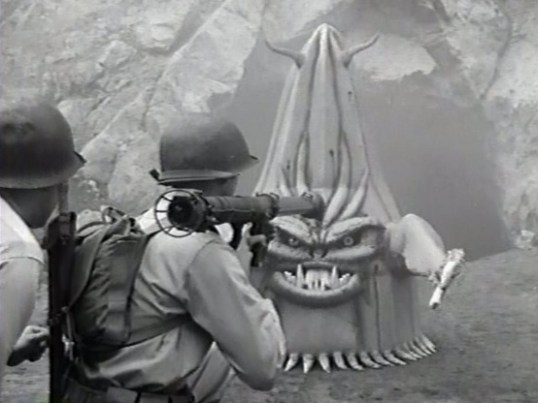
It Conquered The World (1956, dir by Roger Corman, DP: Fred E. West)

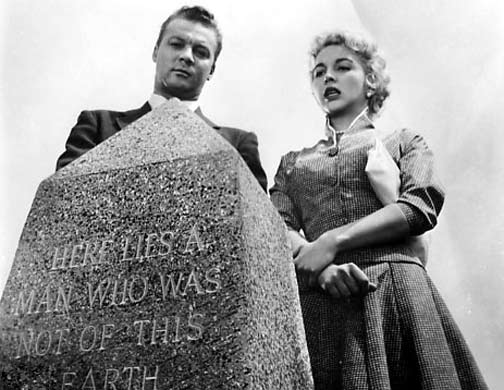
Not Of This Earth (1957, dir by Roger Corman, DP: John J. Mescall)

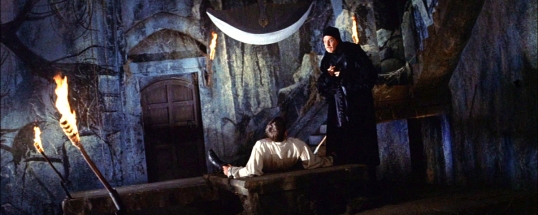
Pit and the Pendulum (1961, dir by Roger Corman, DP: Floyd Crosby)

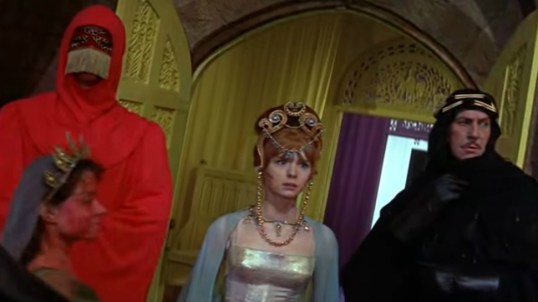
The Masque of the Red Death (1964, dir by Roger Corman, DP: Nicolas Roeg)

The Dastardly Cults of the Pulp Era


by John Walter Scott

Since the start of the pulp era, cults have been a popular subject.  Usually dressed in red and concealing their faces behind hoods, cult members have menaced, tortured, and frightened.  Luckily, there’s often a strong-jawed hero right around the corner to take them out and save the day.

Here’s a few of the cults of the pulp era!

by George Hargis

by Harry Lemon Parkhurst

by Hugh Joseph Ward

by J. Allen St. John

by John Drew

by John Newton Howitt

by Rudolph Zirm

by Tom Lovell

by Walter Baumhofer

by Arnold Kohn

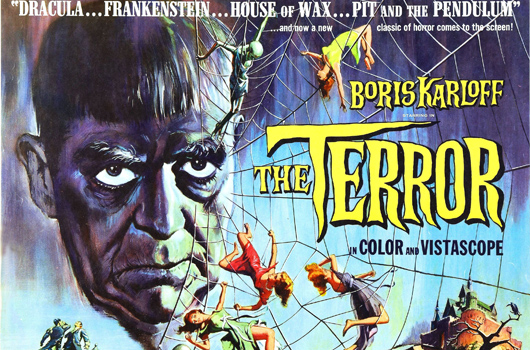
Horror Film Review: The Terror (dir by Roger Corman, Monte Hellman, Francis Ford Coppola, Dennis Jakob, Jack Hill, and Jack Nicholson)


Can you follow the plot of the 1963 horror film, The Terror?

If so, congratulations!  You’ve accomplished something that even the people who made the film have admitted to being unable to do.

The film opens in 19th century Europe.  Andre Duvalier is an earnest French soldier who has somehow gotten lost in Germany.  Andre is played by a youngish, pre-stardom Jack Nicholson.  Nicholson, that most contemporary, sarcastic, and American of actors, is thoroughly unconvincing as an idealistic Frenchman from 1806.  Obviously unsure of what do with the character, Nicholson delivers his lines stiffly and does what he can to downplay the naturally sardonic sound of his voice.  This is probably the only film where Jack Nicholson is a “nice young man.”

Andre meets a mysterious woman named Helene (played by Sandra Knight, who was Nicholson’s wife at the time).  Helene appears to live in a castle with the Baron (Boris Karloff) and his servant, Stefan (Dick Miller, who makes no effort to come across as being, in anyway, European).  However, Helene bears a distinct resemblance to the Baron’s long-dead wife, Ilse, who the Baron killed after discovering her with another man.  However, a witch in the village claims that Ilse’s lover was her son so she put a curse on the Baron and the presence of Helene is a part of that curse.  However, Stefan claims that the Baron isn’t actually the Baron and and that Ilse’s husband isn’t actually dead.  However….

Yes, there’s a ton of plot twists in this movie, which is probably the result of the fact that the film was shot without a completed script.  In fact, the only reason the movie was made was because Roger Corman had access to Boris Karloff and a castle set that he used for The Raven.  When he discovered that he could use the set for two extra days, he shot some random footage with Boris Karloff and then he tried to build a movie around it.  As a result, the cast and the directors largely made up the story as the filmed.

Yes, I said directors.  While Corman shot the Karloff scenes, he no longer had enough money to use a union crew to shoot the rest of the film.  Because Corman was a member of the DGA, he couldn’t direct a nonunion film. So, he assigned the rest of the film to one his assistants, an aspiring filmmaker named Francis Ford Coppola.  Coppola shot the beach scenes and, in a sign of things to come, he went overbudget and got behind schedule.  Coppola was meant to shoot for three days but instead went for eleven.

Though Coppola shot the majority of the film, he got a better job offer before he could do any reshoots.  Coppola suggested that a friend of his from film school, Dennis Jakob, take over.  Jakob shot for three days and reportedly used most of the time to shoot footage for his thesis movie.

Still feeling that the movie needed a few extra scenes to try to make sense of the plot, Corman then gave the film to Monte Hellman and, after Hellman got hired for another job, Jack Hill.  Hellman would later go on to direct films like The Shooting and Two-Lane Blacktop.  Jack Hill would later direct Spider Baby and several other exploitation films in the 70s.  Reportedly, on the final day of shooting, even Jack Nicholson took some time behind the camera.  It was Nicholson’s first directing job.  (Nicholson, for his part, has often said that his original ambition in Hollywood was to become a director and not an actor.)

So, yes, the film’s a bit disjointed.  The plot doesn’t make any sense.  Nicholson shows little of his trademark charisma.  But Dick Miller has a lot of fun as the duplicitous Stefan and Boris Karloff brings his weary dignity to the role of the Baron.  Oddly, even though the Baron’s scene were shot before the script had even been written, they’re the ones that make the most sense.  It’s a messy film but it plays out with a certain hallucinatory style.  It’s a piece of Hollywood history and a testament to Roger Corman’s refusal to waste even two days of shooting.  If you’ve got a star and a set for two days, you’ve got enough for a movie!

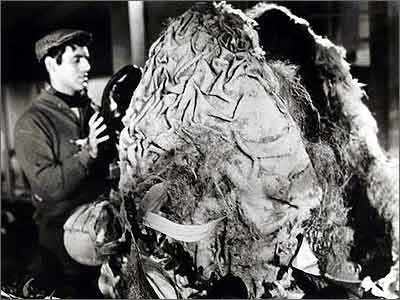
Horror on the Lens: The Little Shop of Horrors (dir by Roger Corman)


(It’s tradition here at the Lens that, every October, we watch the original Little Shop of Horrors.  And always, I start things off by telling this story…)

Enter singing.

Little Shop…Little Shop of Horrors…Little Shop…Little Shop of Terrors…

Hi!  Good morning and Happy October 29th!  For today’s plunge into the world of public domain horror films, I’d like to present you with a true classic.  From 1960, it’s the original Little Shop of Horrors!

When I was 19 years old, I was in a community theater production of the musical Little Shop of Horrors.  Though I think I would have made the perfect Audrey, everybody always snickered whenever I sang so I ended up as a part of “the ensemble.”  Being in the ensemble basically meant that I spent a lot of time dancing and showing off lots of cleavage.  And you know what?  The girl who did play Audrey was screechy, off-key, and annoying and after every show, all the old people in the audience always came back stage and ignored her and went straight over to me.  So there.

Anyway, during rehearsals, our director thought it would be so funny if we all watched the original film.  Now, I’m sorry to say, much like just about everyone else in the cast, this was my first exposure to the original and I even had to be told that the masochistic dentist patient was being played by Jack Nicholson.  However, I’m also very proud to say that — out of that entire cast — I’m the only one who understood that the zero-budget film I was watching was actually better than the big spectacle we were attempting to perform on stage.  Certainly, I understood the film better than that screechy little thing that was playing Audrey.

The first Little Shop of Horrors certainly isn’t scary and there’s nobody singing about somewhere that’s green (I always tear up when I hear that song, by the way).  However, it is a very, very funny film with the just the right amount of a dark streak to make it perfect Halloween viewing.

So, if you have 72 minutes to kill, check out the original and the best Little Shop of Horrors

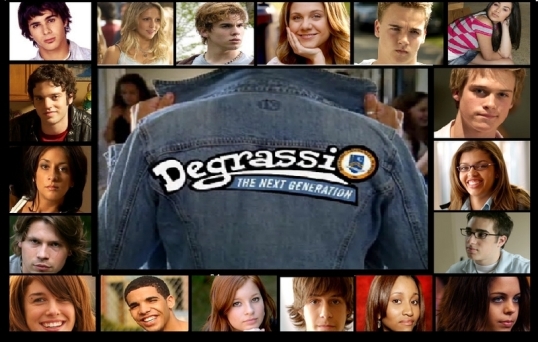
What Lisa Marie Watched Last Night #217: Degrassi: The Next Generation 3.16 “Take on Me” (dir by Phil Earnshaw)


Last night, I watched a classic episode from the 3rd season of Degrassi: The Next Generation, Take On Me!
Why Was I Watching It, eh?

A few days ago, when I wrote my review of R.L. Stine’s Trapped, I started thinking about how much I love Degrassi‘s take on The Breakfast Club.  That led to me getting out my Season 3 DVD and watching Take On Me!

What Was It Aboot?

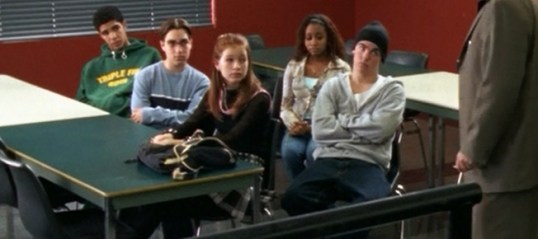
This episode originally aired on February 16th, 2004.  It’s the weekend in Canada but instead of watching a hockey game and studying the dual languages of their native country, five Degrassi high school students are serving detention.  Ellie Nash (Stacey Farber) skipped school.  Hazel Aden (Andrea Lewis) used the school computers to look up porn.  Jimmy Brooks (DRAKE! — back when he was still known as Aubrey Graham) and Toby Isaacs (Jake Goldsbie) hacked into the school’s computers in an attempt to change Jimmy’s grades.  And rebel Sean Cameron (Daniel Clark) is in detention because he’s suspected of being a part of a gang of thieves who are terrorizing the entire school!

Together, the five students talk about their different cliques, play truth or dare, and sneak up to the roof.  Ellie and Sean start to fall for each other but how will Sean react when he discovers that Ellie has a secret motive for being in detention?

What Worked:

This is one of those episodes of Degrassi that you either love or you hate. You either can’t believe how blatantly the show ripped off The Breakfast Club or else you watch it and go, “Oh cool, they’re ripping off The Breakfast Club!”

Myself, I love this episode!  Not only does it center on two of my favorite characters, Ellie and Sean, but it’s also the start of the Ellie/Sean romance!  Unfortunately, the Ellie/Sean romance would only last a few episodes but they were a great couple.  Stacey Farber and Daniel Clark had a really great chemistry in their scenes together, as can be seen in this episode when they go up to the roof and they talk about thievery and self-harm.  The scene where Ellie shows Sean the scars on her arm is one of the best in the history of Degrassi.

This episode also features one of my favorite Degrassi exchanges.  When Ellie says she’s in detention for skipping school, Jimmy deadpans, “Wow, that’s a great story, Ellie.”  It’s just the way the line is delivered.

What Did Not Work:

There’s this really weird subplot involving the principal, Mr. Radish (Dan Woods).  Radish is at the school to supervise detention.  He brags about how it’s all a part of his new “no tolerance” policy for misbehavior.  However, Archie “Snake” Simpson (Stefan Brogren), the media arts teacher, stops by the school and tells Mr. Radish that there’s more to life than just following rules.  Sometimes, tolerance is a good thing.

At the end of the episode, a chastised Mr. Radish tells the detention kids that he’s just trying to do the right thing.  He suddenly decides to show some tolerance and he lets everyone go home early.  The thing is, though — Sean was stealing things from the school.  And Jimmy did bully Toby into trying to change his grades and Toby did hack into the school’s computer.  Hazel and Ellie were both in detention for minor reasons but the three guys actually did some serious things wrong.  Their behavior was exactly the sort of thing that would get most students in a lot more trouble than just weekend detention.  If anything, Mr. Radish was being nice by just having them give up a few weekends as opposed to calling the cops.

Finally, the end of the episode reveals that Ellie was actually working undercover for the local news station, for a story they were planning on doing about the thefts at the school.  But why would a big city news station care about such a minor crime and whose bright idea was it to get the story by putting an emotionally vulnerable teenage girl in potential danger by sending her in with a tape recorder?  And couldn’t they have at least given Ellie a less bulky tape recorder?  It’s almost like they wanted her to get caught.

“Oh my God!  Just Like Me!” Moments

Honestly, every single minute of every single episode of Degrassi is pretty much an “Oh my God!  Just like me!” moment, as far as I’m concerned.  That said, I always related the most to Ellie.  We both have red hair.  We both spent a good deal of high school dressed in black.  We both went through a cutting phase and a rubber band on the wrist phase and I’ve always appreciated the sensitive way that Degrassi handled that subject matter.  (Whatever flaws it may have had, Degrassi was way ahead of its time when it came to dealing with anxiety.)

I especially related to Ellie in this episode, both because I always ended up crushing on the sensitive rebels like Sean Cameron and I also got assigned detention a few times.  Of course, I always skipped detention because I was really into the whole “No one’s going to tell me what to do” thing.  Strangely, I never got in any trouble for not showing up to detention and I always wondered if everyone regularly skipped or if it was just me.

Lessons Learned

There’s nothing more fun and emotionally rewarding than weekend detention!