As we wait to discover who has won the presidential election, here are a few presidential campaign posters (and one button!) from the past. Judging from these images, 2020 has been artistically lacking.
Monthly Archives: November 2020
Artwork of the Day: Don’t Forget!

by Erin Nicole
Music Video of the Day: Vote Or Don’t by They Might Be Giants (2012, dir. by ????)
I went looking for an election day music video and this is what I found. This song first came out in 2008 but the video was released in 2012, a week before the election between Obama and Romney. I think the song is saying that you should vote and you should also convince your friend not to vote because they might vote for someone different from you and cancel out your vote. For instance, I voted last week just to make sure that I canceled out the vote of the one communist in the neighborhood.
By the way, did you know that some people claim that St. Chad is the patron saint of disputed elections because of the grace and humility he showed in 669 when he was ordered to step down from his disputed role of Bishop of York? That’s not an official designation, of course but it is something to remember in case things get weird tonight.
Back to the video. The creepy mannequins in this video reside at The Royal de Luxe in Nantes, France. The Royal de Luxe is a French mechanical marionette street theatre company that is well-known for performances involving giant puppets. They’ve performed in France, Belgium, England, Germany, Iceland, Chile, Australia, Mexico, Canada, Switzerland, Netherlands and Ireland.
Enjoy!
30 More Days of Noir #2: Blonde Ice (dir by Jack Bernhard)
1948’s Blonde Ice tells the story of Claire Cummings (Leslie Brooks), the society columnist for a San Francisco newspaper. Almost every man that Claire meets falls in love with her.
Les Burns (Robert Paige), the paper’s cynical sports reporter? Les is so in love with Claire that he keeps getting involved with her despite the fact that she cheats on him with almost every man that she meets.
Al Herrick (James Griffith)? Yep, he’s still in love with her too.
Carl Hanneman (John Holland), one of the wealthiest men in San Francisco? Carl is so in love with Claire that he’s willing to marry her even after he catches her kissing Les on the day of the wedding!
Congressional candidate Stanley Mason (Michael Whalen)? He’s so in love with Claire that he’s willing to sacrifice his political career just to be with her.
How about Blackie Talon (Russ Vincent), the pilot who witnesses Claire doing some things that she probably wouldn’t want the world to know about? Well, Blackie never gets around to declaring his love for Claire but his obsession with blackmailing her is probably just his way of dealing with the massive crush that he has on her.
The only person who doesn’t appear to be in love with Claire is Dr. Kippinger (David Leonard), a psychiatrist who immediately picks up on the fact that Claire is cold and manipulative. There’s a reason why Les refers to her as being …. can you guess? …. “Blonde Ice!”
Of course, even with all of these men falling in love with her, no one loves Claire as much as Claire loves herself. Claire is a narcissist and a sociopath and she has no problem killing one lover and framing another for the crime. In fact, it’s something that she attempts to do several times over the course of Blonde Ice. Claire, it has to be said, is pretty clever about it too. Her natural ability to manipulate, combined with her total lack of empathy for anyone but herself, makes Claire a dangerous character.
Blonde Ice is somewhat obscure as noirs go. It was clearly a poverty row production, with only a 74-minute running time and a cast largely made up of obscure contract players. And yet, Blonde Ice is a personal favorite of mine, largely because of the ferocious performance of Leslie Brooks. Brooks rips into the role of the femme fatale, delivering her cynical lines with aplomb and murdering anyone who gets in her way. Considering that this film was made in 1948, I was actually a bit shocked at just how high the body count climbed in just an hour and a few minutes. Claire is basically willing to kill anyone and the film often seems to take a perverse delight in showing how easily she can convince others of her innocence. Perhaps the most interesting thing about the film is that Claire attempt to frame the same man for not one but two murders and, even after all that, he still doesn’t seem to be emotionally capable of telling her to get out of his life. In a world of weak men, Claire comes in, takes control, and offers up no apologies.
Obscure though the film may be, Blonde Ice is an enjoyable noir and can be found on YouTube.
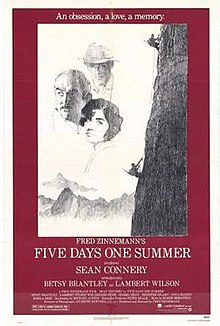
Five Days One Summer (1982, directed by Fred Zinnemann)
In 1932, Dr. Douglas Meredith (Sean Connery) is living in Switzerland with a much younger woman named Kate (Betsy Brantley), whom Meredith introduces as being his wife. When Meredith and Kate go on a climbing holiday in the Alps, they hire a young guide named Johann (Lambert Wilson). As they climb the mountains they not only discover a dead body but Meredith becomes suspicious that Kate might be falling for their guide. Meanwhile, Johann discovers that truth between Meredith and Kate’s forbidden relationship. Two men may go up the mountain but, in the end, only one man comes down.
Director Fred Zinnemann had a long career behind the camera, starting as an apprentice in Germany before coming to Hollywood in 1929. (He was one of the many German and Austrian directors to immigrate as things grew steadily worse in post-war Germany. He would soon be joined by Fritz Lang, Billy Wilder, Robert Siodmak, and many others.) Zinnemann was a master craftsman who made several good film without ever really developing a trademark style. Among his best-known (and Oscar-nominated) movies are High Noon, From Here To Eternity, The Nun’s Story, A Man For All Seasons, and Julia. Unlike a lot of his contemporaries, Zinnemann never resorted to changing his filmmaking habits in an effort to keep up with the new wave of the 60s and the 70s. As a result, he never humiliated himself the way that some of the other Golden Age directors did during the final years of their careers. Instead, he continued to put together well-constructed but old-fashioned and occasionally stodgy movies. Five Days One Summer was his final film. It was one that he had been trying to make for close to 40 years and the combination of the critical drubbing that greeted the film and its failure at the box office inspired Zinnemann to retire from filmmaking.
The love story at the center of Five Days One Summer is a bland one and Brantley doesn’t have much in the way of chemistry with either Connery or Wilson. But the love story is just a distraction from the true star of the movie, the mountain. Some of the mountain climbing segments are amazing to watch and knowing that the three stars were actually putting their lives at risk to get some of the shots makes it all the more impressive. At its worse, the film is a visually impressive but old-fashioned travelogue. At its best, it puts you right on the mountain. The film is far from perfect and it’s certainly not one of Zinnemann’s best but, at the same time, it is hardly the disaster that it’s often described as having been. I think some critics are so wedded to the narrative of the once-great director making a film that proves how out of touch he is with contemporary audiences (think of the final films of Otto Preminger, Richard Brooks, Elia Kazan, and George Stevens) that they overlooked that Zinnemann’s final film is a respectable, middle-of-the-road feature.
Ignore the film’s wan story and instead just concentrate on the amazing scenery and you’ll see that Five Days One Summer was not a terrible film for an old craftsman like Fred Zinnemann to go out on.
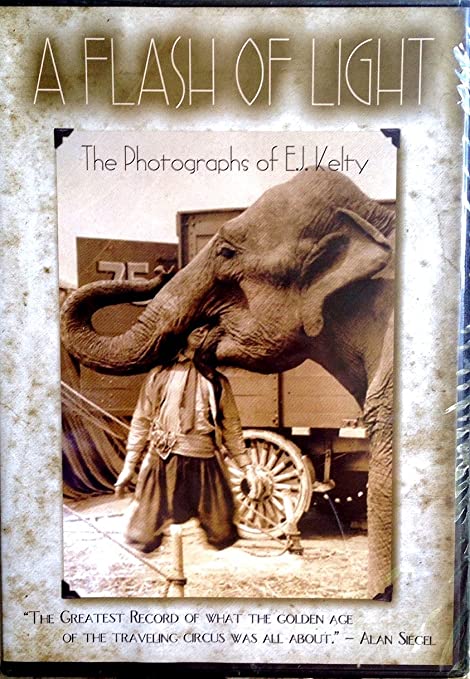
A Flash Of Light: The Photographs of E.J. Kelty (2005, dir. by Will Kelty)
Who was Edward J. Kelty?
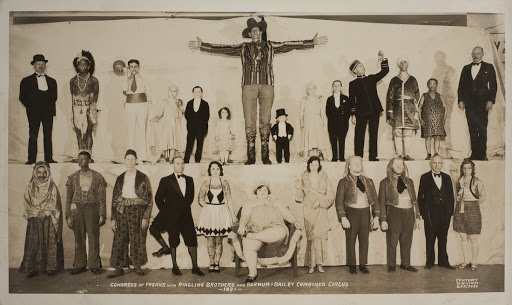
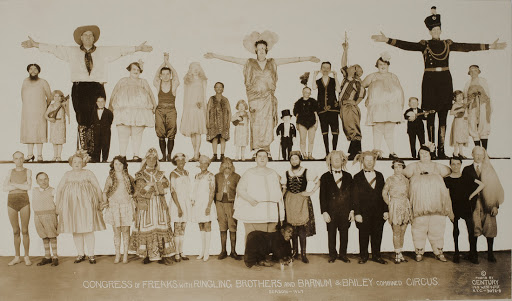
That’s the question that’s explored in the documentary, A Flash of Light. A hard-drinking Manhattan-based photographer, Kelty would spend his summers following the circus as it traveled across the country. Along the way. Kelty would take picture of the performers. Some of them were candid shots while some of them were posed but they all captured the humanity of a group of people who were usually not treated with much respect by the rest of society. From the 1920s through the 40s, Kelty captured indelible images of circus life but then, suddenly, he apparently abandoned both photography and the circus and he moved to Chicago. It was only after his death that collectors started to realize just how special Kelty’s photographs were. In the documentary, one collectors says that he hung one of Kelty’s pictures between pictures taken by Diane Arbus and Irving Penn and that Kelty’s picture was the one that visitors always commented upon!
Featuring hundreds of Kelty’s photographs, along with interviews with collectors and his surviving family members, this documentary gives Kelty his due. While Kelty’s personal life may remain mysterious, his art can speak for itself and A Flash of Light shows not only why Kelty’s photographs are so popular among collectors but also why they are such important documents of their time and place.
I recommend A Flash of Light to anyone who is interested in either the circus or photography.
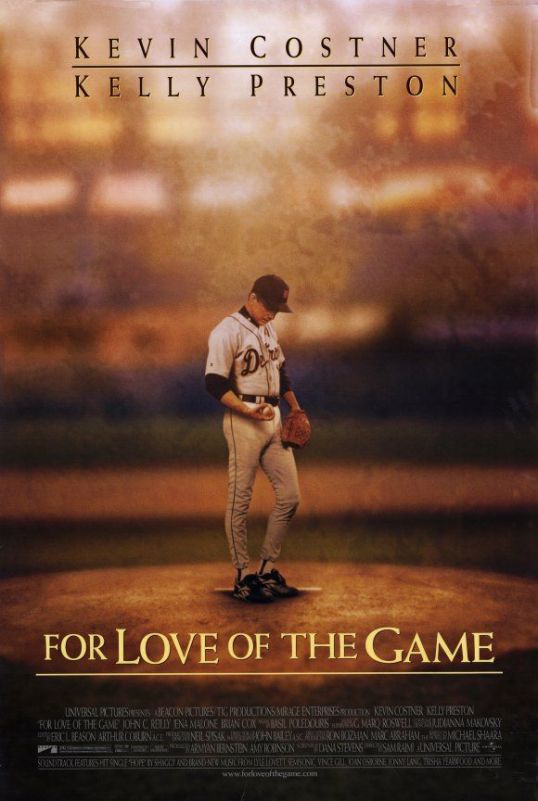
For Love of the Game (1999, dir. by Sam Raimi)
Last week, the Dodgers won the World Series and brought the 2020 MLB season to a close. For me, it was a disappointing season because the Rangers ended up with the worst record in the American League and came nowhere close to the playoffs. I should be used to that by now but it still hurts every season.
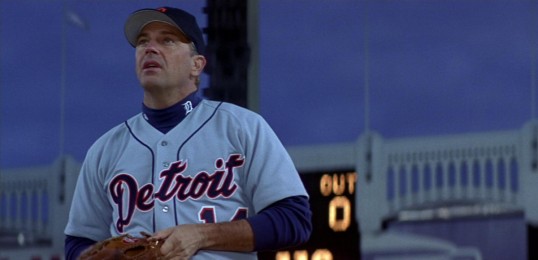
If only we could have had a pitcher like Billy Chapel, who Kevin Costner plays in For Love of the Game. Billy Chapel is a forty year-old veteran who has been playing baseball his entire life and who has spent his entire major league career as a member of the Tigers. Before the start of the team’s final game against the Yankees (the Yankees have already clinched the playoff berth while the Tigers are at the bottom of their division, kind of like my Rangers), Billy is told that the Tigers have been sold and that Billy is going to be traded to the Giants. Will Billy go to San Francisco or will he retire and go to London with the woman he loves, Jane Aubrey (Kelly Preston)?
That’s the decision that Billy is going to have to make. But first, Billy’s going to throw a perfect game against the New York Yankees.
While Billy is pitching the game, he’s also thinking about Jane and having flashbacks to how they first met and fell for each other. Billy loves Jane but he also loves playing baseball and it keeps the two of them apart. Jane doesn’t want to be a baseball groupie and she needs a man who she knows is going to be there for her and her daughter, instead of spending most of the year traveling around the country. Billy, meanwhile, doesn’t want to give up the game that’s defined his life. As Billy throws his perfect game, he has to decide whether or not to keep playing until he can no longer get the ball across the plate or whether to start a new chapter with Jane. Meanwhile, Jane is stuck in an airport, watching Billy play the game of his life.
For Love Of The Game is a good love story but it’s a great baseball movie. I loved the scenes of Billy standing out on the mound, carefully evaluating each batter while blocking out all of the noise around him. (The only villains in this movie are the New Yorkers who won’t stop yelling at Billy during the game.) I enjoyed the interplay between Billy and the catcher (John C. Reilly) and I especially appreciated the way that the movie showed that it takes more than a good pitcher to have a perfect game. It takes teamwork and focus. It’s not just Billy’s perfect game. It’s the entire team’s perfect game.
For Love of the Game may be a romantic drama but it’s also a celebration of everything that makes baseball great. It’s America’s pastime and this movie shows why. Watching Billy Chapel get his perfect game made me look forward to seeing what will happen next year. Who knows? Maybe the Rangers will even shock everyone and make the postseason. If Billy Chapel can throw a perfect game while playing the Yankees in New York City, then anything can happen!
Come Fly With Us! The Flight Attendants Of The Pulp Era
While recently looking through some old pulp covers, I couldn’t help but notice a recurring theme.
Flight attendants!
During the pulp era, flight attendants were apparently a popular subject. Whether they were thwarting hijackings or trying to land the perfect pilot husband, flight attendants lived dramatic, exciting, and sexy lives! It was enough to make me wonder if maybe I made a mistake when I decided that I didn’t want to go to grow up and be a flight attendant. (I was ten so what did I know?)
Here’s just a sampling of pulp covers featuring flight attendants dealing with everything from hijackers to more earthbound pursuits. Where known the artist has been credited.
Enjoy your flight!
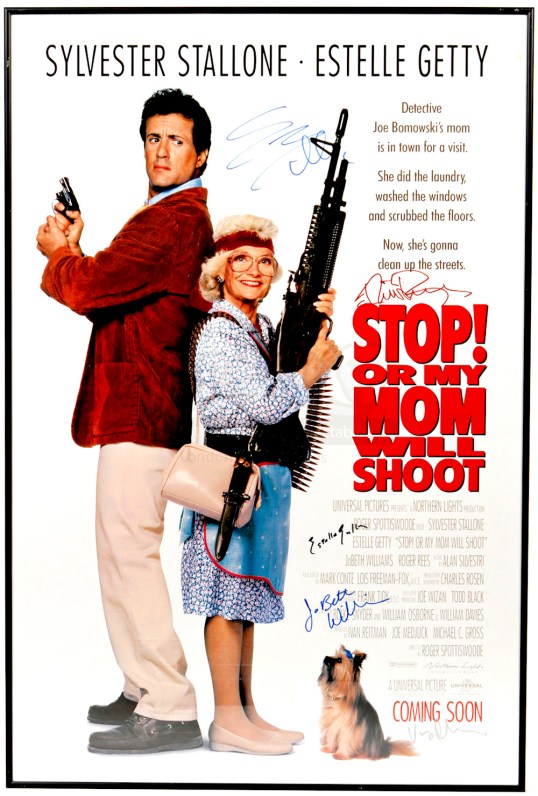
Stop! Or My Mom Will Shoot (1992, dir. by Roger Spottiswoode)
I always thought this was a made-up movie but it does exist! I just watched it on Showtime. This thing is real!
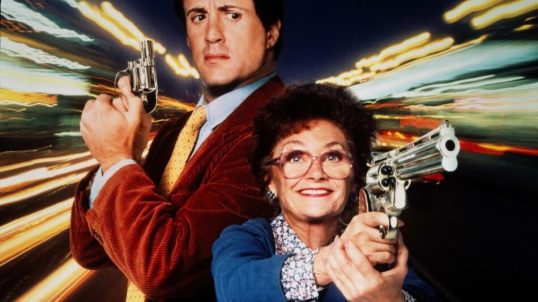
Sylvester Stallone is a tough cop whose mother (Estelle Getty) comes to visit him. She witnesses a murder and, even though she could easily identify the killers and get them off the streets and save lives, she decides to lie to the police because she’s looking for an excuse to spend more time with her son. Mother and son team up to take down the bad guys and Sylvester Stallone shouts, “Stop! Or my mom will shoot!”
I laughed a few time when the movie started, because it was actually funny to see Sylvester Stallone freaking out because his mom was coming to visit. I even laughed when his mother decided to clean his service revolver with Clorox. I probably shouldn’t have laughed when Estelle Getty pointed the barrel of the gun right at her face so that she could check to see if it was loaded but I couldn’t help myself.
But then, mom witnesses the murder and lies to the police and Stallone has a dream where he’s an adult but he’s still wearing a diaper. There are car chases and shoot outs and Getty tries to help Stallone hook up with his boss by sending her a hundred red roses. Getty shoots a man and then says that no one hurts her boy. During the entire film, Stallone has a look on his face like he knows that he’s just made the worst decision of his life but it’s too late to get out of it now. Stop! Or My Mom Will Shoot really one has one joke, which is Sylvester Stallone being nagged and embarrassed by his mom. That jokes get stale after 15 minutes. By the time mom actually shoots, there’s nothing left.
Artwork of the Day: The Sky Before Election Day

by Erin Nicole