
Artist Unknown
Artist Unknown


After spending the last couple of years mainly re-visiting old material (as opposed to merely re-printing it, given that he’s made changes ranging from the significant to the less so to pretty much all his earlier comics in their new iterations), it’s nice to see that Minneapolis cartoonist David Tea is back to producing original stuff with Five Perennial Virtues #11, the latest issue of his intermittent self-published series that’s been going for, what? Nearly two decades now?
My, how time flies — even if, in Dave’s ‘zines, it seems to either crawl or loop back in on itself. Or both. In any case, the “Broken Pieces” subtitle for this issue is entirely apropos, and while tonally and structurally it’s of a piece (or, if you prefer, of a broken piece) with previous installments, it’s also quite different and fairly unique unto itself. Spoiler alert, then : I think you’re…
View original post 756 more words
Oh, Arkansas.
As far as states go, Arkansas usually doesn’t get much respect. In a country where much of the culture is dominated by city-dwelling secular liberals, Arkansas is a state the remains stubbornly rural, religious, and conservative. If your grandparents were a state, they’d probably look a lot like Arkansas. Arkansas is viewed as being old-fashioned and when it does make the news, it’s usually not for anything that anyone in the state particularly wants to brag about. Democrats will always view Arkansas as being the home of Mike Huckabee. Republicans will never forgive the state for springing the Clintons on the rest of the nation. (Interestingly enough, Mike Huckabee and Bill Clinton both grew up in the same tiny town.) Little Rock has gangs and government corruption. Hot Springs has gamblers looking to hide out from the mob. Fouke has the Boggy Creek Monster while Ft. Smith is best-known for having once been home to the hanging judge, Isaac Parker. You get the idea. When it comes to the way that the rest of the country views the state, it often seems as if poor Arkansas just can’t catch a break.
With all that in mind, I have to say that I really love Arkansas. My paternal grandparents lived in Arkansas and I’ve still got relatives all over the state. Arkansas was one of the many states where my family lived while I was growing up. (The others were — deep breath — Texas, Oklahoma, New Mexico, Colorado, and Louisiana.) We would stay in Arkansas for months at a time, depending on how well my mom and dad were getting along at the time. It’s an unpretentious state, one that’s full of friendly, no-nonsense people and beautiful countryside. I have a lot of good memories of Arkansas. It’s always in the back of my mind that, wherever I’m living, I can always just go back to Arkansas and spend the rest of my life living in a small town with my cousins. Of course, I’d probably end up miserable over the lack of movie theaters. Whenever I’m living in the city, I find myself yearning for the simplicity and decency of the country. Whenever I’m in the country, I find myself missing the excitement of the city.
The Natural State (as Arkansas is officially nicknamed) is not only the setting for some of my most cherished memories. It’s also the setting for a film called, appropriately enough, Arkansas. The directorial debut of actor Clark Duke, Arkansas tells the story of four very different men. Kyle Ribb (Liam Hemsworth) is quiet and rather stoic. Swin Horn (Clark Duke) is talkative, eccentric, and perhaps a bit too cocky for his own good. They both work at a national park, where their boss is a veteran ranger named Bright (John Malkovich). Of course, it doesn’t take a lot of effort to notice that neither Kyle nor Ribb really seem to do much work at the park. And, for that matter, Bright certainly does own a big and impressive house for someone who has spent the majority of his life as a ranger….
Kyle, Swin, and Bright are actually drug dealers. They transport drugs all over the southern half of the United States. Kyle and Swin are supervised by Bright. Bright, meanwhile, reports to the mysterious Frog. Kyle and Swin have never actually met Frog and there are rumors that he might not even exist. Of course, the film has already revealed to us that Frog (played by Vince Vaughn) does exist and is a local pawnshop owner.
Kyle narrates the film, informing us that the difference between Southern organized crime and Northern organized crime is that, in the South, it’s not all that organized. As Kyle explains it, the infamous Dixie Mafia is not so much an organization as it’s just a collection of undisciplined lowlifes who have no real integrity or loyalty to anyone else. When you become a drug dealer in the South, you’re a drug dealer for life. There’s no going back if you change your mind. You start out at the bottom of the ladder and, whenever someone above you if either murdered or imprisoned, you get your chance to move up. No one is ever sure who is working for who or who can be trusted. Every order from the boss is examined and re-examined as the two dealers try to figure out whether or not they’ve won the trust of the mysterious Frog.
Unfortunately for Kyle and Swin, a misunderstanding leads to violence and several deaths. With no way to directly communicate with Frog to let him know what exactly happened, Kyle and Swin know that their lives could be in danger. The film follows Kyle and Swin as they prepare for their ultimate meeting with Frog while, at the same time, detailing in flashback how Frog himself eventually came to his position of power. Throughout the entire film, we watch as history repeats itself. As Kyle said, once you’re a drug dealer, you’re a drug dealer for life.
Arkansas is a surprisingly low-key film. Kyle, Swin, Bright, and Frog all manage to be both very laid back and very aggressive at the same time. (Anyone who has spent anytime with a large group of rednecks will understand what I’m talking about.) As a director, Clark Duke is as interested in capturing the rhythms of every day life in Arkansas as he is in orchestrating the inevitable violence that results from all of the film’s betrayals and mistakes and some of the best scenes in the film just feature Kyle and Swin talking about nothing in particular while driving down the interstate. The film’s mix of cheerful goofiness and existential horror will be familiar to anyone who has ever gotten lost on the way to Hot Springs.
Liam Hemsworth and Clark Duke are sympathetic in the lead roles, though Hemsworth’s Southern accent does slip a few times. Swin meets a woman (Eden Brolin) in a grocery store and their subsequent romance manages to be both creepy and touching at the same time. John Malkovich is, as usual, wonderfully eccentric. That said, the film is pretty much dominated by Vince Vaughn, who plays Frog as being both dangerously ruthless and also as someone who understands that his eventual downfall is inevitable. Frog came to power by betraying his boss and, as played by Vaughn, Frog is very much aware that he’s destined to eventually be betrayed as well. Frog has made peace with both his place in the world and the reality of his situation and, in many ways, that makes him an even more dangerous character than he would be otherwise. He has nothing to lose and he knows it.
Obviously, I liked Arkansas, both the state and the movie. It’s an well-done work of Southern pulp.

Enjoy!
 Harry Freeman (Robert Culp) is a radio talk show host in California who specializes in abusing his listeners. They call in and they tell Harry their problems and their opinions and then Harry tells them that they’re stupid and whiny. Despite (or maybe because of) his abrasive style, Harry is very popular. Everyone on the California coast listens to him in the morning.
When a depressed teenage girl named Ingrid (Elayne Heilveil) calls his show and says that she’s going to kill herself, Harry doesn’t taker her seriously and tells her to go ahead and do it. It’s only after he hangs up on her that he realizes that she might have actually been telling the truth. When Harry calls the cops to tell them about the call, they treat him in much the same way that he treated Ingrid. They refuse to take him or Ingrid seriously.
Not getting any help from the police, Harry turns to his listeners. He asks them to help him track down Ingrid and to keep her from harming herself. The film alternates between scenes of Ingrid meeting people throughout the day and then Harry in his studio, taking calls from those people. Since Ingrid is no longer listening to Harry’s show, she has no idea that people are looking for her and it becomes a race against time to find her before she carries out her plans.
A Cry For Help is largely a showcase for Robert Culp, a talented actor whose career was often harmed by his own independence and reputation for being abrasive. That reputation made him the perfect choice to play Harry and Culp gives a terrific performance as a not particularly nice man trying to do the right thing for once. Interestingly, the film keeps it ambiguous as to whether Harry has really had an attack of conscience or if he’s just trying to save Ingrid for the publicity and the ratings. Even at the end of the film, it’s hard to know if Harry was really worried about Ingrid ending her life or if he was just looking to promote himself.
Along with Culp, the film’s cast is a who’s who of 70s television actors. Among those who Ingrid and Harry deal with during the day: Michael Lerner, Bruce Boxlietner, Ken Swofford, Chuck McCann, Julius Harris, and Gordon Jump. Seeing Jump in the film was especially interesting since he would later star in another production about the potential power of radio, WKRP In Cincinnati.
A Cry For Help is a suspenseful made-for-TV movie from 1975. It’s never been released on DVD but it is on YouTube.

Today’s song of the day comes form Ennio Morricone’s score for Lucio Fulci’s 1971 giallo, A Lizard In A Woman’s Skin! This may not be one of Morricone’s best-known scores but it’s still one of my favorites. It perfectly captures the feel of Fulci’s psychedelic thriller.
From Ennio Morricone, here is La Lucertola.
Previous Entries In Our Tribute To Morricone:

by Gilbert Darling
Enjoy!
 Tim Murphy (Don Johnson, with a huge mustache) is a Vietnam vet who is still haunted by his actions during the war. As a result, he can’t hold down a job, he’s abusive to his wife, and he’s woken up in the middle of the night by constant nightmares. One day, at the unemployment office, he meets another vet named Luke (Robert F. Lyons) and the two of them bond over their shared experiences. While Tim tries to come to terms with what happened during the war, his wife Paula (Lisa Blount) tries to keep the household together.
Barely released in 1985, Cease Fire is a largely but unfairly forgotten Vietnam film. According the film’s imdb page, Don Johnson once told an interviewer that he couldn’t even remember starring in a film called Cease Fire. That piece of trivia sounded too good to be true and, after doing a google search, I have not been able to come across any interviews where Johnson says that. In fact, in an interview with the AV Club, Johnson says that he filmed Cease Fire in Miami shortly after doing his first audition for Miami Vice. According to Johnson this was in the early stages of Miami Vice‘s development, before Michael Mann was even attached to the project. Since Miami Vice premiered (with Mann producing and Johnson starring) in 1984, that probably means that Cease Fire was filmed in either 1982 or 1983. Considering that it was a low-budget and talky film about a very unpopular war, it is not surprising to discover that it sat on the shelf for a few years before finally being released in order to capitalize on the sudden stardom of its main actor.
Even though both take place in Miami and feature Don Johnson as a Vietnam vet, Miami Vice and Cease Fire are as different as night and day. Cease Fire is a low-key and muted character study of a traumatized man who is struggling to face what happened in the past. There’s not much action but there is a lot of talking. Some of the dialogue is clumsy and obvious but both Don Johnson and Robert F. Lyons give good performance as the traumatized vets and Cease Fire is honest enough to admit that, even if he does take a few steps in the right direction, Tim still has a long road ahead of him. Cease Fire, which never got a DVD release but which is available on Amazon Prime, is a sincere look at the reality of PTSD and the struggle that many vets face when they first return home. It’s not a perfect movie but it’s saved by its own good intentions and Johnson’s sincere performance in the main role.
Cease Fire was also the first film to be directed by David Nutter. Nutter is today probably best known for directing several episodes of Games of Thrones, a show that has even less in common with Cease Fire than Miami Vice.
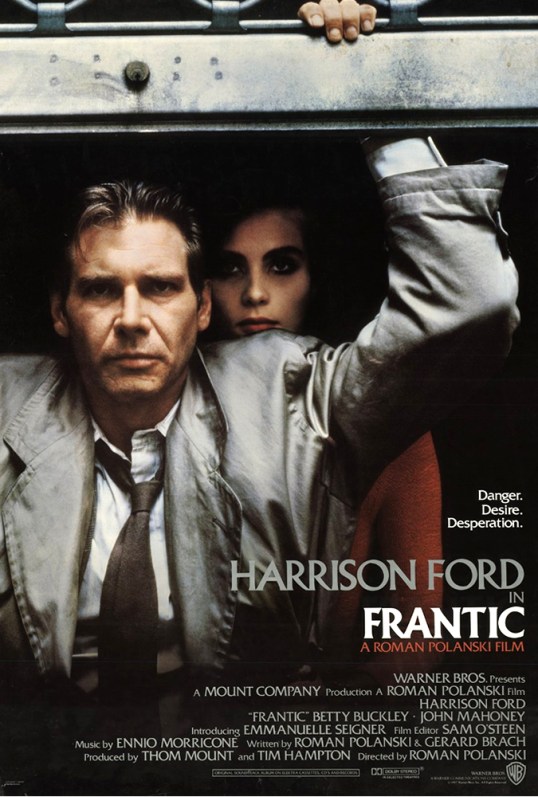
Today’s song of the day comes from the 1988 film, Frantic. This composition, like all of the other songs of the day that we’ve featured over the past two weeks, was composed by the great Ennio Morricone.
Here is the Theme From Frantic.
Previous Entries In Our Tribute To Morricone:
 Through the Shattered Lens