A Very “Explosive Comic,” Indeed


Ryan C. (fourcolorapocalypse)'s avatarRyan C.'s Four Color Apocalypse

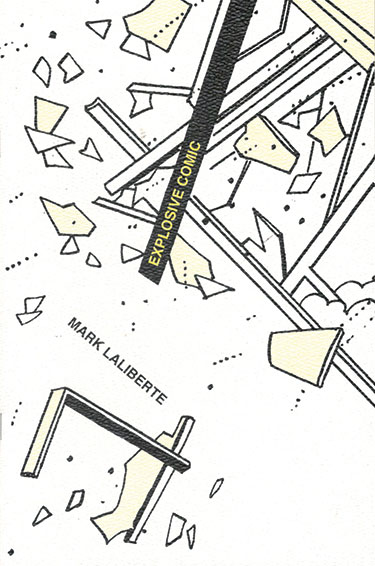
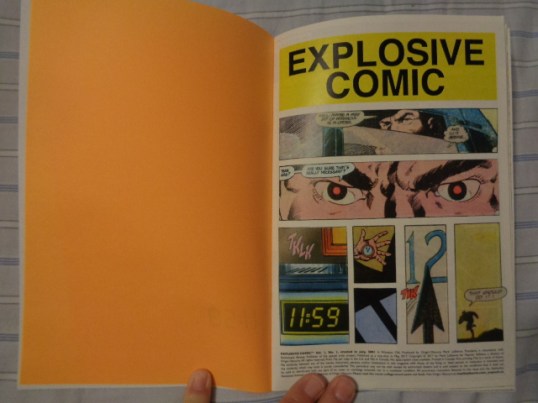
A curious and idiosyncratic exercise in collage that predates vaguely similar works by Samplerman by nearly two decades, Mark Liberte’s Explosive Comic remained mothballed after its production and assemblage in 2001 for reasons I really can’t fathom — then briefly popped its head up above ground to see publication via Swimmers Group in 2017 before disappearing again — and has now briefly re-emerged in 2020 thanks to John Porcellino. As someone once said, “what a long, strange trip it’s been —”

That being said, you know that you’re in “grab it while you can” territory with this one, and now it’s incumbent upon me to tell you why you should. Which, all things considered, is a pretty easy gig, because the work speaks for itself.

Arranged and assembled one panel at a time, the intention behind Laliberte’s meticulous and no doubt time-consuming labors is clear from the outset :…

View original post 555 more words

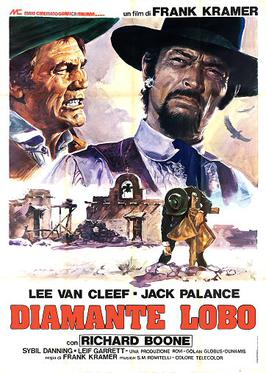
God’s Gun (1976, directed by Gianfranco Parolini)


During the dying days of the old west, outlaw Sam Clayton (Jack Palance) ride into the town of Juno City and try to take things over.  Because the sheriff (Richard Boone, who reportedly walked off the film before shooting was complete) is old and ineffectual, it falls to the town priest, Father John (Lee Van Cleef), to chase them off.  Father John is hardly your typical priest.  He’s a former gunfighter who, even though he no longer carries a weapon, still knows how to throw a punch.  Though he manages to put Sam and the gang behind bars, they are all eventually released.  The first thing they do is gun down Father John in front of his own church.

A mute child, Johnny O’Hara (Leif Garrett), flees town to track down Father John’s twin brother, Lewis (also played by Lee Van Cleef).  What Johnny doesn’t know is that Sam, who years ago raped Johnny’s mother (played by Sybil Danning), might actually be his father.  When Johnny finds Lewis, he finally manages to communicate what’s happened.  Lewis and Johnny head back to town so Lewis can get his vengeance  The only catch is that Lewis promised his brother that he would no longer carry a gun so he’s going to have to use his wits to get his revenge.

God’s Gun is a strange film.  It was one of the last of Spaghetti westerns but, though the director was Italian, it was filmed in Israel and it was produced by none other than Menahem Golan.  Golan brings the same producing aesthetic to God’s Gun that he later brought to many Cannon films — a few recognizable veteran actors (Jack Palance, Lee Van Cleef), an up-and-coming star (Leif Garrett), an international sex symbol (Sybil Danning), and a spin on a popular genre.  Like many of Golan’s films, the plot is occasionally incoherent and the entire production feels cheap and rushed but, at the same time, it’s hard to resist the mix of Van Cleef, Palance, and Danning.

Adding to the film’s strange feel is that every actor is dubbed, even the ones with trademark voices like Jack Palance and Lee Van Cleef.  Palance sneers throughout the entire film and could be giving a good performance but every time he starts to speak, you hear a voice that is clearly not Jack Palance’s and it makes it hard to get into the story.  There’s also an annoying squawking sound effect that explodes on the film’s soundtrack whenever someone is shot or whenever Lewis makes an appearance.

It’s not all a loss, though.  The Israeli desert is an effective Western backdrop and there are a few good camera shots.  When Lee Van Cleef and Jack Palance have their final confrontation, the picture starts to spin around and it’s pretty cool.  Finally, if you’re a Van Cleef fan, this is a rare chance to see him playing a traditional hero.  Because he’s dubbed, it’s hard to judge Van Cleef’s dual performances but this film does show that he could do more than just be a smirking killer.  He’s actually a pretty convincing priest.  Who would have guessed?

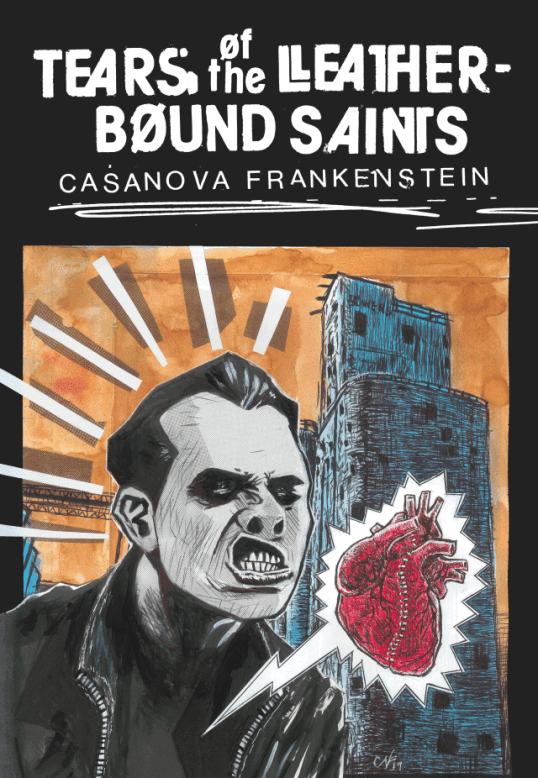
Casanova Frankenstein’s “Tears Of The Leather-Bound Saints” (“Tad Martin” #8) — What Happens After The Darkness Swallows You Whole?


Ryan C. (fourcolorapocalypse)'s avatarRyan C.'s Four Color Apocalypse

I’ve often remarked — no, I swear, I have! — that the best cartoonists are those with no fucks left to give, but leave it to Casanova Frankenstein (or, if you’re old-fashioned, Al Frank) to prove me wrong : you see, he’s living proof that the best cartoonists are those who never had any fucks to give in the first place.

Long-time fans and admirers of Cassie’s Tad Martin work have suffered from an embarrassment of riches in recent years, beginning with Profanity Hill/Teenager Dinosaur issuing The Adventures Of Tad Martin #sicksicksix after nearly a two-decade publishing hiatus for the title, continuing through the artist self-publishing The Adventures Of Tad Martin Super-Secret Special #1 and, later, The Adventures Of Tad Martin Omnibus hardcover through Lulu, and culminating in Austin English’s Domino Books releasing the dreadfully gorgeous Tad Martin #7. In between all that, however, Gary Groth’s “street cred” imprint, Fantagraphics…

View original post 887 more words

4 Shots From 4 Films: Special Jack Nicholson Edition


4 Shots From 4 Films is just what it says it is, 4 shots from 4 of our favorite films. As opposed to the reviews and recaps that we usually post, 4 Shots From 4 Films lets the visuals do the talking!

Today is Jack Nicholson’s 83rd birthday!

It’s been ten years since Jack Nicholson last appeared in a movie, the forgettable How Do You Know.  Rumor has it that he’s basically retired from acting, though it’s said that Nicholson himself has denied it.  However, whether he’s working or not, he remains a screen icon with a filmography that is a cinema lover’s dream.  He’s worked with everyone from Roger Corman to Stanley Kubrick to Milos Forman to Martin Scorsese and, along the way, he’s become a symbol of a very American-type of rebel.  Though often associated with the counter-culture, his style has always been too aggressive and idiosyncratic for him to be a believable hippie.  Instead, he’s one of the last of the beats, an outsider searching for meaning in Americana.

Over the course of his career, Nicholson has won three Oscars and been nominated for a total of 12.  He’s the only actor to have been nominated in every decade from the 1960s to the 2000s.  If he ever writes his autobiography, you know that we’ll all run out and buy a copy.  When the day comes that Jack Nicholson is no longer with us, it will truly be the end of an era.

Happy birthday, Jack Nicholson.  May you have many happy returns!

4 Shots From 4 Films

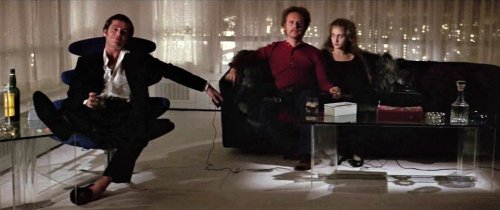
Psych-Out (1968, dir by Richard Rush)

Carnal Knowledge (1971, dir by Mike Nichols)

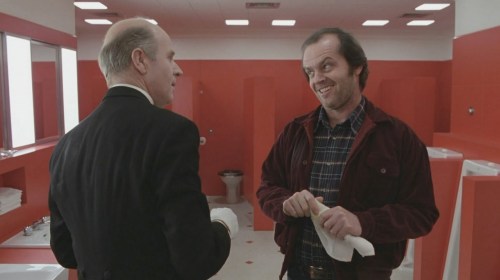
The Shining (1980, dir by Stanley Kubrick)

The Departed (2006, dir by Martin Scorsese)

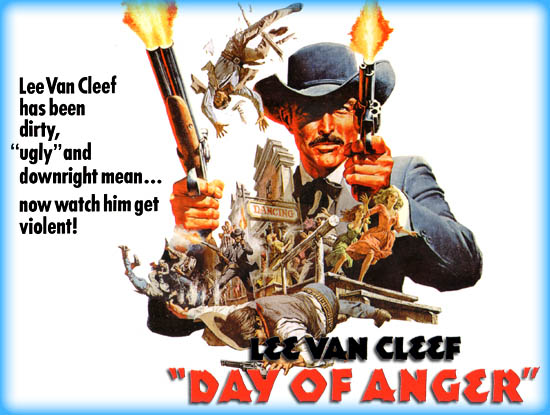
Day of Anger (1967, directed by Tonino Valerii)


During the dying days of the Old West, Clifton, Arizona is a prosperous frontier town.  The leaders of the town are wealthy and well-connected and the saloon has a strictly enforced policy when it comes to only allowing in the right people.  Frank Talby (Lee Van Cleef), the mysterious man who rides into town one day, is considered to be one of the right people.  Scott (Giuliano Gemma) is not.  Because he was born out of wedlock, Scott is looked down upon by the townspeople.  He makes a pitiful living sweeping the streets and doing odd jobs, all while trying to save up enough money to buy himself a gun.

Talby, who has his own reasons for hating the people of Clifton, takes Scott with him into the saloon.  After Scott sees Talby gun down a local roughneck, Scott begs Talby to teach him how to be a gunslinger like him.  Talby reluctantly takes Scott under his wing and teaches him how to be a real outlaw.  Scott also learns that the town of Clifton was founded by money that stolen during a robbery that Talby originally planned.  Talby now wants his money and his revenge.  Working with Scott as his enforcer, Talby takes over the town of Clifton.

At first, Scott has everything that he ever wanted.  The people who once mocked him now respect him as the second-fasted shot in town.  But when Scott’s former boss, Murph (Walter Rilla), reveals that Talby is not as benevolent a mentor as Scott thought he was, the student and teacher turn on each other.

Day of Anger is one of many Spaghetti westerns that featured an older gunslinger taking a younger one under his tutelage.  Lee Van Cleef is so confident and sure himself that it’s easy to see why Scott would idolize him.  Talby is an interesting character because, as ruthless and cold-blooded as he is, he does seem to sincerely like and care about Scott.  They’re both outsiders and they’ve both been screwed over by the town of Clifton and the movie hints that the aging Talby sees the man who he once was when he looks at Scott.  When Talby offers up one final lesson to Scott and tells him that once a man starts killing, he can never stop, Van Cleef says it with downbeat resignation, as if he realizes that Scott is now the one who will have to live his entire life alone, trusting no one, and always listening for the sound of a gun being cocked in the shadows.  Scott finally gets his gun but now he has to decide whether it was worth losing his humanity and Gemma does a good job playing his character’s arc.  Add to that an excellent score from Riz Ortolani and you’ve got a truly superior Spaghetti western.

One final note: Director Tonio Valerii would later be credited for directing another film about an aging gunfighter and his protegee, though there are rumors that the film itself was actually directed by its producer, Sergio Leone.  Starring Terrence Hill and Henry Fond, the entertaining My Name is Nobody re-imagines Day of Anger as a comedy.

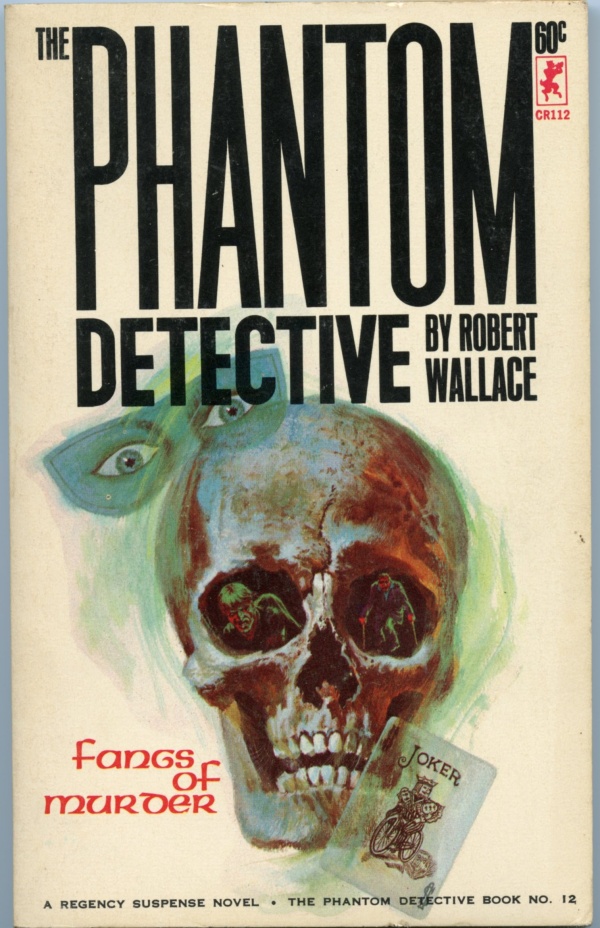
The Phantom Detective Covers of Robert Bonfils


by Robert Bonfils

In the 1960s and 70s, it was common for paperback publishers to reprint old pulp stories in novel form.  Though the stories would remain the same, the covers would often be updated to reflect the times and to hopefully bring in new readers.

Corinth Books, which previously specialized in softcore paperbacks, reprinted over twenty of the Phantom Detective’s adventures.  The Phantom Detective had originally been published from 1932 to 1952 so. when Corinth started reprinting his tales, they knew that they needed a cover artist who could make the stories appeal to a contemporary audience.  They selected the legendary Robert Bonfils, who was one of the first artists to be profiled on this site.

Below are the adventures of the Phantom Detective, reimagined by Robert Bonfils: