
by Ann Cantor
by Ann Cantor
Though everyone is probably most familiar with Joan Jett’s cover of the song, I Love Rock N Roll was originally recorded by a London-based group called Arrows.
Though Arrows were only together for three years (from 1974 to 1977), they were popular with British teenagers and they even had their own TV show on Granada Television, where they would play their own songs and introduce other acts. This video for I Love Rock N Roll comes from that television show. This is probably from the same episode of the show that Joan Jett saw in 1976 while she and the Runaways were on tour in the UK. She liked the song so much that she covered it when she made her first solo album. Her version, of course, went on to become a huge hit.
(As popular as they were in the UK, Arrows were basically unknown in the United States. During the time they were together, they only performed in the U.S. once and that was for an episode of Don Kirshner’s Rock Concert in 1975. When Jett released her version of I Love Rock N Roll, most American listeners were unaware that it was a cover.)
The song was written by Alan Merrill, who was the lead singer for Arrows. Sadly, Merrill, who was sick with COVID-19, died on Sunday. Today’s music video of the day is dedicated to his memory.

Last week, I sheltered in place.
This week, I sheltered in place.
Next week, I imagine that I will shelter in place.
This is getting annoying but at least I’m getting a lot written.
Having seasonal allergies in the middle of a Coronavirus pandemic is a whole new level of stress. I woke up every morning congested and with a slightly sore throat and then I wait an hour to see if they go away. Oh well. Someday, I’ll go to a movie again.
Until then….
Films I Watched:
Television Shows I Watched:
Books I Read:
Music To Which I Listened:
News From Last Week:
Links From The Site:
More From Us:
 Frank Miniver (James Woods) is the prison guard that everyone calls Fast-Walking. He’s involved in almost every vice that a man living in a small town in Oregon can be involved in. He takes bribes. He usually shows up for work stoned and what he doesn’t smoke, he sells to the prisoners and the other guards. He’s got a second job, running a trailer park brothel behind his cousin’s general store.
Frank’s cousin, Wasco (Tim McIntire), has been incarcerated and he expects Frank to help him take over the prison. At first, Frank has no problem working with Wasco and letting his cousin have free reign of the cell block. Wasco has soon established himself as the most powerful man behind bars. When a black power activist named Galliot (Robert Hooks) arrives at the prison, Wasco wants to arrange for him to be assassinated. Meanwhile, Galliot has offered Frank even more money to help him escape from the prison.
While Frank tries to keep both sides happy and make off with some money for himself, he’s also sleeping with Wasco’s accomplice on the outside, Moke (Kay Lenz). Originally, Wasco ordered Moke to seduce Frank in order to keep Frank in line but, as Moke and Frank’s relationship continues, Wasco starts to get jealous and starts plotting to put Frank back in his place.
Fast-Walking is a gritty film that features a good deal of dark humor. Unfortunately, the film’s many different parts never really come together and the film never strikes the right balance between comedy and drama. James Woods is perfectly cast as Frank and the underrated Kay Lenz does wonders with an underwritten role but Tim McIntire is a less than ideal Wasco. McIntire was a good actor but, physically, he’s all wrong for a character who is supposed to be so intimidating that he can walk into a prison and automatically take it over. Wasco is written and played as being such a cartoonish character that it’s difficult to take him or his plots seriously. The movie works best when it’s just focuses of James Woods’s nervy performance and Frank’s attempts to keep the other prison guards (including M. Emmett Walsh) from discovering his own racket.
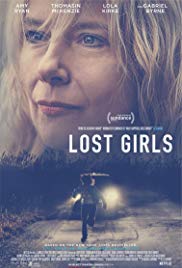
Lost Girls tells the true and infuriating story of Mari Gilbert and her search for her oldest daughter, Shannan.
Mari Gilbert is a single mother who is works as a waitress and struggles to give her children the best life that she can. She’s still haunted by a decision that she made years ago to temporarily put her three daughters into foster care. Though she eventually reclaimed two of her daughters, her eldest — Shannan — has basically been on her own since she was sixteen. Shannan, who is now 24, visits her mother and her sisters on a semi-regular basis. Despite the fact that Shannan claims that she’s just a waitress (like her mother), Shannan always seems to have a lot of money on her. Mari has her suspicions about what Shannan’s doing to make that money but she keeps them to herself.
Then, one day in May, Shannan disappears. Mari can’t get the police to take her seriously when she says her oldest daughter has vanished. They say that Shannan left on her own and will probably return at some point. They dismiss Mari’s concerns, telling her that her daughter was a prostitute and therefore, by their logic, unreliable. Even when Mari gets strange phone calls from a doctor who lives in a gated community in Long Island, the police refuse to take her seriously.
However, Mari then discovers that Shannan called 911 the night that she disappeared. Despite the fact that Shannan sounded panicked, the police waited an hour before responding to her call and, by the time they arrived, Shannan had disappeared. It’s only when Mari goes to the media that the police actually start to search the area of Long Island where Shannan disappeared. The police discover the bodies of several sex workers, all murdered by the same unknown killer.
However, they still don’t find Shannan’s body. Though Mari and her daughter, Sherre (Thomasin McKenzie), are convinced that Shannan is one of the killer’s victims, the police continue to insist that Shannan probably just ran off on her own. In fact, the local police commissioner (Gabriel Byrne) finds himself being pressured to do something about Mari because her now constant presence on TV is making the entire community look bad.
Meanwhile, Mari finds herself caught up in a personal feud between two men who live in the gated community, an amateur investigator (Kevin Corrigan) and a shady doctor (Reed Birney) who has a history of making inappropriate phone calls….
Lost Girls is an interesting but frustrating film. Some of that is because the story on which the film is based did not have a happy ending. The Long Island serial killer has never been identified or captured. The most obvious suspect was never charged with anything and subsequently moved down to Florida. Mari never got justice for Shannan and, sadly, was eventually murdered by her youngest daughter. (The murder is acknowledged via a title card but it is not actually depicted in the film.) As a result, the film itself doesn’t really offer up any of the payoff that you would normally expect to get after devoting 90 minutes of your life to it. It’s frustrating but, at the same time, its understandable.
Amy Ryan gives a great performance as Mari. That shouldn’t shock anyone. She makes you feel Mari’s pain, fury, and guilt. To its credit, the film does shy away from the fact that Mari often looked the other way when it came to how exactly Shannan was making the money that she regularly sent back to her family and Amy Ryan perfectly captures Mari’s struggle to not only get justice for her daughter but also to forgive herself. Unfortunately, the film is a bit less convincing when it deals with the police and the suspects. The film, for instance, can’t seem to decide whether or not Gabriel Byrne’s character is indifferent, incompetent, or just overwhelmed by a bad situation. By that same token, the doctor and his neighbor both seem oddly underwritten and underplayed. Obviously, the film can’t just come out and accuse a real, living person of murder (especially when that person hasn’t been charged with anything) but it still makes for a frustrating viewing experience.
Where Lost Girls succeeds is at creating a properly ominous atmosphere. Every scene seems to be filled with dread and, from the minute that Mari starts her investigation, you feel nervous for her. She’s taking a true journey into the heart of darkness. The film leaves you angry that the police refused to search for Shannan. Sex workers are regularly preyed upon and, because of what they do for a living, society often looks the other way. That’s how you end up with killers like The Green River Killer and the Long Island serial killer. They don’t get away with their crimes because they’re clever. They get away with it because, far too often, society refuses to care about their victims. Lost Girls is an imperfect film but its heart is in the right place and its message is an important one.
Other Entries In The 18 Days Of Paranoia:
Last night, I watched the latest Lifetime premiere, A Mother Knows Worst!

Why Was I Watching It?
Because it was on Lifetime!
Plus, I loved that title. A Mother Knows Worst! I’m seriously hoping that, once this lockdown ends, I’ll run into a really obnoxious woman who is carrying around a baby so that I can snap at her, “A mother knows worst!”
What Was It About?
Okay, so this is kind of a complicated movie and there’s no way for me to totally tell you what it was about without spoiling some of the film’s biggest twists. So, I’ll just tell you what it pretends to be about while assuring you that there’s a few twists and turns that make this film a bit more interesting than you might think from just reading a rudimentary plot description:
Olivia (Kate Leclerc) and Brooke (Victoria Barabas) both gave birth on the same night. According to the hospital, Olivia’s baby died while Brooke’s survived. 6 months later, Olivia’s husband, Harry (Jeff Schine), has a job working for Brooke’s husband, Glen (Todd Cahoon). When Olivia sees Brooke’s daughter, she says that she felt an instant connection to the baby, a connection that Brooke feels that she has yet to establish. While Brooke is happy with the idea of Olivia helping to look after her daughter, both Harry and Glen are concerned that Olivia may be forming an unhealthy obsession with Brooke’s daughter.
Meanwhile, there’s a murderer on the loose and….
Well, that’s all I can really tell you. I know it sounds like a typical Lifetime baby kidnapping film but you’ll just have to take my word for it that it’s actually a bit more complicated than that.
What Worked?
This film was full of twists and turns! Seriously, I love Lifetime film but it’s rare that they take me by surprise. In fact, one of the appeals of the movies they show on Lifetime is that they tend to be predictable. A Mother Knows Worst, however, had some pretty effective surprises and it definitely kept you guessing as to who could be trusted and who should be feared.
Katie Leclerc and Jeff Schine both did a great job playing Olivia and Harry. In fact, the whole film was pretty well-acted. Everyone did a good job of keeping the viewers off-balance.
I loved Brooke and Glen’s house! That pool was to die for.
What Did Not Work?
Unfortunately, towards the end of the film, there’s a lot of flashbacks and they tend to kind of bog down the film’s finale. Though it’s a cliche, sometimes it’s best to just have the villain give a monologue explaining all of their evil deeds, especially when the other option is stopping all the action for a lengthy flashback.
“Oh my God! Just like me!” Moments
Olivia had red hair just like me so, of course, I totally related to her and was on her side. It’s a scary world out there and those of us blessed with the best hair color in the world have to stick together.
Lessons Learned
Take nothing for granted, not even the plot of the latest Lifetime film.

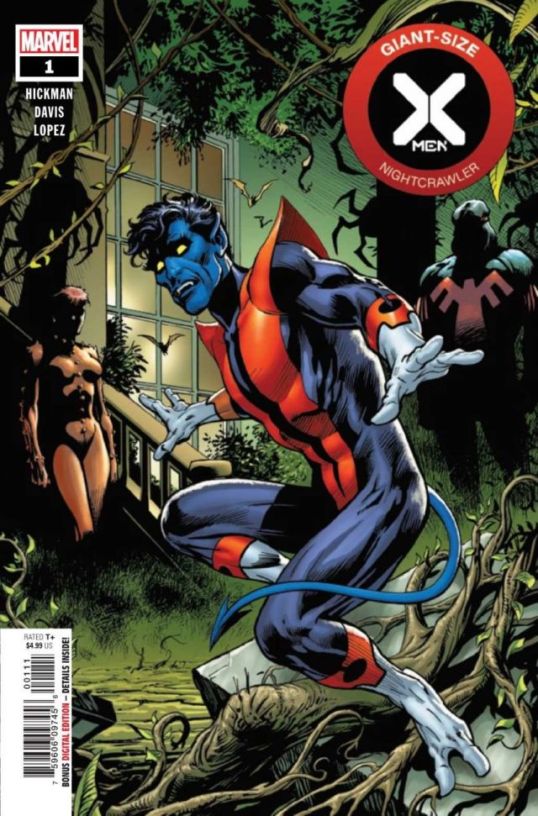
The last week of new comics until who-knows-when owing to the Diamond shut-down — okay, owing to COVID-19 is probably a more accurate way of putting things — yielded a mixed bag of reading for yours truly, so let’s take a look at what was in said bag before this column goes on hiatus (to be temporarily replaced by a standard full-length review post of a small press or self-published comic, as is my usual wont around these parts), shall we? Indeed we shall —
While it’s nice to see Alan Davis back drawing the House of Xavier — and it’s kinda nice to see the House of Xavier itself, come to think of it, given that it’s been abandoned in favor of the mutant island nation of Krakoa — Jonathan Hickman’s script for Giant-Size X-Men : Nightcrawler #1 reads like precisely what it is : an 8-page backup…
View original post 925 more words

by Ann Cantor
Are you tired?
Are you bored?
Are you stuck in a go-no where life?
Are you living in a dystopian future that was apparently inspired by Blade Runner?
Well, don’t worry. Spice Girls are here!
One thing that I like about the Spice Girls is that you could always sing along to their songs. The other thing I like about them is that, regardless of how simple their music may have been, their music videos were almost always ludicrously overproduced. That’s the case here, where Spice Up Your Life is transformed into an anthem for revolution.
Spice Up Your Life was directed by Marcus Nispel, who has subsequently directed a few features film that I didn’t care much for.
Enjoy!
 Stop me if you’ve heard this one before.
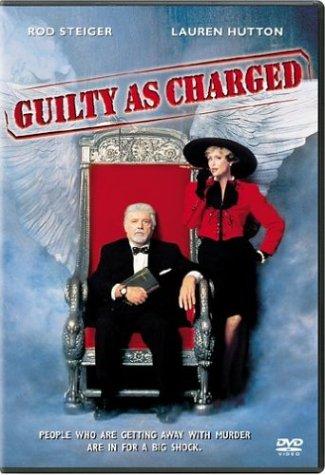
Kalin (Rod Steiger) is a crazy old religious fanatic who is rich enough to own a meatpacking plant and hire goons to work for him. Underneath the meatpacking plant, he has a secret prison and an electric chair that he uses to electrocute people who he feels have escaped justice. Helping out Kalin is a crazy preacher, played by Isaac Hayes (!), who waxes philosophically about how much he loves the smell of burning flesh.
While Kalin and the gang are executing people below ground, parole officer Kimberly (Heather Graham) is above ground and wondering why so many ex-cons are mysteriously vanishing. Kimberly is worried that someone may be executing them but then she gets distracted by a politician named Stanford (Lyman Ward). Stanford wants Kimberly to work on his campaign because she looks like Heather Graham and he’s a sleazy politico.
Meanwhile, a man named Hamilton (Michael Beach) has escaped from prison. Hamilton claims that he was framed for a murder that he didn’t commit but no one is willing to believe him. However, Hamilton is telling the truth and the murder was actually committed by Stanford! The only people who know that Stanford is the murderer are Stanford, his wife (Lauren Hutton!!), and his maid (Zelda Rubinstein!!!).
It all leads to one question: How did all of these talented people all end up in this crappy film!?
The strange thing about Guilty As Charged is that, even though the film is centered around the death penalty, the film itself doesn’t seem to have any opinion on the issue. Kalin and his followers are crazy religious fanatics who claim that they’re doing God’s work by executing people and Hamilton is an innocent man who has been marked for death so you would think that the movie is against the death penalty. But then, in a twist that makes no sense, Kalin reveals that he knows that Hamilton is innocent and he’s only using him to get to Stanford and suddenly, the film is for the death penalty. Kimberly is worried that someone is targeting ex-cons but, by the end of the movie, she’s targeting ex-cons herself even though nothing’s happened that should have made her change her mind.
Guilty as Charged is technically a comedy, though most of the jokes are too thuddingly obvious to provoke even the slightest of a smile. Hayes wins some laughs, just because he seems like he’s having fun. Rod Steiger bellows as if he’s getting paid by the decibel and doesn’t seem to be having any fun at all. Guilty as Charged isn’t funny and it’s not thought-provoking but at least it’s got Isaac Hayes.
 Through the Shattered Lens