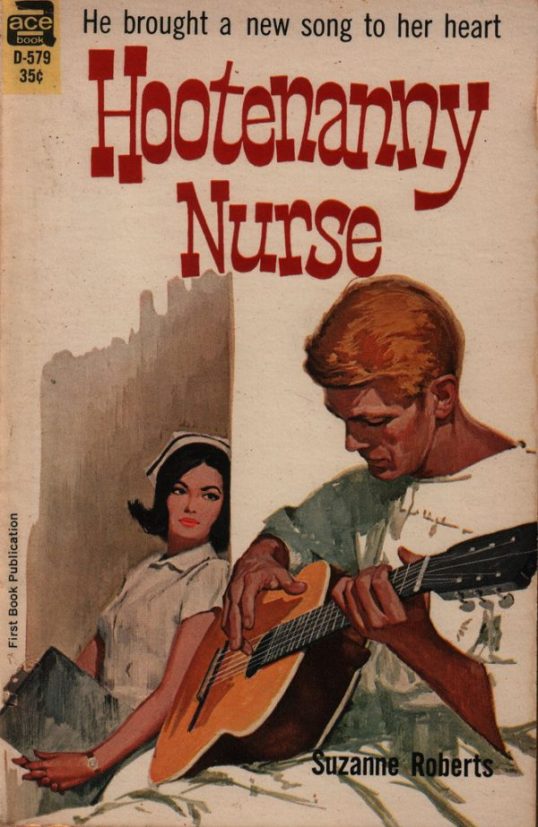
Artist Unknown
Artist Unknown


A silent, rural, two-lane road. A woman in a car on mission. A lifetime of things unspoken hanging thick in the air. And a palpable sense of loss.
Combustible ingredients, to be sure, but in the hands of Emi Gennis, they become Baseline Blvd, a short, clean-lined, visually and emotionally austere book about a journey to a place, sure, but also to a place within where few would dare to go. Where, perhaps, even fewer would come back from.
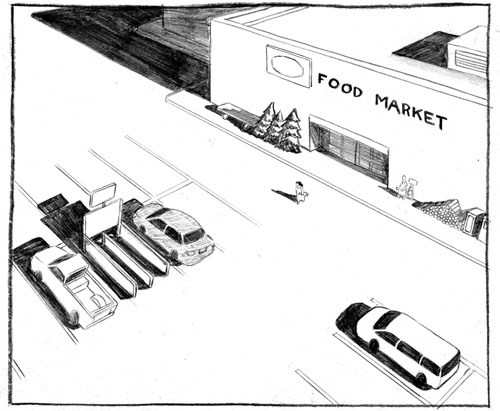
Okay, yeah, I said the ingredients here were combustible, but this is no Molotov of a comic — rather, Gennis sets things on a slow-burn simmer from the outset, and as flashbacks creep in and the scope and nature of what’s compelling our protagonist forward make themselves known, we realize we are following one raw, frayed, threadbare nerve all the way from point A to point B, and that those…
View original post 526 more words

L.A. 2017 is the Steven Spielberg film about which you’ve probably never heard.
To a certain extent, that’s understandable. Spielberg was only 24 when, in 1971, he directed L.A. 2017. It was a film that he directed for television. In fact, it was only his third directorial assignment. As opposed to the huge budgets that we tend to associate with a typical Spielberg production, L.A. 2017 was made for about $300,000. The entire film was shot in about 12 days. In fact, with a running time of only a scant 69 minutes, L.A. 2017 hardly qualifies as a feature-length film. L.A. 2017 has never been released on DVD or Blu-ray, making it a true oddity in Spielberg’s filmography. Despite the fact that Spielberg has credited L.A. 2017 with opening a lot of doors for him, it’s an almost totally forgotten film.
Of course, some of that is because L.A. 2017 really isn’t a film at all. Instead, it was an episode of a television show called The Name of the Game. The show was about Glenn Howard (Gene Barry), a magazine publisher, and the reporters who worked for him. L.A. 2017 was unique in that it was the show’s only excursion into science fiction. In fact, from everything that I’ve read about the show, it appears that L.A. 2017 was nothing like any of the other episodes of The Name of the Game. This episode was also unique because Spielberg directed it as if he was making a feature, as opposed to just another installment in a weekly series. If not for the opening credits (which announce, among other things, that we’re watching a Robert Stack Production), one could easily imagine watching L.A. 2017 in a movie theater, perhaps as a double feature with Beneath The Planet Of The Apes.
L.A. 2017 opens with Glenn driving down a mountain road in California. He’s heading to a pollution summit and, as he drives along, he awkwardly dictates an editorial into a tape recorder. Glenn worries that society may have already ruined the environment to such an extent that the Earth cannot be saved. As if to prove his point, Glenn starts to cough as he’s overcome by all of the smog in the air. His car swerves into a ditch and Glenn is knocked unconscious.

Welcome to the future
When he wakes up, he finds himself being rescued by men wearing wearing protective suits and masks. The sky is a sickly orange and an ominous wind howls in the background. Glenn’s rescuers take him to an underground city where he discovers that, somehow, he has traveled through time. The year is now 2017, which in this film looks a lot like the 70s except that everyone’s now underground and the landline phones are extra bulky. (Needless to say, watching 1971’s version of 2017 in 2019 is an interesting experience.) It turns out that the pollution got so bad that the surface of the planet became uninhabitable. The U.S. is now run by a corporation that is headquartered in Detroit. (Presumably, the Corporation is a former car company.) The U.S. is also at war with England, for some reason. No mention is made about what’s happened to Canada but, if Detroit’s still around, I assume at least some of Canada managed to survive as well.

The …. uh, Future.
Everyone in the future drinks a lot of milk and, when they’re not listening to cheerful announcements, they’re listening to the soothing music that the Corporation provides for them. Everyone in the future is also very friendly. We know this because everyone keeps assuring Glenn that he’s surrounded by friends. In fact, everyone in the future refers to one another by their first name because “it’s friendlier.” It’s also the law. It turns out that there’s a lot of laws in the future. In fact, the underground cities are pretty fascist in the way that they handle things. There are constant announcements encouraging people to pursue a career in law enforcement and anyone who disagrees with the Corporation ends up in a straight jacket. Glenn feels that maybe he’s been brought to the future so he can start a new magazine and challenge the status quo. The Corporation disagrees….

This is what happens when you don’t go underground in the future.
Okay, so there’s nothing subtle about L.A. 2017. From the villainous corporation to the heavy-handed environmental message, there’s nothing here that you haven’t seen in dozens of other sci-fi films. But the lack of subtlety doesn’t matter, largely because Spielberg directs with so much energy and with such an eye to detail that it’s impossible not to get sucked into the story. As opposed to the somewhat complacent Spielberg who has recently given us rather bland and safe blockbusters like Lincoln, The BFG, and The Post, the Spielberg who directed L.A. 2017 was young and obviously eager to show off what he could do with even a low budget and that enthusiasm is present in every frame, from the wide-angle shots of Glenn driving his car to the scenes of Glenn looking up at the shadowy executives and scientists who are staring down at him when he’s first brought to the underground city. As opposed to the sterile vision of so many other future-set films, Spielberg’s future feels as if it’s actually been lived in. When Glenn finds himself in a new world, it comes across as being a real world as opposed to just a narrative contrivance.
Of course, because L.A. 2017 was just one episode in a weekly series, Glenn couldn’t remain in the future and L.A. 2017 returns Glenn to the present in the most contrived and predictable way possible. Still, L.A. 2017 remains an entertaining example of what a young and talented director can do when he’s determined to be recognized. Watching the film, it’s easy to draw a straight line from Spielberg doing L.A. 2017 to doing Duel and then subsequently being hired for Jaws.
Incidentally, Joan Crawford is somewhere in this film. Crawford worked with Spielberg when he directed her in the pilot for Night Gallery and she was one of his first major supporters in Hollywood. Apparently, in L.A. 2017, she plays one of the people staring down at Glenn when he’s first brought into the underground city. I haven’t found her yet but she’s apparently there somewhere.
Unfortunately, L.A. 2017 has never been released on DVD or Blu-ray but it is currently available on YouTube.

Today’s music video of the day comes from the Baltimore-born rapper and producer, Sagat.
There’s actually two versions of this song. The first one, which was released in 1993 and which is still played in the clubs on The Block to this day, was called Fuk Dat and was a list of things that annoyed Sagat in ’93 and which are still annoying today. That version became a club hit but, when it was time to release the song commercially, it was obvious that the song would need a title that wouldn’t get radio stations fined by the FCC. Hence, Fuk Dat became the slightly cleaner Funk Dat.
The music video for Funk Dat was filmed on the streets of New York. The video features not only Sagat but also a really cool kid who has it up to here with the radio playing the same five songs over and over again. This video achieved perhaps its greatest exposure when it was featured on an episode of Beavis and Butthead. This song was also played on one of MTV’s dance shows on the 90s. The dancers would all shout, “Funk dat!” in unison but everyone knew what the song was actually saying.
Enjoy!
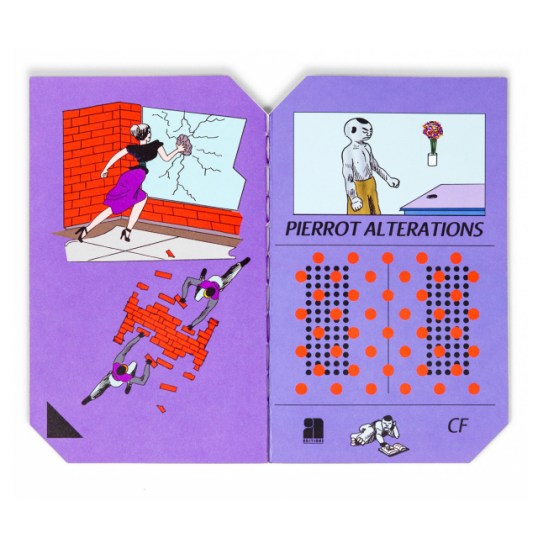
Somewhere, at some point, for some reason, some people are building a city. Only maybe they’re not people, since at least one of them shambles about on all fours. And maybe it’s not a city because all they’ve got finished so far is part of a wall — which is more than you can say for Trump. But hey, maybe they’re just waiting for Mexico to pay for the thing, too. And somehow, in some way, all of this has something to do with a post-modern retelling of the lamentable tale of Pierrot, the archetypal “sad clown” figure of literary history.
Possibly, at any rate.

You guessed it, the recently-released (via Anthology Editions, continuing their very strong publishing year) Pierrot Alterations is a C.F. comic. Or ‘zine. Or maybe even book. I prefer to think it occupies its own unique space somewhere between all three, but not necessarily beholden to…
View original post 522 more words
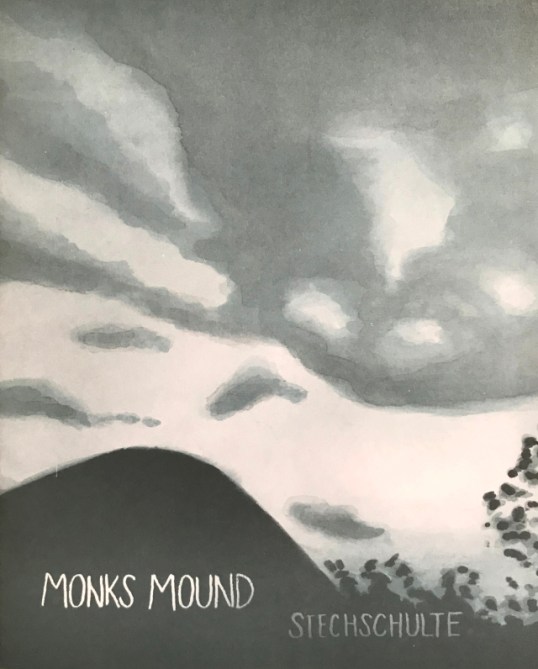
Oblique connections are a recurring theme in Conor Stechschulte’s ongoing Generous Bosom graphic novel series, but the disparate threads that run parallel to each other in that multi-faceted narrative appear to be heading for some sort of convergence as the sure-to-be-big finale approaches; in his latest self-published standalone comic, though, entitled Monks Mound (or, if you prefer, “Monk’s Mound,” as the titular location is referred to in the text of the book itself), the connective tissues linking one of the stories to the other are left entirely in the hands of the reader to either discover or, as is more likely to be the case, intuit for themselves. The end result is a challenging and deliberately disjointed read, part family drama and part history lecture, the overall tone and feel of which is something akin to an ABC After School Special written and directed by David Lynch.
Is that me…
View original post 905 more words

This episode was a true Detective Comics story. It had a eerie feel to it and I understand why- Carol Banker (Director) and Jason Hatem (Writer) are veterans of The X-Files and Supernatural. These shows are often grisly whodunnits and this episode fit that mold.
The direction and character development and dialogue are so confluent that it has an unsettling realism. You watch Dick go through a metamorphosis of grief and brutality into something new- something he doesn’t even know yet. The dialogue is quick and sharp slowly revealing the differences between Jason and Dick, building the tension between Dick’s uncertainty and Jason’s brutality. The last shot of the detective story pulls back with Dick alone, staring at what Jason has wrought. There are crippled police everywhere. The cost of Dick saving his friend is the unleashing of this hurricane of cruelty wearing the costume that he once proudly wore.
This episode picks up right after the last one. It’s uncertain why Jason Todd was there to help Dick. It turns out that Dick and Jason are both Lo-Jacked with tracking devices because of Batman. Batman discovered that someone is hunting down all of the members of the circus that Dick grew up with- essentially his family other than Bruce. This person is the son of the man who killed Dick’s parents. We learn that five years ago Dick got the revenge upon his parents’ killer. Although Dick didn’t do the fatal blow, he purposefully stood back so the killer would die at another’s hands.
This whodunnit also serves as a Mid-Point Crisis and realization for Dick’s story arc. He doesn’t want to be Robin, but he carries the suit across the country. Jason Todd is the new Robin, but Jason, unlike Dick, is pure Robin. Batman had a code of non-killing and certainly forbade beating up people because you could. Jason Todd does not follow that; in fact, he likes to brutalize people for sport. Jason Todd is rage and violence distilled to its darkest conclusion. This is in line with the comics where Jason becomes the Red Hood and straight up murders criminals.
As they work together in the episode to track down the killer, Dick realizes that he’s not Robin anymore, but he’s not on the sidelines either. The Melting Man essentially kills Dick Grayson’s Robin persona because by forcing Dick to work along side Jason to stop him, it causes Dick to realize that he’s no one’s sidekick and that he isn’t a pure psychopath either.
Dick sees Jason’s thrill in beating up cops and crippling them. Dick tries to explain to Jason that this embrace of darkness costs your soul, but Dick realizes soon that you can’t lose something that you never had. Jason Todd is like the Joker – in Christopher Nolan’s words- The Joker is an absolute. The Joker and Jason Todd are the Id of humanity- both absolutes; there is no reasoning with them. They want and do and they do -without feeling.
Dick is likely to evolve into Nightwing, but more importantly we see in this show very careful layering and texture added over time for every character. It really brings out the goose-flesh to see these people struggle with being heroes. It’s so human and painful and more clear when you see a Jason Todd who relishes embracing darkness and violence.
The Robins do save the day, but Dick is left changed permanently. Like the funeral scene the story opened with, Dick Grayson’s Robin is dead. Dick is unaware as to what he will become, but we know it will be born among the Titans. Without question, this is the BEST show on television.


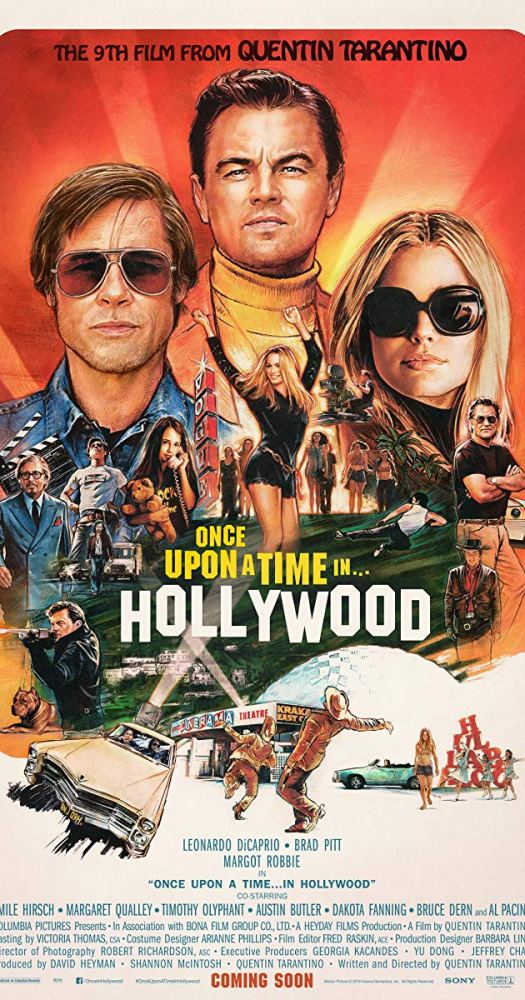
If you’re as much of a movie/television/pop culture fanatic as I am (and if you weren’t, you probably wouldn’t be reading this blog!), I’m here to tell you you’re gonna ABSOLUTELY FUCKING LOVE this latest Quentin Tarantino epic!

ONCE UPON A TIME IN HOLLYWOOD takes place in 1969, at the tail end of Tinseltown’s Glory Days, and the tail end of TV actor Rick Dalton’s career. Dalton (splendidly played by Leonardo DiCaprio) was the star of the late 50s/early 60s TV Western BOUNTY LAW (modeled after Steve McQueen’s WANTED: DEAD OR ALIVE), whose drinking problem has led him on the road to nowheresville, grabbing quick paychecks by guest starring as bad guys on episodic TV. He’s offered the chance to make some low-budget Spaghetti Westerns by producer Marvin Schwarsz (a bloated looking Al Pacino), bottom of the barrel stuff that’ll keep Rick’s name above the title.
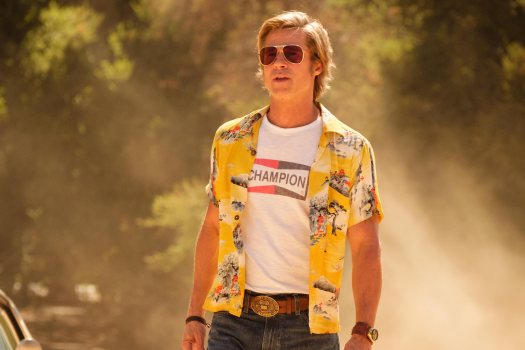
Rick’s best bud Cliff…
View original post 529 more words
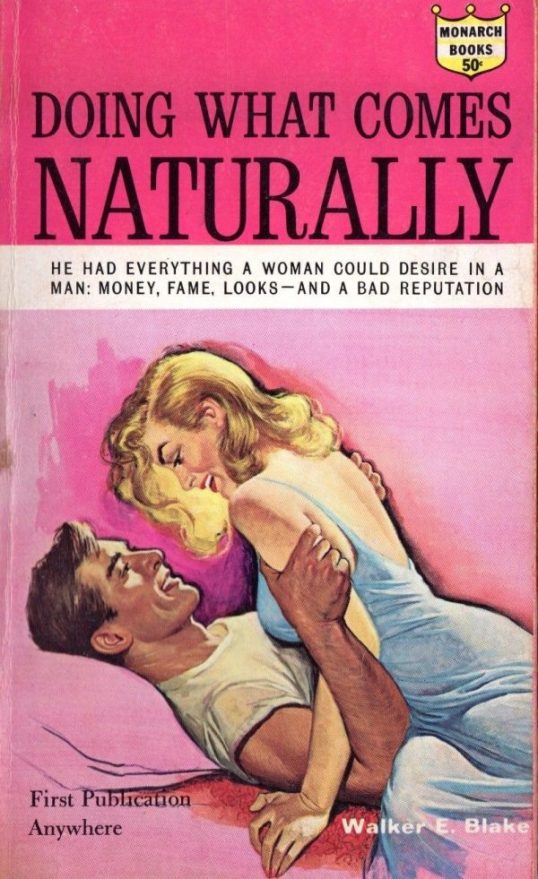
by Rafael DeSoto
Yesterday was the 76th birthday of Sir Michael Phillip Jagger so it seems appropriate to give him today’s music video of the day slot. Visions of Paradise was the first video off of Mick Jagger’s fourth solo album, Goddess in the Doorway.
This video was directed by Dave Meyers, who is one of those music video directors who seems to have worked with everyone. If you look over the list of videos he’s directed, you’ll see everyone from Master P to Kid Rock to Pink and Taylor Swift.
Enjoy and keep rocking, Sir Mick!

 Through the Shattered Lens