Game Review: Deadline (1982, Infocom)


Wealthy industrialist Marshall Robner has been found dead in his study, with the door locked.  The autopsy says that he died of an overdose of antidepressants.  Was it suicide or was it murder?  And, if it was murder, who was responsible?  That’s the mystery that you’ve been given a limited amount of time to solve.

In Deadline, you play a police detective who has 12 hours to investigate and solve the mystery behind the death of Marshall Robson.  The game starts with your arrival at the sprawling Robner estate.  Do you immediately start interviewing the suspects or do you look for clues around the grounds?  Do you attend the reading of Robner’s will or do you search the study where he died?  It’s up to you but just remember that the clock is ticking!

Written by Marc Blank and released by Infocom, Deadline is a classic text adventure from 1982.  From the minute, you enter the Robner estate, you are interacting with suspects like Robner’s adulterous wife and his irresponsible son.  Their actions and their responses to your questions are determined by how you go about investigating the crime and one of the joys of the game is seeing how people react to different approaches.  (When it comes time to read Robner’s will, one character will either show up early or late, depending on whether or not you’ve shown them a key piece of evidence.)

The mystery is complex.  I played through the game a handful of times before realizing that one thing that I felt was very important was actually just a red herring.  The mystery can be solved but you’re going to have to play the game several times and experiment with being in different places at different times and showing different clues to different suspects.  Or you can just type “Deadline Walk-Through” into Google like I eventually did.

Like many other good games from the past, Deadline can currently be found in the Internet Archive.

Artist Profile: Robert G. Harris (1911 — 2007)


A prolific pulp illustrator, Robert G. Harris was born in Kansas City, Missouri and began studying for his career as an artist while still in high school, attending night school at the Kansas City Art Institute.  He also studied at both Grand Central Art School in New York City and at the Arts Student League.  Over the course of his education, he was taught by renowned illustrators like Monte Crews, Harvey Dunn, and George Bridgeman.

His education paid off when Harris opened his own New York-based studio in 1933 and he quickly found success doing covers for both the pulps and for the leading “women’s magazines” of the time.  In 1953, he relocated to Arizona, where he spent the rest of his life.  After retiring from commercial illustration in 1961, Harris continued to be renowned for his portraits and his paintings of life in the old west.

Below is just a small sampling of his work.

Some Things I Liked In 2018


Since I don’t feel comfortable doing a traditional top ten list, I’m just going to list a few things that I liked in 2018.

When it comes to last year’s movies, my two favorite films were both comic book adaptations.  Black Panther and Spider-Man: Into The Spider-Verse both redefined what we traditionally expect from the comic book genre and they worked as both entertainment and as something a little bit deeper.

Among the other films I liked this year, Mission Impossible — Fallout reminded us of just how exciting a good action film can be while Game Night was hands down the best comedy of the year.  Deadpool 2 proved itself to be a worthy sequel while Won’t You Be My Neighbor?, Three Identical Strangers, Free Solo, and Shirkers made this a great year for documentaries.

David Peisner’s Homey Don’t Play That was a fascinating book about the history of In Living Color, examining both the show’s tumultuous history and how it continues to be relevant today.  Also worth reading: Thanks A Lot, Mr. Kibblewhite by Roger Daltrey and Cult City by Daniel J. Flynn.

In a year that seemed to be dominated by adaptations of comic books, it seems appropriate that one of the best comics was about the history of the medium.  Written by Fred Van Lente and illustrated by Ryan Dunlavey and Adam Guzowski, Comics For All was the second installment in their Comic Book History of Comics.  No matter how much you think you may know about comic history, you’ll learn something new from Comics For All.

When it comes to the year’s video games, I’m torn.  Red Dead Redemption II is a totally immersive gaming experience that challenges much of what we’ve come to expect from video games.  On the other hand, Marvel’s Spider-Man is one of the most purely enjoyable games that I’ve ever played.  If I had to pick a best, I’d go with Red Dead Redemption but Spider-Man is the game that I’ll probably end up replaying a month from now.

On television, I continued to enjoy and occasionally be baffled by HBO’s Westworld.  I also enjoyed playing around with Netflix’s Black Mirror: Bandersnatch, an interactive program that introduces you to a likable game designer and then give you the chance to totally mess up his life.

In the States, BBC America televised the the animated restoration of the “lost” Doctor Who serial, Shada.  As an episode of Tom Baker-era Doctor Who, Shada was just as disappointing as many have warned that it would be, an overextended mix of inside jokes about Cambridge.  However, as a piece of Doctor Who history, it was priceless.

Finally, as far as the year in music is concerned, I recommend The Who’s fifth studio album, Who’s Next.  I know Who’s Next came out in 1971 but good music is timeless.

Music Video of the Day: Danger Zone by Kenny Loggins (1986, directed by Tony Scott)


For better or worse, few songs have come to epitomize a decade to the extent that Danger Zone has come to epitomize the 1980s.

The song was originally written by Giorgio Moroder and Tom Whitlock for the Top Gun soundtrack.  When the film’s producers heard the demo (performed by background singer Joe Pizzulo), they knew they wanted the song but they also knew they wanted it to be performed by a big name artist.

The problem was that no one wanted to perform it.

Byran Adams thought that the song and its use in the film would glorify war.  (He wasn’t wrong.)

Corey Hart, best known for Sunglasses at Night, turned down the opportunity because he only wanted to record songs that he had written.

REO Speedwagon (!) declined an offer when they were informed that they wouldn’t be allowed to contribute any other songs to the soundtrack.

Toto came close to recording the song but their lawyers couldn’t come to an agreement with the production’s lawyers.  (Toto’s song, Only You, was also originally written for the film but was rejected in favor of Take My Breath Away.)

In the end, it was Kenny Loggins who finally agreed to perform the song and the rest, as they say, is history.  Not only was the film a huge hit but it spawned one of the best-selling soundtracks of the 1980s.  Fueled by the film’s success, Danger Zone reached the #2 spot on the U.S. Billboard Hot 100.

As for the video, it was directed by Tony Scott (who, of course, also directed Top Gun).  The video mixes footage from the film with shots of Kenny Loggins deep in thought, which makes it appear that Loggins simply can’t stop thinking about the first time that Maverick and Goose met Charlie.  This video has been called “the most effective recruiting poster ever produced.”

For me, though, Danger Zone will always be the song that I used to hear while listening to the classic rock station in Los Santos.

What Lisa Watched Last Night #197: My Daughter’s Ransom (dir by Doug Campbell)


On Thursday, I watched the first Lifetime film of 2019, My Daughter’s Ransom!

(a.k.a. My Daughter’s Ransom)

Why Was I Watching It?

New year, new lifetime movies!  Every year brings changes but one thing that will never change will be my love for these films and the enjoyment I get from reviewing them.

What Was It About?

Rachel (Scottie Thompson) has a good life.  Her husband, Tony (Matthew Pohlkamp), is a successful businessman who is on the verge of finalizing a big deal.  Her daughter, Lindsey (McKinley Blehm), is intelligent enough to know all about the theories of Charles Darwin.

Unfortunately, Rachel also has an ex-boyfriend named Carter (Lucas Kerr).  Carter’s just been released from prison and, as quickly becomes apparent, his incarceration did not lead to rehabilitation.  After spending months stalking Rachel and her family, Carter kidnaps Lindsey at the zoo.  If Rachel doesn’t do everything that Carter orders her to do, he’ll kill her daughter.

As Rachel tries to figure out a way to save her daughter, she also has to keep following Carter’s orders, which are not only increasingly outlandish but also increasingly dangerous for both Rachel and everyone that she loves….

What Worked?

As anyone who has spent any time watching the channel can tell you, the theme of abduction is a popular one when it comes to Lifetime movies.  That’s because these films deal with the fears that every parent has, not only that your child will be abducted but that you’ll be powerless to rescue them.  My Daughter’s Ransom did a good job of making that fear feel real, especially in the early moments when Rachel was desperately running around the zoo, looking for her daughter.  (The camera holds Rachel in a tight close-up while she searches for her daughter, emphasizing Rachel’s desperation to find her.)

For a film like this to work, you need a good villain and Lucas Kerr did a great job making Carter into the type of creepy, hissable bad guy who you just couldn’t wait to see get his comeuppance.  In the role of Rachel, Scottie Thompson also did great work and it was impossible not to sympathize with her as she tried to get someone to notice that she was in trouble without Carter figuring out what she was doing.

In fact, the entire cast did a great job.  My two favorite supporting characters were Gina (Davida Williams), the wife of Tony’s business partner, and Skates (Erika Fong), Tony’s secretary.  Neither one of them was willing to put up with any nonsense.  Personally, I think we need a sequel where Gina and Skates team up and solve crimes.

What Did Not Work?

It all worked!  My Daughter’s Ransom got the year off to a good start.

“Oh my God!  Just like me!” Moments

Much like Rachel, I once had a weakness for bad boys.  Actually, now that I think about it, I still do.  That said, the character I most admired was Skates because it didn’t matter how much Carter ordered Rachel to yell at her and threaten to fire her, Skates wasn’t going to let anyone stop her from doing her job.

Lessons Learned

Bad boys never change.

“Little Teeth,” Big Bite (Advance Review)


Ryan C. (fourcolorapocalypse)'s avatarRyan C.'s Four Color Apocalypse

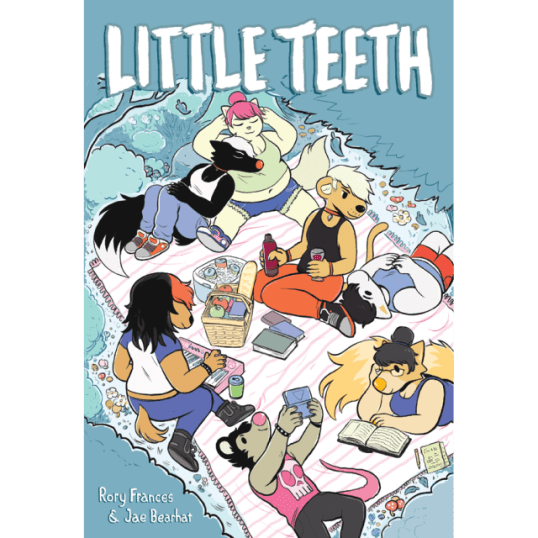
I’m not sue what it is about anthropomorphic animals and the LGBTQ+ comics community, but for the second time in less than a year, we’ve got a tandem of queer creators releasing a book of vignette-style stories centered on the broadly-defined “queer experience.” First out of the gate was Remy Boydell and Michelle Perez’ The Pervert from Image Comics, well-reviewed in most quarters (including this one) and focused on the hard-scrabble life of a trans protagonist subsisting on the economic margins, and in the next few weeks Czap Books will be releasing Little Teeth, drawn by Rory Frances and written by Jae Bearhat, that transposes the so-called “funny animal” trope into a queer communal living situation.

Beyond the more fluid sexual and gender identities and the tails and fur, though, it should be noted that the two books have very little in common, conceptually and tonally, and this points…

View original post 619 more words

Cleaning Out The DVR: Killer Body (dir by David I. Strasser)


(I recorded Killer Body off of Lifetime on December 30th.)

Oh my God, this was a great movie!

Okay, so check this out.  Once upon a time, there was a medical student named Elizabeth (Lindsay Maxwell) who felt like she was being shunned and ignored by her classmates.  She had a crush on a doctor named Chris (Peter Benson) but Chris was in love with Katie Jones (Sunny Mabrey),  Eventually, Elizabeth ended up having a total melt down and was forced to drop out of medical school.  Elizabeth become obsessed with plastic surgery, hoping to make herself look perfect (which, in this case, meant looking more and more like Katie).  Now going by the name Liz Oakley, she goes from doctor to doctor, getting work done and then suing them for malpractice.  And if she can’t get your medical license taken away, she’ll just spray you with poison perfume.  Seriously, this film features 4 separate attacks by toxic perfume.

One day, Liz shows up at Katie’s office and, until Liz introduced herself, Katie doesn’t even recognize her.  Liz wants some minor work done and she claims that she’s been referred by one of Katie’s colleagues.  Of course, Liz soon proves herself to be just as unstable as you might expect someone who regularly murders people to be.  Soon, all Katie’s like, “I don’t want you as my patient anymore,” and Liz is like, “Fine, I’ll just destroy your life.”

Soon, Liz is showing up on a college campus and making a seriously awkward attempt to befriend Liz’s daughter.  Katie and Chris (whose brilliant medical career has been brought to an end by a stroke) take out a restraining order but there’s nothing in that order that can stop Liz from going to another, less ethical plastic surgeon and having more work done in her quest to be perfect and to look more like Katie.  Of course, when the surgery results in Liz having a barely noticeable scar on her chin, it’s not a good thing…

Obviously, the success of a film like this pretty much hinges on the actress who is cast as the stalker/psycho character and fortunately, Liz is played by Lindsay Maxwell.  Maxwell turns Liz into a force of  uncontrollable, narcissistic nature and one of the more entertaining aspects of the film is watching as Liz goes from smiling to screaming in just a matter of seconds.  On the one hand, Liz is a complete psycho but, on the other hand, who hasn’t wanted to be perfect and who hasn’t, at least once, thought about they would do to achieve that perfection?  Maxwell wisely adds just a bit of vulnerability to the character, making Liz a psycho to whom you can relate.  Sunny Mabrey and Peter Benson also contribute good performance but ultimately, the film is dominated by Lindsay Maxwell and her bottle of killer perfume.

Killer Body was a killer melodrama, exactly the type of movie that we watch Lifetime to see.  Between the murders and the intrigue and the attempts to fool Chris into committing adultery, this was a wonderfully entertaining look at just how far people will go to achieve perfection.

Happy Noir Year!: THE BIG COMBO (United Artists 1955)


gary loggins's avatarcracked rear viewer

(ATTENTION: There’s a surprise waiting for you at the end of this post, so read on…)

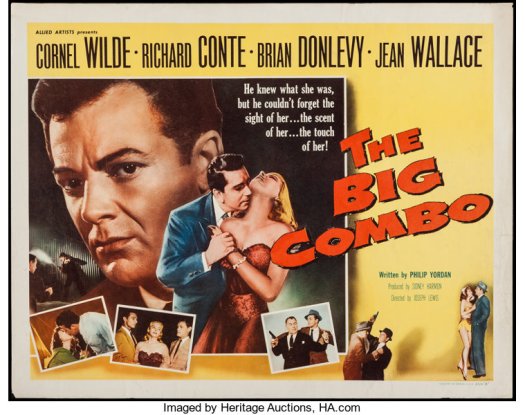
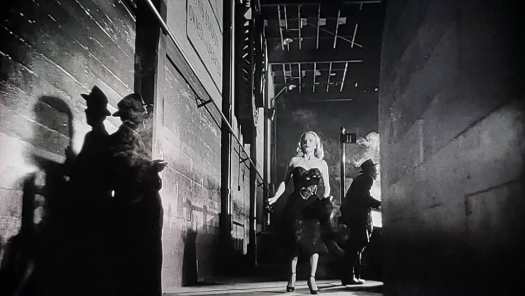
Joseph H. Lewis started his directing career with low-budget Westerns starring singing cowboy Bob Baker and East Side Kids programmers, and ended it back on the range doing epsiodes of THE RIFLEMAN, GUNSMOKE, and THE BIG VALLEY. In between, he created some of the finest films noir the genre has to offer: MY NAME IS JULIA ROSS , SO DARK THE NIGHT, THE UNDERCOVER MAN, and especially GUN CRAZY . His last big screen noir outing is the culmination of his work in the genre, 1955’s THE BIG COMBO.

The plot is fairly simple: Police Lt. Leonard Diamond is out to crack gangster Mr. Brown’s “combination”, which controls crime in the city. But Philip Yordan’s screenplay takes that plot and adds exciting twists and turns, indelible characters, and a level of violence audiences weren’t…

View original post 511 more words